
Self-Employed & 1099
Landscaper Tax Debt: What to Do When You Owe the IRS (2026)
The short answer: most landscaper tax debt comes from self-employment tax and skipped quarterly payments — no one withholds taxes from your jobs, so 25%–30% of your net profit lands as one big bill. You have real options: a payment plan, hardship status, penalty relief, or a settlement. The key is acting before the IRS starts levying.
You had a strong season — mowing routes full, spring cleanups, a couple of good commercial contracts — and now there's an IRS balance you never set money aside for. That gut-punch is common in this trade, because nobody takes taxes out of a landscaping check the way an employer does. This is fixable, and the plan is straightforward once you see where the debt came from.
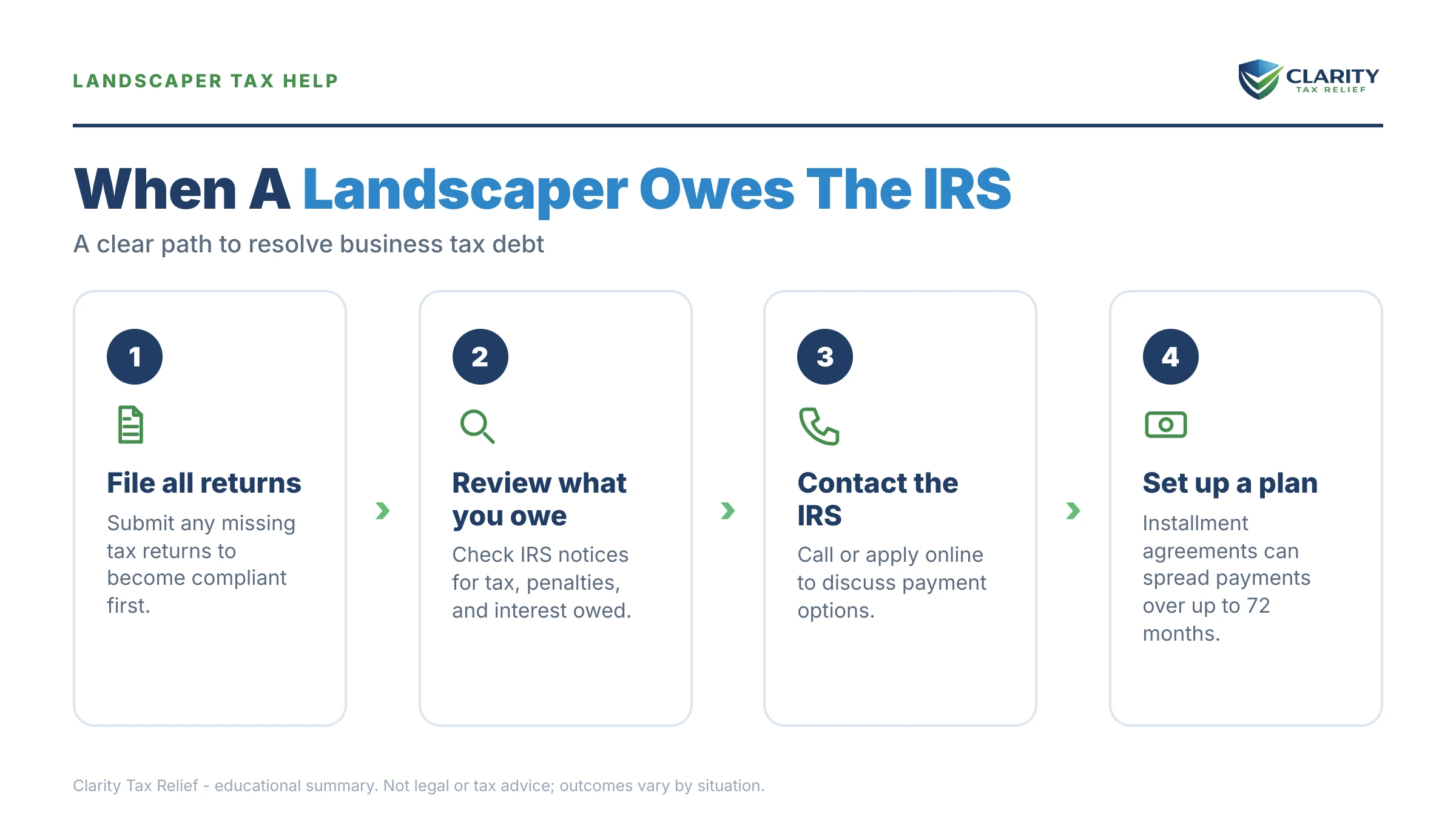
The number on your notice or return isn't just income tax — a big slice is self-employment tax at 15.3%, and the image below shows how a landscaper's bill actually breaks down so you can see what you're really being charged for.
⏱ The clock that's already running: there's no single deadline for "owing," but the meter never stops. The failure-to-pay penalty runs at 0.5% of the balance per month, the failure-to-file penalty at 5% per month (ten times worse), plus daily interest. If you have unfiled seasons, file them first — an unfiled return costs far more than an unpaid one.
Why you owe the IRS as a landscaper
Landscaper tax debt almost always traces to one root cause: no one withholds tax from a self-employed landscaper's income. When you worked a W-2 job, your employer pulled income tax and payroll tax out of every check. On your own, that job is yours, and the bill for a busy season shows up all at once.
Three things stack on top of each other to build the balance:
- Self-employment tax — 15.3% (Social Security + Medicare) on your net profit. A W-2 employee splits this with an employer; you pay both halves. This alone catches most first-year operators off guard. Our guide to the self-employment-tax shock breaks down the math.
- Federal income tax — on top of SE tax, on the same profit.
- No quarterly payments — the IRS expects estimated tax four times a year. Skip them and you not only owe the full amount in April, you also get an estimated-tax underpayment penalty on top.
Landscaping adds its own wrinkles. Income is seasonal, so cash is tight exactly when the April bill is due. A lot of work is paid in cash, which is still fully taxable. And commercial clients — HOAs, property managers, builders — send you a Form 1099-NEC, which reports your income straight to the IRS. If your reported income and your filed return don't match, you can get a CP2000 notice proposing more tax. If this is your first big season on your own, start with the first-year self-employed tax-bill guide.
| Piece of the bill | Rate / trigger | Why landscapers get hit |
|---|---|---|
| Self-employment tax | 15.3% of net profit | You pay both halves; no employer split |
| Federal income tax | 10%–37% by bracket | Stacked on the same profit as SE tax |
| Estimated-tax penalty | Interest-based, per quarter missed | Skipping the four 1040-ES payments |
| Failure-to-pay penalty | 0.5% per month | Balance not paid by the filing deadline |
| Failure-to-file penalty | 5% per month | Season's return never filed |
Worked example: what a solo landscaper really owes
Say you netted $65,000 from your landscaping business last year after deducting fuel, mower repairs, and mileage. You set nothing aside and made no quarterly payments. Here's roughly how the bill builds (numbers are hypothetical and rounded to show the arithmetic):
- Self-employment tax: 15.3% × ($65,000 × 92.35%) = 15.3% × $60,028 ≈ $9,184.
- Income tax: subtract half the SE tax (~$4,592) and the standard deduction (~$15,000), leaving roughly $45,400 taxable. Federal income tax on that (single) lands around $5,400.
- One-year total: about $14,600, before penalties and interest.
Now run that two seasons in a row without paying, add failure-to-pay penalties and interest, and you're realistically looking at a balance near $28,000. On a 72-month installment agreement that's roughly $389/month before interest, and interest (currently around 8% annually, compounding) keeps accruing until it's paid. You can estimate how fast penalties and interest grow on your own balance with our IRS penalty & interest calculator.
The lesson landscapers screenshot: on $65,000 of profit, roughly $1 in every $4.50 was owed to the IRS from the start. That's why setting aside 25%–30% per job keeps you off this page next year.
What happens if you ignore it
An unpaid landscaping balance doesn't sit still — the IRS collection system escalates automatically, and each stage carries more power than the last:
- CP14 notice — the first bill. No enforcement yet; the cheapest moment to act.
- CP501 / CP503 — reminder notices. Still just bills, but penalties and interest keep growing.
- CP504 notice — Notice of Intent to Levy. The IRS can seize your state tax refund and a federal tax lien becomes a real risk.
- LT11 / Letter 1058 — Final Notice of Intent to Levy. After 30 days, the IRS can levy your bank account and garnish income. You get formal appeal rights here, but far fewer good options than you have today.
Two escalation moves hit landscapers especially hard. First, a bank levy can freeze the account you use to make payroll and buy fuel, with a 21-day hold before funds leave. Second, the IRS can send a levy directly to a commercial client that owes you money. Because your 1099 income is contractor pay, this often works as a one-time levy on 1099 income that intercepts a job's payment before it reaches you. And in 2026, with IRS staffing cut about 27%, the automated levies and liens never stopped — the machine keeps escalating even when no human is looking at your file.
Owe the IRS from your landscaping business?
Before a levy hits your bank account or a client's payment, get your situation reviewed. An experienced tax professional will map exactly where you stand and which option fits — free, confidential, no pressure.
Your options if you can't pay in full
The IRS has several programs. The right one for a landscaper depends on how much you owe and whether your income holds up through winter. Here's how they compare:
| Option | Best when | Key threshold / cost |
|---|---|---|
| Short-term plan | You can clear it within a few months (after a slow season) | Up to 180 days · $0 setup |
| Streamlined installment agreement | Steady enough monthly cash flow | Balance ≤ $50,000 · up to 72 months |
| Partial-pay installment agreement | Can pay something, but not the full amount | Requires financial disclosure (Form 433) |
| Currently Not Collectible | Off-season with no income; paying causes hardship | Pauses collection; interest still accrues |
| Offer in Compromise | Assets + income genuinely can't cover the debt | $205 fee (waivable if low-income); ~1 in 5 accepted |
| Penalty abatement | Clean prior 3 years, or reasonable cause | Removes penalties, not the underlying tax |
A note for seasonal earners: an installment agreement is a fixed monthly amount. But you can set the payment low enough to survive January and February. If winter wipes out your income entirely, ask about Currently Not Collectible status for those months instead of defaulting a plan you can't fund. On the settlement side, an Offer in Compromise is real but means-tested — the IRS calculates your Reasonable Collection Potential from your equipment, vehicles, and income, so beware anyone promising to resolve your balance for a tiny fraction of what you owe. That's the exact pitch the FTC has banned. If you're weighing a plan against a settlement, our comparison of a payment plan vs. offer in compromise lays out the tradeoffs.
Owe a specific range? See the tailored playbooks for owing the IRS $25,000 or owing the IRS $30,000 — both squarely in landscaper territory.
How to respond, step by step
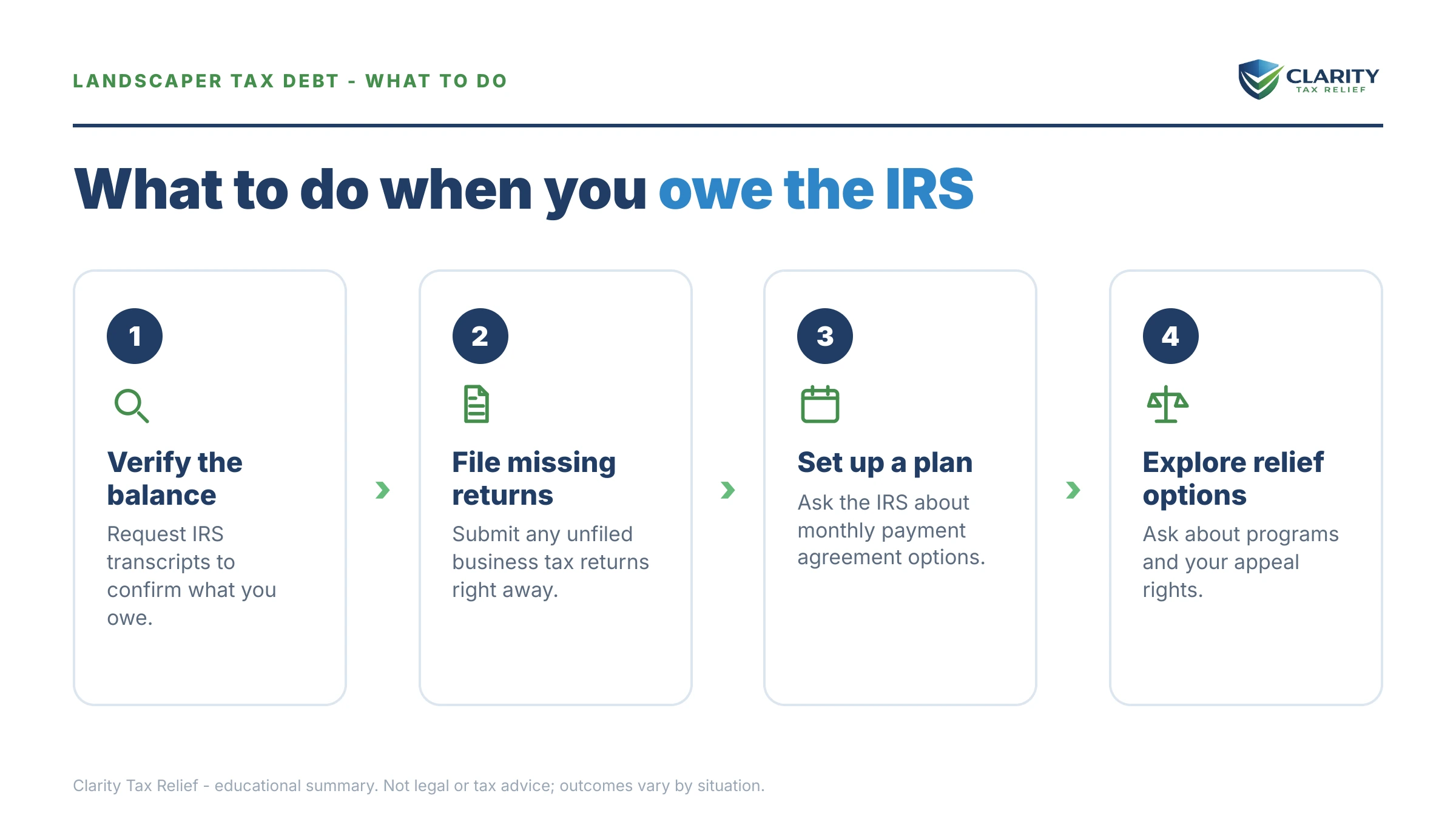
- File every missing season first — even if you can't pay. The 5%-per-month failure-to-file penalty is the most expensive mistake you can make.
- Pull your account transcript at your IRS online account to confirm the exact balance, years, and any 1099-NEC income the IRS has on file.
- Reconstruct income and expenses from bank deposits, invoices, and fuel/equipment receipts if your books are thin — deductions cut the tax before penalties even start.
- Pick the option that fits your cash flow — a payment plan for steady income, hardship status for a dead winter, a settlement only if the math truly supports it.
- Set it up before a levy starts — an active agreement stops the notice sequence and protects your bank account and client payments.
- Get a professional review if crew pay is involved — cash paid to helpers can turn an income-tax debt into a payroll-tax problem, which is handled very differently.
If your helpers were really employees, don't try to guess your way through it — read paid on 1099 but treated like an employee and get advice before the question gets answered for you in an audit.
When you can handle this yourself, and when to get help
Plenty of landscapers can fix this without paying anyone. If you owe under $50,000, have all your returns filed. Your income is steady, you can set up a payment plan yourself online in about 15 minutes. A first-time penalty abatement request is also a simple call or letter when your prior three years are clean. If that's you, our guide to setting up an IRS payment plan online walks you through it, and how to settle tax debt yourself covers the DIY path end to end.
Experienced help changes the outcome when the situation gets tangled: a levy is already in motion, you have several unfiled seasons, you paid a crew in cash and misclassification is in play, or an Offer in Compromise is on the table and the math has to be built correctly the first time. A landscaper juggling equipment loans, a truck payment, and seasonal income has an OIC calculation with a lot of moving parts — getting the Reasonable Collection Potential right is exactly where a pro earns their fee. See our take on the contractor back-taxes path if you also run subcontractors.
Terms on your notice, decoded
- Self-employment (SE) tax — the 15.3% Social Security and Medicare tax you owe on business profit because no employer withheld it.
- Estimated tax (Form 1040-ES) — the four quarterly payments the IRS expects from self-employed people in place of withholding.
- 1099-NEC — the form a commercial client files reporting what they paid you; the IRS gets a copy and matches it to your return.
- Levy vs. lien — a levy takes property (bank funds, a client's payment); a lien is a legal claim that attaches to what you own. See lien vs. levy.
- Currently Not Collectible — a hardship status that pauses IRS collection when paying would leave you unable to cover basic living costs.
- CSED — the collection statute; the IRS generally has 10 years from assessment to collect, though certain actions pause the clock.
Landscaper tax debt questions, answered
Why do landscapers owe so much to the IRS?
Because nobody withholds taxes from your jobs. As a self-employed landscaper you owe 15.3% self-employment tax on top of regular income tax, and no employer takes a cut of each payment. If you don't send in quarterly estimated payments, the whole bill lands at once in April, often 25% to 30% of your net profit. Cash and 1099-NEC income both count, so the amount adds up fast across a busy season.
How much should a landscaper set aside for taxes?
A safe rule of thumb is 25% to 30% of your net profit (income after deductible expenses like fuel, equipment, and mileage) parked in a separate account. That covers self-employment tax plus federal income tax for most solo operators. Higher earners in the 22%+ bracket should lean toward 30%+. If you have a state income tax, add its rate on top of that.
Can I set up an IRS payment plan if my landscaping income is seasonal?
Yes. A standard installment agreement is a fixed monthly amount, but if winter kills your cash flow you have options: set the monthly payment low enough to survive the off-season, or ask for Currently Not Collectible status during the months you have no income. For balances under $50,000 you can usually get a streamlined plan of up to 72 months without detailed financial disclosure.
I paid my crew in cash — am I in trouble with the IRS?
Cash payments to workers aren't illegal, but they still have to be reported and taxed correctly. If your helpers are truly independent (their own tools, other clients), you should issue Form 1099-NEC for anyone paid $600 or more. If they work under your direction on your schedule, the IRS may treat them as employees — which means payroll tax you didn't pay. Misclassification is where a simple income-tax debt can turn into a payroll-tax problem, so get advice before an audit forces the question.
Can I settle my landscaping tax debt for less than I owe?
Sometimes — through an Offer in Compromise, but only if the IRS agrees it could never collect the full amount from your income and assets. The IRS accepted roughly 1 in 5 offers in FY2024, so it is real but not easy, and no outcome is guaranteed. Ignore any company promising to erase your tax debt for a tiny fraction of what you owe — that's the scam pitch the FTC has cracked down on. An honest professional runs your actual numbers first.
What if I haven't filed my landscaping taxes in years?
File first, even before you can pay. The failure-to-file penalty is 5% of the tax per month, ten times the 0.5% failure-to-pay penalty, so an unfiled return costs far more than an unpaid one. You generally need the last six years filed to get back into good standing and qualify for a payment plan or settlement. If you're missing records, transcripts and bank statements can reconstruct your income.
Can the IRS take my truck, trailer, and mowing equipment?
The IRS can levy business assets. But it rarely seizes the tools you need to earn, because taking your equipment destroys its own ability to collect. A far more common move is levying your bank account or sending a levy to a commercial client that owes you money. Setting up a payment plan or hardship status stops levy action before it reaches your equipment.
Your next 24 hours
- Find the numbers. Pull your latest IRS notice (or log into your online account) and write down the exact balance and which tax years it covers.
- Gather three things. Your last filed return, any 1099-NECs from commercial clients, and a rough total of this season's income and expenses.
- Get a free case review. Because penalties and interest accrue every month you wait, call (888) 825-7779 or use the 2-minute form — an experienced tax professional will tell you which option actually fits before a levy reaches your bank or a client's payment.
This guide is general information, not tax or legal advice for your specific situation. Eligibility for IRS programs depends on individual facts and circumstances; no outcome is guaranteed.