
Self-Employed & 1099 Tax Debt
Barber Owes the IRS Back Taxes? Your 2026 Playbook to Fix It
The short answer: when a barber owes the IRS, the bill is almost always self-employment tax, 15.3% that no employer withheld, stacked on income tax and penalties. Nothing is seized just for owing. File any missing returns first, then set up a payment plan, hardship status, or a settlement based on what you can actually pay.
You cut hair for a living, not spreadsheets, and now the IRS says you owe thousands you never saw coming. It usually happens the same way: you rent your chair, get paid in cash and cards, maybe a 1099 from the shop, and no one ever took taxes out. This is fixable, and the order you fix it in matters more than the size of the number.
The reason the number feels crushing is buried in one line most barbers never think about: the self-employment tax. Below, we'll show you exactly where a barber's tax debt comes from, what the IRS can and can't touch, and every option to settle it — starting with the one thing that has to happen before any relief is possible.
⏱ Your clock: back taxes have no single "pay-by" date, but interest and the failure-to-pay penalty accrue every month the balance sits. The failure-to-file penalty is 10× larger (5%/month vs. 0.5%/month), so if you have unfiled years, filing is the single most valuable thing you can do today, even if you can't pay a dime yet.
Why a barber owes the IRS in the first place
A barber owes the IRS because self-employment income arrives with zero tax withheld, and self-employment tax alone runs 15.3% before income tax. When you rented a chair, took booth-rent clients, or picked up a 1099-NEC from the shop, you became your own employer in the eyes of the IRS. That means you cover both halves of Social Security and Medicare (the 15.3%) plus regular income tax, and you're supposed to pre-pay it in quarterly installments no one told you about.
Here's how the debt typically stacks up for a barber:
- Self-employment tax — 15.3% on 92.35% of your net profit, reported on Schedule SE. This is the piece that shocks people.
- Income tax — your ordinary bracket on the same profit, on top of the SE tax.
- Missed quarterly estimates — because nothing was pre-paid, an underpayment penalty gets tacked on.
- Unreported cash tips — tips are taxable; leaving them off understates income and can trigger a later adjustment.
- Missing deductions — the flip side. Many barbers overpay because they never claimed booth rent, supplies, clippers, capes, licensing, or mileage.
Whether you're a chair renter, a booth renter paying the shop, or a shop owner running your own payroll changes the math a lot. This page is written for the individual barber paid on a 1099 or in cash. If you own the shop and have employees, see salon owner tax debt for the payroll side. The underlying driver — the self-employment tax shock — is the same one that hits every stylist. The sibling hair stylist / barber 1099 debt guide walks the deduction rescue in more detail.
| Source of the bill | Roughly how it's figured | Can it be reduced? |
|---|---|---|
| Self-employment tax | 15.3% × (net profit × 92.35%) | Only by lowering profit with legitimate deductions |
| Income tax | Your bracket on net profit, minus half the SE tax | Yes — every real business expense cuts it |
| Failure-to-file penalty | 5% of unpaid tax per month, up to 25% | Yes — abatement may erase it |
| Failure-to-pay penalty | 0.5% of unpaid tax per month, up to 25% | Yes — abatement may erase it |
| Interest | Compounds daily on tax + penalties | Rarely — only if tied to an IRS error |
What happens if you ignore it
Ignoring a barber tax debt doesn't make it quiet. It triggers an automated collection sequence that ends in levies. Because your income is often cash and 1099, the IRS's favorite move is a bank levy on your account or a one-time levy on money a shop or booth owes you. The notices arrive in a fixed order, each one carrying more power than the last:
- CP14 — the first bill. Balance due, penalties and interest started. No enforcement yet.
- CP501 / CP503 — reminder notices. The balance keeps growing every month.
- CP504 — Notice of Intent to Levy. The IRS can now seize your state tax refund and a federal tax lien becomes likely.
- LT11 / Letter 1058 — Final Notice of Intent to Levy. After 30 days the IRS can levy your bank account and money owed to you. This notice starts your Collection Due Process appeal rights.
Two things make this worse for a self-employed barber. First, a bank levy freezes your account for 21 days before the money is sent, which can wipe out chair rent and supply money at the worst moment. Second, if you never filed, the IRS can file a substitute return for you — with no deductions for booth rent, supplies, or mileage — inflating the balance far above what you'd actually owe on a correct return. In 2026, IRS staffing is down sharply, but the levy and lien systems are automated and never stopped running. The machine escalates whether or not a human ever opens your file.
Owe the IRS as a barber and not sure where you stand?
Interest and penalties are growing every month this sits. Send us your notice or just tell us the years — an experienced tax professional will map exactly what you owe, what's still unfiled. Your real options. Free, confidential, no pressure.
Your options when a barber owes back taxes
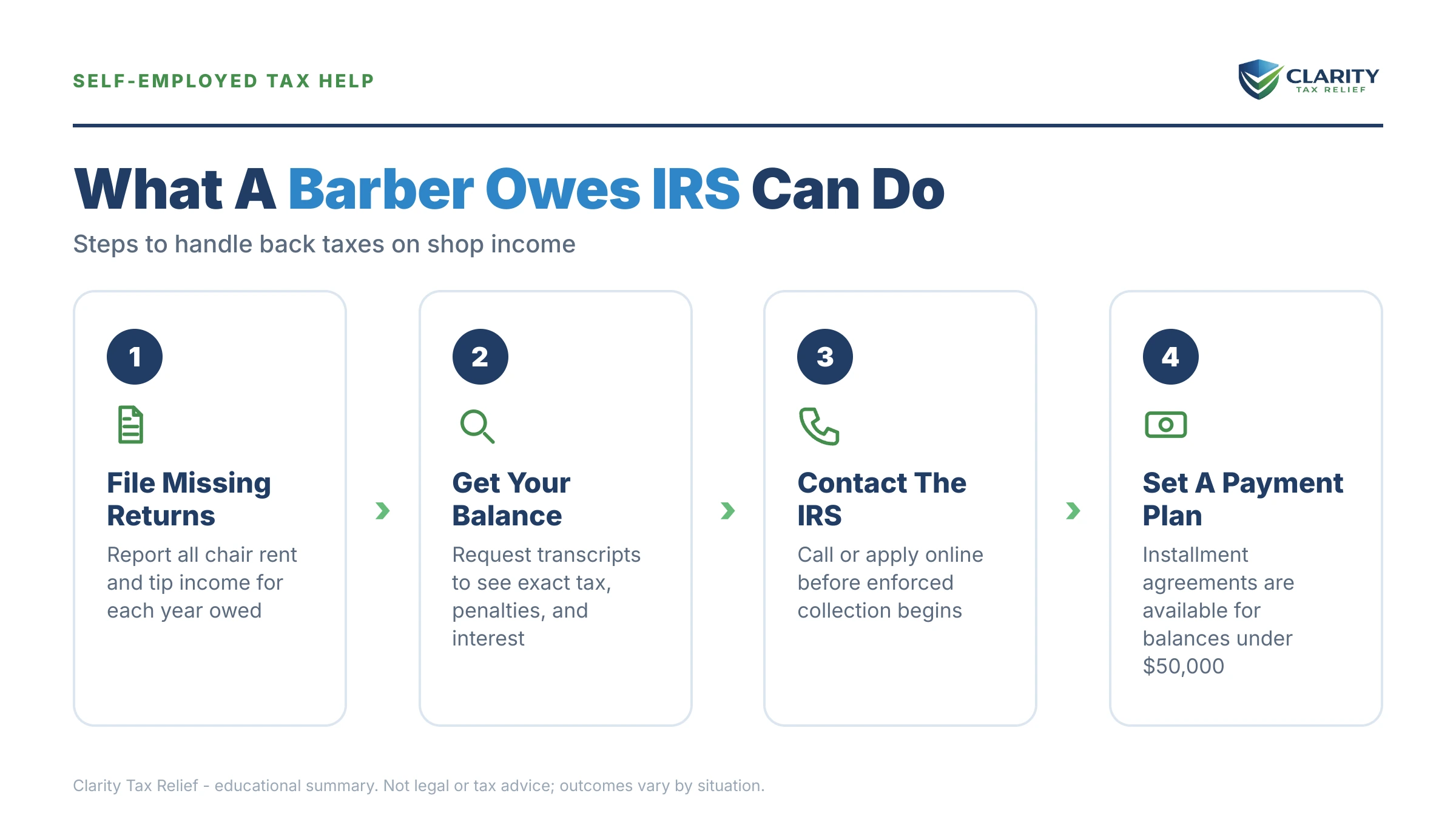
A barber has the same resolution menu as any taxpayer, but every option has one hard gate: every required return must be filed first. The IRS will not approve a payment plan or an offer while returns are missing. Once you're filed, here's what fits which situation:
| Option | Best when | Key threshold / cost |
|---|---|---|
| Short-term payment plan | You can pay in full within 180 days | $0 setup; interest + penalty still run |
| Streamlined installment agreement | You owe ≤ $50,000 and want simple monthly payments | Up to 72 months; usually no financial disclosure |
| Guaranteed installment agreement | You owe ≤ $10,000 and are compliant | Must be accepted if you qualify |
| Currently Not Collectible | Paying anything means you can't cover basics | Collection pauses; interest still accrues |
| Offer in Compromise | Assets + future income can't cover the debt | $205 fee (waivable if low-income); ~1 in 5 accepted |
| Penalty abatement | Clean prior 3 years, or reasonable cause | Removes penalties, not the underlying tax |
A few notes barbers specifically need. The streamlined installment agreement is the workhorse for most single-barber balances under $50,000 because it skips the intrusive financial forms. If cash flow genuinely won't stretch, Currently Not Collectible for the self-employed is a real option — the IRS looks at your net business income against allowable living expenses, not your gross chair receipts. And before anyone sells you on "settling," understand that an Offer in Compromise is means-tested: the IRS accepted roughly 1 in 5 offers in FY2024. It decides the number by math, not marketing. You can estimate your penalty exposure first with our IRS penalty &. Interest calculator to see how much of your balance is even removable.
A worked example: a barber who owes about $18,000
Say you're a chair renter who netted $52,000 last year and never paid quarterly estimates. Here's roughly how the debt builds and how you'd resolve it.
- Self-employment tax: $52,000 × 92.35% = $48,022, taxed at 15.3% ≈ $7,347.
- Income tax: after the deduction for half your SE tax, roughly $6,000–$8,000 depending on your other income and filing status.
- Penalties + interest: a year of failure-to-pay penalty and interest can add $1,500–$2,500.
That lands you near $18,000. On a 72-month streamlined installment agreement, that's roughly $250/month before interest — set up online, no financial disclosure, no levy. If this was your first slip and the prior three years were clean, first-time penalty abatement could strip out the penalty layer, knocking a chunk off the balance. And if you can show the IRS that your net income barely covers rent, food, and supplies, an Offer in Compromise asks the IRS to accept what it could realistically collect over the remaining collection period — never a guaranteed "pennies on the dollar," and only when your finances genuinely support it. If the balance were higher, our I owe the IRS $20,000 and owe the IRS $15,000 guides walk the same math at those levels.
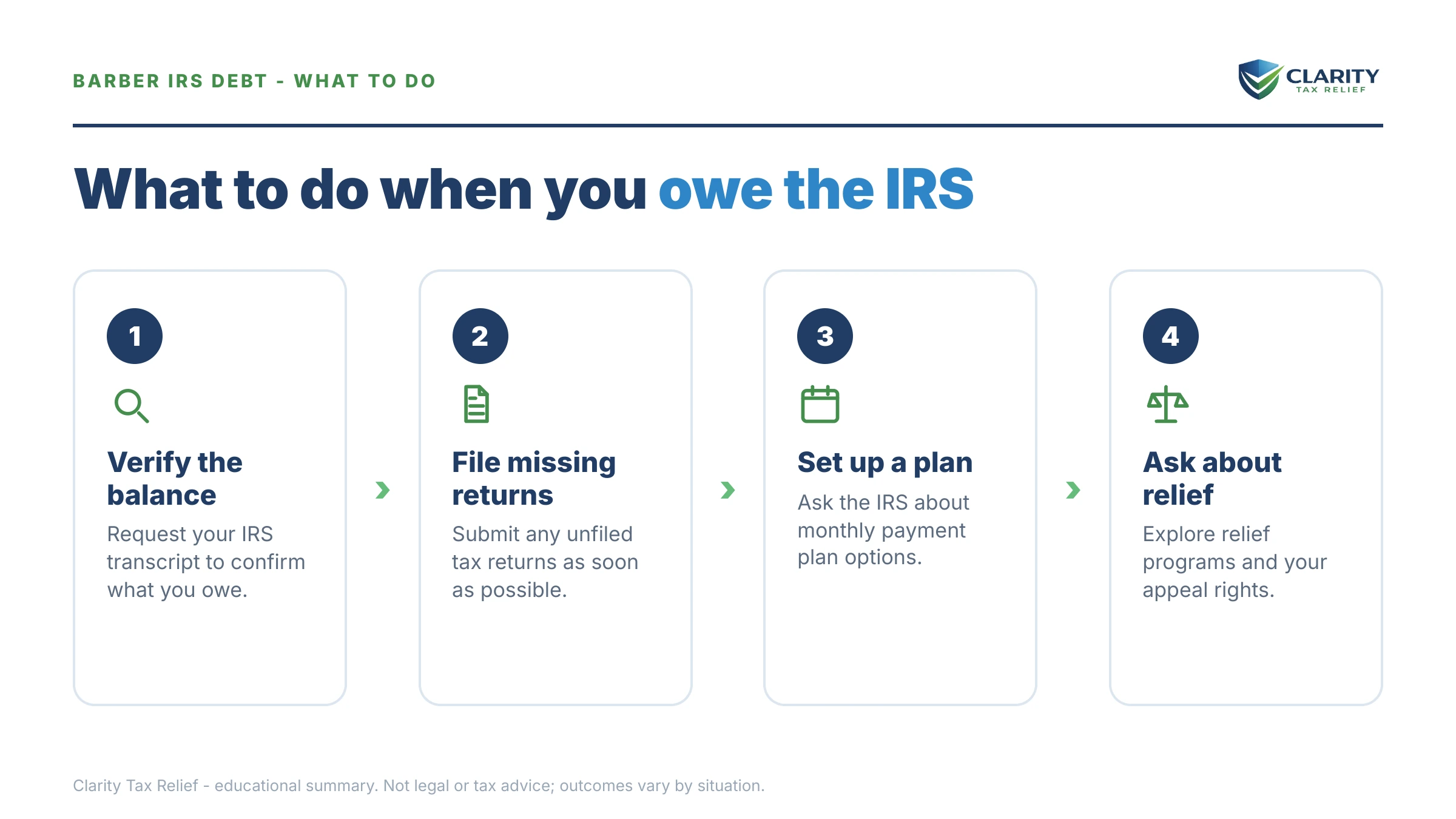
How to respond, step by step
- Pull your transcripts. Get your IRS wage and income transcripts to see every 1099 and form the IRS already has. Your account transcript for the balance by year.
- File every required return. In most cases the IRS wants the last six years filed, and file with your real deductions so you don't overpay.
- Claim your barber deductions. Booth/chair rent, clippers, capes, supplies, licensing, insurance, and mileage all cut both your income tax and SE tax.
- Pick the option that fits. Payment plan if you can afford monthly. Hardship status if you can't. Abatement to shrink penalties. An offer only if the math supports it.
- Fix withholding going forward. Start quarterly estimated payments so next year's return doesn't rebuild the same debt.
- Get a review if it's complex. Multiple unfiled years, a levy in motion, or a large balance changes the order of operations — a professional review pays for itself here.
When you can handle this yourself, and when you shouldn't
You can absolutely handle a small, single-year barber debt on your own. If you owe under about $10,000, have filed all your returns, and can pay it within 180 days or on a simple streamlined plan, the whole thing can be set up at IRS.gov/payments in an afternoon. A first-time penalty abatement request is a phone call. Don't overpay a firm for a job you can do yourself.
Experienced help changes the outcome when the situation gets tangled: you have multiple unfiled years and the IRS has filed substitute returns without your deductions. A levy is already in motion. You're weighing an Offer in Compromise where the number depends entirely on how your business income is presented. Or a revenue officer has contacted you. In cash-heavy trades, how your income and expenses are documented can move the balance by thousands — that's where getting it right the first time matters most.
Terms on your notice, decoded
- Self-employment (SE) tax — the 15.3% Social Security and Medicare tax you pay as your own employer, reported on Schedule SE.
- Schedule C — the form where your barber income and every deduction (booth rent, supplies, mileage) are reported.
- Substitute for Return (SFR) — a return the IRS files for you when you don't; it includes no deductions, so the balance is inflated.
- Levy vs. lien — a lien is a legal claim on your property. A levy is the actual taking of money from a bank account or a payer who owes you.
- CSED — the Collection Statute Expiration Date; the IRS generally has 10 years to collect, though appeals, offers, and bankruptcy pause the clock.
- Currently Not Collectible — a hardship status that pauses collection when paying would leave you unable to meet basic living expenses.
Barber back-tax questions, answered
Why does a barber owe so much to the IRS?
Because no one withholds taxes from a barber's income. On booth-rent or 1099 earnings you owe self-employment tax of 15.3% on top of regular income tax, and nothing was taken out during the year. A barber netting $50,000 can owe roughly $7,000 in self-employment tax alone before income tax is added — which is why the bill feels so large all at once.
Do I have to report cash tips as a barber?
Yes — cash tips are taxable income the same as card payments and chair-rent earnings. The IRS knows barbershops are cash-heavy, so an unusually low reported income compared to the shop's card deposits is a common audit flag. If you underreported in past years, the safest fix is filing accurate amended or original returns before the IRS reconstructs your income for you.
I haven't filed my barber taxes in years — where do I start?
Start by pulling your IRS wage and income transcripts to see what 1099s and other forms the IRS already has on file. In most cases the IRS only requires the last six years of returns to be considered compliant. File the missing returns first, because you can't set up a payment plan or offer until every required return is in.
Can the IRS take my barber chair or shop equipment?
It is legally possible but rare for a small barber balance — the IRS almost always pursues bank accounts, wages, and 1099 payments before seizing tools of the trade. There is even a limited exemption protecting a modest amount of tools you need to earn a living. The far more common risk is a bank levy on your business account or a one-time levy on money a shop owes you.
What if I can't pay my barber back taxes at all?
You may qualify for Currently Not Collectible status, which pauses IRS collection when paying anything would leave you unable to cover basic living expenses. The debt doesn't disappear and interest keeps running, but wage and bank levies stop. If your finances are permanently tight, an Offer in Compromise may let you settle for what the IRS calculates it could realistically collect.
Will owing the IRS affect my barber or cosmetology license?
Your federal tax debt does not directly cause your state barber license to be revoked in most states, though a few states can suspend professional licenses for unpaid state tax. Federally, the bigger stakes are a tax lien on your credit-linked public record and passport certification if your balance exceeds $66,000 in 2026. Resolving the debt or entering a payment plan removes those risks.
How much of my barber income can the IRS garnish?
If you take a W-2 wage from a shop, the IRS can garnish everything above a small exempt amount set by your filing status and dependents. But most barbers are paid on a 1099 or in cash, where the IRS uses a one-time levy that grabs money a payer owes you at that moment rather than a continuous garnishment. A bank levy freezes your account balance for 21 days before funds are sent.
Can penalties on my barber tax debt be removed?
Often, yes. If you had clean compliance in the three prior years, First-Time Penalty Abatement can wipe out the failure-to-file and failure-to-pay penalties on one year. Reasonable-cause relief may apply for illness, a family crisis, or a disaster. Starting in summer 2026, an Automatic Exemption from Penalty is replacing the first-time program for eligible taxpayers — no request needed.
Your next 24 hours
- Find the numbers. Pull out any IRS notice you have and note the tax years and the balance, or log into your IRS online account to see it.
- Gather your records. Grab your last filed return, any 1099-NECs from shops, your booth-rent receipts. A rough list of supplies and mileage — the raw material for deductions that shrink the bill.
- Get a free case review. Because interest and penalties grow every month this sits, don't wait — use the 2-minute form or call (888) 825-7779 and an experienced tax professional will tell you exactly what to file and which option fits.
This guide is general information, not tax or legal advice for your specific situation. Eligibility for IRS programs depends on individual facts and circumstances; no outcome is guaranteed.