
Self-Employed & 1099
Freelance Developer Owes Back Taxes: What to Do When a Freelancer Owes the IRS (2026)
The short answer: when a freelancer owes the IRS, the balance usually comes from 15.3% self-employment tax and skipped quarterly estimates, not withholding. File every missing return first, then set up a payment plan, request Currently Not Collectible status, or apply for an Offer in Compromise based on what you can actually pay.
You billed clients all year at a good rate, the money hit your account, and it felt like yours. Now a notice says the IRS wants tens of thousands you never set aside, and as a freelance developer, nobody withheld a single dollar along the way. That gap is fixable, and this page is the map through it.
The number that shocks most developers isn't the income tax. It's the self-employment tax stacked on top of it, plus penalties for missing quarterlies. The image below shows what an IRS balance-due notice looks like and where to find the tax year and amount that anchor your whole plan.
Two facts change everything about how fast this needs to move: your debt is climbing every month, and because you're paid on 1099s, the IRS can levy money a client owes you in a single grab. Let's break down where the balance came from and every way out.
⏱ The clock that never stops: freelance back taxes rarely have one fixed deadline, but two meters run daily. Interest compounds on the unpaid balance, and the failure-to-file penalty is 5% of the tax per month — ten times the failure-to-pay penalty. File first, even if you can't pay a cent.
Why a freelancer owes the IRS in the first place
A freelancer owes the IRS because no one withholds tax from a 1099 payment. You are the employer and the employee at once. When you were on a W-2, your paycheck already had income tax and half your Social Security and Medicare taken out. Freelance income arrives whole, and the tax on it is your job to set aside.
The piece that catches developers off guard is self-employment tax: a flat 15.3% on your net profit that covers both halves of Social Security and Medicare. That's before a dollar of income tax. Net $90,000 as a solo dev and you owe roughly $13,000 in self-employment tax alone, on top of your bracket.
The second cause is missed quarterly estimated taxes. The IRS expects you to pre-pay four times a year. Skip them and the whole year's tax lands in April at once, plus an estimated-tax underpayment penalty for not paying as you earned. Many first-timers only discover this during their first year self-employed.
Your first bill for it usually arrives as a CP14 notice, the IRS's opening balance-due letter, after you file a return you can't pay. Here's how a typical freelance balance actually breaks down.
| Component | What it is | Why it's bigger for freelancers |
|---|---|---|
| Income tax | Federal tax on your taxable profit at your bracket | No withholding took it out during the year |
| Self-employment tax | 15.3% of net profit for Social Security & Medicare | You pay both the employer and employee halves |
| Failure-to-pay penalty | 0.5% of unpaid tax per month | Runs until the balance is cleared |
| Failure-to-file penalty | 5% per month, up to 25% | Only if you didn't file — 10× the pay penalty |
| Estimated-tax penalty | Interest-style charge for not paying quarterly | Freelancers with no withholding trigger it easily |
| Interest | Compounds daily on tax and penalties | Keeps growing until fully paid |
What happens if you ignore it
If a freelancer keeps ignoring the IRS, the automated collection sequence marches forward on its own, and in 2026 it never stopped, even after the IRS cut roughly 27% of its workforce. Each notice arrives roughly five weeks after the last, carrying more interest and more enforcement power:
- CP14 — first balance-due bill. No enforcement yet, but penalties and interest are already running.
- CP501 / CP503 — reminder notices. Still just bills; the balance grows monthly.
- CP504 — Notice of Intent to Levy. The IRS can seize your state tax refund and a federal tax lien becomes likely.
- LT11 / Letter 1058 — Final Notice of Intent to Levy. Starts a 30-day clock and your Collection Due Process appeal rights. After it, the IRS can levy.
For a freelancer, the levy risk has a twist. Because clients pay you on a 1099, the IRS often issues a one-time levy on 1099 income. It grabs whatever a specific client owes you at that moment. It can also drain a business bank account after the standard 21-day hold and reach PayPal or Venmo balances. Left long enough, a large balance can also trigger passport certification once you cross the $66,000 threshold for 2026.
Doing nothing is the one option that only gets more expensive. Every month adds penalty and interest, and every notice narrows the good choices you still have.
Owe the IRS from freelance work and not sure where you stand?
Send us your notice or a rough number. An experienced tax professional will map your exact balance, which years are unfiled. Your real options — free, confidential, before the notices reach a levy.
Your options when a freelancer owes back taxes
The notice offers two choices, pay in full or else. But the IRS actually runs several programs, and which one fits depends entirely on your finances. Here's how they compare.
| Option | Best when | Key threshold / cost |
|---|---|---|
| Short-term payment plan | You can clear it within 180 days | $0 setup; interest & penalties continue |
| Streamlined installment agreement | Balance $50,000 or less, want simple approval | Up to 72 months; no financial disclosure |
| Currently Not Collectible | Paying anything creates real hardship | Requires a financial statement; pauses collection |
| Offer in Compromise | Assets + future income can't cover the debt | $205 fee (waivable if low-income); ~1 in 5 accepted |
| Penalty abatement | Clean prior 3 years or reasonable cause | Removes failure-to-file/pay penalties, not tax |
A couple of freelancer-specific notes. Because your income is variable, an installment agreement can be sized to your slowest month, not your best. And an Offer in Compromise hinges on the IRS's Reasonable Collection Potential math — what it thinks it could collect from your assets and future 1099 income. Lumpy freelance income makes that projection genuinely hard, which is exactly why the offer route needs careful numbers, not marketing promises. If the balance is around $30,000, our guide to what happens when you owe the IRS $30,000 walks through the same trade-offs by amount.
Beware anyone claiming they'll settle your freelance debt for "pennies on the dollar." The IRS accepted roughly 1 in 5 offers in FY2024, and every one was means-tested — no firm can guarantee it before running your finances.
A worked example: a developer who owes $38,000
Say you're a freelance developer who didn't pay taxes for two years while contracting. In 2024 you netted $92,000 after deductions. Self-employment tax alone is $92,000 × 92.35% × 15.3% ≈ $13,000. Add roughly $12,000 of income tax, do the same for the prior year, layer on failure-to-file and failure-to-pay penalties plus interest. The combined balance lands near $38,000.
Since $38,000 is under $50,000, you'd likely qualify for a streamlined installment agreement over 72 months. That's about $38,000 ÷ 72 ≈ $528 a month before interest, which keeps accruing at the current rate while you pay. You can estimate how the penalties and interest stack up on a balance like this with our IRS penalty and interest calculator.
Now the levers. If your prior three years were penalty-clean, first-time abatement could remove one year's failure-to-file and failure-to-pay penalties, often several thousand dollars off. (Note: FTA is being replaced by an Automatic Exemption from Penalty starting summer 2026, which applies without a request.) If a slow contracting stretch means $528 a month is impossible, Currently Not Collectible could pause collection entirely. These are illustrative figures, not a promised result. Your actual math depends on your real income, deductions, and filing history.
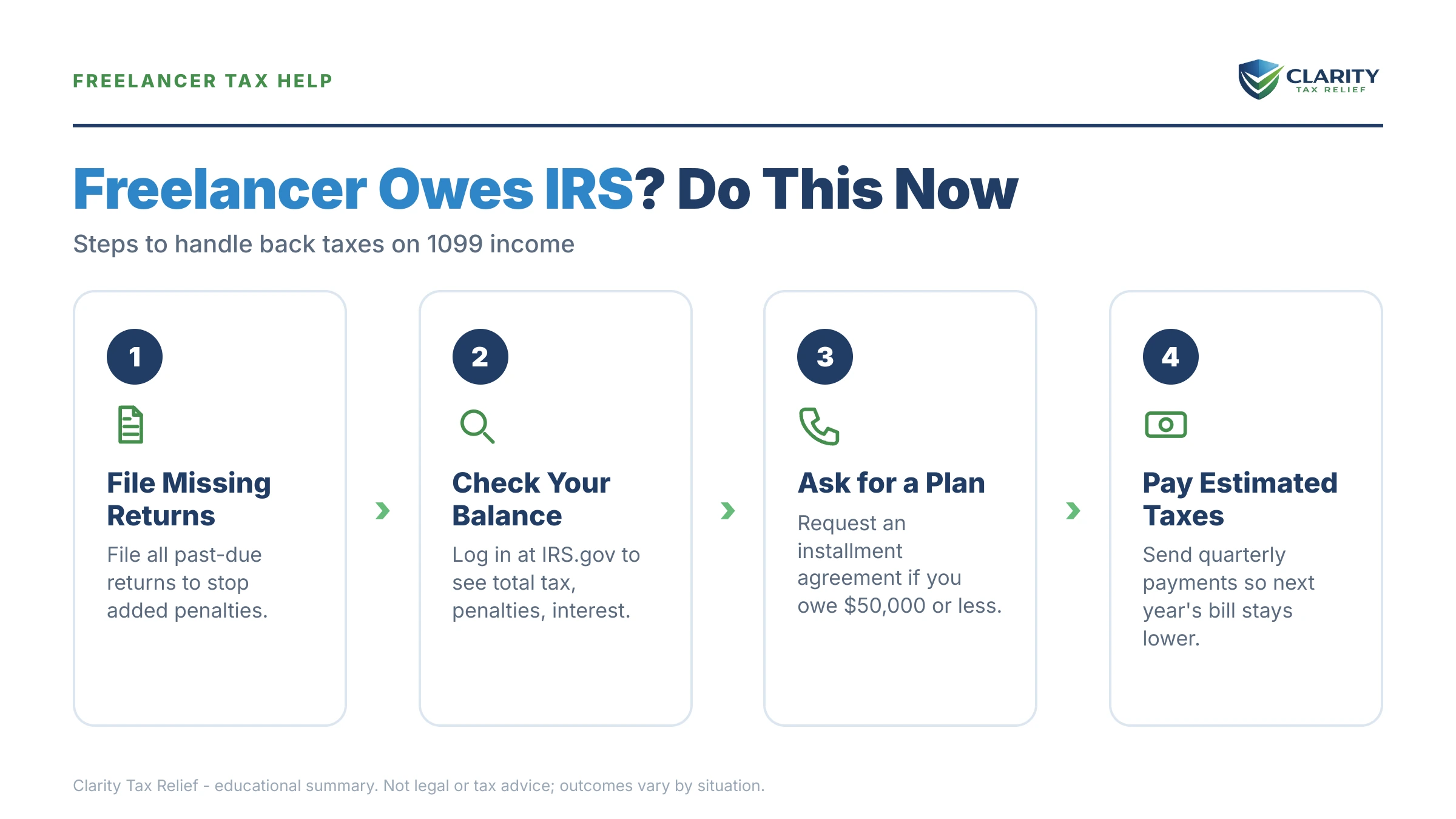
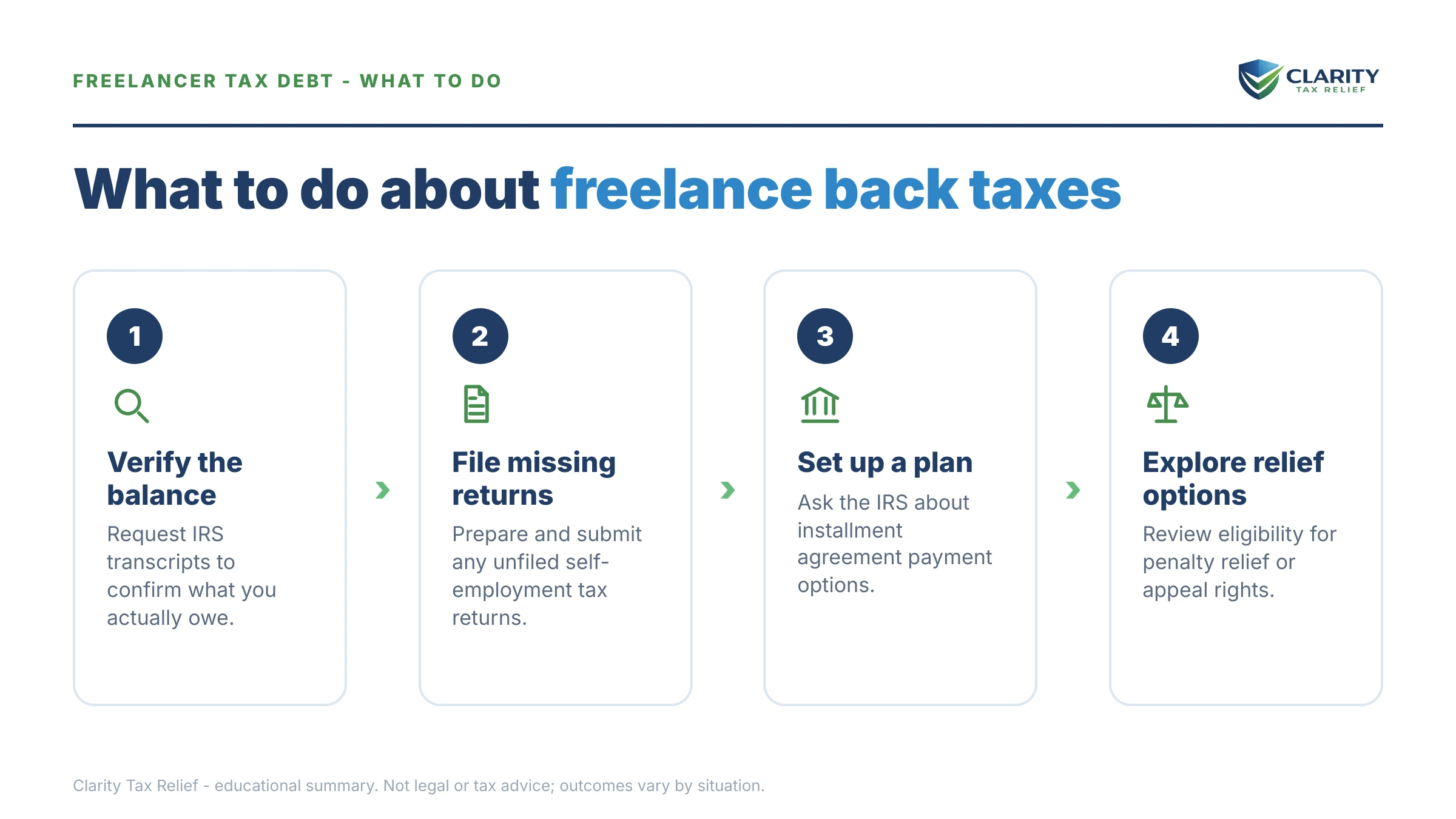
How to respond, step by step
- Pull your income records. Order your IRS wage and income transcripts to see every 1099 clients filed under your name, so you file with the numbers the IRS already has.
- File every missing return first. File the returns before you try to pay, claiming your business deductions — an accurate return usually shrinks the balance and stops the 5% monthly failure-to-file penalty.
- Verify the real balance. Log into your IRS online account and confirm the total tax, self-employment tax, penalties, and interest for each year before you agree to any amount.
- Choose your resolution option. Match your finances to a short-term plan, a streamlined installment agreement, Currently Not Collectible status, an Offer in Compromise, or penalty abatement.
- Set it up before enforcement escalates. Apply for the option you chose before the notice sequence reaches a levy — a plan you start today stops garnishments and bank levies from being filed.
- Fix your estimates going forward. Start paying quarterly estimated taxes so you don't add a new balance on top of the old one while you're resolving it.
How much should a freelance developer set aside going forward?
The fastest way to never owe the IRS again is to bank a fixed slice of every payment. A working rule for federal tax is 25–30% of net freelance income, higher if your state taxes income. Here's roughly what the self-employment portion alone looks like by profit level.
| Net profit | Self-employment tax (15.3%) | Rough total to set aside* |
|---|---|---|
| $40,000 | ~$5,650 | ~$10,000–$12,000 |
| $75,000 | ~$10,600 | ~$19,000–$23,000 |
| $100,000 | ~$14,130 | ~$27,000–$32,000 |
| $150,000 | ~$20,700 | ~$42,000–$50,000 |
*Includes estimated federal income tax plus self-employment tax; income tax varies by bracket, deductions, and state — figures are illustrative, not a quote. See our guide to how much to set aside for side-hustle taxes for the full method.
Half of self-employment tax is deductible, and contributing to a SEP-IRA or solo 401(k) further lowers taxable income — real reasons to work with someone who knows freelance returns.
When you can handle this yourself, and when you shouldn't
You can absolutely handle this alone if it's one filed year, a balance under $50,000 you can pay within 72 months, and no active levy. Filing the missing return, logging into your IRS account, and setting up a payment plan online is a genuinely doable afternoon. You keep every dollar a firm would charge.
Experienced help changes the outcome when the picture is messier: multiple unfiled years, a balance the IRS overstated because it never saw your deductions, a levy already in motion against a client payment, or an Offer in Compromise where the collection-potential math decides whether you save real money. A high-1099 consultant with back taxes and no records is exactly the case where sequencing — which return, which relief, in which order — determines what you ultimately pay. Honest help qualifies your need; it doesn't manufacture it.
Terms on your notice, decoded
Self-employment tax: the 15.3% you owe on net profit to fund Social Security and Medicare — the piece an employer normally splits with a W-2 worker.
1099-NEC: the form each client files reporting what they paid you; the IRS matches it against your return.
Estimated taxes (Form 1040-ES): the four annual pre-payments freelancers make instead of paycheck withholding.
Installment agreement: a monthly IRS payment plan; "streamlined" means simplified approval for balances of $50,000 or less.
Currently Not Collectible: a hardship status that pauses collection when you can't pay basic living expenses and the tax. The debt remains and interest still runs.
CSED: the collection statute expiration date — the IRS generally has 10 years from assessment to collect, though appeals, offers, and bankruptcy can pause that clock.
Freelancer back-taxes questions, answered
Why do freelancers owe the IRS so much?
Freelancers owe more because no one withholds tax from a 1099 payment and because of self-employment tax. On top of regular income tax, you pay 15.3% self-employment tax on net profit to cover Social Security and Medicare — the share an employer would normally split with you. Skip quarterly estimates and a full year's tax lands all at once.
What happens if a freelancer doesn't pay taxes?
The balance grows and the IRS's automated collection sequence escalates. Penalties and interest accrue monthly, then you'll get a CP14 bill, reminder notices, a CP504 intent to levy, and finally an LT11 final notice that starts a 30-day clock before wage and bank levies. The IRS can also issue a one-time levy on money a client owes you.
Can I set up a payment plan if I'm self-employed and owe back taxes?
Yes. If your combined balance is $50,000 or less, you can usually get a streamlined installment agreement online spread over up to 72 months, with no detailed financial disclosure. You must have all required returns filed first. Above $50,000, the IRS will want a financial statement showing your business income and allowable expenses.
Do I still owe self-employment tax on old 1099 income?
Yes. Self-employment tax of 15.3% applies to net profit from freelance work no matter how old the year is. It does not disappear because you forgot to file. It does fund your Social Security record, though. Legitimate business deductions — software, hardware, home office, subscriptions — lower net profit and therefore lower the tax.
Can a freelancer settle IRS debt for less than the full amount?
Sometimes, through an Offer in Compromise, but only when the IRS's own math shows it could never collect the full balance from your assets and future income. The IRS accepted roughly 1 in 5 offers in FY2024, so no outcome is guaranteed. Anyone promising to wipe out your debt for pennies on the dollar is selling a scam.
Should I file my back returns if I can't pay?
Yes — always file, even with no money to send. The failure-to-file penalty is 5% of the unpaid tax per month, ten times the 0.5% failure-to-pay penalty. Filing stops the bigger penalty, starts the collection statute clock, and unlocks payment plans and other relief that require every return to be on file.
How much should I set aside as a freelance developer?
A common rule of thumb is to park 25–30% of every net freelance dollar for federal tax, and more if you live in a state with income tax. Between 15.3% self-employment tax and your income-tax bracket, a developer netting six figures can easily land above 30%. Paying quarterly estimates keeps that money out of reach and avoids the underpayment penalty.
Can the IRS levy a freelancer's income?
Yes, but differently than a paycheck. Because you're paid on a 1099, the IRS usually issues a one-time levy that grabs whatever a specific client owes you at that moment, rather than a continuous wage garnishment. It can also levy your business bank account after the 21-day hold and reach payment-app balances. A payment plan or hardship status stops new levies.
Your next 24 hours
- Find the tax year and amount. On any IRS notice you've received, locate the tax year and the balance-due box. Those two numbers anchor everything that follows.
- Gather your income picture. Pull together your last filed return, every 1099 you can find. A rough tally of business expenses so you know what you actually netted.
- Get a free case review. Use the 2-minute form or call (888) 825-7779. Because interest and penalties compound every month you wait, the sooner you map a plan, the less the freelance balance costs you.
Primary sources: IRS payments, IRS payment plans & installment agreements, and the Taxpayer Advocate Service.
This guide is general information, not tax or legal advice for your specific situation. Eligibility for IRS programs depends on individual facts and circumstances; no outcome is guaranteed.