
Self-Employed & Business Tax Debt
General Contractor Owes the IRS Back Taxes: What to Do in 2026
The short answer: when a general contractor owes the IRS back taxes, you have real, means-tested options — a streamlined installment agreement for balances under $50,000, Currently Not Collectible hardship status, first-time or reasonable-cause penalty relief, or an Offer in Compromise if your finances qualify. Nothing gets levied while you're actively resolving it.
The last draw cleared, your crew's pay is due Friday, and now there's an IRS balance sitting on top of everything — tax on income that got spent on materials and payroll before you ever set a dollar aside. It feels like the one bill you can't build your way out of. It isn't. The debt is a number, and every number has a resolution path.
What makes a contractor's tax problem different from an employee's isn't the size — it's the shape. Your income arrives in lumps, your net profit hides behind materials and subs, and no withholding ever happens automatically. The image below shows what the first IRS balance notice looks like and where the amount and tax year appear, so you can match it to what you actually owe.
Below is the full map: why the balance built up, exactly how the IRS escalates and reaches a 1099 contractor's money, every option with its dollar threshold, and the worked math on a hypothetical $38,000 balance.
⏱ The clock that's already running: there's no single deadline on simply "owing," but two meters are ticking. The failure-to-pay penalty adds 0.5% of the unpaid balance every month, and interest compounds daily on top of it. If you also missed quarterly estimated payments, an underpayment penalty is baked into the balance too. Every month you wait, the number grows.
Why a contractor owes the IRS in the first place
A general contractor almost always owes for the same structural reason: nobody withholds your taxes for you. On a W-2, tax comes out of every check automatically. On 1099 income, that job is yours, and in a cash-flow business, the tax reserve is the easiest thing to spend when a supplier invoice or a payroll run comes due first.
Three specific gaps drive most contractor balances:
- Self-employment tax. Beyond income tax, you owe 15.3% Social Security and Medicare tax on your net earnings — the employer half an employee never sees. On a good year, that alone is a five-figure line. Our guide to the self-employment tax shock walks through how it stacks.
- Missed quarterly estimates. The IRS expects tax as you earn it, in four installments. Skip them and you get a balance plus an underpayment penalty. Here's how quarterly estimated taxes work and why contractors miss them.
- Profit that looked like cash. The money in the account after a job feels like yours. On paper, a big slice is next April's tax. Deposits get reported to the IRS on the 1099-NEC forms your customers file, so what you thought was invisible cash is already on record.
If you paid subs and treated them as 1099 workers who really looked like employees, there's a second layer of exposure — see the worker misclassification penalty. And if this is your broader "how did I get here" question, our companion guide on contractor back taxes digs into the root causes. This page is about resolving the balance you already have.
What happens if you ignore it
An unpaid contractor balance moves through the same automated collection sequence as anyone else's, and in 2026 that machine runs on its own even though IRS staffing was cut roughly 27% in 2025. The notices, liens, and levies are generated by systems that didn't get laid off. Ignore each one and the next arrives roughly five weeks later, carrying more penalty and more power:
- CP14 — the first bill. You're here or near it. No enforcement yet, just a balance due and a pay-by date.
- CP501 / CP503 — reminder notices. Still just bills, but the balance keeps growing monthly.
- CP504 — Notice of Intent to Levy. The IRS can now take your state tax refund, and a federal tax lien becomes a live possibility. See our CP504 notice guide.
- LT11 / Letter 1058 — Final Notice of Intent to Levy. After 30 days the IRS can levy bank accounts and serve levies on the customers who owe you. This notice also opens your Collection Due Process appeal rights.
- Revenue officer assignment — larger self-employed balances (and any payroll debt) can be pulled from the automated line and handed to a person who visits, inspects assets, and can move faster than the notice stream.
For a 1099 contractor, the levy that actually stings isn't usually a paycheck garnishment — it's a hit to the money customers already owe you. That's the mechanism most people don't see coming, and it's the one covered in the next section.
Owe the IRS and running a contracting business?
Before penalties compound another month, or a levy reaches your receivables — get your balance reviewed by an experienced tax professional. We'll decode exactly where you stand and which option fits your cash flow. Free, confidential, no pressure.
Your options when a contractor owes the IRS
The notice only ever offers "pay now or else." In reality the IRS runs several programs, and which one fits depends entirely on your numbers. Here's how they line up for a self-employed contractor.
| Option | Best when you… | Key threshold / catch |
|---|---|---|
| Short-term plan (up to 180 days) | Have a big job or draw coming that will clear it | $0 setup fee; interest & penalty keep accruing |
| Streamlined installment agreement | Owe $50,000 or less and want it off your plate | Up to 72 months; no financial disclosure needed if under threshold |
| Non-streamlined / above $50k plan | Owe more than $50,000 | Requires Form 433-F financials; IRS reviews your income & assets |
| Currently Not Collectible | A slow season means paying anything causes hardship | Pauses collection; debt & interest remain; reviewed as income recovers |
| Offer in Compromise | Assets + future income genuinely can't cover the balance | $205 fee (waivable if low-income); ~1 in 5 accepted; equipment equity counts against you |
| First-time penalty abatement | You had clean compliance the prior 3 years | Removes the penalty, not the tax or interest; one year at a time |
One note on penalties for 2026: the traditional first-time abatement is being folded into an automatic penalty exemption (AEP) rolling out from summer 2026, meaning eligible taxpayers may not have to request it at all. Either way, the failure-to-pay penalty is the piece worth attacking. You can estimate how fast your penalties and interest are stacking with our IRS penalty &. Interest calculator before you decide which route saves the most.
Worked example: a $38,000 contractor balance
Say you're a general contractor who owes $38,000 across 2024 and 2025 — mostly self-employment tax and income tax you never set aside during two busy years. Here's roughly how the paths compare (hypothetical, for illustration):
- Streamlined installment agreement, 72 months: $38,000 ÷ 72 ≈ $528 a month before interest, which adds to the total until the balance is cleared. No financial disclosure required because you're under $50,000.
- If a slow winter hits: you could drop to Currently Not Collectible, pausing payments entirely while the 0.5%/month penalty and interest continue in the background, then resume a plan when jobs pick back up.
- Offer in Compromise: the IRS would calculate your Reasonable Collection Potential — the equity in your truck, tools, and any real estate, plus a multiple of your monthly disposable income. If that math comes to, say, $22,000, your offer generally can't be less than that. If it comes to $40,000, an offer makes no sense and a plan is smarter.
If your balance is closer to the mid-five figures, our breakdown of what to do when you owe the IRS $30,000 shows the same options at that exact number.
How the IRS reaches a 1099 contractor's money
A contractor's collection risk is different from a W-2 employee's because your income isn't a steady paycheck the IRS can garnish continuously — it's invoices, deposits, and receivables. That changes what a levy actually grabs.
| Enforcement action | What it hits | One-time or continuous? |
|---|---|---|
| Bank levy | Funds in your business/personal accounts on the levy date | One-time; 21-day hold before funds leave |
| Levy on a customer / GC | Money a payer owes you at the moment they're served | Usually one-time — grabs the invoice on file |
| Accounts-receivable levy | Outstanding invoices across your customers | Served per payer; can freeze cash flow fast |
| State tax refund seizure | Any state income-tax refund owed to you | One-time, after CP504 |
| Federal tax lien | Attaches to your property, including equipment and real estate | Continuous until released; can block a sale or refinance |
The critical distinction: because you're paid on 1099s, a levy on the person who owes you is generally a one-time levy that catches only what's due that day, not a continuous garnishment. But an accounts-receivable levy served on several customers at once can still starve your cash overnight and put your name in front of the people who pay you. The whole point of setting up an agreement early is to take that option off the IRS's table — see how the IRS garnishes 1099 income for the full mechanics.
How to respond, step by step
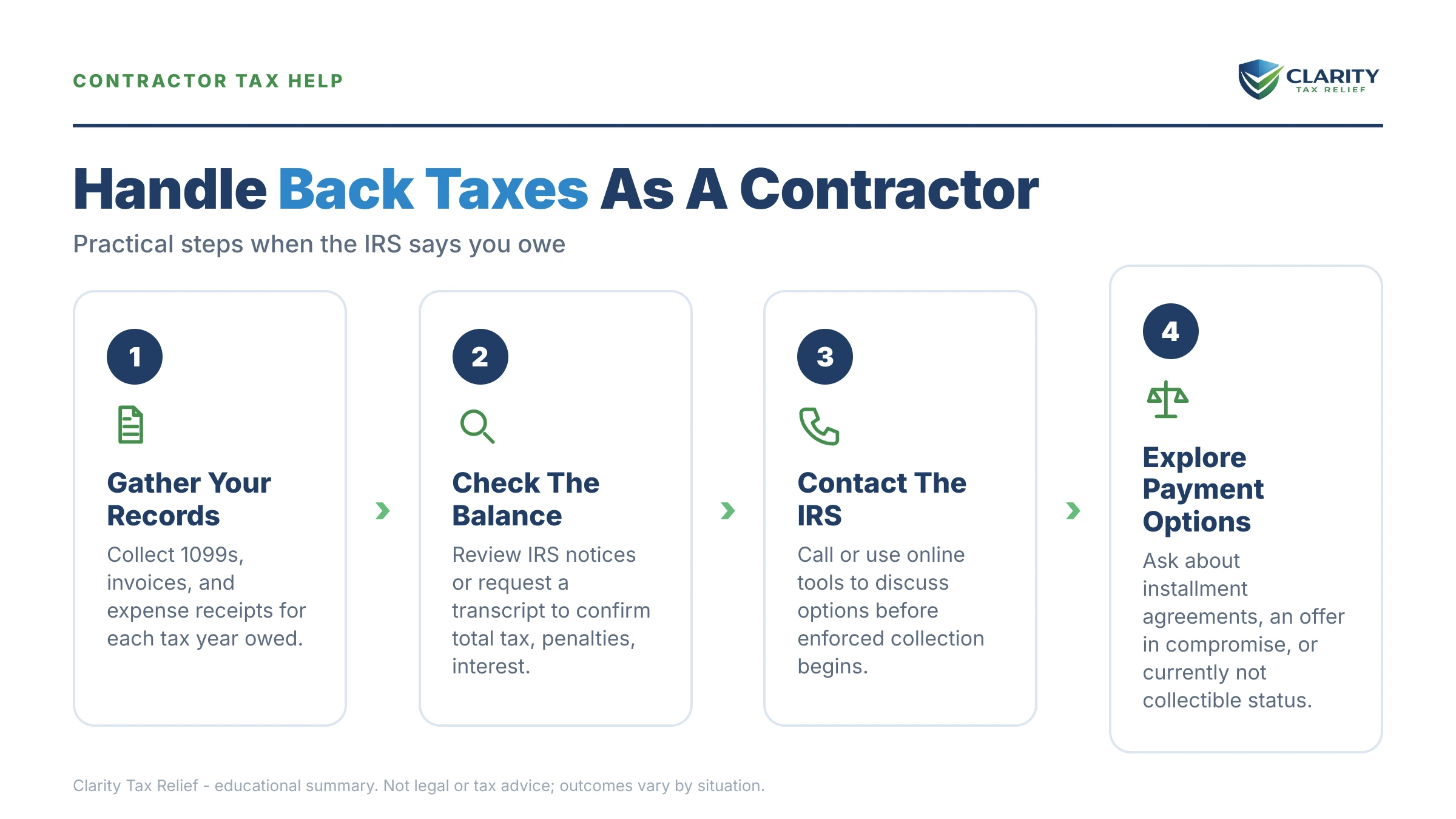
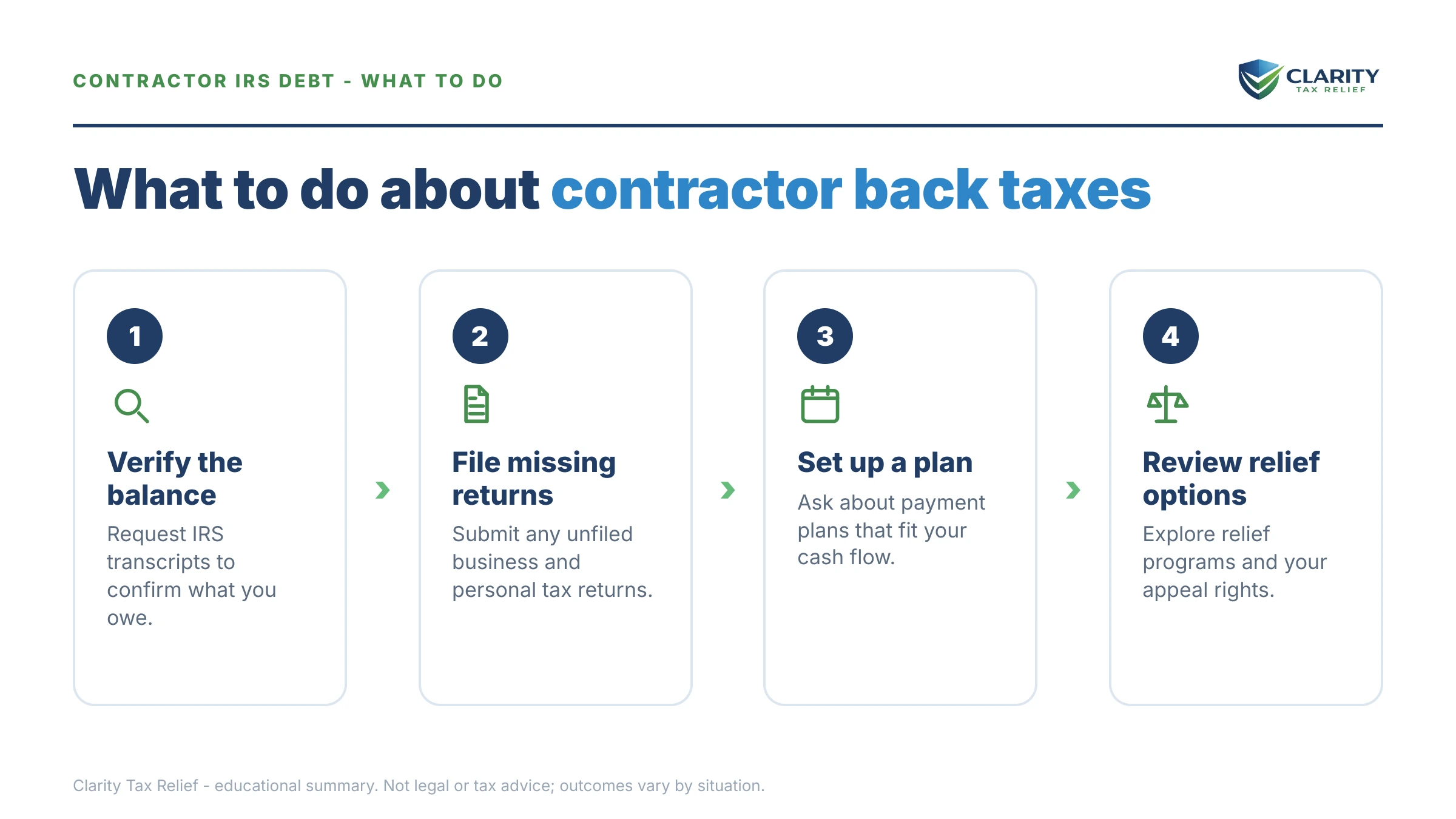
- Confirm every year is filed. Pull your wage and income transcripts and file any missing returns — the IRS won't approve a plan or offer with returns outstanding.
- Verify the balance against your IRS online account so you're negotiating the right number, not a stale or duplicated one.
- Pick the option that fits your cash flow from the table above — a plan if income is steady, hardship status if it isn't, an offer only if the math supports it.
- Request penalty relief for any year you had a clean prior record, so you're not paying penalties you can have removed.
- Set the agreement up before the next notice, even a plan you start today stops the levy sequence cold.
- Fix the cause: start making quarterly estimates on 25–30% of net profit so next year doesn't rebuild the same debt.
When the answer changes: your specific situation
"Contractor owes the IRS" isn't one problem — three details move the answer sharply.
Solo 1099 contractor vs. contractor with employees
This is the biggest fork. If you're a sole proprietor with no employees, your debt is income tax and self-employment tax. The IRS collects it civilly through plans, hardship, and offers. If you have a crew on payroll and fell behind on construction payroll tax debt (Form 941), that's a different animal — unpaid payroll trust-fund tax carries personal liability even behind an LLC or corporation, and enforcement is far more aggressive. Treat any payroll balance as the emergency it is.
You paid subs on 1099s
If you issued 1099-NEC forms to subs, make sure you actually filed those forms — missing information returns carry their own penalties. If the IRS or a worker argues a sub was really an employee, you could face a reclassification bill. Section 530 relief and Form SS-8 determinations exist to manage that exposure, but it's a fight worth handling with help.
You're married and file jointly
A joint return makes both spouses responsible for the whole balance, even if the contracting income was only yours. If your spouse has a W-2 refund coming, filing a plan protects it better than letting the IRS offset it. Where one spouse genuinely didn't know about the underreported income, innocent-spouse relief may apply, but that's a narrow door, not a default.
Not sure whether your situation is one you can handle alone or one where an experienced tax professional changes the outcome? A free case review sorts that in one call.
When you can handle this yourself, and when you shouldn't
Plenty of contractor balances are DIY-friendly. If you owe under $50,000, have all your returns filed. Your income can support a monthly payment, you can set up a streamlined installment agreement online in an afternoon without disclosing your finances. A single year with a clean record behind it is also a straightforward first-time abatement request. Don't pay for help you don't need.
Experienced help earns its fee when the stakes or the complexity climb: a levy already served on your customers, multiple unfiled years, any payroll (941) trust-fund exposure, a balance over $50,000 that requires financial disclosure, a revenue officer at the jobsite, or an Offer in Compromise where one wrong figure on the Reasonable Collection Potential sinks the whole offer. In those cases the order you fix things in, and how you present your finances — directly changes what you end up paying.
Terms on your notice, decoded
Self-employment (SE) tax — the 15.3% Social Security and Medicare tax you owe on net earnings because no employer paid the other half. It's separate from income tax.
Estimated tax underpayment penalty — a charge added when you didn't pay enough tax during the year through quarterly installments.
Reasonable Collection Potential (RCP) — the IRS's formula for the most it could collect from your assets and future income. It sets the floor on any Offer in Compromise.
One-time levy — a levy that captures only what a payer owes you at the moment it's served, common on 1099 income, versus a continuous wage garnishment.
Trust Fund Recovery Penalty (TFRP) — the personal liability imposed on a responsible person for unpaid payroll trust-fund tax; it survives the business closing.
Contractor IRS back-tax questions, answered
Can the IRS take my tools, trucks, and equipment if I owe back taxes?
It can, but it rarely does, and there is a protection for the tools of your trade. Federal law exempts a limited dollar amount of the tools and equipment you need to earn a living from levy. The IRS almost always pursues bank accounts and receivables first because they are faster and cheaper. Seizing and auctioning a work truck is a last resort that usually appears only after a revenue officer is assigned and you have ignored several notices.
Can the IRS levy money a customer or general contractor still owes me?
Yes. The IRS can serve a levy on a customer, a GC you sub for, or a builder who has your invoice on file, ordering them to send your payment to the IRS instead of to you. On a 1099 contractor this is usually a one-time levy that grabs whatever is owed at that moment, not a continuous garnishment. But a levy on your accounts receivable can cut off your cash flow overnight and damage the relationship, which is why setting up an agreement before enforcement starts matters so much.
How much should a general contractor set aside for taxes to avoid owing?
A common working rule is to set aside 25% to 30% of net profit — the money left after materials, subs, and equipment — for federal income tax and self-employment tax combined. Self-employment tax alone is 15.3% on net earnings, on top of income tax. If your state has an income tax, add its rate. Making quarterly estimated payments on that reserve is what keeps a balance from building year after year.
I owe the IRS for several tax years as a contractor — where do I start?
Start by making sure every year is filed, because the IRS will not approve a payment plan or settlement while returns are missing. Pull your wage and income transcripts to see the 1099s the IRS already has, file the oldest open years, and only then negotiate the combined balance as a single agreement. The order matters: filing first, penalty relief second, and the balance last usually produces the lowest total number.
Can a contractor settle IRS back taxes for less than the full amount?
Sometimes — through an Offer in Compromise, but only when the IRS's own math shows it could not collect the full balance from your assets and future income. The IRS accepted roughly 1 in 5 offers in FY2024, so it is neither guaranteed nor a quick fix, and anyone promising to wipe out your debt for pennies on the dollar is selling a scam. For a contractor with equipment equity and strong seasons, hardship status or a payment plan is often the realistic path instead.
Will the IRS shut down my contracting business over back taxes?
For income tax and self-employment tax on a sole proprietorship, the IRS does not shut you down. It collects from your accounts, receivables, and refunds. The risk changes if you have employees and fell behind on payroll (Form 941) taxes, because unpaid trust-fund payroll tax carries personal liability and far more aggressive enforcement, up to seizure of business assets. That is the one debt to treat as an emergency.
Does having an LLC protect me from a personal IRS tax bill?
Usually not for the tax that put you here. A single-member LLC is disregarded for income tax, so the profit and self-employment tax flow onto your personal return and the IRS collects from you personally. An LLC does not separate you from income tax on your own earnings. It never shields the responsible person from unpaid payroll trust-fund tax. The liability protection an LLC offers is for business creditors, not the IRS on your own income.
Your next 24 hours
- Find the balance box. Pull out your most recent IRS notice and read the amount due and the tax year, or log into your IRS online account and confirm the total across every year.
- Gather three things: your last filed return, any 1099-NEC forms your customers sent you. A rough month of income and expenses so a plan or hardship request can be built on real numbers.
- Get a free case review. Call (888) 825-7779 or use the 2-minute form. The sooner an agreement is in place, the less risk a levy ever reaches your receivables, and the sooner the 0.5%-a-month penalty stops compounding.
This guide is general information, not tax or legal advice for your specific situation. Eligibility for IRS programs depends on individual facts and circumstances; no outcome is guaranteed.
Primary sources: IRS Self-Employed Individuals Tax Center, IRS Payment Plans & Installment Agreements, and the Taxpayer Advocate Service.