
Self-Employed & 1099 Tax Debt
Massage Therapist Owes Taxes: Handling Massage Therapist Tax Debt in 2026
The short answer: massage therapist tax debt almost always comes from self-employment income with no tax withheld — booth rent, 1099 pay, cash tips, and app payments. On top of income tax you owe 15.3% self-employment tax. File every year, deduct your real business costs, then pick a payment plan or settlement that fits.
You booked full weeks, the money came in, and the tax bill still blindsided you. As a massage therapist, nobody withheld a dime from your booth-rent income, your cash tips, or your booking-app deposits, so the balance the IRS wants can feel impossibly large. It is fixable, and the amount is usually smaller than it looks once your deductions go on the return.
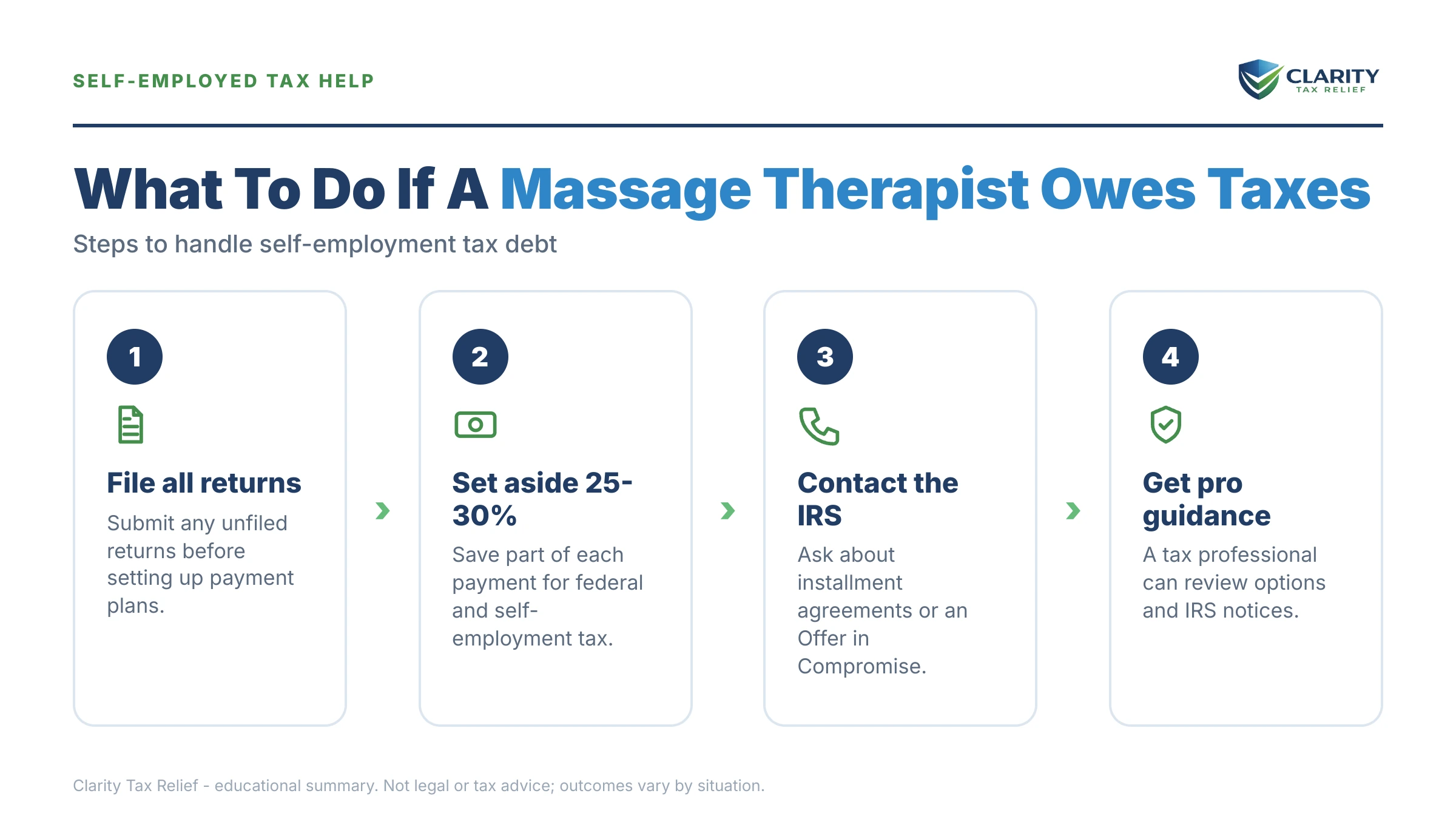
The reason the number stings is the same one that trips up nearly every self-employed massage therapist: the self-employment tax most people never see coming until April. The image below breaks down exactly where a massage therapist's tax debt comes from and which numbers to check first.
Below you'll see why the debt built up, what happens if you leave it, and every option, from a simple payment plan to penalty relief, mapped to what you can actually afford.
⏱ The clock that's running right now: even before any notice arrives, a failure-to-pay penalty of 0.5% per month plus daily-compounding interest is growing on any unpaid balance, and a separate underpayment penalty applies for skipped quarterly estimates. There's no fixed deadline on this page — the cost just climbs every month you wait, so filing and setting up a plan early is what stops the bleed.
Why massage therapists end up owing the IRS
Massage therapist tax debt is a withholding problem, not a spending problem. When you're a W-2 spa employee, taxes come out of every check. The moment you rent a room, go mobile, or take clients on the side, that stops, and you become responsible for the full tax bill plus the employer half of Social Security and Medicare.
Most therapists carry a mix of income types in the same year, which is exactly why the math gets confusing. Here's where the debt comes from.
| Income source | Why it creates a balance due |
|---|---|
| Booth / room rent (independent) | No withholding at all; you owe income tax plus 15.3% self-employment tax on net profit. |
| 1099-NEC from a spa or clinic | Paid gross, nothing withheld — the full tax is yours to remit. |
| 1099-K from a booking or payment app | Reports gross card volume before rent, supplies, and fees; easy to over-report if you don't deduct. |
| Cash tips and cash sessions | Fully taxable even when no one reports them; often the piece people forget. |
| Mixed W-2 + self-employed year | Withholding on the W-2 rarely covers the untaxed 1099 side, leaving a gap at filing. |
If your spa pays you on a 1099 but controls your schedule, prices, and clients, you may be a misclassified employee — a different problem worth a professional look. Therapists in that gray zone share a lot with a hair stylist with 1099 taxes owed or a personal trainer facing 1099 tax debt. And if you own the practice and pay other therapists, your exposure looks more like a salon or spa owner's tax debt, which adds payroll on top.
The self-employment tax shock most therapists miss
Self-employment tax is 15.3% of your net profit, 12.4% Social Security plus 2.9% Medicare, and it's charged before any income tax. That's the number that turns a manageable-looking year into a five-figure bill.
An employee splits that 15.3% with their employer and never notices. When you work for yourself, you pay both halves. The one bit of relief: you deduct half of it against your income tax, and your legitimate business expenses lower the profit it's calculated on. This is the same trap that hits every first-year self-employed person owing taxes, and it's covered in depth in our guide to the self-employment tax when you owe the IRS.
The deductions that shrink the bill
Every dollar of legitimate business expense lowers both your income tax and your 15.3% self-employment tax. Massage therapists routinely leave hundreds, sometimes thousands, of deductible dollars off the return, which inflates the debt.
| Category | Examples |
|---|---|
| Space | Booth rent, room rent, or the home-office portion if you treat clients at home |
| Equipment | Massage table, bolsters, hot-stone kits, chairs, tools; often deductible in the year bought |
| Supplies & laundry | Oils, lotions, creams, sheets, towels, sanitizer, and cleaning or laundry service |
| Licensing & education | State license renewal, CEUs, certifications, and professional association dues |
| Insurance & software | Professional liability insurance, booking software, and card-processing fees |
| Vehicle | Mileage to mobile appointments and between work locations (not your commute) |
If a return you already filed missed these, amending it can lower what you owe. You generally have three years from the original filing deadline to amend and claim a refund or reduce a balance — see our guide on how to amend a return to reduce a tax debt.
What happens if you ignore massage therapist tax debt
An unpaid self-employment balance doesn't sit still. It moves through an automated IRS collection sequence, and each stage carries more power than the last. Here's the order it follows if nothing is done.
- CP14 — the first bill. Penalties and interest are already accruing. This is the cheapest moment to act; see our CP14 notice guide.
- CP501 / CP503 — reminder notices. Still no enforcement, but the balance keeps climbing monthly.
- CP504 — Notice of Intent to Levy. The IRS can now take your state tax refund, and a federal tax lien becomes a real possibility.
- LT11 / Letter 1058 — Final Notice of Intent to Levy. After 30 days the IRS can garnish income and levy bank accounts, though you gain formal appeal rights at this stage.
There's a self-employed twist worth knowing: the IRS can't garnish a booth-rent paycheck the way it garnishes a W-2. But it can issue a one-time levy on money a spa or client owes you. It can levy your business bank account. In 2026, IRS staffing is down sharply, but liens and levies are automated, so the sequence runs whether or not a person ever reviews your file.
Owe the IRS as a massage therapist and not sure where to start?
Send us your notice or a rough number. An experienced tax professional will map your deductions, your filing gaps. The plan that fits your cash flow, before penalties and interest grow any larger. Free, confidential, no pressure.
Your options if you can't pay in full
The bill sounds like "pay now or else," but the IRS has several programs, and which fits depends on your finances, not on what a marketing ad promises.
| Option | Best for | Cost / threshold |
|---|---|---|
| Short-term plan | Can clear it within 180 days | $0 setup; interest/penalty continue |
| Streamlined installment agreement | Owe ≤ $50,000, want simple monthly terms | Small setup fee; up to 72 months, no financial disclosure |
| Currently Not Collectible | Paying anything causes real hardship | Pauses collection; debt and interest remain |
| Offer in Compromise | Assets/income can't cover the debt | $205 fee (waived if low-income); ~1 in 5 accepted |
| First-time penalty abatement | Clean prior 3 years | Removes failure-to-pay/file penalty |
For a first-time slip after years of clean filing, penalty abatement can meaningfully cut the balance, and note that a new Automatic Exemption from Penalty begins rolling out in summer 2026, applying automatically without a request in qualifying cases. If your total owed sits in the mid-five figures, our walkthrough of what to do when you owe the IRS $10,000 maps the same choices dollar-for-dollar.
A worked example: how the numbers actually play out
Say you're a booth-rent massage therapist. Hypothetically, you grossed $58,000 in a year and had $14,000 of real business expenses — booth rent, table, oils, linens, insurance, and CEUs — leaving $44,000 of net profit.
- Self-employment tax: 15.3% on about $40,600 of net = roughly $6,200.
- Income tax after the standard deduction and the half-SE-tax deduction: roughly $2,800.
- That's about $9,000 in true tax, but you paid nothing during the year.
Add a failure-to-pay penalty, an estimated-tax underpayment penalty, and interest, and the balance lands near $10,500. On a 72-month streamlined installment agreement that's roughly $146 a month before the ongoing interest, and first-time abatement could knock off the failure-to-pay piece. You can estimate your own penalty-and-interest running total with our IRS penalty and interest calculator. This is illustrative math, not a promise — your real numbers depend on your income, deductions, and filing history.
How to respond, step by step
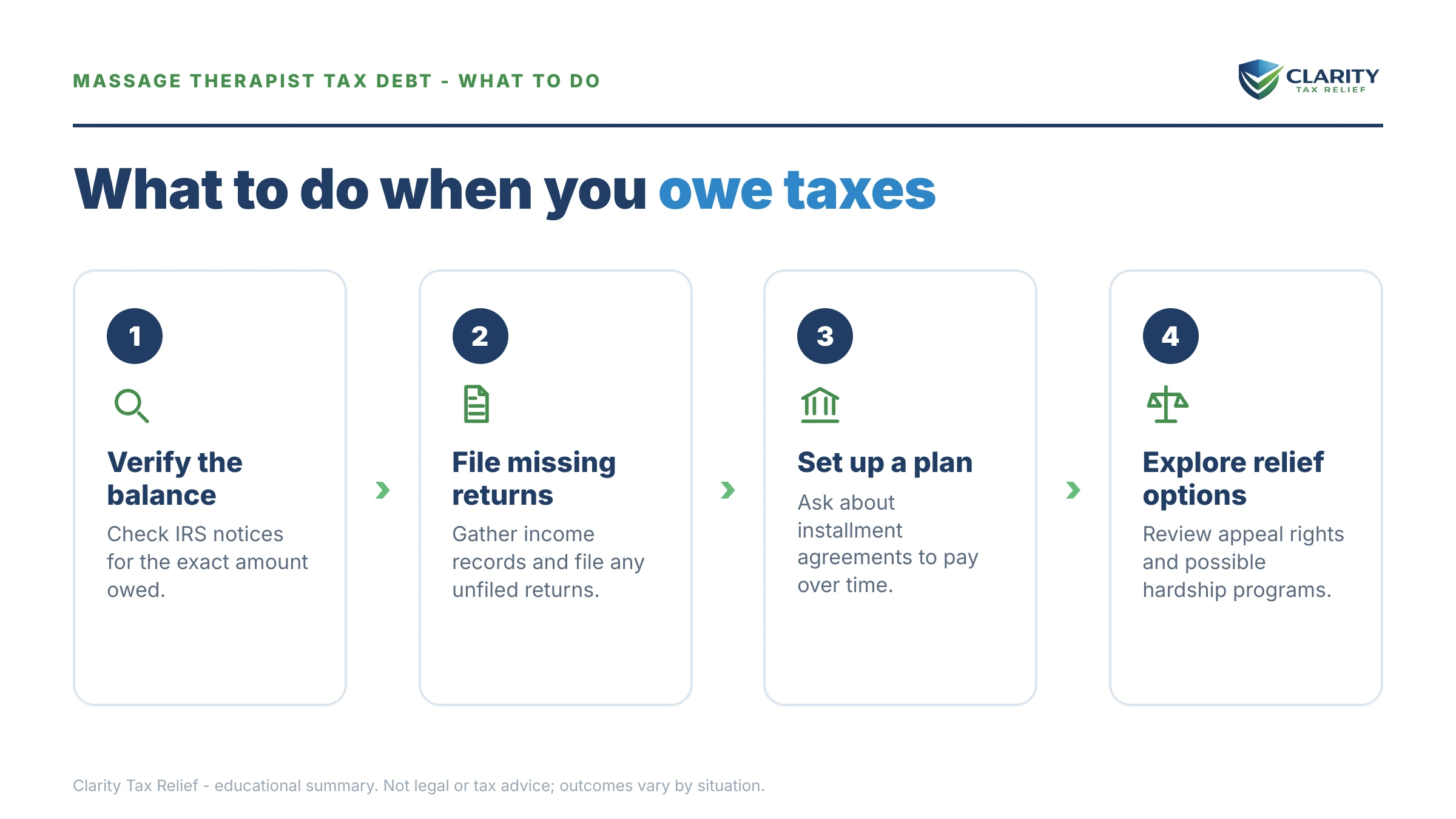
- Pull your transcripts — log into your IRS online account and pull your wage-and-income and account transcripts to see exactly which years and amounts the IRS shows.
- File every missing return — file any unfiled years with your booth rent, supply, and mileage deductions before the IRS files a substitute return that ignores them.
- Rebuild your deductions — total your business expenses from bank records and app statements so your Schedule C reflects real profit, not gross receipts.
- Pick a resolution that fits your cash flow — choose a short-term plan, a streamlined installment agreement, hardship status, or an Offer in Compromise based on what you can actually afford each month.
- Ask for penalty relief — if your prior three years were clean, request first-time penalty abatement to remove the failure-to-pay and failure-to-file penalties.
- Fix next year's withholding — set up quarterly estimated payments so you don't rebuild the same debt while you pay off the old one.
When you can handle this yourself, and when to get help
You can likely handle this alone if you owe one year, you agree with the amount. You can pay it within 180 days or set up a simple online installment agreement under $50,000. Filing a clean Schedule C with your real deductions and clicking through the IRS payment-plan tool is well within reach — our guide to how quarterly estimated taxes work and setting up estimates will keep you from repeating the cycle.
Bring in an experienced tax professional when the picture is bigger: multiple unfiled years, a substitute return already filed against you, a levy on a client payment or business account, a possible worker-misclassification issue with your spa, or an Offer in Compromise where the math has to be exactly right. The sequence you fix things in — returns first, then penalties, then the balance — changes the final number, and that's where guidance pays for itself.
Terms on your notice, decoded
Self-employment (SE) tax: the 15.3% Social Security and Medicare tax on your net business profit, separate from income tax.
Schedule C: the form where you report your massage income and subtract your business expenses to reach net profit.
1099-NEC vs. 1099-K: a 1099-NEC reports what a spa or clinic paid you directly; a 1099-K reports total card and app payments processed on your behalf.
Estimated taxes: quarterly prepayments (Form 1040-ES) the self-employed make in place of withholding; skipping them triggers a separate underpayment penalty.
Substitute for return (SFR): a return the IRS files for you if you don't, with no deductions, which is why it produces a much larger bill.
If your balance spans several years or you're weighing a settlement against a plan, an experienced tax professional can price both paths before you commit — start a free case review or call (888) 825-7779.
Massage therapist tax debt, answered
Why do massage therapists owe so much in taxes?
Because most massage income comes with no tax withheld. When you rent a room, work on a 1099, or take cash and app payments, nothing is taken out for you. You still owe self-employment tax of 15.3% on top of income tax. A therapist netting $44,000 can easily owe $9,000 to $11,000 for a single year they didn't set money aside.
Do I have to report cash tips as a massage therapist?
Yes. All tips are taxable income, whether they came in cash, on a card, or through a booking app, and whether or not anyone reported them to the IRS. If you were a W-2 spa employee, tips over $20 in a month should have been reported to your employer on Form 4070. If you're self-employed, tips go on your Schedule C as gross receipts.
I'm a booth renter — am I self-employed or an employee?
If you rent a room or table and set your own hours, rates, and clients, the IRS treats you as self-employed. You file a Schedule C plus Schedule SE. If the spa controls your schedule, prices, and clients but pays you on a 1099, you may actually be a misclassified employee — that's worth a professional look, because it changes who owes the payroll-tax half.
What can massage therapists deduct to lower a tax bill?
Ordinary and necessary business costs: booth or room rent, massage table and bolsters, oils, lotions and linens, laundry, liability insurance, license and CEU renewals, professional association dues, booking software, and mileage for mobile work. If a return already filed missed these, amending it can shrink the debt — you have three years from the filing deadline to amend most returns.
I got a 1099-K from my booking app — do I owe on all of it?
You owe on your net profit, not the gross on the 1099-K. The 1099-K reports total payments processed, before booth rent, supplies, fees, and refunds are subtracted. For 2026 the reporting threshold is back to $20,000 and 200 transactions, but old debt from earlier low-threshold years doesn't disappear. You still report and deduct against it.
Can I set up a payment plan if I owe for multiple years?
Yes, but every required return has to be filed first — the IRS won't approve a plan while you have missing years. Once you're filed, a streamlined installment agreement covers a combined balance up to $50,000 over as many as 72 months. If your total is higher, you can still get a plan, but you'll need to submit financial details on Form 433-F.
What if I haven't filed in a couple of years?
File the missing returns before the IRS files a substitute return for you — a substitute return gives you zero deductions and inflates the balance. Most non-filers only need the last six years to get back in compliance. Filing your own returns with your booth rent and supply deductions almost always produces a far smaller number than the IRS's version.
Can I settle massage therapist tax debt for less than I owe?
Sometimes, through an Offer in Compromise, but only when your income and assets genuinely can't cover the debt before the collection statute runs out. The IRS accepted roughly 1 in 5 offers in FY2024, so no outcome is guaranteed. Be very wary of any firm promising to wipe out your debt for pennies on the dollar before reviewing your finances.
Your next 24 hours
- Find your real numbers. Locate your latest 1099-NEC, 1099-K, and any notice, and note the tax year and balance the IRS shows.
- Gather your deductions. Pull bank and app statements and total booth rent, supplies, equipment, insurance, license fees, and mileage. This is what shrinks the bill.
- Get a free case review. Use the 2-minute form or call (888) 825-7779. Every month you wait, the failure-to-pay penalty and interest keep growing — starting now stops that clock.
This guide is general information, not tax or legal advice for your specific situation. Eligibility for IRS programs depends on individual facts and circumstances; no outcome is guaranteed.