
Tax Debt by Amount
I Owe the IRS $10,000: What Do I Do? Every Real Option (2026)
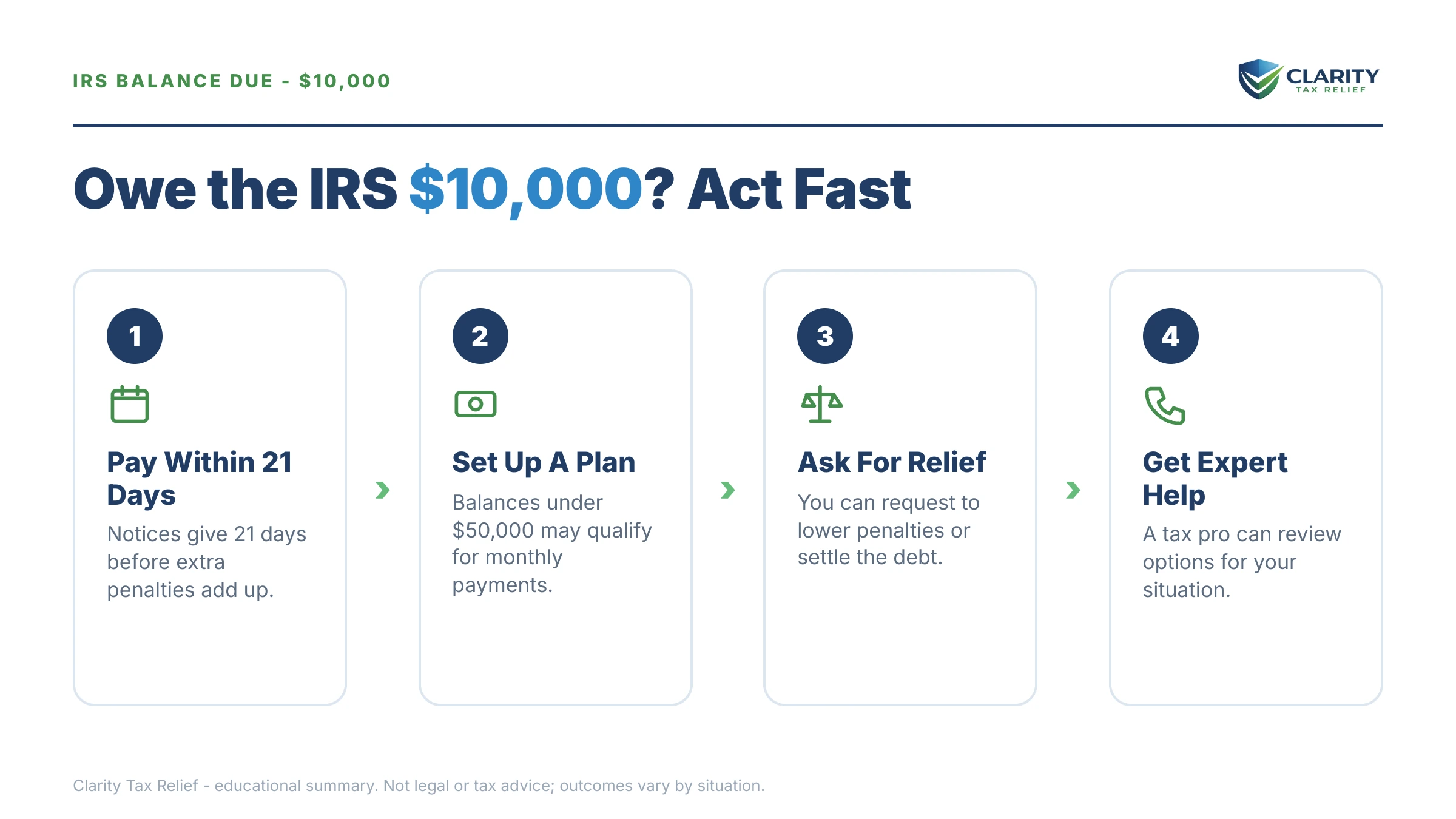
The short answer: if you owe the IRS $10,000, you can almost certainly fix it online. You're under the $50,000 streamlined threshold, so a 72-month payment plan — roughly $139 a month — can be set up at IRS.gov without financial disclosure. And if your tax alone is $10,000 or less, the IRS must accept a qualifying three-year plan.
Maybe it was an IRA withdrawal with no withholding, the year your pension pushed your Social Security into taxable range, or a side income that never had tax taken out. If you're typing "I owe the IRS 10000 what do I do" into a search bar at midnight, here's the honest answer: at this balance you have more options, and cheaper ones — than at almost any other amount the IRS collects.
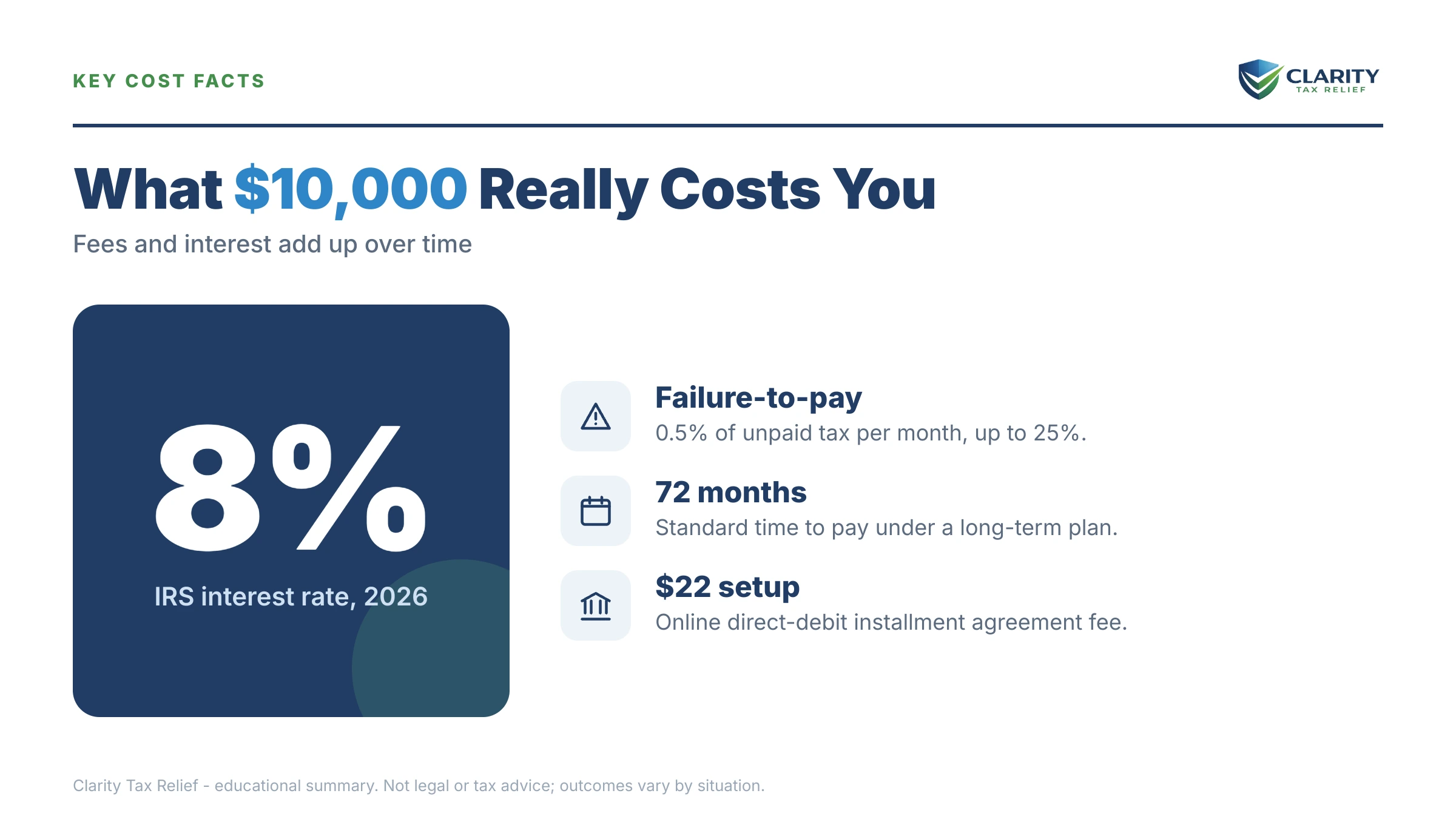
⏱ The real clock: there's no single statutory deadline on a $10,000 balance, but the failure-to-pay penalty adds 0.5% every month and interest compounds daily, so waiting typically costs you $100 or more per month. One exception: if you've received an LT11 or Letter 1058, a hard 30-day levy clock is already running. Check your mail pile first.
Why you owe the IRS $10,000
Most $10,000 IRS debts come from income that had no tax withheld, not from cheating. A retirement-account withdrawal, a pension without withholding elected, a first year of 1099 work, unemployment income, or a CP2000 adjustment for income a payer reported but you didn't. Whatever the source, the IRS treats it the same way: a bill, then an automated collection sequence.
Two things make $10,000 a distinctive number. First, it's the threshold for the guaranteed installment agreement, if you're an individual whose income-tax balance (not counting penalties and interest) is $10,000 or less, all your required returns are filed, you've filed and paid on time for the prior five years with no installment agreement during that period. You agree to pay in full within three years, the IRS is required by law to accept your payment plan. Second, it's small enough that every resolution program on the books is still on the table.
“We generally approve an offer in compromise when the amount you offer represents the most we can expect to collect within a reasonable period of time. Explore all other payment options before you submit an offer in compromise. The Offer in Compromise Program is not for everyone.”
— Offer in compromise (IRS.gov)
What happens if you ignore a $10,000 IRS balance
A $10,000 IRS debt left alone follows an automated path from a mailed bill to a levy on your bank account, paycheck, or Social Security. The sequence isn't personal, and no one at the IRS is deciding to come after you — the system escalates on its own, in this order:
- CP14 — the first bill, with roughly 21 days to pay before the sequence continues. No enforcement yet.
- CP501 / CP503 — reminder notices, typically arriving weeks apart. Still just bills, but the balance grows every month.
- CP504 — Notice of Intent to Levy. The IRS can now take your state tax refund, and a federal tax lien becomes a live possibility.
- LT11 / Letter 1058 — the final notice. It starts a 30-day clock and your Collection Due Process appeal rights. After it passes, levies are authorized.
- Levy — a bank levy freezes funds for 21 days before they're sent to the Treasury. A wage levy is continuous until released. And if you receive Social Security, the Federal Payment Levy Program can take a slice of every check.
The IRS can take up to 15% of a monthly Social Security benefit through the FPLP once the final-notice window closes — the full detail is in our guide to the IRS taking 15 percent of Social Security. Along the way, every federal tax refund you'd otherwise receive is kept and applied to the debt.
One 2026 reality worth knowing: the IRS workforce shrank by roughly 27% in 2025, so reaching a human is harder than ever. But the notices and levies are generated by computers that never stopped running. Slow phones don't mean slow enforcement.
Staring at a $10,000 balance and a stack of IRS letters?
An experienced tax professional will review your notices and your transcript for free, tell you which option actually fits your income, and whether penalty relief could shrink the balance, before another month of penalties and interest posts.
Your options when you owe the IRS $10,000
Every federal resolution program is open at $10,000 — payment plans, hardship status, penalty relief, and, when the math genuinely supports it, an Offer in Compromise. The full do-it-yourself playbook lives in our guide on how to settle tax debt yourself. Here's how each option looks at exactly this balance:
| Option | Do you fit at $10,000? | Upfront cost | The trade-off |
|---|---|---|---|
| Pay in full | Always, if the cash exists | $0 | Stops all penalties and interest immediately; often cheaper than any plan |
| Short-term plan (up to 180 days) | Yes — well under the limit | $0 setup fee | Interest and 0.5%/month penalty continue until paid |
| Long-term installment agreement (up to 72 months) | Yes — $10,000 is far below the $50,000 online ceiling | Modest setup fee; lower with direct debit, waived at low income | Interest continues, but the late-pay penalty drops to 0.25%/month on an active plan |
| Guaranteed installment agreement | Individuals only — income tax of $10,000 or less (excluding penalties and interest), all returns filed, timely filing/payment for the past 5 years with no installment agreement in that period, 3-year payoff | Standard plan fees | The IRS must accept it; higher payment (~$278+/month) because of the 3-year term |
| Currently Not Collectible | If any payment would prevent covering basic living expenses | $0 (financial disclosure required) | Collection pauses; debt remains and interest accrues; refunds still offset |
| Offer in Compromise | Only if income and assets can't cover the debt before the statute expires | $205 fee + 20% down (both waived with low-income certification) | Months of review; roughly 1 in 5 offers accepted in FY2024 |
| Penalty relief (FTA / AEP) | If your prior 3 years are penalty-free | $0 | Removes penalties only — the tax and interest on tax remain |
A few notes the table can't hold. The 72-month plan is the workhorse at this level: because $10,000 sits under the $25,000 streamlined line — let alone the $50,000 online cap — no Form 433-F financial disclosure is required. The whole thing takes about 15 minutes on IRS.gov. Our walkthrough of the IRS payment plan online setup shows every screen.
Currently Not Collectible matters most on fixed incomes. If documenting your budget shows that paying the IRS would leave you unable to cover rent, food, utilities, and medicine, collection stops — see IRS hardship on Social Security for how that works when benefits are your main income.
On settling for less: how an offer in compromise works is a math test, not a negotiation — the IRS calculates what it could realistically collect from you and compares it to your offer. At $10,000, an offer only beats a payment plan when income and assets are genuinely minimal, which is exactly why low-income retirees are among the few people for whom a small-balance offer can make sense. Never trust anyone promising to settle it for "pennies on the dollar". That phrase is a sales pitch, not a program.
What a $10,000 IRS debt actually costs: a worked example
Say you're retired, living on $1,950 a month in Social Security plus a small pension. In 2024 you took an IRA withdrawal to replace a roof, no tax was withheld. The return, filed a year late, showed $10,000 due. Here's the hypothetical math today:
- Failure-to-file penalty (capped): about $2,250
- Failure-to-pay penalty (0.5% × 12 months): about $600
- Interest, compounding daily at the quarterly rate: roughly $750
- Balance now: about $13,600
Now compare the three realistic paths. A 72-month plan on $13,600 runs about $189 a month ($13,600 ÷ 72), with the late-pay penalty dropping to 0.25% monthly while the plan is active. Doing nothing eventually means the FPLP taking 15% of that $1,950 Social Security check — about $292 a month, more than the plan would cost, with no say in the timing. And if $189 would genuinely break the budget, a Form 433-F showing benefits-only income may support Currently Not Collectible status instead.
One more lever: if the prior three years were clean, first-time abatement could remove most of that $2,850 in penalties, pulling the balance back toward $10,750 before a plan even starts. You can estimate your own accruals with our IRS Penalty & Interest Calculator.
How to respond to a $10,000 IRS debt, step by step
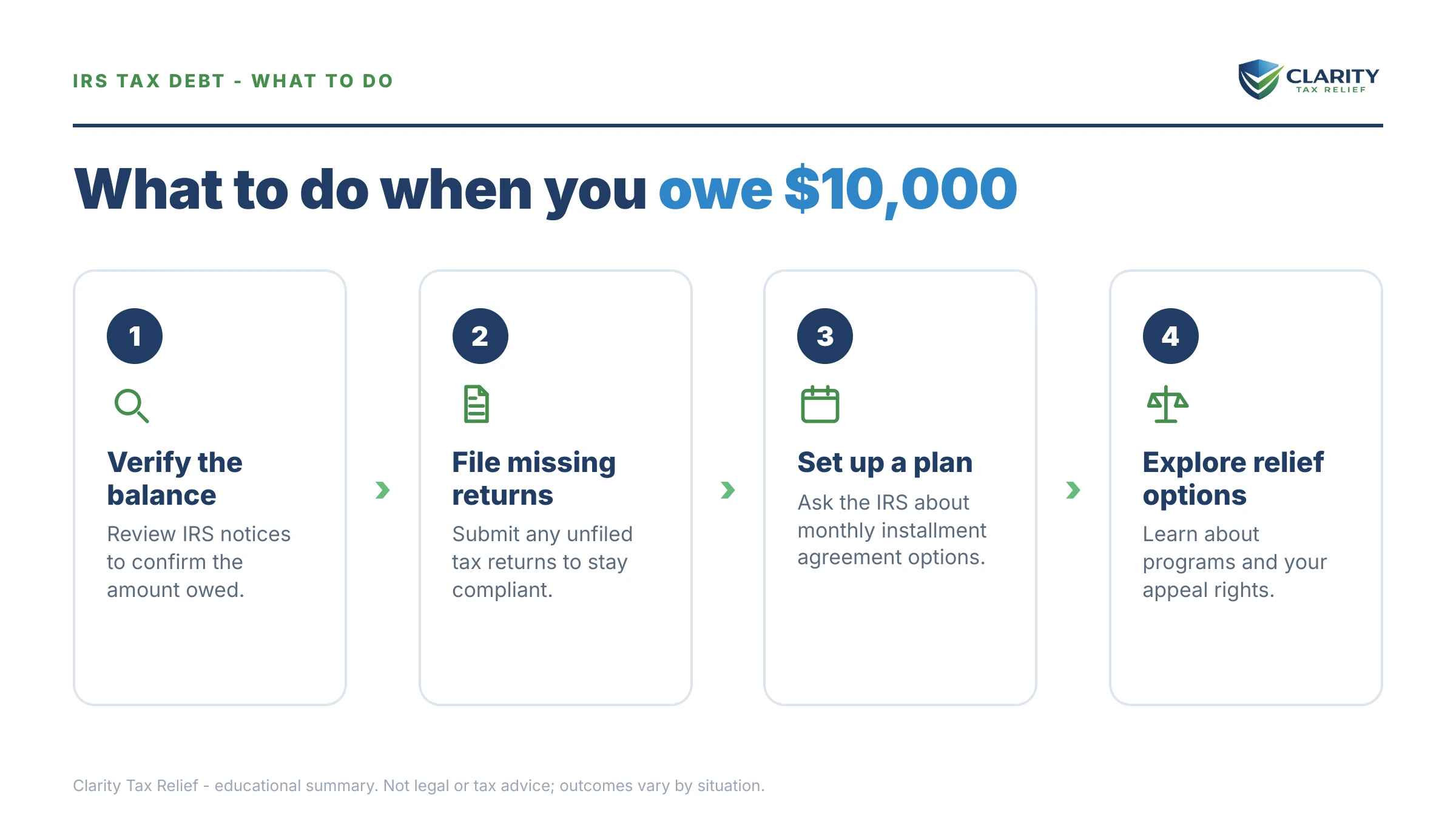
- Confirm your real balance — log into your IRS online account and write down the total, the tax years involved, and how much is penalties and interest rather than tax.
- File any unfiled returns — the failure-to-file penalty is ten times the failure-to-pay penalty (though in months where both apply, the failure-to-file portion drops to 4.5%, for 5% combined). The IRS won't approve any resolution while returns are missing.
- Choose your resolution — set up a 180-day short-term plan or a 72-month installment agreement on the IRS payment plans page — or, if any payment would break your budget, request Currently Not Collectible status instead.
- Request penalty relief — ask for first-time penalty abatement if your prior three years are clean. Starting summer 2026, the new Automatic Exemption from Penalty applies some relief without a request.
- Fix the cause — adjust withholding on your pension, IRA distributions, or paycheck so next April doesn't restart the cycle and default your agreement.
How $10,000 compares to other IRS balance levels
Thresholds, not the raw dollar amount, decide what the IRS asks of you. $10,000 sits below every hard line that makes tax debt genuinely difficult:
| Balance | Realistic path | Threshold in play |
|---|---|---|
| Under $10,000 | Pay in full, short-term plan, or guaranteed installment agreement — see I owe the IRS $5,000 | ≤ $10,000 tax: IRS must accept a qualifying 3-year plan |
| $10,000 (you are here) | Online 72-month plan (~$139/mo) or CNC on a hardship budget | Last stop for the guaranteed agreement; no financial disclosure needed |
| $15,000–$25,000 | Same online plan, higher payment — see I owe the IRS $15,000 and owe IRS $25,000 | $25,000: top of the classic streamlined band |
| $25,000–$50,000 | Online plan usually requires direct debit toward the top of the band | $50,000: ceiling for online setup without financials |
| Over $50,000 | Financial disclosure, possible lien, negotiated terms | $66,000: passport certification threshold for 2026 |
The takeaway: at I owe the IRS $20,000 and above, payments roughly double and the margin for a hardship budget shrinks — which is one more reason to lock in a resolution before penalties and interest push a $10,000 debt into the next band.
Checking your IRS transcript: the codes behind a $10,000 balance
Your account transcript (free in your IRS online account) shows exactly how the balance was built and where collection stands. These are the codes you're most likely to see:
| Code | What it means | What to do |
|---|---|---|
| 150 | Return filed; tax assessed — the debt's start date | Note the date: the 10-year collection statute runs from here |
| 276 | Failure-to-pay penalty posted | Total these — they're the target of an abatement request |
| 196 | Interest charged to the account | Interest on tax generally can't be waived; reduce it by resolving sooner |
| 971 | A notice was issued | Match it to the letter in your mail. It tells you which escalation stage you're at |
| 530 | Account placed in Currently Not Collectible | Collection is paused; keep filing on time so it stays that way |
When you can handle a $10,000 tax debt yourself
A $10,000 IRS debt is one of the most DIY-friendly balances there is. If the amount is correct, your returns are filed, and you can afford roughly $139–$200 a month, set the plan up online yourself tonight. You don't need to pay anyone for that, and no honest firm will tell you otherwise.
Experienced help changes the outcome in a narrower set of situations: a levy or garnishment already in motion, multiple unfiled years that have to be reconstructed before anything else can happen, a balance you dispute (say, a CP2000 that double-counted income), or a fixed income where the CNC or Offer in Compromise math has to be documented precisely to be accepted. If you're retired, our guide for those retired and owing back taxes covers the benefit-protection angles in depth.
Terms you'll run into, decoded
- CSED — the Collection Statute Expiration Date: the IRS generally has 10 years from assessment to collect, though certain events pause the clock.
- FPLP — the Federal Payment Levy Program, the automated system that can take up to 15% of federal payments like Social Security.
- Streamlined installment agreement — a payment plan approved without detailed financial disclosure because the balance is under the threshold.
- Currently Not Collectible (CNC) — a status that pauses collection when paying would prevent you from covering basic living expenses.
- Levy vs. lien — a levy takes property (bank funds, wages, benefits). A lien is a legal claim against your property that secures the debt without taking anything.
Owing the IRS $10,000: your questions answered
Can I set up a payment plan online if I owe the IRS $10,000?
Yes. A $10,000 balance is well under the $50,000 ceiling for setting up a long-term payment plan through the IRS Online Payment Agreement tool, with up to 72 months to pay. You'll need all required returns filed first, and choosing direct debit lowers the setup fee and makes the agreement harder to accidentally default.
What is the minimum monthly payment on $10,000 of IRS debt?
The IRS generally accepts a monthly payment equal to your balance divided by 72 — about $139 a month on $10,000. Interest and a reduced 0.25% monthly late-payment penalty keep accruing on an active plan, so paying more than the minimum shortens the plan and cuts the total cost. There's no penalty for paying it off early.
Will the IRS settle a $10,000 tax debt for less than I owe?
Only if your income and assets genuinely can't cover the debt before the collection statute runs out — that's what an Offer in Compromise measures. The IRS accepted roughly 1 in 5 offers in FY2024, and at $10,000 a payment plan is often faster and cheaper than the offer process. If your AGI is at or below 250% of the federal poverty level, the $205 application fee and 20% down payment are waived, which makes an offer more realistic on a fixed income.
Can the IRS garnish my Social Security check over $10,000?
Yes. Through the Federal Payment Levy Program, the IRS can take up to 15% of your Social Security benefit, but only after sending a final notice of intent to levy and letting the 30-day response window pass. Setting up a payment plan or qualifying for hardship status before that point prevents the levy entirely.
Will the IRS file a tax lien over $10,000?
It can, but at this balance a lien is far from automatic — liens are more common on larger debts and on accounts where notices go unanswered. Getting into a direct-debit installment agreement early is the most reliable way to keep a lien off the table. If a lien has already been filed, paying the debt or completing certain agreements opens the door to release or withdrawal.
Can the IRS take my passport over $10,000 in tax debt?
No — passport certification requires a 'seriously delinquent' debt of $66,000 or more in 2026, so a $10,000 balance is nowhere near that line. The caveat is that ignored debts grow: penalties and interest, plus new balances from later years, can eventually stack toward the threshold. Resolving the debt now keeps that scenario theoretical.
What if I'm on a fixed income and can't afford any monthly payment?
Ask for Currently Not Collectible status. You'll document your income and living expenses, usually on Form 433-F, and if paying the IRS would leave you unable to cover basic necessities, collection is paused: no levies, no garnishments. The debt itself remains and interest keeps accruing, but the 10-year collection statute keeps running while you're protected.
Does a $10,000 IRS debt expire after 10 years?
Generally the IRS has 10 years from the date the tax was assessed to collect, after which the balance expires, but events like an Offer in Compromise, bankruptcy, or a collection appeal pause that clock and stretch the deadline. Waiting out a $10,000 debt also means a decade of notices, offset refunds, and levy risk, which is why it's rarely a plan at this balance.
Your next 24 hours
- Pull your numbers. Log into your IRS online account (or find your most recent notice) and write down the total balance, the tax years. The date of the newest letter, especially if any notice says "intent to levy."
- Gather three things: your last filed tax return, the IRS notices you've received. A simple list of monthly income (Social Security statement, pension 1099-R, pay stubs) and essential expenses.
- Get a free case review. If anything about the balance is unclear, or a monthly payment would strain a fixed income — call (888) 825-7779 or use the 2-minute form. Every month you wait adds another round of penalties and interest to the $10,000; a plan started this week stops the escalation cold.
If a payment plan ever stops working, the Taxpayer Advocate Service is an independent, free resource inside the IRS for cases stuck in the system.
This guide is general information, not tax or legal advice for your specific situation. Eligibility for IRS programs depends on individual facts and circumstances; no outcome is guaranteed.