
Owe Back Taxes
Retired and Owe IRS Back Taxes? What the IRS Can Take, and Your Options (2026)
The short answer: if you're retired and owe IRS back taxes, the IRS can take up to 15% of your Social Security check through the Federal Payment Levy Program, but retirees on fixed incomes often qualify for hardship status, a monthly payment plan, or a reduced settlement. Acting before the final levy notice preserves every option.
You planned retirement around a Social Security deposit and a pension check that arrive like clockwork, and now an IRS bill from your working years, or from a marriage that just ended, is claiming a piece of both. On a fixed income, there's no "pick up extra shifts" fix. That's exactly why the IRS's hardship-based programs exist, and why a retiree's numbers often fit them better than a working filer's ever could.
This guide maps the whole terrain: where retiree tax debt comes from, exactly what the IRS can and cannot touch in retirement, every resolution option with its eligibility line, and — because so many readers of this page are recently divorced or widowed — what happens when the debt started on a joint return that no longer reflects your life.
⏱ The real clock: there is no single deadline on back taxes in retirement, but interest compounds daily and a 0.5% monthly failure-to-pay penalty accrues on the balance, and once the IRS mails a final notice of intent to levy, you have 30 days before it can begin taking up to 15% of each Social Security payment. Check the date printed on any notice you're holding; that date controls.
Why retirees end up owing IRS back taxes
Most retirees who owe IRS back taxes got there through under-withholding — Social Security and most pension payers withhold nothing unless you specifically ask them to. Nobody hands you a W-4 at retirement, and the first sign of trouble is often a balance-due return two or three years in.
The common triggers, in rough order of how often we see them:
- No withholding on Social Security or pension income. If your combined income makes part of your Social Security taxable, the tax is owed even though nothing was taken out.
- Retirement account distributions. Required minimum distributions, a large IRA withdrawal to cover a roof or a medical bill, or cashing out a 401(k) after a divorce all create taxable income, sometimes pushing more of your Social Security into taxable territory at the same time.
- Divorce late in life. Splitting retirement accounts, selling the marital home, and losing the married-filing-jointly brackets can each generate a bill. Worse, old joint-return balances follow both spouses regardless of what the decree says — more on that below.
- A house or investment sale. Capital gains above the home-sale exclusion, or from downsizing an investment property, land as a lump-sum tax with no withholding behind them.
- A spouse's death. The survivor drops to single filing status the following year, often with nearly the same income taxed at higher rates.
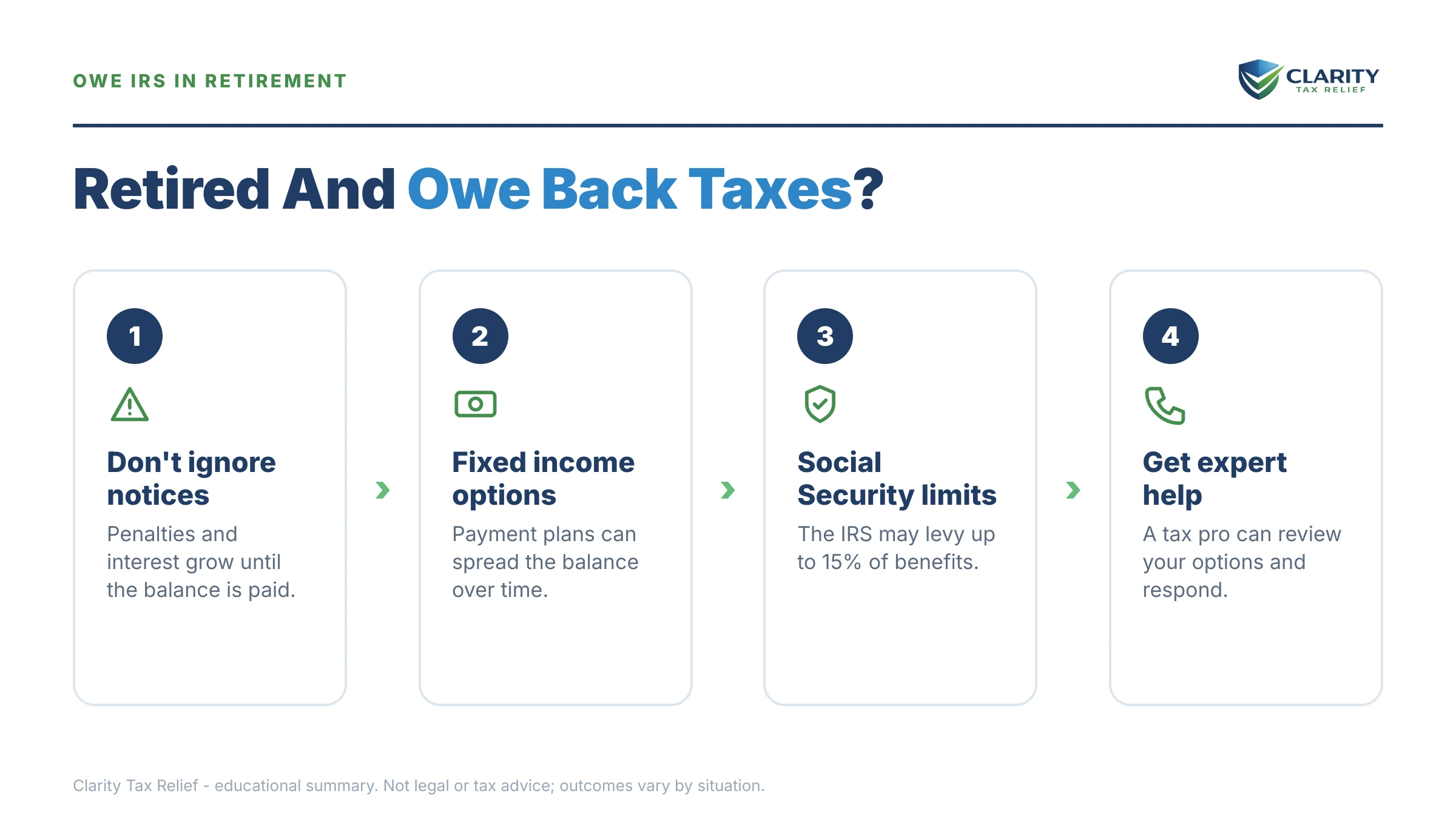
None of these involve wrongdoing. They're plumbing problems in a withholding system built for paychecks. But the IRS collection machine doesn't distinguish between a plumbing problem and defiance. It just escalates on schedule. The image below shows how that escalation ladder looks from where you're standing now.
“We intend to levy up to 15% of your Social Security benefits for unpaid taxes.”
— Understanding your CP91 notice (IRS.gov)
What happens if you ignore back taxes in retirement
The IRS can take up to 15% of your Social Security retirement check through the Federal Payment Levy Program once its final-notice window closes. Before it gets there, an automated notice sequence runs, and each rung is a chance to stop it:
- CP14 — the first bill. No enforcement power yet. This is the cheapest moment in the entire sequence to act.
- CP501 / CP503 — reminders. Still just bills, but interest and the 0.5% monthly late-payment penalty are compounding. Our guide to how IRS interest actually compounds shows why a balance left alone grows faster than most retirees expect.
- CP504 — Notice of Intent to Levy. The IRS can now seize your state tax refund under IRC §6331(d). A federal tax lien against your home becomes a realistic next step.
- LT11 / Letter 1058 — Final Notice of Intent to Levy. A 30-day clock starts, along with your right to a Collection Due Process hearing (requested on Form 12153). This is the last rung with full appeal rights attached.
- Enforcement. The Federal Payment Levy Program takes up to 15% of each Social Security payment — the CP91 notice is the specific warning for that levy. Bank accounts can be levied (with a 21-day hold before funds leave), and if debt across all years reaches $66,000 in 2026, the IRS can certify you to the State Department, blocking passport renewal — a real problem for retirees who travel.
One 2026 reality worth naming: the IRS workforce shrank roughly 27% in 2025, which makes reaching a human harder. But the notices, the FPLP levy. The liens are all issued by automated systems that never stopped. Silence from the IRS does not mean your file went quiet.
| Notice | Your window | What you lose if it passes |
|---|---|---|
| CP14 (first bill) | Typically 21 days from the notice date | The cheapest fix — the balance grows monthly from here |
| CP504 (intent to levy) | The date printed on the notice | Your state tax refund becomes seizable; lien risk rises |
| LT11 / Letter 1058 (final notice) | 30 days | Your right to a Collection Due Process hearing (Form 12153) before levy |
| CP91 (Social Security levy warning) | The window printed on the notice | Up to 15% of every Social Security payment becomes leviable — continuously |
Retired, on a fixed income, and holding an IRS notice?
Get it reviewed free before a final notice starts the 30-day clock on your Social Security. An experienced tax professional will tell you exactly which rung of the ladder you're on and which option fits your budget — no pressure, no obligation.
Your options when you're retired and owe IRS back taxes
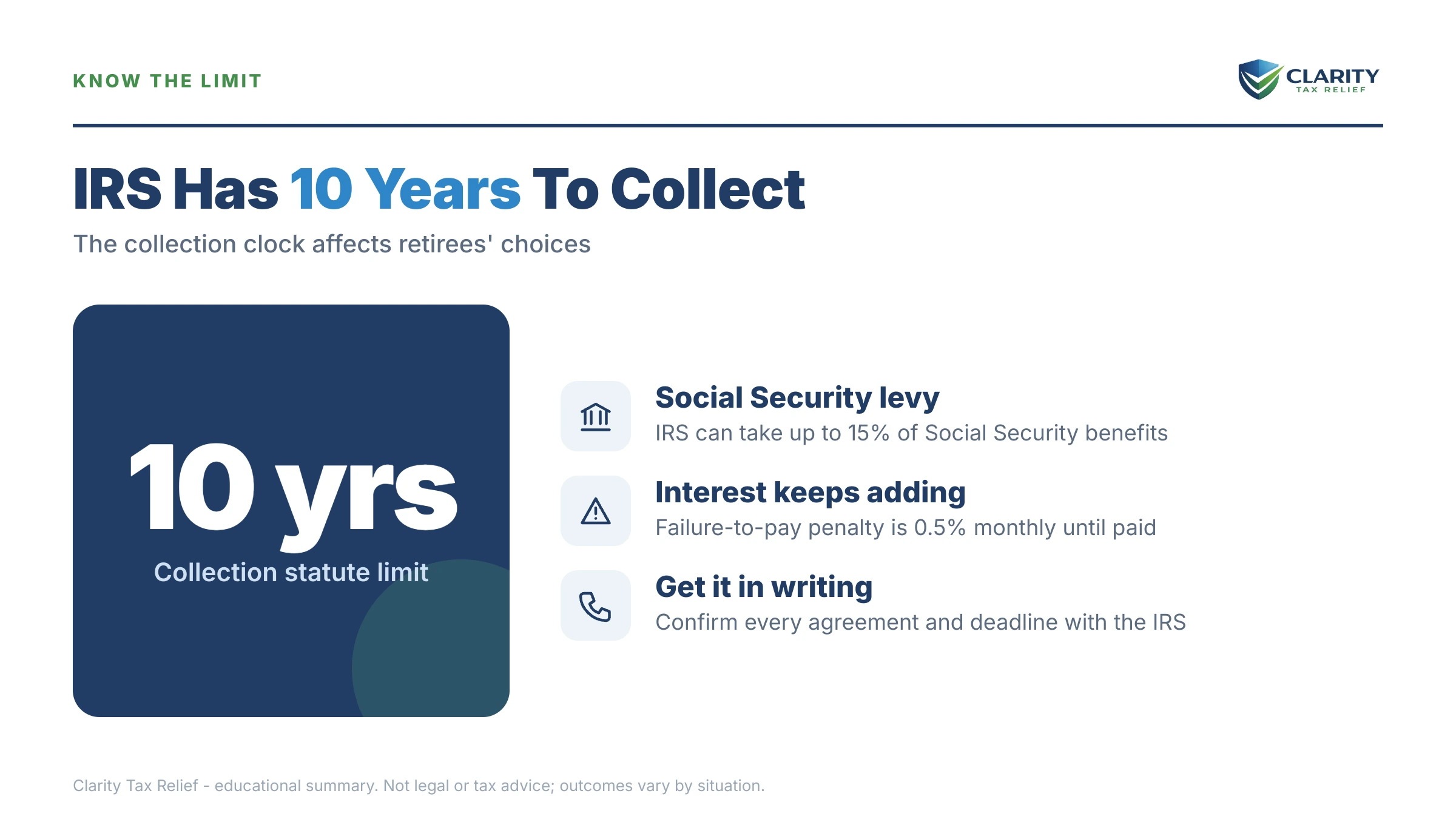
A retiree owing $36,900 fits inside the streamlined installment agreement limit of $50,000 — up to 72 months, arranged online, no full financial disclosure required. But a payment plan is only one of six real paths, and on a fixed income it often isn't the best one. (For the general mechanics of each program, our DIY pillar on how to settle tax debt yourself covers them in depth. Here's how each applies to retirement income specifically.)
| Option | Who qualifies (retiree lens) | The trade-off |
|---|---|---|
| Short-term payment plan | Can pay in full within 180 days | $0 setup fee; interest and penalties continue until paid |
| Streamlined installment agreement | Balance ≤ $50,000; up to 72 months; set up online | Setup fee applies; interest accrues; any refund is offset while you pay |
| Currently Not Collectible (CNC) | Income at or below IRS allowable living expense standards | Collection stops; debt and interest remain; the IRS reviews periodically |
| Offer in Compromise | Assets plus future income genuinely below the balance | $205 fee (waived if AGI ≤ 250% of poverty); roughly 1 in 5 accepted in FY2024 |
| Penalty abatement (FTA / AEP) | Clean compliance in the prior 3 years | Removes penalties, not the underlying tax or interest |
| Waiting out the CSED | Debt near the 10-year collection mark, usually paired with CNC | Levy exposure unless in a protected status; certain actions pause the clock |
Three retiree-specific notes the table can't hold:
- CNC is built for fixed incomes. If Social Security plus pension leaves nothing after the IRS's allowable living expense standards — housing, food, out-of-pocket medical, transportation — the IRS can classify your account Currently Not Collectible. Levies stop while it lasts. Our guide to IRS hardship while on Social Security walks through the exact financial test.
- OIC math cuts both ways for retirees. Low fixed income helps the future-income side of the calculation. But the IRS counts asset equity too — home equity, IRAs, savings. A retiree with a paid-off house and low income is usually a CNC candidate, not an OIC candidate. Never let anyone charge you for an offer before running the asset math.
- Penalty relief is changing in your favor. First-Time Abate still works if your prior three years were clean, and starting summer 2026, the IRS's Automatic Exemption from Penalty (AEP) applies some penalty relief automatically, with no request needed. On a multi-year balance, removed penalties can shrink the total meaningfully.
How to respond when you're retired and owe back taxes, step by step
- Pull your full IRS balance — log in to (or create) your IRS online account, or request account transcripts, so you see every year owed and every notice date — not just the letter in your hand.
- Confirm every return is filed — no resolution program will be approved with unfiled years outstanding, and filing stops the 5%-per-month failure-to-file penalty, which is ten times the late-payment penalty.
- Match your budget to an option — income at or below the IRS allowable living expense standards points to Currently Not Collectible. Genuine room in the budget points to a payment plan. Low income plus low assets points to an Offer in Compromise review.
- Set the resolution up before the next notice — balances up to $50,000 can go on a streamlined plan online in one sitting. Hardship status requires a financial statement, usually Form 433-F, showing income and expenses.
- Request penalty relief — ask for first-time abatement if your prior three years were clean — and note the IRS's new Automatic Exemption from Penalty (AEP), rolling out from summer 2026, applies some relief with no request at all.
- Get a professional review if a levy is pending — an LT11 or CP91 starts clocks that are far easier to work with before they expire — have an experienced tax professional look at the dates the same week the letter arrives.
If you decide to call the IRS yourself, go in prepared — our scripts for what to say when calling the IRS about back taxes cover exactly how to ask for CNC or a plan without volunteering information that hurts you.
What the IRS can, and can't, take in retirement
Social Security retirement benefits can be levied at up to 15%, but Supplemental Security Income (SSI) is exempt from the Federal Payment Levy Program. Here's the full picture of what's reachable:
| Income or asset | Can the IRS reach it? | What actually happens |
|---|---|---|
| Social Security retirement | Yes — up to 15% | Continuous FPLP levy after the final-notice window; warned by CP91 |
| SSI | No | Exempt from the Federal Payment Levy Program |
| Pension, IRA, 401(k) | Legally yes — rarely used | Treated as a last resort, generally for taxpayers who could pay and refused |
| Bank account | Yes | One-time levy with a 21-day hold before funds leave — including deposited Social Security funds |
| Your home | Lien: common. Seizure: rare | A federal tax lien attaches to the title; seizure requires court approval |
| State tax refund | Yes | Seizable after CP504 under IRC §6331(d) |
Two of these deserve a closer look. The Social Security levy is the one retirees actually experience — it's continuous, month after month, until released. Our deep dive on whether the IRS can garnish Social Security and the mechanics of the 15% Social Security levy cover release strategies in detail. The retirement-account levy, by contrast, is mostly a fear headline: the IRS can reach a pension or IRA. But it treats that as a last resort for taxpayers who had the means to pay and simply refused. If you're engaging with the IRS at all, it is very unlikely.
Your home follows the same pattern — the lien is the real, common consequence; forced sale of a primary residence is rare and court-supervised. If the house is your biggest worry, start with can the IRS take my house.
A worked example: divorced, retired, and $36,900 behind
How the IRS runs a retiree's numbers
Say you're 66, recently divorced, and the IRS says you owe $36,900 across two joint-return years. Your income is $2,300 a month in Social Security plus a $1,100 pension — $3,400 total. This is hypothetical, but the math is exactly what the IRS would run:
- Streamlined installment agreement: $36,900 is under the $50,000 line, so you can set this up online for up to 72 months. The floor payment is $36,900 ÷ 72 = about $513/month, and because interest and the late-payment penalty keep accruing, paying more than the floor (say $600) meaningfully shortens the payoff. On $3,400 of fixed income, $513 may or may not be livable; that's the fork in the road.
- Currently Not Collectible: if rent, food, out-of-pocket medical, and transportation genuinely consume the $3,400 under IRS expense standards, you may qualify for CNC — $0/month, levies off, while the 10-year collection clock keeps running. The IRS revisits it periodically, and any tax refund is still kept.
- Offer in Compromise — two versions of the same divorce: if the settlement left you renting with about $15,000 in savings and $150/month of genuine disposable income, a lump-sum offer's math looks roughly like $15,000 + ($150 × 12) = $27,900 of collection potential — under the $36,900 owed, so an offer is worth exploring. But if you kept the house with $80,000 of equity, your collection potential exceeds the debt and an offer is realistically off the table, no matter what a late-night ad promises.
- Innocent spouse angle: if the $36,900 traces to income your ex earned or hid, relief under the innocent-spouse rules could remove your share entirely — a different track from all of the above, covered in the next section.
Notice how the same $36,900 produces four different right answers depending on assets and expenses. That's why the financial review comes before the program choice — never the other way around.
The divorce angle: whose back taxes are these?
The IRS is not bound by your divorce decree — both spouses on a joint return owe 100% of that year's tax until it is paid, settled, or relieved. If your decree says your ex "takes the tax debt" and they don't pay, the IRS bills you, levies you, and liens you exactly as if the decree didn't exist. Your recourse against your ex is back in family court; your recourse against the IRS runs through three specific programs:
- Innocent spouse relief (Form 8857) — when the debt comes from your ex's understated income or bogus deductions and you didn't know and had no reason to know. See how to qualify for innocent spouse relief.
- Separation of liability (Section 6015(c)) — available specifically to divorced, legally separated, or widowed filers: the IRS splits the deficiency based on whose income and whose items caused it.
- Equitable relief — the catch-all when the first two don't fit but holding you liable would be unfair given the facts, including who actually got the benefit of the unpaid tax.
These claims run on their own timelines and evidence rules. They can proceed alongside a payment plan or CNC on the portion that's genuinely yours. For the full picture of how the IRS and family courts interact, see divorce and IRS debt: who pays.
Can you outlast the debt? The 10-year clock, and what happens at death
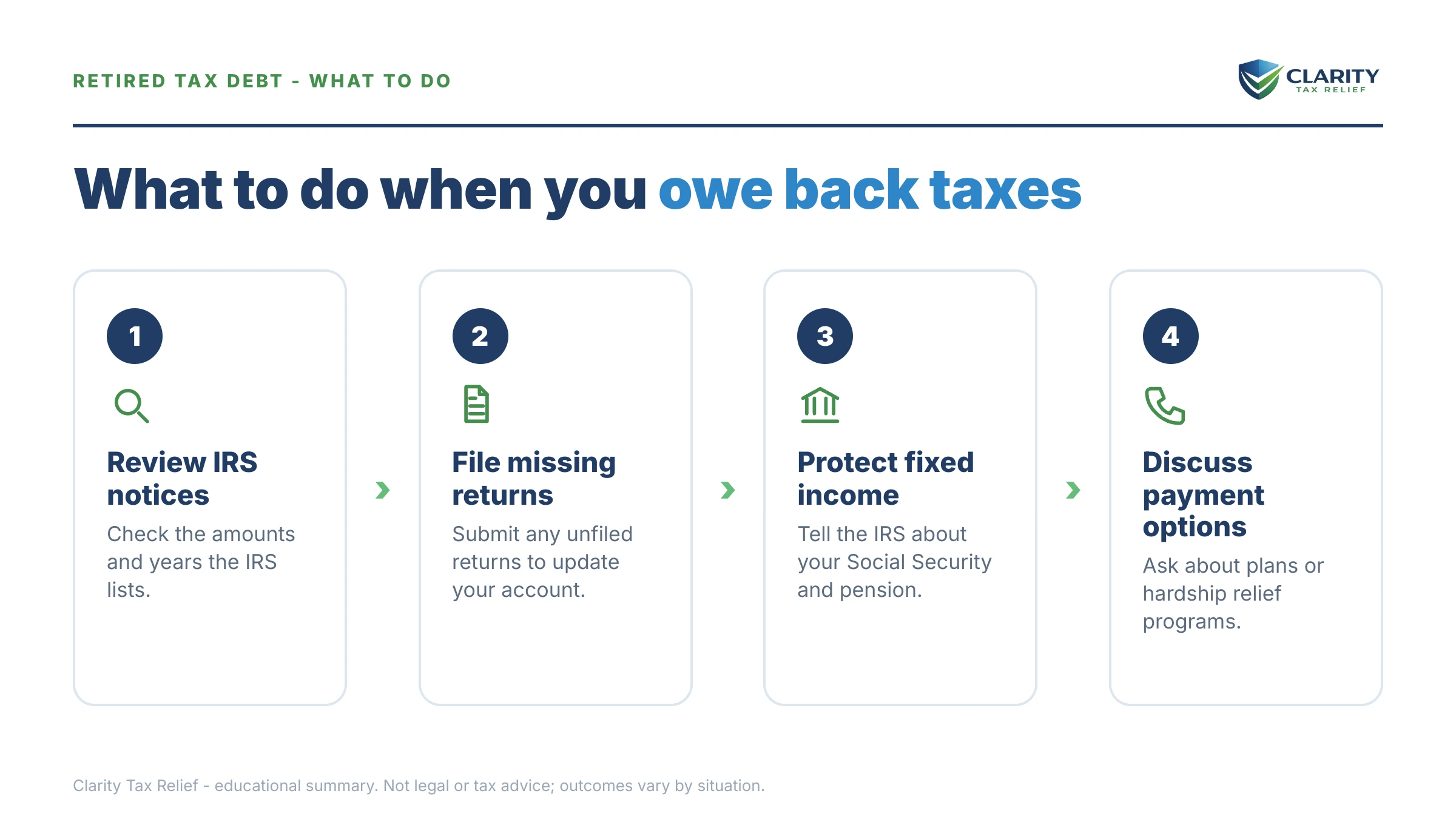
The IRS has 10 years from the date each tax was assessed to collect it. After that Collection Statute Expiration Date (CSED) passes, the remaining balance is written off. For retirees this matters more than for anyone else: a 70-year-old in CNC on a debt assessed six years ago may realistically never pay another dollar — the account rides quietly to expiration.
Two honest caveats. First, the clock pauses (tolls) during an Offer in Compromise review, a Collection Due Process appeal, or bankruptcy, so a poorly-timed OIC can add years to the debt's life. Second, the IRS knows the clock too, and collection pressure often rises as a CSED approaches. You can estimate your own expiration dates with our CSED Calculator. The full rules live in our guide to how long the IRS can collect back taxes.
And if the debt outlives you? It doesn't vanish — the IRS files a claim against your estate, which generally must pay tax debt before heirs receive anything. An executor who distributes assets first can become personally liable. If you're planning around that, or handling a spouse's or parent's balance, start with what happens when an estate owes the IRS. Retirement accounts with named beneficiaries and other assets that pass outside probate follow different rules — worth mapping before you decide whether paying down the balance in your lifetime even makes sense.
When you can handle this yourself, and when help changes the outcome
When to handle it yourself, when to get help
You likely don't need professional help if all three of these are true: the balance is one you agree with, you can pay it within 180 days or afford the streamlined monthly payment, and no levy notice has arrived. Setting up a payment plan online takes about twenty minutes at the IRS's Online Payment Agreement page, and no firm, including ours, adds value to that transaction. If money is tight but the case is simple, the Taxpayer Advocate Service and Low Income Taxpayer Clinics offer free help.
Experienced help changes outcomes in specific situations: a CP91 or LT11 has arrived and the levy clock is running. The debt spans multiple joint years from a marriage that's over. The CNC-versus-OIC decision turns on home equity and retirement-account math. There are unfiled years blocking everything. Or a revenue officer has been assigned. In those cases the order of moves — returns first, penalty relief second, resolution third — and the way the financial statement is presented routinely change what a retiree ends up paying.
If your situation matches that second list — a levy notice in hand, multiple joint years, or offer math tangled up with home equity — a free case review at (888) 825-7779 or through the 2-minute form will tell you where you stand before any window closes.
One more self-help essential: keep filing every year, on time, even when you can't pay. The failure-to-file penalty is ten times the failure-to-pay penalty, and a missed current-year return can default an existing agreement. Our guide on whether to file taxes if you owe back taxes runs the math.
Terms on your notices, decoded
- FPLP (Federal Payment Levy Program): the automated system that takes up to 15% of federal payments, including Social Security retirement, and keeps taking it monthly until the debt is resolved or released.
- CNC (Currently Not Collectible): a status, not forgiveness — the IRS pauses collection because your income can't cover basic living expenses, while the debt and interest remain on the books.
- CSED (Collection Statute Expiration Date): the date, 10 years after assessment, when the IRS's legal right to collect a given tax year ends.
- Levy vs. lien: a levy takes property (a bank balance, a slice of Social Security). A lien is a legal claim recorded against property you keep, most often your home's title.
- RCP (Reasonable Collection Potential): the IRS's math for an Offer in Compromise. Your asset equity plus a multiple of your monthly disposable income; an offer below your RCP won't be accepted.
- Joint and several liability: the rule making each spouse on a joint return responsible for the entire balance — the reason a divorce decree alone can't protect you from a joint-year debt.
Retired-and-owe questions, answered
Can the IRS garnish my Social Security check if I'm retired?
Yes — the IRS can take up to 15% of your monthly Social Security retirement benefit through the Federal Payment Levy Program, and unlike a bank levy, it repeats every month until the debt is resolved or the levy is released. Supplemental Security Income (SSI) is exempt. If the 15% cut would leave you unable to cover basic living costs, you can request a hardship release or Currently Not Collectible status.
Can the IRS take my pension, 401(k), or IRA?
Legally, yes — retirement accounts are not off-limits to an IRS levy. In practice, the IRS treats them as a last resort, generally requiring higher-level approval and reserving them for taxpayers who had the ability to pay and refused. If you're communicating with the IRS and working toward a payment plan or hardship status, a retirement-account levy is very unlikely.
Does the IRS forgive tax debt for senior citizens?
There is no special forgiveness program based on age. Retirees use the same tools as everyone else — payment plans, Currently Not Collectible status, penalty abatement, and the Offer in Compromise. The good news: a fixed income with little left after basic living expenses is exactly the financial picture the hardship-based programs were designed for, so retirees are often stronger candidates than working filers.
Do I have to keep filing tax returns if I'm retired and already owe?
Yes, if your income is above the filing threshold, and filing on time matters even more when you owe. The failure-to-file penalty runs 5% per month, ten times the 0.5% failure-to-pay penalty, and unfiled years block every resolution program. File each year even if you can't send a dime with the return.
Am I responsible for back taxes from a joint return after my divorce?
Yes — both spouses on a joint return are each liable for 100% of that year's tax. A divorce decree assigning the debt to your ex does not bind the IRS. Your remedies are innocent spouse relief or separation of liability under Section 6015(c), which lets divorced filers ask the IRS to split the deficiency based on whose income caused it.
Can I get an Offer in Compromise if my only income is Social Security?
You can apply, and a fixed income that barely covers living expenses strengthens the collectibility math. But the IRS also counts assets — home equity, IRAs, and savings — so a retiree with a paid-off house often can't settle for less despite low income. The IRS accepted roughly 1 in 5 offers in FY2024, so have the math checked before you pay anyone to file one.
What happens to my IRS debt when I die?
It doesn't die with you. The IRS files a claim against your estate, and tax debt generally gets paid before heirs receive anything. An executor who distributes assets first can become personally liable for the shortfall. Assets that pass outside the estate and the 10-year collection statute both shape how much the IRS actually recovers.
Will the IRS take my house if I'm retired and owe back taxes?
Almost never. The IRS files a tax lien against homes far more often than it seizes them — seizure of a primary residence requires court approval and is reserved for extreme cases. The lien clouds your title and complicates selling or refinancing. But you will not lose your home over an ordinary unpaid balance while you're pursuing a resolution.
Does owing back taxes affect my Medicare or Social Security eligibility?
No. Owing the IRS does not reduce your benefit entitlement or affect Medicare coverage in any way. The only intersection is collection: the IRS can levy up to 15% of a Social Security retirement payment through the Federal Payment Levy Program. Your benefit amount, eligibility, and Medicare enrollment are calculated exactly as if you owed nothing.
Your next 24 hours
- Find your total and your notice dates. Pull out the most recent IRS letter and note the notice number (CP14, CP504, LT11, CP91) and the date printed at the top, then log in at IRS.gov to see the full balance across every year.
- Gather three things: your last filed return, your Social Security award letter or pension statements, and, if the debt comes from married years, your divorce decree and both signatures' joint returns. A one-page list of your monthly expenses completes the picture.
- Get the free case review. Call (888) 825-7779 or use the 2-minute form. Interest and the monthly late-payment penalty are accruing on the balance right now, and if a final levy notice is in the stack, the 30-day window it started is the one that matters — an experienced tax professional can tell you in one conversation which of the six options above your numbers actually fit.
This guide is general information, not tax or legal advice for your specific situation. Eligibility for IRS programs depends on individual facts and circumstances; no outcome is guaranteed.