
Unfiled Returns
Can You Go to Jail for Not Filing Taxes? What Really Happens in 2026
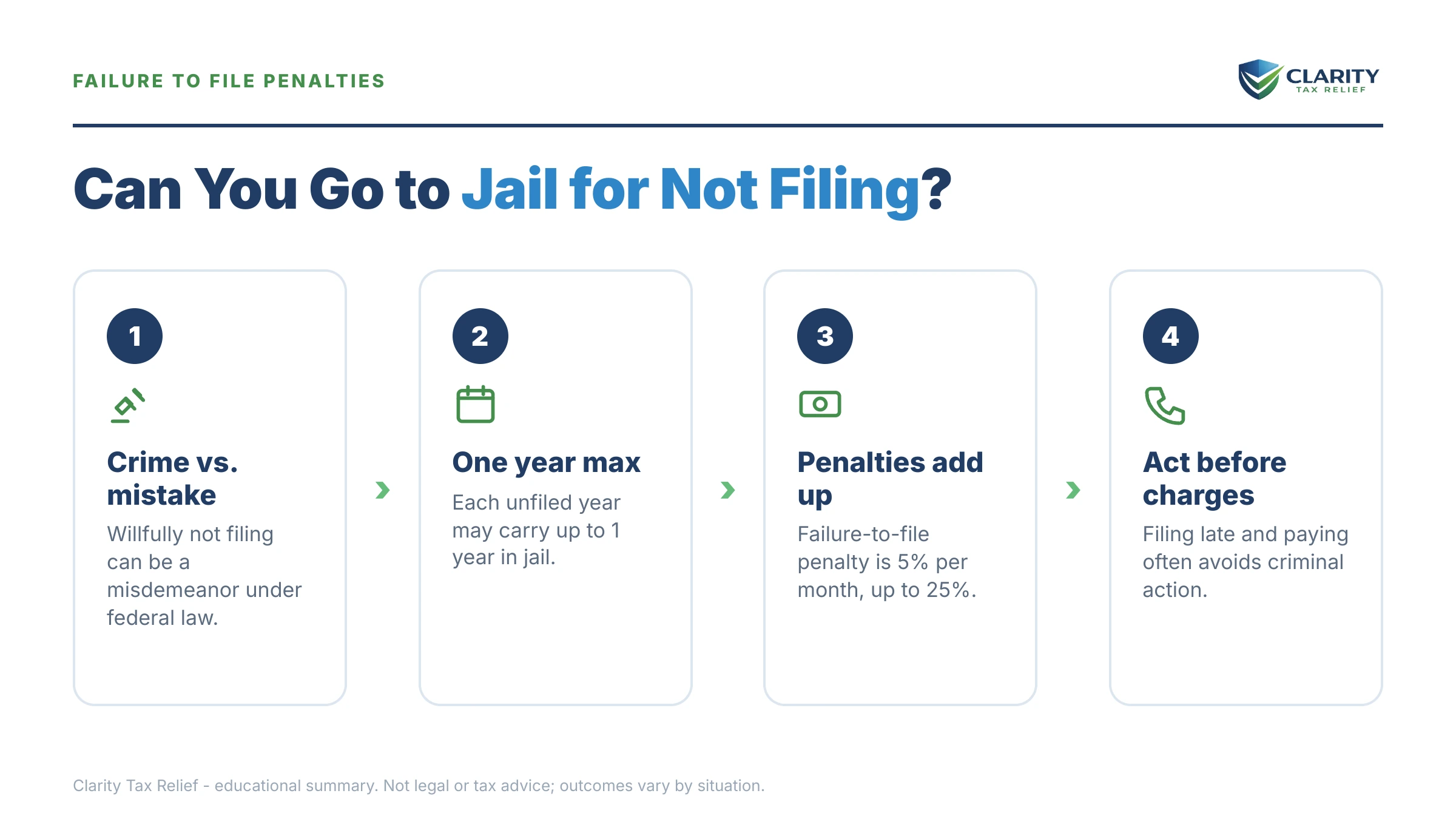
The short answer: yes. You can go to jail for not filing taxes, but only when it's willful. Willful failure to file is a federal misdemeanor (IRC §7203): up to one year in jail per unfiled year. Prosecution is rare, and non-filers who file before a criminal case opens are almost never charged.
You've missed a filing season — maybe two, maybe several — and the question in your head has quietly shifted from "how much will I owe" to "could I actually be arrested for this." That fear is normal, and it's also the least likely outcome on the list. The realistic risks are financial, they grow monthly, and every one of them shrinks the moment you file. Here's exactly where the criminal line sits, and how to stay on the right side of it.
⏱ The real clocks: there is no arrest countdown on an unfiled return, but two clocks are already running. The failure-to-file penalty adds 5% of the unpaid tax every month until it caps at 25%, and any refund from an unfiled year is forfeited forever 3 years after that return's due date.
When can you go to jail for not filing taxes?
Willful failure to file a required tax return is a federal misdemeanor under IRC §7203, punishable by up to one year in jail and fines of up to $25,000 per unfiled year under the tax code — a ceiling that general federal sentencing law (18 U.S.C. §3571) can raise to $100,000 for individuals. That's the statute behind every scary headline, and the key word in it is "willful."
To convict, the government must prove three things: you were required to file, you didn't, and you knew about the duty and deliberately chose to violate it. That last element, willfulness, is where nearly every ordinary non-filer falls outside the criminal zone.
Falling behind because you were overwhelmed, sick, going through a divorce, missing records, or afraid of a bill you couldn't pay is not willfulness in the criminal sense. It creates penalties and interest, a civil problem, not a prosecution.
The felony version is different. Tax evasion under IRC §7201 requires an affirmative act of concealment on top of non-filing — hiding income in someone else's name, dealing in structured cash to dodge reporting, keeping two sets of books, or lying to IRS agents. That's where five-year sentences live, and it's a different universe from "I didn't send in my 1040."
Not filing vs. not paying: only one of them can be a crime
Owing the IRS money you can't pay is a civil debt — no one goes to jail for it. The United States has no debtor's prison for tax balances; the IRS collects unpaid tax through liens, levies, and garnishments, not handcuffs. We cover that side separately in jail for not paying taxes and can you go to jail for owing the IRS.
Not filing is the act Congress chose to criminalize, because the whole system runs on self-reporting. That's also why the penalty math is so lopsided: the failure-to-file penalty runs 5% per month — ten times the 0.5% failure-to-pay penalty.
The practical rule that falls out of both facts: always file, even when you can't pay a dime. Filing an honest return you can't pay removes the criminal question entirely and cuts your penalty rate by 90%. The math is laid out in should I file if I can't pay.
“If you repeatedly do not file, you could be subject to additional enforcement measures, such as additional penalties and/or criminal prosecution.”
— Filing past due tax returns (IRS.gov)
Who actually gets prosecuted for not filing, and who never is
Criminal charges reach only a tiny fraction of non-filers; the overwhelming majority are handled as civil collection cases by automated systems. IRS Criminal Investigation is a small division that chooses cases for deterrence value — which means the profiles it pursues are fairly predictable.
| Question | Civil failure to file (the default) | Criminal failure to file (IRC §7203) |
|---|---|---|
| What it takes | Any required return not filed on time, for any reason | Proof beyond a reasonable doubt that you knew you had to file and deliberately refused |
| Maximum exposure | Penalty up to 25% of unpaid tax (up to 75% if fraudulent), plus interest and collection | Up to one year in jail and fines of up to $25,000 per unfiled year under the tax code — a ceiling that general federal sentencing law (18 U.S.C. §3571) can raise to $100,000 for individuals |
| Who handles it | IRS automated notice systems and civil collection staff | IRS Criminal Investigation, DOJ prosecutors, and a federal court |
| Time limit | None — the IRS can assess an unfiled year forever | Generally 6 years from each return's due date |
| How common | The overwhelming majority of non-filer cases | Rare — reserved for willful, typically high-dollar or egregious cases |
The fact patterns that draw IRS Criminal Investigation attention share common threads: high income across multiple unfiled years, cash businesses with concealed receipts, false statements made to agents after contact, prior warnings ignored, and professionals who plainly knew better — return preparers, attorneys, financial advisors.
Business owners carry one extra exposure worth naming: repeatedly collecting payroll taxes from employees and not turning them over is treated far more seriously than a missed 1040, because that money was never yours. If that's your situation, start with 941 back taxes — the sequencing there is different and less forgiving.
Who essentially never gets prosecuted: people who missed years for ordinary life reasons, kept no double books, told no lies, and came forward on their own. For a deeper look at where the referral line sits, see when does the IRS refer to criminal investigation.
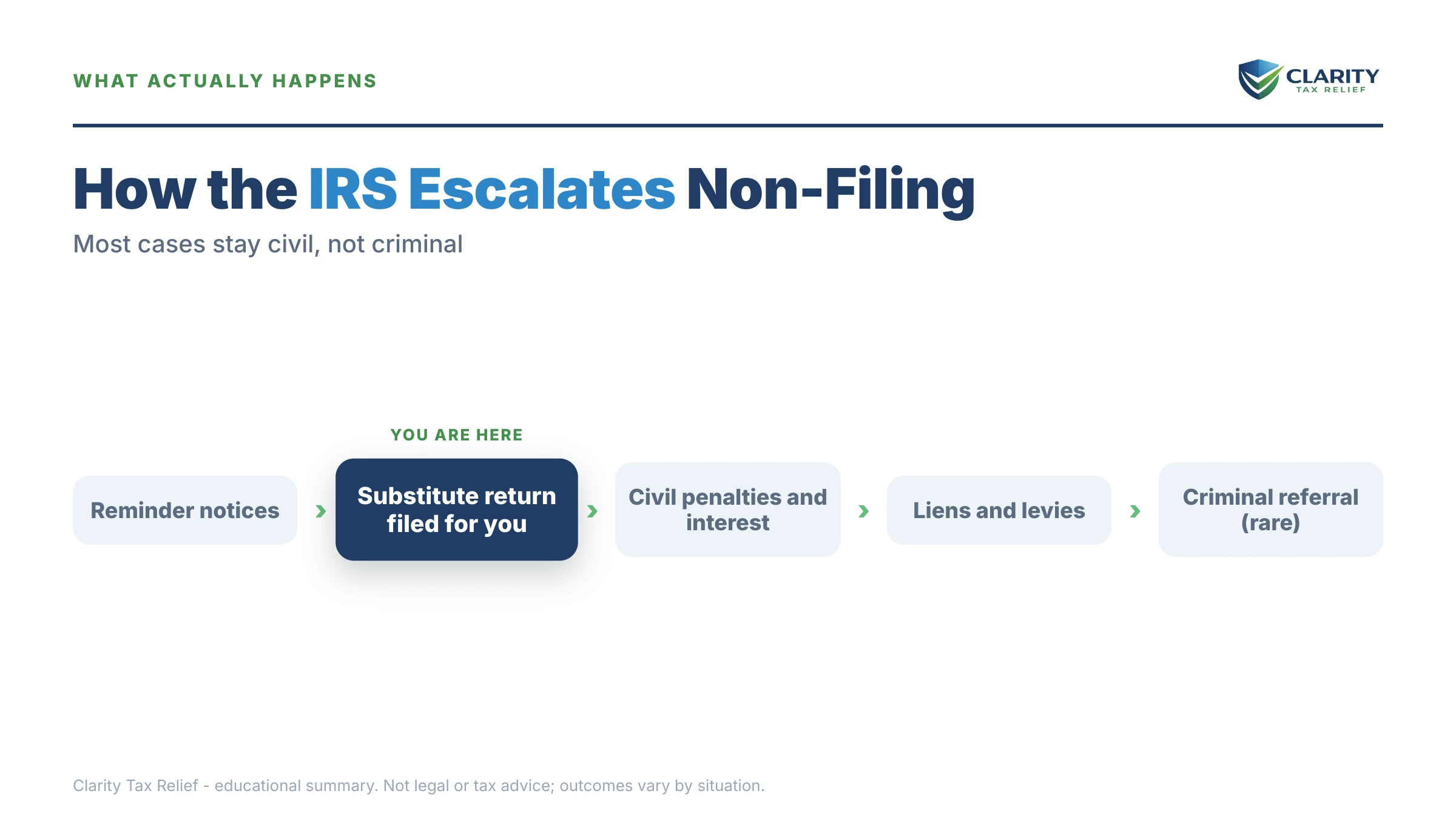
What happens if you keep not filing: the escalation sequence
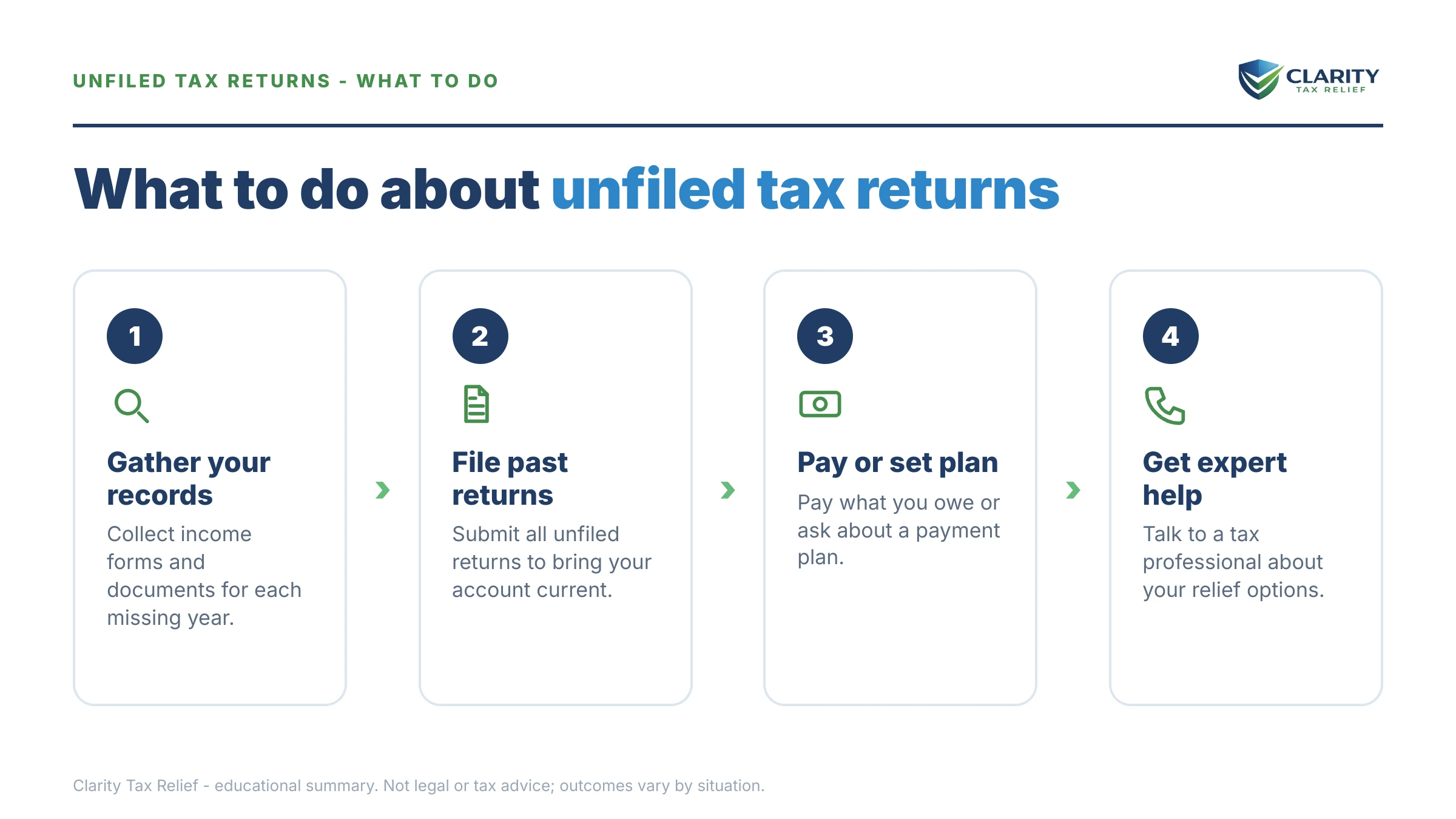
An unfiled return doesn't sit dormant — the IRS's document-matching computers eventually notice the W-2s and 1099s with no return attached, and a fixed sequence begins. Each stage is automated, and each one narrows your options:
- CP59 — the first "we have no record of your return" notice. A request, not enforcement. See the CP59 notice guide.
- CP516 / CP518 — repeated, then final, requests to file. Still no enforcement, but your file is now flagged.
- Substitute for Return (SFR) — the IRS drafts a return for you using the income documents it holds: single or married-filing-separately status, no dependents, no deductions, no business expenses. It is engineered to overstate your tax. If this has already happened, read the IRS filed a substitute return for me.
- CP3219N — a statutory notice of deficiency giving you 90 days to file your own return or petition Tax Court before the SFR amount becomes a legal assessment.
- Assessment and collection — once assessed, the balance enters the normal collection stream: bills, intent-to-levy notices, federal tax lien filings, then wage and bank levies. The 10-year collection clock starts only now, which means a never-assessed unfiled year can chase you indefinitely.
- Criminal referral — only in willful cases, and only a sliver of those. For everyone else, the machine stays civil — expensive, but civil.
One 2026 reality check: the IRS lost roughly a quarter of its workforce in 2025, so reaching a human is harder than ever. But this entire sequence is generated by computers that never took a buyout. Automated non-filer notices, SFRs, and levies continued without pause.
Sitting on unfiled years right now?
Every month adds more penalty and interest. A Substitute for Return can lock in a bill far bigger than an accurate return would show. Get your unfiled-return situation reviewed free — we'll map which years matter, what you'd realistically owe, and the safest order to fix it.
Your options once you file: eligibility at a glance
Filing the missing returns is what ends the criminal question; resolving the balance is a separate, second step with several paths. Which one fits depends on the total you owe and what your budget can carry — the full DIY playbook lives in how to settle tax debt yourself.
| Option | Who's eligible | Cost / key catch |
|---|---|---|
| Pay in full | Anyone | Stops penalties and interest immediately; cheapest total cost |
| Short-term payment plan | Can pay everything within 180 days | $0 setup; interest and the 0.5%/month pay penalty continue |
| Long-term installment agreement | Balances up to $50,000 can be set up online, up to 72 months (guaranteed approval under $10,000) | Setup fee applies (lower with direct debit); interest keeps accruing |
| Currently Not Collectible | Financials (Form 433) show paying anything would prevent basic living expenses | $0; collection pauses but the debt and interest remain |
| Offer in Compromise | You can prove the offer equals the most the IRS could ever collect from you | $205 fee + 20% down on lump-sum offers (both waived with low-income certification); roughly 1 in 5 offers accepted in FY2024 |
| Penalty relief (FTA / AEP / reasonable cause) | Clean compliance the prior 3 years, or circumstances beyond your control | Free to request; the new Automatic Exemption from Penalty (AEP) begins applying automatically in summer 2026 |
Two eligibility details matter specifically for former non-filers. First, every one of these programs requires you to be filing-compliant — the IRS won't approve a plan or an offer while returns are missing. Second, refund years work in your favor: a year with a refund carries no failure-to-file penalty at all, because the penalty is a percentage of unpaid tax.
What unfiled years really cost: a worked example
Say you're a self-employed sole proprietor who never filed your 2023 return. An accurate Schedule C would have shown $19,700 in tax due — income and self-employment tax combined, with no withholding to cover any of it. Here's the hypothetical math as of mid-2026, roughly 27 months past the April 2024 due date:
- Failure-to-file penalty: 5% per month, capped at 25% — about $4,925, fully accrued within the first several months.
- Failure-to-pay penalty: 0.5% per month and still running — roughly 13.5% so far, about $2,660.
- Interest: compounding daily on the tax and penalties for over two years — plausibly another few thousand dollars at recent rates.
A $19,700 problem is now roughly a $30,000 problem — a more than 50% markup for silence, with zero criminal element anywhere in it unless willfulness enters the picture. You can run your own year and balance through our IRS Penalty & Interest Calculator to estimate where you stand.
Now the sharper edge for the self-employed: suppose you keep waiting and the IRS files the SFR instead. Your clients reported, say, $95,000 in 1099-NEC income, so the SFR taxes the full $95,000 with no business expenses, no home office, no mileage, no retirement contributions. The assessed tax could land far above the $19,700 an honest return shows. Filing your own return, even years late, is how you claw that difference back.
One more edge case: if the IRS concludes the failure to file was fraudulent, the civil penalty triples to 15% per month, up to 75% of the tax — still civil, still not jail. But a reason not to let a fixable situation harden into an adversarial one.
How to respond if you haven't filed, step by step
- Confirm which years are missing — log into your IRS online account or request your wage and income transcripts to see exactly what the IRS shows as unfiled.
- Gather income records for each unfiled year — W-2s, 1099s, bank statements — and rebuild expenses from bank and card records where receipts are gone.
- File the last six years first, oldest to newest — that generally satisfies the IRS's compliance policy and gets ahead of any substitute return.
- Replace any Substitute for Return with your own accurate return for that year — your real deductions almost always cut the SFR balance.
- Set up a resolution for whatever balance remains — a payment plan, hardship status, or an Offer in Compromise if your finances genuinely qualify.
- Request penalty relief once the returns post — first-time abatement, the new AEP, or reasonable cause can remove a meaningful slice of what stacked up.
Why six years? IRS policy generally treats the most recent six years of returns as sufficient to restore filing compliance for ordinary cases — the full rule and its exceptions are in how many years of back taxes do I have to file. The IRS's own guidance on late returns is at Filing past due tax returns, and payment options are laid out on the IRS payment plans page.
Coming forward on your own, before any IRS contact, is the single strongest protection against the criminal question ever being asked. The mechanics and timing are covered in voluntarily filing old tax returns.
When you can handle this yourself, and when help changes the outcome
Most people with one or two missing years can fix this without hiring anyone. If you have your W-2s and 1099s, expect refunds or a balance you can pay within 180 days, and no IRS letters beyond a CP59, filing the returns and setting up a plan online is genuinely a do-it-yourself job.
Experienced help earns its cost in specific situations: five or more unfiled years (see haven't filed taxes in 10 years), self-employment years with destroyed or missing records, an SFR already assessed that needs to be unwound, business or payroll tax in the mix, or high income across multiple years. And one bright line: if a special agent from Criminal Investigation has contacted you — two agents, a badge, questions about your returns — stop talking and get representation before saying anything. Statements made in that conversation are exactly what turns civil cases criminal.
If your unfiled years hide a genuinely large balance, it's worth having an experienced tax professional pressure-test the numbers before you file — the order you fix things in changes what you ultimately pay. A free case review takes about 15 minutes.
Terms you'll see, decoded
- Willfulness — the voluntary, intentional violation of a known legal duty; the element that separates a criminal case from an expensive civil one.
- IRC §7203 — the misdemeanor statute for willful failure to file, pay, keep records, or supply information: up to one year per count.
- IRC §7201 — felony tax evasion; requires an affirmative act of concealment, with up to five years per count.
- Substitute for Return (SFR) — a return the IRS prepares for a non-filer using reported income and no deductions, almost always overstating the tax.
- IRS Criminal Investigation (CI) — the IRS's law-enforcement division; its special agents build criminal cases, not payment plans.
- Voluntary disclosure practice — the formal IRS process for taxpayers with willful conduct to come forward through counsel and generally avoid prosecution.
If you believe your case involves genuine willfulness — concealed offshore accounts, false documents, large concealed cash income — don't just quietly file the old returns. The Taxpayer Advocate Service can help with stuck civil cases, but willful-conduct cases call for advice on the formal voluntary disclosure route before anything is submitted.
Jail for not filing taxes: your questions answered
Is not filing taxes a felony?
No — willful failure to file is a misdemeanor under IRC §7203, with a maximum of one year in jail per unfiled year. It becomes felony territory only when the government can prove tax evasion under IRC §7201 — an affirmative act of concealment, like hiding income in nominee accounts or filing a false return — which carries up to five years per count.
How many years can you go without filing taxes before you go to jail?
There is no automatic year count that triggers jail — prosecution turns on willfulness, income, and concealment, not how many years you've missed. As a practical matter, the IRS usually requires the last six years of returns to get back into compliance, and criminal charges for failure to file generally must be brought within six years of each return's due date.
Can you go to jail for not paying taxes if you can't afford them?
No. Owing taxes you can't pay is a civil debt. There are no debtor's prisons for it — the IRS collects through liens, levies, and garnishments instead. Criminal exposure comes from willful acts: not filing, hiding income, or lying to the IRS. If you file honestly and simply can't pay, jail is off the table.
Will the IRS know if I don't file?
Almost certainly, yes. Employers, clients, banks, and payment platforms send W-2s, 1099-NECs, and 1099-Ks straight to the IRS. Its computers match those documents against filed returns automatically. When no return shows up, the system generates a CP59 notice and can eventually file a substitute return for you — using that reported income with none of your deductions.
What happens if you never file taxes at all?
The IRS can eventually file a Substitute for Return that overstates your tax, assess the balance, and collect by lien and levy. The clock on assessing an unfiled year never runs out. You also permanently lose any refund three years after that return's due date. Most never-filers face an expensive civil problem, not a criminal one, but the debt compounds every month.
Does filing old returns voluntarily protect me from prosecution?
In practice, yes for almost everyone. The IRS's longstanding voluntary-compliance approach means non-filers who come forward and file accurate returns before Criminal Investigation contacts them are almost never prosecuted. The protection weakens once an investigation has started, and taxpayers with willful concealment — offshore accounts, false documents — should talk to an experienced tax professional about the formal voluntary disclosure practice before filing anything.
Can I still get a refund from a year I didn't file?
Only if you file within three years of that return's original due date. File inside the window and the IRS pays the refund (with no failure-to-file penalty, since the penalty is a percentage of unpaid tax). Miss the window and the refund is forfeited permanently. It can't even be applied to balances you owe for other years.
Your next 24 hours
- Find out exactly which years are open. Log into your IRS online account (or dig out any CP59 or CP518 letters) and write down every year the IRS shows as unfiled.
- Gather what you have for those years — W-2s, 1099s, bank statements, and your last filed return. Missing documents aren't a dealbreaker; transcripts can fill the gaps.
- Get a free, confidential case review. Call (888) 825-7779 or use the 2-minute form — we'll map your unfiled years, estimate the real balance before penalties bury it deeper, and lay out the safest order to come back into compliance.
This guide is general information, not tax or legal advice for your specific situation. Eligibility for IRS programs depends on individual facts and circumstances; no outcome is guaranteed.