
Tax Debt & Enforcement
Can You Go to Jail for Not Paying Taxes? What's Actually Criminal in 2026
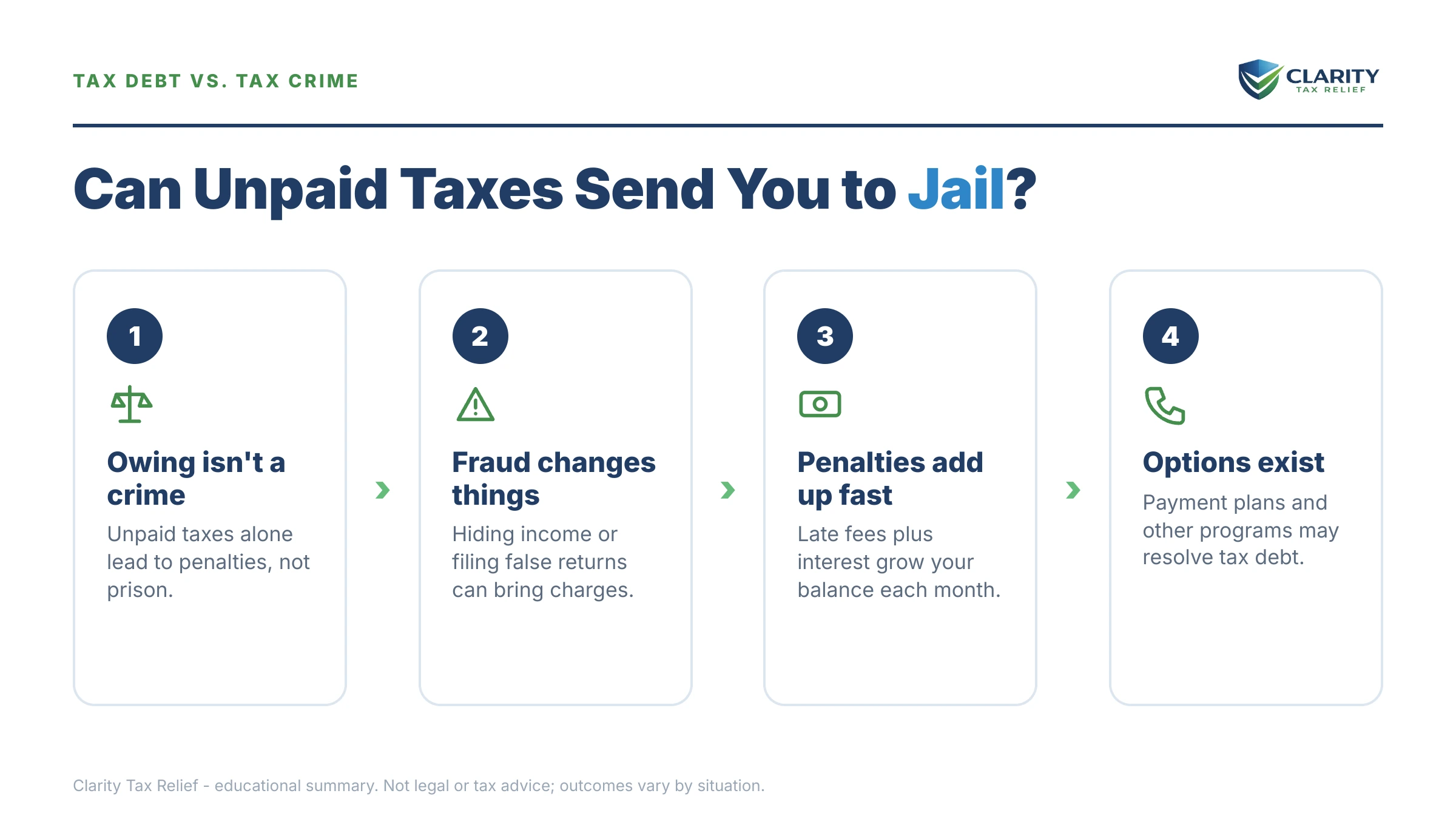
The short answer: no. You cannot go to jail simply for not paying taxes you can't afford. Owing the IRS is a civil debt. Jail requires a willful crime: hiding income, faking records, refusing to file, or keeping employees' withheld payroll taxes. If you filed honestly and can't pay, prison is off the table.
It's 11 p.m., the quarterly deposit you skipped to make payroll is still unpaid, and you just typed "can you go to jail for not paying taxes" into your phone. That fear is doing more damage than the debt is. The answer has a clear line down the middle, and once you see where you stand relative to that line, you can stop bracing for handcuffs and start fixing a math problem.
One caution before the good news: for a business owner running payroll, there is one form of non-payment that carries genuine criminal exposure. We'll cover exactly where that edge sits, because it's the difference that matters most for you.
⏱ The real clock: there is no criminal countdown on an unpaid balance, but the money clock never stops. The failure-to-pay penalty adds 0.5% of your balance every month, interest compounds daily on top, and the IRS's automated notice sequence escalates toward liens and levies whether or not a human ever reviews your file.
Why not paying isn't the crime, and what is
Owing the IRS money is a civil debt, and there is no debtors' prison for federal taxes. The United States abolished imprisonment for debt in the 1800s. The tax code follows that rule: the IRS collects unpaid balances with penalties, interest, liens, and levies — financial tools, not criminal ones. We cover the full can you go to jail for owing irs question in a companion guide. But the short version is that the size of your debt is never what triggers prosecution.
What the government prosecutes is willfulness — a voluntary, intentional violation of a known legal duty. Courts have said for decades that willfulness means deliberate wrongdoing, not carelessness, confusion, or being broke. Here's how common situations sort out:
| What you did | Civil or criminal? | What actually happens |
|---|---|---|
| Filed accurate returns but can't pay the balance | Civil | Penalties, interest, and eventual liens or levies — never jail |
| Ignored IRS collection notices for years | Civil | Enforced collection: wage garnishment, bank levy, federal tax lien |
| Willfully didn't file required returns | Criminal — misdemeanor (IRC §7203) | Up to 1 year per unfiled year; rarely charged when you come forward first |
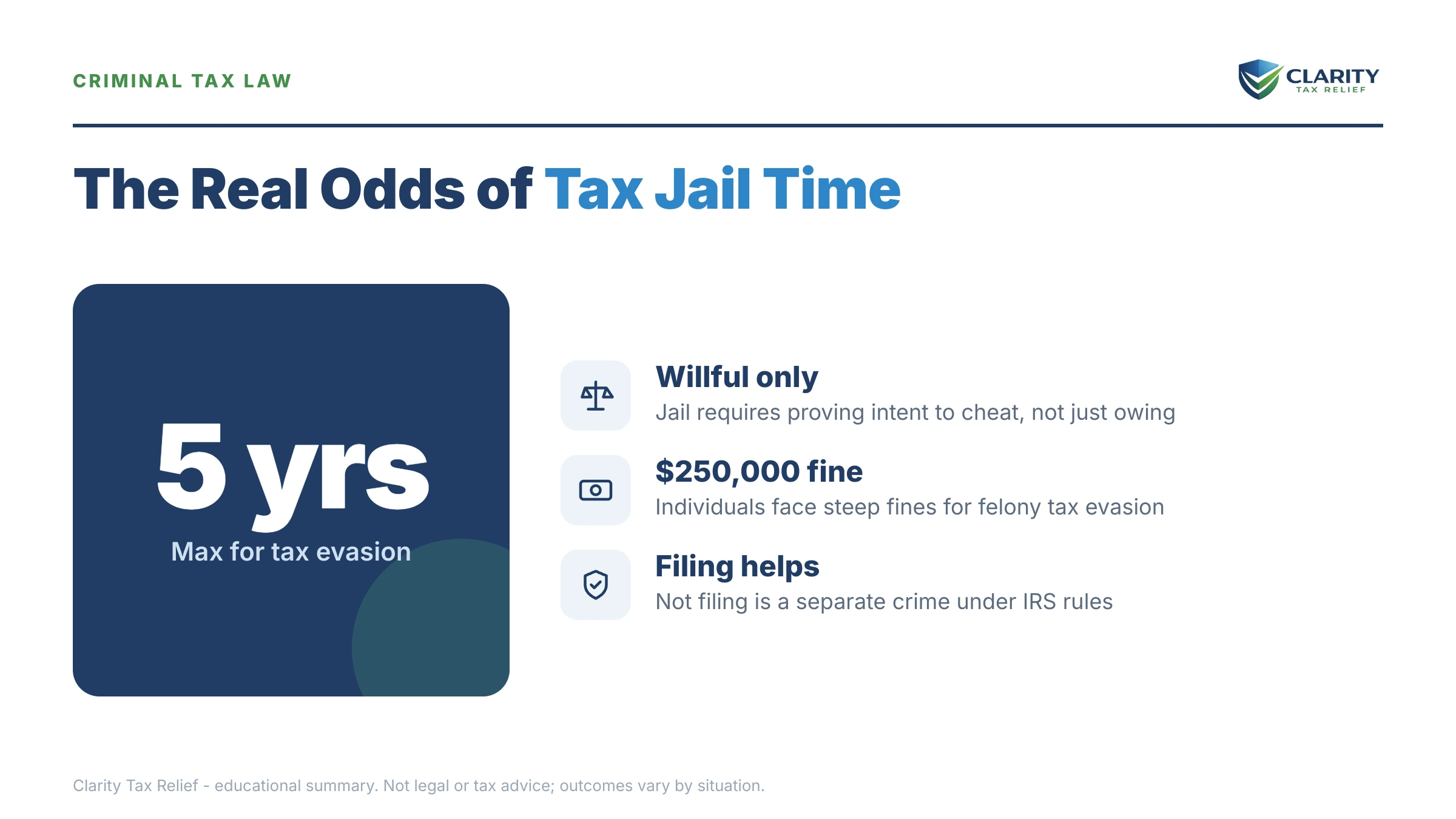
| Hid income or assets to defeat the tax | Criminal — felony (IRC §7201) | Tax evasion; up to 5 years in prison per count |
| Withheld payroll taxes from employees and willfully kept the money | Criminal exposure — felony (IRC §7202) | Up to 5 years per count; usually preceded by the civil Trust Fund Recovery Penalty |
| Lied or submitted false documents during collection | Criminal exposure | False-statement and evasion-of-payment charges become possible |
Read the first two rows again. Everything that describes "I owe and I haven't paid" lives on the civil side. The criminal rows all require you to do something deceptive — an act, not an unpaid bill.
When can you go to jail for not paying taxes?
Jail enters the picture only when non-payment is paired with willful, deceptive conduct, and federal law defines exactly three doorways.
Tax evasion (IRC §7201). The felony everyone pictures. It requires an affirmative act to defeat the tax: unreported cash routed off the books, a second set of records, assets parked in a relative's name, income run through nominee accounts. There's also a less-known branch called evasion of payment — hiding assets after the IRS assesses a debt. That's why lying on a financial disclosure or secretly moving money once collection starts is the one way an ordinary back-tax case can turn criminal later. Penalty: up to five years in prison per count, plus fines and prosecution costs.
Willful failure to pay over payroll taxes (IRC §7202). The doorway built specifically for employers — covered in depth in the next section, because it's the one that applies to a business owner with payroll.
Willful failure to file (IRC §7203). A misdemeanor, up to one year per unfiled year. Notice what it punishes: not filing, never not paying. This is why the single most protective move a scared taxpayer can make is to file every return, even with a balance due you can't touch. If unfiled years are part of your picture, read can you go to jail for not filing taxes — the risk profile is different from a pure payment problem.
In practice, criminal tax cases are rare and deliberately chosen. The IRS pursues a small number of prosecutions each year — reserved for clear, provable, willful fraud — while millions of balance-due accounts move through ordinary civil collection. Our guide on when does irs refer to criminal investigation walks through the specific patterns that get files referred; "filed honestly, engaged with notices, couldn't pay" has never been one of them.
The payroll exception: where a business owner's risk is real
Money withheld from employee paychecks is the one category of unpaid tax the government treats as someone else's stolen property. The income tax and FICA you deduct from each paycheck never belonged to your business. You held it in trust for the U.S. Treasury. Spending it on rent, suppliers, or your own payroll is why 941 back taxes escalate faster and harsher than any personal income tax debt.
Two separate consequences flow from unpaid trust-fund taxes, and it's critical not to confuse them:
- The Trust Fund Recovery Penalty (TFRP) — civil. The IRS assesses the trust-fund portion of the business's debt against responsible individuals personally: owners, officers, sometimes a bookkeeper or anyone with check-signing authority. It survives the business closing and most bankruptcies. It is collected with liens and levies — not prosecution. Our trust fund recovery penalty guide covers who gets tagged and how to fight it.
- IRC §7202 — criminal. Willfully failing to collect or pay over withheld taxes is a felony, up to five years per count. Prosecutions overwhelmingly target one pattern: pyramiding payroll taxes — withholding from paychecks quarter after quarter, spending the money, and accruing new unpaid quarters while old ones sit. Repetition after warnings is what prosecutors use to prove willfulness.
The practical rule for a struggling employer: old payroll debt is a civil problem. New missed deposits are what create criminal exposure. An owner who fell behind, filed every Form 941, stopped the bleeding, and is working out payment looks like a collection case. An owner who keeps withholding and keeps spending it looks like something else. If cash flow forces a choice, current deposits come before everything — including old IRS debt.
What actually happens if you never pay (the civil escalation)
Ignoring a tax debt doesn't lead to arrest. It leads to a predictable, automated collection sequence that gets more expensive at every stage. In 2026, with the IRS workforce down roughly 27% from the 2025 cuts, per TIGTA reports, it's harder than ever to reach a human. But the notice and levy systems are automated and never stopped running. Here's the order:
- First bill (CP14). The IRS states the balance and gives you roughly 21 days (10 business days when the balance is $100,000 or more) before the sequence advances. Cheapest moment to act.
- Reminder notices (CP501/CP503). Still just bills, but the failure-to-pay penalty and daily-compounding interest are stacking every month.
- CP504 — intent to levy. The IRS can now seize your state tax refund, and a federal tax lien becomes a live possibility.
- LT11 / Letter 1058 — final notice. Starts a 30-day clock and your Collection Due Process rights (requested on Form 12153). After it passes, the IRS can garnish wages, levy bank accounts, and levy business receivables. A bank levy freezes funds for 21 days before the money leaves; a wage levy is continuous until released.
- Ongoing enforcement. Up to 15% of Social Security through the Federal Payment Levy Program, refund offsets every year, and — once the debt passes $66,000 in 2026 — passport certification that can block renewal.
- The statute runs. The IRS generally has 10 years from assessment to collect (paused by appeals, an OIC, or bankruptcy). Waiting it out means a decade of levies and liens — a strategy, technically, but a brutal one.
Notice what's absent from that list: an arrest. Every stage is financial. You can estimate how fast your own balance grows through the sequence with our IRS Penalty & Interest Calculator.
Scared the balance is drifting toward something worse?
Whether it's back 941 quarters, a personal balance, or both — an experienced tax professional will review your notices and payroll history free, tell you honestly which side of the civil/criminal line you're on, and map the cheapest way out. No pressure, no scare tactics.
Your options when you owe and can't pay
Every one of these paths keeps you firmly on the civil side while it stops or slows enforcement. Many can be set up yourself — our hub on how to settle tax debt yourself walks each program end to end. Here's how they compare:
| Option | Who typically qualifies | Cost & timeline |
|---|---|---|
| Short-term payment plan | Can pay in full within 180 days | $0 setup; interest and penalties continue until paid |
| Streamlined installment agreement (personal) | Individuals owing $50,000 or less | Setup fee applies; up to 72 monthly payments, set up online |
| Business / payroll installment agreement | Operating businesses with 941 debt, current on new deposits | Stricter thresholds than personal plans; staying current on deposits is mandatory |
| Currently Not Collectible status | Paying anything would prevent basic living or operating expenses | $0; collection pauses, debt and interest remain, IRS reviews periodically |
| Offer in Compromise | Assets plus future income genuinely can't cover the debt | $205 fee + 20% down on lump-sum offers (both waived with low-income certification); roughly 1 in 5 offers accepted in FY2024, per IRS data |
| Penalty relief (FTA / AEP) | Clean compliance history in the prior 3 years | $0; starting summer 2026, Automatic Exemption from Penalty applies qualifying relief with no request needed |
A worked example: $36,900 with payroll in the mix
Say your business owes $36,900 — hypothetically, $21,600 across three unpaid 941 quarters and $15,300 on your personal 1040 from owner draws you didn't withhold on. First, the fear question: none of that is criminal if the returns are filed and you're engaging with the IRS.
Now the math. The personal $15,300 fits a streamlined plan: $15,300 ÷ 72 months ≈ $213/month before interest — call it roughly $240–$260 with accruals, and paying faster cuts the interest sharply. The $21,600 in 941 debt needs a business irs installment agreement, which requires the business to be current on every new deposit before the IRS will agree to terms on the old quarters. The trust-fund share of that payroll debt — the amounts actually withheld from paychecks, say roughly $13,000 of the $21,600 — is what the IRS can assess against you personally through the TFRP if the business plan fails. Civil, personal, and durable, but not jail.
The criminal fork in this scenario is a single decision: if next quarter you again fund payroll by spending the withheld taxes, you've started the pyramiding pattern that turns a collection file into a referral candidate. Deposit current quarters first; negotiate the old ones second. That ordering is the whole game.
How to respond if you owe taxes you can't pay, step by step
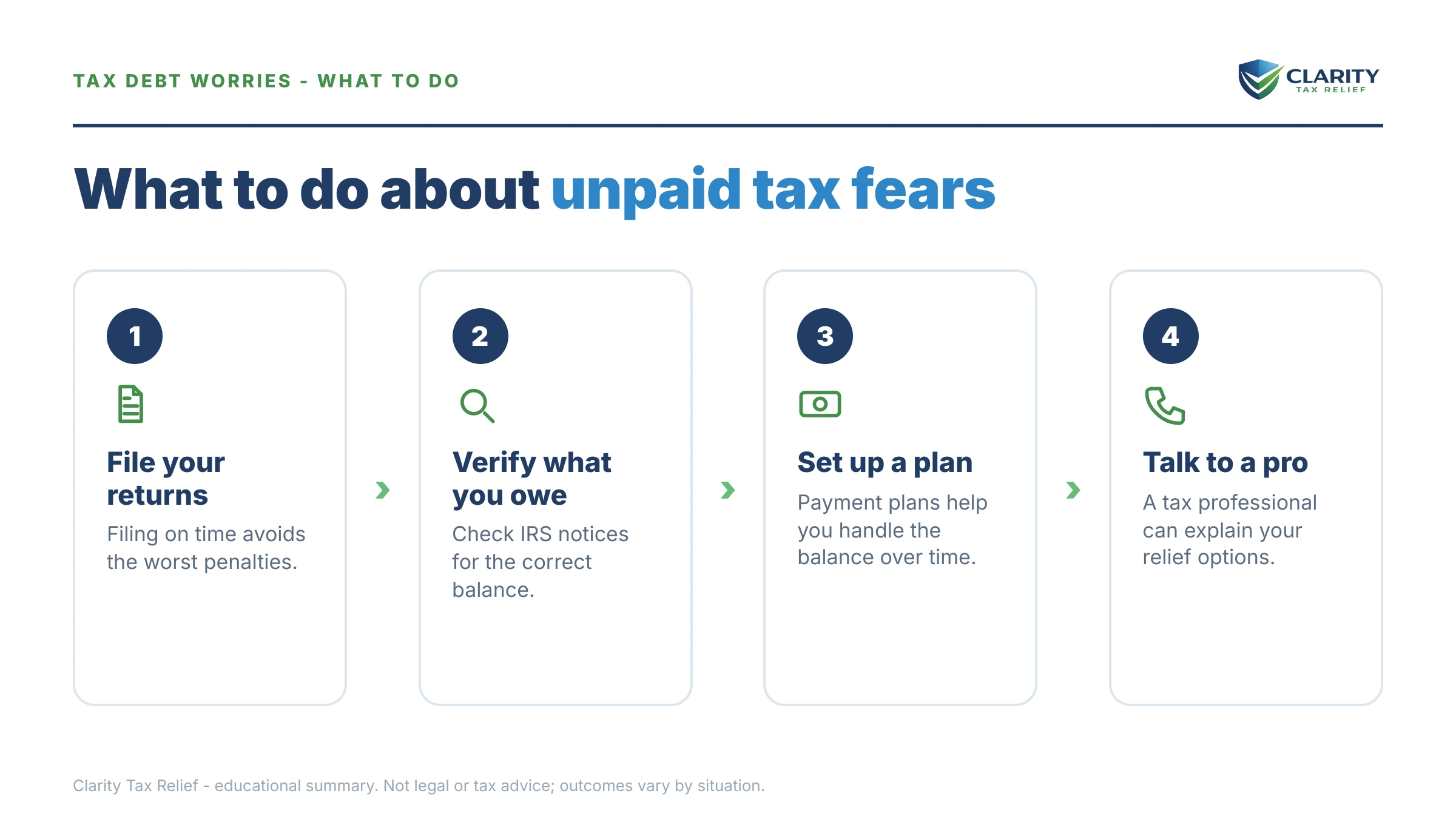
- File every unfiled return. Criminal exposure starts with willful non-filing, not non-payment — filing an accurate return you can't pay converts the problem into a civil debt.
- Confirm your real balance. Pull your IRS online account or account transcripts so you know the exact amounts, years, and penalty breakdown before choosing a plan.
- Protect current payroll first. Deposit this quarter's withheld taxes on time before paying old debt — stopping the pattern is what keeps a payroll balance civil.
- Choose a resolution path. Set up a payment plan, request Currently Not Collectible status, or evaluate an Offer in Compromise before enforced collection starts.
- Answer every notice in writing. Respond by the date printed on each notice and keep copies — steady engagement is what keeps your file a routine collection case.
When you can handle this yourself, and when help changes the outcome
Most people worried about jail can resolve their situation without hiring anyone. Handle it yourself if: every return is filed, you owe personal income tax only, the balance is under $50,000. A payment plan you set up online at IRS.gov's payment plans page fits your budget. That's a 30-minute fix, not a professional engagement.
Experienced help genuinely changes outcomes in a narrower set of situations: unpaid 941 quarters with a Trust Fund Recovery Penalty investigation starting (the interview answers determine who gets assessed personally), multiple unfiled years combined with a balance, a levy already in motion against your bank or receivables, hardship status or OIC math where the financial disclosure decides everything — and, above all, any contact from IRS Criminal Investigation. If special agents appear, say nothing substantive and get representation before you answer a single question. Our guide to irs criminal investigation contact explains what to do and not do in the first hour. If none of that describes you, save the fee.
Terms you'll hear, decoded
- Willfulness — the voluntary, intentional violation of a known legal duty; the ingredient every tax crime requires and inability to pay never supplies.
- Tax evasion (§7201) — a felony requiring an affirmative act of deception to defeat a tax, either dodging the assessment or hiding assets from collection afterward.
- Trust fund taxes — the income tax and FICA withheld from employee paychecks, held in trust for the Treasury and never legally the business's money.
- Trust Fund Recovery Penalty (TFRP) — the civil assessment that moves unpaid trust-fund taxes onto responsible individuals personally.
- Pyramiding — accruing new unpaid payroll quarters on top of old ones; the repeat pattern that creates criminal exposure for employers.
- CSED — the Collection Statute Expiration Date; the IRS generally has 10 years from assessment to collect, paused by appeals, an OIC, or bankruptcy.
Jail-for-taxes questions, answered
Can the IRS put you in jail for not paying taxes you can't afford?
No. Inability to pay a tax you honestly reported is a civil matter, handled through penalties, interest, liens, and levies — never prosecution. Criminal tax charges require willfulness: a voluntary, intentional violation like hiding assets or refusing to file. The one situation where a struggling business owner should be careful is payroll withholding, because repeatedly spending money withheld from employees' paychecks can create felony exposure even when cash is tight.
How much do you have to owe the IRS before jail becomes a risk?
There is no dollar threshold — criminal exposure comes from conduct, not the size of the balance. Someone who owes $500,000 from honestly filed returns faces aggressive civil collection but no prosecution, while someone who hid $40,000 of income with fake records committed a felony. Large balances do trigger bigger civil consequences, like passport certification once a debt passes $66,000 in 2026, but those are collection tools, not charges.
Can a business owner go to jail for not paying payroll taxes?
Yes. This is the one form of non-payment that carries real criminal exposure. Willfully failing to pay over taxes withheld from employees' paychecks is a felony under IRC §7202, punishable by up to five years in prison per count. Prosecutions typically target repeat, deliberate patterns — quarter after quarter of withholding money and spending it elsewhere — not an owner who missed deposits, filed the 941s, and is working out a payment arrangement.
What is the difference between not paying taxes and tax evasion?
Not paying is passive: you filed, you owe, you haven't paid — that's a debt. Tax evasion under IRC §7201 requires an affirmative act of deception intended to defeat the tax: hiding income, keeping two sets of books, putting assets in someone else's name, or lying to a revenue officer about what you own. The IRS must prove that willful act; owing money, even a lot of it for a long time, is not evidence of one.
Is the Trust Fund Recovery Penalty a criminal charge?
No. Despite the intimidating name, the Trust Fund Recovery Penalty is a civil assessment that moves the trust-fund portion of a business's unpaid payroll taxes onto responsible individuals personally — owners, officers, sometimes bookkeepers or check-signers. It can follow you after the business closes and it survives most bankruptcies, but it is collected with liens and levies, not handcuffs. Criminal exposure is a separate question that turns on willful, ongoing conduct.
How would I know if the IRS opened a criminal investigation on me?
Criminal cases are handled by IRS Criminal Investigation special agents, who carry badges, work in pairs, and identify themselves as special agents, not by the revenue officers or automated notices that handle collection. Another common sign is a civil case going suddenly quiet after active contact. If a special agent ever contacts you, decline to answer questions politely and speak with a tax attorney before saying anything — statements made casually can't be unsaid.
Does old tax debt ever turn criminal if it's never paid?
No — time alone never converts a civil debt into a crime. The IRS generally has 10 years from assessment to collect, after which the balance expires, though appeals, an Offer in Compromise, or bankruptcy pause that clock. What can change the picture during those years is new conduct: hiding assets from collection, lying on a financial statement, or accruing fresh unpaid payroll quarters. Sitting still is expensive, but it is not indictable.
Your next 24 hours
- Confirm every return is filed. Log into your IRS online account at IRS.gov and check for missing years — filing, not payment, is where the criminal line sits, and closing that gap is the single most protective move you can make today.
- Gather your paper trail. Every IRS notice you've received, your last filed personal and 941 returns. Your recent payroll deposit records — the picture they form determines which options fit.
- Get a free case review. An experienced tax professional will tell you exactly which side of the line your facts sit on and which resolution costs least — the 2-minute form or (888) 825-7779. Penalties and interest are accruing monthly; the review costs nothing.
If your situation feels bigger than a website can settle, the Taxpayer Advocate Service is also a free, independent resource inside the IRS for taxpayers facing hardship.
This guide is general information, not tax or legal advice for your specific situation. Eligibility for IRS programs depends on individual facts and circumstances; no outcome is guaranteed.