
Tax Debt Situations
Casino Winnings Tax Debt in 2026: How the Bill Happens and How to Resolve It
The short answer: casino winnings tax debt starts with a Form W-2G — the casino reports your win directly to the IRS, and if your return doesn't match, the IRS bills you on the gross win, not what you kept. You can resolve it with a payment plan, hardship status, penalty relief, or in limited cases an Offer in Compromise.
Maybe the jackpot was two years ago and the money went back into the machines the same weekend, and now there's a levy notice on your kitchen counter, or your bank account just locked up, over a win you barely remember cashing out. That's the normal timeline for this debt, not a sign anyone thinks you're a criminal. The bill was built by a computer matching program, and it can be taken apart the same methodical way.
The whole problem traces back to one form: the W-2G the casino handed you (or mailed you) when you hit. The image below shows exactly what that form looks like and where the reported winnings and withholding figures sit — the numbers the IRS matched against your return.
⏱ Your deadline: if your most recent letter is an LT11 or Letter 1058, you have 30 days from the date printed on it to request a Collection Due Process hearing before the IRS can levy your wages or bank account. If a bank levy has already landed, the bank holds the frozen funds for 21 days before sending them to the IRS. No final notice yet? Your clock is quieter but real: interest plus a 0.5%-per-month late-payment penalty accrue until you act.
Why you owe: the casino told the IRS before you filed
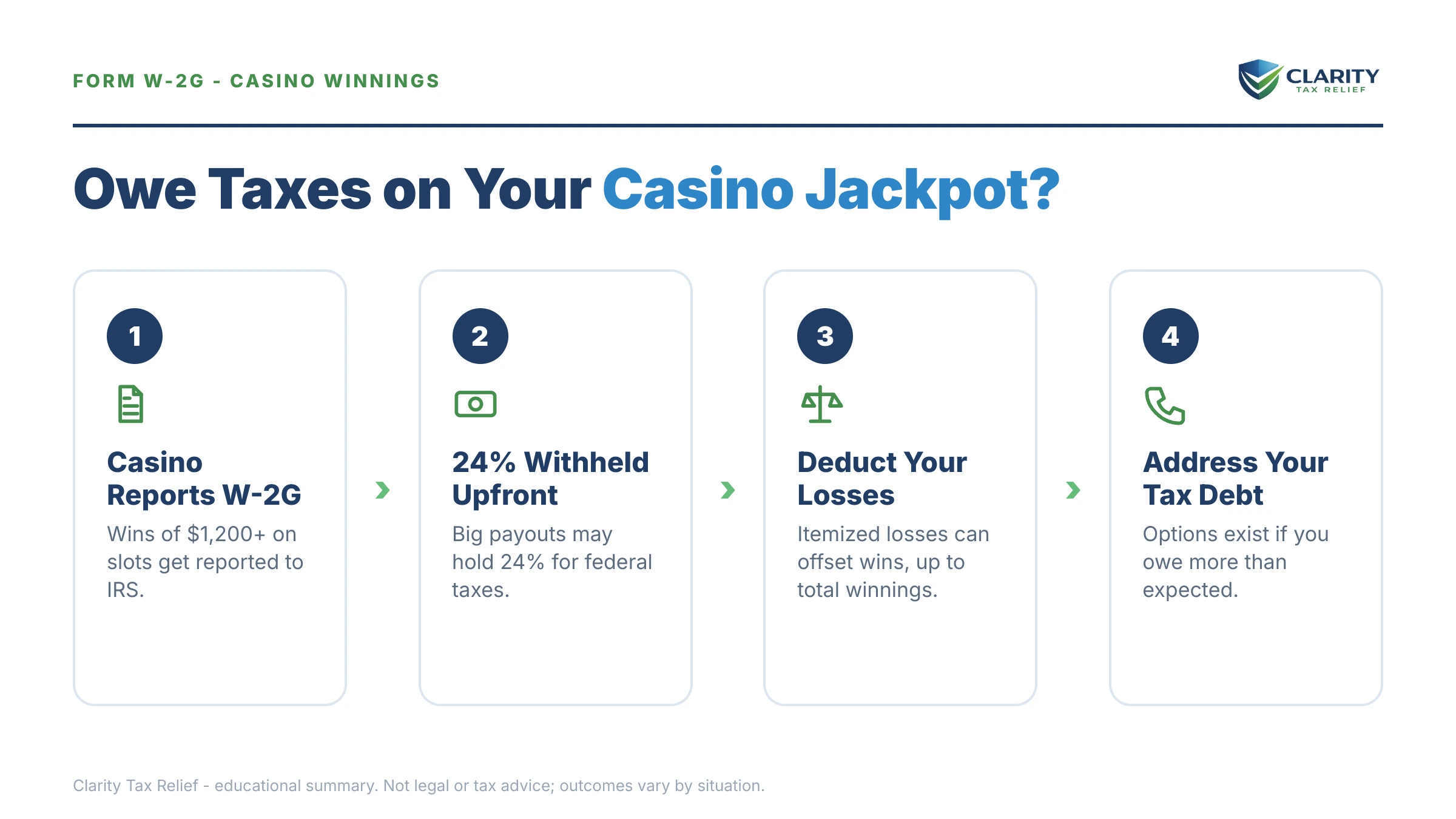
Casinos file a copy of every Form W-2G with the IRS, so the government knows about a reportable win before your tax return is ever due. When a slot machine pays $1,200 or more, a keno game pays $1,500 or more, or a poker tournament pays over $5,000, the casino is required to issue the form. Its copy goes straight into the IRS matching system.
About a year after you file, that system compares every W-2G on record against your return. If the win isn't there, it generates a CP2000 notice proposing extra tax, penalties, and interest — automatically. It's the same third-party matching engine that drives crypto tax debt help cases: no agent decided to come after you; a document didn't match.
Here's what triggers the form the IRS is matching against:
| Game | W-2G issued at | Automatic 24% withholding? |
|---|---|---|
| Slot machines & bingo | $1,200 or more | Generally no. You owe the tax later |
| Keno | $1,500 or more (net of wager) | Generally no |
| Poker tournaments | More than $5,000 (net of buy-in) | Generally no |
| Sweepstakes, lotteries, wagering pools | $600+ and at least 300× the wager | Yes, on proceeds over $5,000 |
| Table games (blackjack, craps, roulette) | Usually no W-2G issued | No, but winnings are still taxable |
Notice the pattern: the most common trigger, a slot jackpot, usually arrives with zero tax withheld. The casino hands you the full amount, the IRS gets the paperwork, and the tax bill waits quietly for the matching cycle.
“Gambling winnings are fully taxable and you must report the income on your tax return. Gambling income includes but isn't limited to winnings from lotteries, raffles, sports betting, horse races, and casinos.”
— Topic no. 419, Gambling income and losses (IRS.gov)
The gross-winnings trap: the bill ignores what you lost back
The IRS taxes each reportable win at its full amount, even if you fed every dollar back into the machines that same night. A $9,000 jackpot is $9,000 of income on the government's books — the losing sessions before and after don't automatically subtract.
Losses can offset winnings, but only on Schedule A as an itemized deduction, only up to the amount of your winnings, and only with documentation. That's a brutal combination for a renter: with no mortgage interest to itemize around, your total itemized deductions rarely beat the standard deduction, which means your losses may legally reduce nothing. Our guide to deducting gambling losses against old debt walks through when the math actually works.
Two more wrinkles specific to gambling income. First, if the losses do help — say you itemize anyway, or the winnings are large enough that documented losses swing the answer — amending a return to lower a tax debt or disputing the CP2000 before assessment can shrink the balance at its source. Second, beginning with tax year 2026 returns, the One Big Beautiful Bill tax changes cap deductible gambling losses at 90% of losses — meaning a break-even year can still produce taxable income. If gambling is genuinely your trade, the session-method rules in our professional gambler taxes guide change the analysis entirely.
What happens if you ignore casino winnings tax debt
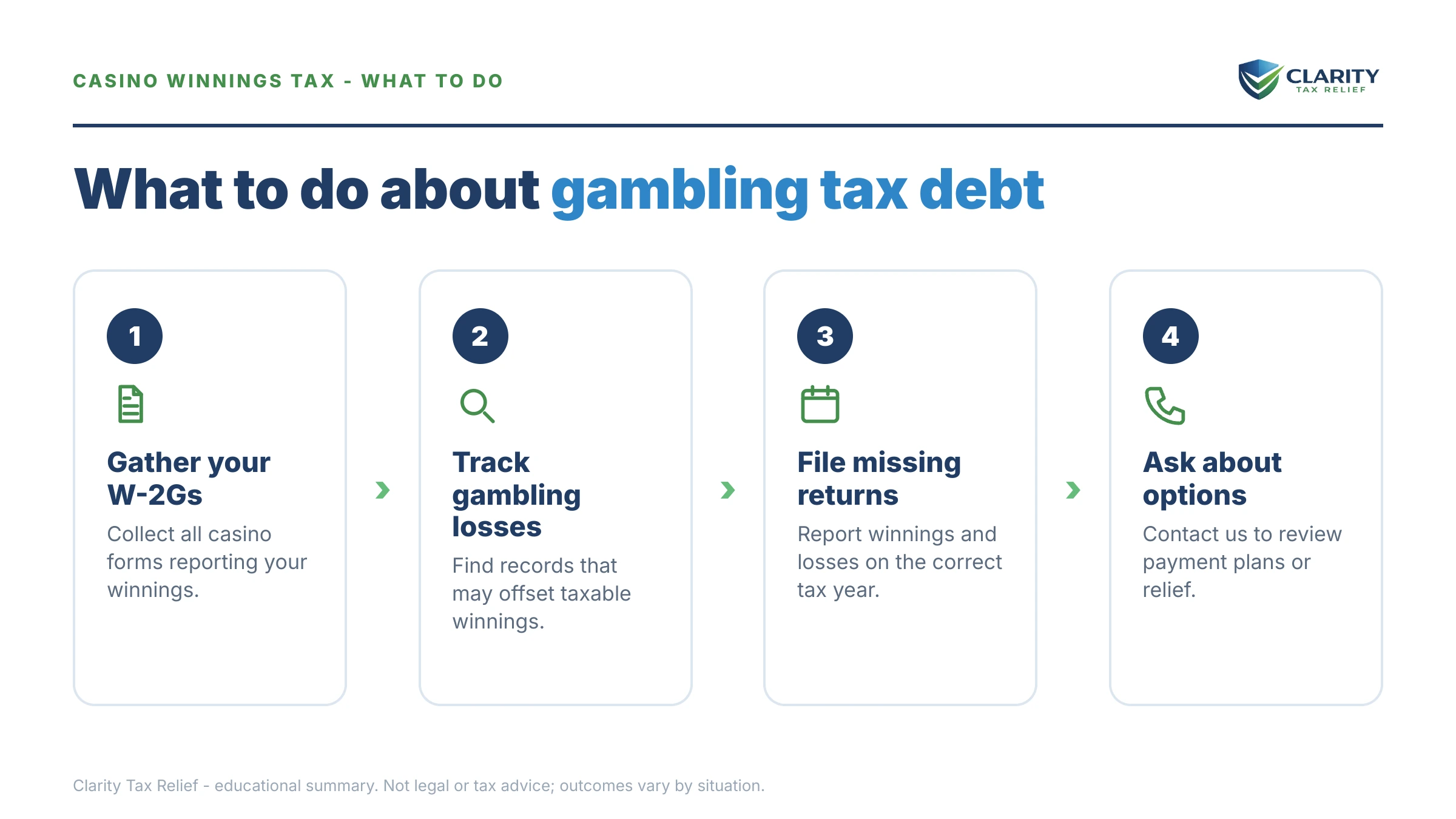
An unanswered W-2G mismatch becomes an assessed debt. An assessed debt moves through the IRS's automated collection sequence until something is seized or something is arranged. The order is fixed:
- CP2000 (or CP2501) — the IRS proposes tax on the unreported win. This is the cheapest stage to fight, because nothing is assessed yet and documented losses can still reduce the number.
- Assessment, then CP14 — the proposal becomes a legal debt and the first bill arrives, with roughly 21 days to respond before reminders start.
- CP501 and CP503 — reminder bills. Still no enforcement, but the failure-to-pay penalty and interest are compounding monthly.
- CP504 — intent to levy your state tax refund under IRC §6331(d). A federal tax lien becomes realistic here.
- LT11 notice or Letter 1058 — the final notice. Thirty days later, the IRS can levy your bank account and garnish your wages. This is also where your strongest appeal right lives, and loses its power if the window passes.
In 2026, the human side of the IRS is thinner than it's been in decades, the workforce shrank roughly 27% in 2025. But this sequence is generated and enforced by automated systems that never stopped running. Slower phone lines don't mean slower levies.
| Notice | Response window | What's at stake |
|---|---|---|
| CP2000 | Date printed on the notice (typically about 30 days) | Your chance to subtract documented losses before the tax is assessed |
| CP14 | Typically 21 days from the notice date | Cheapest moment to pay or arrange — no enforcement yet |
| CP504 | Date printed on the notice | State tax refund can be seized; lien filing becomes likely |
| LT11 / Letter 1058 | 30 days from the notice date | Collection Due Process hearing rights (Form 12153), then wage and bank levies |
| Bank levy served | 21-day hold at the bank | Frozen funds leave for the IRS when the hold ends |
If a levy is already in motion
A levy over gambling winnings can still be released, but every path is deadline-driven. If your account just froze, understand that the money hasn't left yet: under the IRS bank levy 21-day rule, the bank holds the funds before remitting them. A resolution reached inside that window can get them released.
A wage levy is different: it's continuous, taking a slice of every paycheck until the IRS releases it. You can estimate how much of your check a wage levy could reach with our IRS Wage Garnishment Calculator. Three release paths matter most:
- Enter a resolution. Setting up an installment agreement or being placed in hardship status usually gets a levy released, because the account is no longer in enforced collection.
- Prove economic hardship. If the levy leaves you unable to pay rent and basic living expenses, the IRS is required to release it under §6343 — see levy causing hardship for how to document it. For a renter, an eviction risk created by the levy is exactly the kind of evidence this process is built for.
- Use your hearing rights. If you're still inside the 30 days after an LT11, filing a Form 12153 CDP hearing request generally pauses levy action while your case, including collection alternatives, is heard.
Facing a levy over casino winnings?
If a bank levy just hit, the 21-day hold is the window to act, and if you're holding an LT11, the 30-day hearing clock is running. Send us the notice. An experienced tax professional will map your fastest release path and your options — free, confidential, no pressure.
Your options for resolving casino winnings tax debt
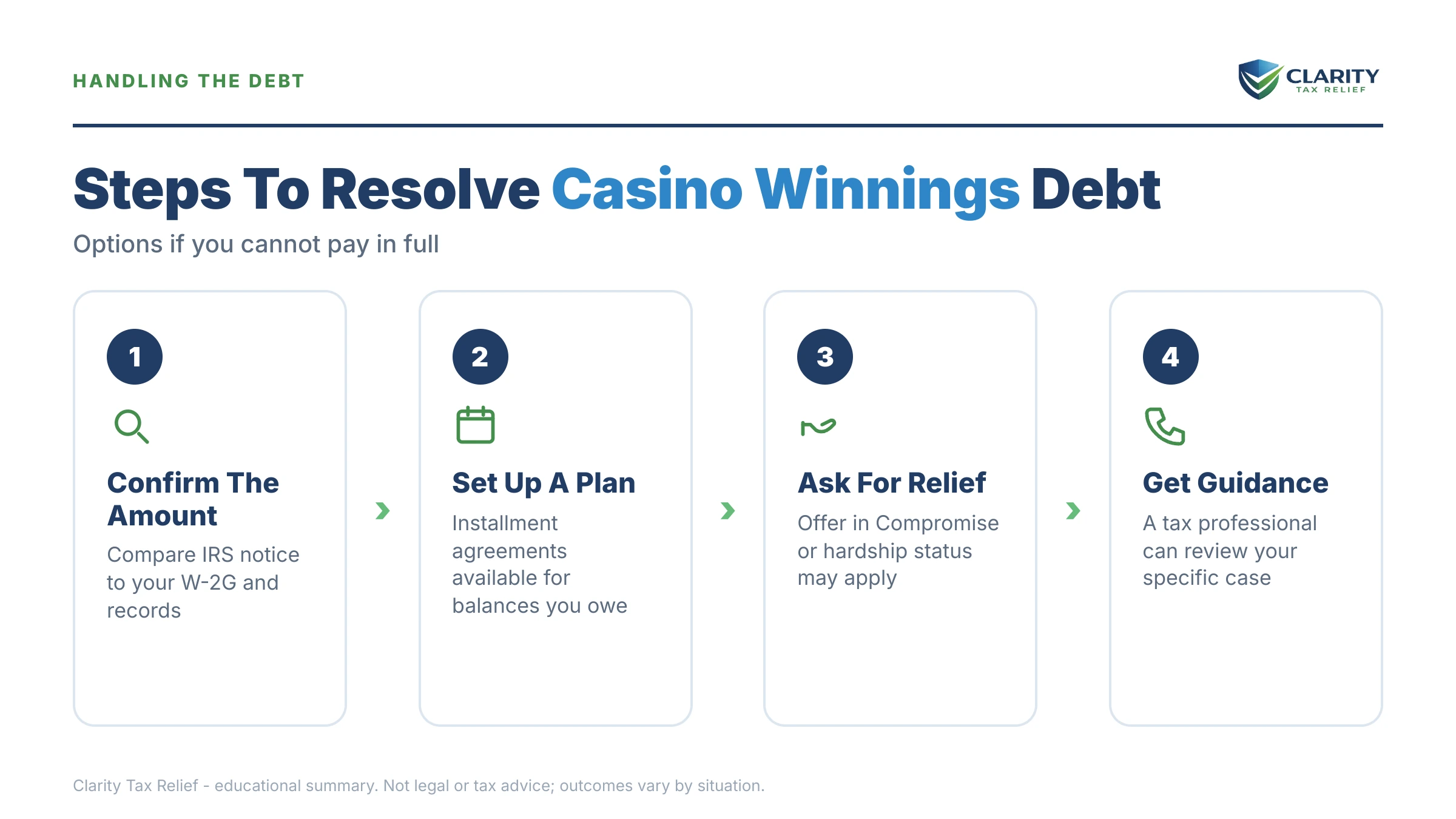
A gambling tax debt is resolved the same way any assessed IRS balance is — the general playbook lives in our guide to how to settle tax debt yourself — but the eligibility lines matter, because most W-2G debts land in the range where the simplest options apply:
| Option | Typically fits when | Cost & notes |
|---|---|---|
| Pay in full | You can cover it without missing rent | Stops penalties and the notice sequence immediately |
| Short-term plan | You can pay within 180 days | $0 setup fee; interest and penalties continue until paid |
| Guaranteed installment agreement | Balance is $10,000 or less, returns filed, paid within 3 years | The IRS must accept it — the official name for the under-$10k plan |
| Streamlined installment agreement | Balance is $50,000 or less | Up to 72 months, set up online, no detailed financial disclosure |
| Currently Not Collectible | Any payment would leave you unable to cover rent and basics | Collection pauses; debt and interest remain; IRS reviews periodically |
| Offer in Compromise | Income and assets genuinely can't cover the balance | $205 fee + 20% down on lump-sum offers (both waived if AGI ≤ 250% of poverty) |
| Penalty relief (FTA / AEP) | Clean compliance the prior 3 years | Can remove penalties; AEP makes this automatic starting summer 2026 |
| Dispute or amend with losses | Documented losses + itemizing beats your standard deduction | Reduces the underlying tax rather than financing it |
A worked example at $6,200
Say the IRS says you owe $6,200 — tax on an unreported $9,000 slot jackpot plus roughly two years of penalties and interest — and you rent, with no savings cushion. This is hypothetical, but the arithmetic is real:
- Guaranteed installment agreement: the balance is under $10,000, so the IRS must accept a plan that pays within 3 years. $6,200 ÷ 36 ≈ $172/month, plus accruing interest, so the payoff runs slightly higher.
- Stretched to 72 months: $6,200 ÷ 72 ≈ $86/month, but the 0.5% monthly failure-to-pay penalty alone starts around $31/month, plus interest. At the minimum payment you'd barely dent principal early on; pay more whenever you can.
- The losses angle: suppose you can document $3,000 of losses from that year. As a single renter, $3,000 of itemized deductions falls far below your standard deduction — the losses would reduce nothing, and paying someone to amend would waste money. If you had $12,000 of documented losses on $9,000 of wins, the analysis flips: up to $9,000 could offset the income, and disputing or amending could erase most of the tax.
- If rent plus basics consume your income: Currently Not Collectible status stops the levy threat entirely while the situation lasts — the debt remains and interest accrues, but nobody touches your paycheck or account.
An Offer in Compromise exists at this size, but the $205 fee, the financial disclosure, and months of review usually make a payment plan the faster, cheaper answer for a $6,200 balance — an OIC earns its keep when the gap between what you owe and what you could ever pay is wide.
How to respond to casino winnings tax debt, step by step
- Pull your IRS records — log into your IRS online account and pull your wage and income transcript for the year in question. It lists every W-2G the IRS has, so you can confirm the bill matches real wins and that any withholding was credited.
- Request your loss documentation — ask each casino's players club for a win/loss statement for that year, and gather bank statements and ATM withdrawals from casino trips. This is the evidence that can shrink the bill if you can itemize.
- Answer the notice in your hand — respond to a CP2000 by the date printed on it, with documented losses if itemizing helps you. If you're holding an LT11 or Letter 1058, file Form 12153 within 30 days to freeze levy action while your case is heard.
- Set up the resolution that fits — apply online for a payment plan if the balance is under $50,000, request Currently Not Collectible status if paying would leave you unable to cover rent and basics, and ask for penalty relief if your prior three years are clean.
- Escalate to a professional if a levy is live, if a bank levy has landed or your paycheck is being taken, get an experienced tax professional involved immediately. The 21-day bank hold and levy-release rules are time-sensitive and unforgiving.
When you can handle this yourself
Most single-year W-2G debts under $10,000 can be resolved without paying anyone. If the win is real, the amount matches your transcript, and no levy has been issued, you can set up a guaranteed or streamlined plan online in about twenty minutes and be done — the DIY steps are in how to settle tax debt yourself.
Experienced help changes the outcome in a narrower set of situations: a bank or wage levy already in motion (the release deadlines are short and the paperwork exacting), several years of unfiled returns behind the gambling year, a losses dispute on tax that's already assessed, or gambling income tangled up with a spouse's finances — where spouse gambling tax debt and innocent-spouse rules come into play. In those cases the order you fix things in changes what you ultimately pay.
Terms on your notice, decoded
- Form W-2G — the "Certain Gambling Winnings" form the casino files with the IRS and gives you when a win crosses a reporting threshold.
- Gross winnings — the full amount of each reportable win, which is what the IRS taxes; your losing sessions don't automatically subtract.
- CP2000 — the automated "proposed changes" notice generated when W-2Gs on file don't match your return; it's a proposal, not a final bill.
- Levy vs. lien — a levy takes property (paycheck, bank funds). A lien is a legal claim against what you own, recorded to protect the IRS's position.
- CDP (Collection Due Process) — the formal hearing right the LT11 triggers; requesting it via Form 12153 within 30 days generally pauses levy action.
- Win/loss statement — the annual activity summary a casino's players club can produce; it's the backbone of most gambling-loss documentation.
Casino winnings tax debt questions, answered
Do I still owe taxes on casino winnings if I lost it all back?
Yes — the IRS taxes your gross winnings, and losses only offset them if you itemize deductions on Schedule A. If you take the standard deduction, as most renters without mortgage interest do, your losses reduce nothing. Losses also can never exceed winnings, and beginning with 2026 returns only 90% of losses are deductible.
How does the IRS know about my casino winnings?
The casino files a copy of every Form W-2G directly with the IRS — for slot and bingo wins of $1,200 or more, keno wins of $1,500 or more, and poker tournament wins over $5,000. IRS computers match those forms against your return about a year after you file. If the winnings aren't on the return, a CP2000 mismatch notice proposes the extra tax automatically — no human decision required.
What happens if I don't pay taxes on casino winnings?
The debt moves through the IRS's automated collection sequence: a bill, reminder notices, a CP504 that lets the IRS take your state refund, then an LT11 final notice that authorizes wage and bank levies 30 days later. Interest and a 0.5%-per-month failure-to-pay penalty accrue the whole way. The balance never quietly disappears — enforcement escalates until you respond or the 10-year collection statute runs out.
Can the IRS levy my bank account over gambling winnings tax debt?
Yes, once it has sent an LT11 or Letter 1058 final notice and 30 days have passed. A bank levy freezes what's in the account on the day it lands. The bank holds those funds for 21 days before sending them to the IRS. That window is your chance to get the levy released. A wage levy is worse: it's continuous, taking part of every paycheck until released.
Can I settle casino winnings tax debt for less than I owe?
Only through an Offer in Compromise, and only if the IRS's math shows it could never collect the full balance from your income and assets — the IRS accepted roughly 1 in 5 offers in FY2024. On a $6,200 debt, a payment plan is usually faster and cheaper than the $205 OIC application and months of review. Anyone promising a settlement before reviewing your finances is selling, not advising.
Can I still claim my gambling losses after the IRS already billed me?
Often, yes. If you're answering a CP2000, you can dispute the proposed amount with documented losses before it's ever assessed. If the tax is already assessed, an amended return claiming itemized losses may reduce the balance, but only if your total itemized deductions beat your standard deduction, and only with records: win/loss statements, players club data, or bank withdrawals at the casino.
The casino withheld 24% — why do I still owe?
Because 24% is a flat withholding rate, not your tax rate, and most slot and bingo W-2Gs have no withholding at all. If the win pushed you into a higher bracket, the withholding falls short, and penalties and interest have been added since the return was due. Check the W-2G's federal withholding box against what the IRS credited before you accept the balance as correct.
Does gambling tax debt from a casino ever expire?
The IRS generally has 10 years from the date the tax was assessed to collect — the CSED. But the clock pauses during an Offer in Compromise, bankruptcy, and certain appeals, so it often runs longer than 10 calendar years. Waiting it out means living under lien and levy risk the entire time, which is usually a worse deal than resolving a mid-four-figure balance.
Your next 24 hours
- Find the notice number and date on the letter in front of you — top right corner. That single line tells you which stage you're at and whether a 30-day hearing clock or a 21-day bank hold is running.
- Gather three things: the notice itself, the tax return for the year of the win (or note that it's unfiled). A win/loss statement request to the casino's players club — you can call or use their website today.
- Get a free case review. If a levy is in motion, the deadlines above are the whole game — call (888) 825-7779 or use the 2-minute form and an experienced tax professional will map your release path and your cheapest resolution before another payment cycle of penalties and interest posts.
For primary sources: the IRS's page on Form W-2G, Certain Gambling Winnings covers the reporting rules, IRS.gov/payments is where every legitimate payment and plan is set up, and the Taxpayer Advocate Service can intervene when a levy creates genuine hardship and normal channels stall.
This guide is general information, not tax or legal advice for your specific situation. Eligibility for IRS programs depends on individual facts and circumstances; no outcome is guaranteed.