
Tax Debt Strategies
Amend Return to Reduce Tax Debt: How Form 1040-X Can Lower What You Owe (2026)
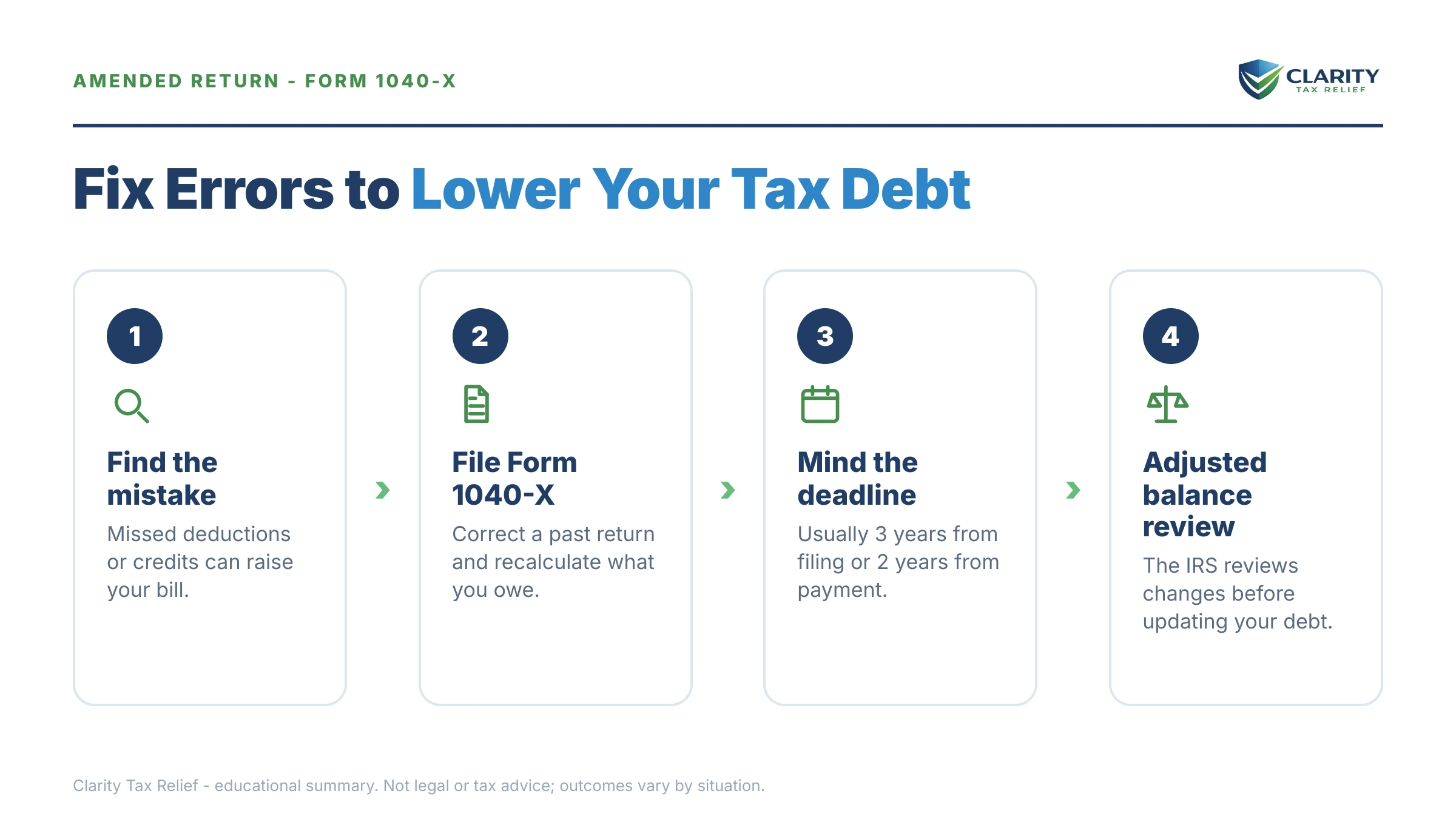
The short answer: yes. You can amend a return to reduce tax debt. If your filed return overstated income or missed deductions, Form 1040-X corrects the assessment, and penalties recompute on the lower tax. If the IRS filed a substitute return for you, file an original return instead, and know that collection continues while either one processes.
You've been staring at an IRS balance that doesn't match reality — maybe it counts your gross gig deposits as pure profit, or skips deductions you know you earned. Here's the part most people miss: an IRS balance is only as accurate as the return underneath it, and you're allowed to fix that return. This guide shows exactly when you can amend a return to reduce tax debt, when a 1040-X is the wrong tool entirely, and how to keep collection off your back while the correction processes.
The one distinction that decides everything: who filed the return the debt is built on. If you filed it, Form 1040-X is your tool. If the IRS filed it for you — a substitute for return (SFR) because you never filed — you don't amend anything. You file an original return for that year, and it usually cuts the balance dramatically, because an SFR gives you zero business expenses, no dependents, and the least favorable filing status.
The image below shows you exactly what Form 1040-X looks like and where to focus when you fill it out — the form is short, but the column layout confuses almost everyone the first time.
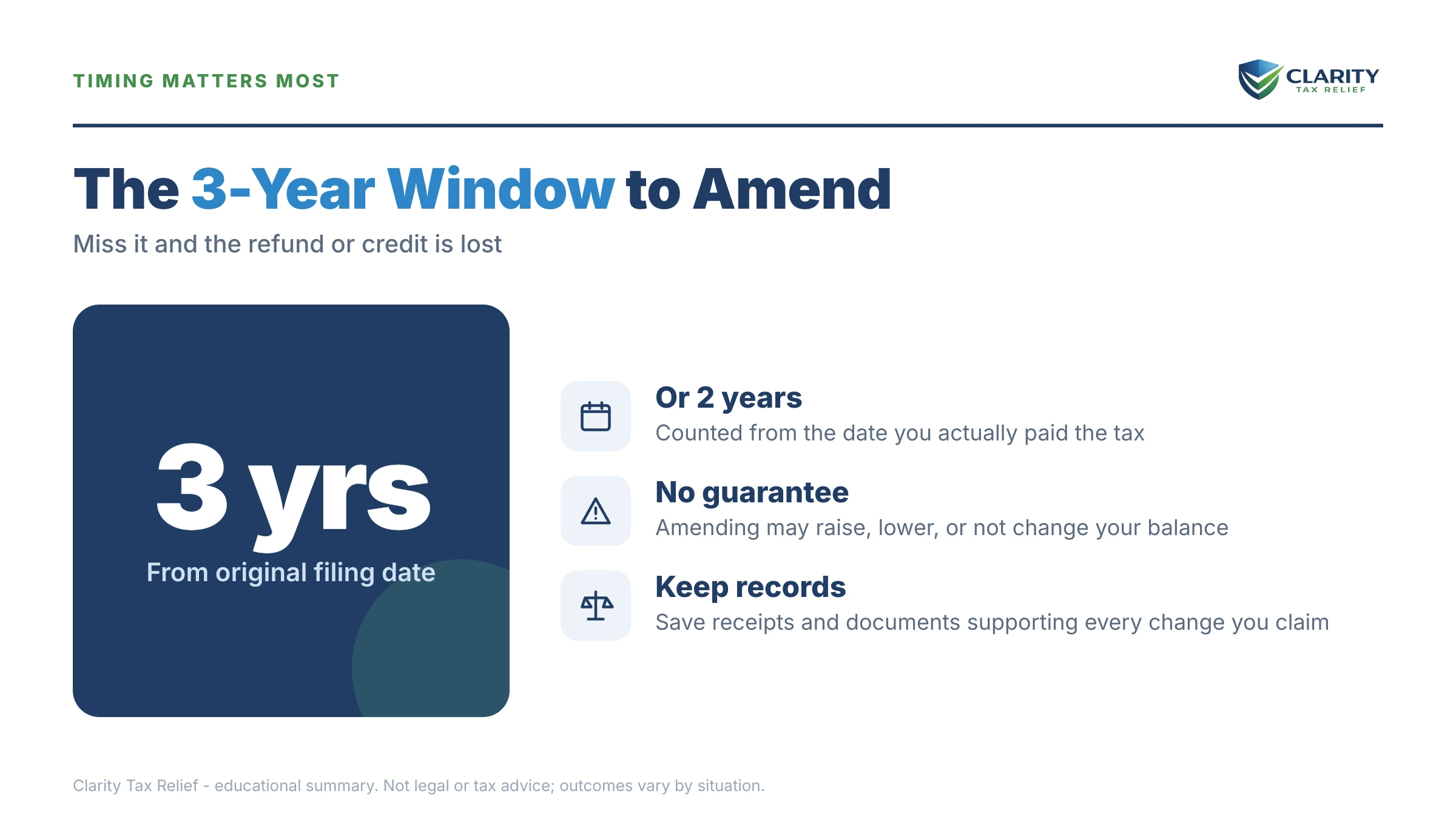
⏱ The clock that matters: you generally have 3 years from the date you filed the original return (or 2 years from the date you paid the tax, whichever is later) to get money back from an amended return. A correction that only reduces a still-unpaid balance can come later, but the IRS treats late requests as discretionary, and interest accrues the entire time you wait.
Why the balance may be bigger than the tax you actually owe
Most inflated tax debts come from a return, yours or the IRS's, that counted income without counting the costs of earning it. The three most common paths:
- You filed fast and thin. You reported the full 1099-NEC or 1099-K amount but skipped Schedule C expenses — mileage, supplies, platform fees, home office, health insurance. Self-employment tax alone runs 15.3% on net profit, so every dollar of missed expenses cost you roughly 15 cents in SE tax before income tax even starts.
- The IRS built the number for you. A substitute for return or a defaulted CP2000 assessment uses only the income reported to the IRS — gross, with no basis, no losses, no expenses. Crypto sellers get taxed on full proceeds as if their coins cost nothing. Gamblers get taxed on every W-2G with no losses netted against them.
- An exam disallowed items you can now prove. If an audit assessed tax because you couldn't produce records at the time, finding those records later opens a different door — audit reconsideration, not a 1040-X.
Reducing the tax is the highest-leverage move in all of tax resolution, because everything else scales off it: failure-to-file and failure-to-pay penalties are percentages of the unpaid tax, and interest compounds on both. Cut the tax and the whole stack shrinks. You can estimate how much of your current balance is penalties and interest with our IRS Penalty & Interest Calculator.
“File Form 1040-X to: Correct Form 1040, 1040-SR, or 1040-NR (or older filings of Form 1040-A or 1040-EZ). Make certain elections after the deadline. Change amounts previously adjusted by the IRS. Make a claim for a carryback due to a loss or unused credit.”
— About Form 1040-X, Amended U.S. Individual Income Tax Return (IRS.gov)
When you can amend a return to reduce tax debt, and when you can't
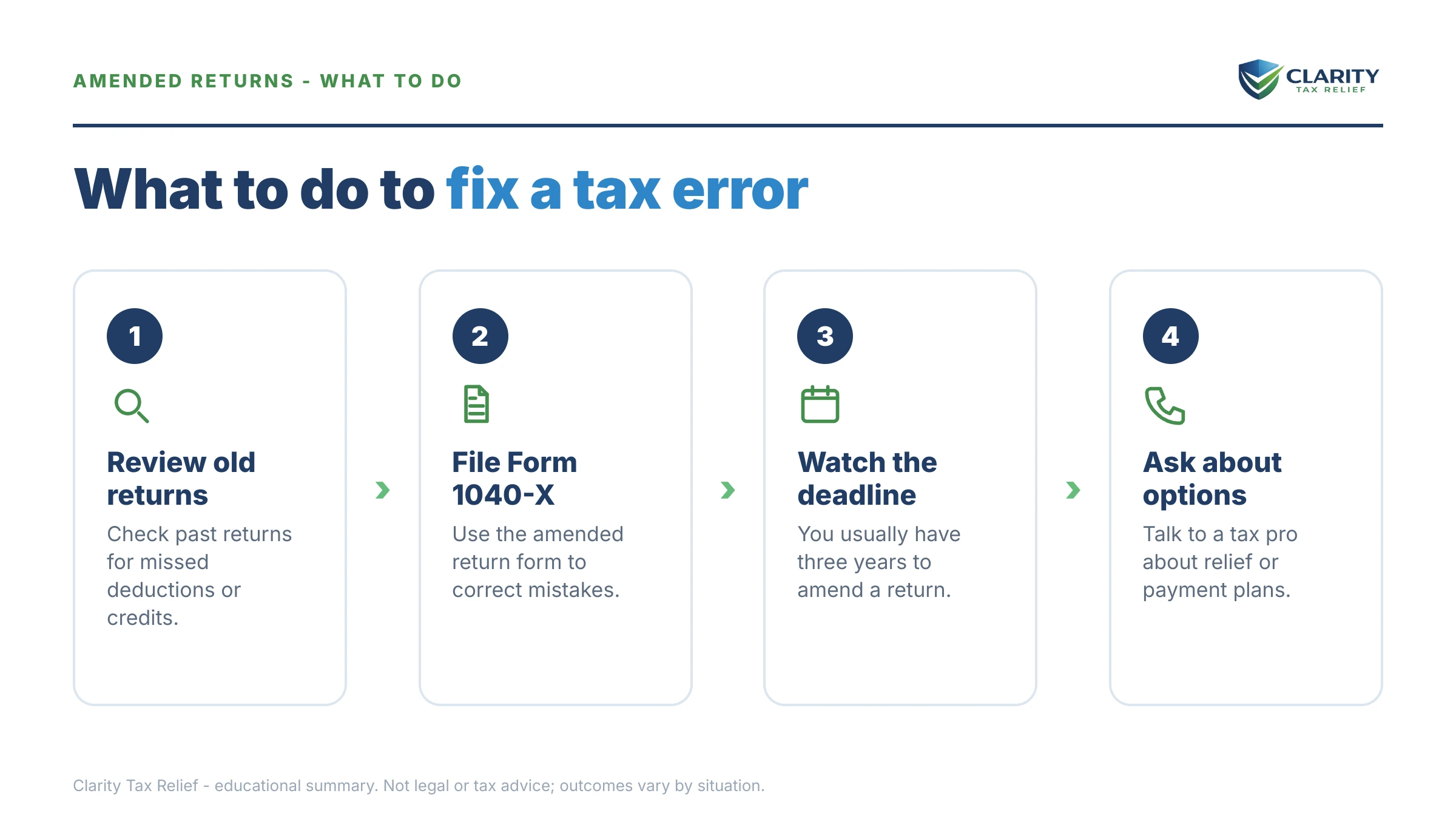
A Form 1040-X reduces a tax debt only when the original return you filed overstated your true liability. It works for missed deductions and credits, unreported cost basis, income reported twice, dependents you were entitled to claim, and some filing-status fixes. You can amend from married filing separately to a joint return, though you generally cannot go the other direction after the filing deadline.
It does not work in four situations that trip people up constantly:
- The IRS filed the year for you (SFR). There's nothing of yours to amend. File an original, signed return; the IRS reprocesses the year through SFR reconsideration.
- A CP2000 case is open. The IRS tells you directly not to file a 1040-X while the underreporter unit holds the case — respond to the CP2000 with your corrected figures instead, or the two processes can collide and double-count the change.
- The debt came from an audit. Use audit reconsideration, which requires information the examiner didn't consider — new records, not a new argument.
- You're inside a 90-day letter window. A Notice of Deficiency starts a Tax Court clock. An amendment doesn't stop it, and missing the 90 days forfeits your pre-payment court rights.
Industry-specific corrections follow the same logic. Gamblers may deduct documented losses against W-2G winnings by itemizing — the core move in casino winnings tax debt cases. Traders who got assessed on gross proceeds fix it by reporting real cost basis — the standard rescue in crypto tax debt help cases. And one more thing to weigh honestly: a corrected return also has to be accurate in both directions. If rebuilding the year reveals income you left off, the amendment must include it — filing a one-sided correction invites exactly the scrutiny you're trying to avoid.
What happens to collection while your amendment processes
Filing a 1040-X does not pause IRS collection — the notice sequence keeps moving while the amendment waits in a processing queue that typically runs 16 weeks or longer. That mismatch is the trap: the automated collection stream can escalate faster than a human ever opens your amendment, especially in 2026 with the IRS workforce down roughly 27% while the notice systems run untouched.
- Assessment + CP14 bill — the balance posts and the first bill gives you about 21 days before escalation begins.
- CP501 / CP503 reminders — still just bills, but penalties and interest compound monthly on the full assessed amount, not your corrected number.
- CP504 — intent to levy — the IRS can seize your state tax refund, and a federal tax lien becomes a live possibility.
- LT11 / Letter 1058 — final notice — a 30-day clock starts on your Collection Due Process rights. After it runs, wage garnishment and bank levies are on the table, amendment pending or not.
The fix is simple but non-obvious: run two tracks at once. File the correction, and put a payment plan or documented collection hold in place so the sequence can't reach a levy while you wait. If your transcript already shows the amendment received — codes 976/977 — that confirms processing started, not that collection stopped. Our guide to amended return processing time when you owe taxes covers what the wait actually looks like this year.
Balance built on the wrong numbers?
Send us your notice and we'll pull your transcripts, confirm how each year was assessed, and tell you whether a corrected return can genuinely cut the debt — free, before interest compounds another month. An experienced tax professional reviews every case.
Your options: match the correction to how the debt was created
The single most common mistake is filing a 1040-X for a year the IRS assessed a different way. It gets rejected or sits unworked while collection continues. Match the tool to the source of the assessment:
| How the balance arose | The right correction | Key limit to know |
|---|---|---|
| You filed, but missed deductions, credits, basis, or dependents | Form 1040-X amended return | Money back only within 3 years of filing / 2 years of payment; later requests are discretionary |
| You never filed; the IRS assessed via substitute for return (SFR) | Original signed return (SFR reconsideration) | Any refund the corrected year produces is lost once the 3-year refund window closes |
| CP2000 proposed or assessed extra tax on matched 1099/W-2 data | CP2000 response with documentation, not a 1040-X | Respond by the date printed on the notice or the proposal becomes a final assessment |
| An audit assessed tax you can now document away | Audit reconsideration | Requires information the examiner didn't consider; collection can continue during review |
| The tax is right, but penalties inflated the balance | First-time abatement, reasonable cause, or Form 843 | Reduces penalties and their interest only — the underlying tax stays |
Two notes on scope. Businesses follow the same logic on their own forms — a C corporation corrects an 1120 with Form 1120-X, for example. And if you amend the federal return, check your state: most states require a matching amended state return, and each state sets its own correction and refund windows, so confirm the rules with your state's tax agency rather than assuming the federal timeline applies.
The deadlines that decide whether correcting the return pays off
Amending has no single due date — instead, several independent clocks each control a different right. Miss one and that specific door closes, even though the others stay open:
| Clock | How long | What you lose when it passes |
|---|---|---|
| Refund statute (RSED) | 3 years from filing or 2 years from payment, whichever is later | Any refund or credit above the debt — the overpayment is forfeited, not applied |
| CP2000 response window | The date printed on the notice (typically 30 days) | The proposed tax becomes a real assessment you must undo the hard way |
| Notice of Deficiency (90-day letter) | 90 days from the notice date | Your right to contest the tax in Tax Court before paying it |
| LT11 / Letter 1058 CDP window | 30 days from the notice date | Your Collection Due Process hearing rights before a levy can issue |
| Collection statute (CSED) | 10 years from assessment (pausable) | Nothing. This one runs in your favor; the IRS's right to collect expires |
The RSED is the one that quietly burns money. If your corrected numbers show you actually overpaid a year — withholding plus corrections exceed the true tax — that overpayment only comes back (or offsets other years) inside the window. File the correction while the refund statute is still open, even if you can't pay anything today.
Worked example: a gig worker, three years unfiled, $13,600 assessed
Say you drove for delivery apps for three years, never filed. The IRS filed substitute returns treating roughly $26,000 of gross 1099 income each year as pure profit. With penalties stacked on top, the bills total $13,600. This is a hypothetical, but the math is the math:
- The SFR's SE tax per year: $26,000 × 92.35% × 15.3% ≈ $3,670 — because the IRS allowed zero expenses.
- Your real Schedule C: about 14,000 business miles plus roughly $1,200 in phone, hot bags, and platform fees — call it $10,500 in deductions, dropping net profit to about $15,500.
- Corrected SE tax per year: $15,500 × 92.35% × 15.3% ≈ $2,190 — roughly $1,480 less per year, about $4,440 across three years, before any income tax savings from the lower net profit.
- The ripple effect: failure-to-file (5%/month, capped) and failure-to-pay (0.5%/month) penalties recompute on the smaller tax, and interest recomputes on both.
Realistically, the corrected returns could pull that $13,600 down into the range of $7,500–$9,000. The remainder fits a streamlined installment agreement at a manageable monthly payment, or full payment within 180 days at no setup fee. No mileage log? That's fixable too — see reconstructing gig deductions when you didn't track miles, and if you're in this exact spot, start with our guide for people who haven't filed taxes in 3 years. Remember: since these years were SFRs, you'd file original returns, not 1040-Xs.
How to amend a return to reduce tax debt, step by step
- Pull your account transcripts. Confirm for each year whether the balance came from your own return, a substitute for return, a CP2000 assessment, or an audit — the source decides which correction tool you use.
- Rebuild the numbers with documentation. Gather 1099s, bank statements, mileage records, and expense proof for every year you're correcting; an unsupported reduction gets denied.
- File the right correction. Use Form 1040-X for a year you filed yourself. File an original return to replace an SFR. Respond to an open CP2000 instead of amending.
- Protect the balance while it processes. Set up a payment plan or request a collection hold so the notice sequence doesn't escalate during the 16-plus-week wait.
- Track the amendment. Watch for codes 971 and 977 on your transcript and check the IRS Where's My Amended Return tool. Interest accrues until the reduction posts.
- Clean up what's left. Once the tax drops, confirm penalties recomputed, request abatement on the remainder, and resolve any leftover balance with a payment arrangement.
On the penalty cleanup in step six: if your compliance record for the prior three years is clean, first-time penalty abatement can remove what survives the correction, and starting summer 2026, the IRS's Automatic Exemption from Penalty (AEP) begins applying some of that relief automatically, no request needed.
When you can handle this yourself, and when help changes the outcome
Plenty of amendments are genuinely DIY. If you filed the original return yourself, the fix is a single clear item — one missed 1098, a forgotten credit, a dependent — and you have the paperwork in hand, tax software or a paper 1040-X handles it fine. If the corrected balance is small enough to pay within 180 days, you don't need anyone. The free path is laid out in our hub on how to settle tax debt yourself.
Experienced help earns its cost when the stakes or the mechanics get heavier: multiple SFR years that need full reconstruction, self-employment records rebuilt from bank statements, an open CP2000 or exam running alongside the correction, a levy or final notice already in motion while the amendment waits, or a reduction large enough that the IRS will scrutinize every line. In those cases the sequencing — which years to fix first, how to hold collection during processing, what documentation survives review — is where outcomes actually diverge. Eligibility for every IRS program is means-tested and fact-specific; a review tells you what's realistic before you commit to anything.
Terms on your notices and transcript, decoded
- Form 1040-X — the amended individual return; three columns showing original figures, the change, and corrected figures.
- SFR (substitute for return) — a return the IRS files for a non-filer using only reported income, with no deductions or expenses.
- Assessment — the formal recording of tax owed on your account; amendments work by reducing (abating) an assessment.
- RSED (refund statute expiration date) — the deadline to get money back: 3 years from filing or 2 years from payment, whichever is later.
- Audit reconsideration — the process for reopening an exam-created assessment with information the examiner never saw.
- Code 977 — the transcript entry showing the IRS received your amended return and it's in processing.
Amending to reduce tax debt: your questions, answered
Can you amend a tax return if you owe the IRS?
Yes. Filing Form 1040-X to correct income, deductions, credits, or filing status is allowed even with an unpaid balance, and if the corrected numbers show less tax, the IRS reduces the assessment and recomputes penalties on the lower amount. The exception: if the IRS created the balance with a substitute return because you never filed, you file an original return for that year instead of a 1040-X.
Does filing an amended return stop IRS collection?
No. The collection notice sequence keeps running while your 1040-X sits in processing, which typically takes 16 weeks or longer in 2026. If you have already received a CP504 or LT11, set up a payment plan or ask the IRS to hold collection while the amendment is reviewed — never assume the amendment itself protects you from a levy.
How long does an amended return take to process in 2026?
The IRS says up to 16 weeks, but after the roughly 27% workforce cut in 2025, many amended returns are taking longer. Track yours with the Where's My Amended Return tool or watch for code 977 on your account transcript. Interest keeps accruing on the assessed balance until the reduction actually posts, so file the correction as early as you can.
Can I amend a return the IRS filed for me?
Not with Form 1040-X. A substitute for return (SFR) isn't your return, so you replace it by filing an original signed return for that year, which the IRS processes through SFR reconsideration. This almost always lowers the balance, because an SFR allows no business expenses, no dependents. The least favorable filing status the IRS can assign you.
Will amending my return to lower the tax trigger an audit?
Not automatically, millions of 1040-X forms are filed every year, but an amendment that cuts your tax does get human review. Keep documentation for every change: mileage logs, expense records, cost-basis reports, loss statements. A well-supported amendment is routine; an unsupported one gets denied or referred for examination.
How far back can you amend a tax return?
You can file a 1040-X for any year. But the money-back window matters: refunds or credits are generally limited to 3 years from when you filed or 2 years from when you paid, whichever is later. A request that only reduces a still-unpaid balance can be made after that window. But the IRS treats it as a discretionary abatement request, so acting early is always safer.
Do penalties go down if an amended return reduces the tax?
Yes. Failure-to-file and failure-to-pay penalties are percentages of the unpaid tax, so when the tax drops, those penalties and the interest charged on them recompute downward. Any penalties left after the correction may still qualify for first-time abatement, and starting summer 2026, the IRS's Automatic Exemption from Penalty applies some relief with no request needed.
Should I amend my return or respond to a CP2000?
Respond to the CP2000. The IRS specifically asks you not to file a 1040-X while an underreporter case is open, because the amendment and the CP2000 unit process separately and can collide, leaving you with a double-counted balance. Send your corrected figures and documentation with the CP2000 response form by the date printed on the notice.
Your next 24 hours
- Find the source of each year's balance. Log into your IRS online account, open the account transcript for every year with a balance, and note whether the assessment came from your return, an SFR, a CP2000, or an exam.
- Gather the raw material. Pull your 1099s, bank statements, mileage and expense records. The most recent IRS notice for each year — the correction is only as strong as the documentation behind it.
- Get the numbers reviewed free. Interest compounds on the full assessed balance every month the wrong numbers stand. The refund window on your oldest year won't wait. Call (888) 825-7779 or use the 2-minute form and an experienced tax professional will tell you whether a corrected return can cut what you owe.
For the IRS's own instructions and the tracking tool, see About Form 1040-X, the Where's My Amended Return tool, and the IRS payment plans page for protecting the balance while you wait.
This guide is general information, not tax or legal advice for your specific situation. Eligibility for IRS programs depends on individual facts and circumstances; no outcome is guaranteed.