
Tax Debt Strategy
Bankruptcy or Offer in Compromise: How to Decide Which Resolves Your Tax Debt (2026)
The short answer: choosing bankruptcy or offer in compromise comes down to timing and debt mix. An OIC settles tax debt the IRS can't fully collect, without a court case or a credit-report hit. Bankruptcy is stronger only when your taxes pass three timing tests, and recent tax debt almost never does.
You've got a bankruptcy attorney's website open in one tab and an offer in compromise ad in the other, and the balance in your head — five figures of self-employment tax that nobody ever withheld — hasn't moved in either. Both paths are real. But they solve different problems, and picking on gut feel is how people spend years pursuing the wrong one.
Here's the fact that decides this question for most readers before any comparison chart: income tax owed for the last three years generally cannot be discharged in Chapter 7 bankruptcy at all, and a year you never filed can never be discharged. An offer in compromise has no such age requirement. This guide walks through the timing tests, the OIC math, the cost of each path, and a worked example at $83,100 so you can see which door is actually open for you.
⏱ The real clock: there's no notice deadline on this decision, but two clocks run anyway. Penalties and interest accrue on your full balance every month you wait, and bankruptcy's timing tests mean recent tax years can't be discharged yet, so "waiting for bankruptcy" is a strategy with a monthly price tag attached.
Bankruptcy or offer in compromise: what each one actually does
An offer in compromise settles IRS debt for what the agency calculates it could realistically collect from you. Bankruptcy asks a federal court to discharge debts — taxes included only when strict rules are met. They're not two brands of the same product. They run through different institutions, on different math, with different collateral damage.
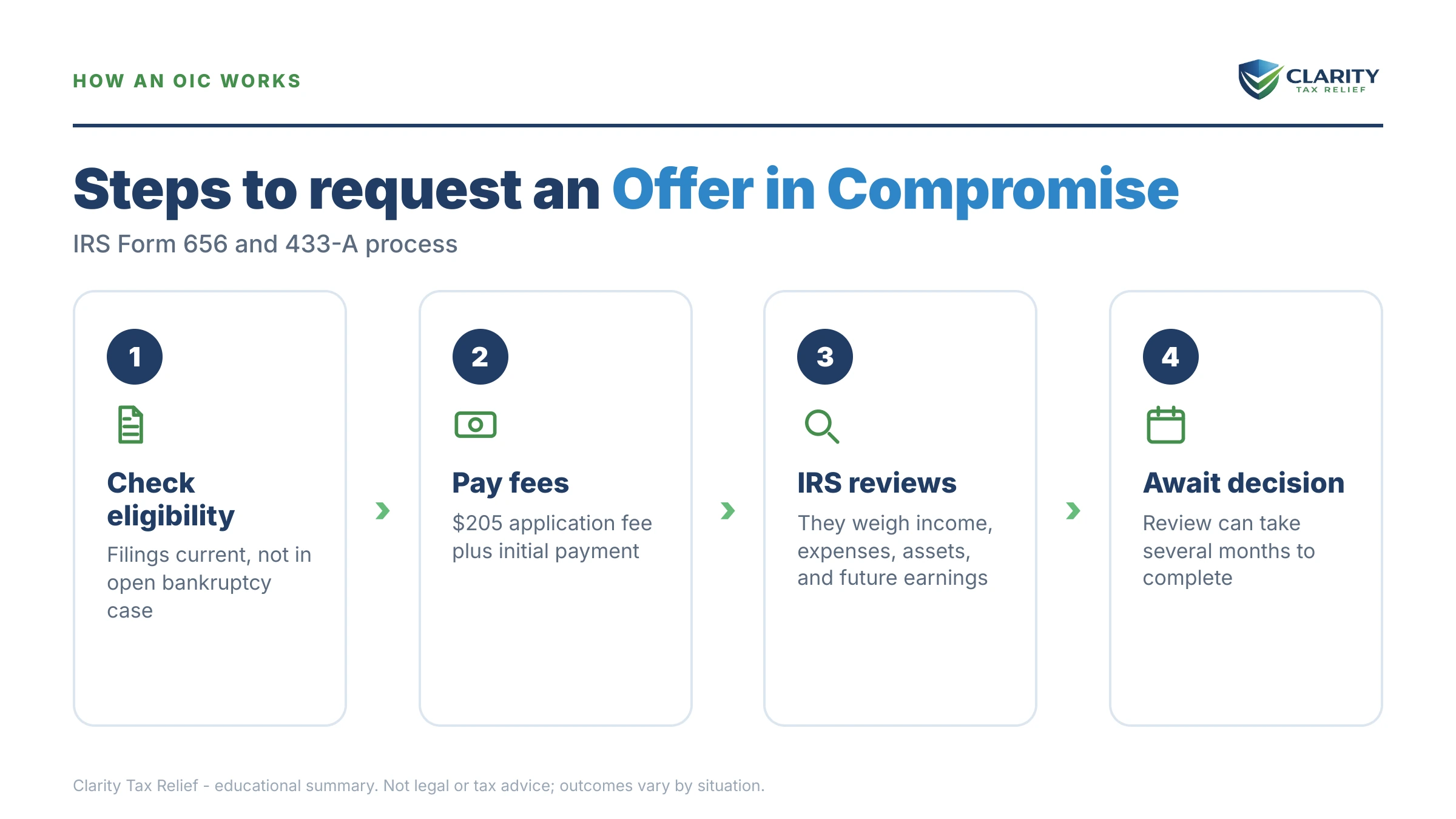
An OIC is an IRS administrative program: you submit Form 656 and a financial disclosure (Form 433-A (OIC)). The IRS compares your offer against a formula called reasonable collection potential. It touches only your tax debt, doesn't appear on your credit report, and requires you to be fully filed and compliant before it will even be reviewed. The mechanics live in our hub on how an offer in compromise actually works. This page covers what that hub doesn't — when a courtroom beats the IRS's own program.
Bankruptcy is a court proceeding that can resolve all your dischargeable debts at once — credit cards, medical bills, personal loans, and qualifying taxes. Chapter 7 discharges eligible debt in a matter of months; Chapter 13 restructures it into a 3-to-5-year repayment plan. The catch for tax debt is eligibility: taxes must clear three timing tests to be discharged, taxes that don't clear them get treated as priority claims that must be paid in full. A recorded federal tax lien survives the case against property you already own.
One more structural difference worth knowing early: the two paths are mutually exclusive while active. The IRS won't consider an offer in compromise during an open bankruptcy case, but it will consider one after discharge, on whatever tax survived. That sequencing option matters later in this guide.
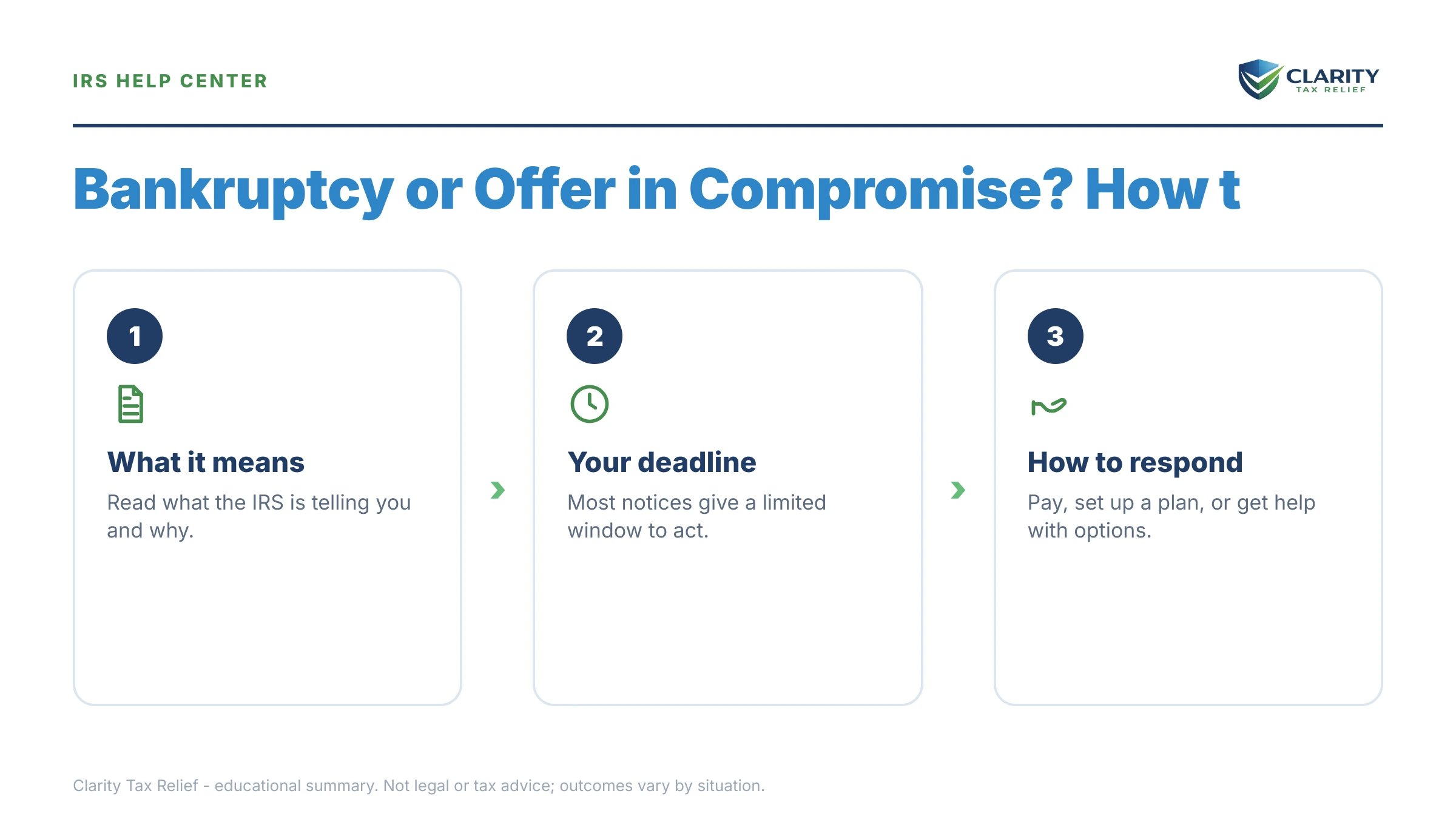
“You're eligible to apply for an offer in compromise if you: Filed all required tax returns and made all required estimated payments. Aren't in an open bankruptcy proceeding.”
— Offer in compromise (IRS.gov)
What happens if you do nothing while you decide
IRS collection escalates on autopilot whether you're researching bankruptcy, drafting an offer, or frozen between the two. At a balance like $83,100, indecision is the most expensive option on the menu, because every stage below arrives on its own schedule:
- The balance compounds monthly. The failure-to-pay penalty runs 0.5% per month, and interest compounds on top of it. On $83,100, the penalty alone is roughly $415 a month before interest.
- The notice sequence advances. Balance-due bills give way to a CP504 (the IRS can then seize your state tax refund), then an LT11 final notice — which starts a 30-day clock on your Collection Due Process rights before levies can begin.
- A federal tax lien can be filed. Once recorded, the lien attaches to everything you own — and, critically for this decision, it survives a later bankruptcy discharge against that property.
- Passport certification. The 2026 threshold for "seriously delinquent" tax debt is $66,000. At $83,100 you're already above it, meaning the State Department can deny or revoke your passport once the IRS certifies the debt. See passport revoked for tax debt.
- Levies begin. A bank levy freezes funds with a 21-day hold before they're sent to the IRS. A wage levy is continuous until released. A 1099 contractor's client payments can be intercepted too.
One quiet clock runs in your favor: the IRS generally has 10 years from assessment to collect. But note the trap — both bankruptcy and a pending OIC pause that clock, so either path extends how long the IRS may collect on anything that survives. That trade-off belongs in the decision, not discovered after.
Stuck between bankruptcy and an offer in compromise?
The right answer is written in your IRS transcripts — the filing dates, assessment dates, and balance detail that decide which path is actually open. An experienced tax professional will pull them, run both sets of math, and tell you honestly which fits — free, while penalties and interest are still accruing on the full balance.
Bankruptcy vs offer in compromise: costs, timelines, and outcomes compared
An OIC costs $205 up front plus a portion of your offer. A Chapter 7 costs a court filing fee plus attorney fees. A Chapter 13 costs 3–5 years of plan payments. Here's the full picture side by side — including a payment plan for reference, since at $83,100 you're above the $50,000 cap for a streamlined online agreement and the IRS will want financial disclosure anyway.
| Option | Upfront cost | Typical timeline | What you pay in the end |
|---|---|---|---|
| OIC — lump sum | $205 fee + 20% of your offer (both waived with low-income certification) | Often 6–12 months of review; deemed accepted if the IRS doesn't decide within 2 years (with narrow exceptions — a returned or rejected offer stops the clock, and time during court disputes does not count) | Your accepted offer, in 5 or fewer payments |
| OIC — periodic payment | $205 fee + first monthly payment; payments continue during review (waived if low-income certified) | Similar review window; payments spread over up to 24 months | Your accepted offer, paid monthly |
| Chapter 7 bankruptcy | Court filing fee (a few hundred dollars) + attorney fees, commonly $1,500–$3,500 | Typically a few months from filing to discharge | $0 on discharged taxes; priority taxes and lien-secured amounts survive |
| Chapter 13 bankruptcy | Court filing fee + attorney fees (often payable through the plan) | 3–5 year court-supervised repayment plan | Priority taxes in full through the plan; older nonpriority tax may be only partly paid |
| IRS payment plan (for comparison) | Setup fee varies; over $50,000 requires financial disclosure | Monthly payments until paid or the collection statute expires | Full balance plus ongoing penalties and interest |
Costs tell you the price; fit tells you the answer. This is where the two paths split by situation rather than by dollars:
| Your situation | Stronger path | Why |
|---|---|---|
| Tax is your only major debt; income barely covers IRS allowable living expenses | Offer in compromise | The formula prices your offer low, and nothing lands on your credit report |
| Old income taxes (filed 2+ years ago, due 3+ years ago) plus heavy credit-card or medical debt | Chapter 7 | One case can discharge the qualifying taxes and the consumer debt together |
| Debt is mostly from the last three tax years | OIC (or a payment plan) | Recent taxes are priority claims — Chapter 7 leaves them fully intact |
| Levy in motion, steady income, taxes too new to discharge | Chapter 13 | The automatic stay generally halts collection while a court plan repays priority tax |
| Unfiled returns for any year in question | Neither — yet | An OIC gets returned for non-compliance, and unfiled years fail the 2-year discharge test |
| Significant home equity or retirement savings | Case-by-case | An OIC counts that equity in your offer; a Chapter 7 trustee can reach nonexempt assets; a lien survives both |
Two adjacent comparisons are covered in their own guides if your situation leans that way: payment plan vs. offer in compromise when you could realistically pay it all over time, and CNC vs offer in compromise when you can't pay anything at all right now.
The three timing tests that decide whether bankruptcy can touch your taxes
Income tax is dischargeable in bankruptcy only when the return was due more than 3 years ago, you filed it more than 2 years ago. The tax was assessed at least 240 days ago. Miss any one test for a given year, and that year's tax rides through the bankruptcy untouched as a priority claim. The full rulebook is in our guide to discharging taxes in bankruptcy — here's the short version:
| Test | The rule | What it means for you |
|---|---|---|
| 3-year rule | The return's due date (including extensions) was more than 3 years before the bankruptcy filing | 2024 taxes, due April 2025, can't be discharged before April 2028 |
| 2-year rule | You actually filed the return more than 2 years before the bankruptcy | File your late returns today and the 2-year clock starts today, not from the original due date |
| 240-day rule | The IRS assessed the tax at least 240 days before the bankruptcy filing | New assessments — from an audit, a CP2000, or a just-filed return — need about 8 months to season |
Three fine-print traps sit under that table, and each one changes real cases:
The substitute-return trap. If the IRS already filed a substitute return for a year you skipped, many courts hold that a late return you file afterward never counts as a "return" for discharge purposes. That year's tax can be permanently nondischargeable. The details are in unfiled returns and bankruptcy, and this trap alone pushes many non-filers to the OIC path.
The debt-type trap. These tests apply to income tax. Trust-fund payroll taxes, the trust fund recovery penalty, and fraud-related liabilities are nondischargeable regardless of age. Business owners weighing this decision on payroll debt are usually really choosing among IRS options — see business offer in compromise on payroll taxes for why even that path is narrow.
The lien trap. Discharge erases your personal liability, not a recorded lien. If the IRS filed a Notice of Federal Tax Lien before your case, it still encumbers the property you owned on the filing date — meaning a "discharged" debt can still collect itself out of your home sale. More in does bankruptcy remove a tax lien.
What bankruptcy does deliver that no IRS program matches: the automatic stay. Filing generally halts levies and garnishments on covered debt immediately — the mechanics are in does bankruptcy stop an IRS levy. And Chapter 7 vs 13 for tax debt covers the choice within the choice: Chapter 13 can force even nondischargeable taxes into a court-protected repayment plan when Chapter 7 can't touch them.
How the IRS prices an offer in compromise
The IRS accepts an offer only when it equals or exceeds your reasonable collection potential — roughly, your reachable asset equity plus 12 or 24 months of your monthly disposable income under IRS expense standards. Twelve months applies to lump-sum offers, twenty-four to periodic-payment offers. The complete formula is broken down in reasonable collection potential. You can estimate your own offer with our Offer in Compromise Calculator before deciding whether the number justifies the process.
Three eligibility facts matter for the bankruptcy comparison. First, compliance is a gate, not a suggestion: every required return filed and current-year estimated taxes paid, or the offer comes back unreviewed. Second, cost scales down for lower incomes, if your AGI is at or below 250% of the federal poverty level, the $205 fee, the 20% down payment, and payments during review are all waived (see the OIC low-income certification). Many gig workers qualify. Third, acceptance is genuinely means-tested: the IRS accepted roughly 1 in 5 offers in FY2024 — the data is in our OIC acceptance rate breakdown — and most rejections are offers priced below the formula, not hardship the IRS ignored.
Timing runs the opposite direction from bankruptcy: an OIC can address this year's tax debt today. But the process itself takes patience — commonly 6 to 12 months, occasionally longer, with a legal backstop that deems the offer accepted if the IRS fails to decide within 2 years (with narrow exceptions — a returned or rejected offer stops the clock, and time during court disputes does not count). Full timeline in how long an OIC takes. Levies are generally on hold while the offer is pending, which buys the same breathing room people often file bankruptcy to get.
A worked example: $83,100, three years unfiled
Say you're a gig worker who hasn't filed for 2022, 2023, or 2024, and once the returns are prepared the total balance — tax, penalties, and interest — lands at $83,100. This is a hypothetical, but the arithmetic is the arithmetic. Here's how each path prices out.
Chapter 7 today: discharges $0 of the tax. Every year fails at least one timing test. The 2024 return wasn't due until April 2025, so the 3-year rule isn't met until April 2028. And because none of the returns has been filed, the 2-year rule hasn't even started — file all three in July 2026 and no year can pass it before July 2028. If the IRS already filed substitute returns for any of those years, that year may never qualify at all. Meanwhile, waiting two years at roughly $415/month in failure-to-pay penalty alone adds about $10,000 before interest, with levies and passport certification live the whole time.
Chapter 13: full repayment with court protection. All three years are recent, so they're priority claims paid 100% through the plan. $83,100 over the maximum 60 months is roughly $1,385/month before trustee and attorney costs — for most people, a more expensive version of an installment agreement, justified only if you need the automatic stay to stop active collection or you're also restructuring other debt.
The OIC: the only path that can reduce this debt now. File the three returns, get current on 2026 quarterly estimates, then run the formula. Suppose your gig income averages $4,700/month and IRS allowable living expenses in your county total $4,350/month. Monthly disposable income: $350. Lump-sum future-income component: $350 × 12 = $4,200. Add reachable assets — say $2,300 in the bank and a work vehicle whose equity falls under the exemption — and reasonable collection potential comes to roughly $6,500 against an $83,100 balance. If your AGI qualifies for low-income certification, the $205 fee and 20% down payment are waived too.
That gap is why the OIC is the lead option for this profile, with honest caveats. The IRS verifies every number. If your income rises during review, the offer price rises with it. And acceptance ran about 1 in 5 in FY2024 because most people's formula doesn't land that low. If yours doesn't, the fallback isn't bankruptcy-someday — it's a payment plan or hardship status while the 10-year collection clock runs. And if the unfiled years are your immediate problem, start with haven't filed taxes in 3 years — nothing on this page is available until those returns exist.
How to decide between bankruptcy and an offer in compromise, step by step
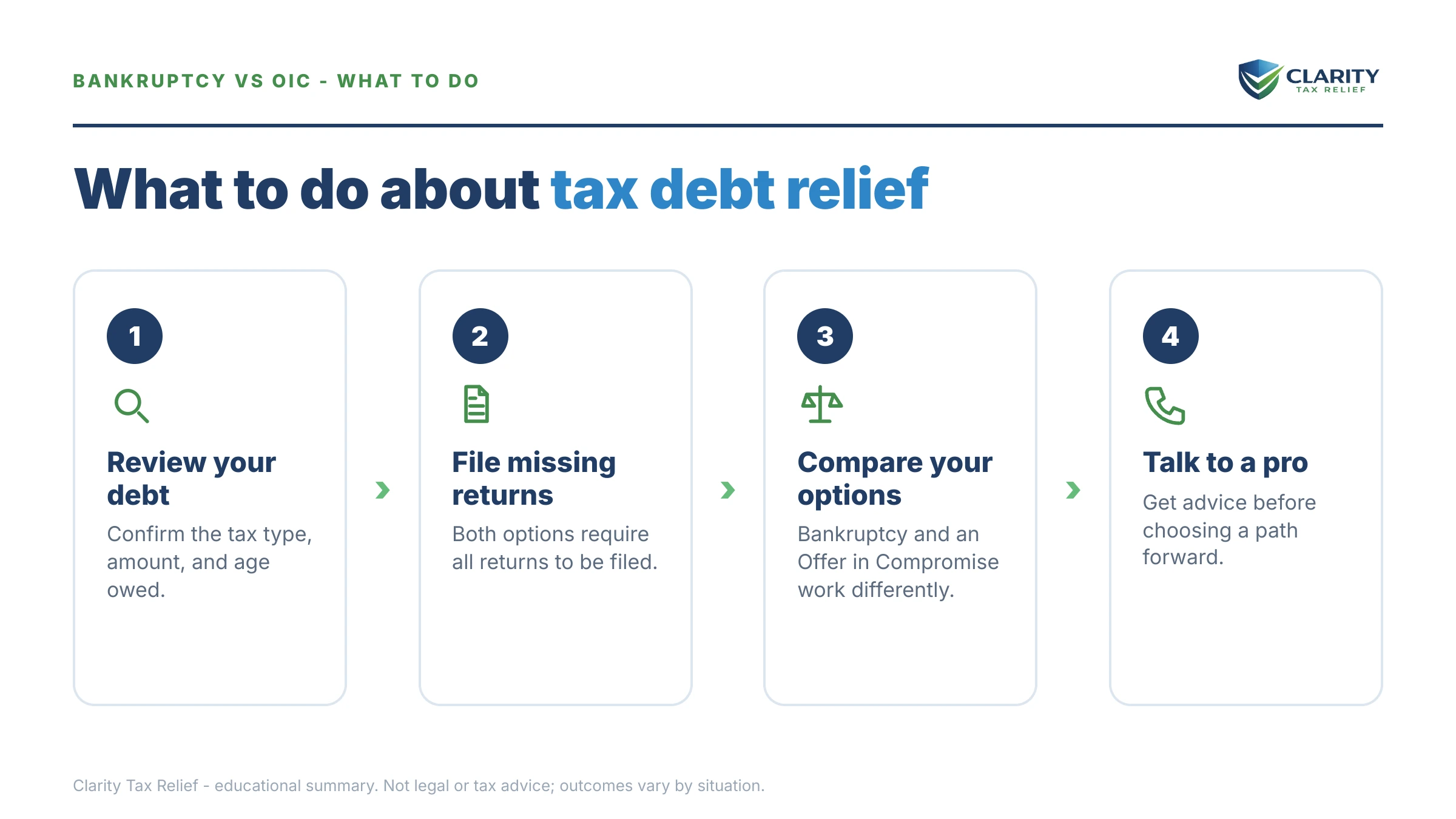
- File every missing return. Both paths are closed until the IRS has actual returns from you — an offer gets returned for non-compliance. An unfiled year can never pass bankruptcy's two-year test.
- Pull your account transcripts. The filing dates and assessment dates on each year's transcript decide whether the 3-year, 2-year, and 240-day discharge tests are met. This is data, not judgment.
- Run the reasonable collection potential math. Add your reachable asset equity to 12 or 24 months of monthly disposable income under IRS expense standards. If that number sits far below your balance, an OIC is genuinely on the table.
- List your non-tax debts. Heavy credit-card, medical, or personal-loan debt tilts the answer toward bankruptcy, because an OIC touches only your tax debt while a bankruptcy case can resolve all of it at once.
- Choose the path and act on it. Submit Form 656 with your financial disclosure for an OIC, or meet with a bankruptcy attorney about Chapter 7 or 13, and do it before the IRS notice sequence reaches the levy stage.
When you can handle this yourself, and when help changes the outcome
You don't need professional help for every version of this problem. If your balance is small enough to pay within 180 days, a short-term payment plan costs nothing to set up and ends the question. If your finances are simple and your income is low, the Form 656-B booklet is designed for self-filers, and low-income certification removes the fees — plenty of straightforward offers succeed without representation. And if your only real issue is unfiled returns with modest balances, free preparation help may get you compliant without spending a dollar.
Experienced help earns its cost in specific situations: three-plus unfiled years with substitute-return assessments (where filing order and what you file determine both your balance and your discharge rights), a levy already in motion, self-employment income that needs to be presented correctly in the RCP math, and any case where the bankruptcy timing analysis is close, because filing a bankruptcy 60 days too early can permanently forfeit a discharge that waiting would have earned. One boundary worth naming plainly: only a bankruptcy attorney can file a bankruptcy case. A tax resolution firm handles the IRS side — transcripts, returns, the offer, collection holds — and a good one will tell you when the bankruptcy math beats the offer math and to go see that attorney.
If you'd rather have both sets of math run for you before choosing, request a free case review or call (888) 825-7779 — deciding with your actual transcript dates beats deciding with a search bar.
Terms in this decision, decoded
- Automatic stay — the court order that takes effect the moment a bankruptcy is filed, generally halting IRS levies and garnishments while the case is open.
- Discharge — the court's permanent erasure of your personal liability for qualifying debts at the end of a bankruptcy case.
- Priority tax claim — recent or otherwise protected tax debt that bankruptcy cannot discharge and a Chapter 13 plan must pay in full.
- Reasonable collection potential (RCP) — the IRS formula (asset equity plus a multiple of monthly disposable income) that sets the minimum acceptable offer amount.
- CSED — the Collection Statute Expiration Date, generally 10 years after assessment, when the IRS's right to collect a tax debt ends.
- Tolling — the pausing of the CSED clock while a bankruptcy, pending OIC, or appeal blocks the IRS from collecting.
Bankruptcy vs. OIC questions, answered
Is bankruptcy or an offer in compromise better for tax debt?
An offer in compromise is usually better when tax is your only major debt and the IRS formula prices your offer well below your balance. Bankruptcy is usually better when your taxes are old enough to pass the discharge timing tests and you also carry credit-card or medical debt. Recent tax years generally survive Chapter 7, which settles the question for many filers. The honest answer starts with your transcripts, not a preference.
Does bankruptcy clear IRS tax debt?
Sometimes. Chapter 7 can discharge income taxes only if they pass three timing tests: the return was due more than 3 years before the bankruptcy, you actually filed it more than 2 years before. The tax was assessed at least 240 days before. Payroll taxes, fraud penalties, and most recent taxes are never discharged. A federal tax lien recorded before the case survives against property you owned when you filed.
Can I file an offer in compromise while in bankruptcy?
No. The IRS will not consider an offer in compromise while you are in an open bankruptcy case — tax debt is handled inside the bankruptcy instead. After discharge, you can submit an OIC on whatever tax survived. Many people use exactly that sequence: discharge the years that qualify, then make an offer on the nondischargeable remainder.
Does an offer in compromise hurt your credit like bankruptcy does?
No. The IRS does not report an accepted offer in compromise to credit bureaus, while a Chapter 7 bankruptcy can stay on your credit report for up to 10 years and a Chapter 13 for about 7. One caveat: a federal tax lien filed before your offer is still a public record, even though tax liens no longer appear on consumer credit reports. For anyone planning to buy a house or borrow soon, this difference matters.
How many offers in compromise does the IRS actually accept?
The IRS accepted roughly 1 in 5 offers in fiscal year 2024. Acceptance is a math outcome, not a negotiation — offers get accepted when they equal or exceed the IRS's calculation of what it could collect from your assets and future income. Offers priced below that formula, or filed while returns are missing, are rejected or returned regardless of hardship.
Can taxes from unfiled returns be discharged in bankruptcy?
No. Bankruptcy's two-year rule requires that you actually filed the return more than two years before the case, so an unfiled year can never be discharged. Worse, if the IRS already filed a substitute return for you, many courts hold that a late return you file afterward never counts for discharge purposes — the tax for that year may be permanently nondischargeable. That single rule pushes many non-filers toward the OIC path.
Does filing bankruptcy stop an IRS levy?
Yes, generally. The automatic stay halts IRS levies and wage garnishments on debt covered by the case once the bankruptcy is filed. The IRS codes your account with transcript code 520 while it is in effect. The stay ends when the case closes or is dismissed, and it does not remove a federal tax lien already recorded against your property. A pending offer in compromise also generally holds off new levies while the IRS reviews it.
Does the IRS 10-year collection clock keep running during bankruptcy or an OIC?
No — both pause it. The 10-year collection statute is suspended while the bankruptcy's automatic stay is in effect, plus six months afterward. It is also suspended while an offer in compromise is pending. If you are close to the collection expiration date, filing either one can add years to how long the IRS may collect, sometimes the smartest move is neither, and simply protecting the clock.
Which is faster, Chapter 7 or an offer in compromise?
Chapter 7 is faster — a straightforward case typically runs a few months from filing to discharge. An offer in compromise commonly takes 6 to 12 months of IRS review and sometimes longer, though the law deems an offer accepted if the IRS fails to decide within 2 years (with narrow exceptions — a returned or rejected offer stops the clock, and time during court disputes does not count). Speed cuts the other way on eligibility, though: recent tax years may need years of waiting before they can be discharged, while an OIC can address them today.
Your next 24 hours
- Pull your transcripts. Log into your IRS online account and note two things for each year: whether a return is on file and the assessment date. Those dates are the entire bankruptcy timing analysis.
- Gather your numbers. Three months of income deposits, your monthly living expenses. A list of what you own and owe. The same figures feed both the OIC formula and a bankruptcy means test.
- Get the decision made. Bring both to a free case review. The form at claritytaxrelief.com/#consult or (888) 825-7779. And get a straight answer on which path your dates and math actually support, while the penalty meter is still the only thing running.
Primary sources if you want to read the rules directly: the IRS's official Offer in Compromise page, the federal judiciary's bankruptcy resources at uscourts.gov, IRS payment options. The independent Taxpayer Advocate Service.
This guide is general information, not tax or legal advice for your specific situation. Eligibility for IRS programs depends on individual facts and circumstances; no outcome is guaranteed.
Read the transcript
Host: So you've got two tabs open. One's a bankruptcy site, the other's an offer in compromise ad, and the number in your head — five figures of self-employment tax nobody ever withheld — hasn't moved in either direction for weeks.
Tax specialist: And that's the spot with a price tag on it. Both paths are real. They just solve different problems.
Host: Okay, so start with the split. What does each one actually do?
Tax specialist: An offer in compromise is an IRS administrative program. You file Form 656 plus a financial disclosure, Form 433-A (OIC), and the IRS compares what you offered against its own formula for what it thinks it could realistically collect from you. It touches only tax debt. Nothing lands on your credit report. Bankruptcy's a court case. It can resolve all your dischargeable debt at once — cards, medical, personal loans — and taxes, but only when strict rules are met.
Host: Those rules being the thing everybody skips past.
Tax specialist: They're the whole decision. Three timing tests, and a tax year has to clear all three. The return had to be due more than three years before you file bankruptcy. You had to actually file that return more than two years before. And the tax had to be assessed at least two hundred forty days before.
Host: Two hundred forty days. Say the second one again, slower.
Tax specialist: You filed the return more than two years before the bankruptcy case. Not the due date — the day you actually filed it. So if you file three late returns today, that two-year clock starts today. Not back in 2023.
Host: Hm. So a year you never filed—
Tax specialist: Can never be discharged. It can't pass a test that requires a filed return. And recent income tax generally can't be discharged in Chapter 7 either. Miss any one test and that year rides through the bankruptcy untouched, as a priority claim.
Host: Priority claim meaning what, in plain terms?
Tax specialist: Bankruptcy can't erase it, and a Chapter 13 plan has to pay it in full.
Host: Okay. And an offer in compromise has no age requirement at all?
Tax specialist: None. That's the asymmetry that decides this for a lot of people. An OIC can address this year's tax debt. Bankruptcy makes you wait for the calendar.
Host: Let's do the worked example from the article, because the arithmetic is brutal. Hypothetical gig worker, hasn't filed 2022, 2023, 2024. Returns get prepared, balance comes to eighty-three thousand one hundred.
Tax specialist: Chapter 7 today discharges zero of that tax. The 2024 return wasn't due until April 2025, so the three-year rule isn't met until April 2028. And since none of the returns were filed, the two-year clock hasn't even started.
Host: So waiting is the strategy.
Tax specialist: Waiting with a meter running. The failure-to-pay penalty is half a percent a month — on that balance it's roughly four hundred fifteen dollars a month before interest. Two years of waiting adds about ten thousand dollars. And the collection machinery doesn't pause while you wait.
Host: Right, walk through that part. What's arriving in the mail?
Tax specialist: Balance-due notices give way to a CP504 — at that point the IRS can take your state tax refund. Then an LT11, the final notice, which starts a thirty-day clock on your Collection Due Process rights before levies can begin. A federal tax lien can get recorded. And the 2026 threshold for seriously delinquent tax debt is sixty-six thousand dollars, so at eighty-three thousand one hundred you're already above it — the State Department can deny or revoke a passport once the IRS certifies the debt.
Host: Sixty-six thousand. Okay. And the lien — I thought bankruptcy handled liens.
Tax specialist: That's the trap. Discharge erases your personal liability. It does not remove a recorded lien. If the Notice of Federal Tax Lien was filed before your case, it still sits on the property you owned that day. So a debt you think is gone can still collect itself out of a home sale.
Host: Oh, that's the part people miss.
Tax specialist: There are two more. Trust-fund payroll taxes, the trust fund recovery penalty, fraud-related liabilities. Those aren't dischargeable regardless of age. And the substitute-return trap: if the IRS already filed a substitute return for a year you skipped, many courts hold that a late return you file afterward never counts as a return for discharge purposes. That year's tax may be permanently nondischargeable.
Host: Wait, back up. So filing late can lock the door behind you?
Tax specialist: On that year, potentially yes. Which is exactly why filing order matters and why that's not a do-it-yourself moment.
Host: Then let's do the OIC math on the same example.
Tax specialist: File the three returns, get current on this year's quarterly estimates — compliance is a gate, not a suggestion. Then the formula. Say gig income averages forty-seven hundred a month and IRS allowable living expenses in the county total four thousand three fifty. Monthly disposable income, three hundred fifty dollars. For a lump-sum offer you multiply by twelve — that's forty-two hundred. Add reachable assets, say twenty-three hundred in the bank, and reasonable collection potential comes to roughly six thousand five hundred against an eighty-three thousand one hundred dollar balance.
Host: Twelve months for lump sum. What about periodic?
Tax specialist: Twenty-four months, and payments continue during review.
Host: And the honest caveats, because that gap sounds too clean.
Tax specialist: The IRS verifies every number. If your income rises during review, the offer price rises with it. And acceptance ran about one in five in fiscal year 2024 — most rejections were offers priced below the formula, not hardship the IRS ignored. It's a math outcome, not a negotiation.
Host: So what does someone actually control here?
Tax specialist: Whether the returns exist. Whether the estimates are current. How accurately self-employment income and expenses get presented in the formula. Those are yours. The formula's answer isn't.
Host: One more thing I want nailed down. Can you run both at once?
Tax specialist: No. The IRS won't consider an offer during an open bankruptcy case. It will consider one after discharge, on whatever tax survived — discharge the years that qualify, then make an offer on the remainder. And know that both paths pause the ten-year collection clock. A pending offer suspends it; the automatic stay suspends it plus six months after. So either one can extend how long the IRS may collect on anything that survives.
Host: Which means if you're close to that expiration date—
Tax specialist: Sometimes the move is neither, and just protecting the clock. That belongs in the decision, not discovered afterward.
Host: And to be clear about where Clarity sits in this.
Tax specialist: Filing a bankruptcy case is outside what we handle — that's a conversation for your own counsel. Our Enrolled Agents work the IRS side: transcripts, returns, the offer, collection holds. And if the bankruptcy math beats the offer math, we'll say so.
Host: So next twenty-four hours.
Tax specialist: Log into your IRS online account and pull transcripts. For each year, note two things — is a return on file, and what's the assessment date. Those dates are the entire timing analysis, and it's data, not opinion. Then gather three months of income deposits, your monthly living expenses, and a list of what you own and owe. Same figures feed both sides.
Host: And bring it to a free case review — claritytaxrelief.com, or 888-825-7779. Deciding with your actual transcript dates beats deciding with a search bar.