
Business Tax Debt
C Corporation Tax Debt: How to Resolve a Form 1120 Balance in 2026
The short answer: C corporation tax debt is the corporation's debt, not yours — Form 1120 income tax stays at the entity level in almost every case. The corporation resolves it by paying in full, setting up an installment agreement, submitting a business Offer in Compromise, or requesting penalty relief while interest keeps accruing.
Maybe you're still running the company. Or maybe you're retired, living on Social Security, and the corporation you built is mostly wound down, yet a CP161 addressed to it says the IRS wants $31,200. Your first fear is that this bill can reach your benefit check or your house. For 1120 income tax, in most cases, it can't, and knowing exactly where that line sits is what this guide is for.
Business balance-due notices look different from the personal letters most people have seen, and they use different numbers — CP161 instead of CP14, CP504B instead of CP504. The image below shows exactly what these business notices look like and where the assessed amount and pay-by date appear, so you can orient yourself before reading further.
⏱ Your controlling deadline: the pay-by date printed on the corporation's most recent IRS notice. If a final intent-to-levy notice (CP297 or Letter 1058) is in the stack, a 30-day window to demand a Collection Due Process hearing is already running. Until the balance is resolved, interest plus a 0.5% monthly late-payment penalty accrue every single month.
Why your C corporation owes the IRS
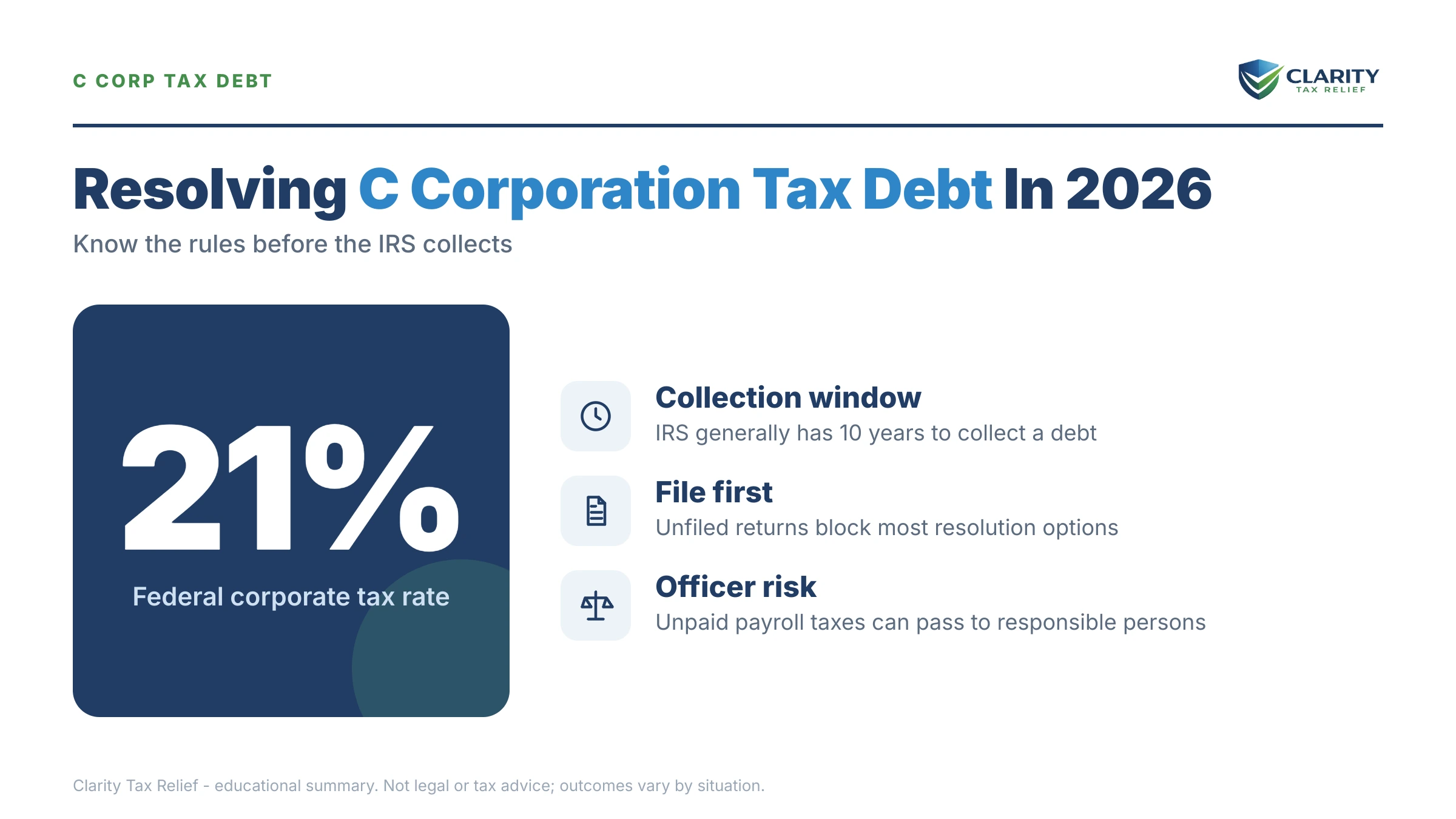
A C corporation is its own taxpayer: it files Form 1120 and pays a flat 21% federal income tax on its profits, and when that tax goes unpaid, the debt is assessed against the corporation's EIN. The most common paths to an 1120 balance are:
- Profit without estimated payments. A corporation that expects to owe $500 or more generally must pay estimated tax through the year. A profitable year with no deposits produces a big April balance plus an underpayment penalty.
- A late-filed 1120. The failure-to-file penalty runs 5% per month, ten times the 0.5% failure-to-pay rate, so one unfiled year can add 25% before interest.
- An audit or IRS adjustment. Exam changes, disallowed deductions, or a math correction can create a balance years after the return was filed, arriving on a CP161 notice or a post-adjustment CP220.
- A return that overstated income. If the 1120 itself was wrong — a duplicated 1099-K, a missed deduction, unclaimed depreciation — amending the return to reduce the tax debt with Form 1120-X can shrink the balance before you negotiate on it.
One thing 1120 debt is not: a personal bill. That distinction drives every decision that follows, so let's draw the line precisely.
Is C corporation tax debt personal? Where the line actually sits
Shareholders and officers are generally not personally liable for a C corporation's unpaid income tax — the corporate veil holds for Form 1120 balances. The IRS collects from the corporation's bank accounts, receivables, and assets, not from your wages, your Social Security, or your home. There are three exceptions that make corporate debt personal, and they're worth checking honestly:
- Unpaid payroll taxes. If the corporation also fell behind on 941 back taxes, the withheld-from-employees portion is "trust fund" money. The IRS can assess that portion against any responsible person — owner, officer, even a check-signer — through the Trust Fund Recovery Penalty. This is the single most common way a corporate problem becomes a personal one.
- Transferee liability. If the corporation paid out cash, property, or "loans" to shareholders while the tax went unpaid, especially during a wind-down, the IRS can pursue the recipients up to the value of what they received.
- Alter ego or nominee findings. If corporate formalities were ignored and the company was effectively your personal checkbook, the IRS can argue the entity and the owner are one and the same. Rare, but real in single-shareholder corporations.
If none of those apply, your personal assets are a wall the IRS's automated collection system does not climb for 1120 tax. That changes your negotiating posture completely: the question isn't "how do I protect my house," it's "what can the corporation afford, and is it worth keeping alive."
What happens if the corporation ignores the debt
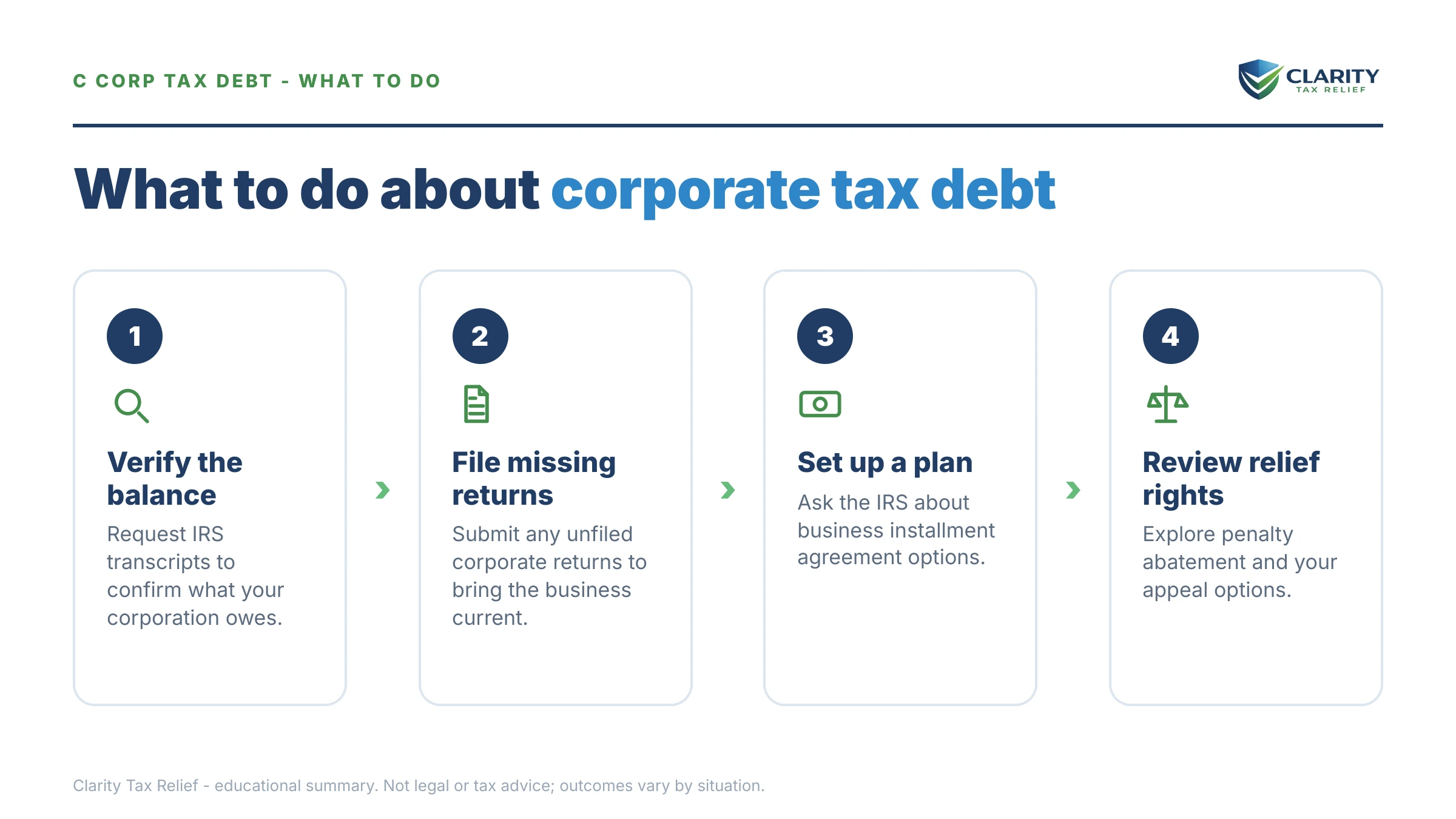
Business collection runs on its own automated notice track, and it ends at the corporation's bank account and receivables. The sequence escalates in stages — each notice carries more enforcement power than the last:
- CP161 — the first business balance-due bill, showing tax, penalties, and interest by year. No enforcement yet; this is the cheapest moment to act.
- CP163 — a reminder that the balance remains, now larger. Still just a bill.
- CP504B — the business intent-to-levy notice under IRC §6331(d). The IRS can seize the corporation's state tax refund, and a federal tax lien against corporate assets becomes likely.
- CP297 or Letter 1058 — the final notice of intent to levy. It starts a 30-day clock to request a Collection Due Process hearing on Form 12153. Miss it. The IRS can levy corporate bank accounts, freeze receivables by sending levies directly to your customers, and, in persistent cases, seize equipment and inventory.
- Enforcement. A corporate bank levy carries the same 21-day hold before funds leave that personal levies do. A levy on accounts receivable is worse: your customers are legally required to pay the IRS instead of you, which most small corporations do not survive.
Two 2026 realities sharpen this. First, the IRS workforce was cut roughly 27% in 2025, so reaching a human to negotiate takes longer. But the notice stream and levies are automated and never paused. Second, a filed lien against the corporation's EIN is public record, and commercial lenders, landlords, and bonding companies check those records even though the lien never touches your personal credit report.
| Notice | What it means | Your deadline & what's at stake |
|---|---|---|
| CP161 | First bill for an 1120 balance due | Pay-by date printed on the notice; the cheapest window before penalties compound |
| CP163 | Reminder — balance still unpaid, growing monthly | Date printed on the notice; last stop before enforcement language begins |
| CP504B | Intent to levy (§6331(d)); state refund seizable, lien likely | Typically 30 days from the notice date before the IRS can move on property |
| CP297 / Letter 1058 | Final notice of intent to levy | 30 days to file Form 12153; miss it and you lose the Collection Due Process hearing that blocks levy while you negotiate |
Your corporation's notices are stacking up?
Send us the CP161, CP504B, or final notice you're holding. An experienced tax professional will confirm whether any of it can reach you personally and map the corporation's real options — free, confidential, before the levy clock runs out.
The corporation's resolution options, by eligibility
A C corporation has most of the same resolution tools an individual has. But the thresholds and forms are different. The notice won't advertise any of them. The general playbook for negotiating with the IRS lives in our guide to how to settle tax debt yourself. Here is how each option applies specifically to an 1120 balance:
| Option | Who qualifies | Cost & trade-offs |
|---|---|---|
| Pay in full | Any corporation with the cash or credit to cover it | Stops penalties and the notice sequence immediately; interest ends |
| Online installment agreement | Combined balance of $25,000 or less (as of this writing); all returns filed | Setup fee applies; interest + 0.5%/month penalty continue until paid |
| Negotiated installment agreement | Balances above the online threshold; requires Form 433-B financials | IRS reviews corporate assets, receivables & cash flow; deposits must stay current |
| Business Offer in Compromise | Corporations whose assets + future income genuinely can't cover the debt | $205 fee, 20% down on lump-sum offers; roughly 1 in 5 offers accepted in FY2024 |
| Currently Not Collectible | Corporations where any payment would force closure; verified by financials | Pauses levies, not the debt — interest accrues and a lien is likely |
| Penalty abatement | Clean prior compliance (first-time abate) or documented reasonable cause | Free to request; can remove 20–25% of an old balance in one letter |
Three notes the table can't hold. First, the business IRS installment agreement rules require every return to be filed and current deposits to be on schedule before the IRS will say yes — compliance first, negotiation second. Second, a business offer in compromise for an operating corporation is a genuinely hard sell: steady revenue is future collection potential in the IRS's math, so offers mostly succeed for corporations that are winding down or insolvent. Third, on penalties, note that business penalty abatement is changing in your favor: starting summer 2026, the IRS's Automatic Exemption from Penalty (AEP) begins applying first-time-abate-style relief automatically, with no request needed, but for balances already assessed, a written request is still the faster path.
And a boundary worth naming: this page covers the corporation's federal income tax. State franchise and income obligations — Delaware, California, Texas — run on entirely separate statutes and collection machinery. See our franchise tax debt guide for those.
What $31,200 of C corporation tax debt actually costs
Say your corporation owes $31,200 from its 2024 Form 1120 — a hypothetical, but a common size. Here's the real arithmetic:
- Doing nothing: the failure-to-pay penalty alone is 0.5% × $31,200 = $156 per month, on top of interest compounding daily at the federal underpayment rate. A year of silence adds roughly $1,900 in penalty before a dollar of interest.
- Installment agreement: at $31,200 the corporation is above the $25,000 online threshold, so it faces Form 433-B disclosure — unless it can pay the balance down by about $6,200 first, dropping under $25,000 and qualifying for the simpler online agreement. Spread over 48 months, that residual $25,000 runs roughly $520/month plus accruing interest and penalty.
- Penalty abatement first: if the balance includes, say, $6,000 of late-filing and late-payment penalties and the corporation had a clean prior three years, a first-time abatement request could remove that $6,000 — nearly enough by itself to reach the online-agreement threshold. You can estimate what penalties and interest are adding to your own balance with our IRS penalty & interest calculator.
- The retiree's version: if you're drawing Social Security and the corporation is barely active, the sharpest question isn't the monthly payment — it's whether keeping the entity alive is worth it. The $31,200 stays with the corporation; your benefit check is untouched unless a trust-fund payroll assessment lands on you personally. Sometimes an orderly wind-down beats a four-year payment plan, but the sequence matters enormously (see below).
How to respond to C corporation tax debt, step by step
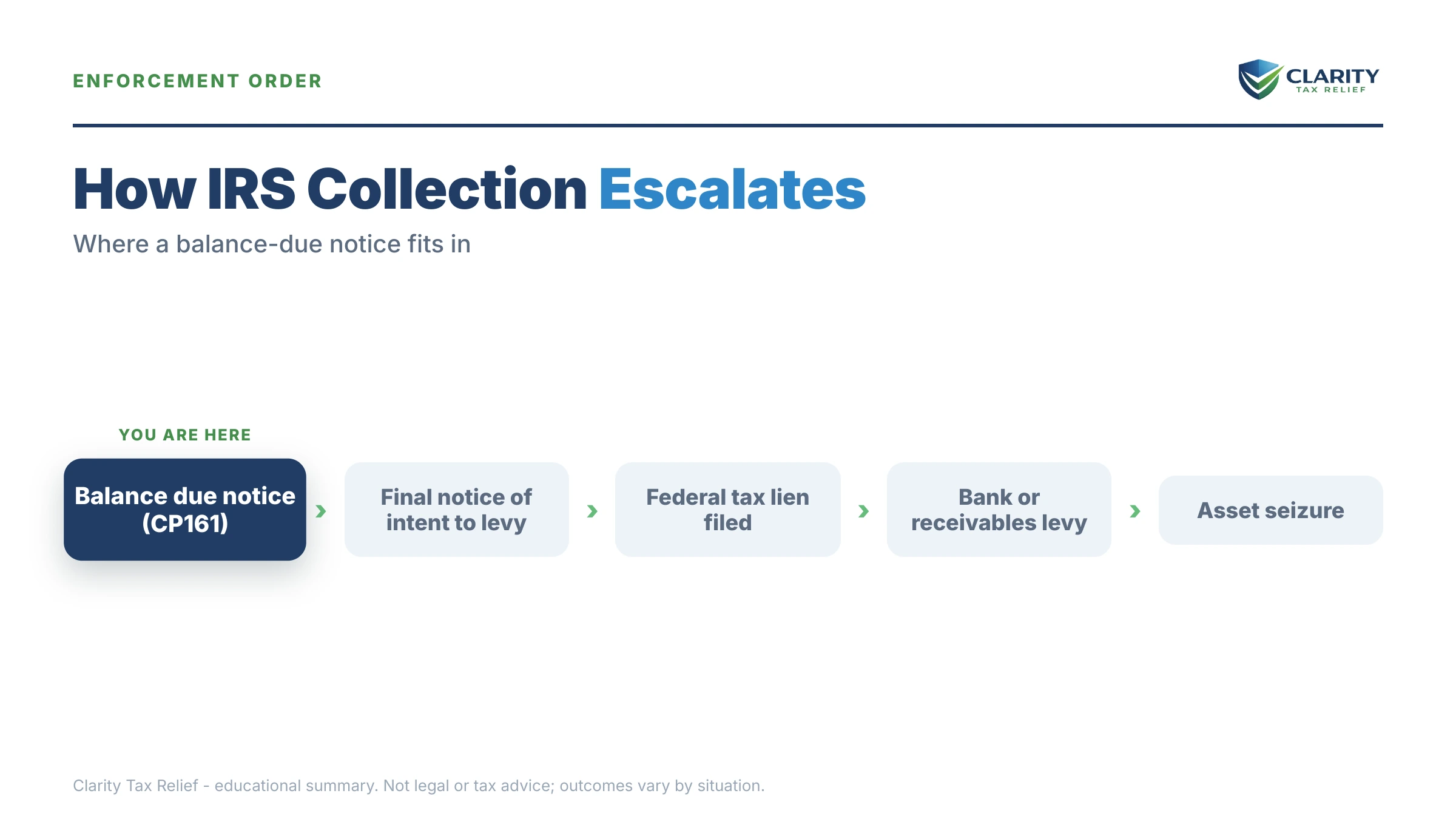
- Verify the assessment: pull the corporation's IRS account transcript and match the assessed balance against the Form 1120 you actually filed before paying anything.
- File every missing return: the IRS will not approve a payment plan or an offer while any required 1120 or 941 is unfiled. The failure-to-file penalty is ten times the failure-to-pay penalty.
- Stop the debt from growing at the front end: get current-quarter estimated tax payments and any federal tax deposits back on schedule so new liability stops stacking on top of the old one.
- Pick the resolution that fits the corporation's finances: choose full payment, an installment agreement, a business Offer in Compromise, or hardship status using the eligibility table above.
- Request penalty relief: ask for first-time abatement or reasonable-cause relief on the failure-to-file and failure-to-pay penalties — on older corporate balances, penalties are often a quarter of the total.
Payments and plan setup happen at IRS.gov/payments. The current business plan terms are on the IRS payment plans page. Form 1120 itself, with instructions, is at the IRS's About Form 1120 page.
Thinking of closing the corporation instead?
Dissolving a C corporation does not erase its tax debt, but done correctly, the debt generally dies with the entity because there is nothing left to collect from. Done incorrectly, it follows you home. The trap is distribution order: if the corporation hands its remaining cash, vehicles, or equipment to shareholders while the IRS balance sits unpaid, transferee liability lets the IRS pursue each recipient up to the value received. Creditors, including the IRS, come before owners in a wind-down, always. If closure is on the table, read the sequencing rules in dissolving a business that owes the IRS before you move a single asset, and get a professional review if payroll debt is any part of the mix.
When you can handle this yourself, and when help changes the outcome
Plenty of corporate balances need no professional at all. Handle it yourself if the corporation received a first CP161 it agrees with and can pay, or if the balance is under the online threshold and a simple installment agreement solves it — the setup takes an afternoon. A straightforward first-time abatement letter is also very much a DIY task. If money is the only constraint, the free help with IRS tax debt options — including the Taxpayer Advocate Service when the IRS itself is causing the harm — are real and worth using.
Experienced help changes outcomes in five specific situations: a CP297 or Letter 1058 has arrived and the 30-day CDP window is running. The debt mixes 1120 and 941 balances (because the payroll piece can become personal). The IRS has levied or is about to levy receivables. You're winding the corporation down with assets still inside it. Or the balance has crossed into six figures, where a revenue officer typically takes the file — see what changes with large tax debt help. In those cases, the order of moves — returns, penalties, financial disclosure, then negotiation — routinely changes the final number and what survives of the business.
Terms on your corporation's notices, decoded
- Form 1120 — the C corporation's own income tax return; the tax on it is assessed against the corporation's EIN, not your SSN.
- Trust-fund vs. non-trust-fund taxes — income tax (1120) is non-trust-fund and stays corporate; taxes withheld from employee paychecks are trust-fund money and can become personal.
- Trust Fund Recovery Penalty (TFRP) — the IRS's tool for assessing unpaid trust-fund payroll taxes against responsible individuals personally.
- Transferee liability — the IRS's right to collect from anyone who received corporate assets while the tax debt was unpaid.
- Federal tax lien vs. levy — a lien is a public claim against the corporation's assets. A levy is the actual seizure of its bank funds, receivables, or property.
- CSED — the Collection Statute Expiration Date: the IRS has 10 years from assessment to collect, pausable by offers, appeals, and bankruptcy.
C corporation tax debt questions, answered
Am I personally liable for my C corporation's tax debt?
Usually not for income tax. A C corporation is a separate legal taxpayer, and Form 1120 income tax is the corporation's debt, not yours. The exceptions are unpaid payroll taxes (the trust-fund portion can be assessed against you personally through the Trust Fund Recovery Penalty), transferee liability if you took corporate assets while the debt was unpaid, and personal guarantees that you signed.
Can the IRS take my Social Security for my corporation's tax debt?
Not for the corporation's Form 1120 income tax. That debt belongs to the corporation, and the IRS collects it from corporate assets and income. Your Social Security is exposed only if a debt is assessed against you personally, such as a Trust Fund Recovery Penalty from unpaid payroll taxes. A personal assessment can trigger a levy of up to 15% of your benefit through the Federal Payment Levy Program.
What notices does the IRS send a C corporation that owes taxes?
The business sequence starts with CP161, the first balance-due bill, followed by CP163 reminders. If those go unanswered, CP504B announces intent to levy. A final notice (CP297 or Letter 1058) starts a 30-day clock to request a Collection Due Process hearing before the IRS can levy bank accounts and receivables. Each notice prints its own pay-by date.
Can a C corporation get an IRS payment plan?
Yes. A corporation that owes $25,000 or less in combined tax, penalties, and interest can usually apply online. Larger balances typically require Form 433-B financial disclosure and negotiation with the IRS. The corporation must stay current on filings and federal tax deposits, and interest plus the 0.5% monthly late-payment penalty continue until the balance is paid.
Can a C corporation file an Offer in Compromise?
Yes — a corporation can submit Form 656 with a Form 433-B (OIC) showing that its assets and future income cannot cover the debt. The application fee is $205, lump-sum offers require 20% down, and the IRS accepted roughly 1 in 5 offers in FY2024. An operating corporation with steady revenue rarely qualifies; offers work best for businesses that are winding down or genuinely insolvent.
What happens to C corporation tax debt if the corporation closes?
The debt generally stays with the corporation and dies with it if there's nothing left to collect — the IRS cannot pursue shareholders for Form 1120 tax simply because the company dissolved. The major exception is transferee liability: if the corporation distributed cash or assets to shareholders while the tax was unpaid, the IRS can pursue those shareholders up to the value of what they received.
Does the 10-year collection statute apply to corporate tax debt?
Yes. The IRS has 10 years from the date it assesses corporate tax to collect it, the same CSED that applies to individuals. Events like a pending Offer in Compromise or bankruptcy pause the clock, so the real expiration date is often later than ten calendar years. The IRS typically escalates enforcement, not patience, as the deadline approaches.
Does my C corporation's tax debt show up on my personal credit report?
No. A federal tax lien for corporate tax is filed against the corporation and its EIN, not your Social Security number, and tax liens were removed from consumer credit reports years ago anyway. But the lien is still a public record: banks, bonding companies, and commercial lenders will find it. It can freeze the corporation's credit lines and complicate contracts.
Your next 24 hours
- Find the notice number and pay-by date on the corporation's most recent IRS letter, top right corner. CP161 or CP163 means you have room; CP504B or CP297 means the levy track is live.
- Gather three things: the last Form 1120 the corporation filed, every IRS notice in the stack. A current snapshot of the corporation's bank balance and receivables.
- Get the free case review. Call (888) 825-7779 or use the 2-minute form. An experienced tax professional will confirm whether any part of this debt can reach you personally and which resolution the corporation's numbers actually support, before another month of penalty and interest posts.
This guide is general information, not tax or legal advice for your specific situation. Eligibility for IRS programs depends on individual facts and circumstances; no outcome is guaranteed.