
Business Tax Debt
Tax Relief for Small Business: Every Real Option in 2026
The short answer: tax relief for small business means matching your debt to a real IRS program — a payment plan (up to 72 months for balances of $50,000 or less), an Offer in Compromise, hardship status, or penalty abatement. Payroll tax debt follows stricter rules: the trust-fund portion can become your personal liability.
You kept the doors open by choosing rent, suppliers, and your crew over the IRS, and now the balance you meant to catch up on has its own penalties, its own notices, and its own momentum. That was a survivable decision, not a fatal one. There is a specific program for every version of this problem; the map below matches yours to the right one.
One distinction controls everything on this page: whether your debt is income tax or payroll tax. Income and self-employment tax debt — the kind a 1099 contractor or Schedule C owner carries on a personal 1040 — moves through the same programs as any individual debt. Unpaid Form 941 payroll taxes are a different animal, because part of that money was withheld from employees and the IRS treats it as stolen trust funds, not a loan.
⏱ The clock that's actually running: there is no single deadline on business tax debt, but the failure-to-pay penalty adds 0.5% of the balance every month, interest compounds daily on top of it, and if you have unfiled returns, the failure-to-file penalty runs at 5% per month, ten times faster. Every month of waiting raises the price of every option below.
Why small businesses fall behind with the IRS
Most small business tax debt starts with cash flow, not dishonesty — no employer is withholding for you, so the tax bill arrives after the money is spent. The common triggers cluster into a few patterns:
- Missed quarterly estimates. 1099 contractors and Schedule C owners owe income tax plus roughly 15.3% self-employment tax. A strong year with no quarterlies produces a five-figure April surprise. (If this is your first year in business, our guide to the first-year self-employed tax-bill shock covers the math.)
- Payroll deposits skipped to make payroll. Using withheld employee taxes as working capital feels temporary and becomes 941 back taxes — the category the IRS pursues hardest.
- Entity-level balances. A corporation's 1120 balance due, a partnership late-filing penalty, or an adjusted business return generates its own notice stream (CP161 rather than CP14).
- A business that already closed. Dissolving the entity does not dissolve trust-fund liabilities — see payroll tax debt business closed and closed business owe sales tax for how those debts follow the owner.
Which pattern you're in decides which relief programs are even on the table, so identify it before you apply for anything.
What happens if you ignore business tax debt
IRS collection is an automated escalation sequence, and in 2026, with the IRS workforce down roughly 27%, the notices, liens, and levies are generated by systems that never got smaller. The stages run in order:
- First bill. A CP14 for personal/Schedule C debt, or a CP161 for an entity balance. No enforcement yet — this is the cheapest moment to act.
- Reminder notices. The balance grows monthly while the letters get firmer.
- Intent to levy — CP504 (or CP504B for businesses). The IRS can now seize your state tax refund. A federal tax lien against business and personal assets becomes likely.
- Final notice — LT11 or Letter 1058. This starts a 30-day clock and your Collection Due Process rights (requested on Form 12153). After it expires, the IRS can levy without further warning.
- Enforcement. Bank levies (a 21-day hold before funds leave), levies on accounts receivable sent directly to your customers, and continuous levies on any W-2 wages you draw. Business assets and inventory can be attached by the lien.
- For payroll debt: the personal stage. A revenue officer investigates who controlled the money. The Trust Fund Recovery Penalty transfers the withheld portion to owners, officers, bookkeepers, anyone who signed checks, as a personal debt, proposed via Letter 1153 with a strict protest window printed on the letter.
An accounts-receivable levy deserves special mention: the IRS orders your clients to send your invoiced payments to the Treasury instead of you. For a contractor or service business, that stage doesn't just cost money. It tells every customer you have a tax problem.
Behind on business taxes right now?
Whether it's a 1040 balance from 1099 income or unpaid 941s, an experienced tax professional will review your notices and transcripts free and map the specific program that fits, before the automated system reaches the levy stage. Penalties and interest are accruing monthly either way.
Tax relief for small business: your options, compared
The IRS runs five real relief programs, and eligibility for each is means-tested — no firm can enroll you in anything your own financials don't support. (For the general mechanics of applying yourself, our pillar on how to settle tax debt yourself covers each program in depth. This table shows how they apply to a business.)
| Option | Best fit | Key eligibility threshold |
|---|---|---|
| Short-term payment plan | Debt you can clear within 180 days | Individuals and sole proprietors; $0 setup fee; all returns filed |
| Streamlined installment agreement | Personal / Schedule C / 1099 debt | Balance ≤ $50,000; up to 72 months; set up online without full financial disclosure |
| In-business installment agreement | Entity-level and payroll (941) balances | Separate thresholds from individual plans; trust-fund express agreements exist for smaller payroll balances — see our business IRS installment agreement guide |
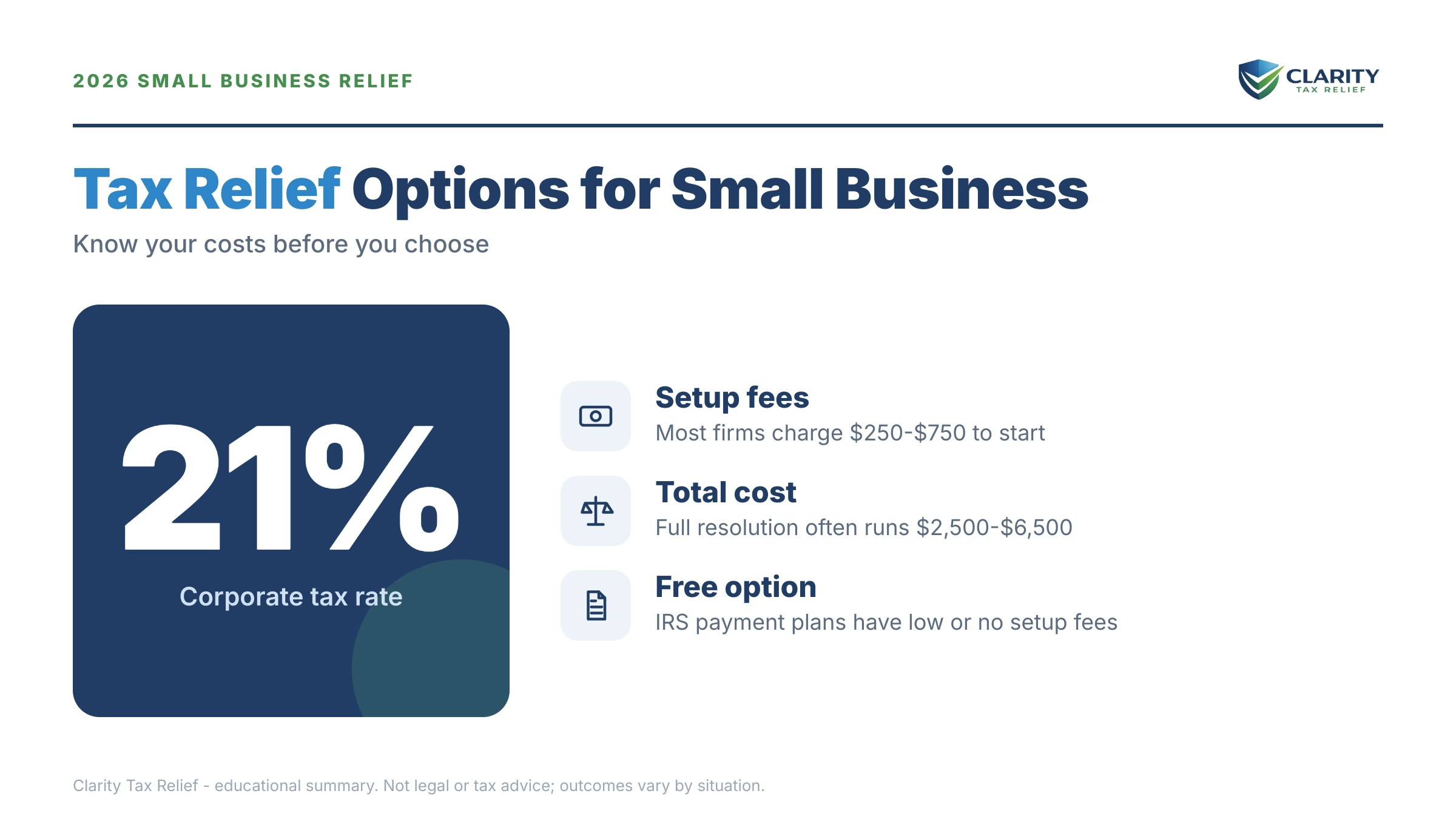
| Offer in Compromise | Debt your assets and income genuinely can't cover | Reasonable Collection Potential below the balance; $205 fee and 20% down on lump-sum offers (both waived with low-income certification) |
| Currently Not Collectible | Genuine hardship — any payment would sink the household or business | Financial disclosure on Form 433-F (individuals) or Form 433-B (businesses); debt remains and interest accrues |
| Penalty abatement (FTA / AEP / reasonable cause) | Shrinking the balance before any of the above | Clean compliance for the prior 3 years (first-time abatement), or documented cause beyond your control |
Two business-specific notes on that table. First, a 1099 contractor's or sole proprietor's "business" debt is legally personal 1040 debt, so the friendlier individual thresholds (180-day plans, the $50,000 streamlined tier, the guaranteed installment agreement under $10,000) all apply to you. Second, an Offer in Compromise from an operating business is genuinely harder: the IRS counts your future business income in its math, so a company generating steady profit usually can't show the debt is uncollectible. The self-employed version has its own quirks — covered in OIC self employed.
What each option costs and how long it takes
Every relief option carries three costs: what the IRS charges, what keeps accruing while you're in it, and what professional help runs if you hire it. Here's the honest ledger:
| Option | Upfront cost | Typical timeline |
|---|---|---|
| Short-term payment plan | $0 setup; interest and 0.5%/month penalty continue | Set up online in minutes; paid off within 180 days |
| Long-term installment agreement | Setup fee varies by application method (reduced or waived at low income) | Days to weeks to establish; up to 72 months to pay |
| Offer in Compromise | $205 application fee + 20% of the offer for lump-sum offers (both waived with low-income certification) | Commonly many months to review; automatically accepted if the IRS doesn't decide within 2 years, with narrow exceptions - a returned or rejected offer stops the clock, and time during court disputes does not count |
| Currently Not Collectible | $0 to request; interest continues and a lien may still be filed | Weeks to document and process; reviewed periodically as income recovers |
| Penalty abatement | $0 to request | First-time abatement can resolve in a single call; reasonable-cause requests take weeks to months |
| Hiring a tax relief firm | Flat or staged fees that scale with complexity — always get the quote in writing | Adds weeks of setup; matters most on payroll, levy, and multi-year cases |
Worked example: a 1099 contractor who owes $13,600
Say you're a 1099 contractor who had a strong year, skipped quarterlies, and filed a return showing $13,600 due — income tax plus self-employment tax. Here's the real math on each path (this is a hypothetical illustration, not a promised result):
- The cost of waiting: the failure-to-pay penalty alone is 0.5% × $13,600 = $68 every month, with daily-compounding interest stacked on top. You can run your own figures with our IRS penalty and interest calculator.
- Short-term plan: $13,600 ÷ 6 months ≈ $2,267/month clears it within the 180-day window at $0 setup — the cheapest exit if a big invoice is coming.
- Streamlined installment agreement: at $13,600 you're well under the $50,000 online threshold. $13,600 ÷ 72 ≈ $189/month as a floor, though the IRS sets the actual payment slightly higher because penalties and interest keep accruing until payoff. No financial disclosure required.
- Guaranteed installment agreement: not available here. That program caps at $10,000. Pay the balance below $10,000 and it becomes an option.
- Offer in Compromise: probably not a fit. With ongoing contract income, the IRS's formula counts your future earnings, and most working contractors' Reasonable Collection Potential exceeds $13,600. It becomes realistic only if income has collapsed and you have no equity to reach.
- Penalty relief: if your prior three years were clean, first-time abatement (or the new automatic AEP relief) can strip the penalties, often several hundred to a few thousand dollars off before you even start paying.
For this profile, the winning sequence is usually: file anything missing, request penalty abatement, then set up the streamlined agreement online, and fix quarterly estimates so next April doesn't rebuild the debt while you're paying off this one.
Payroll tax debt is different: treat it that way
Unpaid payroll taxes are the one small-business debt the IRS can convert into your personal debt regardless of your entity. The withheld portion — your employees' income tax and their share of FICA — is "trust fund" money, and through the Trust Fund Recovery Penalty the IRS assesses it against every "responsible person" who could have paid it and didn't. An LLC or corporation does not shield you from that portion.
Practically, that changes your playbook in three ways. Stay current on this quarter's deposits before negotiating anything — the IRS will not deal with a business still digging the hole. Expect a human: payroll cases get assigned to revenue officers faster than any other debt type. And be careful in the Form 4180 "responsible person" interview, because your answers determine who gets assessed personally. This is the category where representation earns its fee most clearly.
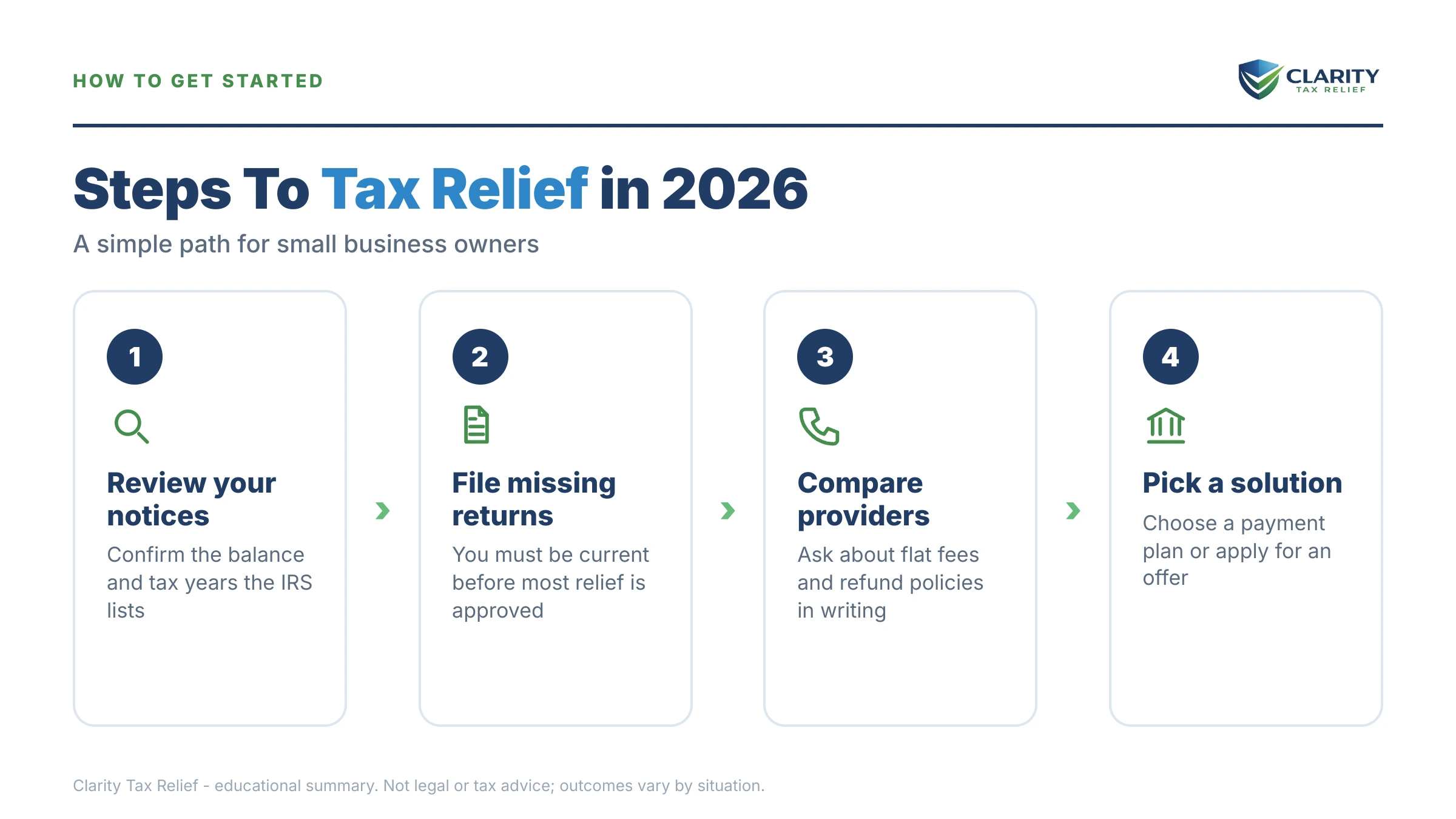
How to get tax relief for your small business, step by step
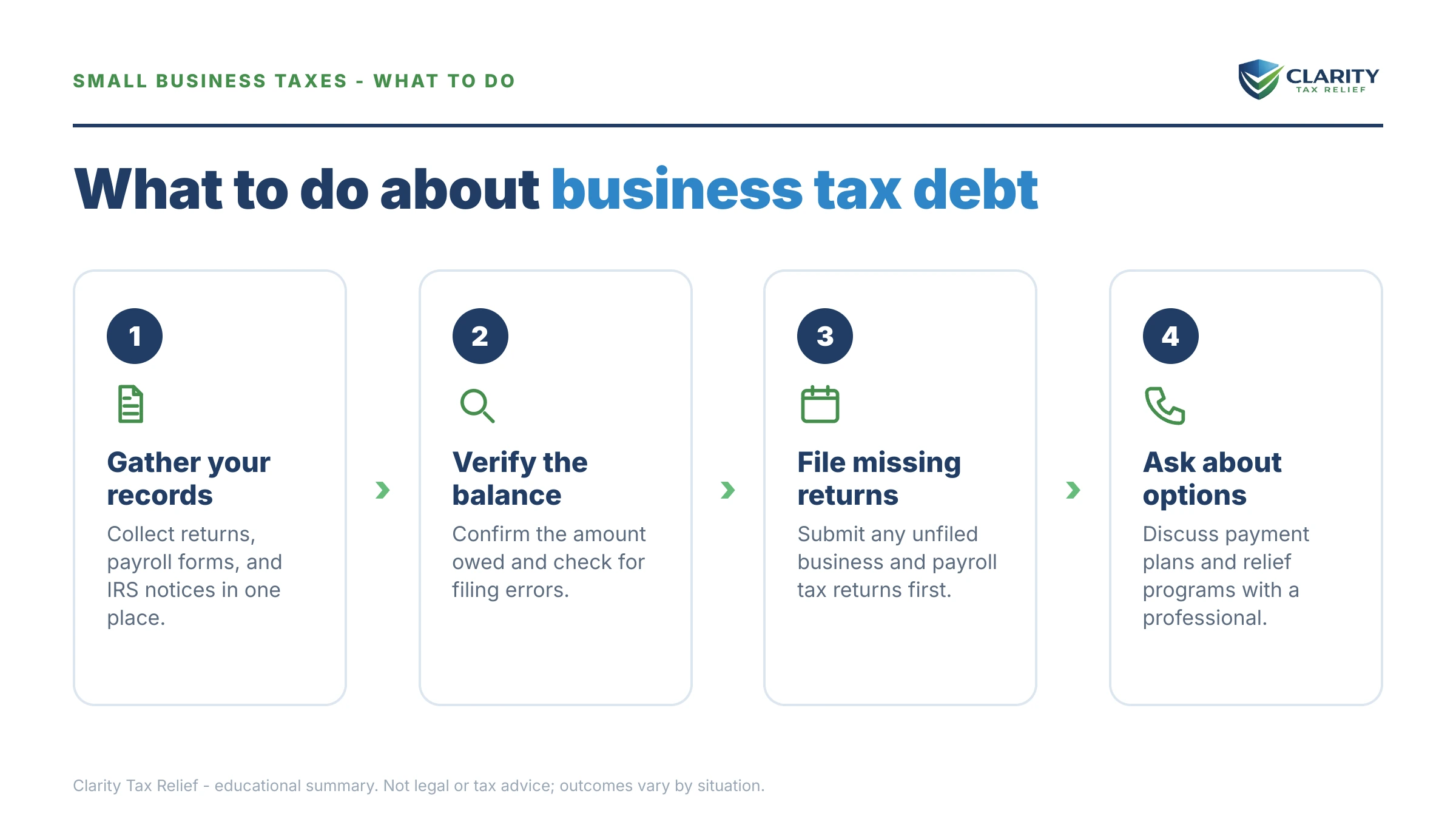
- Pull your IRS records. Log into your IRS online account or order transcripts so you know every year, every tax type (1040, 941, 1120). The exact balance on each — the notice in your hand rarely shows the whole picture.
- File every missing return. The IRS won't approve any payment plan or offer while returns are outstanding. The failure-to-file penalty (5% per month) is ten times the failure-to-pay penalty — filing stops the biggest bleed first.
- Attack the penalties. Request first-time abatement if your prior three years were clean, check whether the new Automatic Exemption from Penalty applies, or document reasonable cause — penalty relief shrinks the balance every other option has to cover.
- Match the debt to a program. Use the options table above: short-term plan if you can pay within 180 days, a streamlined installment agreement for personal/Schedule C debt of $50,000 or less, an in-business agreement for entity debt, an Offer in Compromise or Currently Not Collectible if the numbers genuinely don't work.
- Escalate to a professional when the stakes change. If the debt includes payroll taxes, a revenue officer has been assigned, a levy is in motion, or multiple years are unfiled, have an experienced tax professional review the file before you sign anything.
The IRS's own application portals are at IRS.gov payment plans and the IRS Offer in Compromise page.
When you can handle this yourself, and when help changes the outcome
A meaningful share of small business tax debt needs no professional at all. Handle it yourself when: the debt is personal 1040/Schedule C tax under $50,000, all your returns are filed, you agree with the amount. A payment plan fits your cash flow — that's an online application, not a case. First-time penalty abatement on a clean record is likewise a phone call, and our first-time penalty abatement guide walks through the script.
Experienced help changes outcomes in the situations with moving parts: any 941/payroll debt (because personal liability is being decided), a revenue officer or Form 4180 interview on the calendar, a bank or accounts-receivable levy already in motion, several unfiled years that need reconstructing, mixed entity-and-personal balances, or Offer in Compromise math where a valuation mistake means rejection. If you can't reach the IRS by phone, common with 2026 staffing, the Taxpayer Advocate Service is a free escalation path when a levy is causing hardship.
If you hire help, hire carefully
Any firm promising to settle your business debt for "pennies on the dollar" before seeing a single financial document is selling a fantasy — the IRS decides settlements with a formula, not a negotiation over lunch. Real firms review your transcripts first, quote a written fee, and tell you when the answer is "just set up the plan yourself." Our how to choose a tax relief company checklist covers the vetting questions, how much does tax relief cost breaks down fair pricing, and if you're comparing the big national brands, start with our Optima Tax Relief alternatives comparison — business and payroll cases especially reward firms that handle them routinely.
Terms you'll hear, decoded
- Trust fund taxes: the portion of payroll taxes withheld from employees' paychecks — money the IRS considers held in trust for the government, never yours to spend.
- Trust Fund Recovery Penalty (TFRP): the mechanism that assesses unpaid trust fund taxes personally against anyone who was responsible for paying them and willfully didn't.
- CSED: the Collection Statute Expiration Date — the IRS generally has 10 years from assessment to collect, though offers, appeals, and bankruptcy pause the clock.
- Reasonable Collection Potential (RCP): the IRS's formula for the most it could ever collect from you — asset equity plus a multiple of your monthly ability to pay. An Offer in Compromise succeeds only when your offer meets or beats it.
- Lien vs. levy: a lien is a legal claim securing the debt against your assets. A levy is the actual seizure — of a bank account, receivables, or wages.
Small business tax relief questions, answered
Does the IRS have a tax relief program for small businesses?
Yes, but it's the same set of programs everyone uses, applied under business rules: installment agreements, Offers in Compromise, Currently Not Collectible status, and penalty abatement. There is no special "small business forgiveness program," and any firm advertising one is selling access to programs you can apply for directly. Which program fits depends on your entity type and whether the debt includes payroll taxes.
Can a small business settle its IRS debt for less than it owes?
Sometimes, through an Offer in Compromise. But the IRS accepted roughly 1 in 5 offers in FY2024, and offers from operating businesses face extra scrutiny because the IRS expects future income to cover the debt. An offer works when your assets and realistic income genuinely can't cover the balance before the collection statute runs out. Trust-fund payroll debt is the hardest category to settle.
Am I personally liable for my business's tax debt?
It depends on the entity and the tax. Sole proprietors and single-member LLC owners owe income and self-employment tax personally. There is no separation. Corporate income tax generally stays with the entity. But the trust-fund portion of unpaid payroll taxes can be assessed against any "responsible person" personally through the Trust Fund Recovery Penalty, even after the business closes.
Can the IRS shut down my small business over back taxes?
The IRS rarely padlocks a business. But it can levy business bank accounts, seize accounts receivable directly from your customers, and file liens against business assets — any of which can end a business in practice. A bank levy comes with a 21-day hold before funds leave, which is your window to act. Repeatedly missing payroll deposits ("pyramiding") is what triggers the most aggressive enforcement.
How much does small business tax relief cost?
The IRS's own costs are modest: $0 setup for a short-term plan, a setup fee for long-term agreements (reduced or waived at low income), and a $205 application fee for an Offer in Compromise (waived with low-income certification). Professional fees vary widely with complexity — a simple payment plan costs far less to handle than a payroll-tax or multi-year case. Get a flat-fee quote in writing before hiring anyone.
Is payroll tax debt treated differently from income tax debt?
Yes — much more strictly. The withheld portion of payroll taxes is money the IRS considers taken from your employees, so it assigns revenue officers faster, settles trust-fund debt rarely, and can transfer that portion to owners, officers, and check-signers personally. Income and self-employment tax debt, by contrast, moves through the standard payment-plan and offer programs with far less friction.
Will my business penalties be removed automatically in 2026?
Some may be. Starting in summer 2026, the IRS is rolling out Automatic Exemption from Penalty (AEP), which applies first-time-style relief without a request. Until it fully covers your penalty type, you can still request first-time abatement if you were compliant for the prior three years, or reasonable-cause relief for illness, disaster, or other events outside your control.
Your next 24 hours
- Find the real total. Log into your IRS online account (or pull your latest notices) and write down each year, each tax type (1040, 941, 1120) and the balance on each. The answer changes if any of it is payroll tax.
- Gather three things: your last filed business return, every IRS notice you've received, and roughly three months of income records or bank statements. That's everything an eligibility review needs.
- Get the free case review. Call (888) 825-7779 or use the 2-minute form and an experienced tax professional will map your balances to the right program, while penalties and interest are still accruing on every month of delay.
This guide is general information, not tax or legal advice for your specific situation. Eligibility for IRS programs depends on individual facts and circumstances; no outcome is guaranteed.