
Hiring Help
Tax Attorney vs CPA vs Enrolled Agent: Who Should You Hire in 2026?
The short answer: in the tax attorney vs CPA vs enrolled agent decision, all three can represent you before the IRS with identical, unlimited rights. Enrolled agents are usually the best value for back-tax resolution, CPAs for complex accounting and returns, and tax attorneys when there's criminal exposure, litigation, or bankruptcy involved.
You're comparing a tax attorney vs CPA vs enrolled agent because a real IRS problem just landed on you — maybe a balance from a joint return your ex swore was handled, now arriving in your name only. The credential you pick determines what you pay, what stays confidential, and whether the problem gets solved once or twice.
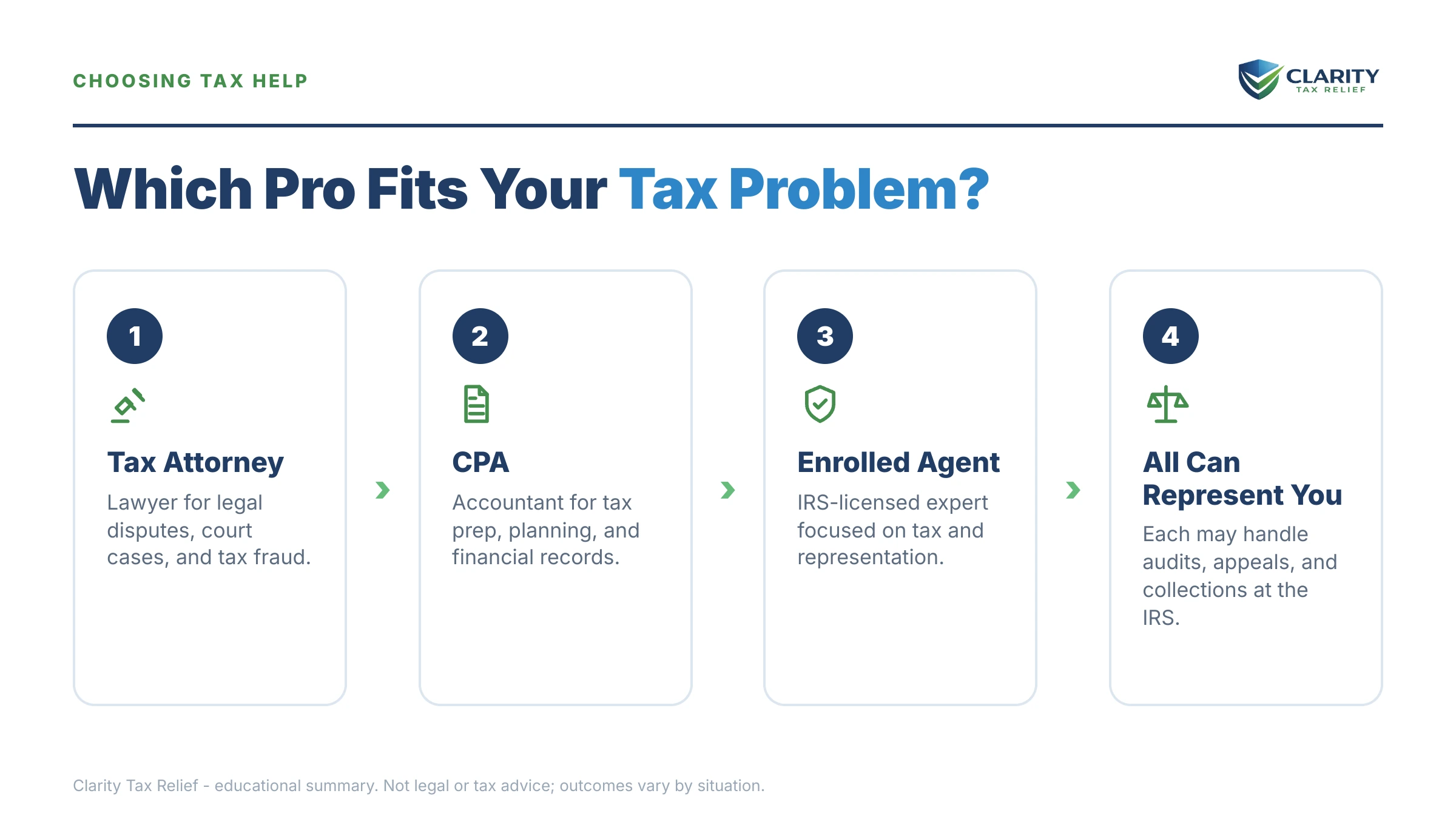
Here's the fact that reframes the whole decision: all three credentials hold identical "unlimited representation rights" before the IRS under Circular 230. An enrolled agent can stand between you and an IRS collector exactly as an attorney can. What differs is training, price, confidentiality rules, and what happens if your case leaves the IRS and enters a courtroom. The comparison image below lays out all three credentials side by side — worth a look before you make any calls.
⏱ The clock while you decide: there's no application deadline on hiring help, but your balance isn't waiting. The failure-to-pay penalty adds 0.5% per month, interest compounds daily on top, and the IRS notice sequence keeps advancing whether or not you've picked a professional.
What each credential actually means
A tax attorney, a CPA. An enrolled agent are licensed by three different bodies, tested on three different things, and priced in three different markets.
Tax attorney. Licensed by a state bar after law school; many carry an LL.M. in taxation on top. The attorney is the only one of the three with full attorney-client privilege — the kind that holds up even if your case turns criminal — and the only one who can represent you in federal district court or bankruptcy court. That legal firepower is real, and it's priced like it.
CPA. Licensed by a state board of accountancy after the CPA exam and experience requirements. CPAs are the strongest of the three on accounting: rebuilding business books, financial statements, multi-entity returns, and audits that turn on how the numbers were kept. The catch most people miss: many CPAs do return prep and never touch IRS collections. The license permits representation; the practice often doesn't include it.
Enrolled agent. The only credential of the three issued by the federal government, the IRS itself, after a three-part Special Enrollment Exam (or years of qualifying IRS experience). EAs are tax-only specialists. For collection work — notices, installment agreements, penalty abatement, Offers in Compromise, levy releases — an EA does the same representation work an attorney would, usually at a fraction of the price. Our full guide to what is an enrolled agent goes deeper on the credential itself.
| Feature | Tax attorney | CPA | Enrolled agent (EA) |
|---|---|---|---|
| Licensed by | State bar | State board of accountancy | The IRS (federal) |
| IRS representation rights | Unlimited | Unlimited | Unlimited |
| Confidentiality | Full attorney-client privilege, including criminal matters | §7525 privilege — civil tax advice only | §7525 privilege — civil tax advice only |
| Can appear in court | Tax Court, district court, bankruptcy court | Generally no (rare Tax Court exam exception) | Generally no (rare Tax Court exam exception) |
| Typical pricing model | Hourly, often $300–$500+, retainer up front | Hourly or project, often ~$150–$400/hr | Usually flat fees for defined resolution work |
| Strongest at | Criminal exposure, litigation, bankruptcy strategy | Business books, complex returns, accounting-heavy audits | Collections: payment plans, OICs, penalties, levies |
“Become an enrolled agent, the highest credential the IRS awards, and find out how to maintain your status.”
— Enrolled agents (IRS.gov)
What happens if you hire the wrong one, or keep waiting
Hiring the wrong credential costs you twice: once in mismatched fees, and again when the case gets handed to the right professional anyway. Pay attorney rates for a routine installment agreement and you've bought a luxury version of a form an EA files every week. Tell a CPA the full story of income you deliberately hid, and that conversation has no criminal-proof privilege protecting it.
Waiting has its own cost, because IRS collections is an automated sequence that advances while you research:
- First bill (CP14) — the balance is stated; typically about 21 days before the system queues the next notice.
- Reminders (CP501/CP503) — no enforcement yet, but the 0.5% monthly penalty and daily interest keep compounding.
- CP504 — the IRS can now seize your state tax refund, and a federal tax lien becomes a live possibility.
- LT11 / Letter 1058 — final notice: a 30-day clock to a wage or bank levy. The stage where Collection Due Process rights must be exercised or lost.
In 2026 the IRS workforce is roughly 27% smaller than it was in early 2025 — humans are harder to reach. But the automated notice stream never stopped. The practical effect: the window where a phone call fixes things is the same, while the help lines are slower. You can estimate what waiting is costing you each month with our IRS penalty and interest calculator.
Not sure which professional your case needs?
Tell us what the IRS sent you and what you owe. An experienced tax professional will tell you, honestly, whether your case needs an EA, a CPA, an attorney, or nobody at all, while penalties and interest are still small. Free and confidential.
Which tax professional fits your situation
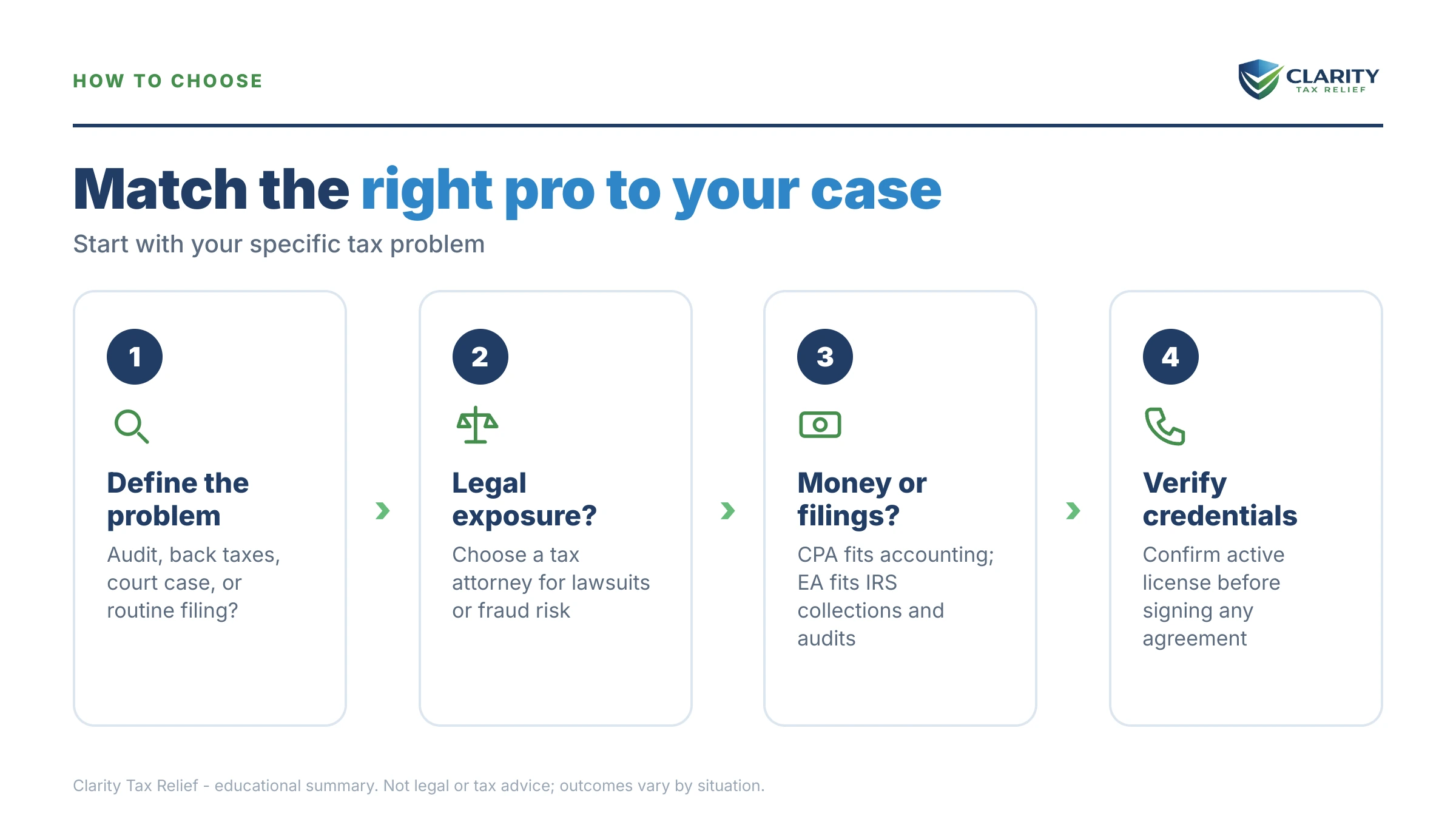
The right hire is decided by the problem, not the prestige of the credential. Match your situation to the table, then read the detail below it.
| Your situation | Best fit | Why |
|---|---|---|
| Owe under $10,000, agree with the bill | Usually nobody | A guaranteed installment agreement is set up online in minutes; a professional fee can exceed the interest saved |
| Collection notices, $10k–$50k, need a plan or penalty relief | Enrolled agent | Same IRS access as an attorney, priced for collections work; flat fees are the norm |
| Joint-return debt from an ex-spouse | EA (attorney if disputed in court) | Innocent spouse claims (Form 8857) are IRS administrative work first, litigation only rarely |
| Audit centered on business books or complex returns | CPA | The fight is over accounting records — the CPA's home field |
| IRS Criminal Investigation contact, fraud indicators | Tax attorney only | Only attorney-client privilege survives a criminal referral; say nothing to anyone else first |
| Tax Court litigation or bankruptcy strategy | Tax attorney | Courtroom representation is the one thing EAs and CPAs generally cannot do |
When the attorney earns the premium. Criminal exposure is the bright line. If a revenue agent starts asking intent questions, if you omitted income on purpose, or if IRS Criminal Investigation makes contact, hire an attorney before you explain anything to anyone — including a CPA or EA, whose §7525 privilege evaporates in criminal proceedings. The other attorney-only lanes: litigating a Tax Court petition rather than settling at Appeals, and using bankruptcy to address tax debt — the chapter 7 vs 13 tax debt analysis is genuinely legal work. For a deeper look at that threshold, see do i need a tax attorney for back taxes.
When the CPA is the right call. If the IRS's number is wrong because the underlying accounting is wrong — unfiled business returns with no books, a Schedule C audit built on bank deposits, depreciation that was never tracked — the fix starts with reconstruction, and that's CPA work. Many strong cases pair a CPA (fix the returns) with an EA (negotiate the resulting balance).
When the EA is the best value. Most consumer tax-debt cases are collections cases: a correct balance the reader can't pay, penalties that might be abated, or a levy that needs releasing. That is exactly what the EA credential was built for. The head-to-head tax attorney vs enrolled agent comparison covers the two-way decision in more depth. And if you're weighing an individual professional against a firm, read tax relief attorney vs company before signing anything.
A worked example: $4,800 of tax debt after a divorce
Say you owe $4,800 — a balance from the last joint return with your ex, and the divorce decree says they'd pay it. First hard truth: the IRS is not bound by your divorce decree. Both signers of a joint return owe 100% of the debt, whatever the family court ordered. (Why, and what to do about it: divorce and IRS debt: who pays.)
Now run the hiring math three ways:
- Do it yourself. At $4,800 you're under the $10,000 line for a guaranteed installment agreement. Spread over 36 months, that's $4,800 ÷ 36 ≈ $133/month plus accruing interest and the 0.5% monthly late-pay penalty (which drops to 0.25% once the agreement is in place). Total professional fees: $0.
- Hire an EA at a flat fee. If a resolution engagement runs, hypothetically, $1,500–$3,000, it only makes sense if the professional changes the outcome — say, an innocent spouse claim because the $4,800 traces to income your ex hid from you. Win that, and your share of the liability can be removed entirely: relief worth $4,800+ for a fee below it. See innocent spouse relief: how to qualify.
- Hire a tax attorney hourly. At $400/hour, ten hours is $4,000, 83% of the debt itself, to do administrative work an EA performs for less. Unless this $4,800 sits next to fraud questions or a court fight with your ex over the liability, the attorney is the wrong tool.
That's the whole decision framework in one number: a professional fee is justified only when the professional can change the outcome, not just process the paperwork.
How to choose the right tax professional, step by step
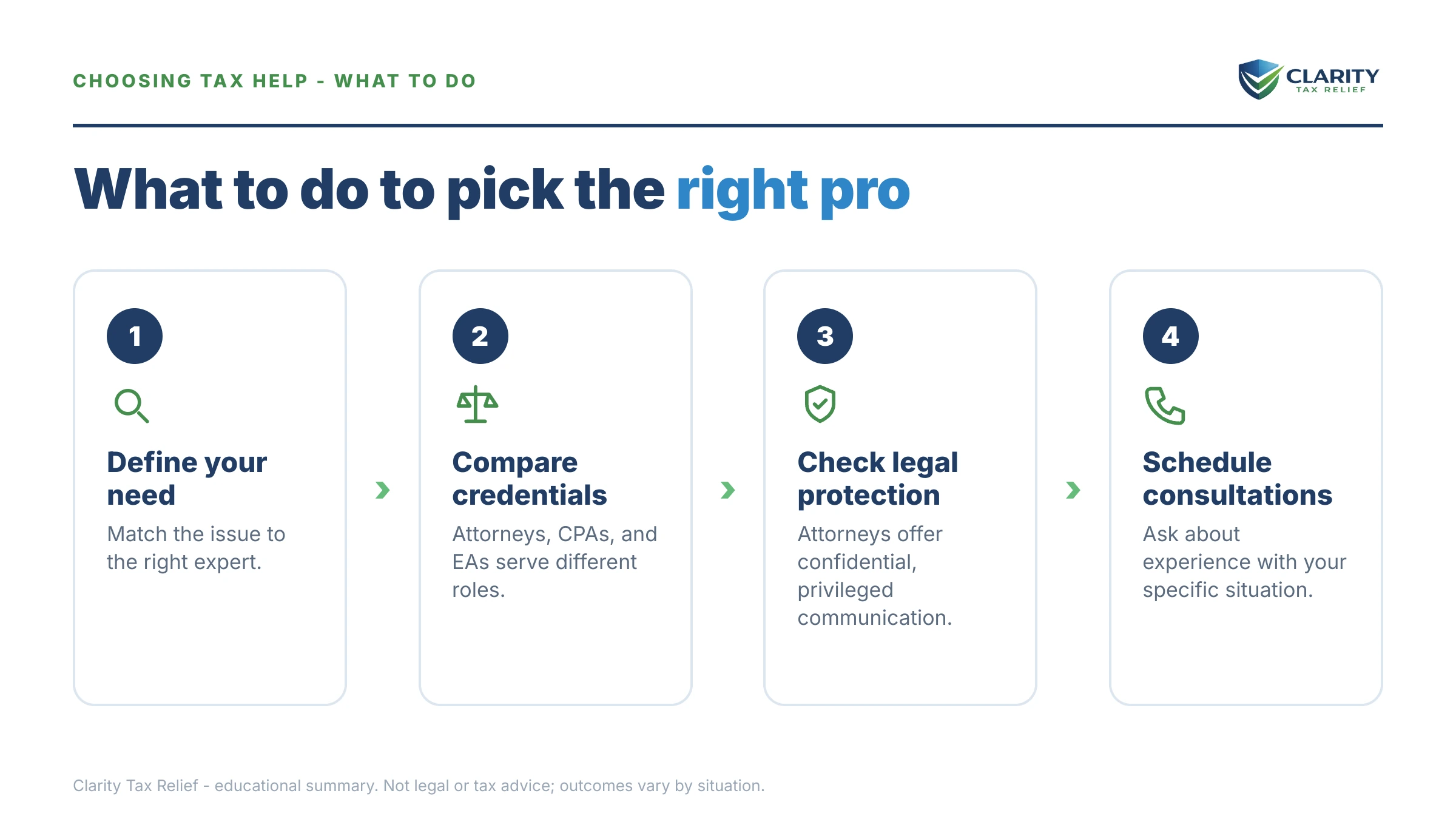
- Name the problem, not the credential. Write one sentence describing your issue: collection notices, unfiled returns, an audit, criminal contact, or a court deadline. The problem picks the professional — collections points to an EA, accounting to a CPA, legal exposure to an attorney.
- Verify the license before the first call. Check an attorney with the state bar, a CPA with the state board of accountancy. An EA against the IRS enrolled agent status process. Anyone who resists verification is disqualified.
- Ask who actually works your case. Confirm the credentialed person you spoke with is the one who will sign your power of attorney and call the IRS, not a salesperson who hands you off after payment.
- Get the fee model in writing. Flat fee or hourly, what is included, what triggers extra charges, and what happens if the IRS rejects the first proposal. No engagement letter, no engagement.
- Sign Form 2848 only after the engagement letter. Form 2848 gives the professional power of attorney with the IRS. Sign it after you have the written engagement, and know you can revoke it at any time if the relationship goes wrong.
For the fee side of step four, our breakdown of how much does tax relief cost shows what different engagement types typically run, and the Form 2848 power of attorney walkthrough explains exactly what you're signing in step five.
When you don't need any of them
An honest comparison has a fourth column: nobody. You can likely handle your case yourself when all of these are true:
- You agree the balance is correct — no disputed income, no ex-spouse liability question, no audit.
- The debt is small enough to pay within 180 days, or fits a streamlined online payment plan (balances up to $50,000 qualify for up to 72 months).
- All your returns are filed and there's no business, payroll, or multi-year mess underneath.
In that case, the step-by-step in our DIY pillar — how to settle tax debt yourself — is genuinely all you need. A single clean penalty-abatement request is often DIY-able too.
Where experienced help reliably changes outcomes: a levy already in motion, multiple unfiled years, business or payroll tax debt (which carries personal-liability rules of its own), Offer in Compromise math — the IRS accepted roughly 1 in 5 offers in FY2024, and most rejections are avoidable math errors — and any case where the liability itself is disputed, like an innocent spouse claim. Those are the files where the fee buys a different result, not just convenience.
Terms in this comparison, decoded
- Circular 230 — the Treasury rulebook governing who may represent taxpayers before the IRS and how they must behave.
- Unlimited representation rights — the authority to represent you at every IRS level (exams, collections, appeals); held equally by attorneys, CPAs, and EAs.
- Enrolled agent (EA) — a tax specialist licensed directly by the IRS after a three-part exam, focused entirely on federal tax.
- Form 2848 — the power-of-attorney form that lets your chosen professional speak to and receive mail from the IRS on your behalf.
- §7525 privilege — a limited confidentiality protection for tax advice from EAs and CPAs; it applies in civil IRS matters but not criminal ones.
- Attorney-client privilege — the broader confidentiality that only attorneys carry, which survives even a criminal investigation.
Tax attorney, CPA, and EA questions, answered
Is an enrolled agent as good as a CPA for tax debt?
For back-tax resolution, yes — an EA holds the same unlimited IRS representation rights as a CPA and is licensed by the IRS itself, exclusively in tax. Where a CPA pulls ahead is accounting: rebuilding business books, financial statements, or complex return work. If your problem is a collection notice, a payment plan, penalties, or an Offer in Compromise, the EA is usually the better-matched and better-priced hire.
When do I actually need a tax attorney instead of a CPA or EA?
You need an attorney when the problem is legal, not financial: contact from IRS Criminal Investigation, fraud indicators in an audit, a Tax Court petition you plan to litigate, or bankruptcy as a tax-debt strategy. Attorneys are the only professionals with full attorney-client privilege that survives a criminal referral. For ordinary collection cases — notices, levies, payment plans — attorney rates buy you the same IRS access an EA already has.
How much does a tax attorney cost compared to a CPA or enrolled agent?
Tax attorneys commonly bill hourly, often in the $300–$500+ range, with retainers of several thousand dollars. CPAs frequently fall between roughly $150 and $400 per hour depending on market and specialty. Enrolled agents most often work on flat fees for defined resolution work, which typically makes them the lowest-cost option for collection cases. Always get the fee model in writing before signing Form 2848.
Can a CPA represent me before the IRS?
Yes — CPAs hold unlimited representation rights under Circular 230, the same as attorneys and enrolled agents, covering audits, collections, and appeals. The practical catch is that many CPAs focus on return preparation and business accounting and rarely handle collections work. Before hiring one for a tax debt, ask specifically how many installment agreements, penalty abatements, or Offers in Compromise they handled in the last year.
Does attorney-client privilege matter for a tax debt case?
For most collection cases, no. There is nothing secret about owing money, and IRC Section 7525 already gives EAs and CPAs a limited confidentiality privilege for tax advice in non-criminal IRS matters. Privilege becomes decisive only when criminal exposure is possible, because the Section 7525 privilege does not apply to criminal proceedings. If there is any chance your case turns criminal, talk to an attorney before telling anyone else the full story.
Can an enrolled agent go to Tax Court?
Generally no. Tax Court representation is limited to attorneys and the small number of non-attorneys who have passed the Tax Court's own admission exam, which most EAs and CPAs have not. An EA can handle everything up to that point — exams, appeals, and collection due process hearings — and most disputes settle at IRS Appeals without a petition ever being litigated. If your case is genuinely headed to trial, that is attorney territory.
Should I hire a tax relief company instead of an individual professional?
It depends on who actually does the work. A legitimate tax relief firm staffs your case with credentialed professionals — EAs, CPAs, or attorneys — and puts their names on your Form 2848. A bad one hands you to unlicensed salespeople. Ask which credentialed person will sign your power of attorney and speak to the IRS for you. If the answer is vague, walk away, whatever the brand.
Your next 24 hours
- Write the one-sentence version of your problem. Pull out the most recent IRS notice, note the notice number in the top corner and the total balance. That sentence decides which professional (if any) you need.
- Gather three things: the notice, your last filed return, and a rough monthly income-and-expenses picture. Every professional you talk to, and the IRS itself — will start with these.
- Get a free case review before you commit to anyone. Send us your situation through the 2-minute form or call (888) 825-7779 — an experienced tax professional will tell you which credential your case actually needs, while the monthly penalty and daily interest are still small.
You can verify any preparer or representative's standing through the IRS's own resources for tax professionals at IRS.gov, set up a payment plan directly at IRS.gov/payments, and — if your case is stuck in IRS bureaucracy causing hardship — get free independent help from the Taxpayer Advocate Service.
This guide is general information, not tax or legal advice for your specific situation. Eligibility for IRS programs depends on individual facts and circumstances; no outcome is guaranteed.