
IRS Forms
Form 2848 Instructions: How to Fill Out the IRS Power of Attorney (2026)
The short answer: Form 2848 is the IRS power of attorney. It lets an attorney, CPA, or enrolled agent deal with the IRS for you. The core Form 2848 instructions: enter your details on line 1, your representative on line 2, the exact taxes and years on line 3, then both of you sign and submit online, by fax, or by mail.
You've decided you're done handling the IRS alone — maybe there's a payroll balance on your business, maybe it's a personal bill that keeps growing — and someone told you the first step is "sign a 2848." They're right. But the Centralized Authorization File (CAF) unit rejects a steady stream of these forms over small, avoidable errors: a vague line 3, a missing spouse signature, an unsigned Part II.
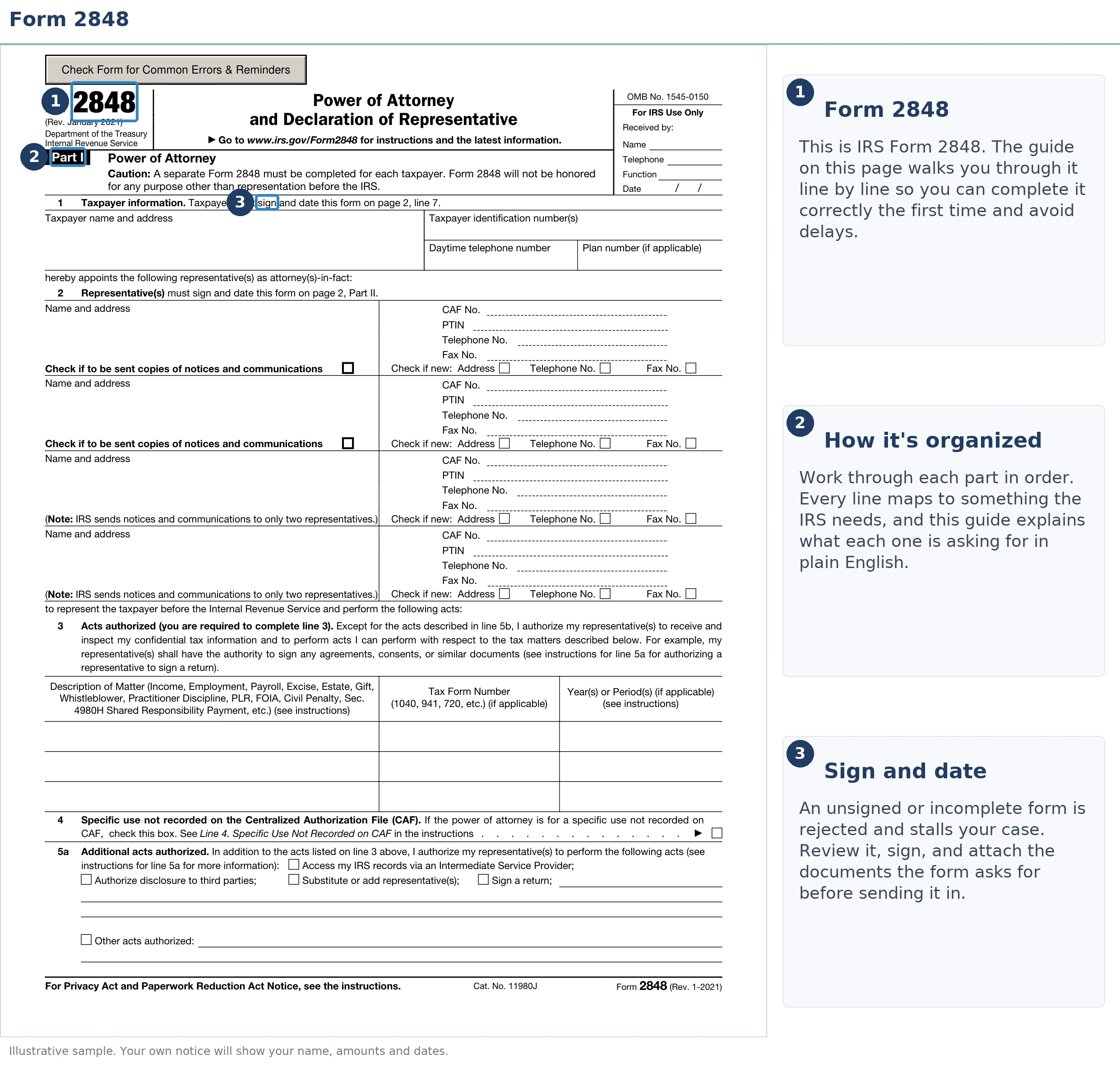
A rejected Form 2848 doesn't just waste paper. It means that for weeks, no one can legally speak for you while the IRS's automated notices keep moving. The image below shows you exactly what the current Form 2848 looks like and where the fields that cause most rejections sit, so you can follow along line by line.
⏱ The real clock: Form 2848 has no filing deadline of its own, but it pauses nothing. Every response window printed on your IRS notices keeps running while the CAF unit processes your authorization, and penalties and interest keep accruing monthly. File it correctly the first time, and have your representative send a copy directly to whoever is handling your case for immediate use.
What Form 2848 does, and when you actually need one
Form 2848 is the only IRS form that lets another person negotiate with the IRS on your behalf — its sibling, Form 8821, only shares information. The full name tells you its two halves: Power of Attorney (Part I, where you grant authority) and Declaration of Representative (Part II, where your representative certifies they're eligible to hold it).
Once a valid 2848 is on file, your representative can call the IRS's dedicated practitioner line, pull your transcripts, respond to notices, negotiate payment plans and penalty relief, and appear for you in audits, appeals, and collection hearings. You stop being the one on hold. If you're not even sure yet why the IRS is writing to you, start with why did I get a letter from the IRS, but if you already know you want someone else handling it, the 2848 is the legal key that makes that possible.
One scope rule surprises people: a 2848 only covers the exact tax types, form numbers, and periods you list on line 3. A power of attorney for your 2024 Form 1040 gives your representative zero authority over your business's Form 941 quarters. Small-business owners resolving both personal and payroll balances usually need the form completed for each, often one 2848 signed personally and one signed as an officer of the business.
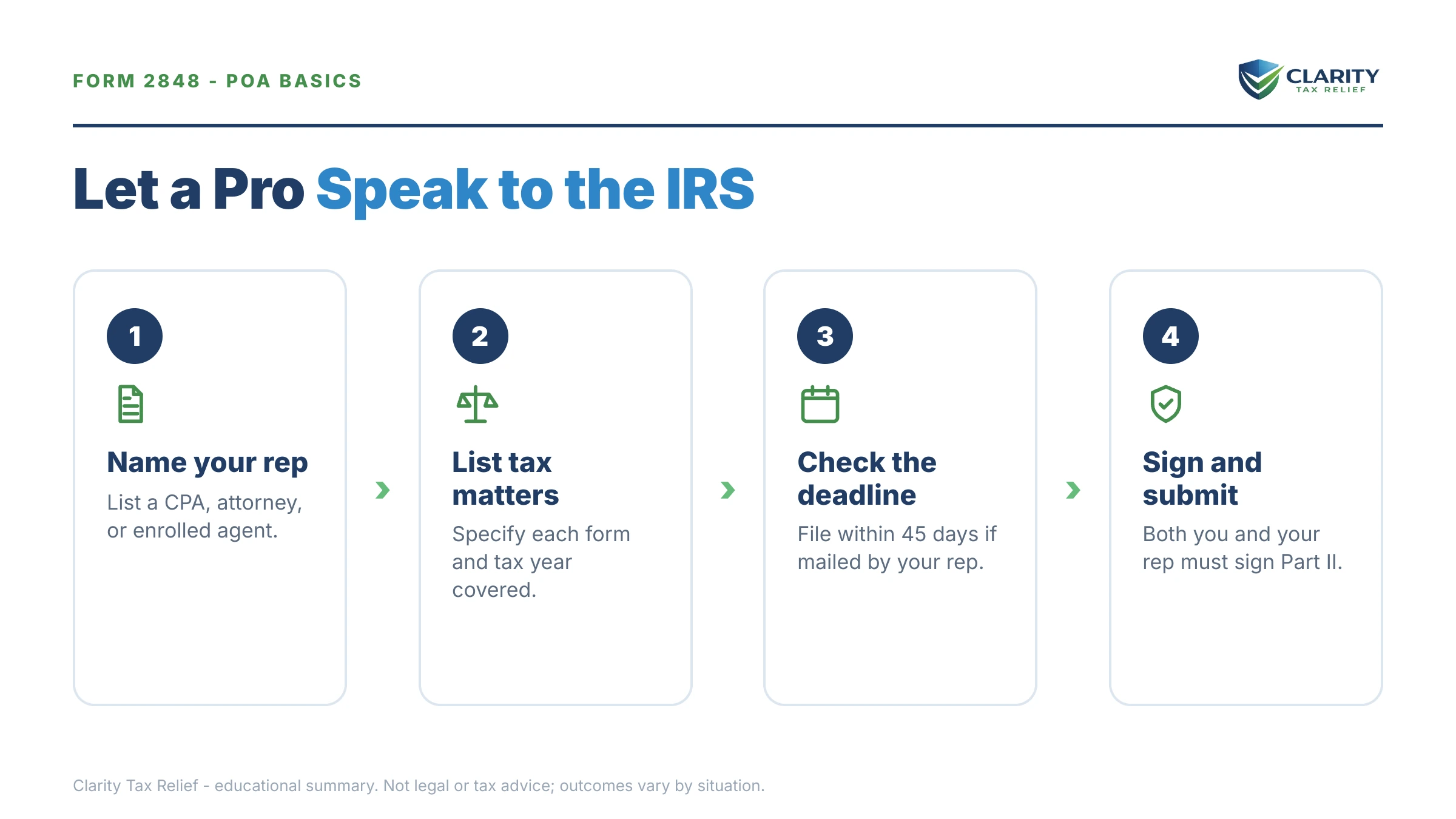
“Use Form 2848 to authorize an individual to represent you before the IRS. The individual you authorize must be a person eligible to practice before the IRS.”
— About Form 2848, Power of Attorney and Declaration of Representative (IRS.gov)
What a Form 2848 mistake costs you: the clock never stops
Filing Form 2848 pauses nothing — every deadline in the IRS collection sequence keeps running while your authorization is processed or, worse, bounced back for correction. If you're filing a 2848 because collection notices are arriving, here's the sequence moving underneath you while the paperwork sorts itself out:
- First bill (CP14 for individuals, CP161 for a business) — typically about 21 days to pay (10 business days if the balance is $100,000 or more) before the system escalates.
- Reminder notices (CP501/CP503) — still just bills, but the balance grows monthly.
- CP504 (or CP504B for a business) — the IRS can now take your state tax refund. A federal tax lien becomes a live possibility.
- LT11 / Letter 1058 — final notice of intent to levy — a 30-day clock starts on your Collection Due Process rights, requested with Form 12153. Miss it, and the IRS can levy wages and bank accounts.
This is why sloppy 2848s are expensive. A form rejected over a vague line 3 can cost you the exact weeks in which a representative could have set up a resolution before the final notice landed. In 2026 — with the IRS workforce down roughly 27% but its automated notice stream fully intact — a clean authorization filed early is one of the few ways to get a human working your file before the machine escalates it.
Filing a 2848 because IRS notices are stacking up?
Send us the notice that started this. An experienced tax professional will tell you exactly what authority the situation needs, prepare the Form 2848 correctly the first time, and get it in front of the right IRS unit — free review, no pressure, while penalties and interest are still small.
The boxes people miss
Two of them cause most of the rejections. If you want your representative to receive copies of notices, you have to check the box on line 2 for that, because it is not implied by naming them. And if you do not want this authorisation to revoke every earlier one on file, there is a separate box for that too, on line 6. Leaving it blank quietly cancels a prior representative you may still want.
Who can represent you, and what each authorization allows
Only certain people can be named on Form 2848, and Part II makes them declare which category they fall into. Attorneys (designation a), CPAs (designation b), and enrolled agents (designation c) have unlimited practice rights before the IRS. More limited categories include corporate officers, full-time employees of a business, immediate family members, enrolled actuaries and retirement plan agents, and — in narrow circumstances tied to returns they prepared — unenrolled return preparers. If you're weighing which credential fits your problem, see tax attorney vs CPA vs enrolled agent. If you're an adult child stepping in for mom or dad, the family-member route is covered in power of attorney for parent IRS.
Just as important is choosing the right form. Many people file a 2848 when the weaker Form 8821 instructions would do, or vice versa. Here's what each actually grants:
| What you need done | Form 2848 | Form 8821 | Nothing on file |
|---|---|---|---|
| View your transcripts and account records | Yes | Yes | Only you can |
| Speak to the IRS on your behalf | Yes | No | No |
| Negotiate a payment plan or penalty relief | Yes | No | No |
| Represent you in an audit, appeal, or collection hearing | Yes | No | No |
| Receive copies of the notices sent to you | Yes (up to two representatives) | Yes | No |
| Sign certain agreements for you | Yes, when authorized | No | No |
The rule of thumb: if anything needs to be argued, negotiated, or signed, only Form 2848 works. If someone just needs to monitor your account or receive copies — a bookkeeper, a lender, a tax preparer keeping watch — Form 8821 is simpler and grants less.
Form 2848 instructions, line by line
Line 3 is where most Forms 2848 die: the CAF unit rejects authorizations that say "all years," "all taxes," or leave the periods vague. Every line in Part I has a job. The table below pairs each one with the mistake that most often gets that section kicked back.
| Line / part | What to enter | Mistake that causes rejection or delay |
|---|---|---|
| Line 1 — Taxpayer | Your name, address, and SSN/ITIN — or the business name, address, and EIN for a business tax matter — plus a daytime phone | Using your personal SSN for a payroll (941) matter that belongs to the business EIN, or a name that doesn't match IRS records |
| Line 2 — Representatives | Each representative's name, address, and CAF number (they write "None" if it's their first authorization); check the box for notice copies | Missing CAF number field, or forgetting the notice-copy checkbox — copies go to a maximum of two representatives |
| Line 3 — Tax matters | Description of the matter (Income, Employment, Civil Penalty…), the form number (1040, 941…), and specific years or quarters | "All years" or "all taxes"; future periods more than 3 years past December 31 of the year the IRS receives the form |
| Line 4 — Specific use | Check only for a narrow, one-time use that shouldn't be recorded on the CAF | Checking it by accident — your representative then isn't in the system for anything else on your account |
| Lines 5a / 5b — Acts | Additional acts you grant (5a) and acts you specifically withhold (5b) | Not granting an act the case turns out to need, forcing an amended form mid-negotiation |
| Line 6 — Prior authorizations | Check the box and attach copies only if an earlier power of attorney should stay in effect | Accidentally revoking an existing representative — a new 2848 wipes prior POAs for the same matters by default |
| Line 7 — Signature | Your signature, date, and title if signing for a business | Unsigned or undated forms; one spouse signing for both; a typed "signature" on a faxed or mailed paper form |
| Part II — Declaration | Representative's designation letter, licensing jurisdiction, and signature | An incomplete or unsigned declaration — the single most common preparer-side rejection |
Two rules deserve extra weight. First, married couples need two separate forms, even on a joint return, each spouse signs their own 2848. Second, line 3's future-period limit means an authorization can reach forward only three years past December 31 of the year the IRS receives it, so long-running matters eventually need a fresh form.
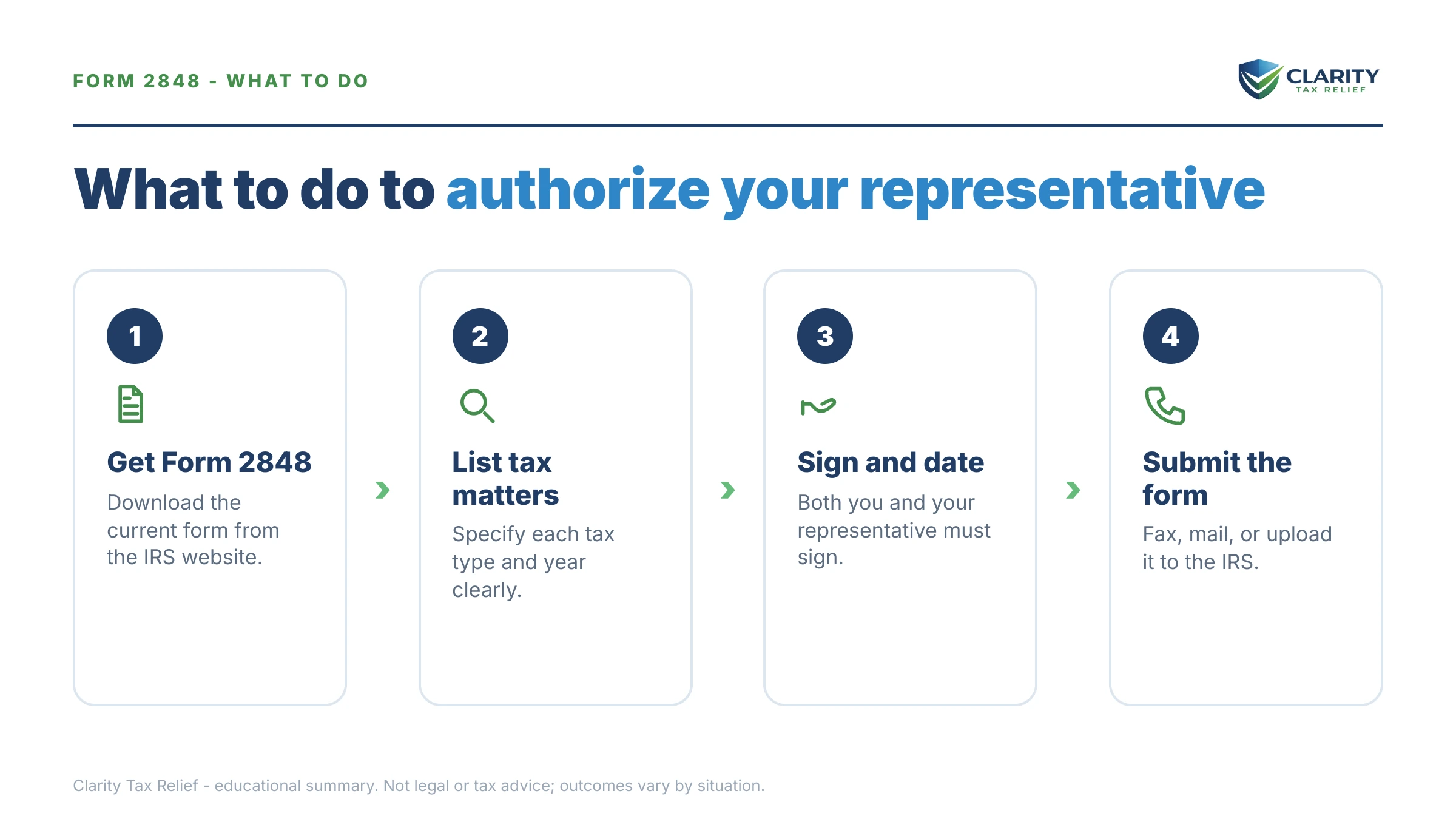
How to fill out and file Form 2848, step by step
- Download the current Form 2848. Get the latest revision directly from IRS.gov — the CAF unit can reject outdated versions. The instructions include the current fax numbers and mailing addresses for your location.
- Complete lines 1 and 2. Enter your name, address, and taxpayer identification number exactly as they appear on your returns — for a business payroll matter, that means the business name and EIN. List each representative's name, address, and CAF number, and check the box if you want them to receive copies of IRS notices (two representatives maximum).
- Describe the tax matters on line 3. State the type of tax, the form number. The specific years or periods — for example, "Employment taxes, Form 941, 1st–4th quarters 2025." Entries like "all years" or "all taxes" get the form rejected.
- Review lines 5a, 5b, and 6. Grant any additional acts your representative needs (like disclosing your information to a third party), list any acts you want to withhold, and check the line 6 box if you want an earlier power of attorney to stay in effect — otherwise the new form revokes it for the same matters.
- Sign, have your representative sign Part II, and submit. You sign and date line 7. Your representative completes the Declaration of Representative with their designation letter and licensing jurisdiction. Submit online through the IRS's upload tool, by fax, or by mail, and if a specific IRS employee is working your case, have your representative send a copy directly to them for immediate use.
On submission methods, the differences matter more than they look:
| Method | How it works | Best for |
|---|---|---|
| Online upload | The IRS's "Submit Forms 2848 and 8821 Online" tool; the only route that accepts electronic signatures, with identity verification | The fastest routine filing path |
| Fax to the CAF unit | Fax number depends on your location — listed in the current form instructions | Paper forms with handwritten signatures |
| Mail to the CAF unit | Address in the current instructions | When fax and upload aren't options — expect the longest wait |
| Direct to the assigned IRS employee | Your representative faxes a signed copy to the revenue officer, examiner, or practitioner line during a call | Same-day use on an active case while the CAF processes the original |
What representation changes: a worked $6,200 payroll example
A correctly scoped Form 2848 is often the difference between guessing at a balance and dismantling it piece by piece. Say you run a small business with payroll and you owe $6,200 across several Form 941 quarters — a mix the notices never quite explain. This is a hypothetical, but the mechanics are how these cases actually work.
Without authorization, you know one number: $6,200. With a 2848 covering "Employment taxes, Form 941" for the right quarters, your representative pulls the business transcripts and sees the composition — say $5,150 in tax, $780 in deposit and late-payment penalties, and $270 in interest. Going forward, the failure-to-pay penalty alone runs 0.5% of the unpaid tax per month: roughly 0.5% × $5,150 ≈ $26 every month, before interest.
Now the plan writes itself. The representative requests abatement of the $780 in penalties where the facts support it — first-time abatement if your deposit history is clean, reasonable cause if a specific event caused the miss (and note that starting summer 2026, the new Automatic Exemption from Penalty begins applying some relief with no request at all). A formal claim can go in on Form 843 instructions. If abatement lands, the balance drops toward $5,420 plus accruals. An installment agreement handles the rest, with the representative, not you, on the phone for every step. If the IRS wants financials first, the same authorization lets them prepare and defend the Form 433-F instructions package. For the bigger picture on payroll balances — including the personal-liability risk that makes them different from income tax — see 941 back taxes.
No outcome here is promised — abatement depends on your compliance history and facts. The point is narrower: none of those moves are possible until a valid 2848 is on file.
When you can handle this yourself
You do not need a power of attorney, or a professional — for everything the IRS sends. If you agree with a small balance and can pay it within 180 days, if you're setting up a simple online payment plan on a debt you don't dispute, or if you just need your own transcripts, your IRS online account handles it and Form 2848 adds nothing. Filing the form yourself to authorize a trusted family member for a straightforward matter is also perfectly doable with the line-by-line table above.
Representation earns its cost when the stakes or complexity rise: a levy already in motion, multiple unfiled years, an audit or appeal, any business payroll debt (where the IRS can pursue owners and check-signers personally), or negotiations where what you say can be used to build the case against you. In those situations, an experienced tax professional with a 2848 doesn't just save you phone time. It changes what gets said, what gets documented, and what the IRS is asked to consider.
Terms on Form 2848, decoded
- CAF number — the ID the IRS assigns a representative the first time an authorization is filed for them. It tracks every client authorization they hold.
- Centralized Authorization File (CAF) — the IRS database that records who is authorized to act for which taxpayer, on which taxes and years.
- Declaration of Representative — Part II of the form, where the representative certifies their eligibility category and licensing jurisdiction under penalty of perjury.
- Enrolled agent — a federally authorized practitioner with full IRS practice rights; see what is an enrolled agent.
- Revocation vs. withdrawal — same result, different signer: you revoke a representative's authority; a representative withdraws their own.
- Practitioner Priority Service — the dedicated IRS phone line for authorized representatives, generally faster than the lines available to the public.
Form 2848 questions, answered
What is IRS Form 2848?
Form 2848 is the IRS power of attorney. It lets an attorney, CPA, or enrolled agent deal with the IRS for you. The core Form 2848 instructions: enter your details on line 1, your representative on line 2, the exact taxes and years on line 3, then both of you sign and submit online, by fax, or by mail.
What is the difference between Form 2848 and Form 8821?
Form 2848 grants representation: your attorney, CPA, or enrolled agent can speak to the IRS, negotiate, and sign certain agreements for you. Form 8821 only authorizes the IRS to share your tax information — the appointee can see records but cannot argue your case or agree to anything. If you want someone to handle a balance due, an audit, or a collection matter, you need Form 2848.
Can a family member be my power of attorney with the IRS?
Yes — designation (f) in Part II lets an immediate family member (spouse, parent, child, sibling, grandparent, or grandchild) represent you on Form 2848. Their practice rights are more limited than an attorney, CPA, or enrolled agent, so for contested matters like an audit or a collection appeal, a credentialed representative can go further. This is a common setup for adult children helping an elderly parent.
How long does it take the IRS to process Form 2848?
CAF processing typically takes a few weeks, and 2026's roughly 27% workforce reduction has stretched that in many cases. You don't have to wait: your representative can fax a signed copy directly to the IRS employee handling your case, or to the practitioner line during a call, for same-day use while the CAF unit catches up.
Does Form 2848 expire?
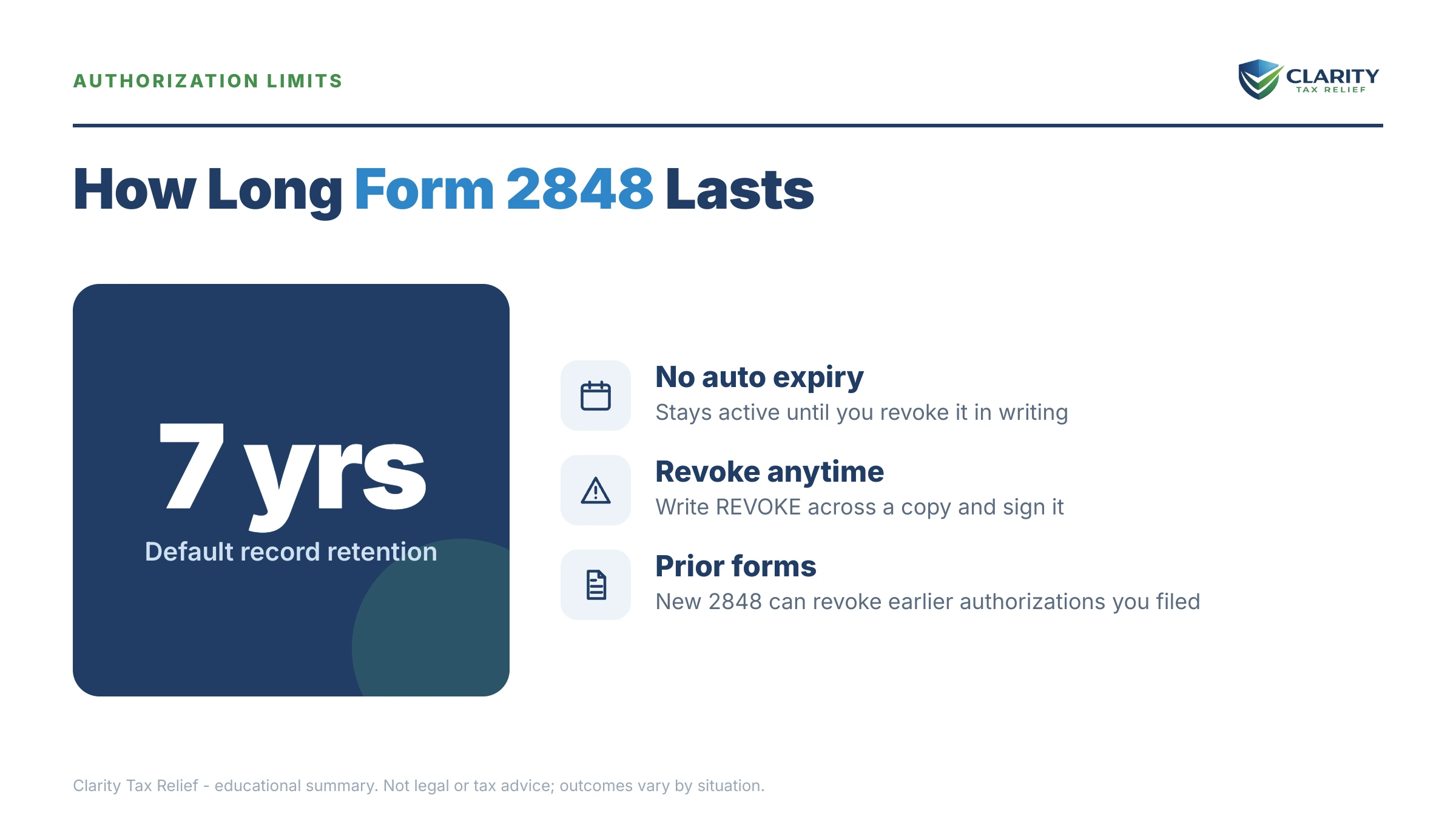
A Form 2848 stays in effect until you revoke it, your representative withdraws, or a newer Form 2848 for the same matters replaces it. It only covers the tax types and periods listed on line 3. It can only reach future periods up to three years past December 31 of the year the IRS receives it — beyond that, you'll need a new form.
How do I revoke a Form 2848?
Write 'REVOKE' across the top of a copy of the form, sign and date it below the notation, and send it to the CAF unit using the fax number or address in the current instructions. If you don't have a copy, send a signed statement naming each representative and the tax matters being revoked. Filing a new Form 2848 for the same matters also revokes the old one automatically unless you check the line 6 box.
Do my spouse and I need separate Forms 2848?
Yes. Even for a jointly filed return, each spouse must complete and sign a separate Form 2848 to authorize a representative. One spouse cannot sign for the other. A joint form signed by only one of you will be rejected or treated as covering only the signer. This trips up couples resolving a joint balance more than almost any other rule on the form.
Can I still talk to the IRS myself after filing Form 2848?
Yes. A power of attorney adds a representative; it never removes your own rights. You still receive the original of every notice, you can call the IRS yourself, and you can attend any meeting. Most people who hire representation choose to route everything through their representative anyway, so nothing gets said to the IRS that shouldn't be.
Your next 24 hours
- Find the paperwork driving this. Pull the notice or balance you want handled and write down the tax form number, the years or quarters. The amounts — that's exactly what line 3 of Form 2848 requires.
- Gather your records. Your last filed return, every IRS letter you've received, and, for a business matter, your EIN and payroll filings. A representative can act only as fast as the information you hand them.
- Get a free case review. Call (888) 825-7779 or use the 2-minute form. An experienced tax professional will confirm whether Form 2848 is the right authorization, prepare it correctly, and get to work while the penalties and interest on your balance are still as small as they'll ever be.
Primary sources: the IRS's official pages for About Form 2848, Power of Attorney and Declaration of Representative and About Form 8821, Tax Information Authorization, plus IRS.gov/payments for resolving the underlying balance.
This guide is general information, not tax or legal advice for your specific situation. Eligibility for IRS programs depends on individual facts and circumstances; no outcome is guaranteed.