
IRS Forms
Form 8379 Injured Spouse Allocation: How to Get Your Share of the Refund Back (2026)
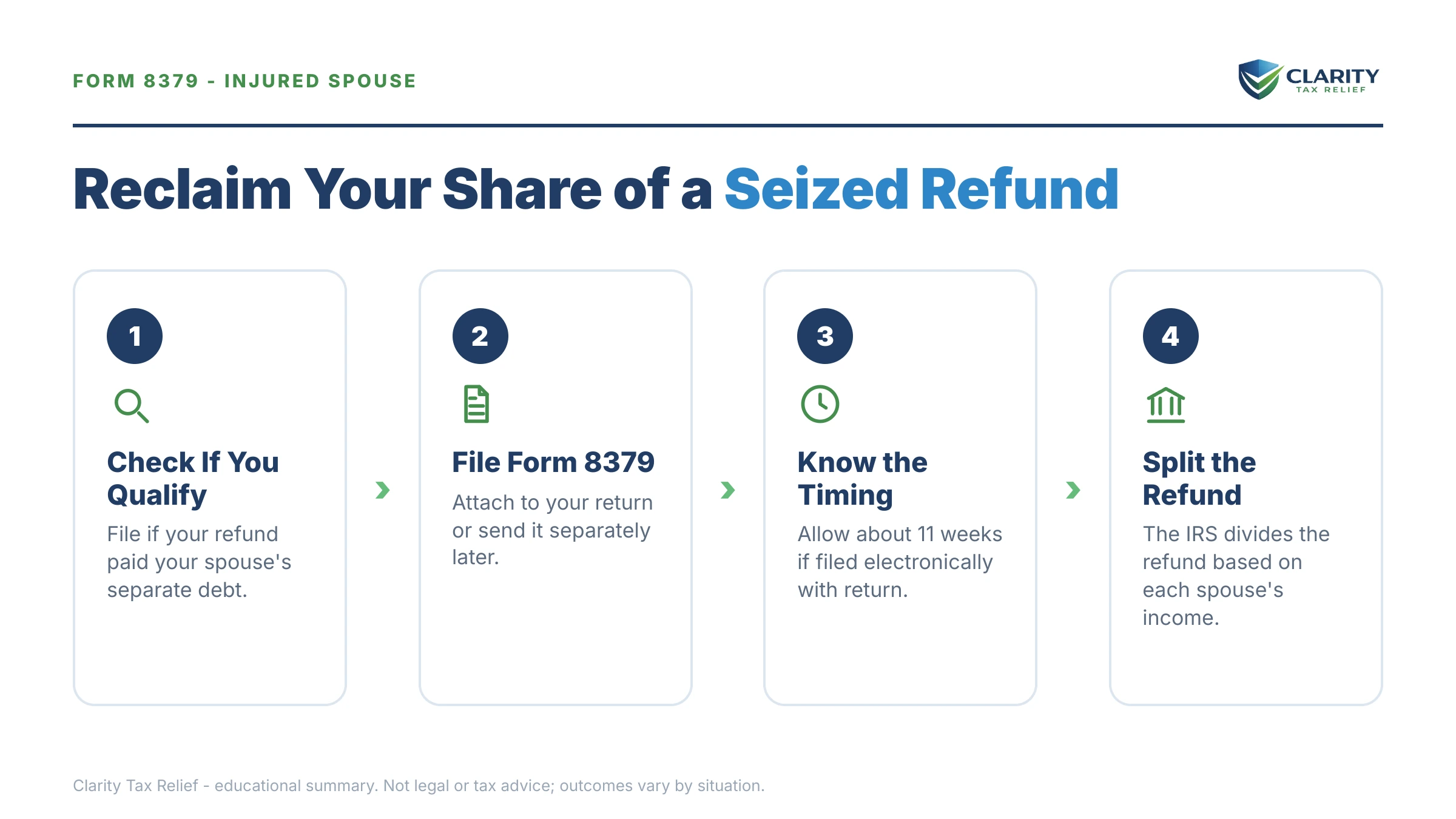
The short answer: Form 8379, the Injured Spouse Allocation, reclaims your share of a joint tax refund seized for your spouse's separate debt — back taxes, child support, or defaulted student loans. File it with your return or generally within 3 years after; the IRS typically takes 8 to 14 weeks to release your portion.
You checked "Where's My Refund" and instead of a deposit date found a message that your refund was applied to a debt. Your spouse's, not yours. You made every estimated payment out of your own 1099 income all year. A Form 8379 injured spouse claim exists for exactly this moment: it tells the IRS which part of that refund was legally yours and makes them give it back.
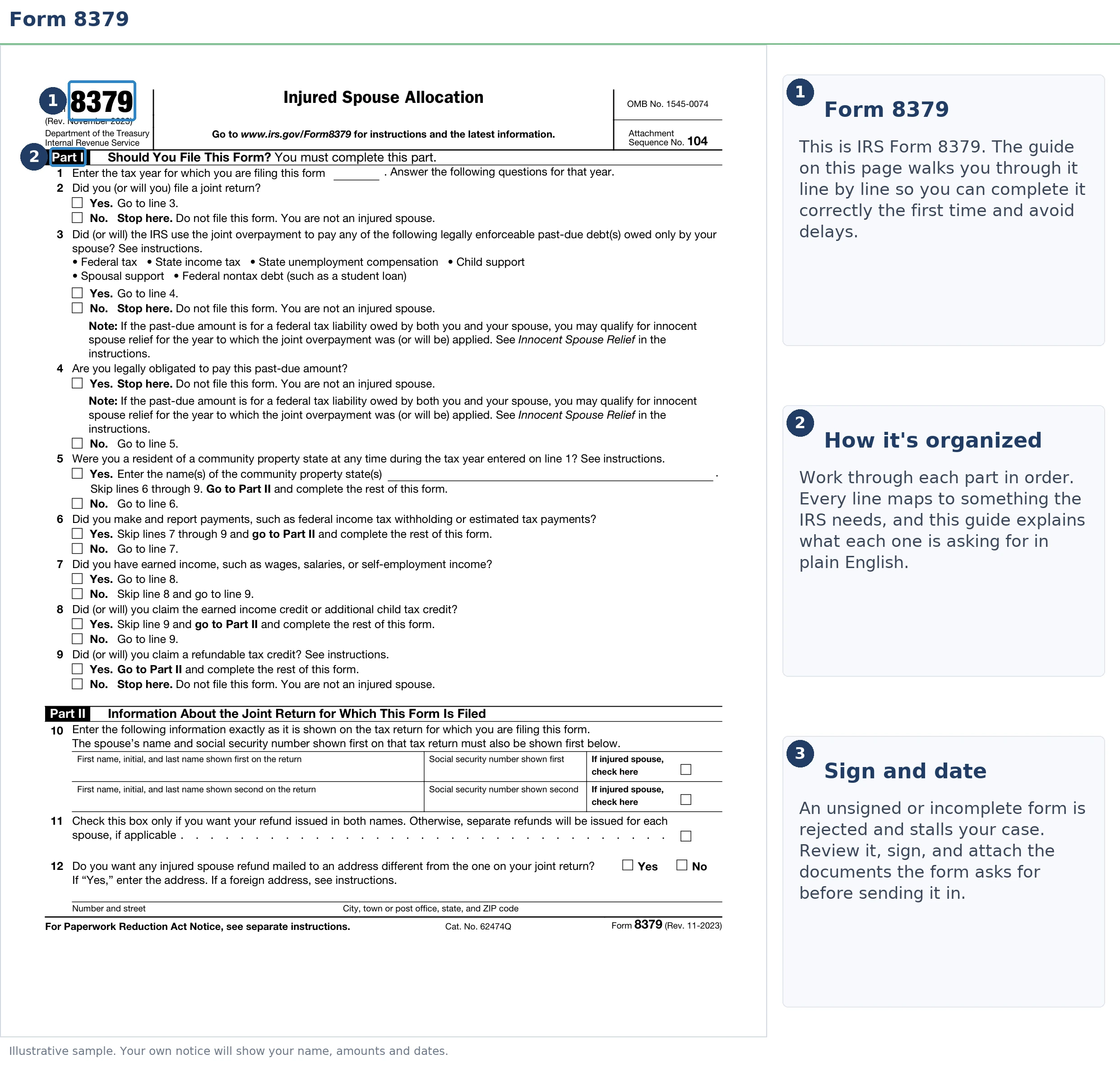
The image below shows exactly what Form 8379 looks like and where its allocation section sits, so you can see the two pages the IRS will actually read before deciding how much of the refund is yours.
⏱ Your window: you generally have 3 years from the due date of the original joint return (including extensions), or 2 years from the date the money was applied to the debt, whichever is later — to file Form 8379 and reclaim your share. Once that window closes for a tax year, that year's money is gone permanently.
Why the government took your joint tax refund
A joint refund can be seized for five kinds of debt that belong to only one spouse: past-due federal tax, past-due state income tax, unpaid child support, state unemployment compensation debt, and defaulted federal non-tax debt such as student loans. When any of those debts sits under your spouse's Social Security number, the entire joint refund is fair game — including the part your money created.
The seizure itself is automated. For non-tax debts, it runs through the Treasury Offset Program, a database match between your refund and every debt federal and state agencies have reported. For your spouse's separate IRS balance, the IRS simply moves the money internally before a refund ever issues. Nobody reviewed whether half that refund came from your withholding or your estimated payments — the offset takes 100% of the joint refund by default, and Form 8379 is the only mechanism that splits it.
If the debt is student loans specifically, our guide to refund offsets for student loans covers what your spouse can do on the loan side while your 8379 works on the refund side.
“The injured spouse on a jointly filed tax return files Form 8379 to get back their share of the joint refund when the joint overpayment is applied to a past-due obligation of the other spouse.”
— About Form 8379, Injured Spouse Allocation (IRS.gov)
Who qualifies for Form 8379 injured spouse relief
Form 8379 injured spouse relief requires three things at once: a joint return, a debt that is legally only your spouse's, and money you personally contributed to the refund. Contribution means your own withholding, your own estimated tax payments, or your share of refundable credits such as the Earned Income Tax Credit or the additional child tax credit.
The word "legally" does the heavy lifting. A student loan your spouse took out before you married is theirs alone — you qualify. A balance from a joint return you both signed is a joint debt — Form 8379 cannot reclaim money applied to a debt you are jointly liable for. If your problem is a joint tax bill your spouse caused, you are in different territory: see injured spouse vs. innocent spouse and the Form 8857 walkthrough.
Two situations change the math for self-employed filers specifically:
- Self-employment tax follows the earner. If you had the 1099 income, the SE tax on it is allocated entirely to you — which raises your share of the joint tax and can shrink your share of the refund. Your estimated payments are allocated to whoever made them, so keep proof they came from you.
- Community property states run different math. In Arizona, California, Idaho, Louisiana, Nevada, New Mexico, Texas, Washington, and Wisconsin, the IRS applies state community property law, which can split income and refunds 50/50 no matter who earned what. You still file the same form; expect a different result.
How the IRS splits the refund: a worked example
The IRS calculates each spouse's share of the refund roughly as if you had filed separate returns, then compares each share of the tax to each spouse's payments. Say you're a 1099 contractor who netted $54,600 last year. Your spouse earned $28,000 in W-2 wages with $1,900 withheld, but carries defaulted federal student loans from before your marriage. This is a hypothetical, with rounded numbers:
- Joint total tax: roughly $12,800 — including about $7,700 of self-employment tax that belongs only to you, since the $54,600 was your income.
- Allocation: about $11,300 of the tax attributed to you, about $1,500 to your spouse.
- Payments: you made $13,600 in quarterly estimated payments; your spouse had $1,900 withheld. Total paid in: $15,500.
- Joint refund: $15,500 − $12,800 = $2,700 — all of it seized for the student loans.
Your injured spouse share: $13,600 paid minus $11,300 of allocated tax = about $2,300 of the $2,700 comes back to you. Your spouse's $400 share ($1,900 − $1,500) stays with the loan. The IRS runs the official computation itself — Part III of the form just tells it whose numbers are whose, and in a community property state the split would look different.
Notice what drove the result: proof that the estimated payments were yours. That's why the allocation columns, visible in the form image on this page, matter more than any other line you'll fill in.
What happens if you never file the injured spouse claim
If you never file Form 8379, your share of the refund stays applied to your spouse's debt permanently once the claim window closes. Nothing escalates against you — no levy, no lien — but the losses compound in a predictable sequence:
- The offset posts. Your full joint refund is applied to the debt — code 898 on your transcript for a non-tax debt, or an internal transfer to your spouse's IRS balance.
- The notice arrives after the fact. The Bureau of the Fiscal Service or the IRS tells you where the money went. There is no pre-offset hearing for you to request — the claim comes after.
- The money sits with the creditor agency. Your share earns you nothing and reduces a debt that was never yours.
- Next filing season it happens again. Every joint refund is offset, year after year, until the debt is paid — the IRS never flags your account as "injured spouse" automatically.
- The reclaim window runs out. After generally 3 years per tax year, your share of that year's refund becomes unrecoverable. The oldest year is always the one about to expire.
Your refund went to a debt that isn't yours?
Get the offset reviewed free before the reclaim window on your oldest year closes. An experienced tax professional will confirm whether you qualify, which years you can still recover, and what your share should be — no pressure, no obligation.
Your options: how and when to file the injured spouse allocation
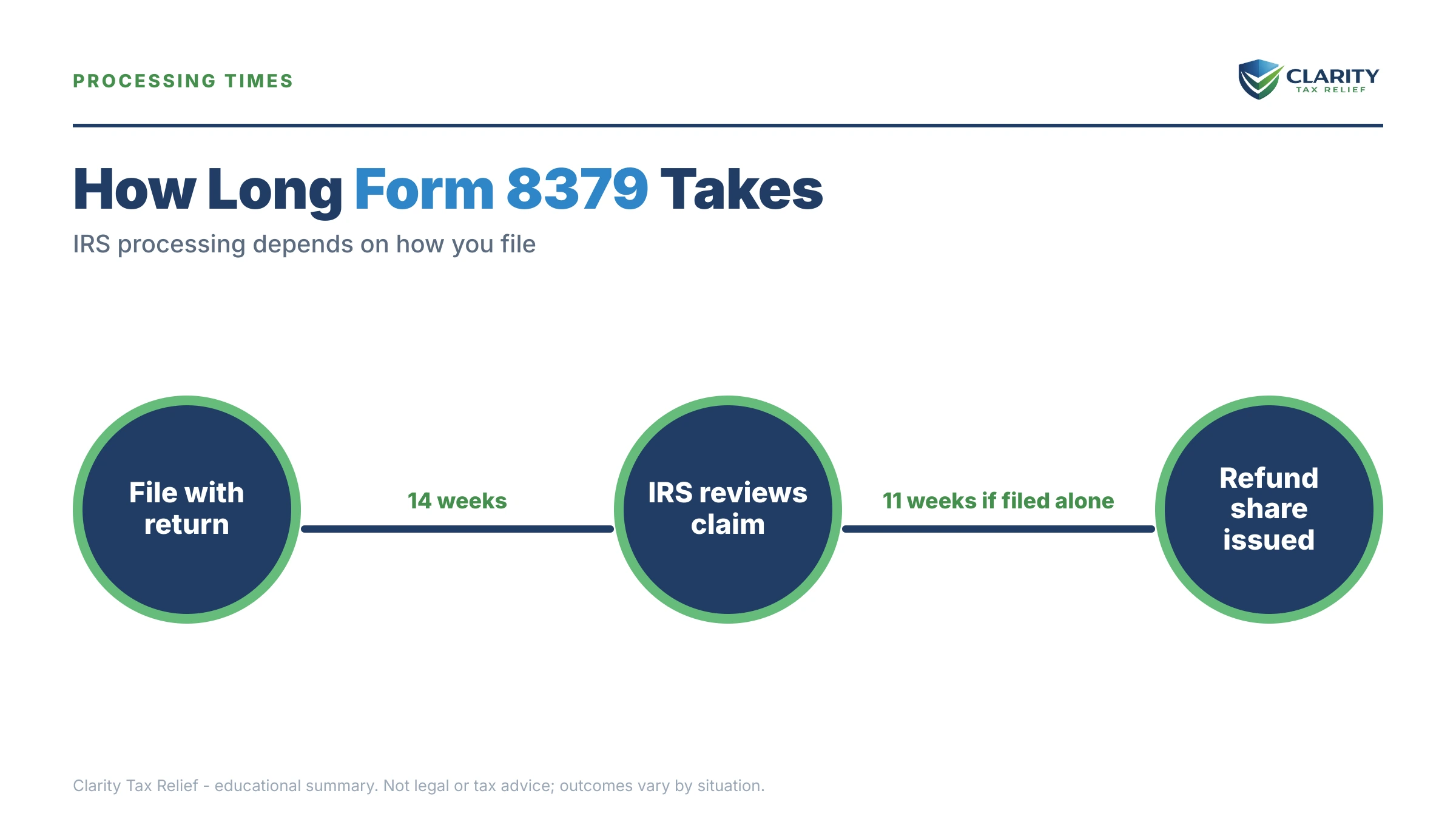
You can file Form 8379 three ways — attached to an e-filed return, attached to a paper return, or by itself after the offset — and the method changes your wait from about 8 weeks to about 14.
| How you file | When it applies | Deadline | Typical processing time |
|---|---|---|---|
| Attached to an e-filed joint return | You know the offset is coming (the debt already exists) | Your return's filing deadline, including extensions | About 11 weeks |
| Attached to a paper joint return | Same — write "Injured Spouse" on the top-left corner of page one | Your return's filing deadline, including extensions | About 14 weeks |
| Filed by itself, after the offset | The refund was already taken and you're reclaiming your share | Generally 3 years from the return's due date, or 2 years from the offset, whichever is later | About 8 weeks |
Form 8379 isn't the only lever. Depending on your situation:
- File it proactively every year. While the debt exists, attach a fresh 8379 to each joint return — you keep your share without waiting for a seizure and reclaim.
- Shrink the refund instead. As a 1099 filer you control your estimated payments — pay in closer to your actual liability and there's little refund left to offset. Never underpay to do it; the penalty math cuts the other way.
- Consider filing separately. Married filing separately when your spouse owes the IRS protects your refund completely, but usually costs you credits and better brackets — run both numbers before switching.
- Innocent spouse relief if the debt is a joint tax bill your spouse caused — a different program with a different form (8857) and different tests.
- An offset bypass refund if you face immediate economic hardship — a narrow, before-the-offset remedy that applies only to IRS tax debt, requested through the Taxpayer Advocate before the refund issues.
How to file Form 8379, step by step
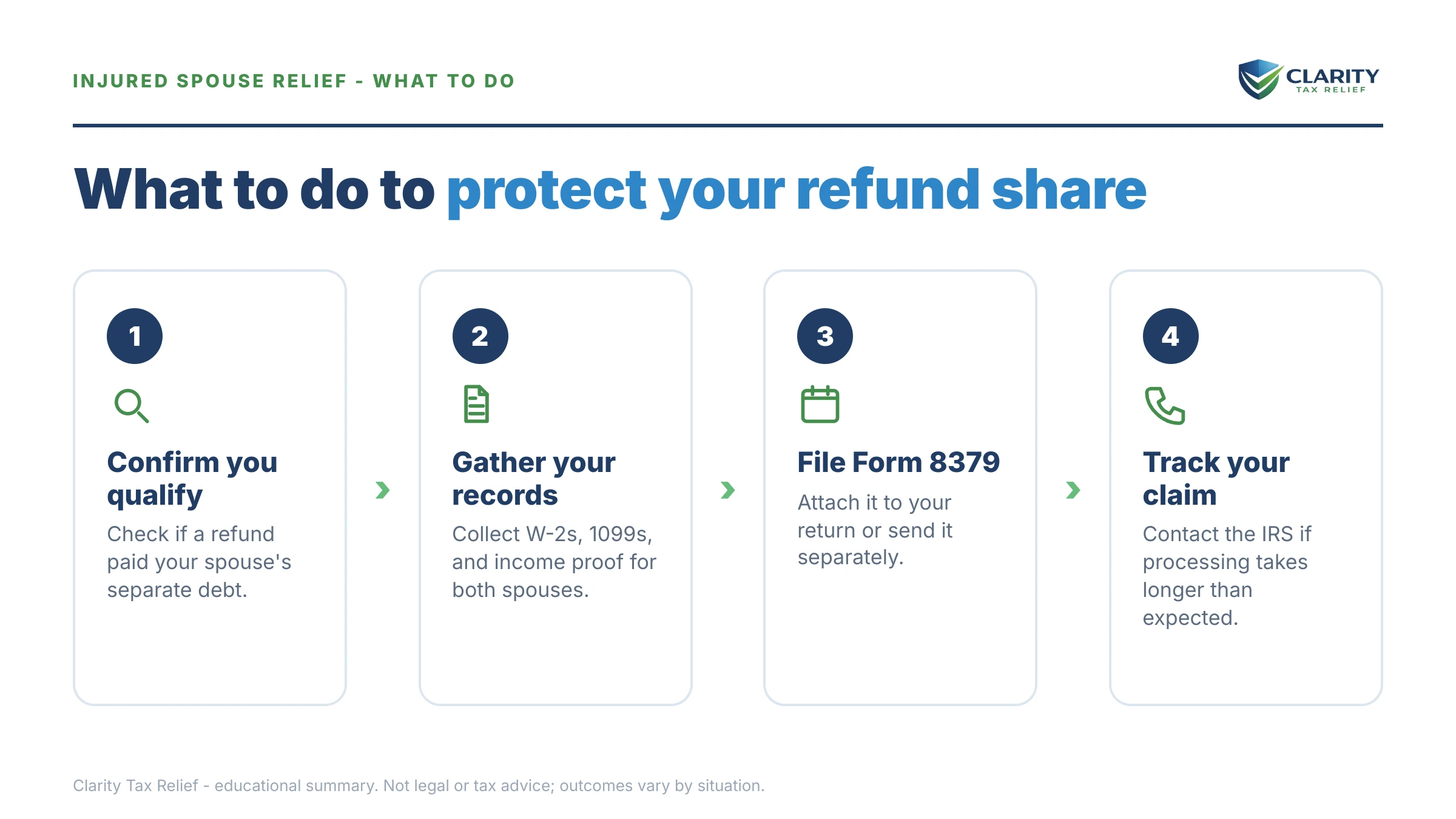
- Confirm which agency took the refund. Read the offset notice, or call the Treasury Offset Program line at 800-304-3107 to learn whose debt it was and which agency is holding the money.
- Verify you qualify. You must not be legally liable for the debt. You must have contributed withholding, estimated payments, or refundable credits to the joint return.
- Complete all three parts of Form 8379. Part I confirms eligibility, Part II identifies the return, and Part III allocates income, deductions, credits, and payments between spouses — the column where your estimated payments land decides your share.
- Attach every W-2 and 1099 showing withholding, for both spouses. Missing income documents are the single most common reason injured spouse claims stall.
- File it the right way. Attach it to your e-filed joint return, write "Injured Spouse" on the top-left corner of page one if you paper-file, or mail it alone to the IRS center where you filed the original return.
- Track the claim. Expect roughly 8 to 14 weeks depending on how you filed, and check your IRS online account for movement before calling.
Which offset notice or transcript code are you looking at?
Several different notices and transcript codes announce a refund offset, and only some of them can be undone with Form 8379. Match yours before you file — the wrong claim wastes months. (Holding a letter you can't identify at all? Start with why did I get a letter from the IRS.)
| What you received | What it means | Does Form 8379 help? |
|---|---|---|
| Offset letter from the Bureau of the Fiscal Service | A non-tax debt — child support, defaulted student loans, state debt — took the refund through the Treasury Offset Program | Yes, if the debt is your spouse's alone |
| CP39 or CP42 notice | The IRS applied your joint refund to your spouse's separate federal tax balance | Yes |
| CP49 notice | The refund went to your own back taxes or a joint liability from a return you signed | No. You can't reclaim money applied to a debt you owe |
| Transcript code 898 | A Treasury Offset Program seizure posted to your account | Yes, within the 3-year/2-year window |
| Transcript code 826 | The refund was moved to another tax year on your own joint account | Usually no, if both spouses owe that year's joint balance |
When you can handle Form 8379 yourself
Most injured spouse claims are genuinely do-it-yourself. If you have W-2 income, straightforward withholding. A spouse with one identifiable debt, the form is two pages, costs nothing to file, and needs no professional. File it, attach your income documents, and wait out the 8 to 14 weeks.
Experienced help changes the outcome in a handful of situations: self-employment income where the SE tax and estimated-payment allocation drives the result (the worked example above is exactly that math). Community property states, where the default split can be challenged depending on the debt type. Multiple expired-or-expiring years to reclaim at once. Or when the "spouse's debt" is actually a joint IRS balance — in which case the real remedy is innocent spouse relief and the strategy, evidence, and deadlines are entirely different. If a professional does handle it, they'll file Form 2848 power of attorney so they can speak to the IRS about the claim directly.
One 2026 reality worth knowing: with the IRS workforce down roughly 27%, injured spouse claims that come in incomplete sit longest. A clean, fully documented first filing is the fastest path to your money — there is no expedite line to call.
Terms on your offset notice, decoded
- Offset — the government keeping a refund and applying it to a debt instead of paying it to you.
- Treasury Offset Program (TOP) — the Bureau of the Fiscal Service database that matches refunds against child support, student loans, and other reported debts.
- Injured spouse — the spouse whose share of a joint refund was taken for the other spouse's separate debt; "injured" refers to your refund, not to any wrongdoing.
- Allocation — Part III of Form 8379, where income, deductions, credits, and payments are split into a joint column and one column per spouse.
- Community property state — one of nine states where marital income is legally shared, which changes how the IRS divides the refund.
- Refundable credit — a credit (like the EITC) that pays out even beyond your tax liability. Your share of it counts as your contribution to the refund.
Form 8379 injured spouse questions, answered
What qualifies you as an injured spouse?
You qualify if you filed a joint return, you are not legally responsible for the debt that took the refund. You contributed to that refund through withholding, estimated payments, or your share of refundable credits like the EITC. All three conditions must be true. If the debt is a joint tax bill from a return you both signed, you are not an injured spouse. That situation calls for innocent spouse relief on Form 8857 instead.
How long does Form 8379 take to process?
Plan on roughly 11 weeks if you e-file it with your joint return, about 14 weeks if you attach it to a paper return, and about 8 weeks if you file it by itself after the offset. Those are the IRS's typical estimates, and 2026 staffing cuts can stretch them. Missing W-2s or 1099s are the most common reason a claim takes longer, so attach every income document that shows withholding.
Can I file Form 8379 electronically?
Yes — every major tax-software product lets you attach Form 8379 to an e-filed joint return, and that is also the fastest processing route. If you are filing the form by itself after an offset, you generally mail it to the IRS service center where you filed the original return, with both spouses' W-2s and 1099s attached. Show both Social Security numbers in the same order they appeared on the joint return.
Do I have to file Form 8379 every year?
Yes. You need a new Form 8379 with every joint return you file while your spouse's debt remains unpaid. The IRS does not carry an injured spouse allocation forward, so skipping a year means that year's refund gets offset and you start the reclaim process over. Some couples instead adjust withholding so there is little refund left to seize, or weigh filing separately.
Does Form 8379 work for child support and student loan offsets?
Yes. Form 8379 covers offsets for your spouse's past-due child support, defaulted federal student loans, state income tax, state unemployment compensation debts, and separate federal tax bills. For the non-tax debts, the money is taken through the Treasury Offset Program, but the IRS still handles your allocation claim. What it does not cover is a debt you are jointly liable for.
What is the difference between injured spouse and innocent spouse relief?
Injured spouse relief (Form 8379) means your refund was taken for a debt that is only your spouse's. You are reclaiming your share of money the IRS agrees was overpaid. Innocent spouse relief (Form 8857) asks the IRS to remove your liability for a joint tax debt caused by your spouse's errors or hidden income. Different forms, different tests, different timelines, and filing the wrong one costs months.
How does Form 8379 work in a community property state?
Differently, and often less in your favor. In the nine community property states (Arizona, California, Idaho, Louisiana, Nevada, New Mexico, Texas, Washington, Wisconsin), the IRS applies state law to the allocation, which can treat income and the refund as 50/50 marital property regardless of who earned it. Depending on the state and the debt, part of what you consider your share can still go to the debt. The form is filed the same way; the math the IRS runs on it changes.
Can Form 8379 get back a refund the government already took?
Yes, as long as you are inside the window — generally 3 years from the original return's due date (including extensions) or 2 years from the date the payment was applied to the debt, whichever is later. You can file for multiple past years, using one Form 8379 per tax year. Once the window closes for a year, that year's share is gone for good.
Your next 24 hours
- Identify the offset. Pull out the offset letter and note the agency, the amount. The tax year, or call the offset hotline at 800-304-3107 if you never received one.
- Gather your proof. The joint return, both spouses' W-2s and 1099s, and records showing your estimated payments came from you — bank statements or IRS payment confirmations.
- Get a free case review. Send us what you have through the 2-minute form or call (888) 825-7779. Every filing season the offset repeats. The reclaim window on your oldest year is the one closest to closing — the sooner the claim goes in clean, the sooner your share comes back.
Primary sources: the IRS's official page for About Form 8379, Injured Spouse Allocation. The Bureau of the Fiscal Service, which runs the Treasury Offset Program. And the Taxpayer Advocate Service for hardship cases and offset bypass requests.
This guide is general information, not tax or legal advice for your specific situation. Eligibility for IRS programs depends on individual facts and circumstances; no outcome is guaranteed.