
IRS Forms
Form 907 ERC Extension: Protecting Your Two-Year Right to Sue (2026)
The short answer: a Form 907 ERC extension stretches the two-year deadline (IRC §6532(a)) to sue for a refund after the IRS disallows your Employee Retention Credit claim. Filing an appeal does not stop that clock. Form 907 must be signed by both you and the IRS before the two years expire, or your claim dies.
Your business claimed the ERC, the IRS said no, and now — with your appeal still sitting in a queue somewhere — someone mentioned "Form 907" as the thing standing between you and losing the money forever. They're right. The trap here isn't the disallowance itself; it's a countdown almost nobody notices until it's nearly over. This page walks you through exactly how the form works and how to get it signed in time.
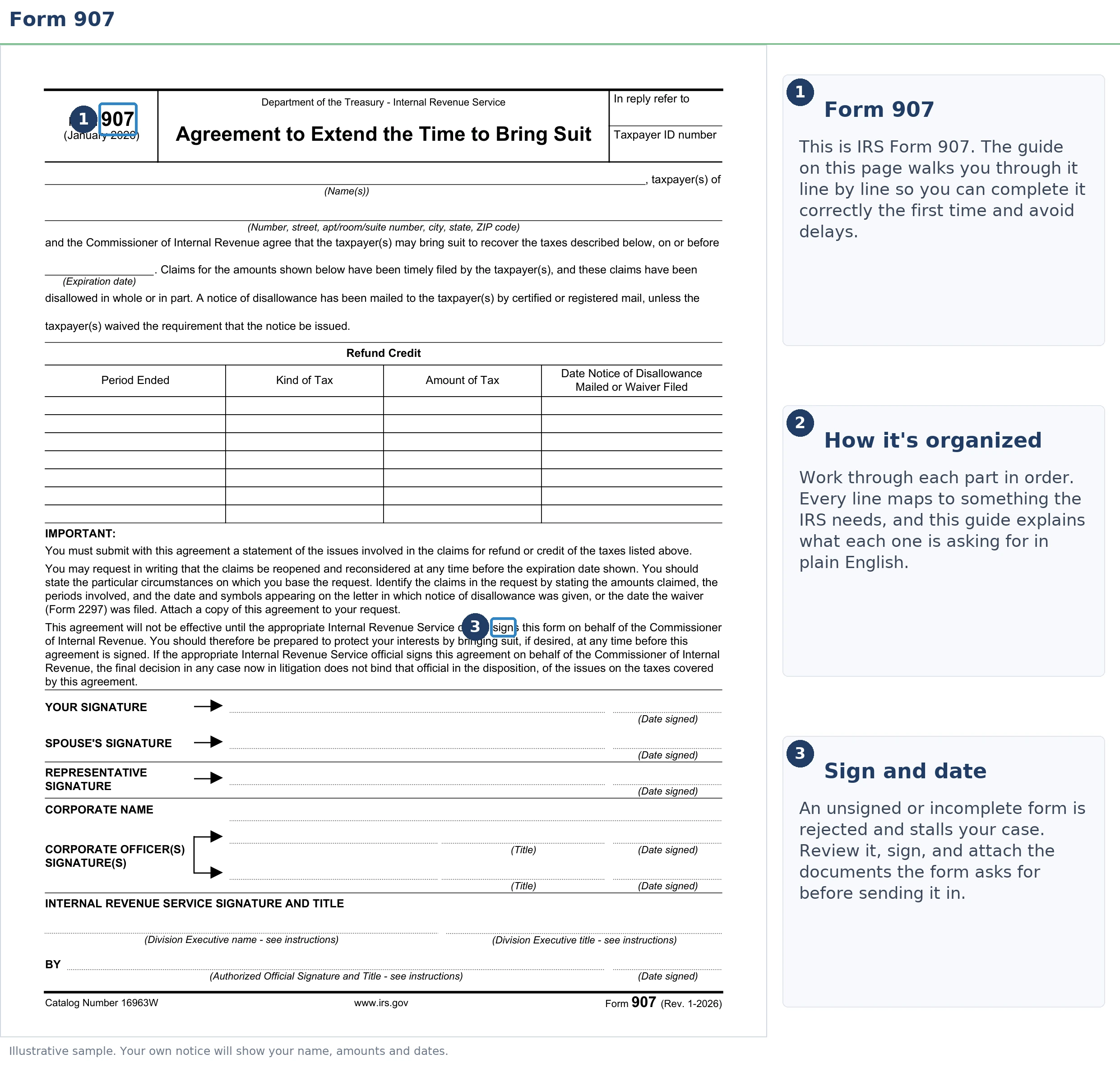
Form 907 is a single page, and the two lines that matter most, the extension date and the signature blocks, are easy to get wrong. The image below shows you exactly what the form looks like and where to look.
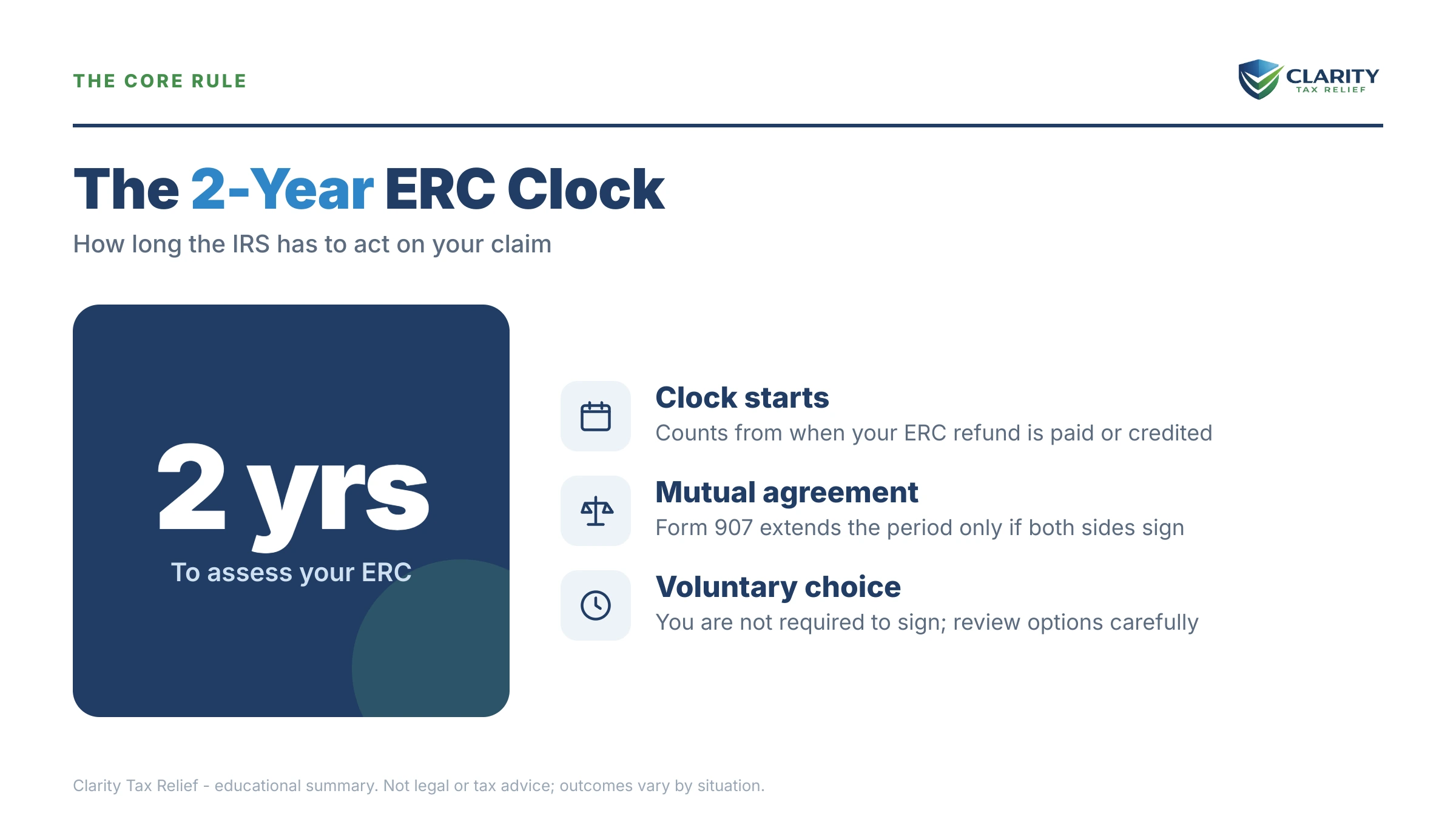
⏱ Your deadline: two years from the date the IRS mailed your Letter 105-C or 106-C disallowance. That is the last day to file a refund suit under IRC §6532(a). A Form 907 must be fully signed, by you and the IRS, before that date. Filing an appeal does not pause this clock.
Why you're being told to sign Form 907 for your ERC claim
Form 907, "Agreement to Extend the Time to Bring Suit", extends the two-year window under IRC §6532(a) to take the IRS to court after it disallows a refund claim. That's its entire job. It existed in obscurity for decades until the ERC turned it into one of the most important forms a small employer can sign.
Here's the chain. The IRS has been disallowing ERC claims in large batches, using Letter 105-C for a full disallowance and Letter 106-C for a partial one, sent by certified or registered mail. The mailing date on that letter starts your two-year suit period. Thousands of employers appealed, but the IRS workforce shrank roughly 27% in 2025, and appeal cases are moving slowly.
The math is brutal: letters mailed in 2024 and 2025 have suit deadlines expiring in 2026 and 2027, and many appeals won't be decided by then. Form 907 is the pressure valve. The IRS has signaled that Appeals will consider signing extensions in ERC cases that can't be finished in time, because a lapsed deadline hurts its ability to settle, too.
One detail that trips up multi-quarter claimants: each disallowance letter starts its own two-year clock. If you claimed ERC on four quarters through separate Forms 941-X and received separate letters, you may be tracking four different deadlines. You may need more than one Form 907.
If you're staring at IRS mail and aren't even sure it's a disallowance, start with our decoder on why did I get a letter from the IRS, then come back. Everything below assumes the IRS has refused to pay some or all of your ERC.
The two-year trap: what happens if you let the clock run
Filing an ERC appeal does not stop the two-year lawsuit clock — the appeal and the clock run in parallel. This is the single most expensive misunderstanding in ERC disputes right now, and the sequence plays out the same way every time:
- Letter 105-C or 106-C is mailed. The §6532(a) two-year suit period starts on the mailing date, whether or not you open the envelope promptly.
- You file a protest or appeal. Your case enters the Appeals queue. Nothing about that filing pauses, tolls, or restarts the suit clock underneath it.
- The backlog stretches. With IRS staffing down sharply since 2025, ERC appeals can sit unassigned for long stretches while your window quietly shrinks.
- The two-year date approaches. This is the last stage at which a Form 907 can be executed or a refund suit filed. Nothing after this point can be fixed retroactively.
- The date passes with neither in place. The claim is extinguished. No court can hear it, and under IRC §6514 a refund paid after the period lapses is legally "erroneous", so even an Appeals officer who agrees with you generally can't pay you.
That last stage is what makes Form 907 different from most IRS paperwork. Missing a collection notice costs you penalties; missing this date costs you the entire claim, permanently, with no appeal from the expiration itself.
| Event | Effect on the clock | The right at stake |
|---|---|---|
| Letter 105-C or 106-C mailed | Two-year suit period under IRC §6532(a) begins on the mailing date | Your right to sue for the disallowed ERC in federal court |
| You file an appeal or protest | None — the two-year clock keeps running during the appeal | A pending appeal alone does not preserve the claim |
| Form 907 signed by you AND the IRS before the deadline | Suit period extended to the specific date written on the form | Right to sue preserved through that date; extendable again by a new Form 907 |
| Two-year date passes — no suit filed, no executed Form 907 | Clock expires permanently | Claim is legally dead; courts can't hear it and the IRS generally can't pay it |
ERC disallowed and the clock running?
Your two-year suit deadline is set by the mailing date on your Letter 105-C, and no one at the IRS will call to warn you it's expiring. Get your disallowance letter and deadline reviewed free before your window closes: (888) 825-7779 or the 2-minute form.
Your options after an ERC disallowance, by time left on the clock
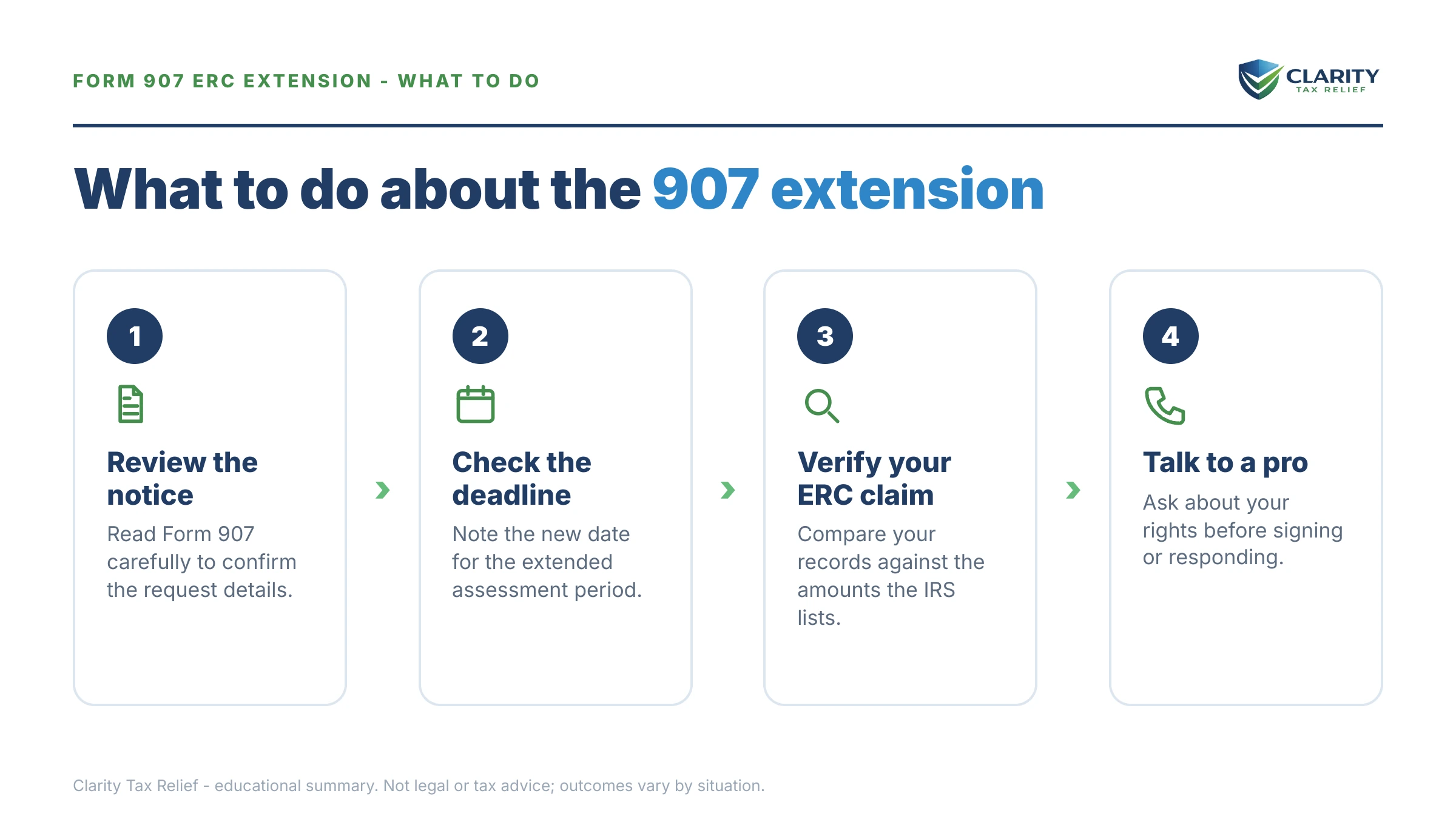
After an ERC disallowance, you have exactly three ways to keep your claim alive: win at Appeals before the deadline, extend the deadline with Form 907, or file a refund suit before it expires. Which move is right depends almost entirely on how much time is left.
| Where your case stands | Best move | What it costs / what it preserves |
|---|---|---|
| 12+ months left, no appeal filed yet | File the appeal or written protest now | Free to file; positions you for an administrative win while the clock is still long |
| Appeal pending, roughly 6–12 months left | Request Form 907 from your Appeals contact | No fee; preserves the suit right to the date on the form while Appeals works the case |
| Under ~90 days left, no executed Form 907 | Push hard for a countersigned 907, and prepare a refund suit as the backstop | A suit means court filing fees and litigation costs, but it stops the clock the day it's filed |
| Deadline already passed | Get a professional review of the mailing date, address, and any signed extensions | Occasionally a misdated or misaddressed letter, or an existing extension, saves the claim; otherwise it's gone |
The appeal itself. A disallowance over $25,000 per period generally requires a formal written protest. Smaller cases can often use the simpler Form 12203 appeal request. Our guide to the ERC disallowance appeal covers what a persuasive protest looks like — eligibility proof, gross-receipts math, government-order documentation.
The Form 907 extension. Free, but consensual — you cannot file it unilaterally. It extends the period only to the specific date written on the form, it can be renewed by successive agreements, and signing it concedes nothing about the merits of your claim.
The refund suit. Filing suit in U.S. District Court or the Court of Federal Claims before the deadline permanently protects the claim, but litigation against the government is expensive relative to a small-business-sized credit, which is why the free extension is almost always the first move.
Two clarifications that save people from chasing the wrong process. First, Form 907 is your clock — don't confuse it with the government's separate five-year window to assess ERC claims, covered in our ERC statute of limitations guide. Second, if the IRS already paid your ERC and is now demanding it back, you're in collection territory, not refund territory — see can't repay ERC instead.
A worked example: protecting a $36,900 disallowed claim
Say you run a small courier company with a handful of W-2 drivers. A promoter filed ERC claims on your behalf — $23,700 for Q2 2021 and $13,200 for Q3 2021, a combined $36,900. On March 18, 2025, the IRS mails a Letter 105-C disallowing the full claim. Your suit deadline is March 18, 2027 — the letter date plus exactly two years.
You file a formal protest in June 2025 (required, since the amount exceeds $25,000). By November 2026, month 20 of 24, no Appeals conference has been scheduled, and roughly four months remain on the clock. This is the Form 907 moment: you request the extension in writing, and in January 2027 both sides sign a Form 907 extending the suit period to December 31, 2027.
Compare the alternatives. Filing a refund suit to protect the claim would mean court fees plus professional fees that could consume a meaningful share of the $36,900 before anyone argues the merits. The executed Form 907 costs nothing but two signatures, and keeps the Appeals path open, where most of these cases actually get resolved.
One wrinkle from this scenario worth flagging: if you also have unfiled personal returns — say you haven't filed taxes in 3 years — that doesn't change the §6532(a) clock at all. But it weakens your credibility at Appeals, and any refund ultimately allowed can be held or offset against unassessed years. Get the filings done while the appeal pends. And if a promoter built the claim on facts you can't verify, read ERC mill claim problems before you defend numbers you didn't compute.
How to get a Form 907 extension, step by step
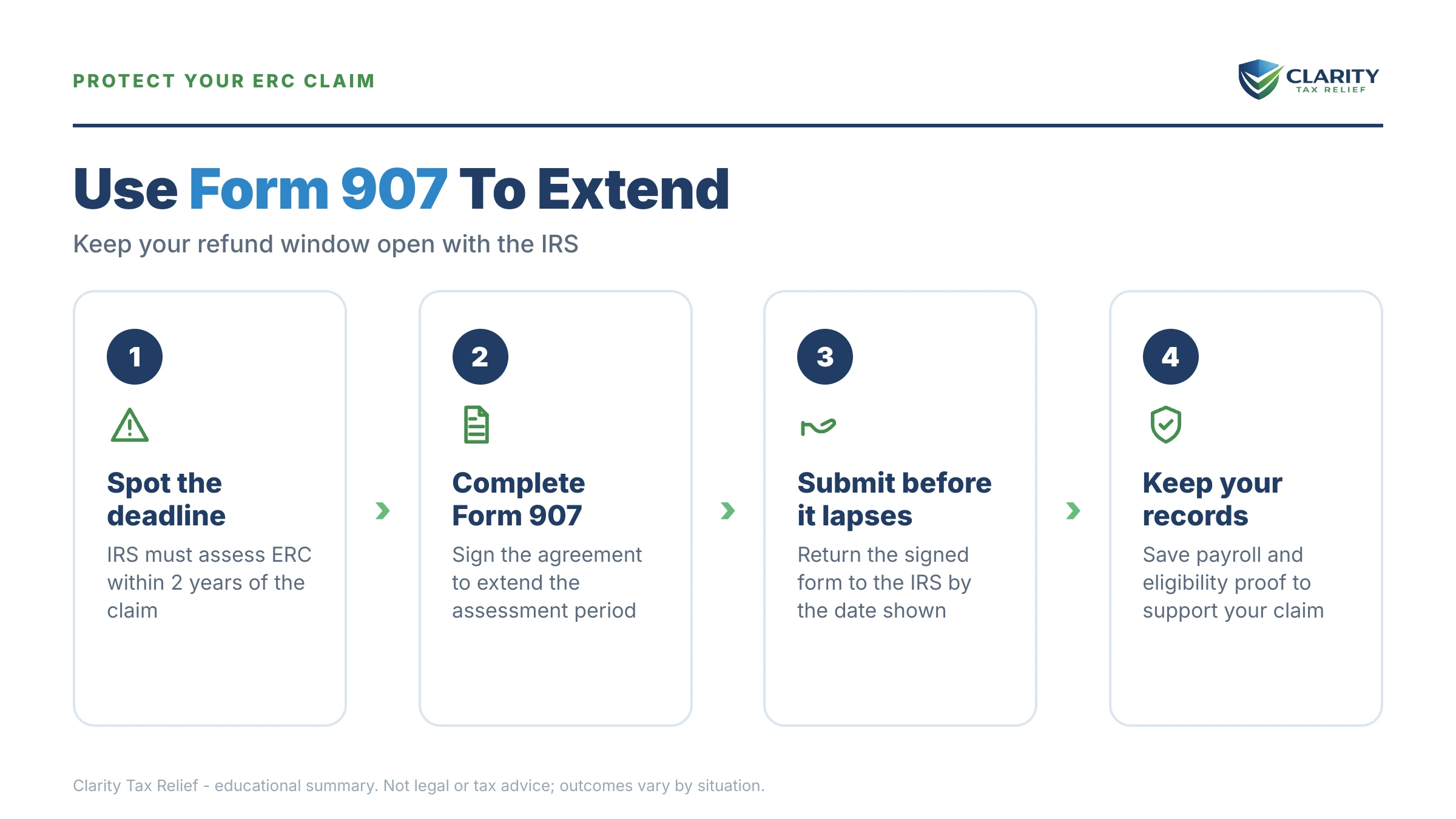
- Find your suit deadline: Locate the date on your Letter 105-C or 106-C and count exactly two years forward — every decision below runs against that date.
- Confirm where your case sits: Verify that your appeal or protest is actually docketed with the IRS Independent Office of Appeals and get the name of your assigned contact.
- Request the Form 907 in writing: Ask your Appeals officer, or the contact listed on your letter, to prepare a Form 907 extending the suit period, and follow up until the form is in hand.
- Sign with proper authority before the deadline: Have an owner, officer, or Form 2848-authorized representative sign, and confirm the IRS countersigns while the clock is still running.
- Calendar the new date and keep the executed copy: The extension only reaches the date written on the form — diary it, and request a successive extension early if the case is still open.
If a professional is handling this for you, their authority to sign must be spelled out on file — our Form 2848 instructions walk through how a power of attorney is set up so a representative can act on agreements like this one.
When you can handle Form 907 yourself, and when help changes the outcome
Requesting a Form 907 is not complicated when the case is clean. If you have one disallowance letter, a docketed appeal, a cooperative Appeals contact. A year or more on the clock, this is genuinely a do-it-yourself task: a written request, two signatures, a calendar entry. You do not need to pay anyone for that.
Experienced help changes the outcome in the harder patterns: fewer than 90 days remain and the form isn't countersigned yet. You hold multiple letters with different dates across quarters. The business has dissolved and signing authority is unclear. The IRS declines to extend and a refund suit has to be evaluated and filed in time. Or the disallowance overlaps an ERC claim disallowed mess a promoter left behind. In those cases, the fee buys deadline management — the one thing this process punishes without mercy.
Terms on your ERC paperwork, decoded
- Notice of claim disallowance — the certified letter (105-C full, 106-C partial) formally refusing to pay your refund claim. Its mailing date starts the two-year suit period.
- Section 6532(a) period — the two years, counted from that mailing date, in which a refund lawsuit must be filed or the right to sue is lost.
- Refund suit — a lawsuit under IRC §7422 in U.S. District Court or the Court of Federal Claims asking a judge to order the refund the IRS refused.
- Executed agreement — a Form 907 signed by both you and an authorized IRS official; one signature is not an extension.
- Successive agreement — a follow-on Form 907 extending an already-extended period, valid only if signed before the current extension date passes.
Form 907 ERC questions, answered
What is IRS Form 907?
Form 907 is the "Agreement to Extend the Time to Bring Suit" — a short written agreement between you and the IRS that extends the two-year deadline to file a refund lawsuit after the IRS disallows a claim. In the ERC context, it preserves your right to sue over a Letter 105-C or 106-C disallowance while your appeal is still being worked. It is a consent agreement, not a filing you can submit unilaterally.
Does appealing my ERC disallowance stop the two-year clock?
No. The two-year period under IRC §6532(a) runs from the date the disallowance notice was mailed, and filing an appeal or protest does not pause it. Many employers assume a pending appeal protects them. It doesn't. If the two years expire mid-appeal without an executed Form 907 or a filed lawsuit, the claim generally cannot be paid even if Appeals sides with you.
When does Form 907 have to be signed?
Before your current two-year period, or a previously extended period — expires. Both signatures, yours and the IRS's, must be in place by that date; a Form 907 signed one day late extends nothing. Start the request well ahead of the deadline, since routing the form to an IRS official with signing authority takes time, and keep the fully executed copy.
Who signs Form 907 for a business?
Someone with legal authority to bind the taxpayer: the owner of a sole proprietorship, a member-manager for an LLC, or a corporate officer for a corporation. A representative can sign only if a valid Form 2848 power of attorney on file specifically authorizes it. If the business has since dissolved, signing authority gets complicated — get experienced help before the deadline, not after.
Can the two-year period be extended more than once?
Yes. The period can be extended by successive written agreements, as long as each new Form 907 is fully executed before the current expiration date. ERC appeals are moving slowly in 2026, so a second extension is common when the first extension date approaches and the case still isn't resolved. Calendar every extension date the moment the form is countersigned.
What if my two-year deadline has already passed?
In most cases the claim is legally dead — no court can hear it and the IRS generally cannot pay it. Before conceding, verify the actual mailing date of the disallowance letter, confirm it was sent to your last known address, and check whether any signed extension already exists in the file. Those facts occasionally revive a claim, and they are worth a professional review when tens of thousands of dollars are at stake.
Does Form 907 apply if the IRS already paid my ERC and wants it back?
No. Form 907 protects a refund claim the IRS refused to pay. If the IRS paid your ERC and is now clawing it back — through an audit, a recapture assessment, or a balance-due bill — you are in a collection posture, not a refund posture, and entirely different deadlines and options apply. See our guide to options when you can't repay ERC for that situation.
Will the IRS agree to sign a Form 907 for my ERC case?
It is discretionary. But the IRS has signaled that Appeals will consider extensions where an ERC appeal cannot be completed before the two-year date — an extension protects the government's ability to resolve the case administratively, too. Ask your assigned Appeals officer or the contact named on your correspondence directly. If the IRS declines to sign, your remaining way to preserve the claim is filing a refund suit before the deadline.
Your next 24 hours
- Find the date at the top of your Letter 105-C or 106-C and write down the date exactly two years later. That is your suit deadline, and every choice runs against it.
- Gather the file: the disallowance letter, your Forms 941-X, your protest or appeal correspondence, and any Form 907 already signed.
- Get a free case review before your two-year window closes — use the 2-minute form or call (888) 825-7779. An experienced tax professional will map your exact deadline and the fastest way to protect the claim.
For background straight from the source, see the IRS's Employee Retention Credit page, the IRS Independent Office of Appeals, and — if IRS delay itself is causing you financial harm — the Taxpayer Advocate Service.
This guide is general information, not tax or legal advice for your specific situation. Eligibility for IRS programs depends on individual facts and circumstances; no outcome is guaranteed.