
ERC Notices & Letters
IRS Letter 106-C: Partial ERC Disallowance, What It Means and What to Do (2026)
The short answer: IRS Letter 106-C means the IRS partially disallowed your Employee Retention Credit (ERC) claim. It approved some of it and denied the rest. You keep the approved portion, and you have 2 years from the letter's date to dispute the disallowed portion through IRS Appeals or a federal refund suit.
You opened an envelope from the IRS expecting a refund check, and instead you're holding Letter 106-C telling you part of your ERC was denied. The number your business was counting on just shrank, and the letter's language about lawsuits and statutes makes it sound final. It isn't. A partial disallowance is a starting point for a dispute, not the end of one.
This guide walks through partial versus full disallowance, why the IRS denied part of your claim, exactly how to dispute the disallowed portion, the documentation the IRS wants to see, and the two deadlines that decide whether you keep the right to fight.
Below, the highlighted boxes on a real, redacted Letter 106-C show exactly which line carries your refund-suit deadline — the date most business owners never notice until it's too late.
⏱ Your deadline: you have 2 years from the date printed on Letter 106-C to file a refund suit in federal court under IRC §6532. To use IRS Appeals instead, respond in writing promptly — generally within 30 days — but an appeal alone does not pause the 2-year clock unless you sign Form 907.

What Letter 106-C actually means for your ERC
Letter 106-C is a statutory notice of partial claim disallowance — the IRS reviewed your amended payroll returns (Forms 941-X) and agreed with part of your Employee Retention Credit while rejecting the rest. It is the "letter 106c erc" notice thousands of businesses received as the IRS worked through its ERC backlog.
The letter does three things at once. It tells you the dollar amount it allowed (which you keep, usually paid with interest), the amount it disallowed (which is now in dispute). The legal reason for the denial. It also quietly starts your clock to challenge the denial.
Because it is a formal notice of disallowance, Letter 106-C carries the same appeal and litigation rights as a full denial. That is the key point: a partial disallowance is not "the IRS's final word." It is the moment your dispute rights switch on.
“If the IRS disallowed your ERC claim with Letter 105-C and you disagree, you may request an administrative appeal, review by the IRS Independent Office of Appeals, or file suit.”
— Employee Retention Credit (IRS.gov)
Partial vs. full disallowance: Letter 106-C vs. Letter 105-C
The difference between the two ERC denial letters is simple — 106-C denies part of your claim, 105-C denies all of it — but the deadlines and rights are nearly identical.
| Feature | Letter 106-C (partial) | Letter 105-C (full) |
|---|---|---|
| What it denies | A portion of the ERC (some quarters or a reduced amount) | The entire ERC claim |
| What you keep | The allowed portion, usually paid with interest | Nothing from that claim |
| Refund-suit deadline | 2 years from the letter date (IRC §6532) | 2 years from the letter date (IRC §6532) |
| Appeals rights | Yes — protest to IRS Appeals | Yes — protest to IRS Appeals |
| Extend time to sue | Form 907 | Form 907 |
If you received the full-denial version instead, read our companion guide on Letter 105-C and a disallowed ERC claim. If your claim is still being reviewed rather than denied, see Notice CP320B when your ERC claim is under review. That one comes before either denial letter.
Why the IRS partially disallowed your ERC
Most partial ERC disallowances come down to the IRS accepting your eligibility for some quarters and rejecting it for others. The reason is stated on the letter, usually in a short paragraph, and it tells you exactly what evidence you need to fight back.
The most common reasons the IRS gives for denying part of a claim:
- Partial-suspension argument rejected for certain quarters. The IRS agreed a government order affected you in one quarter but not another, or decided the order did not suspend "more than a nominal portion" of your operations.
- Gross receipts didn't fall enough. Some quarters met the required decline (50% in 2020, 20% in 2021 versus 2019) and some didn't, so the IRS allowed only the qualifying quarters.
- Wages already used for PPP forgiveness. The same payroll dollars can't count for both PPP loan forgiveness and the ERC, so the overlapping wages were removed.
- Owner and relative wages. Wages paid to majority owners and certain relatives are excluded, which can shave a claim.
- Large-employer wage base. If you were a "large employer," only wages paid to employees who were not working count — a common source of reductions.
- Recovery startup or aggregation issues. Cap limits, controlled-group aggregation, or recovery-startup rules can trim an otherwise valid claim.
If the denial reason looks like a documentation gap rather than a true eligibility failure, that is often the most winnable kind of partial disallowance. If you also received an examination request, our guide on what to expect in an ERC audit covers how those reviews unfold.
What happens if you do nothing
The danger with Letter 106-C is not collection — it's the silent expiration of your dispute rights. Nobody garnishes anything over a partial disallowance. Instead, the deadlines run out quietly, and one day the disallowed portion is gone for good.
Here is the sequence after the letter is dated:
- Day 0 — Letter 106-C is dated. The 2-year refund-suit statute under IRC §6532 begins. You are here.
- Around 30 days — best window for Appeals. Sending a written protest promptly keeps the administrative option open and cheap. Wait too long and Appeals may decline to take it up.
- The 2-year clock keeps running. An appeal, phone calls, and back-and-forth correspondence do not pause it. Only filing suit or signing Form 907 protects the deadline.
- 2 years from the letter date — the door closes. Once IRC §6532's window expires without a suit filed (or a valid Form 907 in place), you generally lose the right to recover the disallowed portion in court, no matter how strong your evidence was.
In 2026 this matters more than usual. IRS staffing was cut sharply in 2025, so an appeal can sit for months while your 2-year statute keeps ticking. A slow IRS does not stop your clock — which is exactly why the deadline, not the IRS's pace, has to drive your timing.
Got Letter 106-C denying part of your ERC?
Have the disallowance reviewed free before your 2-year refund-suit window closes. An experienced tax professional will read the exact denial reason on your letter and tell you whether the disallowed portion is worth fighting, and how.
Your options to dispute the disallowed portion
You have two real paths to challenge Letter 106-C — an administrative appeal or a refund suit — and you can pursue Appeals first without giving up your right to sue, as long as you protect the deadline.
| Option | Deadline | Best when |
|---|---|---|
| Written protest to IRS Appeals | Respond promptly (generally within 30 days) | The denial is documentation- or judgment-based and you want a cheaper, faster review |
| Refund suit — U.S. District Court | Within 2 years of the letter date | Appeals stalls or you prefer a jury and full discovery |
| Refund suit — Court of Federal Claims | Within 2 years of the letter date | You want a tax-experienced forum with no jury |
| Form 907 (extend time to sue) | Signed before the 2-year window closes | Appeals won't finish in time and you want to keep negotiating |
The administrative appeal is a written protest to the IRS Independent Office of Appeals — a separate office from the one that denied you. You lay out the quarters in dispute, the legal basis, and your evidence. Appeals can allow the credit, split the difference, or sustain the denial. For a full walkthrough of the protest, deadlines, and forum choices, see our guide on how to appeal an ERC disallowance.
The refund suit takes the disallowed portion straight to federal court. You can sue in U.S. District Court or the U.S. Court of Federal Claims. Both require filing within the 2-year window. Litigation is slower and costs more, but it's the backstop when Appeals won't move your number.
Form 907 is the safety valve. If Appeals is genuinely working your case but won't finish before the 2-year mark, a signed Form 907 extends your time to sue so you don't have to file a protective lawsuit just to keep the clock alive. Read our explainer on Form 907 to extend the time to sue on a disallowed ERC before you sign one — extending the deadline also keeps your case open longer.
Documentation the IRS wants to reverse a partial disallowance
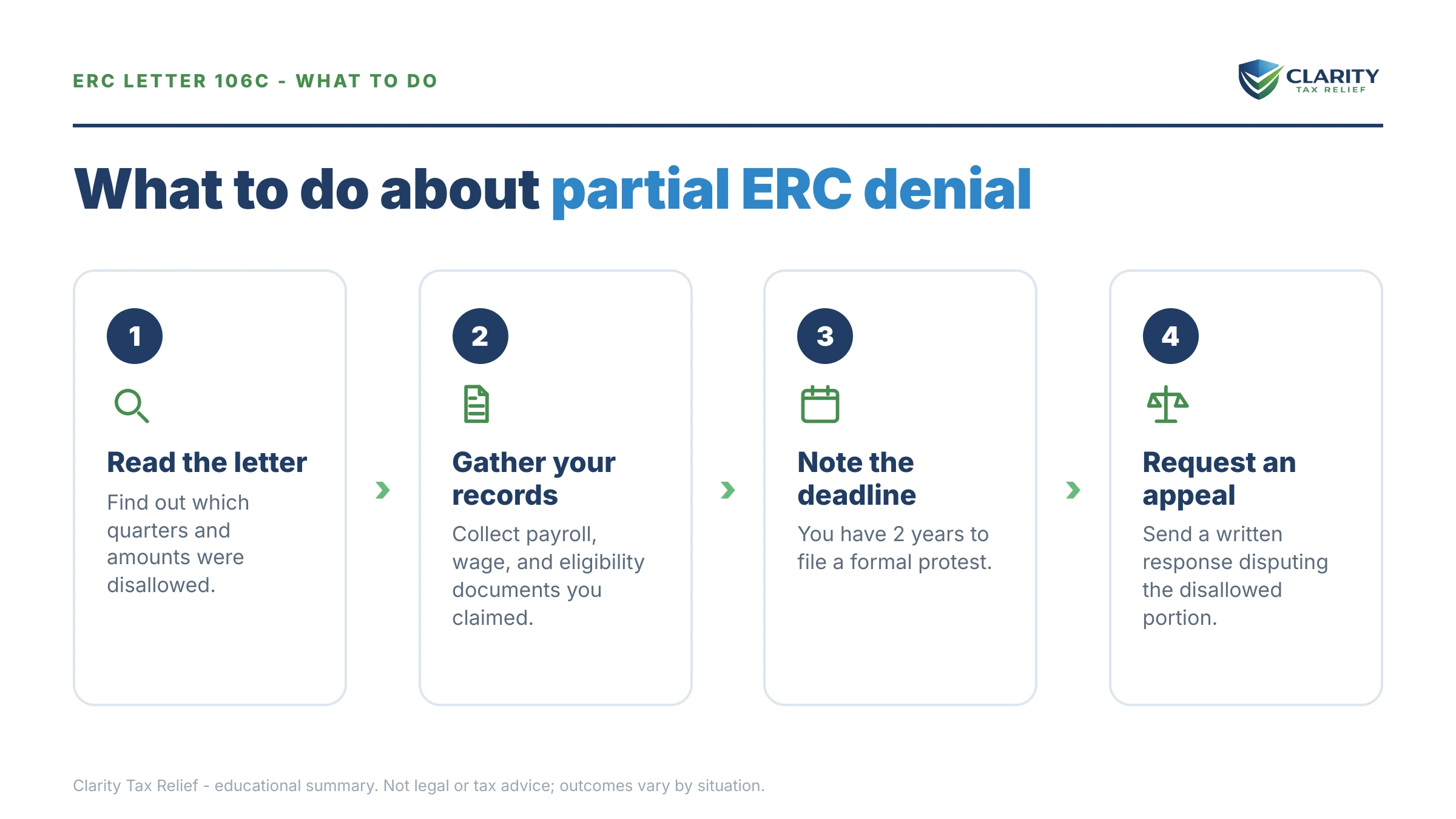
To flip the disallowed portion, you have to prove eligibility for the exact quarters the IRS denied, not the ones it already allowed. The evidence has to match the denial reason on your letter.
Assemble a package that includes:
- Government orders. The specific federal, state, county, or city orders that suspended your operations, with effective dates and the jurisdiction, plus a short narrative connecting each order to the affected quarter.
- Impact evidence. Proof the suspension affected more than a nominal portion of your business (often the "10% test") — reduced hours, closed departments, capacity limits, canceled services.
- Gross-receipts calculations. Quarter-by-quarter receipts against the 2019 comparison quarters, showing the required decline for any quarter claimed on that basis.
- Payroll records. Qualified wages by employee by quarter, tied to your Forms 941 and 941-X, with owner/relative wages and health-plan costs handled correctly.
- PPP reconciliation. Documentation showing which wages were used for PPP forgiveness so the IRS can see the ERC wages are separate.
- Employer-size support. Full-time employee counts establishing whether you were a small or large employer for the year in question.
Organize the package by quarter and by disallowance reason. A reviewer who can find each fact quickly is far more likely to reverse the denial than one who has to dig through an unlabeled binder.
A worked example: how the math looks
A concrete, hypothetical example shows how a partial disallowance plays out. Say your business claimed $180,000 in ERC across 2020 and 2021.
Letter 106-C allows $110,000 — the 2021 quarters where your gross receipts clearly dropped more than 20% versus 2019. That $110,000 is paid or credited to you, typically with overpayment interest, and it is not at risk from your dispute.
The letter disallows $70,000 tied to a 2020 partial-suspension argument the IRS rejected, saying the government order didn't suspend more than a nominal part of your operations. That $70,000 is what's now in play.
Your realistic paths: file a written protest to Appeals with the actual county closure order, your reduced-hours logs. A schedule showing the closed portion of the business exceeded 10% of operations — aiming to recover some or all of the $70,000. If Appeals won't move and the 2-year deadline is approaching, you either sign Form 907 to keep negotiating or file a refund suit for the $70,000 (plus interest) in district court. Do nothing, and at the 2-year mark that $70,000 is simply gone.
The arithmetic that matters: you're not fighting over the full $180,000 — you're fighting over the $70,000 disallowed slice. The cost and effort of the dispute should be weighed against that number.
How to respond to Letter 106-C, step by step
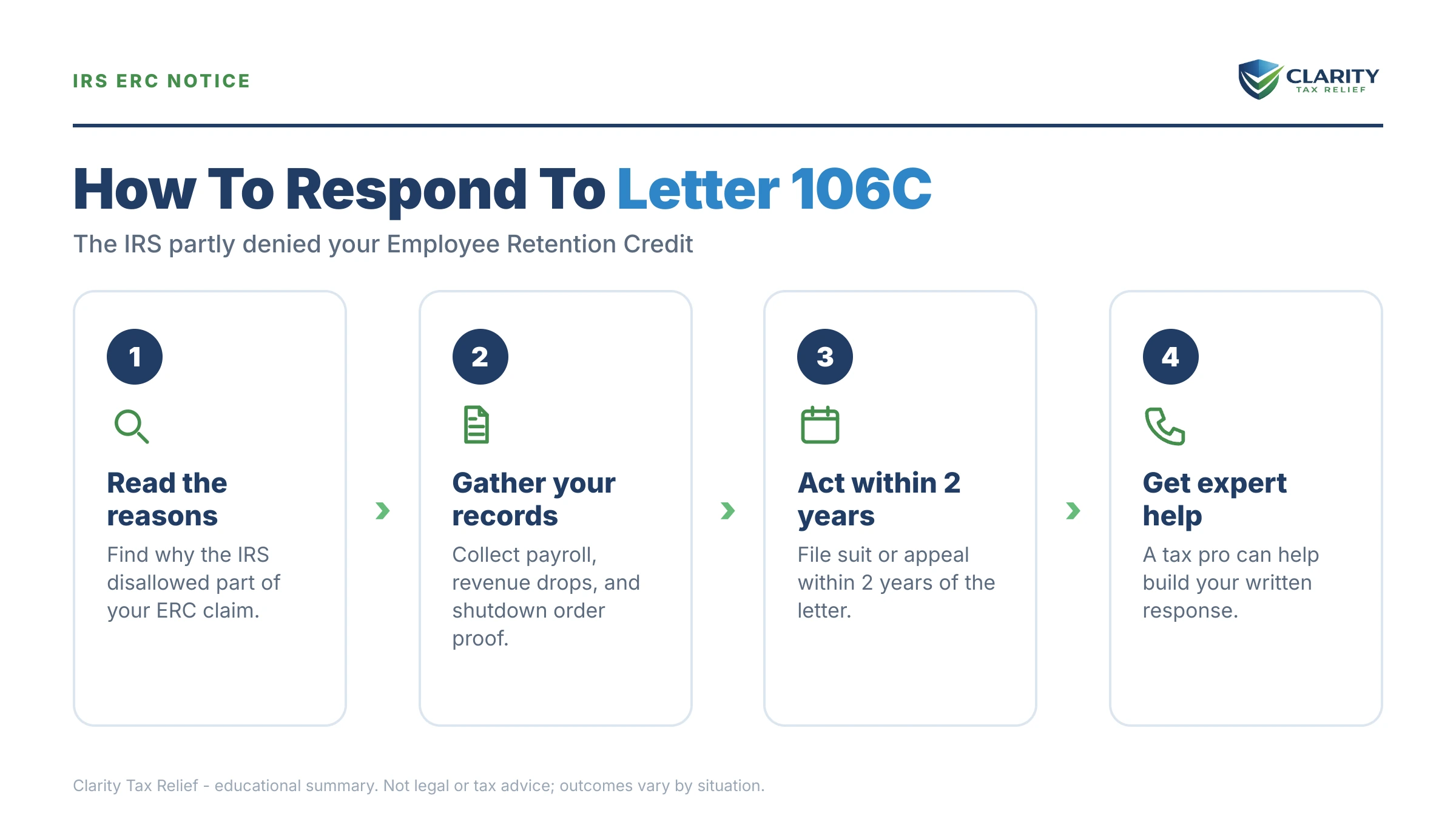
The fastest way to protect the disallowed portion is to work the letter in order — read it, date it, document it, then choose your path before the 2-year clock gets short.
- Read exactly what was allowed and disallowed. Compare the letter line by line against your Forms 941-X so you know which quarters and dollars are in dispute.
- Write down the letter date. That date starts the 2-year refund-suit statute under IRC §6532 — the deadline everything else revolves around.
- Gather eligibility proof for the denied quarters. Pull the government orders, gross-receipts math, payroll records, and PPP reconciliation for only the disallowed portion.
- Choose your dispute path. Decide between a written protest to IRS Appeals or a refund suit, based on the denial reason and the dollar amount at stake.
- File your protest or preserve the deadline. Send a timely, evidence-backed protest, and if Appeals will run past the 2-year mark, sign Form 907 or file suit before the statute closes.
- Get an experienced review of the denial reason. Have an experienced tax professional confirm whether the IRS applied the eligibility rules correctly before you commit to a path.
Not sure whether your denial is worth appealing? A quick, no-cost read of your Letter 106-C can tell you before you spend anything — start a free case review or call (888) 825-7779.
When you can handle this yourself, and when you shouldn't
You can often handle a partial disallowance yourself when the denied amount is small and the reason is a simple documentation gap you can close quickly.
Do it yourself when: the disallowed portion is modest, the IRS's reason is a missing document you already have (the closure order, a corrected gross-receipts schedule), your records are clean, and you're comfortable writing a clear protest and mailing it well inside the 30-day window.
Get experienced help when the stakes or the complexity rise:
- The disallowed portion is large and the denial turns on a legal judgment (partial suspension, nominal-portion test) rather than a missing form.
- Multiple quarters or multiple entities are involved, with aggregation or large-employer wage-base issues.
- The 2-year deadline is close and you need to decide between Form 907 and a protective refund suit.
- Appeals sustained the denial and litigation is the next realistic step.
- You also received an audit or examination request alongside the letter.
Honesty matters here: a $3,000 documentation fix rarely needs a professional. A disputed $70,000 built on a partial-suspension argument, with the statute running, usually does, because the order you argue it in and the evidence you lead with change the outcome.
Terms on your Letter 106-C, decoded
- Letter 106-C — a statutory notice that the IRS partially disallowed your refund claim (here, part of your ERC).
- Letter 105-C — the full-disallowance version; the IRS denied the entire claim.
- IRC §6532 — the law giving you 2 years from the disallowance date to file a refund suit.
- Refund suit — a lawsuit to recover a disallowed refund, filed in U.S. District Court or the Court of Federal Claims.
- IRS Independent Office of Appeals — the separate IRS office that reviews disputes without going to court.
- Form 907 — an agreement that extends the 2-year deadline to bring a refund suit.
Letter 106-C questions, answered
What does Letter 106-C mean for my ERC claim?
Letter 106-C means the IRS partially disallowed your Employee Retention Credit. It approved part of your claim and denied the rest. You keep the approved portion. You can dispute the disallowed portion through IRS Appeals or a federal refund suit within 2 years of the letter's date.
What is the difference between Letter 106-C and Letter 105-C?
Letter 106-C is a partial disallowance — the IRS allows some of your ERC and denies some. Letter 105-C is a full disallowance — the IRS denies the entire claim. Both are statutory notices of claim disallowance that start the same 2-year deadline to file a refund suit.
How long do I have to dispute Letter 106-C?
You have 2 years from the date printed on Letter 106-C to file a refund suit in federal court under IRC Section 6532. To use IRS Appeals, respond in writing promptly, generally within 30 days. But the appeal alone does not stop the 2-year clock unless you sign Form 907.
Do I have to go through IRS Appeals before suing?
No. IRS Appeals is optional. You can file a refund suit in U.S. District Court or the Court of Federal Claims once your claim is disallowed, as long as you file within the 2-year window. Many businesses try Appeals first because it is faster and cheaper than litigation.
What documents does the IRS want to reverse a partial ERC disallowance?
The IRS wants proof of eligibility for the disallowed quarters: the specific government orders that suspended your operations with dates, quarterly gross-receipts calculations showing the required decline, payroll records identifying qualified wages by employee, and PPP records showing no wages were double-counted.
Does requesting an appeal stop the 2-year refund-suit clock?
No. The 2-year period to file a refund suit keeps running while Appeals reviews your case. If Appeals will not finish before the deadline, you can sign Form 907 to extend the time to sue, or you can file the refund suit to preserve your rights while negotiations continue.
Can I still keep the part of the ERC the IRS allowed?
Yes. Letter 106-C only denies a portion of your claim. The allowed amount is paid or credited to you separately, usually with overpayment interest. Disputing the disallowed portion does not put the approved amount at risk unless a later examination reopens the whole claim.
Should I sign Form 907?
Form 907 extends the 2-year deadline to file a refund suit, which is useful when IRS Appeals cannot resolve your case in time. It protects your right to sue, but it also keeps your case open longer. Have an experienced tax professional weigh the timing before you sign.
Your next 24 hours
- Find the date on your Letter 106-C. It's near the top of the letter and it starts your 2-year refund-suit clock — mark two years out on your calendar today.
- Gather the eligibility file for the disallowed quarters. Pull your Forms 941-X, the government orders, your gross-receipts numbers, and payroll records for only the portion the IRS denied.
- Get a free case review. Send us a photo of the letter through the 2-minute form or call (888) 825-7779. An experienced tax professional will tell you whether the disallowed portion is worth disputing, and which path protects your deadline.
This guide is general information, not tax or legal advice for your specific situation. Eligibility for IRS programs depends on individual facts and circumstances; no outcome is guaranteed.
Primary sources: the IRS overview of the Employee Retention Credit, the IRS guidance on ERC claim denials and disallowance letters. The independent Taxpayer Advocate Service.