
ERC Disputes
IRS Letter 105-C: Your ERC Claim Was Disallowed, How to Respond and Appeal (2026)
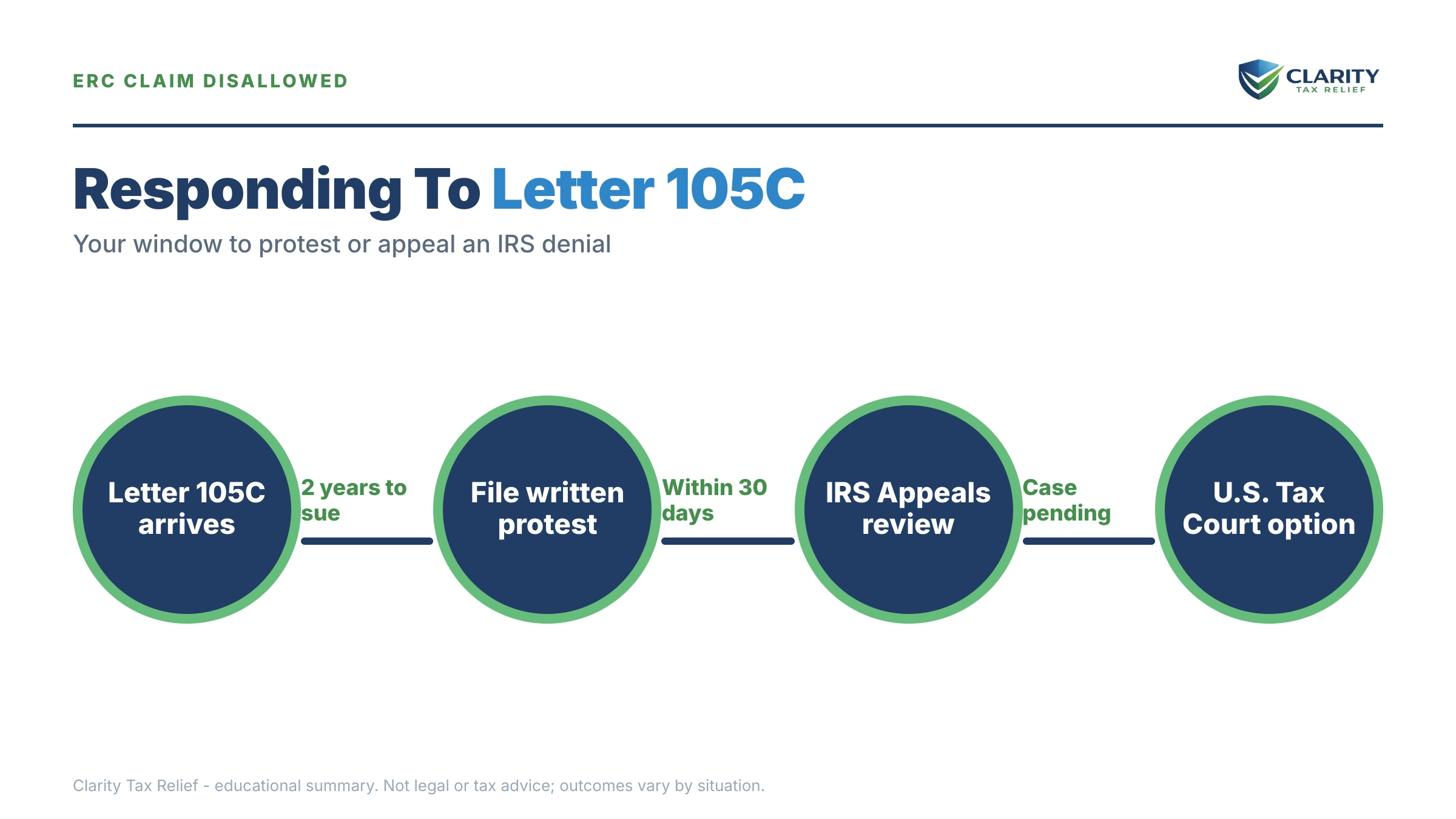
The short answer: IRS Letter 105-C means the IRS has fully disallowed your Employee Retention Credit claim. You have two years from the date on the letter to file a refund lawsuit in federal court — the single hardest deadline in the process. You can also protest to IRS Appeals, but that does not pause the two-year clock.
You filed an amended payroll return, waited months, maybe more than a year, and now a certified letter tells you the answer is no. The whole credit, gone. Letter 105-C looks final, and in the administrative sense it is: this is the IRS's official notice of claim disallowance. But "final from the IRS" is not the same as "over." You still have real, enforceable rights, and one deadline that outranks all the others.
The mistake that costs businesses their ERC is not disagreeing with the letter. It's misreading which date on the page actually matters. Below, the highlighted boxes on a real, redacted Letter 105-C show exactly where the two-year suit deadline is anchored — most people fixate on the 30-day appeal window and let the more important clock run out.
Here's the map: what a full disallowance means, what it does and doesn't take from you, how to appeal, when Form 907 can buy you time, and where a refund suit fits. This is a high-stakes B2B decision, and the order you do things in changes the outcome.
⏱ Your deadline: you have 2 years from the date the IRS mailed Letter 105-C to file a refund suit under IRC §6532(a). A separate 30-day window to protest to IRS Appeals is noted in the letter, but filing an appeal does not extend the two-year suit deadline. Only a signed Form 907 does.

What a Letter 105-C ERC disallowance actually means
Letter 105-C is a statutory notice of claim disallowance that rejects your entire Employee Retention Credit. It tells you the IRS reviewed the amended Form 941-X you filed to claim the credit and decided the answer is no across the board, not a reduced amount, but zero.
This is different from a bill. Nobody is levying you over this letter, and there's no balance due attached to the disallowance itself. What's at stake is money you were expecting to receive, not money the IRS is trying to collect. That changes your whole strategy: you are the one seeking a refund, which means you carry the burden of proving eligibility. But it also means you get to choose the forum and the timing of a fight.
The letter names a reason. In practice, ERC disallowance reasons tend to be generic and template-driven — "no qualifying government order," "insufficient decline in gross receipts," "wages claimed for another credit." A generic reason is not proof you were wrong. It's the IRS's opening position. It is frequently rebuttable with documentation the examiner never saw.
Letter 105-C vs. Letter 106-C: full vs. partial disallowance
Letter 105-C is a full disallowance; Letter 106-C is a partial disallowance. The difference is simple but important. With a 105-C the IRS denies the whole claim. With a 106-C the IRS allows part of it, often one quarter but not another, and denies the rest.
Both letters carry the same core rights: a 30-day path to IRS Appeals and the same two-year statute to file a refund suit. If you received a mix of letters across quarters, or a CP notice earlier in the process, map each one to its own deadline. A common trap is treating multiple quarters as one file when each amended return has its own claim, its own disallowance. Its own clock.
| Feature | Letter 105-C (full) | Letter 106-C (partial) |
|---|---|---|
| What the IRS decided | Entire ERC claim denied | Some allowed, rest denied |
| Appeal to IRS Appeals | Yes — 30-day protest | Yes — 30-day protest |
| Refund suit deadline | 2 years from letter date | 2 years from letter date |
| Form 907 available | Yes | Yes |
The clock that actually matters: your 2-year deadline to sue
The two-year statute of limitations under IRC §6532(a) is the deadline that decides whether you keep your right to the money. It starts the day the IRS mails the notice of disallowance, usually by certified mail, which is why the mailing date is the one to trust. Miss it, and courts will not hear your case no matter how strong your ERC eligibility is.
The 30-day appeal window feels more urgent because it's shorter, but it's administrative — missing it costs you the internal Appeals track, not your claim. The two-year window is set by statute, and it is unforgiving. This is the single most misunderstood fact about a 105-C: an ongoing appeal does not stop the two-year suit clock from running.
So while you work the appeal, someone has to be watching the calendar. If Appeals is slow, and in 2026, with IRS staffing cut roughly 27% from prior levels, ERC cases move slowly — the two years can quietly expire mid-negotiation. That's the exact situation Form 907 exists to prevent.
What happens if you do nothing
Doing nothing after a Letter 105-C means your ERC claim dies on a schedule you can predict to the day. There's no levy or lien here — the consequence is simpler and permanent: you lose the credit. Here's the sequence:
- Day 0 — Letter 105-C mailed. Full disallowance issued. Both your 30-day appeal window and your 2-year suit clock begin.
- ~Day 30 — Appeals protest window closes. Miss it and you lose the low-cost administrative route through the IRS Independent Office of Appeals. You can still sue, but you've given up a free bite at the apple.
- Months 1–24 — the claim sits. Interest that would have accrued on a paid refund is not building for you, and evidence gets harder to reassemble as time passes.
- 2 years from the letter date — the suit deadline expires. Without a filed lawsuit or a signed Form 907, your right to recover the disallowed ERC is generally gone for good.
Because the endpoint is a hard legal bar rather than an escalating collection action, the danger is quiet. No one calls to remind you. If your ERC claim was five or six figures, letting that date pass is often the most expensive thing a business can do by accident.
Your 2-year ERC suit clock is already running
Get your Letter 105-C reviewed free before the two-year deadline narrows your options. An experienced tax professional will read the stated reason, check every quarter's date, and tell you whether Appeals, a Form 907 extension, or a refund suit fits your case.
Your options after a full ERC disallowance
You have four realistic paths after a Letter 105-C. They are not mutually exclusive — most businesses start administratively and preserve the litigation option. The right mix depends on the strength of your documentation, the size of the claim, and how much time is left on the clock.
| Option | Deadline | Who it fits |
|---|---|---|
| Accept the disallowance | None | You agree the claim was not valid |
| Protest to IRS Appeals | 30 days from letter | Strong evidence the examiner overlooked |
| Form 907 extension | Before 2-year date | Appeals still working as the clock nears |
| Refund suit in federal court | 2 years from letter | Appeals fails or you skip it entirely |
1. Protest to IRS Appeals
An appeal to the IRS Independent Office of Appeals is the lowest-cost way to challenge a disallowance. You file a written protest — for larger claims a formal protest, for smaller ones the simpler Form 12203 — laying out the facts, the law. The evidence the examiner didn't fully weigh. Appeals officers are independent of the team that issued the letter and can settle based on the "hazards of litigation," meaning how the case would likely play out in court. Our full walkthrough of the ERC disallowance appeal covers the protest letter in detail.
2. File a refund suit in federal court
If Appeals fails, or you choose to skip it. You can sue the government for the refund in U.S. District Court or the U.S. Court of Federal Claims. A judge, not the IRS, decides. You must have a valid refund claim already on file (your Form 941-X), and you must file suit within the two-year window. This is the ultimate backstop, and the reason the deadline matters so much.
3. Sign a Form 907 to extend the deadline
When Appeals is actively working your case but the two years are running short, a Form 907 lets you extend the suit deadline instead of filing a protective lawsuit you may not need. It has to be signed by both you and the IRS before the deadline passes — more on the mechanics and risks below.
4. Accept it
Sometimes, after an honest review, the disallowance is correct — the business didn't have a qualifying order and gross receipts never dropped enough. If so, doing nothing simply lets the claim lapse; there's no penalty for a disallowed claim you never received money on. What you don't want is to accept a wrong denial by default because no one read the file.
Form 907: how to extend the 2-year ERC suit deadline
Form 907, "Agreement to Extend the Time to Bring Suit," is the only tool that stops the two-year clock without filing a lawsuit. It's a mutual agreement: you and the IRS both sign, setting a new, later date by which you may file a refund suit. It must be executed before the original two years expire — a Form 907 signed one day late is worthless.
Use it when Appeals is genuinely engaged and productive but slow, and you'd rather keep negotiating than spend the money to file a protective suit. The main risk is practical, not legal: signing it keeps your case in administrative limbo. An extension only helps if the IRS is actually moving toward a resolution. If Appeals has gone silent, filing suit may be the better forcing function. Weigh a Form 907 ERC extension with an experienced tax professional before you sign, and never let the deadline arrive without either a signed 907 or a filed complaint.
A worked example: how the numbers and deadlines play out
Say a restaurant group filed Forms 941-X claiming $180,000 in ERC across two quarters of 2021 — $95,000 for Q2 and $85,000 for Q3. Eighteen months later, two Letter 105-C notices arrive, each dated the same day, disallowing both quarters in full for "no qualifying government order."
The owner's clocks: 30 days to protest each quarter to Appeals, and 2 years from the letter date to sue for each. The business had, in fact, operated under a county capacity order that cut indoor dining — documentation the examiner apparently never received.
Path taken: file a written protest within 30 days with the county order, the capacity math, and payroll records attached. Appeals engages but is slow. At the 20-month mark, with the case unresolved, the owner and the IRS sign a Form 907 extending the suit deadline another year — preserving the right to sue while Appeals keeps working. If Appeals ultimately allows the claim, the $180,000 is paid with statutory interest. If it doesn't, the extended deadline still leaves room to file a refund suit in the Court of Federal Claims.
Contrast the do-nothing version: the same owner files no protest, assumes the letter is final, and never calendars the two-year date. At month 25, the statute expires. The $180,000 is unrecoverable, not because the claim was weak, but because the clock ran out. This is a hypothetical illustration; your facts and numbers will differ.
How to respond to Letter 105-C, step by step
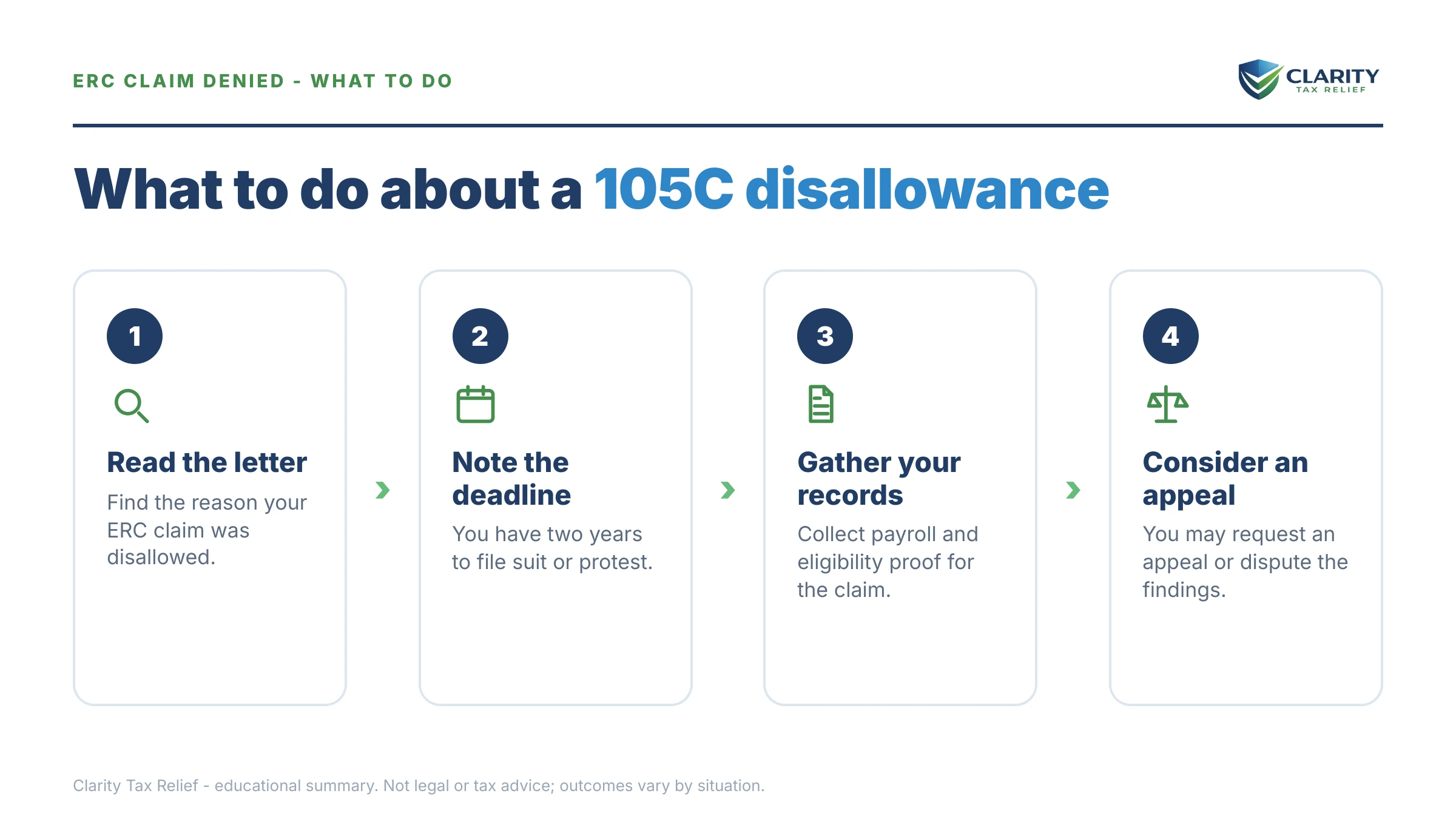
- Find the mailing date and calendar the 2-year deadline. Mark exactly two years out for each quarter's letter. This is your hard suit deadline.
- Read the stated reason for disallowance. Pin down why the IRS said no so you know exactly what evidence rebuts it.
- Gather your substantiation. Pull the Form 941-X, government shutdown or capacity orders, gross-receipts records by quarter, payroll registers, and PPP documentation.
- File a written protest within 30 days. Send it to IRS Appeals to keep the low-cost administrative track open while the clock runs.
- Watch the calendar and consider Form 907. If Appeals is still working as the two years near, negotiate a signed extension before the deadline.
- File a refund suit if needed. Before the deadline, file in U.S. District Court or the Court of Federal Claims to preserve your right to the credit.
When you can handle this yourself, and when you shouldn't
You can reasonably handle a Letter 105-C alone when the disallowance is small, your documentation is airtight, or you already agree the claim wasn't valid. Filing a straightforward Form 12203 protest with clean records — a clear county shutdown order and matching payroll — is something a well-organized business owner can do.
Experienced help changes the outcome when the stakes and complexity rise: a five- or six-figure claim, multiple quarters with different letters and deadlines, a two-year date approaching with Appeals still open, or a decision about Form 907 versus filing suit. The choice of court, the drafting of a refund complaint, and the "hazards of litigation" argument at Appeals are places where representation regularly moves the number.
Be especially wary if the same promoter who prepared your ERC claim is now offering to "fix" the disallowance for a contingency fee — the FTC and IRS have both warned about aggressive ERC mills. You want an independent, experienced tax professional reviewing the actual file, not the shop with a stake in the original claim.
Terms on your Letter 105-C, decoded
Full disallowance: the IRS rejects your entire claim — zero credit allowed, as opposed to a partial disallowance on a 106-C.
Notice of claim disallowance (IRC §6532): the formal letter that starts your two-year clock to file a refund suit.
Refund suit: a lawsuit against the government to recover a refund the IRS denied, filed in U.S. District Court or the Court of Federal Claims.
Form 907: an agreement, signed by you and the IRS, that extends the two-year deadline to bring a refund suit.
IRS Independent Office of Appeals: a separate IRS unit that reviews disputes and can settle based on litigation risk, independent of the team that denied your claim.
Form 941-X: the amended employment tax return you filed to claim the ERC. Your underlying refund claim.
Letter 105-C ERC disallowance questions, answered
What is IRS Letter 105-C for an ERC claim?
Letter 105-C is a formal notice of claim disallowance. It means the IRS has fully rejected your Employee Retention Credit claim. You get nothing from the amended Form 941-X you filed. It is the IRS's final administrative word on the claim and, by law, it starts your 2-year deadline to sue for the refund in federal court.
What is the difference between Letter 105-C and Letter 106-C?
Letter 105-C is a full disallowance — the IRS is denying your entire ERC claim. Letter 106-C is a partial disallowance — the IRS is allowing some of your claim and denying the rest. Both start the same 2-year clock to file a refund suit, and both can be protested to IRS Appeals.
How long do I have to appeal a Letter 105-C ERC disallowance?
You generally have 30 days from the date on the letter to file a written protest with the IRS Independent Office of Appeals. Separately, you have 2 years from the date the IRS mailed the disallowance to file a refund lawsuit. The 30-day appeal window is administrative; the 2-year suit deadline is the one set by statute and is far harder to fix if missed.
Does filing an IRS Appeals protest stop the 2-year deadline to sue?
No. Requesting Appeals consideration does not pause or extend the 2-year statute of limitations to file a refund suit under IRC Section 6532. The clock keeps running while your case sits in Appeals. The only way to extend it is to have the IRS sign a Form 907, Agreement to Extend the Time to Bring Suit, before the 2 years expire.
What is Form 907 and should I sign it?
Form 907 is an agreement between you and the IRS to extend the 2-year deadline to file a refund suit. It is useful when Appeals is still working your case and the 2 years are about to run out, so you don't have to file suit prematurely to protect your rights. It must be signed by both you and the IRS before the deadline passes. You should weigh it with an experienced tax professional before signing.
Can I still win my ERC after a full disallowance?
Yes. A Letter 105-C is not the end of the road. Many disallowances rest on template letters, missing documentation, or a misreading of your eligibility. You can present new evidence to IRS Appeals, and if that fails you can sue for the refund in U.S. District Court or the Court of Federal Claims, where a judge, not the IRS, decides.
Do I have to pay anything before suing for my ERC refund?
Usually no. Because an ERC claim is a request for a refund of employment taxes you say you overpaid, you are the one seeking money back. You are not paying an assessment first. You do need a valid, timely refund claim on file (your Form 941-X) and you must file suit within the 2-year window after the disallowance.
Which court do I file my ERC refund suit in?
You choose between the U.S. District Court for the district where your business is located and the U.S. Court of Federal Claims in Washington, D.C. Both hear tax refund cases. The choice affects procedure, precedent, and cost, so it is a decision to make with counsel rather than by default.
What happens if I miss the 2-year deadline to sue?
If the 2 years expire without a filed suit or a signed Form 907, your right to recover the disallowed ERC is generally lost for good. Courts strictly enforce this statute of limitations, and neither an ongoing appeal nor good-faith negotiation revives it. This is why the date on your Letter 105-C matters more than any other number on the page.
Why was my ERC claim disallowed?
Common reasons include the IRS concluding your business had no qualifying government shutdown order, no sufficient decline in gross receipts, wages already used for PPP forgiveness, or missing documentation to substantiate the claim. The letter states a reason, but the stated reason is often generic — reviewing the actual basis is the first step in any appeal.
Your next 24 hours
Turn the letter into three concrete moves today:
- Find the mailing date. Locate the date the IRS mailed each Letter 105-C and write down the exact two-year suit deadline for each quarter. This is the number everything else depends on.
- Gather your file. Pull your Form 941-X, any government shutdown or capacity orders, quarterly gross-receipts records, payroll registers, and PPP documents into one place.
- Get a free case review. Send us a photo of the letter through the 2-minute form or call (888) 825-7779. An experienced tax professional will confirm your deadlines and tell you whether Appeals, a Form 907 extension, or a refund suit fits, before the two-year clock narrows your choices.
This guide is general information, not tax or legal advice for your specific situation. Eligibility for IRS programs depends on individual facts and circumstances; no outcome is guaranteed.