
IRS Audits & the Employee Retention Credit
IRS ERC Audit: What to Expect When Your Employee Retention Credit Is Examined (2026)
The short answer: an ERC audit is an IRS examination of your Employee Retention Credit claim. The IRS requests payroll records, proof of a gross-receipts decline, and the government orders you relied on. You typically get 30 days to answer each document request. A disallowed credit means repaying the refund plus interest, often with a 20% penalty on top.
You claimed the Employee Retention Credit, the refund came through, and now an IRS letter is asking for payroll registers, quarterly revenue, and the shutdown orders that made your business eligible. The pit in your stomach is real, but an ERC audit is a document exercise, not a verdict. If your claim is legitimate and you can show it, you win it.
The businesses that lose ERC audits usually lose them the same way: they let a promoter file the claim, never built an eligibility file, and then ignored the first request. This guide walks you through exactly what the IRS asks for, why claims get disallowed, what the penalties look like, and how to prepare so the paperwork works for you instead of against you.
Below, the highlighted boxes on the sample Information Document Request show exactly which line carries your real response deadline — most people read the mailing date and miss the date that actually starts the clock.
⏱ Your deadline: the response date printed on the Information Document Request (Form 4564), usually 30 days from the date on the letter. Miss it and the examiner can move forward on the record in front of them, which almost always means a proposed disallowance. Ask for more time in writing before the date if you need it; do not just send nothing.

Why your ERC claim is being audited
The IRS is examining ERC claims because a wave of aggressive promoters filed credits for businesses that never qualified. These "ERC mills" advertised on the radio, charged a percentage of the refund, and pushed one-size-fits-all eligibility memos, then vanished once the money landed. The IRS paused new claim processing in late 2023 and opened a broad examination effort to claw back improper refunds.
Being selected does not mean the IRS has decided you were wrong. Selection is driven by risk signals: a claim size that looks large for your payroll, a preparer the IRS is scrutinizing, a government-order argument that many businesses over-applied, or simple statistical sampling. A well-documented claim survives the same audit that sinks a promoter-driven one.
If your first contact was a notice rather than a full examination letter, read our companion guide to Notice CP320B, "your ERC claim is under review," which is the softer front end of this same process.
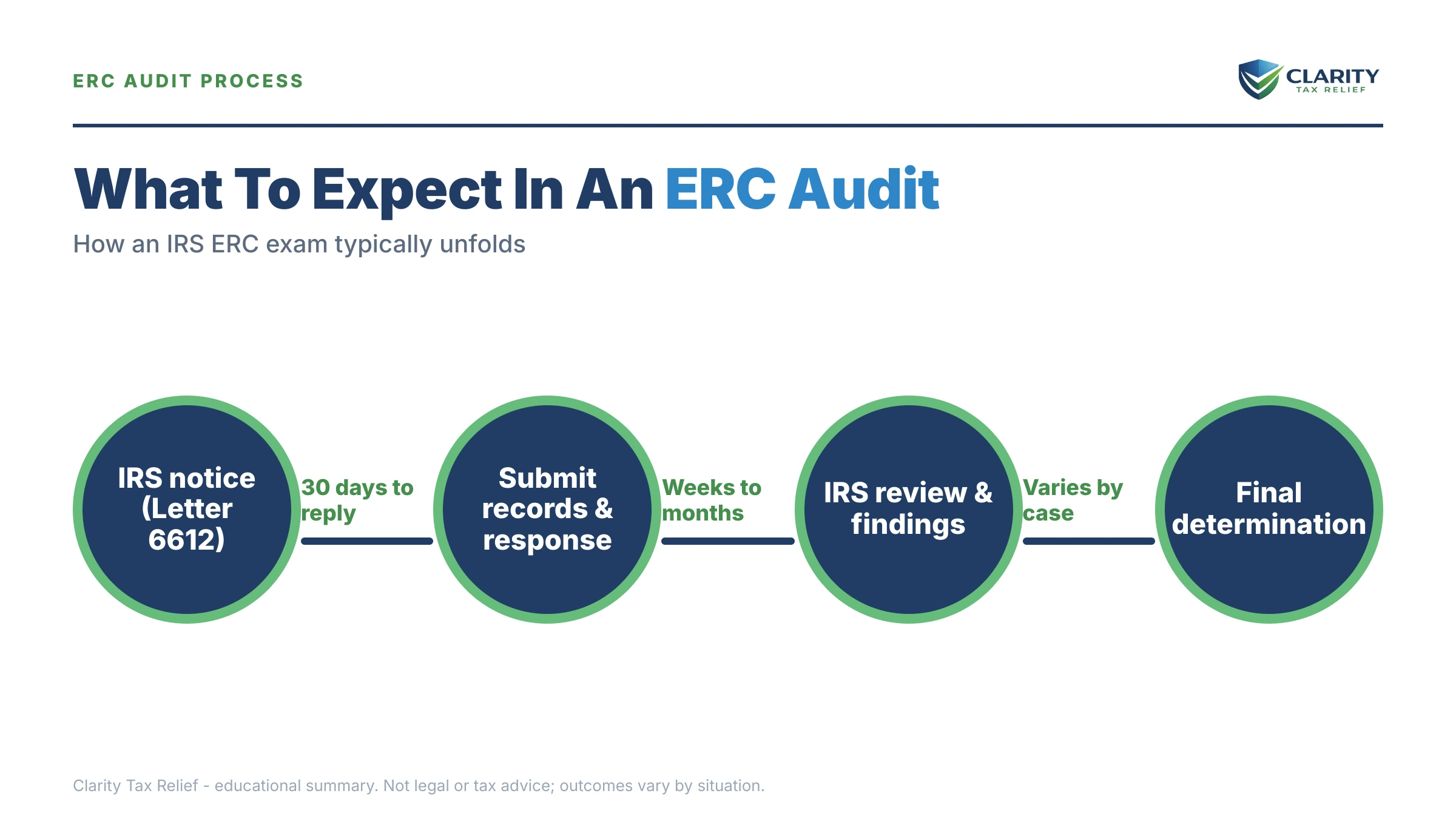
How an ERC audit actually unfolds
An ERC audit is a defined sequence, and knowing the stages tells you where you stand. It typically starts with a contact letter and an Information Document Request and ends either with a "no change" letter or a proposed disallowance you can contest.
- Initial contact letter — the IRS notifies you the ERC quarters are under examination and assigns an examiner or campus unit.
- Information Document Request (Form 4564) — the list of records you must produce, with a response date usually 30 days out.
- Review and follow-up IDRs — the examiner reviews what you sent and often issues additional requests to fill gaps.
- Form 886-A — a written explanation of the IRS's position and proposed adjustment if it intends to disallow all or part of the credit.
- Letter 105-C or 106-C — the formal full disallowance (Letter 105-C) or partial disallowance (Letter 106-C) of your refund claim.
- Appeal or refund suit. You can protest to IRS Appeals and, if needed, file a refund suit in court. See how to appeal an ERC disallowance.
What documents the IRS requests in an ERC audit
The IRS builds its ERC audit around three eligibility pillars: your payroll, your gross-receipts decline, and any government order that suspended your operations. Every document request maps to one of those pillars, and to proving you did not double-count wages.
Here is what the Information Document Request will ask for, and why each item matters.
| Document | Eligibility pillar | What it proves |
|---|---|---|
| Payroll registers & wage detail by employee and quarter | Qualified wages | The actual wages the credit was calculated on |
| Forms 941 and amended Forms 941-X | Qualified wages | What you originally reported vs. what you claimed |
| Quarterly gross receipts for claim quarters and 2019 comparisons | Gross-receipts decline | Whether you met the required percentage drop |
| The specific federal, state, or local government orders | Government-order suspension | That a real order more than nominally limited operations |
| PPP loan and forgiveness records | No double-dipping | That ERC wages were not also used for PPP forgiveness |
| Health-plan expense allocations | Qualified wages | That claimed health costs are properly tied to qualified wages |
| Name of the preparer and eligibility memo | Promoter scrutiny | Who calculated the claim and on what basis |
Two documentation points trip up the most businesses. First, the gross-receipts test compares each 2020 or 2021 quarter to the same quarter in 2019 — 2020 required roughly a 50% decline, 2021 roughly a 20% decline — so you need clean quarterly revenue for both years, not annual totals. Second, a government-order claim must point to an actual order that more than nominally suspended your operations; "business was slow" or "customers stayed home" is not, by itself, a qualifying suspension.
Common reasons the IRS disallows an ERC claim
Most ERC disallowances come down to a handful of repeat failures, and nearly all of them are documentation and eligibility problems the business could see coming. Knowing the list lets you pressure-test your own claim before the examiner does.
| Disallowance reason | What went wrong | How to prevent or answer it |
|---|---|---|
| No qualifying government order | Relied on general fear or a supplier's slowdown, not an order affecting you | Cite the exact order, dates, and how it limited more than a nominal part of operations |
| Gross-receipts decline not met | The quarter did not actually drop by the required percentage vs. 2019 | Produce clean quarterly figures; drop quarters that do not qualify |
| Wages double-counted with PPP | Same wages used for both ERC and PPP forgiveness | Reconcile and show separate wage pools for each program |
| Wages for majority owners / relatives | Claimed wages that are excluded for >50% owners and certain family | Remove ineligible owner-related wages from the calculation |
| No records to support the claim | A promoter filed it and left no supporting file | Rebuild payroll, receipts, and order documentation independently |
| "Supply chain" theory overreach | Claimed suspension because a supplier was affected | Show a specific order to the supplier and a direct, more-than-nominal impact on you |
Penalties and interest exposure if your ERC is disallowed
A disallowed ERC is not just "give the money back" — the IRS charges interest from the day it paid you. It can layer penalties on top. Understanding the exposure tells you how hard the claim is worth defending.
- Repayment of the credit — the full disallowed amount becomes a balance due.
- Interest — accrues from the date the refund was issued to you, not from the audit date, so a claim paid in 2022 has years of interest attached.
- Accuracy-related penalty (IRC §6662) — 20% of the underpayment for negligence or a substantial understatement.
- Erroneous refund claim penalty (IRC §6676) — 20% of the excessive refund amount when there was no reasonable basis for the claim.
- Civil fraud penalty (IRC §6663) — up to 75% when the IRS shows intentional wrongdoing; reserved for the worst cases.
Reasonable-cause relief can knock out some penalties if you acted in good faith and relied on complete, accurate professional advice, but "an ERC mill told me I qualified" is a weak reasonable-cause argument when the mill never verified your facts. To sanity-check what interest and penalties on a disallowance might total, our IRS penalty and interest calculator estimates the running cost (it estimates only — the examiner's numbers govern).
Worked example: what a disallowed ERC actually costs
Say your business claimed $180,000 in ERC across three 2021 quarters, and the refund was paid in mid-2022. On audit, the IRS finds the government-order argument does not hold and disallows the full amount.
You now owe the $180,000 back. Interest running from mid-2022 through a 2026 assessment could add roughly $35,000–$45,000 depending on the rate periods. If the IRS also asserts a 20% accuracy penalty, that is another $36,000. Total exposure lands near $250,000–$260,000 — on a credit you may have paid a promoter 20% of to obtain. That arithmetic is why documentation, and challenging a weak disallowance, matters so much.
If a disallowance leaves you with a five- or six-figure balance you cannot pay at once, the same resolution paths apply as any large tax debt — see, for example, options when you owe the IRS $80,000 or owe the IRS $90,000.
Got an ERC audit letter or a proposed disallowance?
Send us the IDR or the Letter 105-C. An experienced tax professional will review your eligibility file and map your response before the 30-day window closes — free, confidential, no pressure.
How far back the IRS can audit your ERC
The assessment window is what makes 2026 the peak year for ERC audits. For 2020 and the first two quarters of 2021, the IRS generally has three years from when the return was filed to assess additional tax. For the third and fourth quarters of 2021, Congress extended that period to five years. Fraud carries no statute of limitations at all.
Those windows are also why deadlines cut both ways. If a disallowance is heading toward the two-year limit on your right to sue for the refund, a business may be asked to sign an extension — our guide to Form 907 and extending the time to bring an ERC suit explains when signing protects you and when it simply hands the IRS more time.
How to respond to an ERC audit, step by step
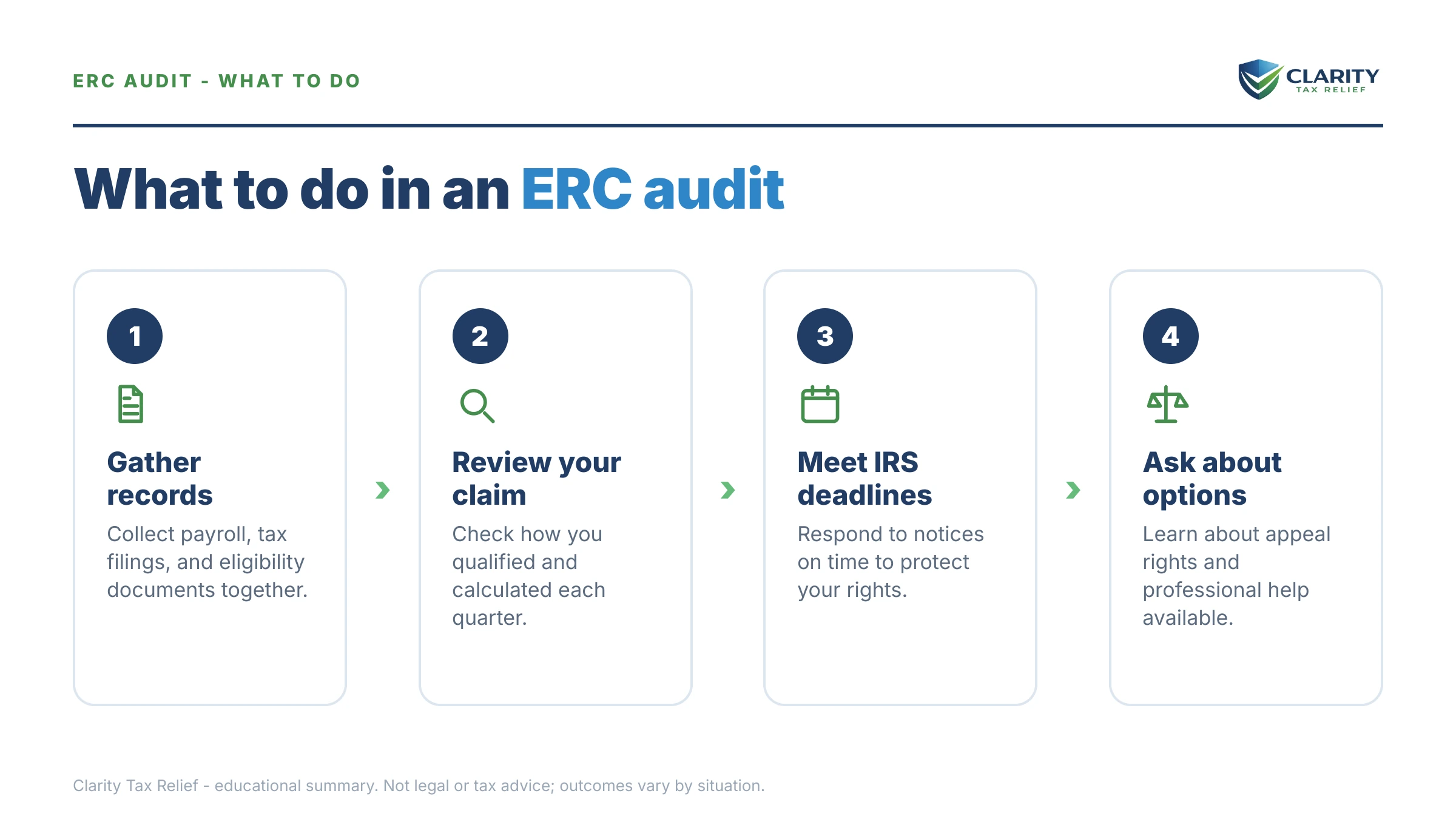
The businesses that come through ERC audits cleanly do the same six things in the same order. Follow them and you turn a stack of requests into an organized defense.
- Read the letter and calendar the deadline — know whether you have an IDR, a CP320B, or a 105-C, and put the response date (usually 30 days) on your calendar.
- Rebuild your eligibility file — gather payroll detail, Forms 941 and 941-X, quarterly gross receipts, and the exact government orders you relied on.
- Reconcile PPP and wage overlap — confirm no ERC wages were also used for PPP forgiveness, owner wages, or other credits.
- Answer the IDR item by item — respond to each numbered request with labeled documents and a short cover memo tying your facts to the rule.
- Request more time if you need it — ask the examiner in writing before the deadline rather than sending an incomplete package.
- Bring in representation for disallowances — if the IRS proposes cutting the credit, get a professional review before the appeal deadline passes.
When you can handle an ERC audit yourself, and when you shouldn't
You can often handle a clean, well-documented ERC audit on your own. If a knowledgeable preparer built your claim, your gross-receipts decline is clearly met with quarterly numbers you can produce, or your government order plainly suspended a meaningful part of your operations, answering the IDR completely and on time may be all it takes to earn a "no change."
Experienced help changes outcomes in the harder cases: large dollar amounts, a promoter-prepared claim with no supporting file, a government-order theory the IRS is challenging, a proposed penalty, or a full or partial disallowance you need to appeal. In those situations the legal standards, the burden of proof. The deadlines are unforgiving. A strong written response early can prevent a fight later. Never let the mill that filed the claim also "defend" it — many charged contingent fees and produced memos that fold under examination.
Terms on your ERC audit letter, decoded
- Information Document Request (Form 4564) — the IRS's itemized list of records you must produce, with a response deadline.
- Form 886-A — the examiner's written explanation of the IRS position and the proposed adjustment.
- Letter 105-C — a formal full disallowance of your refund claim.
- Letter 106-C — a formal partial disallowance; the IRS allows some of the credit and denies the rest.
- Gross-receipts test — the eligibility path based on a quarterly revenue decline versus 2019.
- Partial suspension — the eligibility path based on a government order that more than nominally limited your operations.
- Assessment period — the window (3 or 5 years) in which the IRS can charge back a disallowed credit.
ERC audit questions, answered
How long does an ERC audit take?
Most ERC audits run six months to well over a year. The clock depends on how quickly you produce documents, how many quarters are under review, and whether the case moves to Appeals. Responding fully and on time to the first Information Document Request is the single biggest factor in keeping it short.
What documents does the IRS want in an ERC audit?
The IRS asks for payroll registers, Forms 941 and 941-X, quarterly gross-receipts figures for the claim quarters and the 2019 comparison quarters, the specific federal, state, or local government orders you relied on, and proof that no wages were double-counted with PPP forgiveness. It also wants to know who prepared the claim.
What are the penalties if my ERC is disallowed?
A disallowed ERC means repaying the refund plus interest from the date it was paid to you. On top of that, the IRS can add a 20% accuracy-related penalty under IRC 6662 or a 20% erroneous refund claim penalty under IRC 6676, and in cases involving intentional wrongdoing a 75% civil fraud penalty. Reasonable-cause relief can reduce some of these.
How far back can the IRS audit my ERC?
For 2020 and the first two quarters of 2021, the IRS generally has three years from when the return was filed to assess. For the third and fourth quarters of 2021, Congress extended the assessment period to five years. Fraud has no time limit. These windows are why many ERC audits are landing in 2026.
Can I withdraw my ERC claim to avoid an audit?
If your ERC claim has not yet been paid or you have not cashed the refund check, the IRS withdrawal process lets you pull the claim as if it were never filed, with no penalty or interest. If you already received and cashed the refund, withdrawal no longer applies and you would look at repayment or, when available, a disclosure program instead.
Why is the IRS auditing so many ERC claims?
Aggressive promoters, often called ERC mills, filed enormous numbers of claims for businesses that did not qualify, taking a percentage fee off the top. The IRS paused new claim processing and launched a wave of examinations to recover improper refunds. A legitimate claim with real documentation has nothing to fear from that scrutiny; a promoter-driven one often does.
What happens if I already spent the ERC refund?
You are still liable to repay a disallowed credit even if the money is gone. If you cannot pay the full amount at once, the IRS collection options apply — an installment agreement, Currently Not Collectible status if repayment would cause hardship, or in some cases an Offer in Compromise. The debt does not disappear because you spent it.
Do I need a tax professional for an ERC audit?
You can handle a straightforward audit yourself if you have clean documentation and a clear eligibility basis. Experienced representation changes outcomes when large dollars are at stake, when a promoter prepared your claim, when the IRS proposes a penalty, or when you need to appeal a disallowance — the legal standards and deadlines in those situations are unforgiving.
What if an ERC mill prepared my claim?
Do not rely on the promoter to defend the audit. Many charged a contingent fee, disappeared after the refund was paid, and produced eligibility memos that do not hold up. Pull your own records, verify whether you actually met the gross-receipts or government-order test, and get an independent review before you respond to the IRS.
Can I appeal an ERC disallowance?
Yes. If the IRS issues a full or partial disallowance you can file a protest to the IRS Independent Office of Appeals, and if that fails you can pursue a refund suit in federal district court or the Court of Federal Claims. Each path has strict deadlines — missing them can forfeit your right to challenge the disallowance.
Your next 24 hours
You do not have to solve the whole audit today. Do these three things and you convert the anxiety into a plan.
- Find the response date on your Information Document Request or notice — the date that starts the 30-day clock, not the mailing date.
- Gather the eligibility file — payroll registers, Forms 941 and 941-X, quarterly gross receipts for the claim quarters and 2019, the government orders. Your PPP forgiveness records.
- Get a free case review before you respond — send us the letter through the 2-minute form or call (888) 825-7779. An experienced tax professional will map your response before the deadline hits.
This guide is general information, not tax or legal advice for your specific situation. Eligibility for IRS programs depends on individual facts and circumstances; no outcome is guaranteed.