
Owe Back Taxes
I Owe the IRS $80,000: What to Do About It (2026)
The short answer: if you owe the IRS $80,000, you're above the $50,000 streamlined payment-plan line and above the $66,000 passport-certification line for 2026. You still have four real paths — a non-streamlined installment agreement, Currently Not Collectible status, an Offer in Compromise, or penalty relief — but each now requires a financial statement.
You added up the notices, or you finally logged into your IRS account, and the number staring back is around $80,000. That figure is big enough to feel unfixable, and big enough that the automatic, no-questions-asked options you'd have had at a smaller balance are off the table. It is still very fixable, and this page is the map.
At this size, three thresholds now work against you at once: the lien threshold, the passport threshold, and the point where the IRS wants to see your full financial picture before it agrees to anything. Below, the highlighted boxes on the annotated IRS account transcript show exactly where to read your assessment date and true balance — the two numbers that decide which options you actually qualify for.
The good news buried in an $80,000 balance: it is almost always a mix of tax, penalties, and interest across more than one year — which means there is often more than one lever to pull to bring it down.
⏱ The clock that matters most at $80,000: your debt is over the $66,000 "seriously delinquent" threshold for 2026, so the IRS can certify it to the State Department and your passport can be denied or revoked. A final Notice of Intent to Levy (LT11) also starts a 30-day window before the IRS can garnish wages or levy bank accounts. Getting into any active resolution stops both clocks.
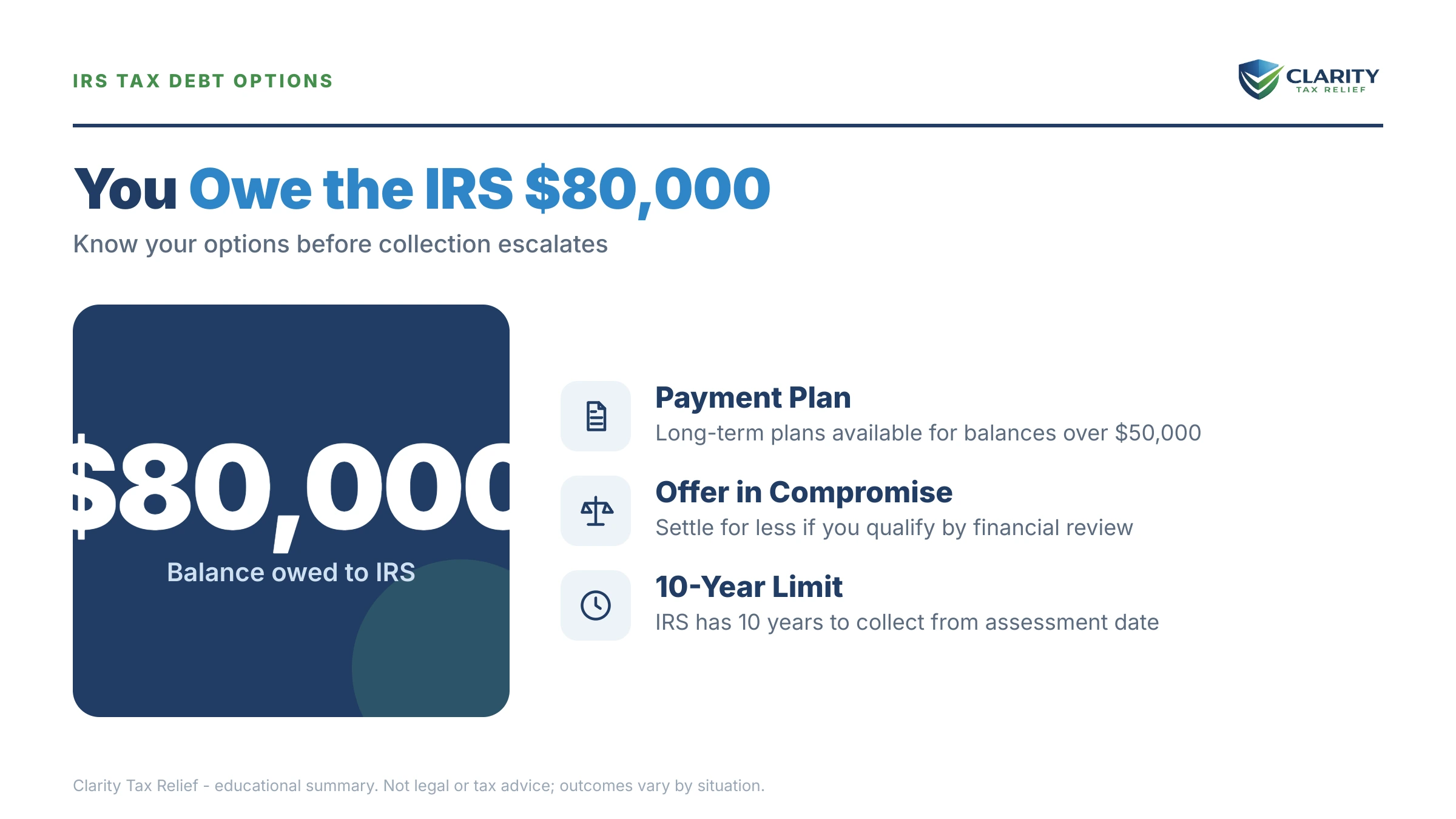
What owing the IRS $80,000 really means in 2026
An $80,000 IRS balance is a collection matter, not a criminal one — no one is arrested for being unable to pay. What the number triggers is a set of automated enforcement tools: liens, levies, and passport certification. The size is what pushes you past the "easy" thresholds and into the territory where the IRS asks to see your income, expenses, and assets before it agrees to a plan.
Most $80,000 balances are built from more than one tax year, and each year usually breaks into three parts: the tax you reported, the failure-to-pay penalty that grows at 0.5% a month, and interest compounding daily. Because penalties and interest are stacked on top, part of your $80,000 may be reducible even before you negotiate the underlying tax.
Owing this much sits between the mid-range balances covered in our guides on owing the IRS $60,000 and owing the IRS $70,000. The higher-exposure range in owing the IRS $90,000. The mechanics are similar, but $80,000 is the band where the passport rule and full financial disclosure both kick in.
“Seriously delinquent tax debts are legally enforceable, unpaid federal tax debt (including assessed penalties and interest) totaling more than $66,000 (adjusted yearly for inflation).”
— Revocation or denial of passport in cases of certain unpaid taxes (IRS.gov)
Why $80,000 crosses thresholds a smaller balance doesn't
Three specific IRS thresholds change your options once your balance passes them, and $80,000 clears all three.
The $50,000 streamlined ceiling. Below $50,000, an individual can usually set up a long-term installment agreement online with no financial disclosure — the IRS just takes the monthly payment. At $80,000 that door is closed. You either pay the balance down under $50,000 to reopen it, or move to a non-streamlined agreement that requires a Collection Information Statement.
The $66,000 passport threshold. Under federal law, once a tax debt is "seriously delinquent" the IRS certifies it to the State Department, which can deny, revoke, or refuse to renew your passport. For 2026 that threshold is $66,000, and it adjusts for inflation each year. At $80,000 you are over it, and the IRS mails Notice CP508C when it certifies. The IRS reverses certification once you're in an installment agreement, an accepted or pending Offer in Compromise, or Currently Not Collectible status.
The $10,000 lien threshold. The IRS generally files a Notice of Federal Tax Lien once a balance passes $10,000. At $80,000 a lien is likely if you don't act. It attaches to your home, becomes public record, and can block a sale or refinance. A lien is not a levy: it secures the IRS's claim but takes nothing on its own.
The IRS collection timeline: what happens at each stage
An $80,000 balance moves through the same automated notice sequence as any other, but the enforcement steps carry more weight. Here's the order and the day counts.
| Stage | What it is | Timing |
|---|---|---|
| CP14 | First bill for the balance due | ~21 days to pay or arrange |
| CP501 / CP503 | Reminder notices; balance still growing | ~5 weeks apart |
| CP504 | Intent to levy your state tax refund; lien becomes likely | 30 days before state-refund levy |
| CP508C | Passport certified as "seriously delinquent" (over $66,000) | Any time balance exceeds threshold |
| LT11 / Letter 1058 | Final Notice of Intent to Levy + appeal rights | 30-day clock before wage/bank levy |
| Levy / NFTL | Wage garnishment, bank levy (21-day hold), lien filed | After the 30-day LT11 window |
What happens if you do nothing
Ignoring an $80,000 balance doesn't freeze it. It grows and escalates on autopilot. Here is the sequence, and roughly when each step lands if you never respond:
- Days 1–60: penalties and interest keep compounding. The failure-to-pay penalty adds 0.5% of the balance every month; interest compounds daily.
- Months 2–4: reminder notices (CP501, CP503) arrive, then CP504, which lets the IRS seize your state tax refund and signals a lien is coming.
- Anytime over $66,000: the IRS certifies your debt to the State Department (CP508C). Your passport can be denied or revoked.
- After the LT11 30-day window: the IRS can garnish your wages (continuous until released), levy your bank accounts (21-day hold, then funds leave), and take up to 15% of Social Security.
- In the background: a federal tax lien is filed, attaching to your home and hitting your public record.
In 2026 this matters more than ever. The IRS workforce shrank roughly 27% in 2025, so reaching a human is harder. But the levies, liens, and certifications are issued by automated systems that never slowed down. Delay costs money and options; it does not buy safety.
Owe the IRS $80,000 and worried about your passport or a levy?
Send us your notice. An experienced tax professional will read your transcripts, tell you whether you're over the certification threshold, and map the fastest path into a resolution that stops the clock — free, confidential, no pressure.
Your resolution options for an $80,000 IRS debt
You have four real paths at $80,000, and the right one depends entirely on your income, expenses, and asset equity. Here's how they compare.
| Option | Who it fits | What it costs / requires |
|---|---|---|
| Pay down + streamlined plan | Can drop balance under $50,000 | $0 setup online; up to 72 months; no financial statement once under $50k |
| Non-streamlined installment agreement | Can afford a monthly payment; balance $50k–$250k | Setup fee; Form 433-F/433-A; interest + 0.25% monthly penalty continue |
| Currently Not Collectible | Paying anything creates hardship | Form 433-F/433-A; collection pauses; debt and interest remain |
| Offer in Compromise | Assets + future income can't cover $80k before CSED | $205 fee (waivable if low-income); 20% down for lump sum; Form 656 + 433-A(OIC) |
| Penalty relief | Clean prior 3 years, or reasonable cause | Free to request; removes penalty portion, not the tax |
Non-streamlined installment agreement
For balances from $50,000 to $250,000, the IRS offers a non-streamlined installment agreement — a monthly plan that requires you to show your finances. You complete a Collection Information Statement, and the monthly payment is generally what that statement shows you can afford. In some cases, agreeing to direct-debit payments streamlines the review and can help avoid or withdraw a lien. Interest and a reduced 0.25% monthly penalty continue while you pay.
Currently Not Collectible (CNC)
If your allowable living expenses eat up your income, the IRS can place your account in Currently Not Collectible status — collection stops, levies pause, and passport certification is prevented or reversed. The $80,000 doesn't disappear; interest keeps running and the IRS reviews your finances periodically. But for someone genuinely unable to pay, CNC buys real breathing room, and the collection statute keeps ticking in the background.
Offer in Compromise (the real version)
An Offer in Compromise lets you settle for less than $80,000 only when the IRS's own formula shows it can't collect the full amount. That formula is your Reasonable Collection Potential (RCP): the equity in your assets plus a multiple of your monthly disposable income. If your RCP comes to $32,000, an offer near that figure can be accepted; if your RCP is $85,000, an offer won't be. You can estimate your own number with our Offer in Compromise Calculator before spending a dollar pursuing one.
Be clear-eyed: the IRS accepted roughly 1 in 5 offers in FY2024. It's a genuine path, not an easy one, and any firm promising to settle your $80,000 for "pennies on the dollar" before reviewing your finances is describing a scam, not a program.
Penalty relief
If a chunk of your $80,000 is penalties, relief can shrink it. First-Time Abate removes the failure-to-pay and failure-to-file penalties for one year if your prior 3 years are clean. Reasonable-cause relief may apply for serious illness, disaster, or events beyond your control. Note that First-Time Abate is being replaced by an Automatic Exemption from Penalty (AEP), starting summer 2026 — applied automatically, with no request needed. You can estimate the penalty portion with our penalty & interest calculator.
The financial statements the IRS will require
At $80,000 you almost always have to complete a Collection Information Statement — the IRS won't approve a plan, CNC, or offer without one. Which form you file depends on the path.
- Form 433-F — the shorter Collection Information Statement, often used for phone-set-up installment agreements and CNC requests.
- Form 433-A — the detailed version for wage earners and self-employed individuals; more schedules, more documentation.
- Form 433-A(OIC) — the version required with an Offer in Compromise, plus Form 656 (the offer itself).
- Form 433-B — used for a business that owes, separate from your personal statement.
These forms list your income, your IRS-allowable living expenses (housing, food, transportation, health care), and the equity in your home, vehicles, and accounts. The single biggest driver of your result is asset equity, especially home equity, because the IRS counts it toward what it believes it can collect. Getting these numbers right is where an experienced tax professional often changes the outcome, since a misstated expense or overvalued asset can cost you thousands.
Worked example: how $80,000 actually plays out
Say you owe $80,000 across three tax years — a hypothetical, not a client. Here's how the main paths shake out on that number.
Path A — non-streamlined installment agreement. Your financial statement shows you can afford about $1,400 a month. Spread over 72 months at roughly 8% interest, $80,000 fully pays off around $1,400/month — with the reduced 0.25% monthly penalty and interest baked in. You stay compliant, your passport certification reverses, and no levy hits.
Path B — pay down then streamline. You have $32,000 in savings. You pay that toward the balance, dropping it to $48,000 — now under the $50,000 line. You set up a streamlined 72-month plan online with no financial statement: $48,000 over 72 months is roughly $667/month before interest. Simpler, faster, and it takes you off the passport list.
Path C — Offer in Compromise. Suppose your assets are modest: $6,000 in a bank account, $4,000 of car equity, and $12,000 of home equity — $22,000 in net realizable equity. Your monthly disposable income after allowable expenses is $250. For a lump-sum offer, the IRS adds 12 months of that ($3,000), so your RCP is about $25,000. An offer near $25,000 could be considered, but only if the IRS agrees with every figure, and acceptance is never guaranteed.
Path D — Currently Not Collectible. If a job loss means your income barely covers allowable living expenses, the IRS may mark the account CNC. You pay $0 for now, collection and levies stop. The passport certification reverses, while interest continues and the 10-year collection statute keeps running toward expiration.
Four very different outcomes from the same $80,000, driven entirely by what your finances show. That's why the financial statement isn't paperwork — it's the whole negotiation.
How to respond, step by step
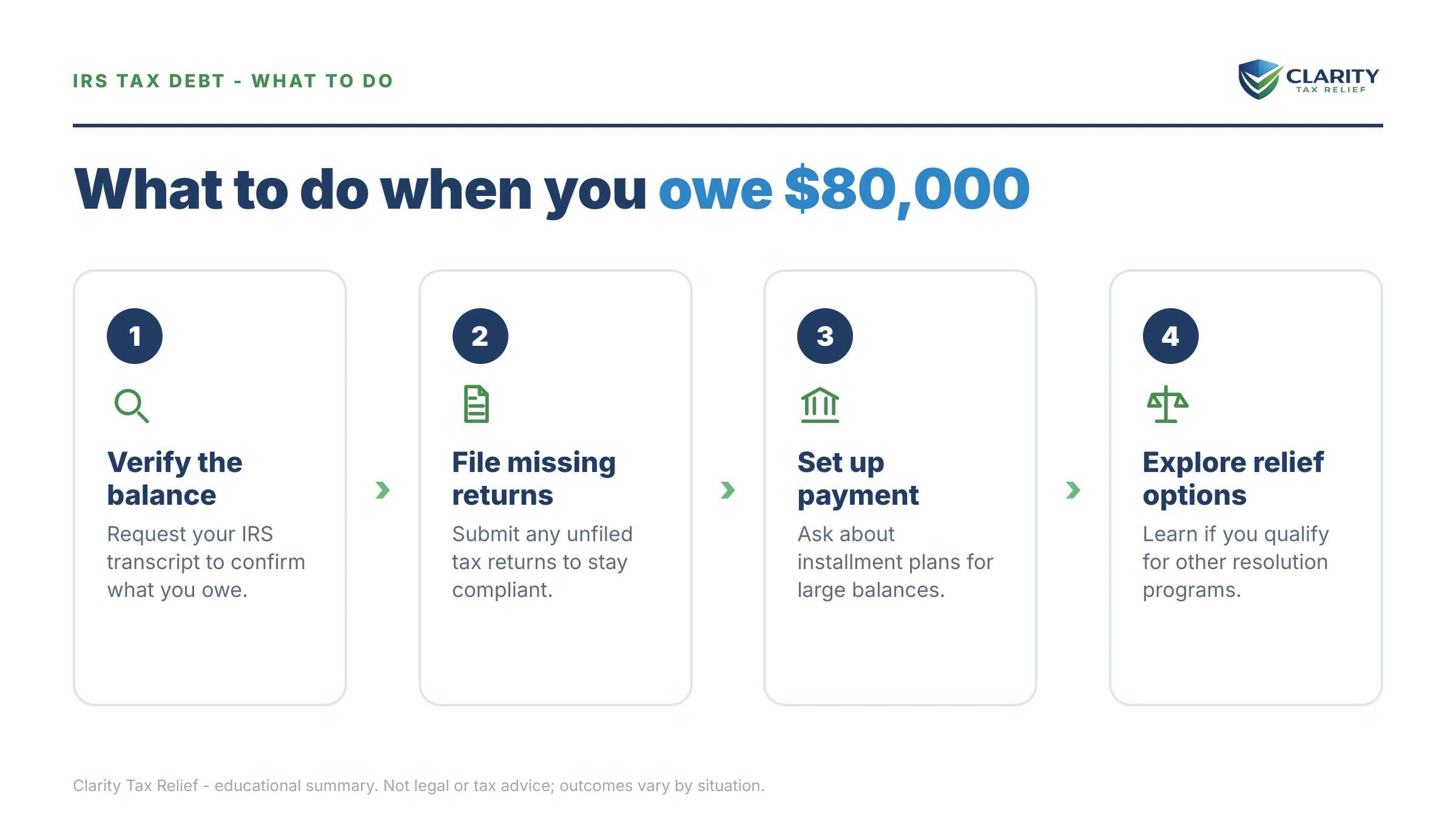
- Pull your account. Log into your IRS online account and pull account transcripts for every year — confirm the exact balance, the assessment dates, and any missing returns.
- Confirm all returns are filed. The IRS approves nothing while a required return is missing; file anything outstanding first.
- Run your own numbers. Calculate your monthly disposable income and asset equity so you know which paths you qualify for before you call.
- Choose the path that fits — installment agreement, CNC, Offer in Compromise, or penalty relief — and prepare the financial statement it requires.
- File the request before enforcement. Submit your plan, Form 656, or CNC request before a levy or passport certification lands, and keep copies of everything.
- Get a professional review. At $80,000 the order you fix things in changes what you pay — have an experienced tax professional review your transcripts first.
If a levy is already in motion or your passport has been certified, don't wait for the next notice — have your case reviewed now so a resolution can be filed before the balance climbs further.
When you can handle this yourself, and when help changes the outcome
Not every $80,000 balance needs a professional, and honest advice matters more than a sales pitch. You can likely handle it yourself if your situation is simple: all your returns are filed, you agree with the balance. You can either pay it down under $50,000 for a streamlined plan or comfortably afford a straightforward monthly payment. Setting up a payment plan online is genuinely easy when you fit the box.
Experienced help tends to change the outcome when the facts get complicated: a levy or wage garnishment is already active, your passport has been certified, you have multiple unfiled years or a substitute return inflating your balance, the debt is business or payroll tax, or you're weighing an Offer in Compromise where the RCP math and asset valuations decide everything. In those cases the difference between doing it right and doing it wrong is often measured in thousands of dollars and years of collection.
If your balance is closer to a different band, our companion guides on owing the IRS $40,000 and owing the IRS $70,000 walk through how the thresholds shift at those amounts.
Terms on your notices, decoded
- Seriously delinquent tax debt — a federal tax debt over $66,000 (2026) that the IRS can certify to the State Department, triggering passport denial or revocation.
- Notice CP508C — the letter the IRS sends when it certifies your debt as seriously delinquent for passport purposes.
- Reasonable Collection Potential (RCP) — the IRS's estimate of what it can collect: asset equity plus a multiple of monthly disposable income. It sets the floor for any Offer in Compromise.
- Collection Statute Expiration Date (CSED) — the date, generally 10 years from assessment, after which the IRS can no longer collect. It pauses (tolls) during offers, appeals, and bankruptcy.
- Levy vs. lien — a lien secures the IRS's claim against your property; a levy actually seizes wages, bank funds, or refunds.
- Collection Information Statement — Form 433-F, 433-A, or 433-A(OIC): the financial disclosure the IRS requires before approving a plan, CNC, or offer above $50,000.
Owe the IRS $80,000: your questions, answered
Can I go to jail for owing the IRS $80,000?
No. Owing $80,000 in assessed tax is a civil debt, not a crime, and no one goes to jail for being unable to pay. Jail is reserved for tax fraud and evasion — deliberately hiding income or filing false returns — not for a balance you can't afford. What you do face is collection: liens, levies, and passport certification if you ignore the notices.
Will I lose my passport if I owe the IRS $80,000?
You are exposed. For 2026 the IRS can certify a tax debt as 'seriously delinquent' once it exceeds $66,000, and $80,000 is over that line. Certification (Notice CP508C) lets the State Department deny a new passport or revoke an existing one. But an active installment agreement, a pending or accepted Offer in Compromise, or Currently Not Collectible status generally prevents or reverses certification, so getting into a resolution is what protects your passport.
Can I get a payment plan if I owe the IRS $80,000?
Yes, but not the automatic streamlined one. Streamlined installment agreements are capped at $50,000, and $80,000 is above that. You can either pay the balance down under $50,000 to qualify, or set up a non-streamlined agreement for balances up to $250,000 — which usually requires a financial statement (Form 433-F or 433-A) showing the IRS your income, expenses, and assets.
Can I settle $80,000 in IRS debt for less than I owe?
Sometimes — through an Offer in Compromise, but only when the IRS's own math shows it cannot collect the full amount before the debt expires. The IRS calculates your Reasonable Collection Potential from your asset equity plus future income. If that number is below $80,000, an offer near that figure may be accepted. The IRS accepted roughly 1 in 5 offers in FY2024, so this is real but not easy or guaranteed. Anyone promising to settle for 'pennies on the dollar' before reviewing your finances is selling a scam.
Will the IRS put a lien on my house for $80,000?
Very likely if you don't resolve it. The IRS generally files a Notice of Federal Tax Lien once a balance passes $10,000, and $80,000 is well over that. A lien attaches to everything you own, becomes public record, and can surface when you sell or refinance. A lien is not a levy, it doesn't take anything, but it protects the IRS's claim ahead of other creditors. An installment agreement set up by direct debit can sometimes avoid or withdraw a lien.
Do I have to give the IRS a financial statement to owe $80,000?
Usually, yes, because $80,000 is above the $50,000 streamlined ceiling. For a non-streamlined installment agreement, Currently Not Collectible status, or an Offer in Compromise, you'll complete a Collection Information Statement — Form 433-F or the more detailed 433-A for individuals, or 433-A(OIC) for an offer. These list your income, living expenses. The equity in your home, vehicles, and accounts, so the IRS can see what you can realistically pay.
How much would monthly payments be on $80,000 of IRS debt?
It depends on the term and the interest rate. Spread over 72 months at roughly 8% interest, an $80,000 balance runs about $1,400 a month if you're fully paying it off. If the IRS lets you pay over the remaining collection statute instead, the term can be longer and the monthly payment lower, but interest and a reduced 0.25% monthly penalty keep accruing the whole time. Your actual payment on a non-streamlined plan is based on what your financial statement shows you can afford.
Does $80,000 of IRS debt ever go away on its own?
Eventually — the IRS generally has 10 years from the date each tax was assessed to collect, called the Collection Statute Expiration Date (CSED). After that the debt legally expires. But the clock pauses (tolls) while an Offer in Compromise, bankruptcy, a Collection Due Process appeal, or certain other actions are pending, which can push the date years later. It is not a reliable plan, and the IRS can levy aggressively in the years before the statute runs.
What if I owe $80,000 and haven't filed all my tax returns?
File the missing returns first — the IRS will not approve any payment plan, Offer in Compromise, or hardship status while a required return is missing. If the IRS filed a substitute return for you, it left off deductions and credits, so your real balance is often lower once you file the correct return. Fixing unfiled years is frequently the step that shrinks the $80,000 before you ever negotiate.
Your next 24 hours
- Find two numbers. On your notice or account transcript, locate the total balance and the assessment date for each year — the assessment date is what your 10-year collection clock runs from.
- Gather three things. Your most recent tax return, every IRS notice you've received. A rough list of your monthly income, living expenses, and asset equity (home, cars, accounts).
- Get a free case review. Because $80,000 is over the passport and lien thresholds, don't sit on it — call (888) 825-7779 or use the 2-minute form so an experienced tax professional can map your path before certification or a levy lands.
This guide is general information, not tax or legal advice for your specific situation. Eligibility for IRS programs depends on individual facts and circumstances; no outcome is guaranteed. Authoritative sources: the IRS explainers on passport revocation for unpaid taxes, payment plans and installment agreements, and the Offer in Compromise program, plus the Taxpayer Advocate Service.