
Owe Back Taxes
I Owe the IRS $40,000: Your Options to Resolve It (2026)
The short answer: if you owe the IRS $40,000, you can usually resolve it with a streamlined installment agreement — up to 72 months, no financial disclosure — because you're under the $50,000 threshold. Other paths include currently not collectible status, an offer in compromise, or penalty relief.
You saw the number — $40,000 — and your stomach dropped. Maybe it built up over a few unpaid years, maybe a single return blew up with penalties and interest, maybe a business shortfall landed on your personal account. Whatever put you here, this is a solvable balance, and $40,000 happens to sit on the good side of some important IRS lines.
Here's the map. The key fact to hold onto: at $40,000 you're below the $50,000 mark that makes the simplest payment plan available and below the $66,000 line that puts a passport at risk. That gives you more room than someone owing six figures.
Below, the annotated account transcript shows exactly which line carries your true balance — most people read the "amount due" on the notice and miss that penalties and interest are still climbing underneath it.
⏱ Your deadline depends on the notice in your hand: a CP14 gives about 21 days to pay or arrange before escalation; a CP504 lets the IRS take your state refund after 30 days; a final LT11 / Letter 1058 starts a 30-day clock before wage and bank levies. There is no deadline to "just decide", but every month you wait adds penalties and interest to the $40,000.
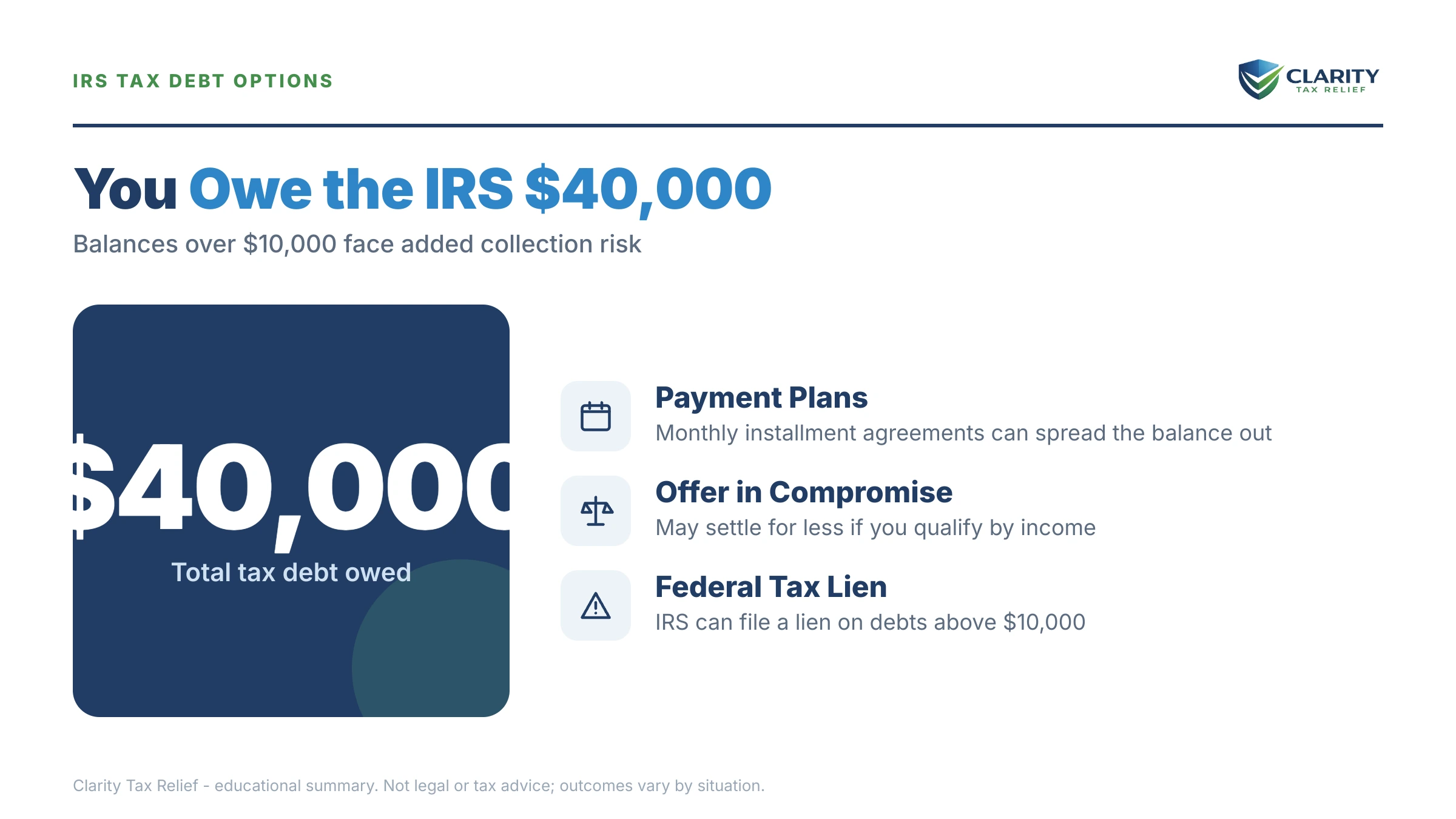
What owing $40,000 specifically triggers
A $40,000 balance crosses two IRS thresholds and stays under two others, and knowing which is which changes your whole strategy. The dollar amount, not just your intent, decides which doors are open.
Above $10,000, the IRS can and often does file a Notice of Federal Tax Lien, a public record that attaches to everything you own and can tank your credit and complicate a home sale. At $40,000 you're comfortably over that line, so lien exposure is real. But you stay under $50,000, which keeps the streamlined installment agreement open, and under $66,000 (the 2026 seriously-delinquent figure), so your passport is not certified to the State Department on this debt alone.
| Threshold | Amount | Does $40,000 cross it? |
|---|---|---|
| Federal tax lien likely filed | Over $10,000 | Yes — lien exposure is real |
| Streamlined installment agreement | $50,000 or less | No — you qualify |
| Passport certification (seriously delinquent) | $66,000 (2026) | No — passport safe on this debt |
| Guaranteed installment agreement | $10,000 or less | Over it — not guaranteed, but streamlined |
“Simple payment plan (installment agreement): You owe $50,000 or less in combined tax, penalties and interest. You have filed all required returns.”
— Online payment agreement application (IRS.gov)
What happens if you ignore a $40,000 balance
Ignoring a $40,000 IRS debt sets off an automated collection sequence that ends in liens and levies, and in 2026 those systems run without a human deciding to press the button. IRS staffing dropped roughly 27% in 2025, but the notice-and-levy machine never slowed down.
- CP14 — first bill. About 21 days to pay or arrange. No enforcement yet.
- CP501 / CP503 — reminder notices, roughly five weeks apart. The balance grows monthly.
- CP504 — Notice of Intent to Levy. The IRS can seize your state tax refund and a federal tax lien becomes likely.
- LT11 / Letter 1058 — Final Notice of Intent to Levy. After 30 days, the IRS can garnish wages (continuous until released) and levy bank accounts (21-day hold, then funds are gone). You gain Collection Due Process appeal rights here — request them with Form 12153.
The whole way down, penalties and interest keep compounding. The failure-to-pay penalty runs 0.5% per month, and interest (currently around 8% annually) accrues on the full balance, so a $40,000 debt left alone for a year can quietly become $44,000–$46,000.
| Stage | Rough timing | What the IRS can do |
|---|---|---|
| CP14 | Day 0 | Send the bill; charge penalties + interest |
| CP501 / CP503 | ~5–15 weeks | Reminders; balance grows |
| CP504 | ~15–25 weeks | Seize state refund; file lien |
| LT11 / Letter 1058 | ~6+ months | After 30 days: wage garnishment, bank levy |
Got a levy notice on your $40,000 balance?
If you're holding an LT11 or Letter 1058, the 30-day levy clock is already running. Get your notice reviewed free before that window closes — an experienced tax professional will tell you exactly which option stops the escalation.
Your options to resolve $40,000, compared
At $40,000, five real resolution paths are on the table. The right one depends on whether you can pay monthly, pay nothing, or genuinely can't cover the debt at all. Here's how they line up.
| Option | Who it fits | Cost / setup |
|---|---|---|
| Short-term payment plan | Can pay in full within 180 days | $0 setup; interest + penalty accrue |
| Streamlined installment agreement | Under $50k, can pay monthly | Low online setup fee; up to 72 months |
| Currently Not Collectible | Paying anything causes hardship | No payment; collection paused |
| Offer in Compromise | Assets + income can't cover the debt | $205 fee (waivable); 20% down on lump sum |
| Penalty relief | Clean 3-year history or reasonable cause | Free to request; reduces balance |
Streamlined installment agreement: the default at $40,000
Because $40,000 is under $50,000, you qualify for a streamlined installment agreement with no Form 433 financial disclosure. You can spread the balance over up to 72 months and set it up online without proving your budget line by line. Choose direct debit: on balances up to $50,000, a direct-debit agreement can keep the IRS from filing a lien, or lead to withdrawal of one already filed — under the Fresh Start rules.
Short-term payment plan, if the money's coming soon
If a bonus, a sale, or a refund is on the way, a short-term plan gives you up to 180 days to pay the $40,000 in full with $0 setup fee. Interest and the late-payment penalty still accrue, but enforcement stops while you gather the funds. This beats a long-term plan if you can realistically clear it inside six months.
Currently Not Collectible, when you can't pay anything
Currently Not Collectible (CNC) status pauses IRS collection entirely when paying toward the $40,000 would leave you unable to cover basic living expenses. No garnishments, no levies. The debt doesn't vanish — interest keeps running and the IRS revisits your income periodically — but the pressure stops while you recover. This is a real option, not a last resort, and it can be the bridge to an offer later.
Offer in Compromise: the real odds at this balance
An offer in compromise (OIC) settles a debt for less than the full amount. But the IRS accepted only about 1 in 5 offers in FY2024, and approval turns on your finances, not the size of the balance. The IRS calculates your Reasonable Collection Potential (RCP): the equity in your assets plus what it thinks it can collect from your future income before the collection statute expires. If that number is below $40,000, an offer can work. If you have home equity or steady income, expect the IRS to want a payment plan instead.
You can estimate your own number before spending anything with our Offer in Compromise Calculator. Anyone promising to settle your $40,000 for "pennies on the dollar" is selling a fantasy — the FTC permanently banned a major tax-relief firm in June 2026 for exactly that pitch. An offer is math, not marketing.
Penalty relief: shrink the balance before you pay it
If penalties make up a chunk of your $40,000, first-time abatement can wipe out the failure-to-pay and failure-to-file penalties when you've had a clean compliance record for the prior 3 years. Note that first-time abatement is being replaced by Automatic Exemption from Penalty (AEP), starting summer 2026 — applied automatically, with no request needed. Reasonable-cause relief (serious illness, disaster, records lost in a fire) can also remove penalties on any year. Always ask before you finalize a plan, because relief reduces the number you're repaying.
Worked example: paying off $40,000
Say you owe $40,000 and choose a 72-month streamlined installment agreement. Here's the arithmetic.
- Principal only: $40,000 ÷ 72 months ≈ $556/month.
- With interest + penalty: at roughly 8% interest plus the 0.5% monthly late-payment penalty on the shrinking balance, the realistic figure to actually clear it in six years is closer to $650–$700/month.
- Total interest cost: stretching it the full 72 months could add roughly $9,000–$11,000 in interest and penalty over the life of the plan.
Now say your finances are tight. If a budget review shows you can only afford $150/month without falling behind on rent, the IRS may grant a partial-pay installment agreement or place you in CNC, and if your RCP works out to, say, $12,000, an offer in compromise for that amount (paid as a lump sum with 20% down, or over months) could be worth pursuing. The same $40,000 produces completely different answers depending on your numbers. That's why the resolution starts with your finances, not the balance.
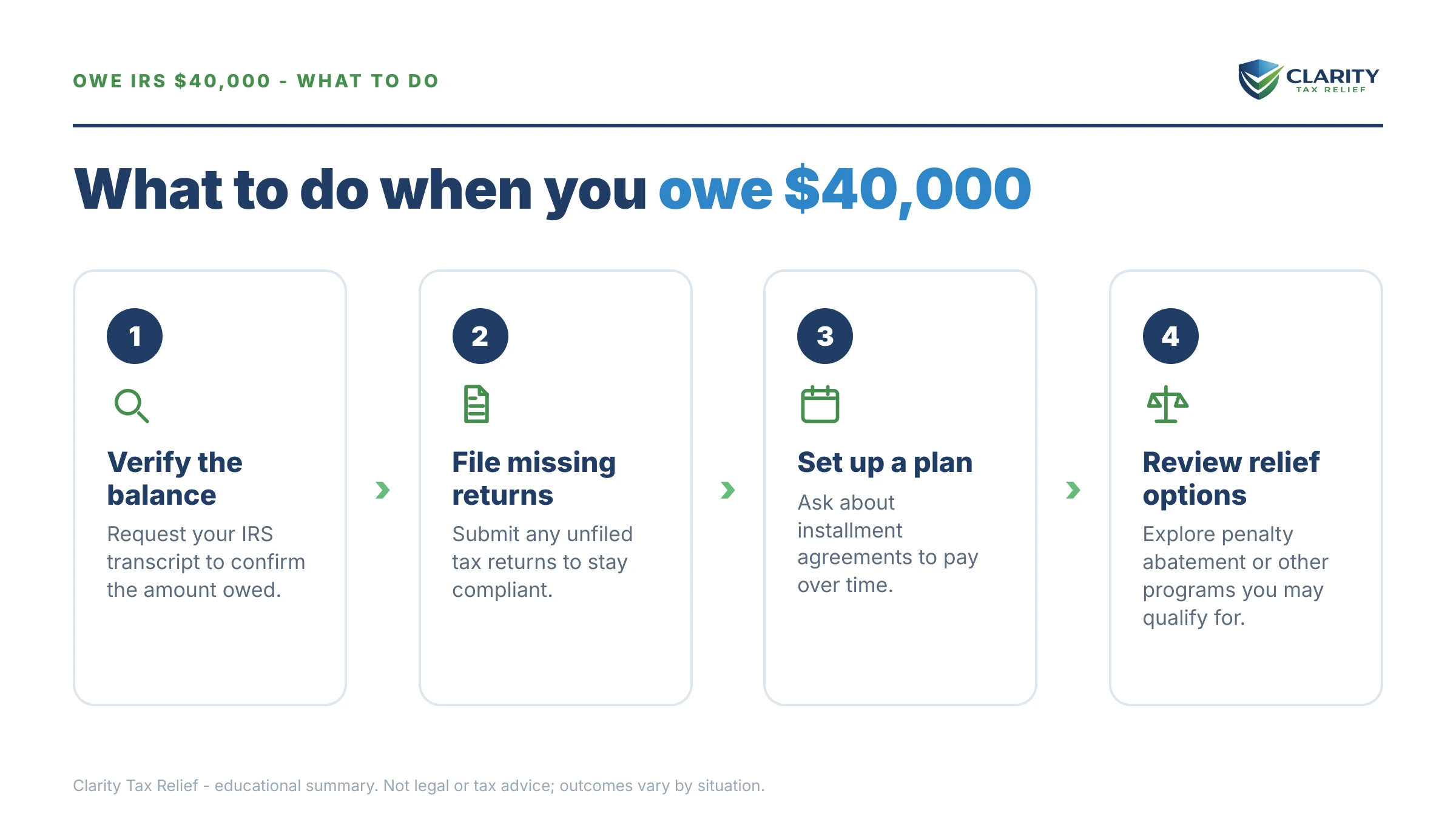
How to respond, step by step
- Confirm the balance — log into your IRS online account, verify the $40,000, and note how much is tax vs. penalties and interest.
- File any missing returns first — the IRS won't approve a plan or offer while returns are unfiled.
- Pick the option that fits — streamlined 72-month plan if you can pay monthly; CNC or an offer if you can't.
- Set up direct debit — on balances up to $50,000 this protects you from a lien and locks in the agreement.
- Request penalty relief — ask for first-time abatement or reasonable cause to cut the total.
- Get a professional review if it's complex — multiple unfiled years, business or payroll tax, or an active levy all change the play.
Not sure whether a plan or an offer is smarter for your $40,000? A free case review maps it to your actual numbers in about 20 minutes.
Situations that change the answer
The same $40,000 balance plays out differently depending on how it arose and who's on the return. These are the wrinkles that reroute the strategy.
Married filing jointly. A joint return makes both spouses fully responsible for the whole $40,000. If the debt is really your spouse's, unreported income you didn't know about, innocent spouse relief may remove your share. Married filing separately changes both the liability and the RCP math on an offer.
Self-employed or 1099. If the $40,000 grew from missed quarterly estimated payments, the IRS will want to see you're current on this year's estimates before approving a plan — otherwise you'll default it by adding new debt. Build the estimates into your budget.
Business or payroll tax. If part of the $40,000 is unpaid payroll tax (trust fund), the rules are far harsher — the IRS can assess a Trust Fund Recovery Penalty against you personally, and payroll debt is not treated like income tax. Get experienced help before you touch it.
Multiple years. $40,000 spread across several years means several Collection Statute Expiration Dates. The order you resolve them in matters, because older years may be closer to expiring.
State tax too. A federal plan doesn't touch a state balance. California's Franchise Tax Board has a 20-year collection statute (double the IRS's 10), and New York files a tax warrant that becomes a public-record judgment and lien. Coordinate both, or the state keeps collecting while the IRS is paused.
When you can handle this yourself, and when help changes the outcome
You can absolutely handle a $40,000 balance yourself when three things are true: the amount is correct, every required return is filed. You can afford a streamlined monthly payment. In that case, set up the direct-debit agreement at IRS.gov in about 15 minutes and you're done — no fee to a professional needed.
Experienced help earns its cost when the situation is harder: a wage or bank levy already in motion, multiple unfiled years, business or payroll tax in the mix, a dispute over whether you even owe the $40,000, or an offer in compromise where the RCP math decides whether you save real money. In those cases the order of operations, and knowing what the IRS will actually accept — changes what you pay. Honesty here is the point: if you don't need us, we'll tell you.
Terms on your notice, decoded
- Streamlined installment agreement — a monthly IRS payment plan for balances of $50,000 or less, up to 72 months, with no detailed financial disclosure.
- Notice of Federal Tax Lien — a public filing that attaches the IRS's claim to your property; common on balances over $10,000.
- Levy vs. lien — a lien is a claim on your property; a levy actually takes it (wages, bank funds, refunds).
- Reasonable Collection Potential (RCP) — the IRS's estimate of what it can collect from your assets and future income. It sets the floor for an offer in compromise.
- Currently Not Collectible (CNC) — a status that pauses collection when paying would cause hardship; the debt and interest remain.
- CSED — the Collection Statute Expiration Date. The IRS generally has 10 years from assessment to collect, though appeals, offers, and bankruptcy can pause the clock.
$40,000 IRS debt questions, answered
Will the IRS put a lien on me if I owe $40,000?
It can. The IRS generally files a Notice of Federal Tax Lien once a balance passes $10,000, and $40,000 is well over that line. The most reliable way to avoid one is to set up a direct-debit streamlined installment agreement — on balances up to $50,000, that can keep the IRS from filing, or lead to withdrawal of a lien already filed.
Can I set up a payment plan for $40,000 without giving the IRS my financial information?
Yes. Because $40,000 is under the $50,000 threshold, you generally qualify for a streamlined installment agreement, which does not require Form 433 financial disclosure. You can spread it over up to 72 months and set it up online without proving your budget line by line.
What are my odds of settling a $40,000 tax debt for less?
The IRS accepted roughly one in five offers in compromise in FY2024, and approval depends entirely on your finances, not the size of the balance. An offer only works when the IRS calculates that your assets and future income can't cover the full $40,000 before the collection statute expires. If you have equity or steady income, expect a payment plan, not a settlement.
Does owing $40,000 affect my passport?
No. The IRS certifies tax debt to the State Department only once it becomes seriously delinquent — $66,000 for 2026. A $40,000 balance is below that line, so your passport is not at risk on the debt alone. But interest and penalties can push a growing balance over the threshold, which is one more reason to resolve it.
How much will a $40,000 IRS payment plan cost per month?
On a 72-month streamlined agreement, $40,000 works out to about $556 per month in principal, before interest. Because interest (currently around 8% annually) and the late-payment penalty keep accruing on the shrinking balance, the realistic monthly figure to fully clear it is closer to $650–$700. Paying more each month shortens the plan and cuts total interest.
What happens if I just ignore a $40,000 balance?
The IRS collection sequence escalates automatically — CP14, then CP501/CP503 reminders, then a CP504 that can seize your state refund, then an LT11 final notice that starts a 30-day clock before wage garnishment and bank levies. A federal tax lien is likely along the way. The balance also grows every month from penalties and interest.
Can I get currently not collectible status with a $40,000 debt?
Yes, if paying anything toward the debt would leave you unable to cover basic living expenses. Currently not collectible status pauses IRS collection, no levies or garnishments, while your finances recover. The $40,000 doesn't disappear; interest keeps accruing, and the IRS reviews your income periodically, but the pressure stops.
Should I hire someone to deal with $40,000, or handle it myself?
If the balance is correct, all your returns are filed. You can afford a streamlined monthly payment, you can set that up yourself at IRS.gov. Experienced help changes the outcome when a levy is already in motion, you have multiple unfiled years, the debt involves business or payroll tax, or you want to test whether an offer in compromise is realistic before spending money on it.
Your next 24 hours
- Find the real number. On your notice, locate the "amount due" and the tax year, then log into your IRS online account to confirm the $40,000 and see how much is penalties and interest.
- Gather three things: your most recent filed return, the notice itself, and a rough monthly income-and-expense snapshot. That's everything needed to pick between a plan, CNC, and an offer.
- Get a free case review. If you're facing a levy notice or you're not sure which option saves the most, call (888) 825-7779 or use the 2-minute form, before any 30-day levy clock runs out.
This guide is general information, not tax or legal advice for your specific situation. Eligibility for IRS programs depends on individual facts and circumstances; no outcome is guaranteed.
Primary sources: Online payment agreement application