
Owe Back Taxes
I Owe the IRS $70,000: Your Resolution Options (2026)
The short answer: if you owe the IRS $70,000, you have four realistic paths — a long-term installment agreement, Currently Not Collectible status, an Offer in Compromise if your finances truly qualify, or penalty relief that shrinks the balance. At this size, expect a federal tax lien and possible passport certification, so act before the levy clock starts.
You logged into your IRS account, or opened a notice, and the number staring back is around $70,000. That's a knot-in-the-stomach figure — big enough to feel unpayable, big enough to trigger a lien, and now it's sitting in an automated collection system that won't wait for you to feel ready. Here's the reassuring part: a $70,000 balance is squarely in the range the IRS resolves every single day, and you have more control than the notice suggests.
What matters now is choosing the right path for your numbers and locking it in before enforcement escalates. Below, the annotated transcript image shows exactly where to find your assessment dates and the split between tax, penalties, and interest — the numbers that decide which option you actually qualify for. Most people look at the wrong line and pick the wrong plan.
⏱ Two clocks are running: if the IRS has sent a Final Notice of Intent to Levy (LT11 / Letter 1058), you have 30 days to respond before it can garnish wages or levy bank accounts. Separately, a balance over $66,000 in 2026 can be certified as "seriously delinquent," putting your passport at risk. Interest and penalties keep accruing the whole time.
Why a $70,000 IRS balance is different from a smaller one
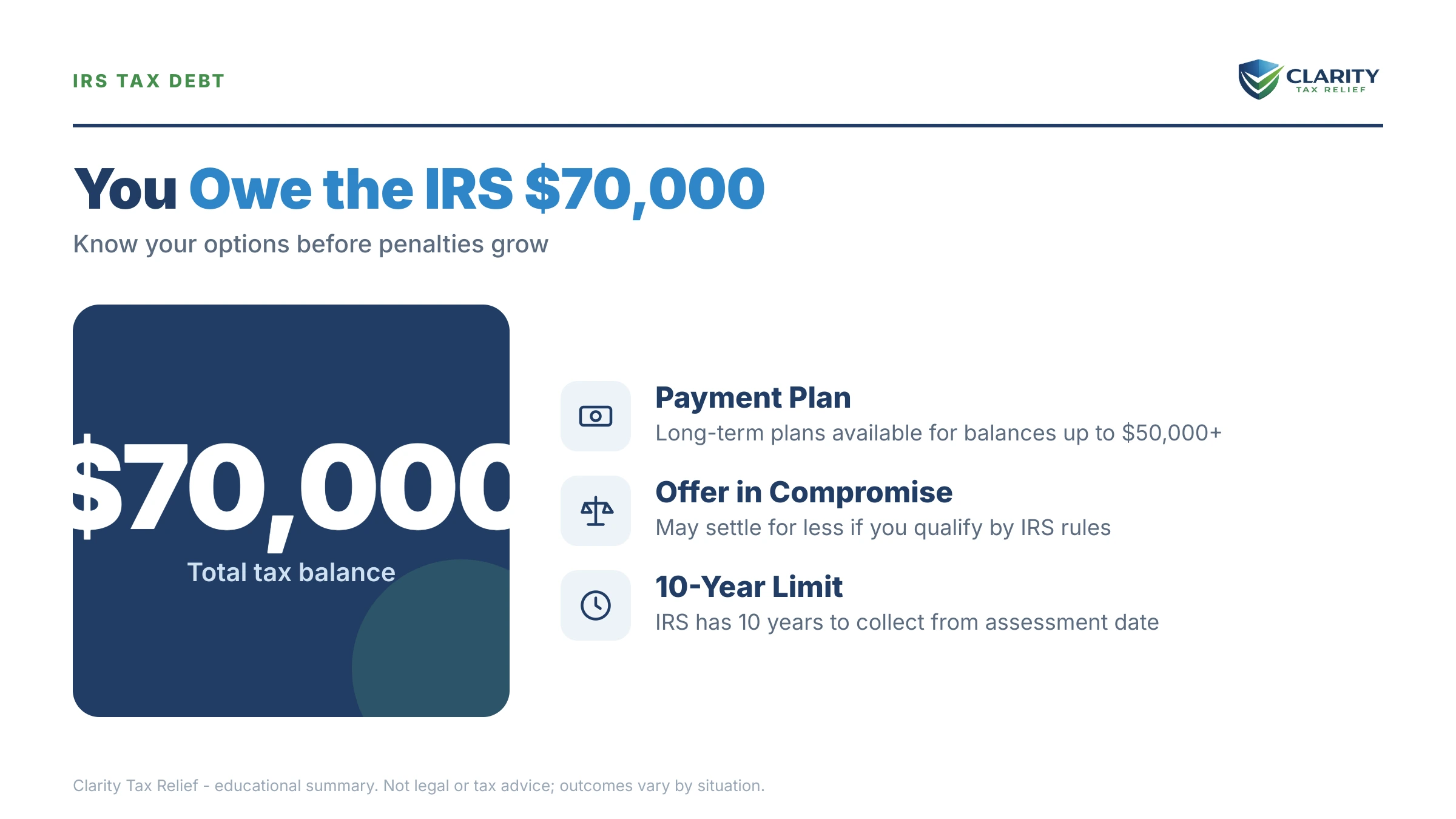
At $70,000, you've crossed three thresholds that change your options and your risk. This is the level where the IRS stops treating you as a small, automatic case and starts applying its heavier collection tools, while still leaving every resolution program open to you.
The three lines you've crossed matter in practice. First, $70,000 is above the $50,000 cap for the simplest streamlined and online payment plans, so the IRS will usually want to see your finances. Second, it's above the $10,000 level where a federal tax lien becomes routine. Third, it's above the $66,000 2026 passport-certification threshold. None of these are catastrophes, but they mean a $70,000 case rewards doing things in the right order.
How you got here also shapes the fix. A W-2 employee who under-withheld faces a different plan than a self-employed contractor with no withholding. A business owner with payroll (trust fund) tax owes a debt that behaves differently from personal income tax. We'll cover each below.
“An offer in compromise allows you to settle your tax debt for less than the full amount you owe. It may be a legitimate option if you can't pay your full tax liability or doing so creates a financial hardship.”
— Offer in compromise (IRS.gov)
What happens if you ignore $70,000 in IRS debt
Ignoring a $70,000 balance doesn't freeze it. It grows and escalates on a predictable, automated schedule. The IRS collection sequence moves in stages, each roughly five weeks apart, and each one hands the IRS more power over your paycheck, bank account, and property.
- CP14 — first bill. The opening notice showing the balance due. No enforcement yet, but penalties and interest start compounding.
- CP501 / CP503 — reminders. Roughly 5 and 10 weeks later. Still bills, but your balance is climbing every month.
- CP504 — Notice of Intent to Levy. The IRS can now seize your state tax refund and prepares to file a federal tax lien. This is not the final notice.
- LT11 / Letter 1058 — Final Notice of Intent to Levy. Starts a 30-day clock. After it expires, the IRS can garnish wages and levy bank accounts. This notice also carries your Collection Due Process appeal rights (Form 12153).
- Enforced collection. Wage levy (continuous until released), bank levy (21-day hold, then funds leave), and — because you're over $66,000 — certification of your debt to the State Department for passport denial or revocation.
In 2026 this matters more than ever. IRS staffing was cut about 27% during 2025, so reaching a human is harder. But the notices, liens, and levies are generated by automated systems that never slowed down. The machine keeps escalating whether or not anyone is reviewing your file, which is exactly why acting before a deadline beats waiting to "explain your situation" to someone.
| Stage | Timing (approx.) | What the IRS can do |
|---|---|---|
| CP14 first bill | Day 0 | Bill only; penalties + interest accrue |
| CP501 / CP503 | Weeks 5–10 | Reminders; balance growing |
| CP504 | Weeks 10–15 | Seize state refund; lien likely |
| LT11 / Letter 1058 | Weeks 15–20 | 30-day clock to levy wages & bank |
| Levy + passport hold | After 30-day window | Wage/bank levy; passport certified (over $66k) |
Owe around $70,000 and worried about a levy or your passport?
If a Final Notice arrived, the 30-day levy window is the one deadline you can't miss. An experienced tax professional will review your balance free and tell you which option protects you, before that clock runs out.
Your resolution options at $70,000
You have five ways to resolve a $70,000 IRS debt, and the right one depends entirely on your income, expenses, and assets. No single option is best for everyone — the goal is matching your real financial picture to the program the IRS will actually approve.
| Option | Who it fits | Cost / setup |
|---|---|---|
| Short-term plan (≤180 days) | Can full-pay soon | $0 setup; interest + penalty continue |
| Long-term installment agreement | Steady income, can't pay now | Setup fee; ~$970–$1,225/mo over 72 mo |
| Currently Not Collectible | Paying anything = hardship | $0; collection paused, debt remains |
| Offer in Compromise | Assets + income < balance | $205 fee (waivable) + 20% down |
| Penalty abatement | Clean prior 3 years / good cause | $0; can remove failure-to-pay/file penalty |
1. Installment agreement (the most common $70,000 outcome)
An installment agreement is the default resolution for most $70,000 balances. You pay monthly until the debt is cleared or the collection statute expires. Because $70,000 is above the $50,000 online cap, you generally can't set the whole thing up through the IRS website. You'll apply by phone or with Form 9465 and usually provide financial detail on Form 433-F.
The IRS wants a $70,000 balance paid off within 72 months or by the collection statute date, whichever comes first. If your proposed payment doesn't full-pay in that window, the IRS reviews your income and allowable living expenses to set the amount. A direct-debit agreement is worth requesting. It lowers your setup fee and can help you avoid or withdraw a lien.
2. Currently Not Collectible (when you truly can't pay)
Currently Not Collectible (CNC) status pauses IRS collection when paying anything would leave you unable to cover basic living expenses. The debt doesn't go away and interest keeps accruing, but wage garnishments and bank levies stop while you're in hardship. The IRS reviews your finances (Form 433-F or 433-A) and can revisit the status as your income recovers.
CNC can also run out the clock: if your finances stay tight long enough, some or all of the $70,000 can hit its collection statute expiration before the IRS ever collects it.
3. Offer in Compromise: the honest math
An Offer in Compromise lets you settle $70,000 for less, but only when the IRS calculates that the smaller amount is the most it could realistically collect — a figure called your Reasonable Collection Potential (RCP). RCP is roughly the net value of your assets plus your future monthly income multiplied by a set number of months. If your RCP is above $70,000, the IRS won't accept a discount, no matter how much you'd like one.
Be realistic: the IRS accepted about 1 in 5 offers in FY2024. Anyone promising to settle "for pennies on the dollar" before looking at your finances is describing a scam the FTC has prosecuted, not a program. Before you spend a dollar chasing an offer, you can estimate your own offer with our Offer in Compromise Calculator to see whether your numbers are even in range. The application fee is $205 (waived if you certify as low-income, with AGI at or below 250% of the poverty line), plus 20% down for a lump-sum offer.
If you want to compare where $70,000 sits against nearby balances, see our companion guides on owing the IRS $60,000 and owing the IRS $80,000 — the option mix shifts as the number climbs.
4. Penalty relief (shrink the balance first)
Penalty relief can carve thousands off a $70,000 balance before you even pick a payment plan. A large chunk of most tax debts is penalties: failure-to-file runs 5% per month and failure-to-pay 0.5% per month, plus interest on top. If you've been compliant the prior three years, first-time abatement can remove those penalties for one year.
Note a 2026 change: first-time abate is being replaced by Automatic Exemption from Penalty (AEP) starting summer 2026 — applied automatically, with no request needed for qualifying taxpayers. Reasonable-cause relief (serious illness, disaster, records lost through no fault of yours) remains available on top of that.
5. Short-term full payment (≤180 days)
If you can raise the full $70,000 within 180 days — a bonus, a sale, a loan — the IRS grants a short-term plan with $0 setup fee. Interest and the late-payment penalty still accrue, but you avoid the fees, financial disclosure, and lien exposure that come with a longer arrangement.
A worked example: what $70,000 actually looks like on a plan
Here's a concrete, hypothetical example so you can see the arithmetic. Say you owe $70,000 and have steady W-2 income with no unusual assets.
Installment agreement: spread over the maximum 72 months, that's about $972 a month in principal ($70,000 ÷ 72). But interest, around 8% a year in this example, keeps running, so to actually full-pay in 72 months you'd send closer to $1,225 a month. Over six years that's roughly $88,000 total, meaning about $18,000 in interest. Painful, but predictable, and it stops the levies.
Offer in Compromise: suppose you have $8,000 of equity in a car and can spare $300 a month after allowable living expenses. A lump-sum offer's RCP is roughly your asset equity plus 12 months of that available income: $8,000 + ($300 × 12) = $11,600. If the IRS agrees with those numbers, an offer near that figure could resolve the full $70,000, but only because the math shows the IRS couldn't collect more before the statute expires. Change the facts (more equity, higher income) and the offer number climbs fast.
Currently Not Collectible: if that same $300 disappears — you lose the higher-paying job and can only cover rent, food, and utilities — CNC could pause collection entirely, with interest still accruing quietly in the background until your situation changes or the statute runs.
How different situations change the answer
The right move on a $70,000 debt depends heavily on who you are and how the debt arose. Five situations change the analysis the most.
Self-employed / 1099: your biggest risk is falling behind again this year. The IRS won't approve a plan while you're accruing new debt, so you'll likely need to start quarterly estimated payments as a condition of any agreement.
Married filing jointly: both spouses are liable for a joint balance, so IRS collection can reach either spouse's wages and accounts. If the debt came from one spouse's income or wrongdoing, innocent spouse relief may protect the other.
Married filing separately: only the spouse who signed the return is liable — which sometimes shelters the other spouse's income, but usually costs more in overall tax. Worth modeling both ways.
Business / payroll tax: if part of the $70,000 is unpaid payroll (trust fund) tax, that portion is far more aggressive — the IRS can assess a Trust Fund Recovery Penalty personally against owners and officers. It generally can't be settled as easily. This is a get-help-now situation.
Multiple unfiled years: the IRS will not approve any plan or offer until every required return is filed. If missing returns are part of your $70,000 picture, filing them is step one — see our guide on unfiled tax returns.
Lien and levy risk at $70,000
At $70,000, a federal tax lien is likely and a levy is possible if you don't respond. Understanding the difference tells you how urgent your situation really is.
A lien is a legal claim against your property — it's public record, attaches to your home and other assets, and gets paid when you sell or refinance. It damages credit and borrowing power but doesn't take anything today. The IRS routinely files a Notice of Federal Tax Lien once a balance passes $10,000.
A levy actually seizes money — wages, bank funds, or up to 15% of Social Security through the Federal Payment Levy Program. A bank levy triggers a 21-day hold before funds leave; a wage levy is continuous until released. A levy can only happen after the LT11 Final Notice and its 30-day window expire. Setting up a plan, offer, or CNC before that deadline prevents it. If a garnishment is already in motion, our wage garnishment calculator estimates how much the IRS could take from each paycheck.
When you can handle this yourself, and when help changes the outcome
Plenty of $70,000 cases can be handled on your own, and you shouldn't pay for help you don't need. If you can full-pay within 180 days, or your finances comfortably support a 72-month plan and you have no missing returns, setting up an installment agreement by phone or with Form 9465 is a reasonable DIY project.
Experienced help changes outcomes in specific, higher-stakes situations. Bring in a professional when a levy or garnishment is already in motion, when you have multiple unfiled years, when part of the debt is business or payroll (trust fund) tax, when you're weighing an Offer in Compromise and the RCP math isn't obvious, or when your passport is at risk and you need certification reversed quickly. In these cases, the order and framing of your request can change what you ultimately pay. A wrong first move (like defaulting an offer or missing the CDP window) is expensive to undo.
An honest firm will tell you when you don't need them. If your case is simple, we'll say so on the free call.
How to respond, step by step
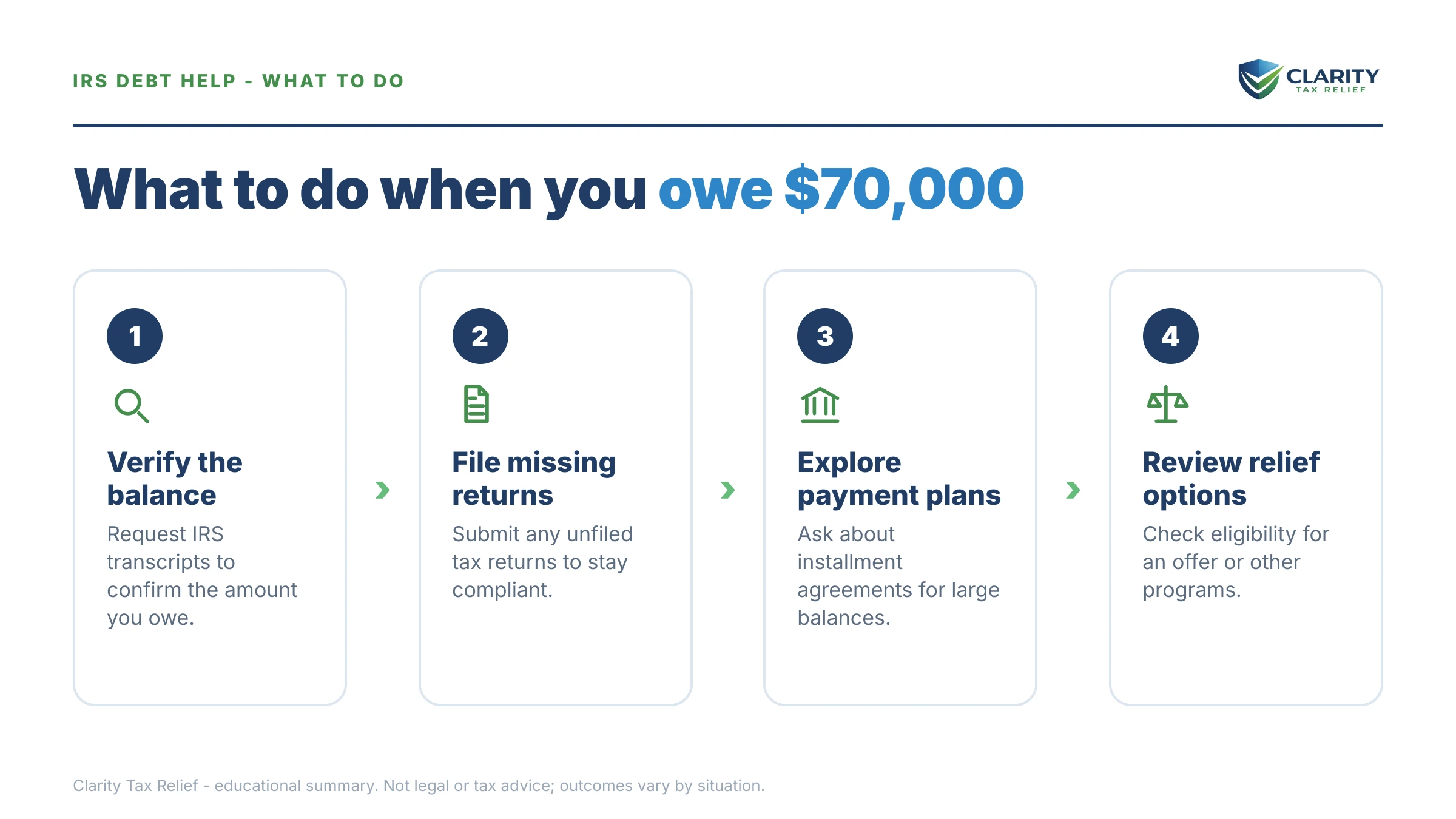
- Confirm the balance. Pull your IRS account transcript for every year and verify the $70,000 is correct and split between tax, penalties, and interest.
- File any missing returns. The IRS approves no plan or offer while returns are outstanding — file them first.
- Match your finances to a program. Compare an installment agreement, CNC, and an Offer in Compromise against your income, expenses, and assets.
- Request penalty relief. Ask for first-time abatement (or note the new AEP) and reasonable cause to strip penalties off before you lock in.
- Set it up before the levy clock runs. Submit the plan, offer, or hardship request before any LT11 30-day deadline expires.
- Stay current going forward. Keep withholding or estimated payments up to date so the deal doesn't default.
Terms on your notice, decoded
- Lien vs. levy: a lien is a legal claim on your property; a levy actually seizes wages or bank funds.
- CSED (Collection Statute Expiration Date): the roughly 10-year deadline the IRS has to collect a debt — pausable by offers, appeals, and bankruptcy.
- RCP (Reasonable Collection Potential): the IRS's estimate of what it could collect from your assets and future income — the floor for any Offer in Compromise.
- Streamlined vs. non-streamlined agreement: streamlined plans (≤ $50,000) skip detailed financials; above $50,000 you generally must disclose income and expenses.
- Seriously delinquent tax debt: a balance over $66,000 in 2026 the IRS can certify to the State Department, risking your passport.
- CDP (Collection Due Process): your right to appeal a levy within 30 days of an LT11, using Form 12153.
Owe $70,000 to the IRS: frequently asked questions
Can you go to jail for owing the IRS $70,000?
No. Owing $70,000 in taxes is a civil debt, not a crime. Jail is reserved for tax fraud or willful evasion — hiding income, filing false returns, or lying to investigators. Simply owing money you reported but can't pay is a collection matter, resolved with payment plans, hardship status, or a settlement, never a prison sentence.
Will the IRS take my house if I owe $70,000?
It is very unlikely. The IRS almost never seizes a primary home. It requires court approval and is reserved for extreme, non-cooperative cases. At $70,000, the far more common actions are a federal tax lien on the property, a wage garnishment, or a bank levy. A lien attaches to the house and gets paid when you sell or refinance, but you keep living there.
Can I settle $70,000 of IRS debt for less than I owe?
Sometimes, through an Offer in Compromise, but only if the IRS calculates that $70,000 is more than it could ever realistically collect from your income and assets before the debt expires. The IRS accepted roughly 1 in 5 offers in FY2024. Anyone promising to settle for pennies on the dollar before reviewing your finances is selling a scam.
What is the monthly payment on a $70,000 IRS installment plan?
To full-pay $70,000 over the maximum 72 months, you'd pay roughly $970 a month in principal alone — closer to $1,225 a month once interest of about 8% is included. Because $70,000 is above the $50,000 online threshold, the IRS will usually want financial information before approving the plan. The exact payment depends on your income, expenses, and how much time is left on the collection statute.
Will owing the IRS $70,000 affect my passport?
Yes, it can. For 2026 the IRS can certify a tax debt as "seriously delinquent" once the total exceeds $66,000, and $70,000 is over that line. Certification lets the State Department deny a passport application or renewal. Setting up an installment agreement, an accepted offer, or Currently Not Collectible status generally reverses or prevents the certification.
Does a $70,000 IRS debt go away after 10 years?
The IRS generally has 10 years from the date each tax was assessed to collect it — the Collection Statute Expiration Date. But the clock pauses while an Offer in Compromise, bankruptcy, a Collection Due Process appeal, or certain other actions are pending, which pushes the expiration date later. The debt does not simply vanish on a fixed calendar date.
Will the IRS file a tax lien for $70,000?
Likely yes. The IRS generally files a Notice of Federal Tax Lien once a balance passes $10,000, and $70,000 is well above that. The lien is public record, attaches to your property, and can affect your credit and ability to sell or borrow. A properly structured direct-debit installment agreement can sometimes prevent a lien or get one withdrawn.
Can I set up a $70,000 IRS payment plan online?
Usually not fully. The IRS online payment agreement tool is limited to balances of $50,000 or less for individuals. At $70,000 you'll generally need to apply by phone or with Form 9465 and provide financial information on Form 433-F, unless you can pay the balance down under $50,000 first or full-pay within 180 days.
Your next 24 hours
You don't need to solve the whole $70,000 today — you need three small, concrete moves that turn the panic into a plan.
- Find the deadline. Look at your most recent notice for the "respond by" date — especially any LT11 with a 30-day levy clock. That date decides how fast you have to move.
- Gather three things: your most recent tax return, the latest IRS notice, and a rough monthly income-and-expense list. Those are exactly what any resolution starts from.
- Get a free case review. Use the 2-minute form or call (888) 825-7779. An experienced tax professional will confirm your balance and tell you which option fits, before the levy or passport clock runs out.
This guide is general information, not tax or legal advice for your specific situation. Eligibility for IRS programs depends on individual facts and circumstances; no outcome is guaranteed.
Primary sources: Offer in compromise