
Owe Back Taxes
I Owe the IRS $60,000: How to Settle, Pay, or Get Relief (2026)
The short answer: if you owe the IRS $60,000 you have four real paths — a monthly installment agreement, a partial-pay agreement, hardship (Currently Not Collectible) status, or an Offer in Compromise. Because $60,000 tops the $50,000 streamlined limit, the IRS can require financial disclosure before approving a plan.
You logged into your IRS account, or opened a notice, and the number staring back is around $60,000. That figure feels heavy, but it is a workable balance, and where it sits matters: it's above the line where the IRS starts asking for your financials, and just below the line where your passport is at risk.
This guide maps every option at $60,000, what each one costs, what disqualifies you, and the exact forms the IRS will demand. Below, the annotated account transcript shows exactly which line reveals your real balance and your collection-statute date — the two numbers that decide your best move.
The most expensive thing you can do with a $60,000 balance is nothing. The IRS collection machine is automated, and in 2026 it keeps escalating even though the agency itself is stretched thin.
⏱ The clock that matters: you have 30 days from the date on an LT11 final notice before the IRS can legally garnish wages and levy bank accounts. Behind that sits the 10-year collection statute, but interest and penalties grow every month you wait, and a $60,000 balance can climb toward the $66,000 passport line.
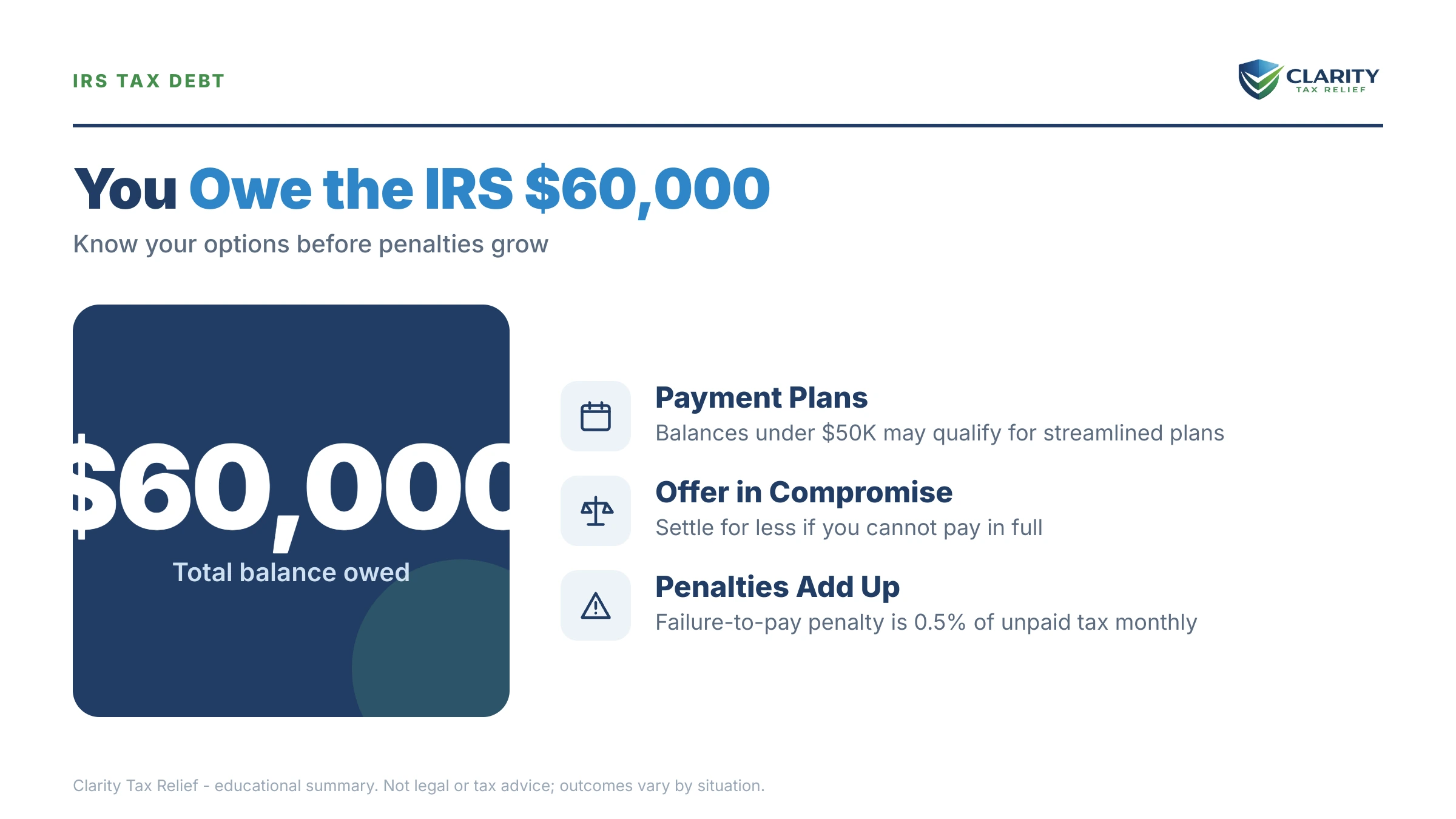
Why you owe the IRS $60,000
A $60,000 balance almost always builds from more than one year or more than one cause. Knowing which cause drove yours changes the fix.
The most common sources at this level:
- Self-employment or 1099 income with no withholding — a few years of unpaid quarterly taxes compound fast.
- A large one-time event — a business sale, retirement withdrawal, stock gains, or forgiven debt that generated tax you didn't set aside.
- Unfiled or late returns where the failure-to-file penalty (5% a month, up to 25%) piled on top of the tax.
- An audit or CP2000 adjustment that added tax, penalties, and interest to a return you thought was closed.
- Payroll or business tax from a company you own — which carries its own, harsher rules.
A big share of that $60,000 is often penalties and interest rather than tax. That matters, because penalties can sometimes be removed, and knowing the split is the first step. Pull your transcripts to see it.
“An offer in compromise allows you to settle your tax debt for less than the full amount you owe. It may be a legitimate option if you can't pay your full tax liability or doing so creates a financial hardship.”
— Offer in compromise (IRS.gov)
What $60,000 crosses: the thresholds that change your options
At $60,000 you sit between two IRS lines that reshape what's available to you. Getting these right is the difference between a smooth plan and a demand for your bank statements.
The $50,000 streamlined line. Individual balances of $50,000 or less (tax, penalties, and interest combined) usually qualify for a streamlined installment agreement — up to 72 months, set up online, with no financial disclosure. At $60,000 you're over that line, so the IRS can require a Collection Information Statement (Form 433-F or 433-A) before approving a plan.
The $66,000 passport line. The IRS certifies "seriously delinquent" tax debt to the State Department for passport denial or revocation once your balance passes $66,000 for 2026. At $60,000 you're under it, but only barely. Left alone, interest and penalties can push a $60,000 debt over that threshold within a year or two.
There's a strategy hidden in the first line: if you can pay the balance down below $50,000, you may sidestep the disclosure entirely and lock in a streamlined plan. Whether that beats keeping your cash depends on your finances — it's exactly the trade-off to run before you file anything.
| Option | Who it fits | Disclosure & cost |
|---|---|---|
| Full-pay installment agreement | You can clear $60k within the 10-year statute (roughly $1,050/mo over 72 months) | Form 433-F may be required over $50k; setup fee $29–$178; interest + penalty accrue |
| Partial-pay installment agreement | You can pay something monthly but not the full balance before the statute expires | Form 433-F/433-A required; reviewed every ~2 years; remaining balance can expire at CSED |
| Currently Not Collectible | Paying anything would leave you unable to cover basic living expenses | Form 433-F/433-A required; $0/mo but interest still accrues; lien likely |
| Offer in Compromise | Your income + asset equity genuinely can't cover $60k before the statute | Form 656 + 433-A(OIC); $205 fee (waivable); 20% down for lump sum; ~1 in 5 accepted |
| Penalty abatement / AEP | Clean prior 3 years, or reasonable cause (illness, disaster) | Reduces the balance; no disclosure needed; AEP auto-applied starting summer 2026 |
What happens if you ignore a $60,000 balance
Ignoring $60,000 doesn't make it go away — the automated collection sequence keeps moving, and each stage carries more power. Here's the escalation, roughly five weeks between steps:
- CP14 — the first bill, giving you about 21 days before escalation. Penalties and interest already accruing.
- CP501 / CP503 — reminder notices. The balance grows monthly; still no enforcement.
- CP504 — Notice of Intent to Levy. The IRS can seize your state tax refund and a federal tax lien becomes likely, attaching to everything you own.
- LT11 / Letter 1058 — the final notice. After 30 days the IRS can garnish wages and levy bank accounts. This notice also opens your Collection Due Process appeal rights (Form 12153).
- Levy & passport risk — wage garnishment runs continuously until released; a bank levy holds funds 21 days before they leave. If interest pushes you past $66,000, passport certification can follow.
The whole time, a monthly failure-to-pay penalty and daily interest keep compounding. On $60,000 that can add several hundred dollars a month to what you owe — the reason acting early is almost always cheaper.
Get your $60,000 balance reviewed before the levy clock starts
Send us a photo of your latest notice or your transcript. An experienced tax professional will decode where you are in the sequence and which option actually fits your finances — free, confidential, no pressure.
Your options to settle, pay, or get relief on $60,000
You have five realistic ways to resolve a $60,000 IRS debt, and the right one depends entirely on your income, expenses, and assets. Here's how each works at this balance.
1. Installment agreement (monthly payments)
An installment agreement is the most common resolution for a $60,000 balance. Because you're over $50,000, the IRS can ask for a Form 433-F Collection Information Statement. It may set your payment based on what you can afford rather than a flat figure.
You can request one with Form 9465 or through your online account. Interest and the 0.5%-a-month failure-to-pay penalty keep accruing, but enforcement stops the moment the plan is accepted. If you can drop the balance under $50,000, a streamlined plan skips the disclosure.
2. Partial-pay installment agreement (PPIA)
A partial-pay agreement lets you pay a smaller monthly amount, and whatever balance remains when the 10-year statute expires simply goes away. It fits when you can pay something but not the full $60,000 before your CSED.
The IRS requires full financial disclosure and reviews the agreement about every two years, so an income jump can raise your payment. It's a middle path between a full-pay plan and an Offer.
3. Currently Not Collectible (hardship)
If paying anything toward the $60,000 would leave you unable to cover necessary living expenses, the IRS can place your account in Currently Not Collectible status. Garnishments and levies stop, and your payment is $0.
The debt doesn't vanish — interest still runs and a lien usually gets filed — but the 10-year clock keeps ticking. For many people in genuine hardship, the balance can expire in CNC before they're ever asked to pay.
4. Offer in Compromise (settling for less)
An Offer in Compromise lets you settle $60,000 for less than the full amount, but only if you prove the IRS could never collect the full balance. The IRS bases its decision on your Reasonable Collection Potential (RCP): your asset equity plus your future monthly disposable income over a set number of months.
If RCP is genuinely lower than $60,000, an Offer can make sense. If it isn't, the IRS will reject it and you've spent months for nothing. You can estimate your own offer with our Offer in Compromise Calculator before you file. It estimates a figure, it does not promise acceptance.
The application fee is $205 (waived if you certify as low-income, AGI ≤ 250% of the poverty line), lump-sum offers require 20% down. The IRS accepted roughly 1 in 5 offers in FY2024. Be deeply skeptical of anyone promising to settle for "pennies on the dollar". That phrasing is a marketing scam, not a program.
5. Penalty abatement
Penalty relief can shrink a $60,000 balance without any financial disclosure. If you had clean compliance for the prior three years, first-time abatement can remove the failure-to-file and failure-to-pay penalties entirely.
Reasonable-cause relief may apply for illness, a natural disaster, or other events beyond your control. And starting summer 2026, an Automatic Exemption from Penalty (AEP) replaces first-time abatement for eligible taxpayers — applied automatically, with no request needed. On a balance where penalties may be a big slice, this is worth pursuing first. You can gauge the size with our penalty & interest calculator.
A worked example: what $60,000 looks like in real numbers
Say you owe the IRS $60,000 — about $45,000 in tax and $15,000 in penalties and interest across two years. Here's how the same balance plays out across three paths (all figures are hypothetical and rounded).
| Path | What you pay | Notes |
|---|---|---|
| Full-pay installment (72 mo) | ~$1,050/month | Pays off $60k with ~8% interest; Form 433-F may be required |
| Partial-pay installment | ~$400/month | Balance left at CSED expires; reviewed every ~2 years |
| Offer in Compromise (lump sum) | ~$12,400 offer | Only if RCP supports it; ~1 in 5 accepted; not guaranteed |
The installment math: to fully pay $60,000 over 72 months while interest runs at roughly 8% a year, the payment works out to about $1,050 a month. Principal alone would be $833; the rest is interest that keeps accruing until the balance is gone.
The Offer math: suppose you have $10,000 of equity in a car and savings, and after allowable living expenses you have $200 a month left over. For a lump-sum offer, the IRS multiplies that $200 by 12 and adds your equity: $10,000 + ($200 × 12) = $12,400. That's the figure the IRS might accept, but only if your disclosed finances actually back it up. Overstate your ability to pay and the offer is rejected; understate it and the IRS recalculates.
The lesson: the "best" number isn't the lowest one on paper — it's the one your finances can actually support. That's why running your own numbers before filing matters.
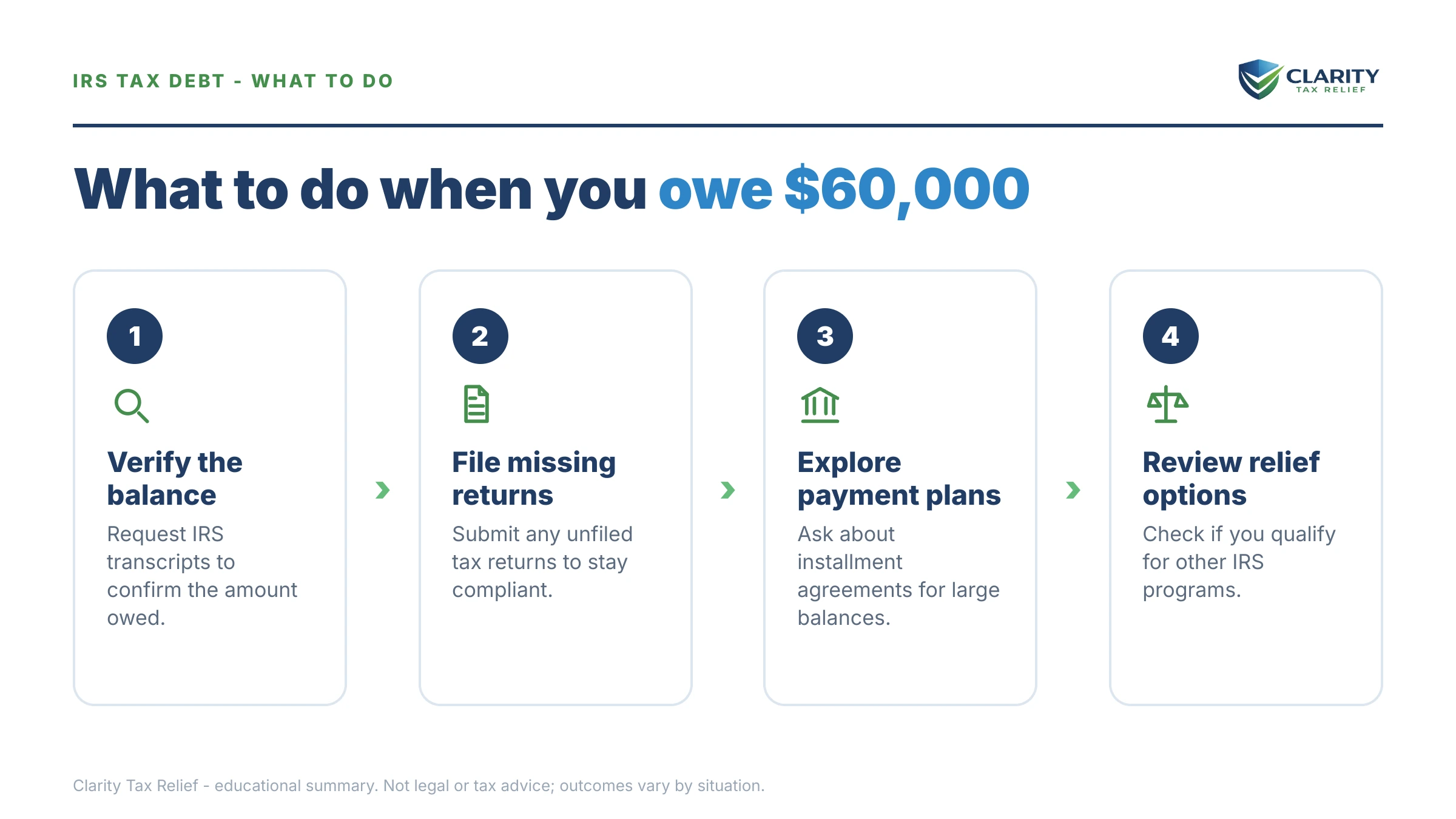
How to respond, step by step
Here's the order that keeps a $60,000 balance from getting more expensive, and protects your best options.
- Confirm the balance and the years. Log into your IRS online account and pull account transcripts to verify the $60,000 total and how much is penalty and interest.
- File any missing returns. The IRS won't approve a plan or Offer while any return is unfiled — get every year filed first, even ones you can't pay.
- Run your own numbers. Estimate your monthly disposable income and asset equity so you know whether a plan, hardship, or an Offer is realistic before you commit.
- Choose the option that fits. Match your numbers to a full-pay plan, partial-pay agreement, CNC, or Offer, and gather the Form 433 disclosure that option requires.
- Request penalty relief. Ask for first-time abatement or reasonable-cause relief — on a $60,000 balance, penalties can be a large, removable slice.
- Submit before the next notice hits. File your resolution before an LT11 starts the 30-day levy clock.
If you have unfiled years or a levy already in motion, the sequence gets more complex — a quick case review can tell you whether a partial-pay agreement or an Offer changes your bottom line before you commit to a plan.
When you can handle this yourself, and when help changes the outcome
Not every $60,000 balance needs a professional, and honest advice matters more than a hard sell. Here's the line.
You can likely handle it yourself if: all your returns are filed, you agree with the balance. You can pay it down under $50,000 to set up a streamlined 72-month plan online — no disclosure, no negotiation. If you can afford roughly $1,050 a month and just want it resolved, the IRS online payment agreement tool is straightforward.
Experienced help usually changes the outcome when: the IRS is requiring a Form 433 and you don't know which expenses they'll allow. A wage or bank levy is already in motion. You have multiple unfiled years. The debt is business or payroll tax. Or you think an Offer or partial-pay agreement fits but aren't sure the math holds. In those cases, the difference between a good and bad setup is thousands of dollars. The order you fix things in (returns, then penalties, then the balance) changes what you end up paying.
Situations that change the answer at $60,000
Your filing status and income type can shift the best path entirely. A few common ones:
Married filing jointly. Both spouses are liable for a joint balance. The IRS looks at household income and assets for a plan or Offer. If the debt is really one spouse's — from before the marriage or from hidden income — innocent spouse relief may separate you from part of it.
Married filing separately. Filing separately can wall off one spouse's income from the other's collection. But it often raises the total tax and complicates a joint plan. Run both scenarios before assuming separation helps.
Self-employed or 1099. The IRS will expect you to make estimated payments going forward as a condition of any agreement. Fall behind on the current year and the whole plan can default — build the estimated tax into your budget from day one.
Business or payroll tax. If part of the $60,000 is unpaid payroll tax, the trust-fund portion can be assessed against you personally as a Trust Fund Recovery Penalty. It generally can't be settled or wiped out as easily. This is the case where professional help matters most.
Multiple years. A $60,000 balance spread over several years means several CSED dates. The oldest year may be closest to expiring, which can change whether a partial-pay agreement or waiting out the statute makes sense.
State tax too. State agencies collect separately and often more aggressively. California's FTB has a 20-year collection statute, double the IRS's ten, and New York files a tax warrant that becomes a public-record judgment and lien. A $60,000 federal balance frequently comes with a state balance that needs its own plan.
Terms on your notice, decoded
The words the IRS uses on a $60,000 balance, in plain English:
- CSED (Collection Statute Expiration Date): the date, generally 10 years after assessment, when the IRS can no longer collect a debt, though it pauses for Offers, bankruptcy, and some appeals.
- Tax lien vs. levy: a lien is a legal claim on your property that protects the IRS's interest. A levy is the actual seizure of wages, bank funds, or refunds.
- Collection Information Statement (Form 433-F / 433-A): the financial disclosure the IRS uses to decide what you can afford — income, expenses, and asset equity.
- Reasonable Collection Potential (RCP): the IRS's estimate of the most it could collect from you — the number that makes or breaks an Offer in Compromise.
- Statutory additions: the penalties and interest the law adds automatically to unpaid tax, growing every month.
- Passport certification: the IRS's referral of "seriously delinquent" tax debt (over $66,000 in 2026) to the State Department for passport action.
Frequently asked questions about owing the IRS $60,000
Can I settle $60,000 of IRS debt for less than I owe?
Sometimes, through an Offer in Compromise, but only if you can prove the IRS could never realistically collect the full $60,000 from your income and assets. The IRS accepted roughly 1 in 5 offers in FY2024, so it is real but not easy or guaranteed. Anyone promising to settle for pennies on the dollar before reviewing your finances is selling a scam.
Will I lose my passport if I owe the IRS $60,000?
Not at $60,000. The IRS certifies tax debt to the State Department for passport denial or revocation only once your balance passes $66,000 for 2026. A $60,000 balance is below that line, but interest and penalties can push you over it, so a growing $60,000 debt is worth resolving before it crosses the threshold.
What is the monthly payment on a $60,000 IRS installment plan?
To fully pay $60,000 over 72 months while interest keeps accruing at roughly 8% a year, expect around $1,050 a month. Because $60,000 is above the $50,000 streamlined limit, the IRS may ask for a financial disclosure and could set a payment based on what you can actually afford rather than a flat 72-month figure.
Do I have to disclose my finances to the IRS if I owe $60,000?
Usually yes. Because $60,000 is above the $50,000 streamlined threshold, the IRS can require a Collection Information Statement, Form 433-F or 433-A, showing your income, expenses, and assets before approving a plan. You can avoid the disclosure by paying the balance down under $50,000 first to qualify for a streamlined agreement.
Can the IRS take my house if I owe $60,000?
It is very unlikely at $60,000. The IRS can file a tax lien that attaches to your home, but seizing and selling a primary residence is rare, requires court approval, and is not how the IRS collects a balance this size. Wage garnishment and bank levies are the far more common enforcement tools, and both can be stopped with a payment arrangement.
How long does the IRS have to collect $60,000?
Generally 10 years from the date each tax was assessed — the Collection Statute Expiration Date, or CSED. After that, the debt legally expires. But the clock pauses while an Offer in Compromise, bankruptcy, or certain appeals are pending, so the debt does not simply disappear on a fixed date.
Should I use my retirement account to pay off $60,000?
Be careful — cashing out a retirement account can trigger income tax and a 10% early-withdrawal penalty, creating a brand-new balance for next year. It can also hurt your chances at an Offer in Compromise or hardship status. Run the full cost before draining retirement savings, and get a professional to compare it against a payment plan.
Can I get penalties removed on a $60,000 balance?
Often yes. First-time abatement can erase the failure-to-file and failure-to-pay penalties if you had clean compliance for the prior three years, and reasonable-cause relief may apply for illness, disaster, or other events beyond your control. Starting summer 2026, an Automatic Exemption from Penalty replaces first-time abatement for eligible taxpayers, applied without a request.
What happens if I ignore a $60,000 IRS balance?
The automated collection sequence escalates from reminder notices to a CP504 (intent to levy your state refund) to an LT11 final notice that starts a 30-day levy clock. After that the IRS can garnish wages and levy bank accounts. Penalties and interest keep growing the whole time, and a $60,000 balance can climb toward the $66,000 passport threshold.
Is $60,000 in IRS debt enough to hire a tax professional?
For most people, yes — $60,000 crosses the streamlined threshold, so the IRS can demand financial disclosure and negotiate your payment amount. An experienced tax professional can decide whether an Offer, hardship status, or a partial-pay agreement saves you more than a straight payment plan, and can hold off enforcement while it's arranged.
Your next 24 hours
Turn the anxiety into three concrete moves today:
- Find your real numbers. Log into your IRS online account and note the exact balance, the tax years, and how much is penalty and interest, plus the assessment date on each year.
- Gather three things. Your most recent tax return, any notice you've received. A rough list of your monthly income, expenses, and assets — the same figures the IRS uses on Form 433.
- Get a free case review. Call (888) 825-7779 or use the 2-minute form before an LT11 starts the 30-day levy clock. An experienced tax professional will tell you which option fits your $60,000 balance, and whether penalty relief can shrink it.
This guide is general information, not tax or legal advice for your specific situation. Eligibility for IRS programs depends on individual facts and circumstances; no outcome is guaranteed.
Primary sources: Offer in compromise