
Large Tax Debt
I Owe the IRS $90,000: How to Handle a Large IRS Tax Debt (2026)
The short answer: if you owe the IRS $90,000, you have four real paths — a full-disclosure installment agreement, Currently Not Collectible status, an Offer in Compromise, or penalty relief. At this size a federal tax lien is likely, and because $90,000 is above the $66,000 passport threshold, your debt can be certified to the State Department. Act before the levy clock runs.
You opened your IRS account, added up the years, and the total crossed $90,000 — a number big enough that the old advice about just setting up a plan online no longer fits. The fear at this level is real: liens, wage levies, and even your passport are on the table. But a $90,000 balance is a solvable problem, and the size actually opens doors that a small debt doesn't.
Here's what changes at this size and what stays the same. The collection sequence is identical to any other balance, but you're now above the thresholds that trigger liens, passport certification, and mandatory financial disclosure. That means the order in which you fix things matters more than the balance itself.
Below, the highlighted boxes on a real (redacted) CP508C passport-certification notice show exactly which line tells you whether the State Department has already been notified — most people never realize their travel is at risk until they're at the counter.
⏱ Your deadline: if your most recent notice is an LT11 / Letter 1058, you have 30 days from the date on it to request a Collection Due Process hearing and stop enforced collection. If you're earlier in the sequence, the "pay by" date on your notice is when penalties, interest, and escalation continue. Passport certification can happen once your balance passes $66,000 — separate from the levy clock.
Why a $90,000 tax debt is a different problem
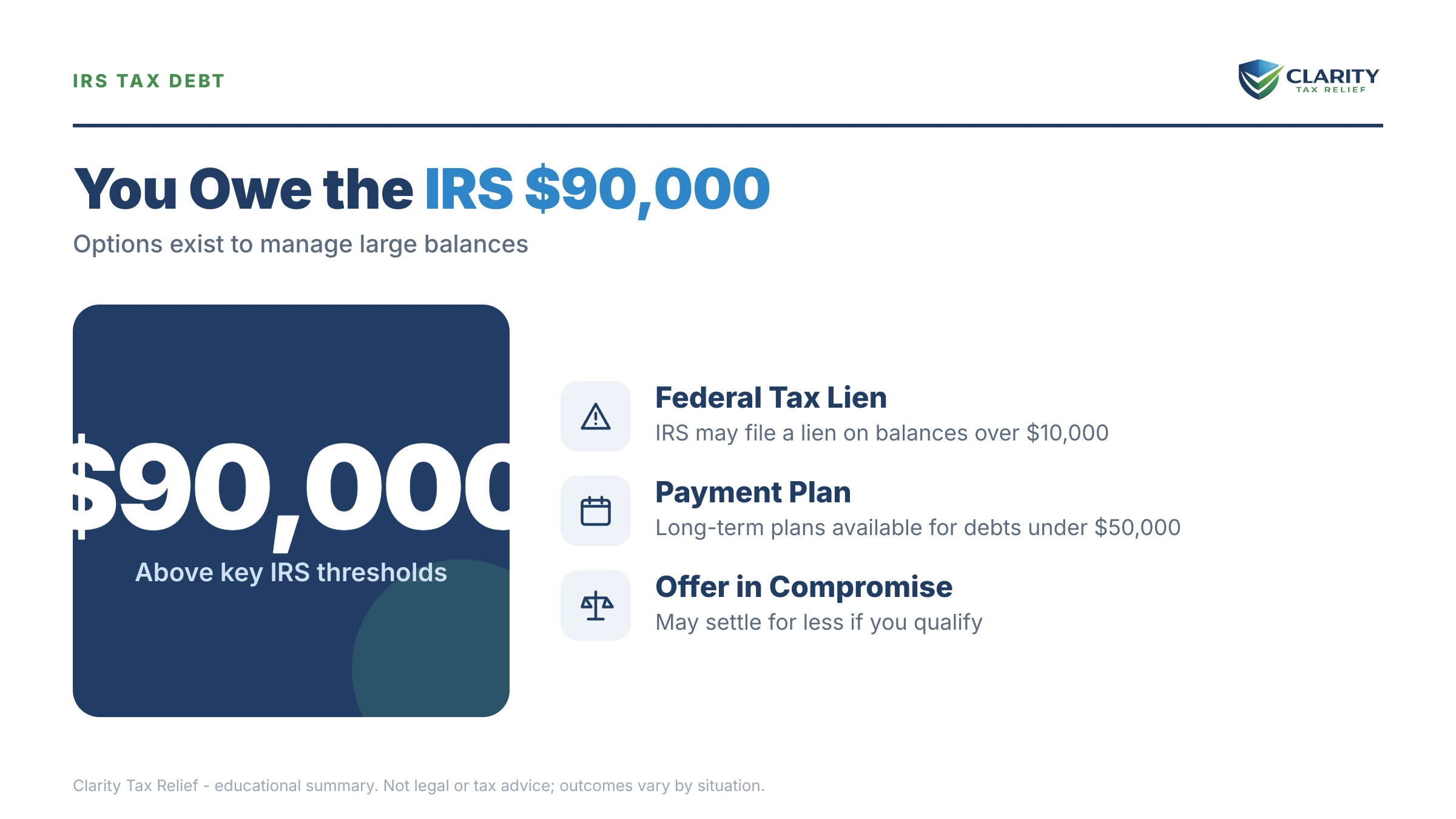
A $90,000 balance sits in the IRS's "large dollar" collection tier, where automatic protections you had at smaller balances disappear. Below $50,000 you can often set up a payment plan online with no financial questions. At $90,000 you're past that line: the IRS wants to see your income, expenses, and assets before it agrees to anything.
Three things become near-certain at this size that weren't at $20,000 or $30,000:
- A Notice of Federal Tax Lien. The IRS generally files a lien once a balance passes $10,000. At $90,000 it's routine — the lien attaches to everything you own and hits public records.
- Passport certification. Once your combined federal tax debt exceeds $66,000 in 2026, the IRS can label it "seriously delinquent" and send the State Department a CP508C. That can block a new passport or renewal.
- Mandatory financial disclosure. To get a plan, you'll likely complete Form 433-F or 433-A showing every dollar you earn, spend, and own.
If your balance is a bit lower or higher, the mechanics are similar — see our companion guides for owing the IRS $80,000 and owing $70,000. The closer you get to $100,000, the faster and more aggressive the IRS's own timelines become.
What happens if you ignore a $90,000 IRS debt
Ignoring a $90,000 balance doesn't freeze it — the automated collection machine keeps escalating on a fixed schedule while penalties and interest compound daily. Here's the sequence, with rough day counts from the first bill:
- CP14 — first bill (day 0). The balance-due notice. You typically have about 21 days before the next notice generates.
- CP501 / CP503 — reminders (weeks 5–11). Still bills, but the balance grows each month and a lien may be filed.
- CP504 — intent to levy state refund (around week 15). The IRS can seize your state tax refund and moves toward a federal levy. Not the final notice.
- CP508C — passport certification (any point above $66,000). Your debt is reported to the State Department; passport applications and renewals can be denied.
- LT11 / Letter 1058 — final notice of intent to levy (30-day clock). After 30 days the IRS can garnish wages continuously and levy bank accounts. You have Collection Due Process appeal rights here — request them with Form 12153.
- Enforced collection. Wage levy (continuous until released), bank levy (21-day hold, then funds leave), and up to 15% of Social Security through the Federal Payment Levy Program.
In 2026 this matters more than ever. The IRS cut roughly 27% of its workforce in 2025, so reaching a human is harder. But the notices, liens, levies, and passport certifications are issued by automated systems that never slowed down. Delay only works against you.
Owe around $90,000 and worried about a levy or your passport?
Get your notices reviewed free before the LT11 30-day window closes. An experienced tax professional will tell you where you stand, whether you've been certified to the State Department, and which resolution actually fits your numbers — no pressure.
The passport problem: how $66,000+ triggers CP508C
A tax debt over $66,000 in 2026 can be certified as "seriously delinquent," and that certification is what puts your passport at risk. When the IRS certifies your debt, it notifies the State Department, which can then deny a new passport, deny a renewal, or in some cases revoke a passport you already hold.
The certification notice is CP508C. The highlighted boxes on the sample notice above show where it states the certified amount and the date the State Department was notified. That date is what matters if you have travel planned. A $90,000 balance is comfortably above the threshold, so if you haven't resolved it, assume certification is possible.
The good news: certification reverses once you're in a resolution the IRS accepts. Getting into an installment agreement, having an Offer in Compromise accepted, being placed in Currently Not Collectible status, or requesting a timely Collection Due Process hearing all move you back toward "not seriously delinquent." The IRS then sends a CP508R to reverse the certification, though it can take weeks to process, so don't wait until the week before a trip.
Your options to resolve $90,000
At $90,000 you have four core resolution paths, and the right one depends entirely on your income, expenses, and asset equity. Here's how they compare.
| Option | Who it fits | Cost & commitment |
|---|---|---|
| Installment agreement (full disclosure) | Steady income; can pay the balance over time | Setup fee; monthly payment over up to 72 months or the remaining collection period. Interest/penalties continue. |
| Currently Not Collectible | Paying anything would create genuine hardship | $0 payment while it lasts; debt and interest remain. IRS reviews periodically. |
| Offer in Compromise | Assets + future income genuinely can't cover the debt before the statute expires | $205 application fee (waivable if low-income), 20% down for lump-sum. ~1 in 5 accepted. |
| Penalty relief (FTA / reasonable cause / AEP) | Clean prior 3 years, or a qualifying cause like illness/disaster | No fee; reduces balance by removing penalties, not the underlying tax. |
Because $90,000 exceeds the $50,000 online threshold, none of these are "set it and forget it." You'll generally provide financial disclosure. The IRS decides based on its own formula, not a percentage any company can promise you up front. Penalty relief is worth checking early: the First-Time Abate program still exists for a clean prior three years. The IRS is rolling out an automatic penalty exemption (AEP) starting in summer 2026 that requires no request.
What a $90,000 installment agreement actually costs
An installment agreement on $90,000 spreads the balance into monthly payments, but interest and the failure-to-pay penalty keep accruing until it's paid, so the real total is higher than $90,000. Here's roughly what different terms look like on the principal alone, before ongoing interest.
| Term | Principal ÷ months | Realistic monthly (with accruals) |
|---|---|---|
| 36 months | $2,500 | ~$2,850–$3,000 |
| 60 months | $1,500 | ~$1,800–$1,950 |
| 72 months | $1,250 | ~$1,500–$1,650 |
These are illustrations, not quotes — the IRS sets your minimum based on your disclosed finances, and interest compounds daily at the federal underpayment rate. The longer the term, the more total interest you pay, but the lower the monthly strain. If your income can't support even the 72-month figure, that's exactly when Currently Not Collectible status or an Offer becomes the better conversation.
Worked example: say you owe $90,000
Say you owe $90,000 across three tax years and you're a self-employed contractor. On a 72-month installment agreement, the base is $90,000 ÷ 72 = $1,250 a month, but with interest and the 0.5%/month failure-to-pay penalty still running, your real payment lands closer to $1,550. Over six years, you'd pay well north of $100,000 in total.
Now run the Offer in Compromise math instead. The IRS looks at your reasonable collection potential — the equity in your assets plus your future monthly disposable income. Say you have $18,000 of equity in a vehicle and savings, and after allowable living expenses you have $350 left each month. For a lump-sum offer, the IRS multiplies monthly disposable income by 12: $350 × 12 = $4,200, plus $18,000 equity = a $22,200 offer.
That's not "pennies on the dollar" — a phrase you should treat as a red flag whenever a company promises it — but it's a legitimate figure if your finances genuinely support it. You can estimate your own number with our Offer in Compromise Calculator before you spend anything on the process. Remember the IRS accepted only about 1 in 5 offers in FY2024, so the math has to be real.
Offer in Compromise at $90,000: when the math works
An Offer in Compromise settles a $90,000 debt for less only when the IRS agrees it can't collect the full amount before the collection statute expires. The offer is built on Form 656 and a detailed Form 433-A(OIC). The number is driven by your reasonable collection potential, not by how much you'd like to pay.
Two things sink most offers at this level. First, high asset equity: if you have significant home equity, retirement balances, or business value, the IRS counts it, and your offer amount climbs. Second, high future income: a strong monthly surplus tells the IRS you can pay through a plan instead. If either is true, an installment agreement or Currently Not Collectible status is usually the more honest fit.
One protection worth knowing: if the IRS doesn't decide on your offer within 2 years, it's automatically accepted. And while your offer is pending, the collection statute clock pauses — a trade-off an experienced professional weighs against your Collection Statute Expiration Date before filing.
How to respond, step by step
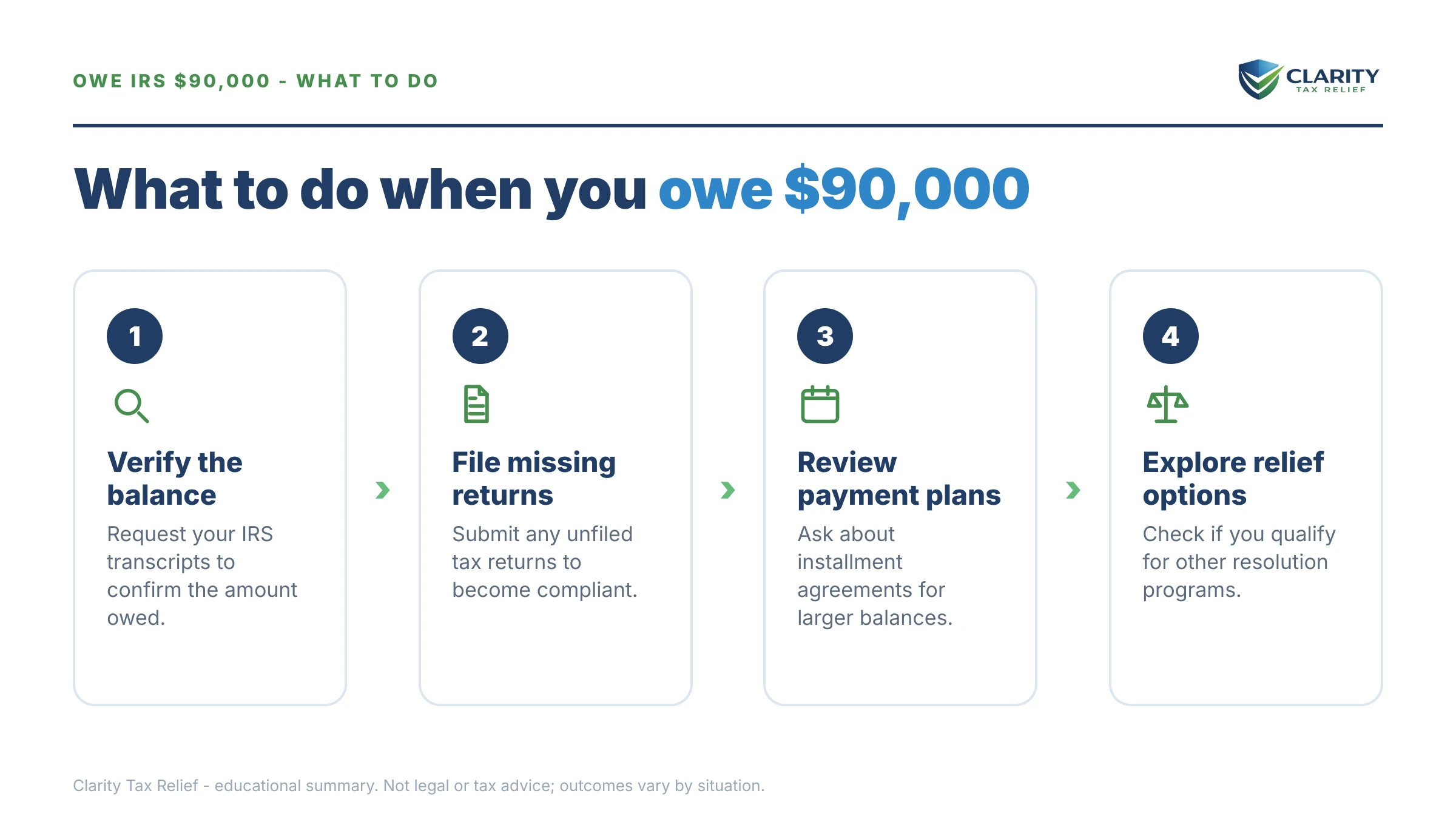
- Confirm the exact balance. Log into your IRS online account and pull account transcripts for every year so you know the true total and which years are involved.
- File any missing returns. The IRS won't approve a plan or Offer while you have unfiled years — get into compliance first.
- Check your passport risk. A balance over $66,000 can be certified; find out whether a CP508C has gone out before you plan travel.
- Run your numbers against each option. Compare a full-disclosure installment agreement, Currently Not Collectible, and an Offer using your real income, expenses, and equity.
- Set up a resolution before the levy clock runs. Establishing a plan, hardship status, or a timely CDP request stops enforced collection and can reverse passport certification.
- Get a professional review at this balance. With liens, disclosure, and Offer math in play, experienced help often changes the total you pay.
When you can handle a $90,000 debt yourself, and when you shouldn't
You can handle a $90,000 balance yourself if your situation is simple: one tax year, all returns filed, steady income, and you're comfortable completing Form 433-F and negotiating a straightforward payment plan you agree with. If you can pay it within the plan and you're not worried about a levy or your passport, doing it directly with the IRS is reasonable, and free.
Experienced help changes the outcome when the facts get harder:
- A levy is already in motion or an LT11 30-day clock is running.
- You have multiple unfiled years — the filing order affects your total.
- The debt is business or payroll tax (trust fund penalties personally attach to owners and officers).
- You're weighing an Offer and need the reasonable collection potential math done right the first time.
- Your passport has been certified and you have travel or immigration deadlines.
Honesty matters here: a company that tells you everyone qualifies for a settlement is selling, not advising. The value of representation at $90,000 is getting into the right program and not overpaying, not a guaranteed result.
Situations that change the answer
The right move on a $90,000 debt shifts based on who owes it and how it arose. A few common variations:
Married filing jointly. Both spouses are jointly liable for a joint return's balance. If the debt is really one spouse's, from unreported income you didn't know about, innocent spouse relief may separate you from part of it.
Married filing separately. Only the spouse who signed the return owes, but in community-property states the IRS may still reach shared assets. This changes both liability and Offer math.
Self-employed or 1099. If quarterly estimated payments fell behind, the fastest fix is often adjusting current-year estimates so you stop adding new debt while resolving the old — otherwise the balance keeps climbing past $90,000.
Business or payroll debt. Unpaid payroll taxes carry the Trust Fund Recovery Penalty, which the IRS can assess personally against owners and responsible officers. That debt behaves differently and needs specialized handling. If yours involves an Employee Retention Credit issue, see our guides on the ERC audit process and appealing an ERC disallowance.
State tax debt too. State collection runs separately and often longer — California's Franchise Tax Board has a 20-year collection statute. A New York tax warrant becomes a public-record civil judgment and lien. A federal plan doesn't resolve a state balance.
Terms on your notice, decoded
- Seriously delinquent tax debt: a federal tax debt over $66,000 (2026) that the IRS can certify to the State Department, putting your passport at risk.
- Notice of Federal Tax Lien: a public claim against your property for the debt; different from a levy, which actually seizes.
- Levy: the actual seizure of wages, bank funds, or refunds — the enforcement step a lien only warns about.
- CSED (Collection Statute Expiration Date): the date, generally 10 years after assessment, when the IRS can no longer collect — pausable by Offers, appeals, bankruptcy, and time abroad.
- Reasonable collection potential: the IRS's formula for what it could collect from your assets plus future income; the basis for any Offer amount.
- Collection Due Process (CDP): your right, triggered by an LT11, to appeal a levy before it happens — requested on Form 12153 within 30 days.
$90,000 tax debt questions, answered
Will I lose my passport if I owe the IRS $90,000?
You can. A balance of $90,000 is above the 2026 seriously delinquent tax debt threshold of $66,000, so the IRS can certify your debt to the State Department, which can then deny a passport application or revoke an existing passport. Setting up an installment agreement, an accepted Offer, or Currently Not Collectible status reverses the certification.
Can I get a payment plan if I owe $90,000?
Yes, but $90,000 is above the $50,000 online threshold, so you cannot simply set it up on the website with no questions asked. You generally file a financial disclosure on Form 433-F or 433-A and negotiate a monthly amount, often spread over up to 72 months or the remaining collection period.
Can I settle a $90,000 tax debt for less?
Sometimes, through an Offer in Compromise, but only if the IRS's own math shows it cannot collect the full amount from your income and assets before the collection statute expires. The IRS accepted roughly 1 in 5 offers in FY2024. The offer amount is based on your reasonable collection potential, not a percentage anyone can promise.
Will the IRS file a tax lien for $90,000?
Almost certainly. The IRS generally files a Notice of Federal Tax Lien on balances above $10,000, and a $90,000 debt is well past that. The lien attaches to your property, appears on public records, and can affect financing until the debt is resolved or the lien is released or withdrawn.
How much interest and penalty accrues on $90,000?
The failure-to-pay penalty runs 0.5% of the unpaid balance per month up to 25%, and interest compounds daily at the federal underpayment rate. On $90,000 that can add well over $1,000 a month early on, which is why setting up any resolution quickly matters even if you cannot pay in full.
What happens if I just ignore a $90,000 IRS debt?
The automated collection sequence escalates from balance-due notices to a CP504 intent to levy your state refund, then an LT11 final notice that starts a 30-day clock to wage garnishment and bank levies. Penalties and interest grow the whole time, and a balance over $66,000 can also trigger passport certification.
Does a $90,000 tax debt expire after 10 years?
The IRS generally has 10 years from the date of assessment to collect, called the Collection Statute Expiration Date. But that clock pauses during a pending Offer in Compromise, bankruptcy, certain appeals, and time abroad, so the real deadline is often later than 10 years from when you filed.
Should I hire someone if I owe the IRS $90,000?
At $90,000 with full financial disclosure, possible liens, passport certification, and Offer math all in play, experienced representation often changes the total you pay and which program you land in. A simple balance you can pay within 180 days or a straightforward plan you agree with, you can handle yourself.
Your next 24 hours
- Find the certified amount and date. On any CP508C, locate the box showing the certified balance and the date the State Department was notified. That tells you whether your passport is already at risk.
- Gather three things. Your most recent notices, account transcripts for every year. A rough list of your monthly income, expenses, and asset equity — the numbers every option depends on.
- Get a free case review. Call (888) 825-7779 or use the 2-minute form and an experienced tax professional will tell you where you stand and which resolution fits, before the LT11 30-day levy window closes.
This guide is general information, not tax or legal advice for your specific situation. Eligibility for IRS programs depends on individual facts and circumstances; no outcome is guaranteed.