
Gambling & Tax Debt
DraftKings Taxes: How Much You Can Win Before Paying, Withholding, Tax Forms and What If You Owe (2026)
Read the transcript
Host: So you had a good season on DraftKings, and now there's either a balance due on your return that's way bigger than you expected, or an IRS envelope on the counter listing winnings you'd half forgotten about. That's the situation we're in today.
Tax specialist: Yeah, and the thing I want people to hear first is that this is mechanical. It feels personal because it's gambling money, but nobody at the IRS decided to look at you.
Host: Explain that.
Tax specialist: DraftKings files copies of your paperwork with the IRS. Daily fantasy net winnings of six hundred dollars or more generally get reported on a 1099-MISC. Sportsbook or casino-style wins can throw a W-2G instead. Then the IRS underreporter system compares every form filed under your Social Security number against what's on your return. If the form exists and the income isn't there, a computer flags it.
Host: A 1099-MISC for the fantasy side, W-2G for sportsbook. Got it.
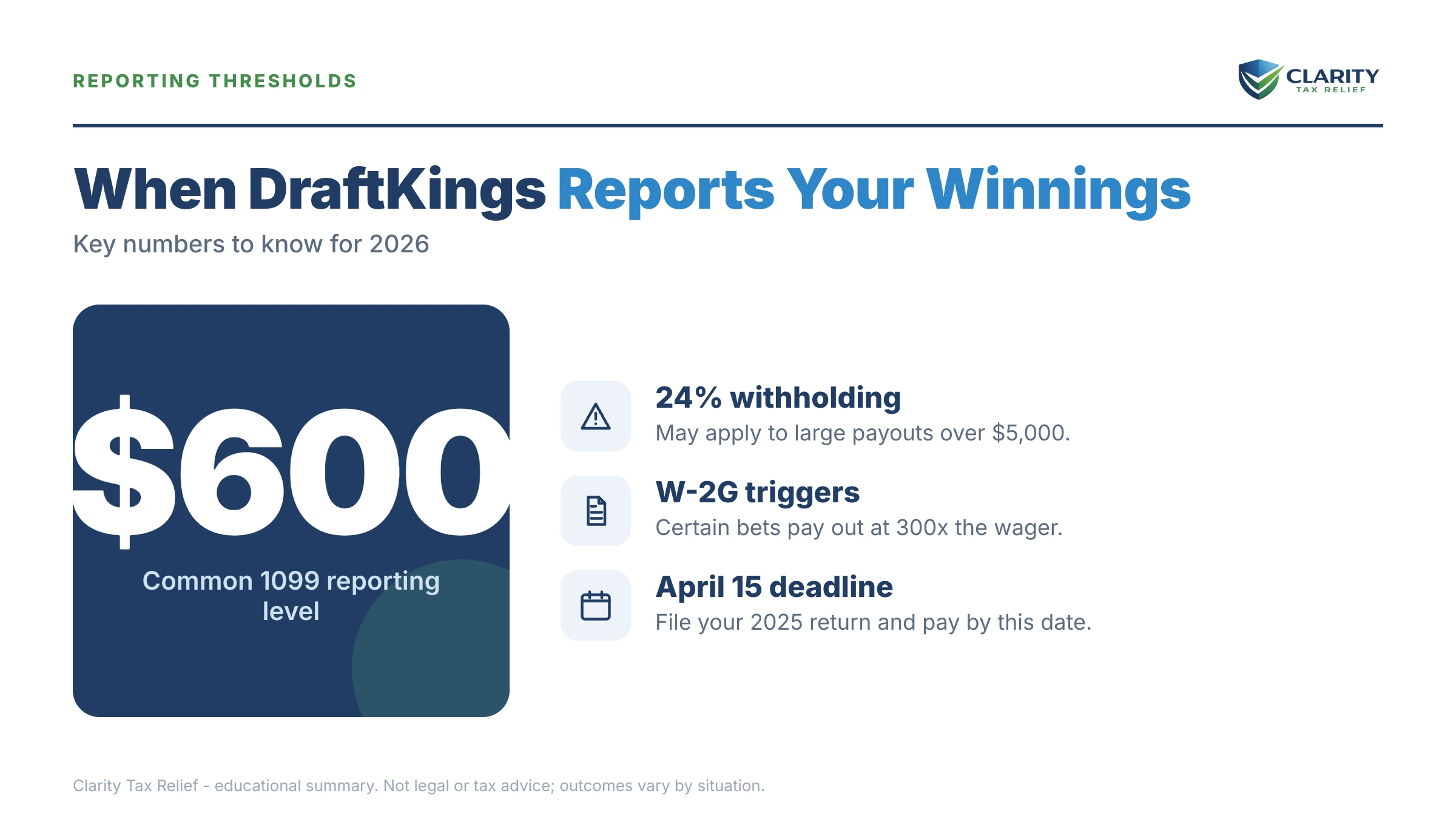
Tax specialist: Right. And the second half of the trap is withholding. Your employer takes tax out of every paycheck, so April usually nets out. DraftKings withholds federal tax on a narrow slice of large wins — generally twenty-four percent, and only on certain payouts over five thousand dollars at long odds. So a whole profitable season of ordinary-sized wins arrives with zero tax paid in.
Host: And the entire bill lands at once.
Tax specialist: At filing time, all of it.
Host: Okay, here's the part I think trips people up the most. What if you lost more than you won?
Tax specialist: You can still owe. Winnings are counted gross, not net. The article's example. You deposit eight thousand, win fifteen, lose twelve chasing it. The matching system sees the reported winnings. Your losses live on a completely different part of the return.
Host: Wait. So the losses don't just cancel out.
Tax specialist: No. Losses are deductible only if you itemize, only up to your winnings, and starting with 2026 returns, only up to ninety percent of your losses under the One Big Beautiful Bill Act. So even someone who broke exactly even in 2026 can owe tax on the winning side of the ledger.
Host: Hm.
Tax specialist: And the itemizing part is what stings W-2 filers. If you take the standard deduction, which most single employees do, your losses produce zero tax benefit. You pay tax on reported winnings in a net losing year.
Host: That's brutal. Say it simply for me — when do losses actually help?
Tax specialist: When itemizing them beats your standard deduction. That's a math problem, and it's worth running before you agree to any IRS number. And if you're holding a notice that taxes your gross winnings, documented losses are still live. You respond with a win/loss statement and itemized figures instead of just signing the consent. That's the mechanism. I can't tell you where your number lands.
Host: Let's do the notice sequence, because I think that's where the anxiety actually lives. What order does this come in?
Tax specialist: Okay, so. If you didn't report, it starts with a CP2000 — proposed change, usually with a twenty percent accuracy-related penalty attached. You typically get thirty days to agree, dispute, or correct it. That is the only stage where the amount itself is still negotiable by mail.
Host: Thirty days on the CP2000, and that's the best window.
Tax specialist: Best window. No response, and you get a CP3219A — the Notice of Deficiency, the ninety-day letter. Ninety days to petition Tax Court, and after that the proposed amount becomes a legal assessment. That court piece, by the way, is a different track and sits outside what we handle here — anyone thinking about it should talk to their own counsel.
Host: Understood. Keep going.
Tax specialist: Then CP14, the first actual bill, roughly twenty-one days to pay. Then CP501 and CP503, reminders. Then CP504, Notice of Intent to Levy — the IRS can take your state refund at that point, and a federal lien becomes realistic. Then LT11, or Letter 1058, the final notice. That starts a thirty-day clock and your Collection Due Process rights, requested on Form 12153. After it expires, wages and bank accounts are on the table.
Host: And if someone filed honestly and just can't pay?
Tax specialist: Then your sequence starts at CP14 instead. Same collection track, no accuracy penalty.
Host: The article has a worked example I want you to walk through. Hypothetical, right?
Tax specialist: Clearly hypothetical. Single W-2 employee, seventy-two thousand of wages, so the last dollars sit in the twenty-two percent bracket. Forty-two thousand in reported winnings, none of it on the return. Tax is forty-two thousand times twenty-two percent — nine thousand two hundred forty. Accuracy penalty is twenty percent of the understatement, so eighteen forty-eight. Interest since the original due date, roughly two hundred twelve and climbing daily. About eleven thousand three hundred total.
Host: So the tax is nine two forty and everything above it is—
Tax specialist: Penalty and interest that grows with delay. That's the whole point of that example. And while you're waiting, the failure-to-pay penalty adds half a percent of the balance every month plus interest that compounds daily, until you pay or set up a plan.
Host: Which brings us to the plans. Short version of each.
Tax specialist: Short-term plan if you can pay in full within a hundred eighty days — no setup fee, but interest and that half-percent keep running. Streamlined installment agreement for balances up to fifty thousand with all returns filed, up to seventy-two months, set up online with no financial disclosure. There's also the Guaranteed Installment Agreement, which is for tax balances of ten thousand dollars or less and has to be paid within three years.
Host: So on that eleven-three example, you'd be just over the line for the Guaranteed Installment Agreement.
Tax specialist: Just over. Paying the balance below ten thousand first can open that door. Then Currently Not Collectible, which is for people where paying anything would leave them unable to cover basic living costs — collection pauses, debt and interest remain, and the IRS revisits your finances. And an Offer in Compromise, which is means-tested. Two hundred five dollar fee plus twenty percent down on lump-sum offers, both waived for low-income applicants. Roughly one in five offers were accepted in fiscal year 2024.
Host: And the honest caveat on that one?
Tax specialist: A steady W-2 paycheck with years left on the collection statute usually means the IRS calculates it can collect in full. That's the hard part, and I'd rather say it than not.
Host: Penalty relief — where does that fit?
Tax specialist: After the tax is arranged, not before. First-Time Abate needs clean compliance the prior three years, or you go the reasonable cause route. It removes penalties, not the tax or interest. And one sequencing note — starting summer 2026 the IRS is rolling out an Automatic Exemption from Penalty that applies qualifying relief without a request. So before you pay a penalty in full, check whether it's about to come off on its own.
Host: Last thing. When is this genuinely a do-it-yourself job?
Tax specialist: Most single-year gambling bills under about twenty-five thousand. If the IRS's winnings figure matches your DraftKings records, you took the standard deduction anyway, and your only problem is cash flow. You can set that plan up online in under an hour and ask for first-time abatement by phone. No firm, including ours, adds much there.
Host: And when it's not?
Tax specialist: A CP2000 taxing gross winnings when you have documentable losses. Multiple unreported years, because each year is its own matching cycle and they surface one at a time. Anything already at CP504 or LT11, where deadlines control everything. And betting heavy enough that professional-gambler treatment is in play.
Host: So today. Next twenty-four hours.
Tax specialist: Find the controlling number. If there's a notice, the response date printed on it and the winnings figure the IRS is using. If there's no notice, log into the DraftKings tax document center and download everything including the year-end win/loss statement, and pull your IRS wage and income transcript so you can see what was actually reported under your Social. Then gather last year's return and your deposit and withdrawal history.
Host: And don't skip filing this year because you owe for last year.
Tax specialist: Opposite. A new unfiled year disqualifies you from every payment program.
Host: If you want an Enrolled Agent to check whether the IRS's number is even right before that response date passes, call (888) 825-7779, or use the two-minute form. Free, confidential, and every option is cheaper on this side of the deadline.
The short answer: there is no amount you can win on DraftKings without owing tax. The IRS says gambling winnings "are fully taxable and you must report the income on your tax return," including "winnings that aren't reported on a Form W-2G." The dollar figures people search for ($600, $5,000) are reporting and withholding thresholds: they decide when DraftKings sends a form and when it takes 24% out, not when tax starts. DraftKings withholds only on long-odds sports wins over $5,000, so a winning year usually arrives with nothing paid in. If you owe and cannot pay, a 180-day plan or a monthly installment agreement stops the escalation.
Maybe your tax software just flashed a balance due bigger than you expected, or an IRS envelope arrived listing DraftKings winnings you had half-forgotten, with a proposed tax attached. Either way, the money you had fun winning has turned into a tax question, and the answers are more mechanical than they feel. This page covers the thresholds, whether DraftKings takes taxes out, which form you get, what the win/loss statement does for you, and what to do if the bill is real and you cannot cover it.
The structural problem is simple: DraftKings withholds almost nothing during the year, but it files copies of your winnings paperwork directly with the IRS. The image below shows what that paperwork looks like and where the reported winnings figure sits; knowing which number the IRS is working from is half the battle.
⏱ Your clock: if an IRS notice about your DraftKings winnings is in your hand, the response date printed on it controls, typically 30 days on a CP2000. If you filed and simply owe, there is no letter deadline yet, but the failure-to-pay penalty adds 0.5% of the balance every month, plus interest that compounds daily, until you pay or set up a plan.
How much can you win on DraftKings without paying taxes?
Nothing. The tax starts at dollar one. What changes at the well-known dollar figures is reporting: below them, DraftKings sends nothing to the IRS and you report the winnings yourself as gambling income on Schedule 1. Above them, DraftKings files a form and the IRS receives its copy whether or not you open yours. The IRS's own rule, from Topic 419: "You must report all gambling winnings on Form 1040 or Form 1040-SR (use Schedule 1 (Form 1040)), including winnings that aren't reported on a Form W-2G."
| DraftKings product | Form DraftKings files | Reporting trigger | Federal withholding |
|---|---|---|---|
| Daily fantasy sports (DFS) | Form 1099-MISC | Net winnings of $600 or more for the year | None |
| Sportsbook | Form W-2G | The IRS's general threshold is $600 or more, and for sports wagering the winnings must also be at least 300 times the wager | 24% when winnings minus the wager exceed $5,000 and are at least 300 times the wager |
| Casino-style games | Form W-2G | Game-specific thresholds; the IRS lists $1,200 or more from slot machines and $1,500 or more from keno | Regular withholding does not apply to bingo, keno or slots; backup withholding can if no taxpayer ID is on file |
| Wins below every threshold | No form | Still taxable; you report it yourself | None |
Two wrinkles. Winnings are counted gross, not net: if you deposited $8,000, won $15,000 and lost $12,000 chasing it, the IRS's matching system sees reported winnings. Your losses live on a different part of the return with strings attached (below). And a withdrawal routed through a payment app can also generate a Form 1099-K at the $20,000 and 200-transaction threshold, which is a second copy of money already reported, not extra income.
Does DraftKings automatically take out taxes?
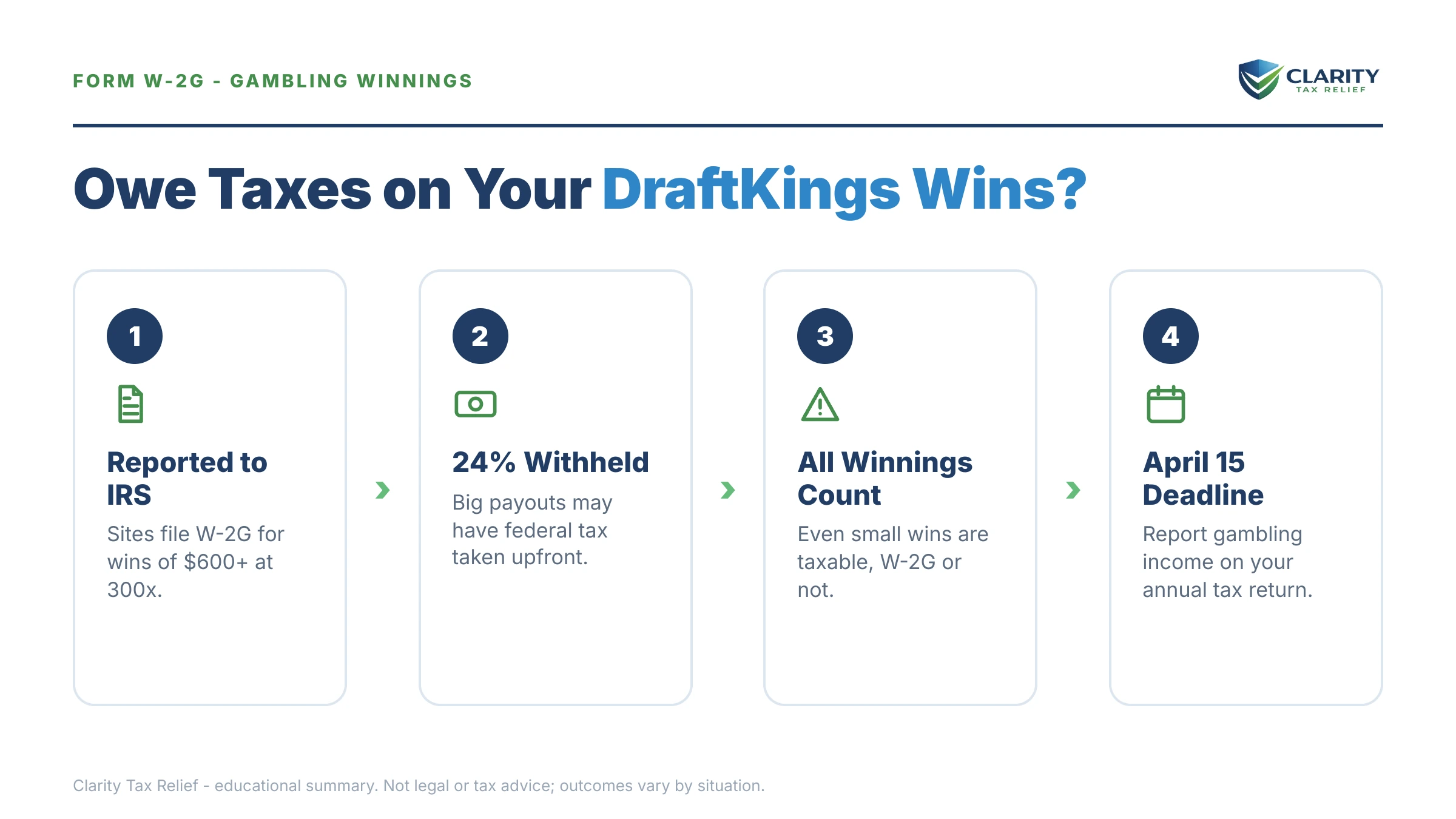
Rarely. The federal rule DraftKings follows is the IRS's regular gambling withholding: "Withhold at the 24% rate if the winnings minus the wager are more than $5,000" and, for "sports wagering and other wagering transactions, if the winnings are at least 300 times the amount wagered." The withholding is figured on the whole payout minus the wager, not just the part above $5,000. It shows in box 4 of your W-2G. A $20 parlay that pays $7,000 meets both tests; a $500 favorite that pays $5,900 meets neither. A profitable season made of ordinary-sized wins therefore arrives with zero tax paid in, and the entire liability lands at filing time. If you are winning consistently, the IRS's own advice in Topic 419 is that "you may be required to pay an estimated tax on that additional income."
Two other withholding lines you may see. Backup withholding, also 24%, applies when a reportable win is paid and DraftKings does not have a correct taxpayer identification number on file, which is why the app insists on your Social Security number before a large payout. And a "withholding reversal" in your transaction history is money coming back to your account: withholding that was applied to a payout and then reversed, typically because the wager was voided or settled differently, or because the withholding was applied in error. Whatever the reason, the number that matters at tax time is the total in box 4 of the W-2G, which nets the reversal out. Check that it matches your account history before you file.
Which DraftKings tax form you get, and when
DraftKings issues its tax documents through the account's tax document center rather than by mail. The IRS deadline for furnishing W-2G and 1099-MISC copies to recipients is January 31. If you played daily fantasy and finished the year with net winnings of $600 or more, expect a 1099-MISC showing the figure as other income. If a sportsbook or casino win met the W-2G tests, expect a W-2G for each qualifying win, with any withholding in box 4. If you never crossed a threshold, you get no form at all, and the absence of a form changes nothing about what you owe. The IRS copy of every form lands on your wage and income transcript, which is the fastest way to see exactly what was reported under your Social Security number before you file.
Do you pay taxes on DraftKings if you don't withdraw?
Yes. Winnings are income when they are credited to your account, not when you move them to your bank. Leaving a balance in DraftKings does not defer the tax, and the forms DraftKings files are built from your account activity, not your withdrawals. The same logic runs the other way: money you deposit and lose is not "spent" for tax purposes either. It is a gambling loss, which is deductible only under the rules below.
The DraftKings win/loss statement, and which losses you can deduct
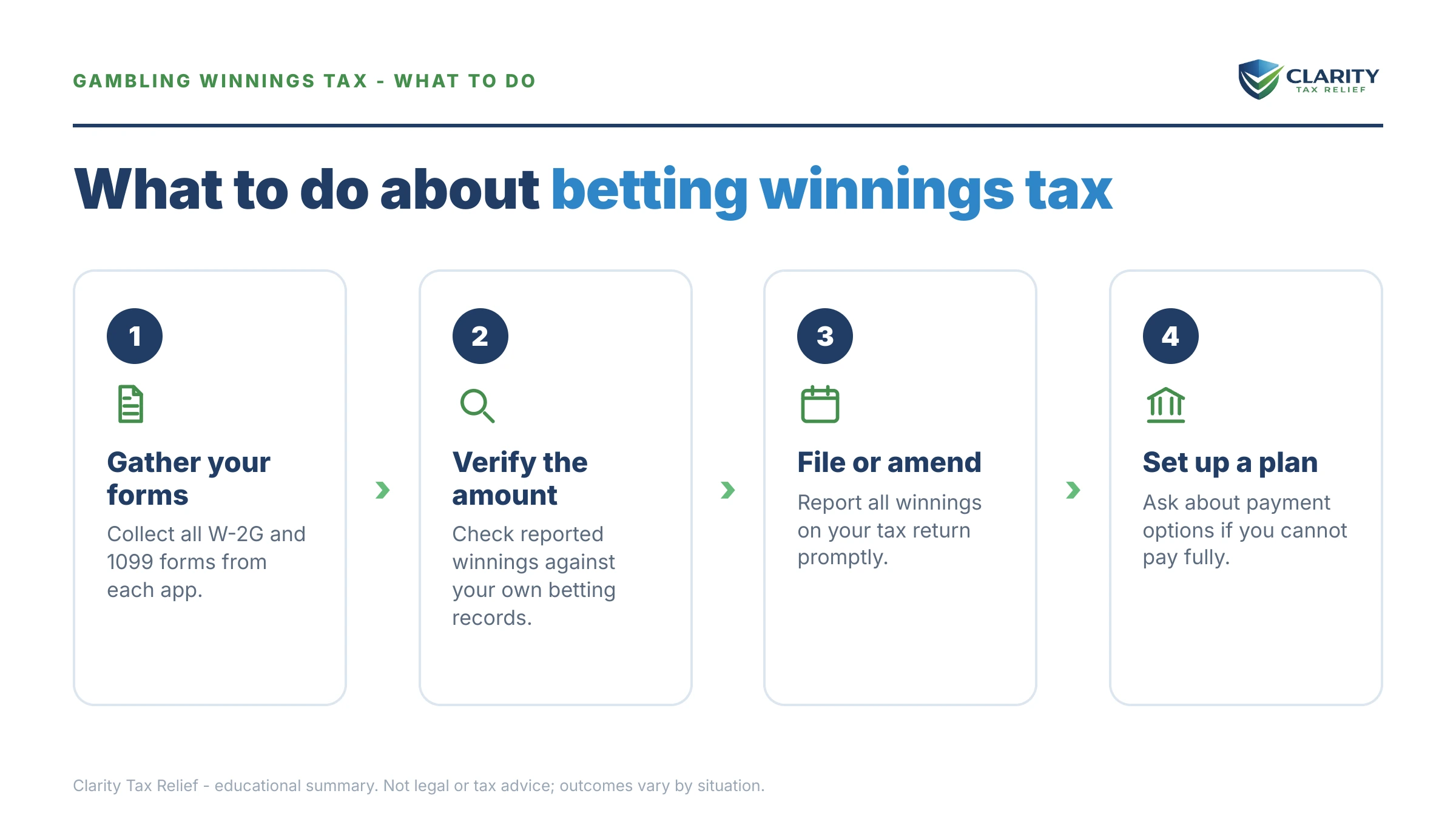
The IRS rule is short: "You may deduct gambling losses only if you itemize your deductions on Schedule A (Form 1040) and kept a record of your winnings and losses. The amount of losses you deduct can't be more than the amount of gambling income you reported on your return." Starting with 2026 returns, a further limit from the One Big Beautiful Bill Act caps the deduction at 90% of losses, so even a bettor who broke exactly even in 2026 can owe some tax on the winning side of the ledger.
The itemizing requirement is the part that stings most W-2 filers. If you take the standard deduction, as most single employees do, your losses produce no tax benefit and you pay tax on the reported winnings even in a net losing year. Whether itemizing beats your standard deduction is a math problem worth running before you agree to any IRS number. The DraftKings win/loss statement, available in the same tax document center as your forms, is the record the IRS's recordkeeping rule asks for: "an accurate diary or similar record of your gambling winnings and losses" backed by "receipts, tickets, statements, or other records." Keep it with your deposit and withdrawal history and bank records, and never net your results on the return itself.
For a bill that already exists, losses are still a live weapon: a CP2000 that taxes gross DraftKings winnings can often be reduced by responding with the win/loss statement and itemized figures instead of just signing the consent. How that works against an already-assessed year is covered in deducting gambling losses against back taxes.
DraftKings tax calculator: what a winning year costs, worked through
There is no special gambling rate; winnings are added to your other income and taxed at your marginal bracket. Say you are a single W-2 employee earning $72,000, which puts your last dollars in the 22% federal bracket, and DraftKings reported $42,000 in winnings under your Social Security number across W-2G and 1099-MISC forms. Reported on time, the federal tax is roughly $42,000 × 22% = $9,240, before any state tax and before losses if you itemize. Left off the return, the same figure comes back eighteen months later on a CP2000 proposing $9,240 of tax plus a 20% accuracy-related penalty of $1,848 and about $212 of interest, roughly $11,300, with the interest growing daily. Everything above $9,240 is delay. Our Penalty & Interest Calculator estimates what waiting another six months adds, and if you kept records showing real losses, the $42,000 itself may be attackable, because the IRS's opening number taxes gross winnings with no losses considered.
Does DraftKings report to the IRS?
Yes, above the thresholds in the table, and that reporting is why "I didn't know" does not stop the bill. The IRS's underreporter system compares every W-2G and 1099 filed under your Social Security number against the income on your return. When a DraftKings form exists and the income does not appear, a computer flags the mismatch and a CP2000 notice follows, commonly a year or more after the return, proposing tax on the gross winnings with a 20% accuracy-related penalty attached. No response to that turns it into a Notice of Deficiency, then an assessment, then the collection sequence that ends with a levy. The IRS knows where you bank because that is where your DraftKings withdrawals landed.
NJ DraftKings tax, and other states
New Jersey taxes gambling winnings under its Gross Income Tax, including "online and in-person sports betting," and its Division of Taxation says "New Jersey Income Tax is withheld at an amount equal to 3% of the payout for both New Jersey residents and nonresidents." That 3% shows on your DraftKings paperwork as state withholding and is a credit on your NJ return, not the whole bill. New Jersey does let you offset winnings with losses from the same year up to the amount of winnings, with a supporting statement of totals. But a net loss cannot be reported as a negative. Winnings from a New Jersey location are taxable to nonresidents too. Other states vary from no income tax at all to full taxation with no loss offset, so check your own state's rule before assuming the federal answer carries over.
Holding a CP2000 or IRS bill for your DraftKings winnings?
Send us a photo of it before the response date printed on it passes. An experienced tax professional will check whether the IRS's number is even right, since many gambling CP2000s tax gross winnings that documented losses can reduce, and map your cheapest way out. Free and confidential.
What to do if you owe taxes on DraftKings winnings and can't pay
File first, even if you cannot pay, because an unfiled year disqualifies you from every payment program and adds a failure-to-file penalty on top. Then pick the path that fits the balance. A short-term plan gives you up to 180 days with no setup fee. A monthly installment agreement on a balance of $50,000 or less can be set up online for up to 72 months with no financial disclosure. On the $11,300 example that is about $157 a month at the floor, or about $330 a month to be done in three years with far less interest. Currently Not Collectible status pauses collection if paying anything would leave you unable to cover basic living costs, while the debt and interest remain. An Offer in Compromise is means-tested. A steady W-2 salary with years left on the collection statute usually means the IRS calculates it can collect in full. Once the tax is arranged, ask for first-time penalty abatement if your prior three years are clean. The accuracy-related penalty on a CP2000 is contested separately on reasonable cause. The full self-help playbook is in how to settle tax debt yourself, and if gambling is your livelihood rather than a side pursuit, the whole picture changes to Schedule C and self-employment tax.
When you can handle this yourself
Most single-year DraftKings tax bills under about $25,000 are a do-it-yourself project. If the IRS's winnings figure matches your DraftKings records, you took the standard deduction anyway. Your only problem is cash flow, you can set up a payment plan online in under an hour at the IRS payment plans page and request first-time abatement with a phone call. Experienced help changes the outcome in four situations: a CP2000 taxing gross winnings when you have documentable losses that could cut the bill by thousands. Multiple years of unreported activity, since each year is a separate matching cycle that surfaces one at a time. A case that has already reached CP504 or LT11, where appeal deadlines control everything. And betting heavy enough that professional-gambler treatment is on the table. Owing for last year is never a reason to skip filing this year. Our guide on whether you should file taxes if you owe back taxes explains why filing always comes first.
Terms on your DraftKings paperwork, decoded
- Form W-2G: the form gambling operators file for certain wins; box 1 is the gross winnings and box 4 is federal tax withheld. The IRS receives its copy the moment you do.
- Form 1099-MISC: how DraftKings reports $600 or more in net daily fantasy winnings, shown as other income.
- Win/loss statement: DraftKings' year-end summary of your activity; the record the IRS expects behind any loss deduction.
- CP2000: the automated underreporter notice proposing extra tax when forms filed under your Social Security number do not match your return.
DraftKings tax questions, answered
How much can you win on DraftKings without paying taxes?
No amount is tax-free. The IRS says you must report all gambling winnings, including winnings that are not reported on a Form W-2G. The $600 figure is when DraftKings files a 1099-MISC for daily fantasy net winnings, and the $5,000 figure is when 24% federal withholding kicks in on long-odds sports wins. Both are reporting and withholding thresholds, not the point where tax begins.
Does DraftKings automatically take out taxes?
Only in narrow cases. Under the IRS's W-2G rules, 24% federal withholding applies when a sports wager's winnings minus the wager exceed $5,000 and the winnings are at least 300 times the wager. Most wins never meet both tests, so most DraftKings customers have nothing withheld all year. New Jersey separately withholds 3% of payouts on gambling winnings.
What tax form does DraftKings send?
A Form 1099-MISC for daily fantasy net winnings of $600 or more. A Form W-2G for each sportsbook or casino win that meets the IRS reporting tests, with any withholding in box 4. Forms are posted in the account's tax document center, and the IRS deadline for furnishing them is January 31. Wins that never cross a threshold produce no form and are still taxable.
What is a DraftKings tax withholding reversal?
A transaction line showing previously withheld tax being returned to your account, typically because the wager that triggered the withholding was voided or settled differently, or because the withholding was applied in error. The figure that counts at tax time is the total in box 4 of your W-2G, which reflects the reversal. Confirm it matches your transaction history before you file.
When do you have to pay taxes on DraftKings winnings?
With your federal return for the year you won, due in April, on Schedule 1 as gambling income. If the winnings are large and nothing was withheld, the IRS notes that you may be required to make estimated tax payments during the year to avoid an underpayment penalty. Tax is owed for the year the winnings are credited, whether or not you withdrew them.
Do you pay taxes on DraftKings if you don't withdraw?
Yes. Winnings are income when they are credited to your DraftKings account, not when you move them to your bank. Leaving the balance in the app does not defer the tax, and the forms DraftKings files are built from account activity rather than withdrawals.
Does DraftKings report to the IRS?
Yes, above the reporting thresholds: daily fantasy net winnings of $600 or more on a 1099-MISC, and sportsbook or casino wins that meet the W-2G tests. The IRS matches those forms against your return automatically. A form with no matching income on the return usually produces a CP2000 underreporter notice a year or more after you filed.
Where do I get my DraftKings win/loss statement?
In your DraftKings account's tax document center, alongside any W-2G or 1099-MISC. Download it with your deposit and withdrawal history. Together they are the record the IRS asks for before it allows a loss deduction. They are what you send with a CP2000 response when the IRS has taxed gross winnings without losses.
Does New Jersey tax DraftKings winnings?
Yes. New Jersey's Gross Income Tax covers online and in-person sports betting and casino winnings. The state withholds 3% of the payout for residents and nonresidents alike. Losses from the same year can offset winnings up to the amount won, with a supporting statement. But a net loss cannot be reported as a negative on the New Jersey return.
What if I can't pay the tax on my DraftKings winnings?
File the return anyway, then use the IRS's online plans: up to 180 days with no setup fee, or a monthly installment agreement of up to 72 months for balances of $50,000 or less. Hardship status and an Offer in Compromise exist but are means-tested. A steady W-2 paycheck usually points to a payment plan plus penalty relief instead. If a CP2000 is involved, respond by its printed date before agreeing to any amount.
Your next 24 hours
- Find the controlling number. If you have an IRS notice, locate the response date and the winnings amount the IRS is using. If you do not, log into DraftKings and download every tax document and the year-end win/loss statement.
- Gather three things: last year's tax return, your DraftKings forms and statements, and your deposit and withdrawal history. That is everything needed to check the IRS's math and price your options.
- Get a free case review. Call (888) 825-7779 or use the 2-minute form. Interest and the monthly late-pay penalty are accruing on any balance right now, and if a notice deadline is printed on your letter, every option is cheaper on this side of it.
Primary sources: the IRS's Topic 419, Gambling income and losses, the Instructions for Forms W-2G and 5754. The New Jersey Division of Taxation's Lottery and Gambling Winnings page.
This guide is general information, not tax or legal advice for your specific situation. Eligibility for IRS programs depends on individual facts and circumstances; no outcome is guaranteed.