
Business Tax Debt
Payroll Tax Debt When the Business Closed: What You Still Owe (2026)
The short answer: payroll tax debt does not go away when a business closed. The trust-fund portion — income tax and the employee half of Social Security and Medicare withheld from paychecks — can be assessed against you personally through the Trust Fund Recovery Penalty. The employer's share and most penalties usually stay with a dissolved corporation or LLC.
The doors are locked, the EIN is retired, maybe the state already accepted your articles of dissolution, and the IRS mail keeps coming. Some of it is addressed to a company that no longer exists. The letter that matters is the one that will eventually be addressed to you. The good news: only part of that payroll tax debt from the business that closed can legally follow you home, the rest usually can't, and knowing which is which is the whole game.
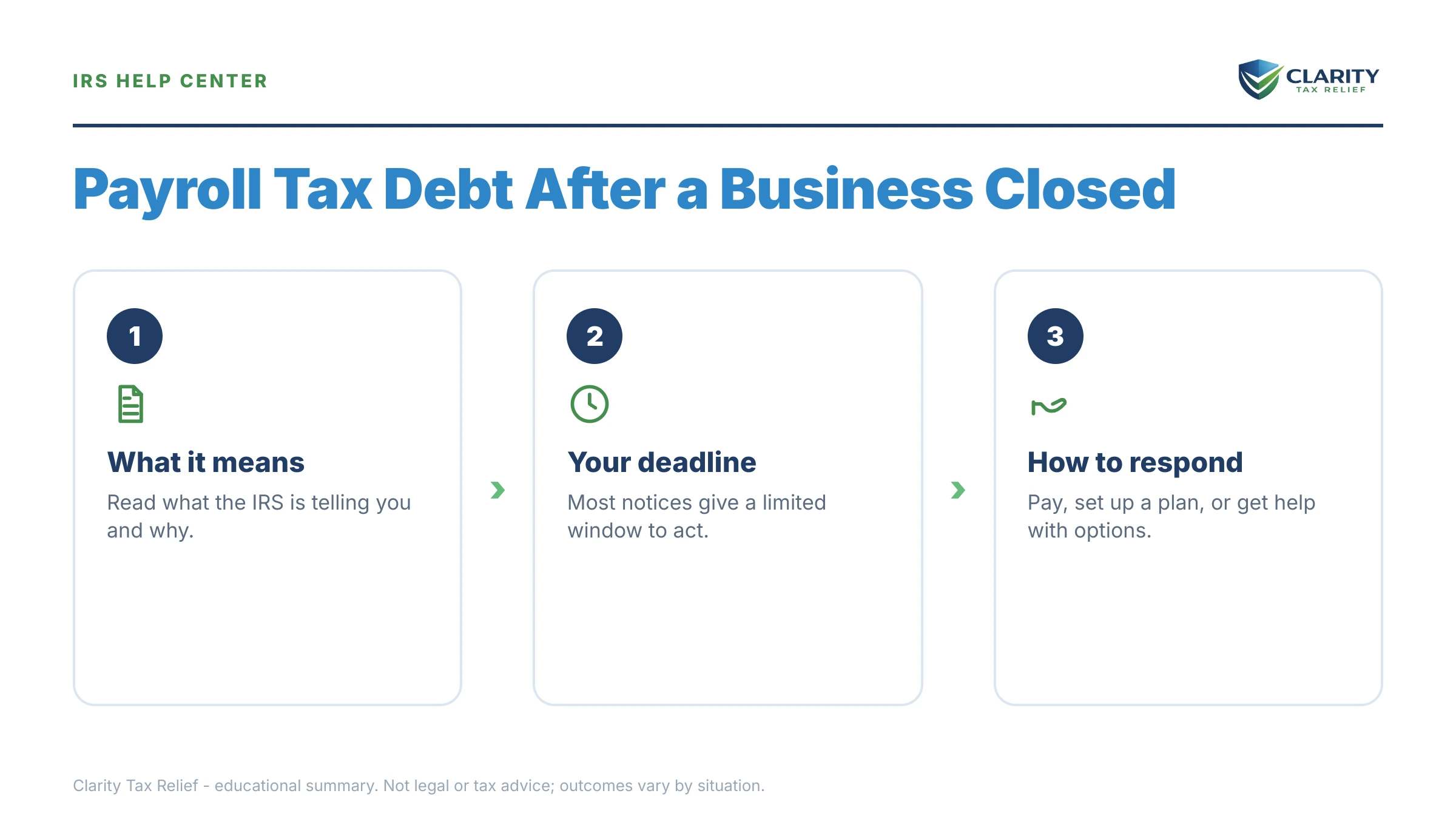
⏱ Your deadline: if you've received Letter 1153 proposing the Trust Fund Recovery Penalty, you have 60 days from the date on it to protest before the debt is assessed against you personally. If no Letter 1153 has arrived yet, the clock that's running is interest. It accrues on the full balance every month the debt sits unresolved.
Why payroll tax debt survives a closed business
Dissolving a corporation or LLC ends the business. It does not end the trust-fund portion of its payroll tax debt. When you ran payroll, you withheld federal income tax and the employee half of Social Security and Medicare from every paycheck. That money was never the company's; you held it in trust for the government. Under IRC §6672, the IRS can assess 100% of that withheld money against any "responsible person" who willfully failed to pay it over. This is the trust fund recovery penalty, and no corporate or LLC shield blocks it.
"Responsible" and "willful" are lower bars than they sound. If you could sign checks or decide which creditors got paid, you're likely responsible. If you paid rent, suppliers, or wages while knowing the 941 deposits were behind, that's willfulness — no bad intent required. Whether you're actually personally liable for payroll taxes depends on what you controlled, not your title.
The flip side: the rest of the debt usually does not follow you. Here's the breakdown for a closed corporation or LLC:
| Component of the 941/940 debt | Collectible from you personally? | Why |
|---|---|---|
| Federal income tax withheld from employees | Yes — via the TFRP | Trust-fund money held for the government; §6672 pierces the entity |
| Employee half of Social Security & Medicare | Yes — via the TFRP | Also withheld from paychecks, so also trust-fund money |
| Employer half of Social Security & Medicare | Generally no (corp/LLC) | Entity-level liability; typically dies with the dissolved entity |
| FUTA (Form 940) tax | Generally no (corp/LLC) | Employer-only tax, not withheld from anyone |
| Failure-to-deposit penalties & interest on the entity | Generally no (corp/LLC) | Assessed to the EIN, though interest accrues fresh on the TFRP once it posts to you |
Two important exceptions. If you operated as a sole proprietor, there is no entity to absorb anything — the entire balance, employer share and penalties included, is already yours. The sole proprietor payroll tax debt guide covers that path. And if you pulled cash or assets out of the company during the wind-down while the taxes went unpaid, the IRS can pursue those transfers separately — the order you shut things down in matters, which is why the dissolve business owe IRS sequence exists.
A worked example: $76,400 from a closed S corporation
Say you and your spouse file jointly, and your S corporation shut down last year owing $76,400 across four quarters of Form 941. The transcript breaks it down like this (hypothetical numbers):
- Federal income tax withheld from employees: $34,100
- Employee half of Social Security/Medicare: $10,700
- Employer half of Social Security/Medicare: $10,700
- Failure-to-deposit penalties and accrued interest: $20,900
The trust-fund portion is $34,100 + $10,700 = $44,800. If you signed the checks and your spouse never touched payroll, the IRS can propose a $44,800 TFRP against you alone, not against your spouse, and not the full $76,400. The remaining $31,600 stays with the dissolved corporation, where it is usually uncollectible. Your real problem just shrank by 41%, but the $44,800 that remains is now a personal debt the IRS will pursue like any other, against your wages, accounts, and home equity.
What happens if you ignore it: the escalation sequence
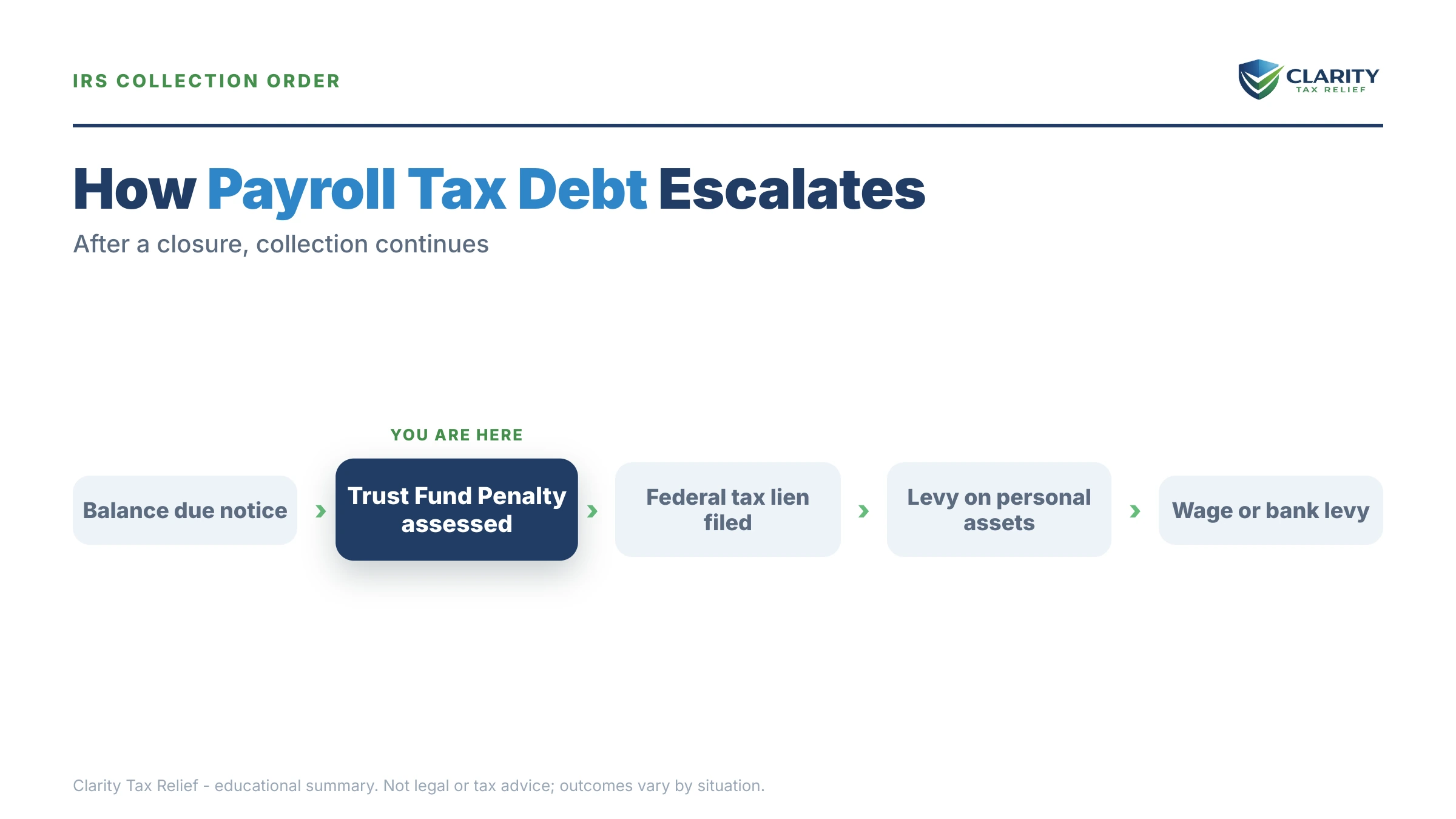
The IRS does not forget a payroll debt because the business that owed it closed. It re-routes the trust-fund portion to the people behind it. The sequence runs in a predictable order:
- Balance-due notices to the dead entity. Automated bills keep going to the business address and EIN. Ignoring these feels safe, the company has no assets, but each one moves the file closer to a human.
- The TFRP investigation. A revenue officer identifies everyone who could have controlled the money and requests Form 4180 interviews — owners, officers, bookkeepers, anyone with signature authority. What you say in that interview becomes the permanent record.
- Letter 1153 — the proposed assessment. This is the formal notice that the IRS intends to assess the trust-fund portion against you personally. You have 60 days to protest through Appeals. Miss it, and the assessment posts.
- Personal assessment. The TFRP appears on your individual account with its own fresh 10-year collection clock, often years after the quarters in question.
- Personal enforcement. From here it runs like any individual tax debt: a federal tax lien can hit your home, your wages can be levied continuously, a bank levy freezes funds for 21 days before they're sent, and every tax refund is offset until the balance is gone.
One 2026 reality worth naming: IRS staffing fell roughly 27% in 2025, so reaching a human is harder than ever. But the notice stream, lien filings, and levies are automated and never paused. Waiting for the system to lose your file is not a strategy.
The business is gone: don't let its payroll debt become yours by default
Before the IRS decides who was "responsible," get your closed-business 941 debt reviewed free. If you're holding Letter 1153, the 60-day protest window is already running — an experienced tax professional can tell you exactly what's collectible from you and what isn't.
Your options for payroll tax debt after the business closed
Once the trust-fund portion is assessed against you personally, every individual resolution program is on the table, because it is now an individual debt. The general playbook for resolving a balance on your own lives in our guide to how to settle tax debt yourself. Here's how each option applies to a TFRP from a closed business:
| Option | Who typically qualifies | Cost | Typical timeline |
|---|---|---|---|
| Protest / Appeals (before assessment) | Anyone who received Letter 1153 and disputes being responsible or willful | $0 IRS fee | Must file within 60 days; Appeals review takes months |
| Short-term payment plan | Assessed balance you can pay within 180 days | $0 setup; interest continues | Up to 180 days |
| Streamlined installment agreement | Assessed personal balance of $50,000 or less | Setup fee (reduced with direct debit or low income); interest continues | Up to 72 months, set up online |
| Currently Not Collectible | Paying anything would leave you unable to cover basic living expenses | $0; interest continues, lien likely | Until finances improve; reviewed periodically |
| Offer in Compromise | Income and assets genuinely can't cover the debt before the collection statute runs | $205 fee + 20% down on lump-sum offers (both waived if AGI ≤ 250% of poverty) | Months to 2 years; auto-accepted if the IRS doesn't decide within 2 years |
A few TFRP-specific wrinkles. First, designated payments: if any money is voluntarily paid toward the business's old 941 debt — by you, a co-owner, or from leftover business funds — designate it in writing to the trust-fund portion of the oldest quarter. Undesignated payments get applied where the IRS chooses, which is usually the entity-only balance that can't hurt you anyway. Second, penalty relief works differently here: the TFRP itself is a penalty, so first-time abatement doesn't apply to it. But a reasonable-cause challenge is possible — see trust fund penalty abatement. Third, an offer on this kind of debt has its own strict math and history requirements, covered in business offer in compromise payroll.
And the debt is not forever. Each TFRP assessment carries a 10-year Collection Statute Expiration Date, paused by appeals, a pending offer, or bankruptcy. If your closed business's quarters were assessed years ago, part of the answer may simply be knowing when each clock runs out. You can estimate yours with our CSED Calculator.
Back to the worked example: with $44,800 assessed against you, you're under the $50,000 streamlined ceiling. A 72-month online agreement runs roughly $623 per month ($44,800 ÷ 72) plus accruing interest — no financial disclosure package required. If your household budget genuinely can't support that, Currently Not Collectible or an offer becomes the conversation, and both are decided on documented income and expenses, not on how the business ended.
Don't forget the state side
States run their own trust-fund liability rules, and closing the business doesn't stop them either. If the company withheld state income tax or collected sales tax, most states can assess responsible individuals under their own statutes — California's EDD is especially aggressive, covered in California EDD payroll tax. Sales tax collected from customers is trust-fund money too; if that's part of your wind-down, see closed business owe sales tax. Never assume an IRS threshold or timeline applies to a state agency — each has its own statutes and windows, so verify directly with the agency named on the state notice.
How to respond, step by step
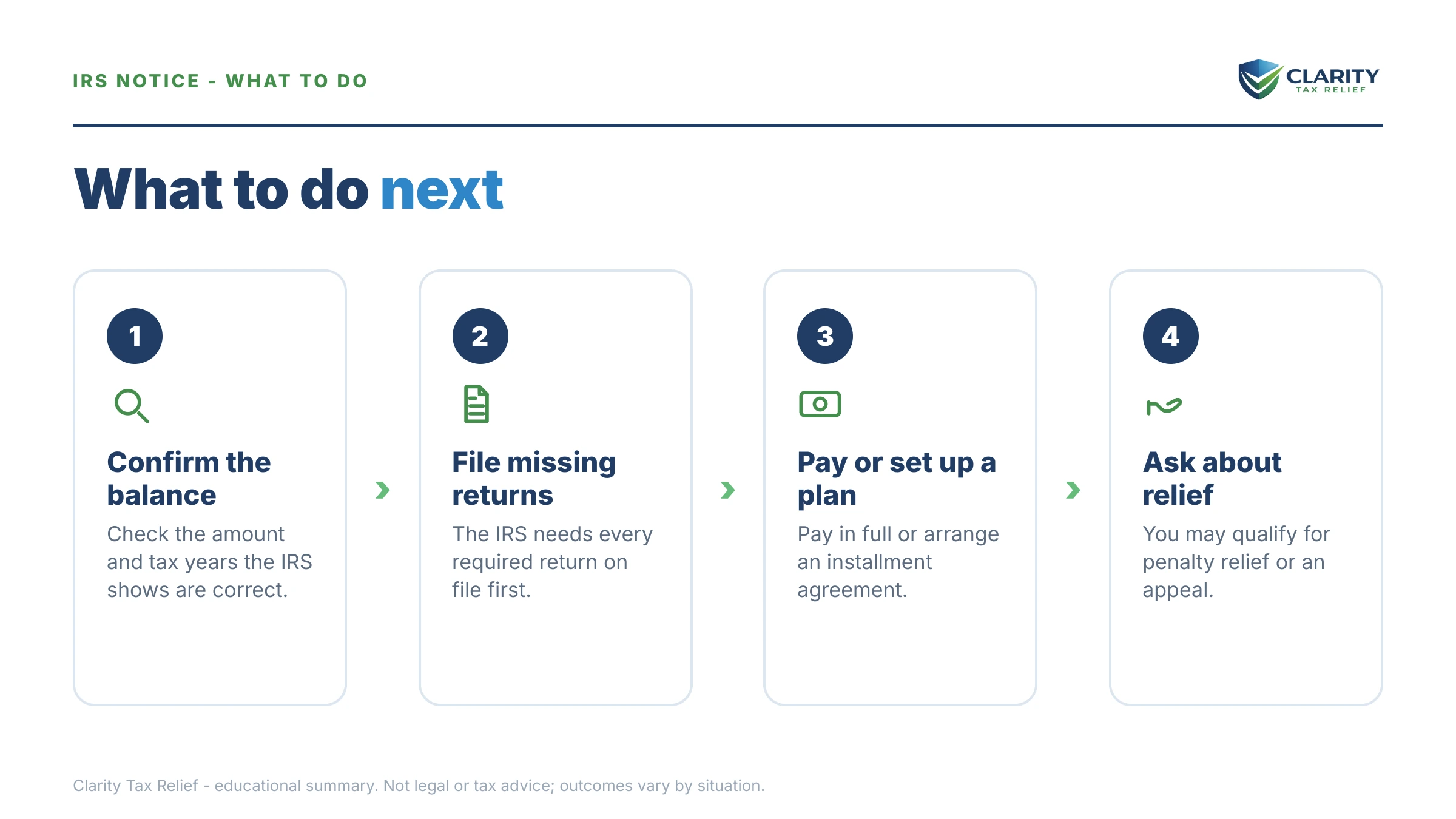
- Pull the account transcripts. Request account transcripts for the business EIN and for your own SSN so you can see what was assessed, which quarters are unpaid, and whether the TFRP has already posted against you.
- Map who counts as a responsible person. Before any Form 4180 interview, write down who signed payroll checks, who hired and fired, and who decided which bills got paid. That record is what the IRS's determination turns on.
- Respond to Letter 1153 within 60 days. If you have received the TFRP proposal, file a written protest before the 60-day deadline or you lose your right to an Appeals hearing before the assessment posts.
- Designate any voluntary payments in writing. If any money is paid toward the business debt, designate it to the trust-fund portion of the oldest quarter so every dollar reduces your personal exposure instead of the entity-only balance.
- Choose a resolution path for the personal balance. Once the TFRP is assessed against you, set up a payment plan, request Currently Not Collectible status if paying would be a hardship, or run the Offer in Compromise math.
- Get experienced help if a revenue officer is involved. The 4180 interview and the protest shape the record permanently — an experienced tax professional involved before the interview, not after, changes outcomes.
What this means for your spouse and joint finances
The TFRP is assessed against individuals, not households — a spouse who had no role in the business cannot be made liable for it. But once the assessment posts against one of you, joint life still feels it. A federal tax lien attaches to your interest in jointly owned property, including the house. If you file jointly, your combined refund can be offset to the assessed spouse's balance every year — the non-liable spouse can recover their share with Form 8379, the injured spouse allocation. And if both spouses were officers or check-signers, the IRS can assess 100% against each of you, so sorting out who actually controlled the money before the Form 4180 interviews is not a formality.
When you can handle this yourself
Not every closed-business payroll debt needs professional representation. You can reasonably go it alone when the total trust-fund exposure is small, you agree you were the responsible person. The assessed balance fits a streamlined agreement you can set up online in an afternoon. If no revenue officer has been assigned and no Letter 1153 has arrived, getting current on transcripts and budgeting for the eventual assessment is work you can do yourself.
Experienced help changes outcomes in four situations: a revenue officer has requested a Form 4180 interview (what you say there cannot be unsaid), Letter 1153 has arrived and the 60-day protest clock is running, the IRS is pursuing multiple people and the responsibility question is genuinely disputed, or the numbers only work through an offer — where the trust-fund math is unforgiving and one wrong figure sinks the application. Our buyer's guide to tax relief for small business covers what good representation looks like and what it should cost. If your case fits the first paragraph, save your money. If it fits the second, get help before the interview, not after — a free case review will tell you which one you're in.
Terms on your notices, decoded
- Trust fund taxes: the money withheld from employee paychecks — income tax plus their half of Social Security and Medicare — that the business held "in trust" for the government.
- Trust Fund Recovery Penalty (TFRP): the IRC §6672 assessment that makes responsible individuals personally liable for 100% of the trust-fund portion.
- Responsible person: anyone with the authority to decide which bills got paid — ownership isn't required, and titles don't control.
- Willfulness: paying any other creditor while knowing the payroll taxes were unpaid. No fraud or bad intent needed.
- Letter 1153: the formal proposal to assess the TFRP against you, opening a 60-day window to protest through Appeals.
- CSED: the Collection Statute Expiration Date — 10 years from each assessment, restarted for the TFRP on the day it posts to you personally, and pausable by appeals, offers, and bankruptcy.
Payroll tax debt after closing: your questions, answered
Does payroll tax debt go away when a business closes?
No. Closing or dissolving the business does not erase the debt. The trust-fund portion — income tax and the employee half of Social Security and Medicare withheld from paychecks — can be assessed against you personally through the Trust Fund Recovery Penalty under IRC §6672. Only the employer-side share and most business penalties typically stay behind with a dissolved corporation or LLC.
Am I personally liable for payroll taxes if my LLC or corporation closed?
You are if the IRS determines you were a responsible person who willfully failed to pay the withheld taxes. Titles don't decide this — check-signing authority, control over which bills got paid, and hiring power do. Owners, officers, and even bookkeepers can be assessed, and the LLC or corporate shield does not protect against the Trust Fund Recovery Penalty.
Can my spouse be held liable for my closed business's payroll taxes?
Only if your spouse was independently a responsible person — for example, a co-owner who signed payroll checks or decided which creditors got paid. A spouse who had no role in the business cannot be assessed the TFRP. But if you file jointly, your joint refund can be offset to your assessed balance; Form 8379 (injured spouse) can protect your spouse's share of it.
How long can the IRS collect payroll taxes after a business closes?
Generally 10 years from the date each liability was assessed. The Trust Fund Recovery Penalty gets its own fresh 10-year collection clock starting the day it is assessed against you personally — which can be years after the quarters in question. Appeals, an Offer in Compromise, and bankruptcy pause that clock, so the real expiration date is often later than a simple 10-year count.
Can I settle trust fund payroll tax debt with an Offer in Compromise?
Yes — once the TFRP is assessed against you personally, it can be included in an individual Offer in Compromise. Approval is means-tested on your income, expenses, and assets, not on how sympathetic the story is. The IRS accepted roughly 1 in 5 offers in FY2024. The application costs $205 with a 20% down payment on lump-sum offers, both waived if your AGI is at or below 250% of the poverty level.
What happens if I ignore Letter 1153?
After 60 days, you lose the right to protest the proposed Trust Fund Recovery Penalty through IRS Appeals. The assessment posts to your personal account. From there the IRS can file a lien against your home, levy your wages and bank accounts, and offset your refunds. Fighting the assessment after it posts is possible but far harder and more expensive than protesting on time.
Can the IRS assess the trust fund penalty against more than one person?
Yes. The IRS can assess 100% of the trust-fund portion against every responsible person at the same time — co-owners, officers, and check-signers can each be billed the full amount. The IRS only collects the total once. But it collects from whoever pays first, then the payers are left to sort out contribution among themselves.
Can I start a new business if I still owe payroll taxes from the closed one?
You can, the debt does not legally block a new EIN. But the TFRP follows you personally. A federal tax lien can attach to your interest in the new company. The IRS also watches for owners who close one business and repeat the pattern. Falling behind on the new company's deposits while owing old trust-fund debt invites much harsher enforcement.
Your next 24 hours
- Check who the latest IRS letter is addressed to. A notice to the business EIN means the debt hasn't reached you yet. A Letter 1153 or anything addressed to you personally means the 60-day protest clock, or personal collection — has started.
- Gather the paper trail. The last 941s filed, the dissolution documents, business bank statements showing who signed checks, and every IRS notice — this is what determines how much of the $76,400-style balance is actually yours.
- Get a free case review. Call (888) 825-7779 or use the 2-minute form. An experienced tax professional will separate the trust-fund portion from the part that died with the entity, before the IRS makes that call for you.
For primary-source detail, see the IRS pages on payment plans and installment agreements and making payments to the IRS. If IRS collection action is causing genuine hardship and you can't get traction through normal channels, the Taxpayer Advocate Service is an independent resource within the IRS.
This guide is general information, not tax or legal advice for your specific situation. Eligibility for IRS programs depends on individual facts and circumstances; no outcome is guaranteed.