
IRS Collections
What to Say When Calling the IRS About Back Taxes (2026 Scripts)
The short answer: call the IRS at 800-829-1040 (7 a.m.–7 p.m. local time, weekdays), verify your identity, and ask for your balance by tax year. Then request what you want by its official name — a 180-day short-term plan, an installment agreement, first-time penalty abatement, or currently not collectible status. Answer honestly, but never volunteer extra financial details.
You've had the number pulled up for twenty minutes. The balance is real, the notices keep coming, and the only thing between you and a handled problem is a call you don't know how to start. That's the whole reason this page exists — knowing exactly what to say when calling the IRS about back taxes turns a dreaded conversation into a fifteen-minute transaction.
Here's the part nobody tells you: the agent on the other end handles dozens of these calls a day, and the callers who get good outcomes aren't the smoothest talkers. They're the ones who ask for the right thing, by its official program name, and stop talking after they've asked.
⏱ The only clock here is accrual: the failure-to-pay penalty adds 0.5% of your balance every month, and interest compounds daily on top, until the day an arrangement is in place. There's no printed deadline to beat — only a meter that runs until you make the call.
Which IRS phone number to call about back taxes
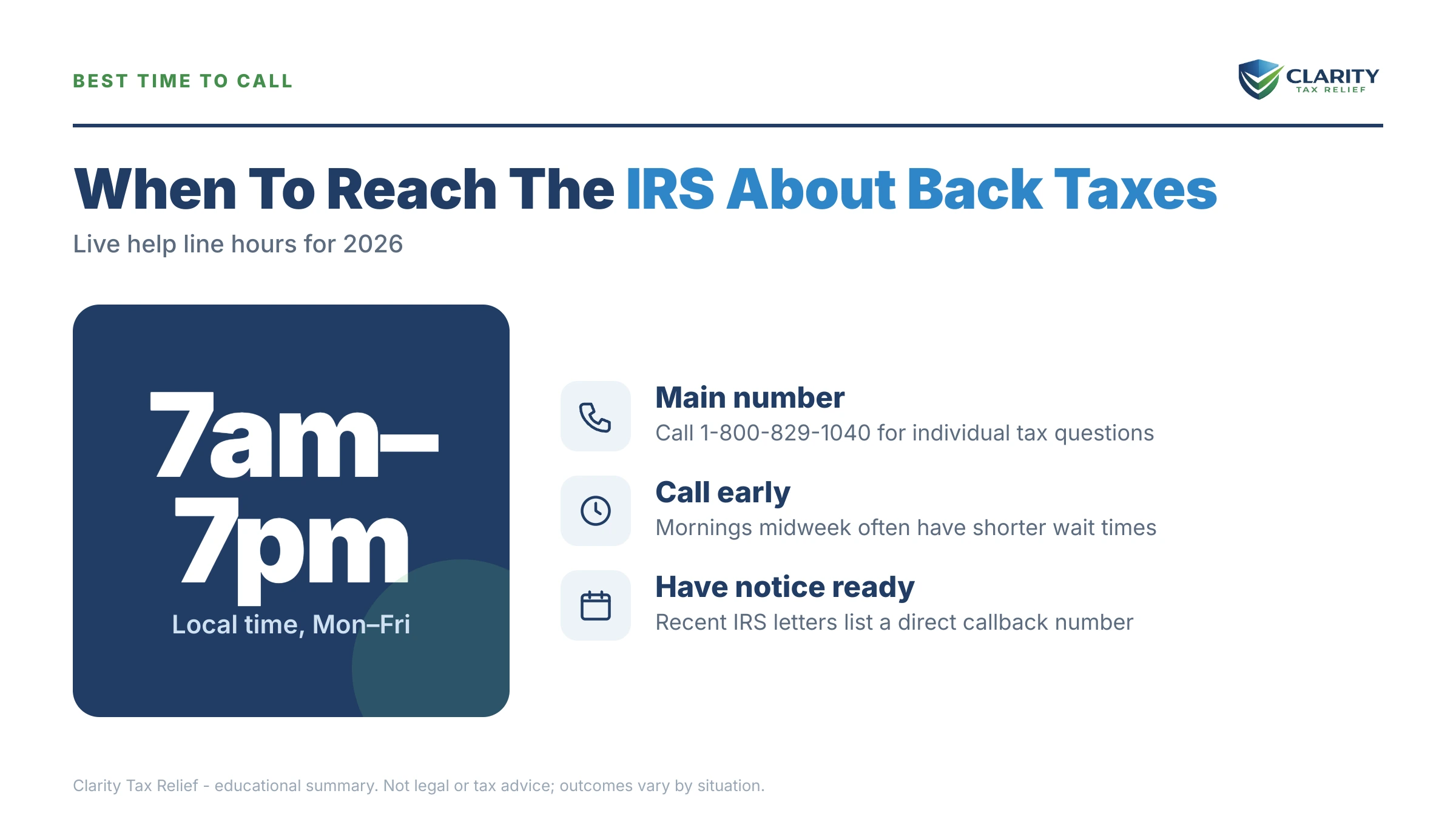
For personal back taxes, the IRS number to call is 800-829-1040, open 7 a.m. to 7 p.m. your local time, Monday through Friday. Businesses use a different line, and if you're holding a notice, the number printed on it is usually the fastest route to the unit that actually owns your case.
| Your situation | Number to call | What to know |
|---|---|---|
| Personal (1040) back taxes | 800-829-1040 | The main individual line; handles balances, payment plans, and penalty requests |
| Business balances (941, 940, 1120) | 800-829-4933 | Payroll and business tax accounts; have your EIN ready |
| You're holding an IRS notice | The number printed on the notice | Routes directly to the unit working your account, often Automated Collection System (ACS) |
| Hardship and normal channels have failed | Taxpayer Advocate Service, 877-777-4778 | An independent unit inside the IRS for cases stuck or causing genuine hardship |
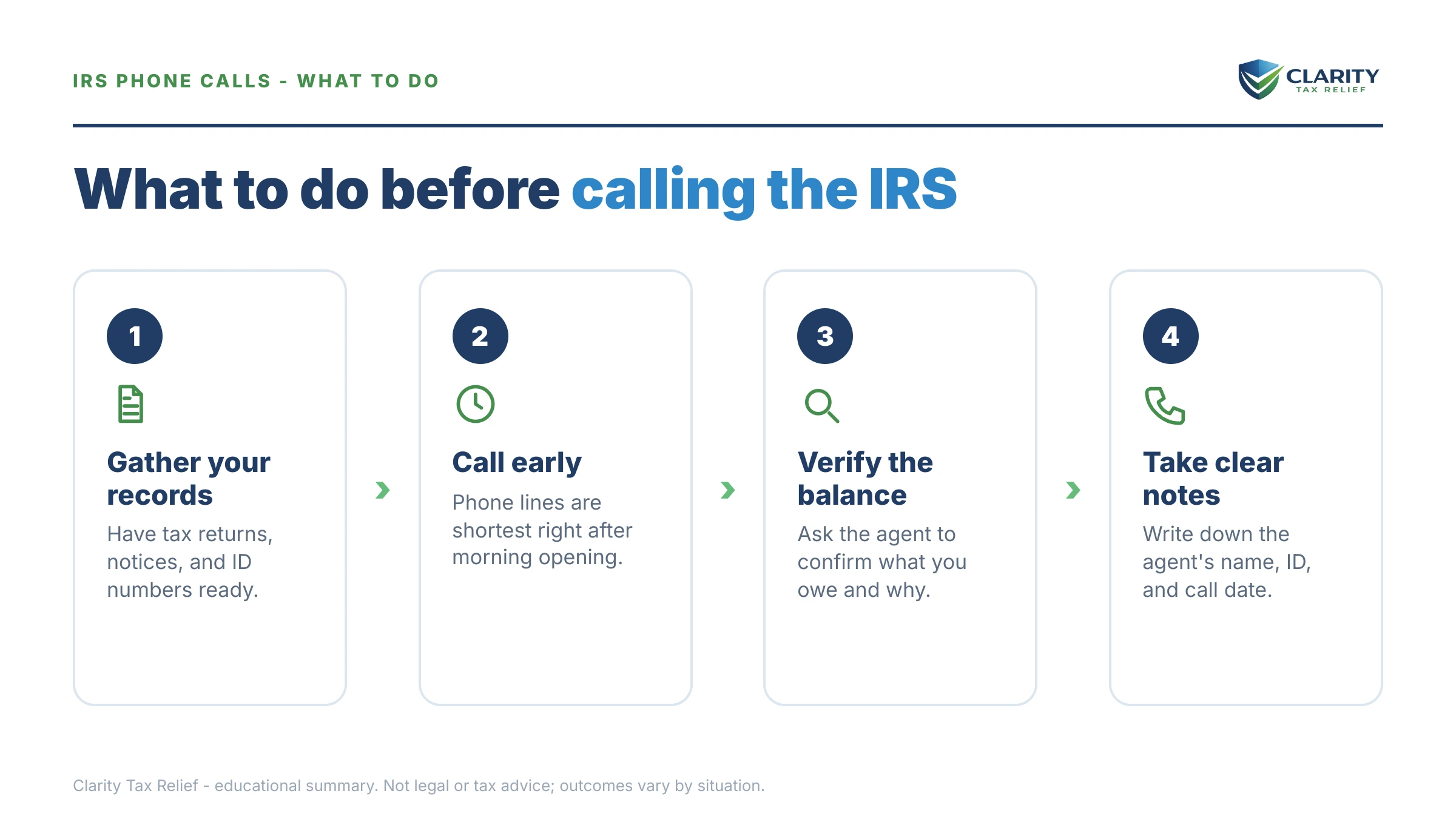
Timing matters more in 2026 than it ever has. The IRS workforce was cut roughly 27% in 2025, and hold times ballooned. But the automated systems that send notices and issue levies kept running at full speed. Call right at 7 a.m. local time, ideally Tuesday through Thursday, and avoid Mondays and the weeks around April 15.
If you keep hitting a wall of hold music and disconnects, there's a whole playbook for when you can't reach the IRS on the phone — including the moves that don't require a call at all.
Before you dial: what to have in front of you
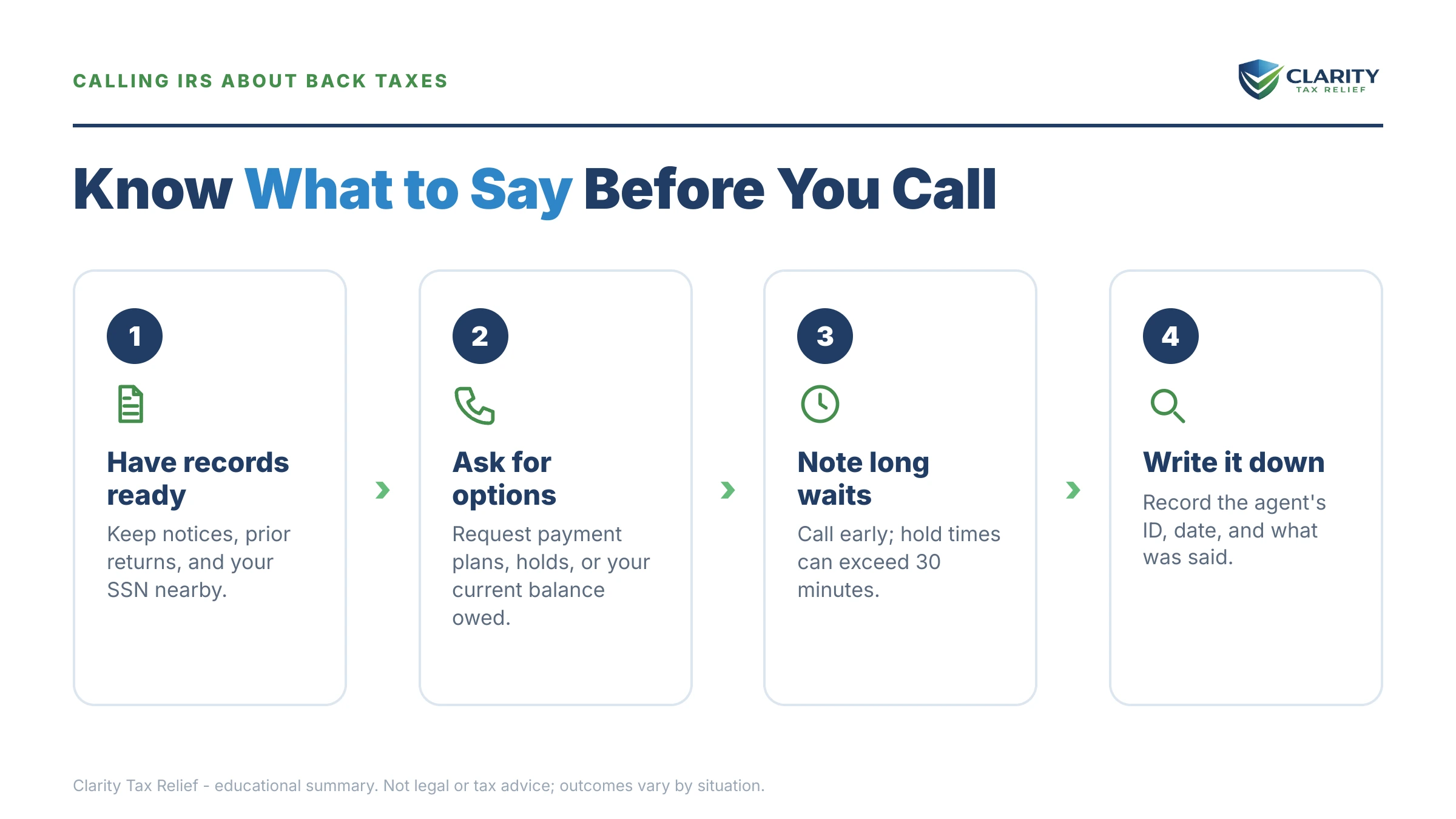
The IRS will not discuss a back-tax balance until you pass identity verification, typically your Social Security number, date of birth, filing status, and figures from your last filed return. Getting bounced at verification wastes the entire hold time, so stage everything before you dial:
- Your last filed tax return — the agent may ask for the adjusted gross income or filing status from it.
- Every IRS notice you've received, with the notice numbers (CP14, CP504, LT11) visible in the corner.
- Your current balance by year. Pull it first through your IRS online account so you're comparing the agent's numbers against your own.
- One monthly payment number your budget can genuinely sustain — decided before the call, not under pressure during it.
- Bank routing and account numbers if you want direct debit (it lowers setup fees and prevents accidental default).
- If you're self-employed: a rough picture of this year's income and whether you've made your 2026 quarterly estimated payments — the agent will ask.
One structural note before the scripts: if your balance is on a joint return, either spouse can call about those years. But if you filed separately, the agent cannot discuss your spouse's account with you at all — only your own.
What to say when calling the IRS about back taxes: the scripts
The single most effective thing to say on an IRS back-tax call is the official name of the resolution you want. Agents work from defined programs with defined thresholds; a caller who names the program skips the fishing expedition and goes straight to eligibility. Open every call the same way:
"Hi, I'm calling about a balance on my individual account for tax year 2024. First I'd like to confirm the total owed for each year, including penalties and interest, and then I'd like to set up a resolution."
That opening does three things: it tells the agent you're cooperative, it forces a year-by-year accounting before you agree to anything. It frames the call as you choosing a program rather than the IRS choosing one for you. From there, use the script that matches your goal.
If you can pay everything within six months
"I'd like a short-term payment plan — the full-pay extension of up to 180 days." There's no setup fee for a short-term plan, active enforcement stops while it runs, and interest plus the 0.5% monthly penalty are the only ongoing cost. This is the cheapest resolution the IRS offers and agents grant it routinely.
If you need monthly payments
"I'd like to set up an installment agreement at [your number] per month, by direct debit." Balances of $50,000 or less generally fit a streamlined agreement of up to 72 months with no financial disclosure. If you're an individual owing $10,000 or less in income tax (not counting penalties and interest), with all returns filed, timely filing and payment for the past 5 years with no installment agreement in that period. A plan that full-pays within three years, you fall under the guaranteed installment agreement rules, the IRS's own program name. The agent essentially cannot say no.
Name your monthly amount first. If you let the agent propose one, they'll often divide the balance by the shortest allowable term, which produces a payment higher than you need to accept.
If you genuinely can't pay anything
"Paying anything right now would leave me unable to cover basic living expenses. I'd like my account reviewed for currently not collectible status." Expect a financial mini-interview on the spot — income, rent, utilities, car payments — essentially a verbal Form 433-F. Know your real monthly numbers before you dial, because Currently Not Collectible status is granted or denied on that math. The debt doesn't disappear in CNC, but levies and demands stop while it's in place.
If you want penalties removed
"I'm requesting first-time penalty abatement for tax year 2024." If your prior three years are clean — no penalties, all returns filed — agents can often grant first-time penalty abatement on the call itself. Use the exact phrase; a vague "can you waive the fees?" gets a vague no. And note the 2026 change: the IRS is rolling out an Automatic Exemption from Penalty (AEP) starting this summer, which applies some relief automatically, so ask the agent whether your account already qualifies before you spend the request.
If you disagree with the amount
"I don't agree with this balance. Can you tell me how it was calculated, and what payments and credits are posted for that year?" Do not argue the merits on this call — the phone agent didn't create the assessment and can't unwind it. Your goal is information: get the breakdown, request your account transcripts, and dispute in writing with documentation. Never agree that a disputed amount is correct just to end the call; that concession gets noted on your account.
If you have unfiled years
"Which years show as unfiled on my account?" Ask this before requesting any plan, because the IRS requires filing compliance before it approves most resolutions — the agent will check. An agreement request with open years gets stalled. Get the exact list of missing years, then see how many years of back taxes you have to file before calling back — it's usually fewer than people fear.
If the debt is business or payroll tax
Slow down here. On 941 payroll balances, casual answers about who signed checks, approved payments, or ran the books feed directly into the IRS's Trust Fund Recovery Penalty analysis — the process that turns a company's payroll debt into your personal debt. Confirm the balance, ask what notices are pending, and say nothing about roles and duties until you've read how liability works when an LLC owes IRS back taxes, or better, until a professional makes that call for you.
The phrases that help, and the ones that hurt
IRS calls are recorded and the agent takes account notes that follow your case. You must be truthful, never lie to a federal employee, but truthful and volunteering are different things. This table is the difference:
| Say this | Not this |
|---|---|
| "I'd like to set up an installment agreement for tax year 2024 at $200 per month." | "I'll never be able to pay this." (Invites a full financial interview you didn't prepare for.) |
| "I'm requesting first-time penalty abatement." | "Can you give me a break on the fees?" (No program name, no result.) |
| "What's the balance for each year, split into tax, penalties, and interest?" | "I think I owe around nine grand?" (Let their records do the talking; never guess on the record.) |
| "I need to review that with my tax professional before I agree." | "Fine, whatever amount you say." (Agreements made under pressure default, and defaults restart enforcement.) |
| "Please note on the account that I called today and requested a resolution." | Unprompted details about your bank, your clients, or your assets. (Answer what's asked; stop there.) |
| "Which years show as unfiled?" | A long explanation of why you didn't file. (Reasons volunteered on a recorded line rarely help and sometimes hurt.) |
One more scope note: everything you arrange on this call binds only the IRS. If you also owe your state, that's a separate agency, separate balance, and separate phone call — an IRS plan does nothing to stop state collection.
What happens if you keep putting the call off
An unaddressed back-tax balance moves through the IRS's automated notice stream from a bill to a levy without a human ever reviewing your file. The sequence is fixed, and every stage you wait through costs you leverage:
- CP14 — the first bill. Typically about 21 days to pay before the system queues the next notice. Cheapest moment to call.
- CP501 / CP503 — reminders. Still just bills, but the 0.5% monthly penalty and daily interest are compounding the whole time.
- CP504 — intent to levy your state refund. The IRS can now seize state tax refunds. A federal tax lien becomes a live possibility.
- LT11 / Letter 1058 — final notice of intent to levy. A 30-day clock starts, along with your Collection Due Process rights (requested on Form 12153). After it runs, wage and bank levies are on the table.
- Levy stage. A bank levy freezes funds for 21 days before they're sent to the Treasury. A wage levy is continuous until released; Social Security can be reduced by up to 15% through the Federal Payment Levy Program.
Along the way, every refund you're ever due gets swept — see will the IRS take my refund for back taxes — and balances that grow past $66,000 (the 2026 threshold) can trigger passport certification. One phone call, made at any stage before the levy lands, stops most of this sequence cold.
Dreading the call?
You don't have to make it alone, or at all. An experienced tax professional can review your back-tax balance free, tell you exactly which program to request, or make the call for you under power of attorney while penalties and interest are still small.
What you can ask for on the call: options and thresholds
Phone agents can approve payment plans, hardship status, and first-time penalty relief on the spot, but not everything is a phone product, and each program has its own threshold. Here's the full menu, so you know which name to say:
| What to ask for | Who generally qualifies | Cost & what to know |
|---|---|---|
| Short-term payment plan (180 days) | Anyone who can full-pay within about six months | $0 setup fee; interest and the 0.5%/month penalty continue until paid |
| Guaranteed installment agreement | Individuals only; owe $10,000 or less in income tax (excluding penalties and interest), all returns filed, timely filing and payment for the past 5 years with no installment agreement in that period, full-pay within 3 years | The IRS must accept if criteria are met; setup fee applies (lower with direct debit) |
| Streamlined installment agreement | Owe $25,000 or less, or up to $50,000 with direct debit; up to 72 months | No detailed financial disclosure required; often cheaper to set up online than by phone |
| Currently Not Collectible status | Paying would prevent covering basic living expenses | Free; requires a financial interview (Form 433-F style); debt and accrual continue but levies stop |
| First-time penalty abatement | Clean compliance for the prior 3 years | Free; often granted on the call — being replaced by automatic AEP relief starting summer 2026 |
| Offer in Compromise | Assets and income genuinely can't cover the debt before the collection statute runs | Not a phone product — filed on Form 656 with a $205 fee and 20% down (both waived with low-income certification); roughly 1 in 5 offers were accepted in FY2024 |
Two honest caveats before you pick. First, every payment plan keeps accruing interest and the monthly late-payment penalty — see how the IRS interest rate on back taxes in 2026 compounds, because it changes the real cost of a long plan. Second, no agent on this line can "settle" your debt on the phone, and anyone who promises otherwise before seeing your finances is selling, not advising. The full decision framework lives in our guide to how to settle tax debt yourself.
Worked example: a sole proprietor calling about $8,900
Say you're self-employed and owe $8,900 from last year's Schedule C income — a clearly hypothetical example, but a common shape. Here's the math behind each thing you could say on the call:
- The cost of waiting: the failure-to-pay penalty runs 0.5% × $8,900 ≈ $44.50 every month, plus daily compounding interest on top. Six months of silence adds roughly $267 in penalty alone before interest.
- Short-term plan: $8,900 ÷ 6 months ≈ $1,483/month. Steep, but $0 setup fee and the fastest exit from accrual.
- Guaranteed installment agreement: at $8,900 you're under the $10,000 line, which counts income tax only, not penalties and interest. Full-pay within 3 years means $8,900 ÷ 36 ≈ $248/month, and if all your returns are filed and your past 5 years show timely filing and payment with no installment agreement, the agent essentially must approve it.
- Streamlined over 72 months: $8,900 ÷ 72 ≈ $124/month minimum, but at the minimum, ongoing accrual stretches the real payoff, so paying even $50 above it meaningfully shortens the plan.
- Penalty relief: if your prior three years are clean, one sentence, "I'm requesting first-time penalty abatement", could strip the failure-to-pay penalties already posted.
One trap specific to self-employed callers: the agent will ask whether you're current on this year's estimated taxes. If you're not making 2026 quarterly payments, the plan can be refused, or approved and then defaulted when next April's balance lands on top of it. Fix the quarterlies as part of the same conversation. To see what waiting is actually costing you month by month, run your numbers through our IRS penalty and interest calculator before you pick a plan length.
How to call the IRS about back taxes, step by step
Here's the whole call, compressed into six moves:
- Gather your verification documents — pull your last filed return, Social Security number, filing status, any IRS notices. Your balance from your IRS online account before you dial.
- Call the right line at opening — dial 800-829-1040 (individuals) or 800-829-4933 (businesses) right at 7 a.m. local time, Tuesday through Thursday, to minimize hold time.
- Confirm the balance by tax year — ask the agent for the total owed for each year, broken into tax, penalties, and interest, and confirm every return shows as filed.
- Request your resolution by name — state the specific program you want: a 180-day short-term plan, an installment agreement at a set monthly amount, first-time penalty abatement, or a currently not collectible review.
- Confirm every term before agreeing — repeat back the monthly amount, first due date, setup fee, and payment method, and don't commit to a payment your budget can't sustain.
- Document the call — write down the agent's name and ID number, the date and time, and what was agreed, then watch your mail for the written confirmation.
The official program terms and current fee tiers are on the IRS's own payment plans and installment agreements page — worth skimming before the call so nothing the agent says surprises you.
When you can make this call yourself, and when to send a professional
Most people with a straightforward balance can make this call themselves and get a fine outcome. You don't need help when:
- You agree with the balance, all your returns are filed. You just need a payment plan — in fact, for a simple streamlined agreement, it's often faster and cheaper to set up an IRS payment plan online and skip the hold music entirely.
- You can full-pay within 180 days and just need the short-term extension.
- You're making a single, clean first-time abatement request with three clean prior years behind you.
Experienced help changes the outcome, not just the stress level, in a narrower set of situations:
- A levy is already in motion (LT11 in hand, bank funds frozen, wages being taken). Sequencing and speed matter, and one wrong answer can cost the release.
- Multiple unfiled years. The order you file, resolve penalties, and then set the plan changes what you ultimately pay.
- Business or payroll debt. Trust-fund questions on that call carry personal-liability consequences; those answers should be planned, not improvised.
- You think you're an Offer in Compromise candidate. The OIC is a math-heavy paper filing with a roughly 1-in-5 acceptance rate — worth a professional read on the numbers before you commit a year to it.
- A revenue officer has been assigned. That's no longer a call-center matter; it's a negotiation with a specific human who has enforcement authority.
A professional handles all of this under a Form 2848 power of attorney — meaning the IRS talks to them, on the practitioner line. You never pick up the phone. If your situation involves a levy in motion, unfiled years, or payroll debt, have an experienced tax professional make the call for you — start with a free case review or (888) 825-7779.
Terms you'll hear on the call, decoded
- ACS (Automated Collection System): the call-center arm of IRS collections — the unit you're most likely talking to on a back-tax call.
- CSED (Collection Statute Expiration Date): the date, 10 years from assessment, when the IRS's legal right to collect a balance ends — though certain events pause the clock.
- Filing compliance: IRS-speak for "all required returns are filed" — the gate you must pass before most resolutions get approved.
- Streamlined agreement: a payment plan approved on thresholds alone (balance and term), with no detailed financial disclosure.
- Currently Not Collectible (CNC): a hardship status that pauses levies and payment demands while the debt, and its accrual — remains on the books.
- Form 433-F: the collection information statement listing your income, expenses, and assets — the questions a phone agent asks for CNC or larger plans mirror it line by line.
If you've exhausted the phone lines and a levy or genuine hardship is in motion, the Taxpayer Advocate Service is the independent escalation path built for exactly that.
Calling the IRS about back taxes: your questions, answered
What phone number do I call the IRS about back taxes?
Call 800-829-1040 for personal back taxes, open 7 a.m. to 7 p.m. local time, Monday through Friday. Businesses with payroll or corporate balances call 800-829-4933 instead. If you're holding a notice, the number printed on it routes you to the unit that actually owns your case, which is usually faster than the main line.
What information do I need before calling the IRS about back taxes?
Have your Social Security number, date of birth, filing status. A copy of your last filed tax return — the agent uses these to verify your identity before discussing anything. Also have any IRS notices, your bank details if you plan to set up direct debit. A monthly payment number you know your budget can sustain.
Can I set up an IRS payment plan over the phone?
Yes — agents can set up short-term plans (up to 180 days) and installment agreements directly on the call. Balances of $50,000 or less generally qualify for a streamlined agreement of up to 72 months without full financial disclosure. Note that setup fees are often lower online, so for a simple plan the IRS online portal may cost less than the phone.
What is the best time to call the IRS in 2026?
Call right at 7 a.m. local time, ideally Tuesday through Thursday — waits grow through the day and peak on Mondays and around filing deadlines. The IRS workforce was cut roughly 27% in 2025, so hold times of an hour or more are common midday. If you're disconnected, calling back at opening the next morning usually beats holding.
Should I tell the IRS I can't pay my back taxes?
Yes, but say it as a request, not a confession: ask for a specific program like an installment agreement or currently not collectible status. Saying 'I can't pay' with no request attached invites the agent to demand full payment or start a financial interview. Naming the program keeps you in control of where the call goes.
Can the IRS remove penalties over the phone?
Often, yes. First-time penalty abatement can be requested and sometimes granted on the call if your prior three years are clean — ask for it by name. Larger or reasonable-cause requests usually require a written statement or Form 843. Starting in summer 2026, the IRS's Automatic Exemption from Penalty (AEP) begins applying some relief automatically, with no request needed.
Will calling the IRS about back taxes trigger collections or an audit?
No — calling does not flag you for audit or accelerate enforcement. The collection notices are already generated automatically whether you call or not. In practice, calling usually slows enforcement, because an agreement or hardship status on your account generally stops levy action while it's in place. Silence, not contact, is what lets the machine escalate.
Can someone else call the IRS about my back taxes for me?
Yes, with authorization. A tax professional or family member needs Form 2848 (power of attorney, which allows them to negotiate) or Form 8821 (information only) on file, or you can join the call and give verbal consent for that conversation. Experienced tax professionals also use a dedicated practitioner line, which typically has shorter waits than the consumer line.
What if I can't get through to the IRS at all?
Don't let a busy line become a missed deadline. Most payment plans can be set up in your IRS online account with no call at all, and written responses to notices count even when the phones don't connect. If a levy or genuine hardship is in motion and you truly can't reach anyone, the Taxpayer Advocate Service at 877-777-4778 can intervene.
Your next 24 hours
- Pull your exact balance. Log into your IRS online account, or find the "Amount due" box on your most recent notice, and write down the total for each tax year, so nothing on the call is a surprise.
- Stage your call kit. Last filed return, every notice you've received, and the one monthly payment number your budget can genuinely sustain. If you'll pay anything today, use IRS.gov/payments. It posts fastest.
- Get a free case review before you dial. Fill out the 2-minute form or call (888) 825-7779, and walk into the IRS call knowing exactly which program to request, while the penalties and interest still accruing on your balance are as small as they'll ever be.
This guide is general information, not tax or legal advice for your specific situation. Eligibility for IRS programs depends on individual facts and circumstances; no outcome is guaranteed.