
City Guides
Tax Relief in Miami: Every Real Option for IRS Debt in 2026
The short answer: tax relief in Miami is almost entirely an IRS matter — Florida has no personal income tax, so your options are federal: payment plans up to 72 months, Currently Not Collectible status, penalty abatement, and the Offer in Compromise. If you have unfiled returns, filing them is step one; no IRS program opens until you do.
If you're searching for tax relief in Miami, odds are your problem looks like a stack of 1099s and a stack of IRS letters — DoorDash, Uber, charter work, hospitality shifts — with a few tax years you never quite got around to filing. Nobody withheld anything, no Florida return ever reminded you to file, and now the balance the IRS claims feels unreal.
That situation is common in this city, and it's fixable in a specific order. This guide covers what's actually available to Miami taxpayers in 2026, with the eligibility numbers, the costs, and a worked example for a gig worker who owes $19,700 across three unfiled years.
⏱ The real clock: there's no single deadline on tax debt itself, but the failure-to-file penalty grows at 5% per month, ten times the 0.5% failure-to-pay rate, and caps at 25% of each year's unpaid tax. If you have unfiled returns, filing them today stops the fastest-growing charge immediately, even if you can't pay a dime.
Why tax relief in Miami is almost always an IRS problem
Florida collects no personal income tax, so for Miami individuals, "tax relief" means resolving federal IRS debt. There is no state income-tax agency to negotiate with. That cuts both ways. You'll never owe two income-tax agencies at once, the way a New Yorker or Californian can. But the absence of a state return also removes the annual prompt that keeps many people filing — which is why so many Miami gig workers, servers, stylists, and charter crews drift into multiple unfiled years without noticing.
Miami's economy makes it worse. Tourism, hospitality, rideshare, delivery, short-term rentals, and construction all run heavy on 1099 income with zero tax withheld. Every platform reports your earnings to the IRS whether or not you file, so the IRS usually knows your income to the dollar — it's just waiting for the return, or preparing to invent one for you.
Two Florida-specific wrinkles matter. First, Florida's famous homestead protection does not stop a federal tax lien — federal law overrides it, so an IRS lien attaches to a homesteaded Miami property like any other. Second, if you own a business, the Florida side of back taxes is real but narrow: the Florida Department of Revenue collects sales tax and reemployment tax and can pursue owners personally for unremitted sales tax. Individuals without a business have essentially one creditor here: the IRS.
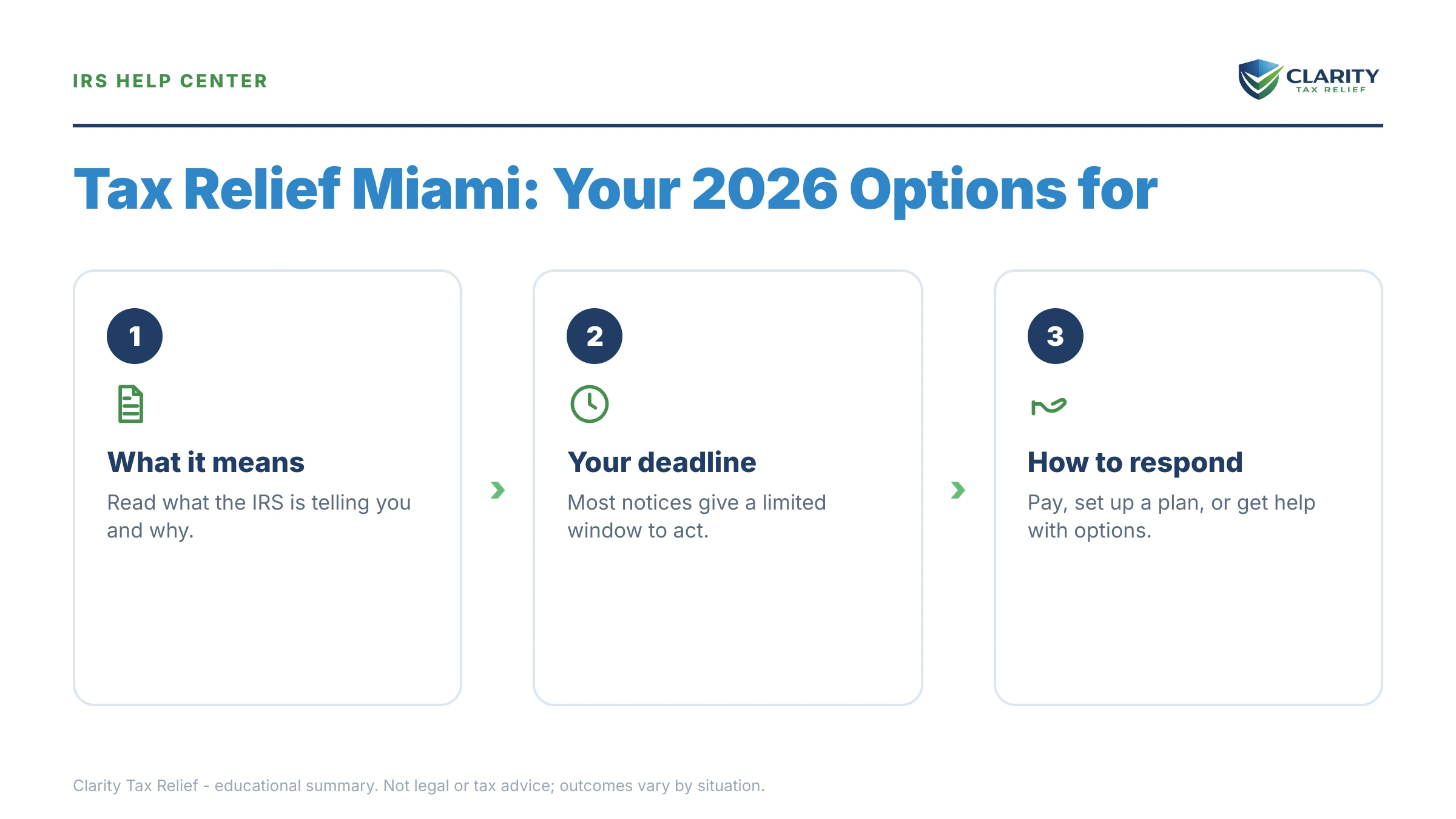
What happens if you ignore IRS debt in Miami
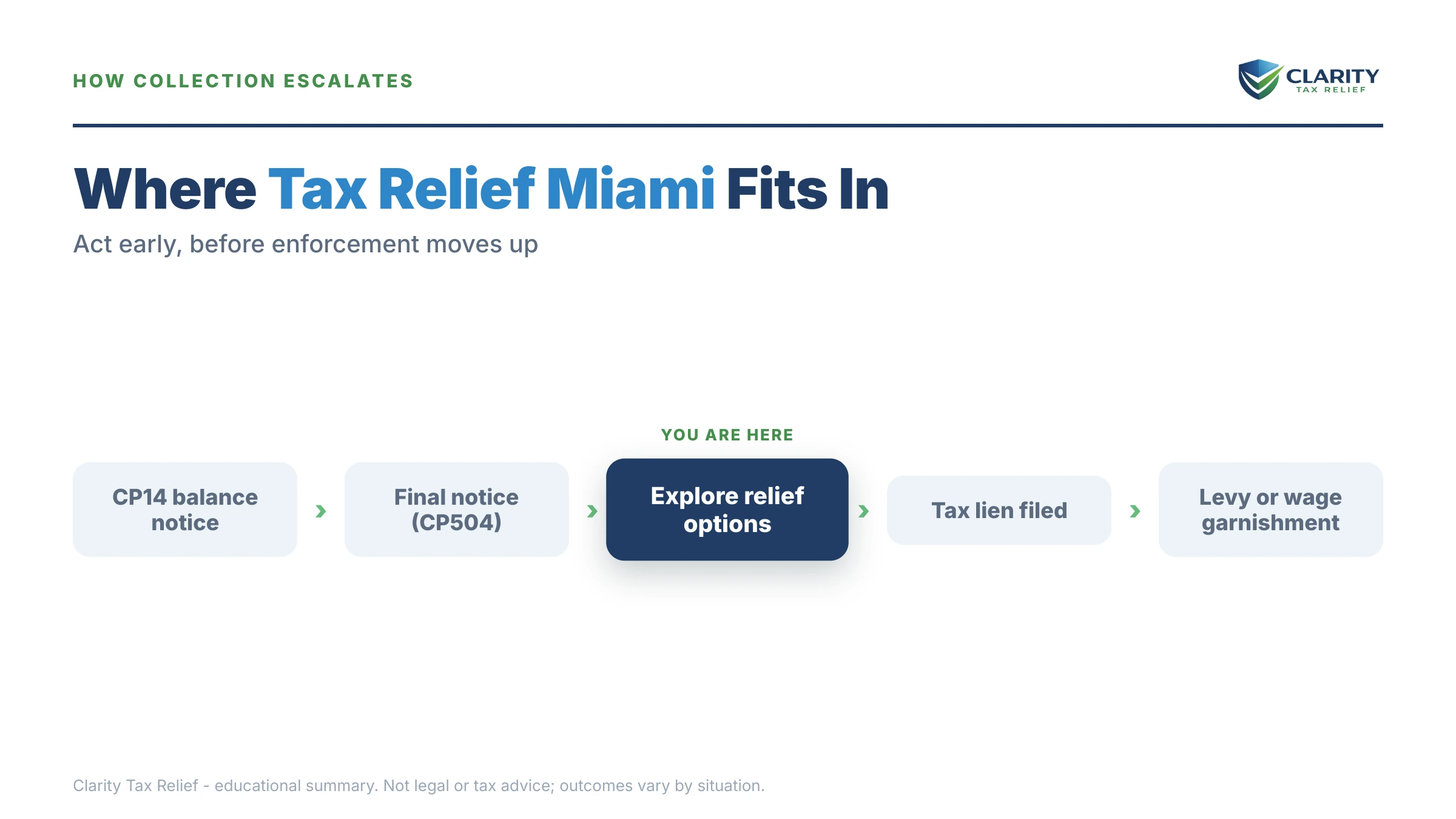
Ignoring IRS debt in Miami triggers the same automated notice sequence as everywhere else, ending in a federal tax lien and a levy — with one local twist along the way. The sequence is machine-driven; it does not require a human to escalate:
- CP14 — the first bill. Typically about 21 days to pay or arrange something before the next notice queues up. Cheapest moment to act.
- CP501 / CP503 — reminders. Still just bills, but interest and the monthly failure-to-pay penalty are compounding the whole time.
- CP504 — intent to levy your state tax refund. Here's the Miami twist: Floridians have no state income-tax refund to seize, so the CP504's headline threat is mostly empty here. Its real meaning is positional — you are one notice from full levy power, and a federal tax lien is now a live possibility.
- LT11 / Letter 1058 — final notice of intent to levy. This starts a 30-day clock and your Collection Due Process rights (requested on Form 12153). After 30 days, the IRS can levy bank accounts, garnish wages, and send levies to gig platforms.
- Levy. A bank levy freezes funds for 21 days before they're sent to the IRS. A W-2 wage levy is continuous until released. A levy on 1099 pay grabs whatever the platform owes you when the levy lands. Up to 15% of Social Security can be taken through the Federal Payment Levy Program.
For non-filers there's a parallel track: if you don't file, the IRS can eventually file a substitute return (SFR) for you — using gross 1099 income with no mileage, no expenses, no deductions — and then bill and collect on that inflated number. And if a balance grows past $66,000 (the 2026 threshold), the IRS can certify it to the State Department, which can deny or revoke your passport — no small thing in a city where half the economy crosses a border or boards a ship.
One more 2026 reality: the IRS cut roughly 27% of its workforce in 2025. That means longer phone waits and slower fixes, but the notices, liens, and levies are automated and never paused. Understaffing makes problems harder to undo, not harder to get.
Unfiled years and IRS letters stacking up in Miami?
Every month adds penalties and interest, and the notice sequence doesn't wait for you to feel ready. Get a free, confidential case review from an experienced tax professional — we'll pull your IRS records and map the exact order to fix this in.
Tax relief in Miami: which option fits your situation
The IRS has five real relief paths, and eligibility is set by hard numbers. Your balance, your income, and whether your returns are filed. (For the mechanics of each program in depth, see our guide on how to settle tax debt yourself. Here's how they map to your numbers.)
| Option | Balance / eligibility threshold | What it does | Key catch |
|---|---|---|---|
| Short-term payment plan | Any balance you can clear in 180 days | Extra time to pay in full, $0 setup | Interest and penalties keep accruing |
| Guaranteed installment agreement | ≤ $10,000, payable within 3 years | IRS must accept if you're filing-compliant | Must stay current on all future filings |
| Streamlined installment agreement | ≤ $25,000 (≤ $50,000 with direct debit); up to 72 months online for balances under $50k | Monthly plan, no detailed financial disclosure | All returns must be filed first |
| Currently Not Collectible (CNC) | Income doesn't cover IRS allowable living expenses (Form 433-F test) | Pauses all collection during hardship | Debt remains; balance keeps growing; IRS reviews periodically |
| Offer in Compromise (OIC) | Assets + future income genuinely can't cover the debt | Settles for less than the full balance | Roughly 1 in 5 offers accepted in FY2024 — means-tested, never guaranteed |
| Penalty abatement (FTA / AEP / reasonable cause) | Clean prior 3 years (FTA), or documented cause | Removes penalties; interest on them falls off too | Doesn't touch the underlying tax |
A few Miami-relevant notes on that table. The CNC and OIC tests both run on IRS allowable-expense standards. The housing figures are set by county — Miami-Dade's high housing costs work in your favor in the hardship math, because more of your income is treated as unavailable to the IRS. On penalties, note the 2026 change: first-time penalty abatement is being replaced by the Automatic Exemption from Penalty (AEP) starting summer 2026, which applies automatically with no request needed, so FTA is no longer the only path, but reasonable-cause relief still matters for multi-year cases. If you want a sense of what your penalties and interest have grown to before you call anyone, our IRS penalty &. Interest calculator can estimate the damage year by year.
Here's what each path costs and how long it takes:
| Option | IRS cost to apply | Typical timeline |
|---|---|---|
| Short-term plan (180 days) | $0 setup | Set up online the same day |
| Installment agreement | Modest setup fee — lower for direct debit, waived or reimbursed for low-income taxpayers | Same day online once all returns are filed |
| Currently Not Collectible | $0 — requires financial disclosure (Form 433-F) | Weeks, depending on how fast you document income and expenses |
| Offer in Compromise | $205 fee + 20% down on lump-sum offers — both waived with low-income certification (AGI ≤ 250% of the poverty line) | Commonly the better part of a year; by law, auto-accepted if the IRS doesn't decide within 2 years |
| Penalty abatement | $0 | Phone or letter request; AEP (from summer 2026) applies automatically |
Say you owe $19,700 across three unfiled years in Miami
Here's a hypothetical to make the math concrete. Say you're a Miami gig worker, rideshare and delivery, who never filed for three years, and once the returns are prepared the total tax comes to $19,700, roughly $6,600 per year.
The penalty picture first. Each unfiled year accrues the failure-to-file penalty at 5% per month until it caps at 25% of that year's unpaid tax: about $1,640 per year, or roughly $4,900 across all three if they've all sat unpaid long enough. The 0.5%-per-month failure-to-pay penalty and daily-compounding interest stack on top. Filing all three returns, even with no payment, stops the 5% charge cold.
Now the resolution. At $19,700, you're under the $25,000 streamlined threshold, so once the returns are filed you can set up a payment plan online with no detailed financial disclosure. Spread over 72 months, the base math is $19,700 ÷ 72 ≈ $274 per month — realistically a bit more, because interest keeps accruing (though the failure-to-pay rate drops to 0.25% per month while an approved agreement is in effect).
But if gig income barely covers Miami rent, two other doors open. CNC status pauses collection entirely if the Form 433-F math shows no room to pay — Miami-Dade's county-based housing allowance helps here. And an Offer in Compromise becomes worth pricing out: with low-income certification, the $205 fee, the 20% down payment, and payments during review are all waived. No one can promise an offer gets accepted, the IRS took roughly 1 in 5 in FY2024, but for a low-income filer with no assets, it's a legitimate path, not a late-night-radio fantasy.
One more thing worth checking before you assume you owe on every year: if any of those years had withholding or refundable credits, a refund can still be claimed, but only within three years of the original due date. Wait longer and that money is forfeited permanently. Our guide for people who haven't filed taxes in 3 years walks the catch-up sequence in detail.
How to get tax relief in Miami, step by step
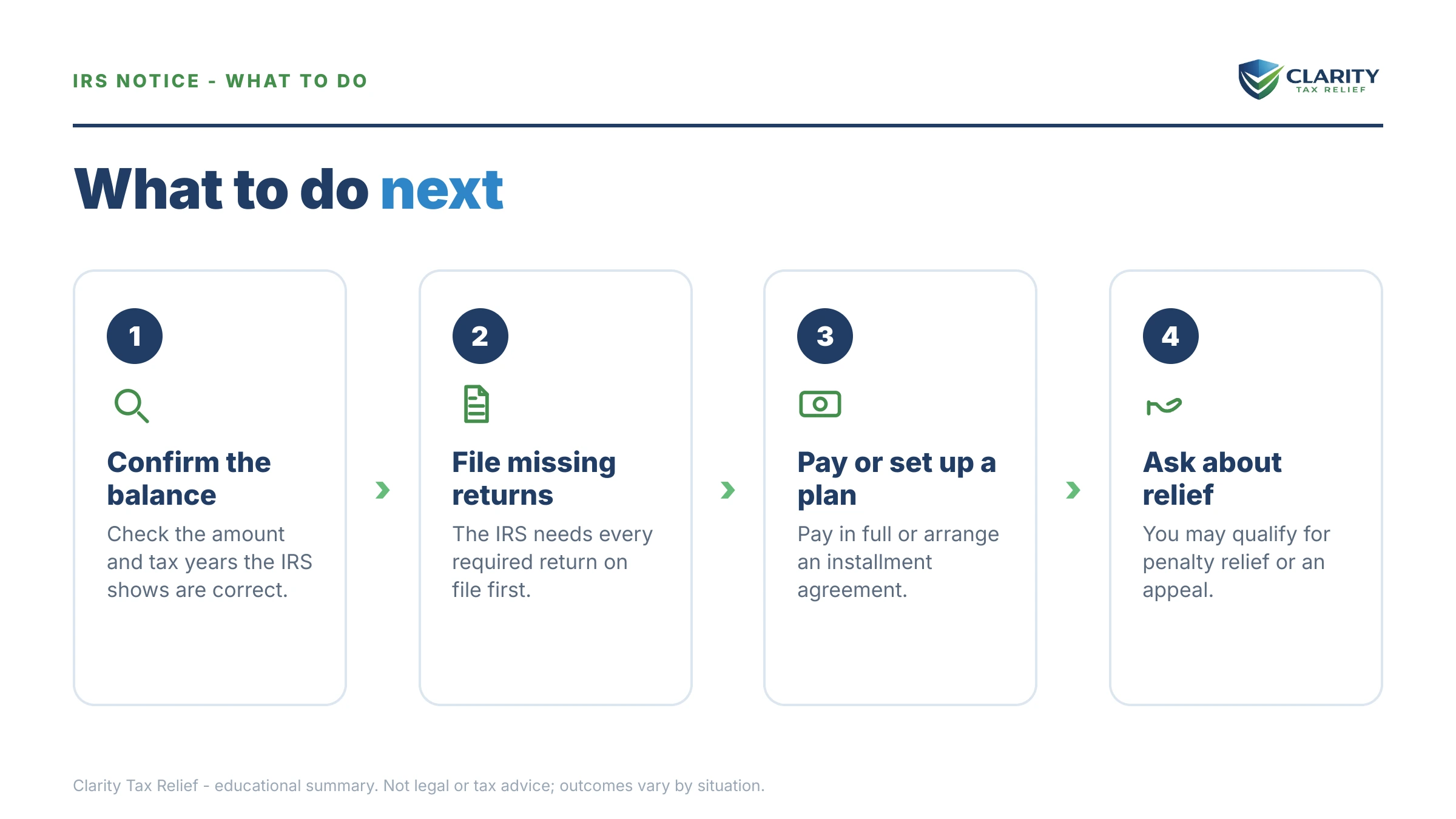
- Pull your IRS transcripts — get wage and income transcripts for each unfiled year so your returns match what the IRS already has on file.
- File every unfiled return — no payment plan, OIC, or hardship status is available until you're filing-compliant, and filing stops the 5%-per-month penalty.
- Verify or challenge any SFR balances — if the IRS filed a substitute return for you, filing your own real return usually lowers the assessment.
- Choose the resolution that fits your numbers — use the eligibility table above to match your balance and budget to a payment plan, CNC status, or an OIC.
- Request penalty relief — ask for first-time abatement or reasonable-cause relief on qualifying years; penalties can be a quarter of the balance.
- Set it up before enforcement starts — an agreement in place stops the notice sequence before liens and levies begin.
When you can handle Miami IRS debt yourself
Plenty of Miami tax problems don't need professional help, and it's worth being honest about which ones. You can likely handle this yourself if: your returns are all filed and the balance is accurate. You can pay within 180 days (the short-term plan is free and set up online in minutes). Or you owe under $25,000 with steady income and just need a streamlined agreement. The IRS online tools genuinely work for these cases.
Experienced help changes outcomes in different situations: multiple unfiled years where the return preparation itself drives the final balance (a gig worker's mileage and expense reconstruction can cut the tax dramatically before any "relief" program enters the picture). An SFR assessment you need to displace. A levy already in motion against a bank account or platform payout. Business debt involving payroll or Florida sales tax. Or OIC math, where a badly built offer wastes months and gets rejected. If you run a Miami business behind on 941s or sales tax, start with our tax relief for small business guide — business cases follow different rules than personal ones.
Choosing tax relief help in Miami: local vs. national
Tax relief work is federal, so a Miami zip code on the letterhead matters far less than credentials and pricing. IRS representation happens by phone, fax, and e-services regardless of where the representative sits — what matters is that a credentialed professional (EA, CPA, or attorney), not a salesperson, evaluates your case. That fees are flat and in writing. Miami's heavy Spanish-language ad market for "alivio de impuestos" includes some excellent firms and some pure sales operations. The pitch language is the tell, not the language it's pitched in.
Walk away from anyone who promises a settlement before seeing your transcripts, quotes a fee before knowing your facts, or leads with "pennies on the dollar". That phrase is a marketing script, not a program. Our buyer's checklist for choosing a tax relief company covers the exact questions to ask, and if you're comparing the big national advertisers, our Optima Tax Relief alternatives breakdown shows how the models differ. For what fair pricing looks like across case types, see how much tax relief costs.
Free and low-cost tax help in Miami
Miami taxpayers have real free options, and if your income is modest you should know them before paying anyone. Low Income Taxpayer Clinics represent qualifying taxpayers in IRS disputes for free or a nominal fee — the Taxpayer Advocate Service maintains the current clinic directory and can itself intervene when IRS delays are causing you harm. The IRS also runs a Taxpayer Assistance Center in Miami, appointment-only (call 844-545-5640 to schedule) — useful for identity verification and document drop-offs, though it can't negotiate resolutions on the spot.
Two more resources specific to this region. When FEMA declares a disaster covering Miami-Dade, a near-annual event in hurricane season, the IRS typically postpones filing and payment deadlines automatically for affected addresses. Check the current declarations before assuming a deadline applies to you. And for anything you can do yourself, payments and payment plans are handled directly at IRS.gov/payments. Business owners with Florida sales or reemployment tax issues deal with a separate agency entirely: the Florida Department of Revenue, which has its own collection process and timelines — never assume IRS rules or deadlines apply there.
Tax relief in Miami: your questions, answered
Does Florida have a state tax relief program for income taxes?
No — Florida has no personal income tax, so there is no state income-tax debt to relieve. For Miami individuals, tax relief means resolving federal IRS debt. The exception is business owners: the Florida Department of Revenue collects sales tax and reemployment tax. It can pursue owners personally for unremitted sales tax, with its own payment-plan and compromise processes.
Can the IRS take my homesteaded house in Miami?
Florida's homestead protection does not stop a federal tax lien — federal law overrides it, so an IRS lien attaches to your Miami home despite the homestead exemption. Actual seizure of a primary residence is rare and requires federal court approval, and the IRS almost always prefers payment arrangements. The realistic risk is the lien complicating a sale or refinance, not losing the house.
How much does tax relief cost in Miami?
IRS program costs are modest: $0 for a short-term plan, a small setup fee for installment agreements (reduced for direct debit and waived or reimbursed for low-income taxpayers), and a $205 Offer in Compromise application fee that's waived with low-income certification. Professional representation is a separate cost that varies with case complexity — get flat-fee quotes in writing and compare before hiring anyone.
Can the IRS levy my Uber, DoorDash, or Instacart pay in Miami?
Yes. The IRS can send a levy to a gig platform just as it can to an employer. The difference: a levy on 1099 contractor pay generally grabs only what the platform owes you the moment the levy arrives, while a W-2 wage levy is continuous until released. Either way, a levy only comes after a final notice (LT11) and a 30-day window to respond.
I haven't filed taxes in three years — will I go to jail?
Almost certainly not if you come forward voluntarily. Not filing can be a crime in theory. But the IRS pursues criminal cases against a tiny number of egregious, willful non-filers — voluntary filers who owe money are handled civilly. The bigger costs of waiting are the 5%-per-month failure-to-file penalty and losing any refund older than three years, which is forfeited permanently.
Can the IRS take my passport over tax debt?
Only if your debt is certified as seriously delinquent — the threshold is $66,000 for 2026, including penalties and interest. Certification lets the State Department deny or revoke your passport, a real problem in a travel-heavy city like Miami. Getting into an installment agreement, an accepted OIC, or CNC status generally prevents or reverses certification.
Is the IRS even enforcing in Miami after the 2025 layoffs?
Yes. The IRS workforce shrank roughly 27% in 2025, which makes phone lines and appointments slower, but collection notices, liens, and levies are generated by automated systems that never stopped. In practice, understaffing makes it harder to fix problems and no harder for the IRS to create them, which is an argument for acting before enforcement starts.
Do hurricane disaster declarations pause IRS deadlines in Miami-Dade?
When FEMA issues a disaster declaration covering Miami-Dade County, the IRS typically postpones filing and payment deadlines for affected taxpayers automatically, based on the address on file. Relief postpones deadlines. It does not erase existing tax debt, and balances from prior years generally keep accruing interest. Check IRS.gov's disaster relief page for current declarations before assuming you're covered.
Your next 24 hours
- Find your most recent IRS letter — note the notice number in the top corner and the tax years listed, or log into your IRS online account to see the balance and which years are missing returns.
- Gather your income records — 1099s, platform earnings summaries, bank statements, and any mileage or expense records for each unfiled year. Missing paperwork isn't a dealbreaker; the IRS's own transcripts can fill gaps.
- Get a free case review — call (888) 825-7779 or use the 2-minute form. An experienced tax professional will map your unfiled years, your penalty exposure. The resolution that fits your numbers, before another month of penalties and interest posts to the balance.
This guide is general information, not tax or legal advice for your specific situation. Eligibility for IRS programs depends on individual facts and circumstances; no outcome is guaranteed.