
Free IRS Help
Low Income Taxpayer Clinic (LITC): Who Qualifies and How to Get Free IRS Help in 2026
The short answer: a low income taxpayer clinic (LITC) is an independent organization that represents taxpayers in IRS disputes for free or a small fee. Most clinics accept your case if your income is at or below 250% of the federal poverty guidelines and the disputed amount is $50,000 or less per tax year.
You're driving, delivering, or freelancing to keep the lights on, three tax seasons slipped by unfiled, and now the IRS letters are stacking up faster than you can afford to answer them. The debt feels too big to pay and too complicated to fight alone, and hiring help feels out of reach. That gap is exactly what LITCs exist to close: real representation, staffed by attorneys, CPAs, and enrolled agents, at no cost to people who qualify.
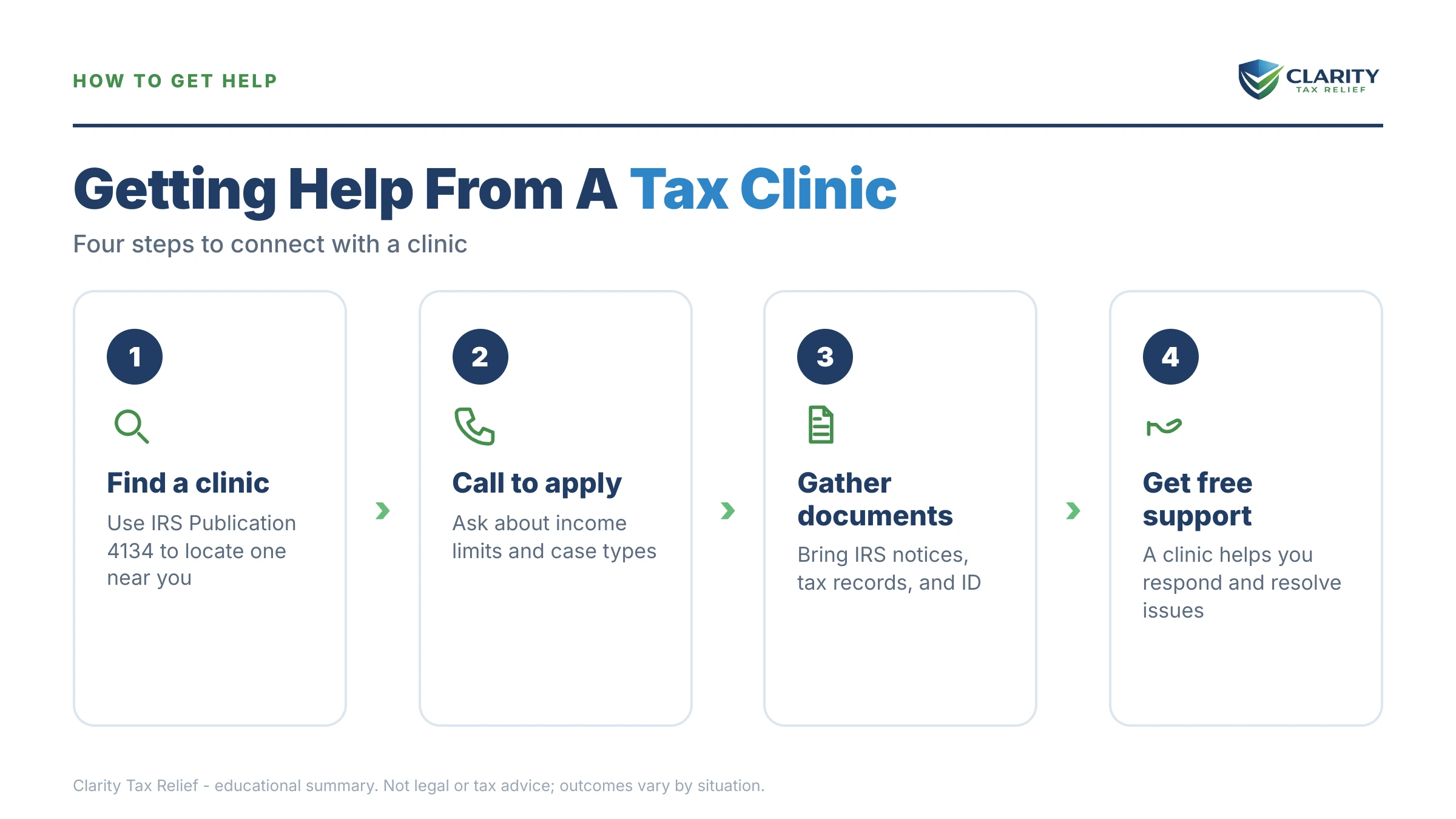
Every clinic in the country is listed in one official IRS directory, Publication 4134, and the image below shows you exactly what that resource looks like and how to spot the clinics that serve your state.
⏱ The clock that matters: there is no application deadline for a clinic, but an LITC cannot pause the deadlines printed on your IRS notices. Response windows — like the 30-day clock on a final levy notice — keep running while you search for help, and penalties and interest keep accruing every month on unfiled years. Start intake now, not after the next letter.
What a low income taxpayer clinic is, and what makes it different
An LITC is an independent organization — usually a law school clinic, legal aid society, or nonprofit — that represents eligible taxpayers in disputes with the IRS at no charge. Clinics receive partial funding through a federal grant program administered by the Taxpayer Advocate Service, but the IRS does not run them, staff them, or see your file. What you tell your clinic representative is confidential.
The word "clinic" undersells it. LITC staff and supervised law students handle audits, appeals, collection cases, identity theft, innocent spouse claims, and litigation in the United States Tax Court — the same work a paid representative does. Many clinics also run education programs for taxpayers who speak English as a second language.
Two things an LITC is not. It is not the VITA free tax filing program, which prepares current-year returns but doesn't fight disputes. And it is not the Taxpayer Advocate Service, which is an ombudsman inside the IRS that unsticks stalled cases but doesn't act as your advocate against an assessment. All three are free; they solve different problems, and the table further down shows exactly which one fits which situation.
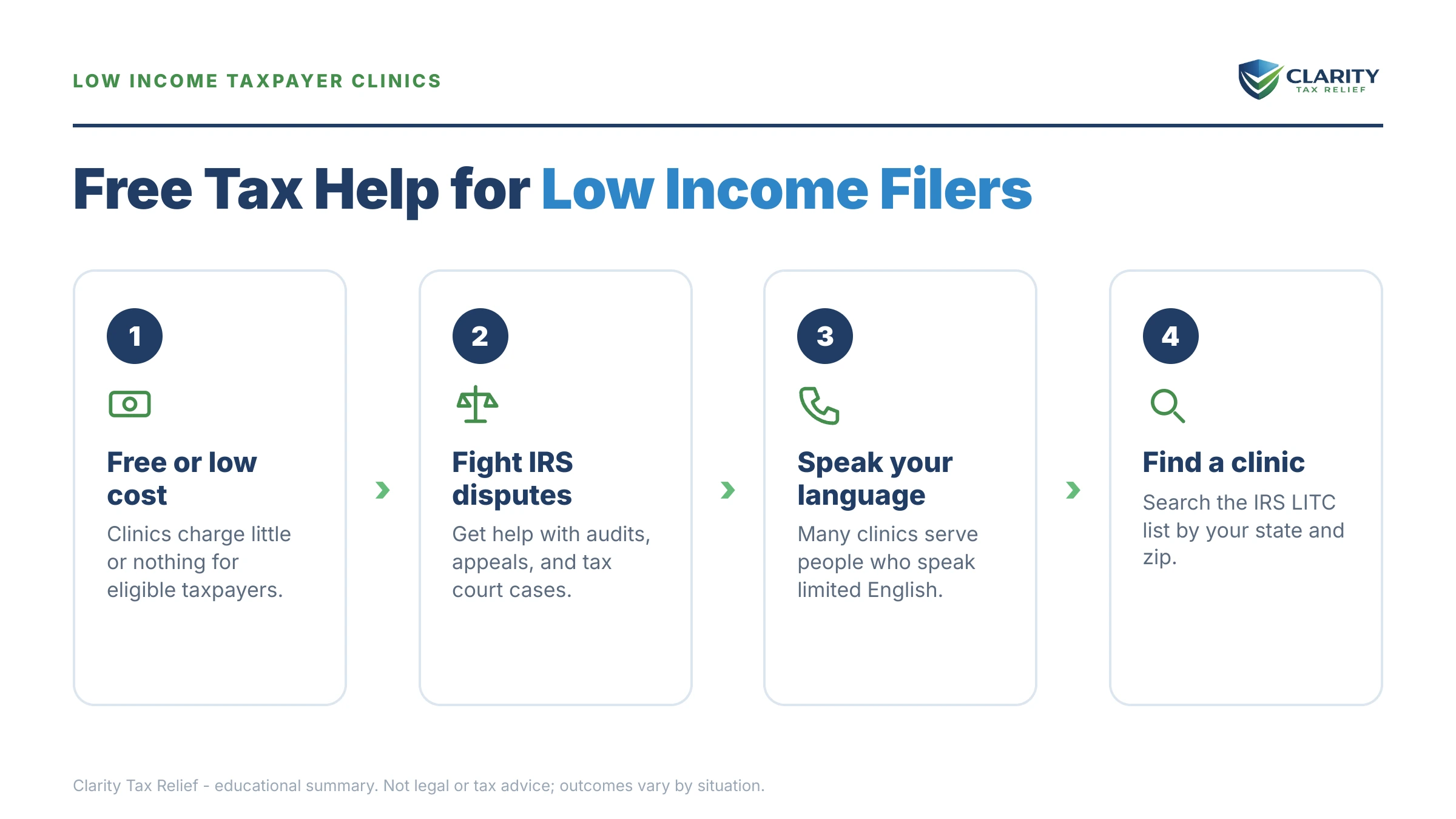
“In order to qualify for assistance from an LITC, generally a taxpayer’s income must be below a certain threshold. The amount in dispute with the IRS is usually less than $50,000.”
— Low Income Taxpayer Clinics (IRS.gov)
Who qualifies for a low income taxpayer clinic in 2026
LITCs generally accept taxpayers whose household income is at or below 250% of the federal poverty guidelines and whose disputed amount is $50,000 or less per tax year. Both tests come from the federal grant guidelines, but each clinic sets its own intake rules within those limits — some are stricter, some make exceptions, and calling costs nothing.
What 250% of poverty means in dollars changes every January and depends on household size. Based on recent guideline levels, it works out to roughly $39,000 for a single person and roughly $80,000 for a family of four — the clinic applies the current-year table when you call, so don't rule yourself out over a rough estimate.
Three points people miss:
- The $50,000 cap is per tax year, not total. If you owe $27,500 spread across three years, every year is comfortably under the cap even though the total feels large.
- You need a controversy, not just a tax bill you dislike. Clinics handle disputes and collection matters — a proposed assessment, a levy threat, an audit, a denied credit. Pure current-year return prep goes to VITA instead.
- The income test looks at your household, not just you. A spouse's income counts, which occasionally disqualifies a low-earning filer married to a higher earner.
Here's a detail almost nobody tells you: the LITC income test uses the same 250%-of-poverty line as the IRS's OIC low-income certification. If you qualify for a clinic, you very likely also qualify to have the $205 Offer in Compromise application fee, the 20% down payment, and payments during review waived — which matters enormously later in this article.
What happens if you keep waiting
For someone with unfiled years, the IRS doesn't wait for you to file. It eventually files for you, on the worst possible terms. The sequence runs on autopilot, and in 2026, with the IRS workforce cut roughly 27% in 2025, the automated side is the part still running at full speed:
- CP59 notice — the IRS's first "we have no return from you" letter for a missing year. See the CP59 notice guide for what it looks like.
- CP516 and CP518 — follow-up and final unfiled-return notices. Still just letters, but the file is moving.
- Substitute for Return (SFR) — the IRS prepares a return for you using the 1099s it received. An SFR gives a gig worker zero business deductions — no mileage, no expenses, single or married-filing-separately status, standard deduction only. The resulting "balance due" is almost always far higher than what a real return would show. Here's what to do if the IRS filed a substitute return for me.
- CP3219N, the 90-day letter for non-filers. Your one statutory window to petition Tax Court before the inflated SFR amount becomes a legal assessment. LITCs handle exactly these petitions.
- Assessment and the collection ladder — a CP14 bill (typically 21 days to respond), reminder notices, then CP504, then an LT11 final notice that starts a 30-day clock on your Collection Due Process rights.
- Levy — bank accounts (with a 21-day hold before funds leave) and levies sent directly to the app companies and clients that pay you.
One more clock runs quietly in the background: refunds from old years expire three years after the return was due. If withholding or credits would have produced a refund in your oldest unfiled year, waiting can forfeit money you were owed. If this is your situation, the haven't filed in 3 years guide walks through the filing sequence itself.
Years unfiled and the letters are stacking up?
Whether a free clinic or professional representation is the right fit, the worst move is letting the IRS file your returns for you with zero deductions. Get a free, confidential review of your unfiled years and options before the balance grows another month — no pressure, no obligation.
What an LITC can pursue on your behalf
A clinic can put you into any IRS resolution program you'd reach through a paid representative — the programs belong to the IRS, not to whoever files the paperwork. The shared background on each option lives in our guide to how to settle tax debt yourself. Here's the threshold map a clinic works from:
| Option | Key eligibility threshold | What it does |
|---|---|---|
| Short-term payment plan | Full balance payable within 180 days; $0 setup fee | Buys time and stops enforcement while you pay |
| Guaranteed installment agreement | Balance of $10,000 or less, all returns filed | The IRS must accept a qualifying request |
| Streamlined installment agreement | Balance of $50,000 or less; up to 72 months online | Monthly plan without full financial disclosure |
| Offer in Compromise with low-income certification | AGI at or below 250% of poverty waives the $205 fee, the 20% down payment, and payments during review | Settles for less than owed when the IRS's own math shows it can't collect the full amount — roughly 1 in 5 offers were accepted in FY2024 |
| Currently Not Collectible (CNC) | Income barely covers IRS allowable living expenses | Pauses collection; penalties and interest still accrue |
| First-Time Abate / AEP | Clean compliance history in the prior 3 years | Removes eligible penalties; the new Automatic Exemption from Penalty applies without a request starting summer 2026 |
| Innocent spouse relief (Form 8857) | Joint return; the debt stems from your spouse's error or omission | Can relieve you of liability for a spouse's understatement |
Clinics are especially strong in a few lanes where low-income taxpayers get hurt most: Earned Income Tax Credit audits and denied dependents, SFR assessments that need real returns filed against them, identity theft cases, and innocent spouse claims, if your spouse hid income from me describes your situation, that's textbook clinic work. So is disputing phantom income from a 1099-C cancelled debt when you were insolvent.
LITC vs. VITA vs. the Taxpayer Advocate Service
These three free programs get confused constantly, and calling the wrong one costs you weeks. One prepares returns, one fights disputes, one unsticks the IRS's own machinery:
| Program | What it does | Who qualifies | Cost |
|---|---|---|---|
| Low income taxpayer clinic (LITC) | Represents you in IRS disputes: audits, collections, appeals, Tax Court | Income ≤ 250% of poverty guidelines; dispute generally ≤ $50,000 per tax year | Free or nominal fee |
| VITA / TCE | Prepares and files returns — current year and often prior years | Moderate income, persons with disabilities, limited-English speakers; TCE serves age 60+ | Free |
| Taxpayer Advocate Service (TAS) | Independent voice inside the IRS; intervenes when IRS delays or actions cause hardship (request via Form 911) | Any taxpayer facing economic harm or a stalled IRS process — no income limit | Free |
| IRS self-service tools | Online account, payment plans, transcripts, balance checks | Anyone who can verify identity online | Free (some plan setup fees apply) |
They stack, too. A clinic can file a Form 911 to bring TAS into a stalled case. It can send you to VITA for the return prep it doesn't do. Our roundup of free help with IRS tax debt maps every no-cost door in one place.
A worked example: $27,500 across three unfiled years
Say you're a single gig worker earning about $30,000 a year, with three years unfiled. This is hypothetical, but the math is real:
- If the IRS files SFRs for you, it taxes your gross 1099 income with no mileage, no supplies, no expenses. A driver grossing $48,000 with $18,000 of legitimate expenses gets taxed as if the full $48,000 were profit — the SFR balance can easily run 50% or more above reality.
- If you (or a clinic) file real returns, suppose the honest three-year total lands at $27,500 including penalties and interest. Filing also matters because the failure-to-file penalty runs 5% per month, ten times the 0.5% failure-to-pay rate, and filing is the only thing that stops the bigger clock. You can estimate the penalty side with our Penalty & Interest Calculator.
- A streamlined installment agreement on $27,500 over 72 months runs roughly $382/month ($27,500 ÷ 72), plus interest that continues to accrue until it's paid.
- At $30,000 of income for a household of one, you're under 250% of the poverty guidelines — which means an LITC can likely take the case, and if an Offer in Compromise makes sense, low-income certification waives the $205 fee, the 20% down payment, and payments during review. Whether an offer actually makes sense depends on the IRS's Reasonable Collection Potential math — your assets plus what it could collect from future income — which the clinic runs the same way the IRS does.
- If $382/month is genuinely impossible, CNC hardship status is the honest alternative: collection pauses, though the balance keeps growing and the IRS revisits your finances periodically.
Notice what a clinic changed in that picture: it didn't erase the debt. It replaced an inflated SFR number with the real one, stopped the fastest-growing penalty, and opened fee-waived doors that only exist below the 250% line.
How to get help from a low income taxpayer clinic, step by step
- Check your eligibility. Compare your household income to 250% of the federal poverty guidelines and confirm the amount in dispute is $50,000 or less per tax year. If you're close to the line, call anyway — clinics apply the current-year table at intake, and each clinic sets its own rules within the federal limits.
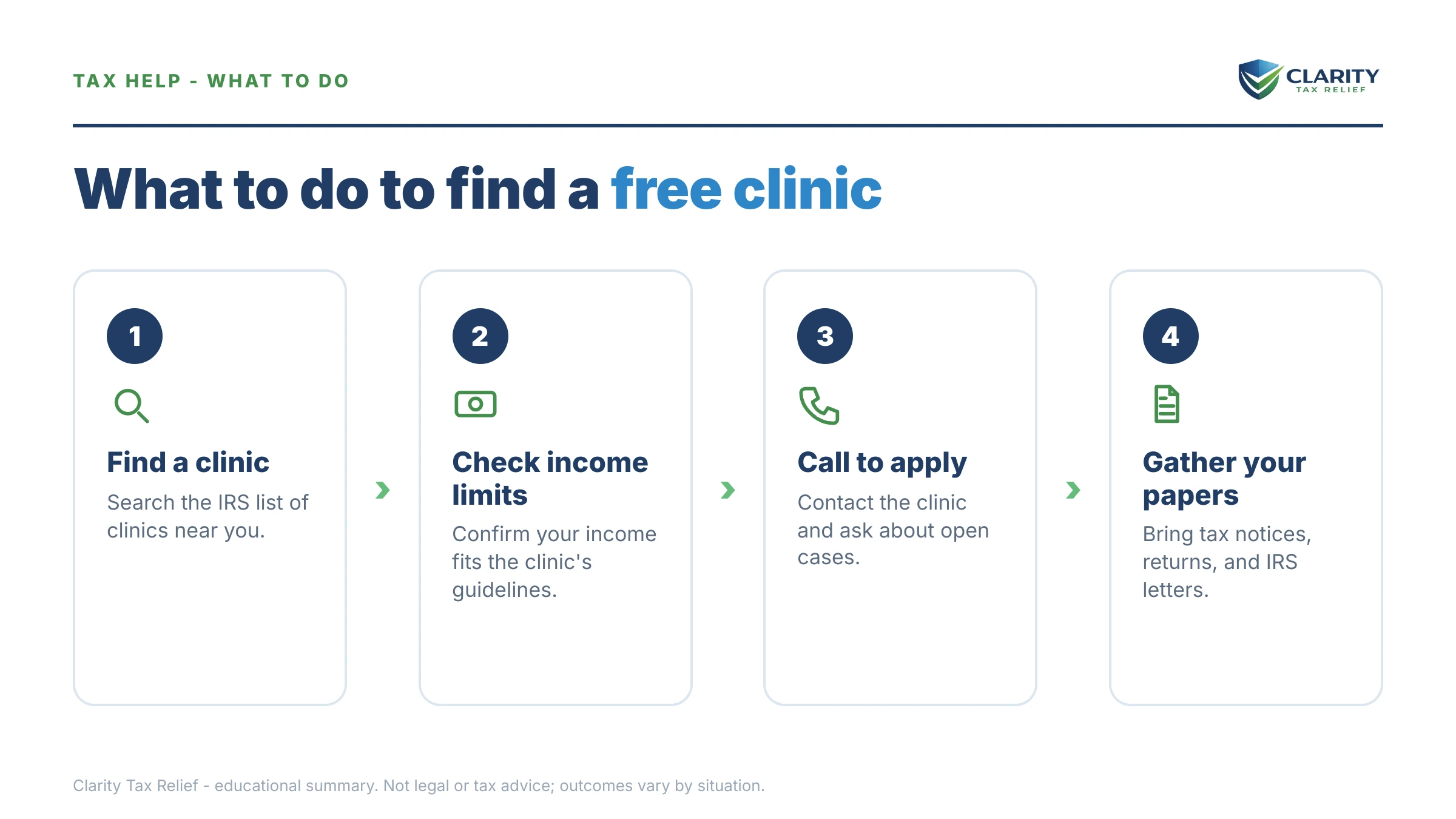
- Find clinics that serve your area. Download IRS Publication 4134, the official Low Income Taxpayer Clinic list, or browse the clinic information at taxpayeradvocate.irs.gov. Write down every clinic covering your state — capacity varies, so you may need to call more than one.
- Call for an intake screening. Have your most recent IRS notice, your income information, and your household size ready. Intake usually takes one phone call; the clinic will tell you whether it can open your case and what documents to send next.
- Sign the engagement letter and Form 2848. If accepted, you'll sign a representation agreement and IRS Form 2848 so the clinic can speak to the IRS on your behalf. From that point, IRS calls and correspondence route through your representative instead of you.
- Keep every IRS deadline while you wait. Acceptance can take days or weeks, and no clinic can pause the response windows printed on your notices. If a deadline arrives first, respond yourself, even a basic written reply or an online payment-plan request protects your rights.
Curious what that power of attorney does? Our Form 2848 instructions walk through it line by line.
When you can handle this yourself, and when a clinic isn't enough
You genuinely don't need a clinic, or anyone — for some problems. If you have one filed year, agree with the balance, and can pay within 180 days, the IRS's free short-term plan takes ten minutes online. A streamlined installment agreement under $50,000 is likewise a self-service task for most people.
A clinic (or an experienced tax professional) changes the outcome when the stakes and complexity climb: SFR assessments that need real returns and possibly audit reconsideration, a levy already in motion, an EIC audit, an innocent spouse claim, or a Tax Court deadline. Multiple unfiled years plus active collection is exactly the profile clinics were funded to handle, and exactly the profile that goes worst when handled alone.
Be realistic about the trade-offs, too. Clinics run on grants and student labor: intake can be slow, capacity fills, some states have thin coverage. A clinic can decline your case for reasons that have nothing to do with you. If your income is over the line, your dispute exceeds $50,000 in a year, or you simply can't find an open slot before your deadline, that's when a free consultation with an experienced tax professional is the sensible next call — not a defeat.
Terms you'll hear at intake, decoded
- Amount in controversy — the dollar amount actually in dispute for a tax year; the figure the $50,000 cap measures.
- Federal poverty guidelines — the income table HHS publishes each January; LITC eligibility is 250% of the line for your household size.
- Publication 4134 — the IRS's official directory of every funded clinic, updated as the grant list changes.
- Pro bono — professional work done free of charge; how clinic attorneys and volunteer practitioners serve you.
- Substitute for Return (SFR) — a return the IRS creates for a non-filer using third-party income data, with no deductions in your favor.
- Taxpayer Advocate Service (TAS) — the independent organization inside the IRS that both administers the LITC grant program and intervenes in hardship cases.
Low income taxpayer clinic questions, answered
What does a low income taxpayer clinic actually do?
An LITC represents you in disputes with the IRS — audits, appeals, collection actions, identity theft, innocent spouse claims, and even Tax Court cases — at no charge. Staff attorneys, CPAs, enrolled agents, and supervised law students handle the work. Clinics also provide education for taxpayers who speak English as a second language. What they generally don't do is prepare your current-year return; that's the VITA program's job.
Who qualifies for a low income taxpayer clinic in 2026?
Most clinics accept taxpayers whose household income is at or below 250% of the federal poverty guidelines — roughly $39,000 for one person and roughly $80,000 for a family of four, based on recent guideline levels — and whose disputed amount is generally $50,000 or less per tax year. Each clinic sets its own intake rules within those federal limits, so a call costs you nothing even if you're near the line.
Are low income taxpayer clinics really free?
Yes — representation is free or at most a nominal fee; the terms of the federal grant program require it. You may still face out-of-pocket costs the clinic doesn't control, like a Tax Court filing fee. Just as important, the clinic works for you, not the IRS: what you tell your clinic representative stays confidential.
Is an LITC part of the IRS?
No. LITCs are independent organizations — law school clinics, legal aid societies, and nonprofits — that receive partial funding through a federal grant program administered by the Taxpayer Advocate Service. The IRS does not run them, staff them, or see your file. Anything you share with the clinic is confidential and is never reported back to the IRS.
Will an LITC file my back tax returns?
Sometimes, when the unfiled returns are part of an active controversy — for example, filing real returns to replace substitute-for-return assessments the IRS created for you. Clinics don't do routine current-year preparation; the free VITA program handles that if your income qualifies. Ask at intake: many clinics will handle delinquent returns precisely because filing them is the first step to resolving the collection case.
Can an LITC take my case to Tax Court?
Yes — LITCs can represent you in the United States Tax Court, and many clinics also staff calendar-call programs that offer same-day pro bono help to unrepresented taxpayers on trial dates. The catch is deadlines: a Tax Court petition generally must be filed within 90 days of a notice of deficiency. The clinic can't extend that window, so call before the deadline, not after.
What if there's no clinic near me or it can't take my case?
Coverage varies — some states have several clinics, others only one, and clinics routinely hit capacity. If you're declined, try the Taxpayer Advocate Service for IRS-caused hardship, handle a simple payment plan yourself online, or get a free consultation from an experienced tax professional. Being over the income limit doesn't mean you're out of options; it just changes which door you use.
Can an LITC stop a levy or wage garnishment?
A clinic can pursue every release path a paid representative would: proving economic hardship, negotiating an installment agreement or Currently Not Collectible status, or asserting Collection Due Process rights if the window is still open. No one, clinic or paid firm, can make a levy vanish instantly. But a bank levy's 21-day holding period and a continuing wage levy both create real leverage to negotiate a release.
Your next 24 hours
- Pin down what the IRS claims. Gather every IRS letter you've received and note the tax year and amount on each, or log into your IRS online account for the current balances. You can't screen for a clinic without knowing the per-year numbers.
- Assemble your intake packet. Photo ID, your last two months of income (pay stubs, app earnings statements, or 1099s), your household size, the notices, and any returns you did file. Every clinic will ask for these first.
- Make one call today. Pick a clinic from Publication 4134 and start intake — or, if you're over the income line, above the $50,000 cap, or can't find an open slot, get a free case review from Clarity at (888) 825-7779 or the 2-minute form. Penalties and interest accrue monthly on unfiled years; the balance only moves one direction while you wait.
Primary sources: the official clinic directory is IRS Publication 4134, the Low Income Taxpayer Clinic List. Program details live at the Taxpayer Advocate Service. And payment options are at IRS.gov/payments.
This guide is general information, not tax or legal advice for your specific situation. Eligibility for IRS programs depends on individual facts and circumstances; no outcome is guaranteed.