
Innocent Spouse Relief
Spouse Hid Income From Me: Building Your Innocent Spouse Case (2026)
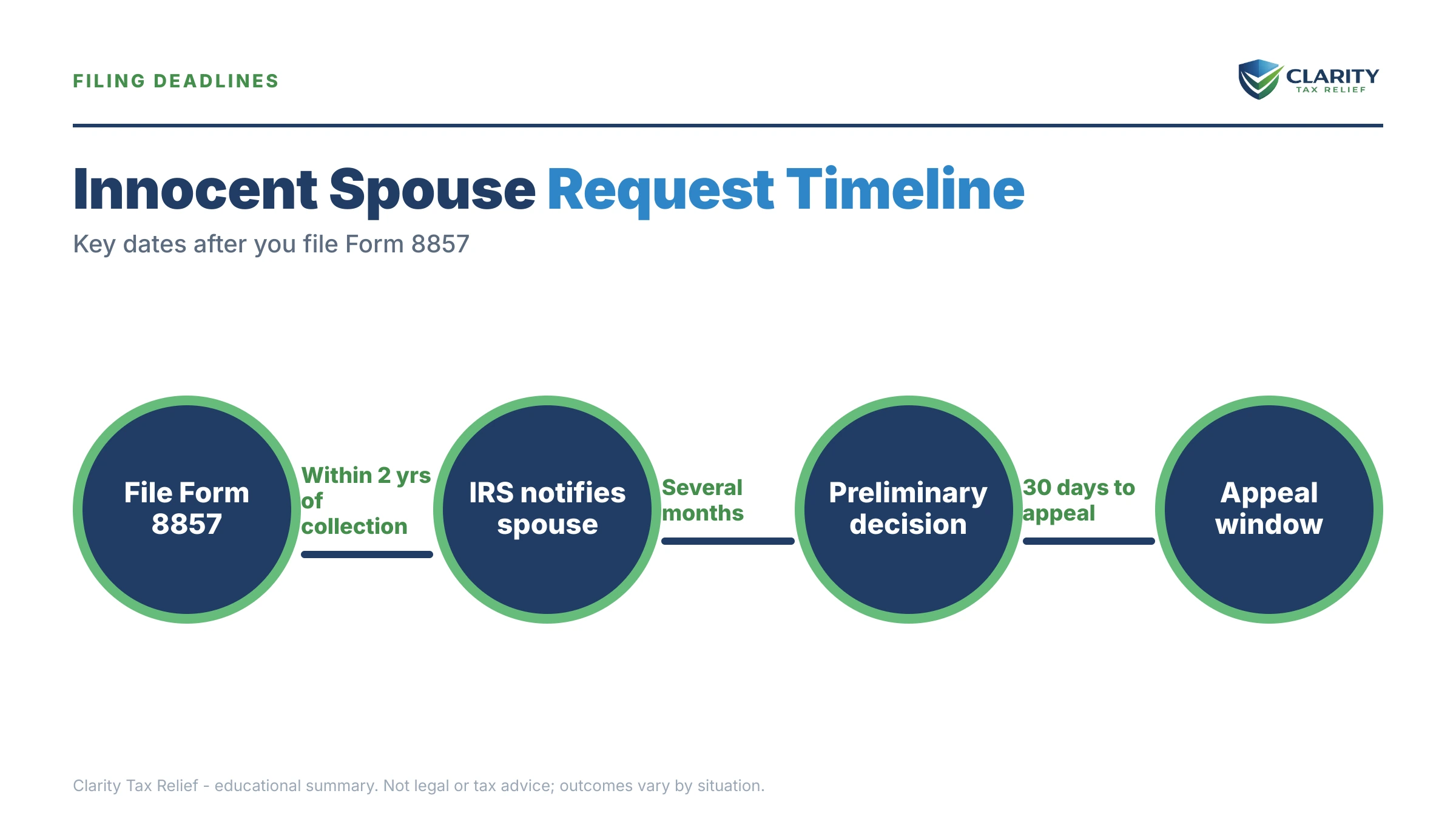
The short answer: if your spouse hid income on a joint return, the IRS can bill you for the whole debt, but innocent spouse relief (Form 8857) can remove your liability for tax on income you didn't know about. Two of the three relief types must be requested within 2 years of the IRS's first collection action against you.
If you're searching "spouse hid income from me" while staring at an IRS letter, the letter probably lists a payer you don't recognize and dollars that never touched any account you could see. You signed a joint return in good faith, and now the IRS says the resulting bill belongs to you exactly as much as to the person who hid it. That's infuriating. It's also a situation federal law specifically anticipates, with three separate relief paths built for it.
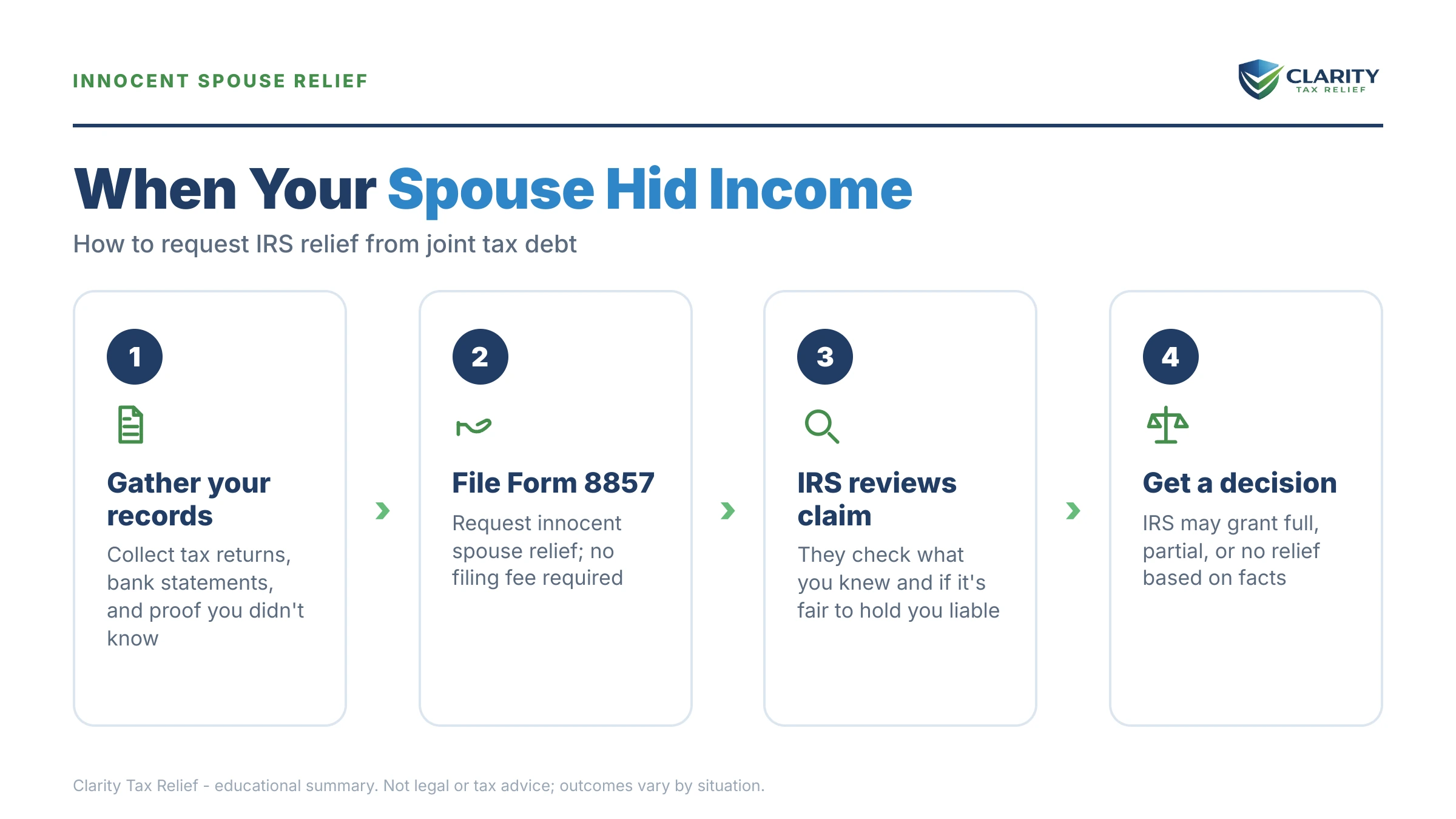
Everything runs through one document — Form 8857, Request for Innocent Spouse Relief — and the visual guide below maps the deadlines and options that carry the weight of your case.
⏱ Your deadline: You have 2 years from the IRS's first collection activity against you to request relief under §6015(b) or separation of liability under §6015(c). A refund offset, a levy, or a collection suit can each start that clock. Equitable relief under §6015(f) has a longer window — generally as long as the 10-year collection statute stays open — but evidence gets harder to reconstruct every year you wait.
"My spouse hid income from me": why the IRS bills you anyway
A joint tax return creates joint and several liability: the IRS can legally collect 100% of the debt from either signer, regardless of whose income caused it. The IRS doesn't referee marriages. Its computers matched the 1099s and W-2s payers filed against what your joint return reported, found a gap, and assessed both names on the return, usually through a CP2000 notice or an audit.
This matters double if you're a 1099 contractor yourself. Your own income already arrives on 1099s, so when hidden 1099s surface under the same joint account, the IRS's transcript doesn't distinguish "your client" from "your spouse's secret side work." Part of building your case is proving exactly which payer relationships were never yours.
One more hard truth up front: a divorce decree assigning this debt to your ex does not bind the IRS. The decree matters — as evidence, and as a way to pursue your ex in state court — but the federal government wasn't a party to your divorce. More on that in divorce decree irs debt.
“You must request innocent spouse relief within 2 years of receiving an IRS notice of an audit or taxes due because of an error on your return.”
— Innocent spouse relief (IRS.gov)
What happens if you ignore a joint tax bill
On a joint liability, the IRS pursues whichever spouse is easier to collect from. That is often the innocent one, because you're the one with the visible income and the working bank account. The sequence below is automated. In 2026, with IRS staffing down roughly 27%, the notices and levies still fire on schedule even when no human reviews the file.
- Assessment. The CP2000 or audit becomes a final assessment against both names on the return. Penalties and interest start compounding on the full amount.
- Balance-due notices. A first bill, then reminders. Your tax refunds — including refunds on returns you file alone going forward, unless you take steps — get offset against the joint debt.
- CP504. The IRS can seize your state tax refund, and a federal tax lien against your property becomes a live possibility.
- LT11 / Letter 1058 — final notice. A 30-day clock starts. After it runs, the IRS can levy bank accounts and income. For a 1099 contractor there's no employer buffer: a levy can attach directly to payments your clients owe you. A bank levy freezes funds for a 21-day hold before they're sent to the Treasury.
- Ongoing enforcement. Levies repeat and liens attach to what you own — including your half of jointly held property. See can the irs take my spouse's bank account for how joint accounts get treated.
Here's the leverage you have right now: filing Form 8857 generally suspends collection against you while the IRS considers your claim. Waiting until a levy is already in motion means fighting the levy and the liability at the same time.
The hidden income is on your record right now
Send us the notice. An experienced tax professional will map which relief type fits your facts and whether your 2-year window under §6015(b) and (c) is already running — free, confidential, no pressure.
Your options: three kinds of innocent spouse relief
Federal law (IRC §6015) offers three distinct relief types, and one Form 8857 asks the IRS to consider all of them. Because your spouse hid income, you're dealing with an understatement — the strongest fact pattern, since it opens all three doors. (A spouse who reported income honestly but never paid creates an underpayment, where only equitable relief applies.)
| Relief type | Key requirements | Deadline | Best fit |
|---|---|---|---|
| Innocent spouse relief — §6015(b) | Understatement from your spouse's items; you didn't know and had no reason to know; unfair to hold you liable | 2 years from first collection activity | Still married or divorced; genuinely in the dark; refunds possible |
| Separation of liability — §6015(c) | Divorced, legally separated, widowed, or living apart 12+ months; IRS must prove you had actual knowledge to block it | 2 years from first collection activity | Split households; allocates the debt by whose income caused it; no refunds |
| Equitable relief — §6015(f) | Fairness factors: hardship, abuse or financial control, knowledge, who benefited, your compliance since | While the 10-year collection statute is open (refund statute for refunds) | Missed the 2-year window, underpayments, or abuse situations |
| Community property tax relief — §66 | You live in a community property state and were taxed on your spouse's hidden community income | Varies by relief subtype | AZ, CA, ID, LA, NV, NM, TX, WA, WI, even on separate returns |
Two distinctions trip people up. First, injured spouse vs innocent spouse: injured spouse (Form 8379) only recovers your share of a refund taken for a debt that's solely your spouse's. It does nothing about a joint liability. Second, separation of liability is often the sleeper win here: the IRS carries the burden of proving you actually knew about the specific hidden income, not merely that you could have suspected something.
Say the IRS says you owe $13,600: the math, worked
This is a hypothetical, but it's the shape of most of these cases. Say you're a 1099 graphic-design contractor. You reported your own $62,000 of contract income correctly on Schedule C. Your spouse ran cash-and-app side work — about $41,000 over the year — paid into an account you never saw. A CP2000 lands, and after the dust settles the assessment reads:
- Additional tax on the unreported $41,000: $11,333
- 20% accuracy-related penalty: $11,333 × 0.20 = $2,267
- Total assessed: $13,600, with interest compounding on top (you can estimate how fast a balance like this grows with our Penalty & Interest Calculator)
Under separation of liability, the understatement is allocated by whose items caused it. Every dollar of that $13,600 traces to your spouse's hidden payers — none to your Schedule C. If you're divorced or separated and the IRS can't prove you actually knew about that account, your allocated share of the $13,600 could be $0. Nothing here is guaranteed, the IRS weighs your specific facts, but this is the analysis, in numbers.
Now the contrast. If relief isn't available — say you're still living together and you knew about the side work, just not the tax gap — the fallback is paying it down: $13,600 over a 72-month streamlined plan is roughly $189/month, plus the interest and late-payment penalty that continue to accrue until it's gone.
If relief fails or only covers part: realistic paths by balance
Relief can be granted in full, in part, or denied, so know your backstop before you file. The mechanics of setting these up yourself are in our guide to how to settle tax debt yourself. The table below shows which door is realistic at which balance.
| Balance left in your name | Realistic payment path | What it takes |
|---|---|---|
| Under $10,000 | Guaranteed installment agreement, or full pay within 180 days ($0 setup) | Minimal paperwork; filing compliance going forward |
| $10,000–$25,000 (a $13,600 case lands here) | Streamlined installment agreement, up to 72 months | No detailed financial disclosure; set up online |
| $25,000–$50,000 | Streamlined plan with direct debit | Direct debit required at the upper end of the band |
| Over $50,000, or genuine hardship at any amount | Financially verified plan, Currently Not Collectible, or an Offer in Compromise if the math truly supports one | Form 433-series financial disclosure; OIC acceptance is roughly 1 in 5, never automatic |
How to respond, step by step
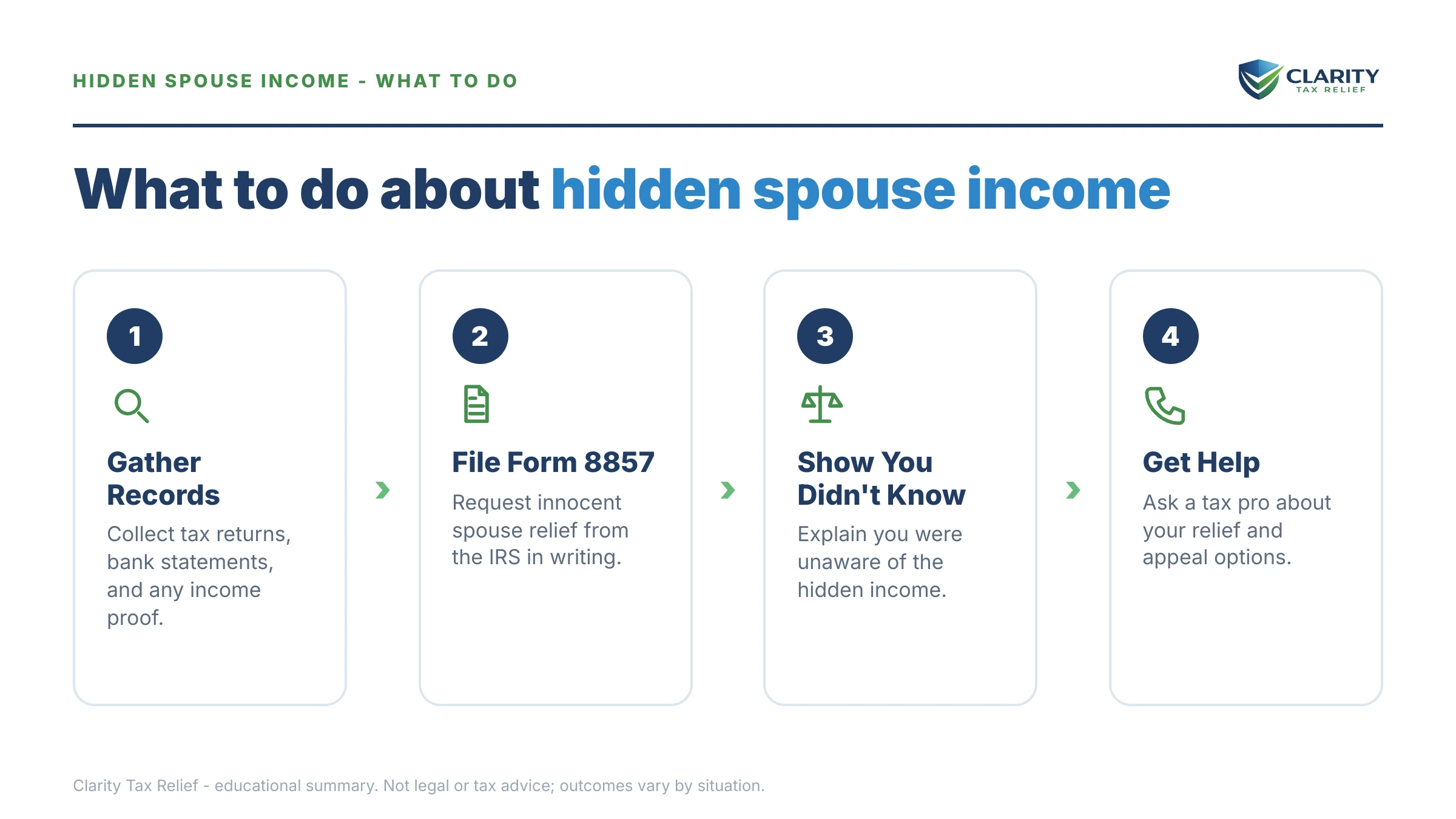
- Pull your IRS transcripts — Get your account transcript and wage &. Income transcript for the year in question so you can see exactly which 1099s or W-2s triggered the bill — and prove which payers were your spouse's, not yours.
- Answer any live notice deadline first — If you're holding a CP2000 or a 90-day Notice of Deficiency, respond by its printed date — filing for innocent spouse relief does not pause those clocks.
- Gather your evidence — Collect bank statements, the divorce or separation record if one exists, and anything showing your spouse controlled the hidden money — separate accounts, statements mailed elsewhere, passwords you were never given.
- File Form 8857 — One form asks the IRS to consider all three relief types for you. Mail or fax it with your documentation attached and keep a complete copy.
- Protect your appeal rights — Calendar every IRS response. If the determination denies relief, you generally have 90 days to petition the U.S. Tax Court — a deadline you cannot get back.
Our line-by-line Form 8857 walkthrough covers what each question is really testing. The IRS's own overview is at IRS.gov — Innocent spouse relief. The current form and instructions are at About Form 8857.
When you can handle this yourself, and when help changes the outcome
Form 8857 is free, and plenty of people file it successfully without help. You can reasonably handle this alone when the facts are clean: you're divorced, the hidden income traces entirely to your ex's payers, you have bank records showing you never touched the money, and no levy is in motion. Write the narrative plainly, attach documents for every claim, and file.
Experienced help tends to change outcomes in four situations. You're still married and living together, where the "reason to know" fight is at its sharpest. Some of the income arguably touches you — as a contractor, a shared client, a joint account deposit, or a jointly titled asset muddies allocation. Abuse or financial control is part of the story, which changes the legal analysis but demands careful, documented presentation. Collection is already active — a levy notice, a lien, or an offset — where sequencing the relief claim against the collection clock matters as much as the claim itself. If you can't afford representation, a Low Income Taxpayer Clinic or the Taxpayer Advocate Service may be able to step in.
One preventive note while any of this is unresolved: filing future returns as married filing separately keeps new years out of the joint-liability trap. The trade-offs are covered in married filing separately spouse owes irs.
Terms on your IRS letters, decoded
- Joint and several liability — each signer of a joint return owes 100% of the debt. The IRS can collect all of it from either of you.
- Understatement vs. underpayment — hidden income the return never showed is an understatement (all three relief types apply). Tax reported but never paid is an underpayment (equitable relief only).
- Actual knowledge vs. reason to know — "actual knowledge" means you knew of the specific hidden income; "reason to know" asks whether a reasonable person in your shoes would have questioned the return.
- Allocation — under separation of liability, the debt is divided based on whose income and items caused it, as if you'd filed separately.
- Non-requesting spouse — the other person on the joint return. The IRS must notify them of your claim, but never shares your address or employer.
- CSED — the 10-year collection statute expiration date. A pending Form 8857 pauses it, so relief requests extend the IRS's time to collect whatever remains yours.
Innocent spouse questions, answered
Can I get innocent spouse relief if we're still married and living together?
Yes — two of the three relief types have no divorce requirement. Classic innocent spouse relief under §6015(b) and equitable relief under §6015(f) are open to couples who are still married and living together. Only separation of liability under §6015(c) requires that you be divorced, legally separated, widowed, or living apart for the 12 months before you file. Staying married can make the knowledge and benefit questions harder, so documentation matters more.
How long do I have to file Form 8857?
Generally 2 years from the IRS's first collection activity against you for relief under §6015(b) or (c) — a levy, an offset of your refund, or a collection suit can all start that clock. Equitable relief under §6015(f) can be requested any time the 10-year collection statute is still open, or within the refund statute if you're seeking money back. Don't wait: bank records get purged and memories fade.
Will the IRS contact my spouse or ex-spouse if I file?
Yes — the law requires it. The IRS must notify the other person on the joint return and give them a chance to participate, even in cases involving abuse. What the IRS will not share is your current address, phone number, or employer information. If contact raises safety concerns, say so on Form 8857 — the form asks directly, and abuse changes how the IRS weighs the equity factors.
What if I signed the return without reading it?
Signing without reading doesn't disqualify you, but it doesn't excuse you by itself either. The IRS applies a 'reason to know' test: would a reasonable person in your position have questioned the return? Unexplained deposits, a lifestyle that outran the reported income, or being shut out of the finances all get weighed — active concealment by your spouse supports your case, while ignoring obvious red flags cuts against it.
What's the difference between injured spouse and innocent spouse relief?
Innocent spouse relief removes your liability for a joint tax debt caused by your spouse's errors — you're saying the debt shouldn't be yours. Injured spouse relief (Form 8379) recovers your share of a joint refund the IRS took for a debt that belongs only to your spouse, like their old taxes or child support. Hidden income on a joint return is an innocent spouse problem, not an injured spouse one.
Can the IRS collect from me while my Form 8857 claim is pending?
Generally no — a §6015 request suspends most collection against you while the IRS considers the claim, which often takes months. The trade-off is that the 10-year collection statute is paused for the same period plus 60 days, so the debt doesn't quietly age out while you wait. Interest continues to accrue on whatever portion ultimately stays with you.
My divorce decree says my ex pays this debt — am I protected?
Not from the IRS. A divorce decree binds you and your ex, not the federal government, so the IRS can still collect the full joint liability from either name on the return. The decree isn't useless — it's evidence in an equitable relief analysis and gives you a way to pursue your ex in state court — but it does not stop a levy on your income.
What happens if my innocent spouse claim is denied?
You can appeal inside the IRS, and if the final determination still goes against you, you generally have 90 days to petition the U.S. Tax Court — a genuine second look, not a rubber stamp. Denials often turn on thin documentation rather than bad facts, so an appeal with better evidence can succeed. If relief fails entirely, payment plans and hardship status remain available for the balance.
If your claim does come back denied, start with innocent spouse denied — the appeal path and the Tax Court clock are covered step by step.
Your next 24 hours
- Find the year and the income source on your notice. The tax year and the payer names on the CP2000 or bill tell you exactly what was hidden and where your evidence hunt starts.
- Gather three things: the joint return for that year, every bank statement you can access for it, and any record of separation, divorce, or who controlled the money.
- Get a free case review. The 2-year window on two of the three relief types may already be running, and interest compounds on the full balance either way. Call (888) 825-7779 or use the 2-minute form — an experienced tax professional will tell you which relief type your facts actually support.
This guide is general information, not tax or legal advice for your specific situation. Eligibility for IRS programs depends on individual facts and circumstances; no outcome is guaranteed.