
Divorce & Tax Debt
Divorce Decree and IRS Debt: Why the IRS Can Ignore Your Decree (2026)
The short answer: a divorce decree cannot stop the IRS from collecting a joint tax debt from you. Joint returns create joint and several liability under federal law, and the IRS was never a party to your divorce. Your real protections are innocent spouse relief, separation of liability, or equitable relief — all requested on Form 8857.
The judge signed it. The decree says, in black and white, that your ex pays the joint tax years. So why is the IRS notice addressed to you — for the full balance? That's the divorce decree IRS debt trap: the decree divided the debt between two people, but the federal assessment was never divided at all.
The fix isn't arguing the decree with the IRS — it's Form 8857, the one document that can actually move your name off a joint liability. The visual guide below maps the deadlines and relief options so you know what you're working toward as you read.
⏱ Your real deadline: for innocent spouse relief and separation of liability, you must file Form 8857 within 2 years of the IRS's first collection activity against you — a refund offset, a levy, or a collection suit can all start that clock. Equitable relief stays available longer, generally as long as the 10-year collection statute is open, but penalties and interest accrue on the joint balance every month you wait.
Why the IRS ignores your divorce decree
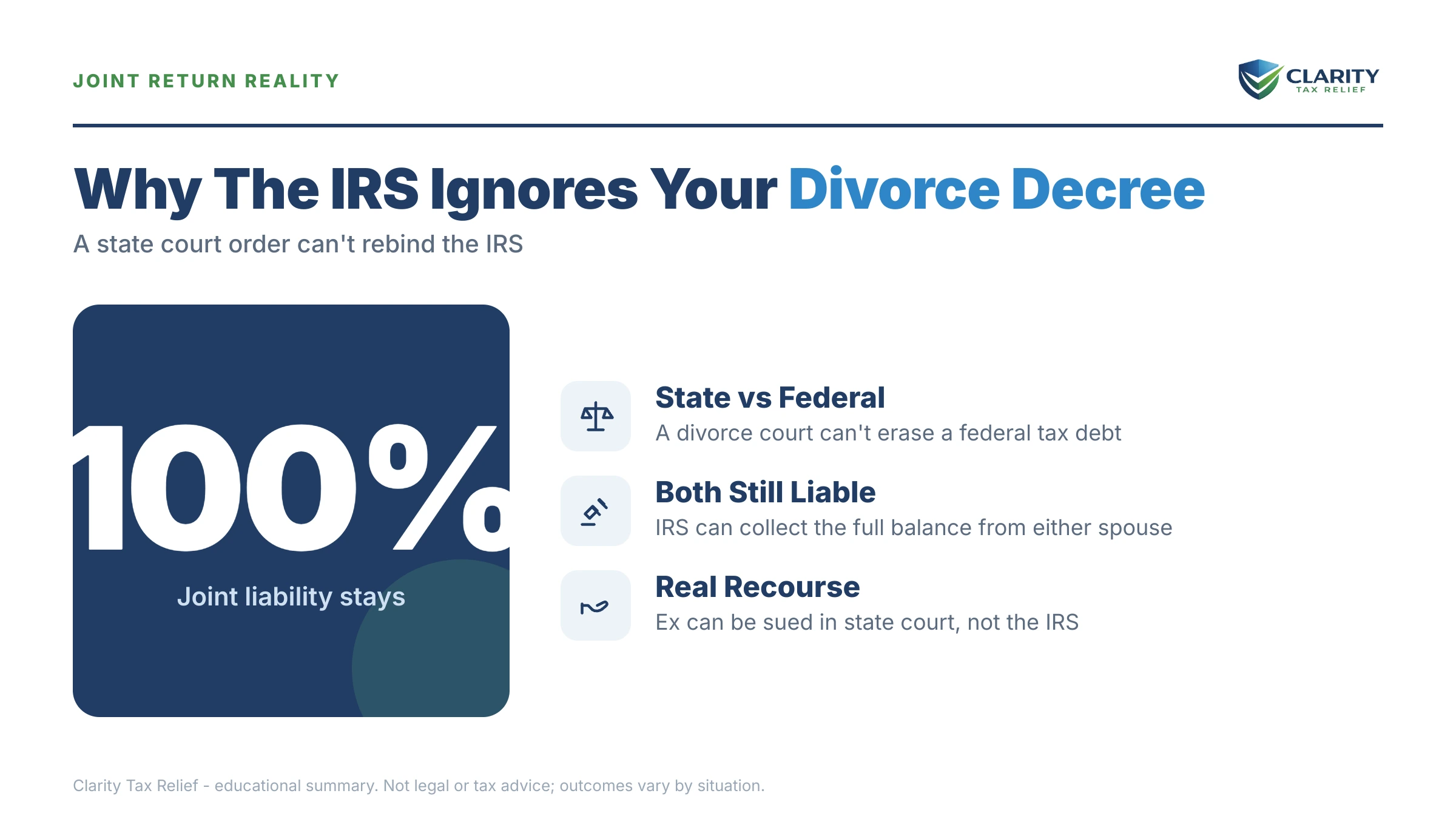
A divorce decree binds two ex-spouses. It does not bind the IRS, which can collect 100% of a joint tax debt from either person no matter what the decree says. When you signed a joint return, federal law (IRC §6013(d)(3)) made each of you individually responsible for the entire liability, not half of it. A state family-court judge has no authority to change a federal tax assessment.
Think of the decree as a contract between you and your ex about who writes the check. If your ex breaks that contract, you can haul them back to family court. But the IRS's computers see two names on the account. They will pursue whichever ex-spouse is easier to collect from, usually the one with a current address, a findable bank account, or steady deposits.
If you're a self-employed sole proprietor, that's often you. Your business checking account, your client receivables. Your annual refund are all visible and reachable, and unlike a wage earner, you have no employer between the IRS and your income to slow anything down.
| Question | Your divorce decree | Federal tax law |
|---|---|---|
| Who it binds | You and your ex-spouse only | Both signers of every joint return, individually, for the full amount |
| Can it stop IRS collection? | No — the IRS was not a party to the divorce | Yes — §6015 relief, payment, or the statute expiring are the only exits |
| Where it's enforced | State family court (contempt, money judgment) | IRS administrative process, Appeals, and federal courts |
| What it's worth to you | The right to recover from your ex what you pay, and a favorable factor in equitable relief | The Form 8857 relief paths and their 2-year window |
“When you file a joint tax return with your spouse, regardless of how you file, you are both responsible for the tax and any interest or penalty due. This is true even if: You later divorce A divorce decree states that your spouse is responsible for the taxes”
— Innocent spouse relief (IRS.gov)
What happens if you ignore a joint tax debt after divorce
A joint balance keeps both names on the account, and the IRS's automated collection stream escalates against both ex-spouses in parallel. Here's the sequence, in order:
- Bills and refund offsets. Balance-due notices go to each spouse's last known address — which may still be the old marital home, so you can miss them entirely. Every federal refund either of you is owed gets applied to the joint balance.
- CP504 — intent to levy your state refund. The IRS can take your state tax refund and a federal tax lien becomes likely. That lien attaches to property you kept in the divorce — including a house the decree awarded to you.
- LT11 / Letter 1058 — final notice. This starts a 30-day clock and your Collection Due Process rights. After it passes, the IRS can levy your bank accounts and, for a sole proprietor, send levies directly to your business clients for what they owe you.
- Passport certification. Once a balance is certified as seriously delinquent — the 2026 threshold is $66,000 — the State Department can deny or revoke your passport. A $76,400 joint debt clears that bar with room to spare.
Notice what's missing from that sequence: any step where the IRS reads your decree. It never does. The account escalates against the reachable spouse, and the decree only matters later, in a different courtroom.
The decree said this debt wasn't yours?
Get the joint balance reviewed free before the Form 8857 window narrows — the 2-year clock runs from the IRS's first collection step against you. It may already be ticking. An experienced tax professional will map which dollars can come off your name and which need a payment strategy.
Divorce decree IRS debt relief: your real options
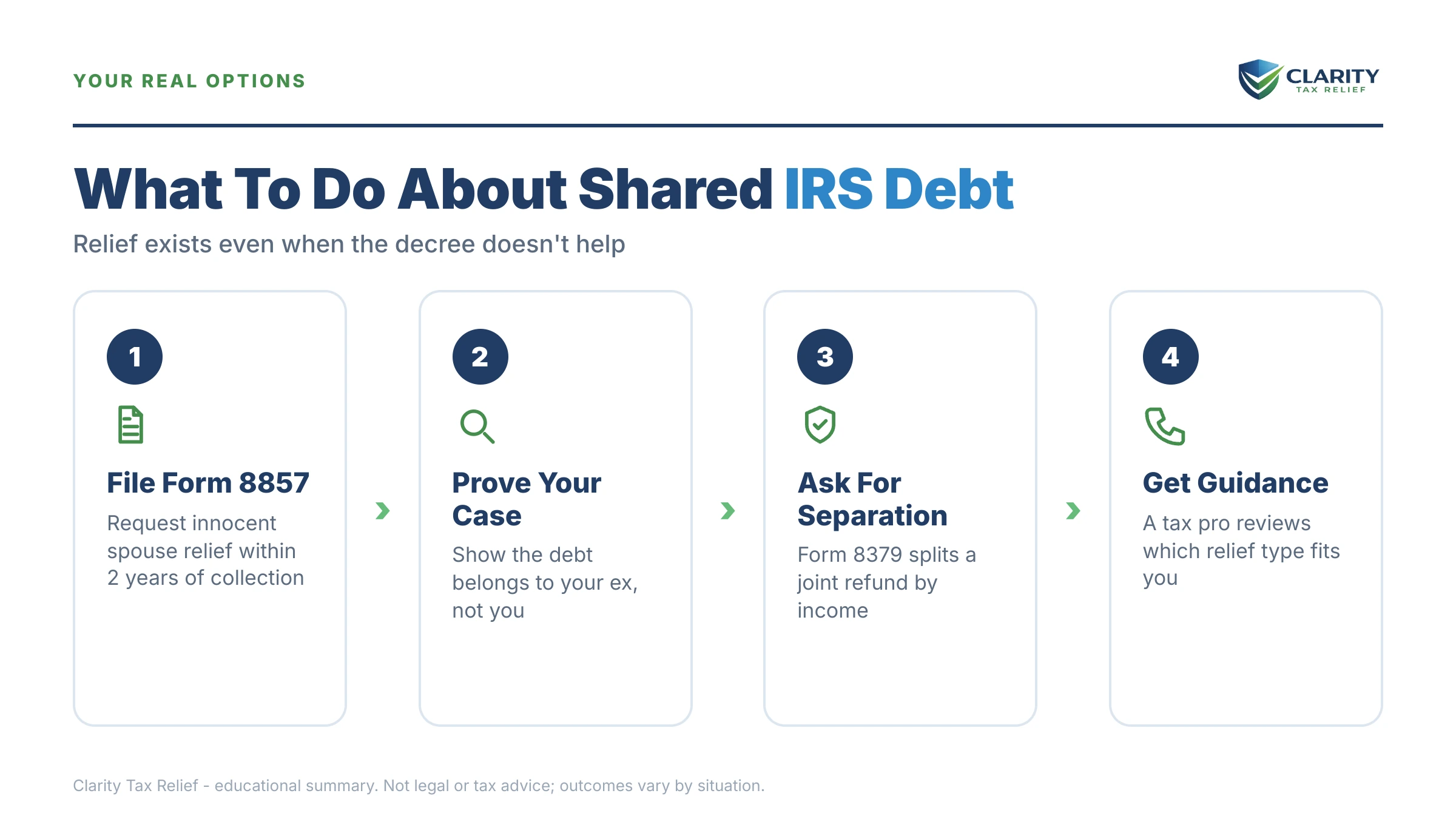
Federal law gives divorced taxpayers three distinct relief paths from a joint liability, and which one applies depends on how the debt arose. The single biggest fork: was the tax understated (the IRS added it later, through an audit or a CP2000 match) or simply unpaid (you both reported it but never sent the money)? Understatements can qualify for innocent spouse relief or separation of liability. Reported-but-unpaid balances qualify only for equitable relief — where, helpfully, the decree assigning the debt to your ex is a factor in your favor.
All three are requested on a single form; our Form 8857 walkthrough covers it line by line. For general balance-resolution mechanics — payment plans, offers, hardship status — see our guide to how to settle tax debt yourself. This table shows how each tool fits the post-divorce version of the problem.
| Option | Best fit after divorce | Filing window | The catch |
|---|---|---|---|
| Innocent spouse relief — §6015(b) | Understatement caused by your ex's income or deductions that you didn't know about | 2 years from first IRS collection activity against you | Knowledge, or reason to know, of the item usually defeats it |
| Separation of liability — §6015(c) | Divorced or legally separated; splits an understatement by whose income caused it | 2 years from first IRS collection activity against you | Only covers understatements, never unpaid reported tax; actual knowledge of the item blocks it |
| Equitable relief — §6015(f) | Reported-but-unpaid balances, especially where the decree assigned the debt to your ex | Generally any time the 10-year collection statute is open | Facts-and-circumstances test — helpful factors, no automatic wins |
| Injured spouse — Form 8379 | You remarried and your new joint refund was taken for the old debt | With, or after, the joint return that lost the refund | Recovers a refund; does not remove liability for the old debt |
| Installment agreement | Any portion that stays yours after relief | Any time | Above $50,000, financial disclosure is required; interest and penalties keep accruing |
| Offer in Compromise | The remaining debt genuinely exceeds what your income and assets could ever pay | Any time | $205 fee, means-tested; the IRS accepted roughly 1 in 5 offers in FY2024 |
| Currently Not Collectible | Paying anything would leave you unable to cover basic living expenses | Any time | Pauses collection but the balance keeps growing; the IRS re-reviews your finances |
Two edge cases worth flagging. If you divorced in a community property state and filed separately during the marriage, your ex's income can still land on your account — that's a different relief provision entirely, covered in our guide to community property tax relief. And if you're weighing a settlement on whatever balance survives, splitting a joint liability inside an offer has its own rules — see OIC divorced spouse.
One more thing states won't tell you: they ignore decrees too. If the marriage left you owing both a state agency and the IRS, the sequencing question is covered in state tax debt vs IRS — never assume a federal relief grant transfers to the state, because each state runs its own program on its own rules.
A worked example: $76,400 across two joint years
Say you're a self-employed sole proprietor whose decree assigned all joint tax debt to your ex. The IRS is now billing you $76,400 across two joint years. Pulling transcripts, the balance splits like this (hypothetical numbers):
- $41,000 — tax the IRS added after an underreporter match caught contract income your ex never told you about (an understatement).
- $24,000 — tax you both reported on the second year's return but never paid, driven partly by your own Schedule C profit (an underpayment).
- $11,400 — penalties and interest spread across both years.
Because you're divorced, separation of liability under §6015(c) can allocate the $41,000 understatement — plus, say, roughly $7,000 of the related penalties and interest — to your ex, since it flows from their income. That's about $48,000 potentially off your name, dropping your exposure from $76,400 to roughly $28,400.
The $24,000 underpayment is different. The share tied to your business income stays yours under every relief theory — no form removes tax on money you earned. Any slice tied to your ex's income can ride through equitable relief, with the decree as a supporting factor. On whatever remains, the math looks like this: the failure-to-pay penalty runs 0.5% per month — about $142 a month on $28,400 — plus compounding interest (you can rough out your own accrual with our penalty and interest calculator). A $28,400 balance is under the $50,000 streamlined line, so a 72-month online plan works out to roughly $395 a month before interest. Without any relief, the full $76,400 sits above $50,000 — meaning full financial disclosure before any plan, as explained in IRS payment plan over $50,000 — and above the $66,000 passport threshold.
Same debt, two very different futures, and the difference is the allocation work, not the decree.
What your decree is actually good for
The decree is far from worthless. It just works in a different courtroom. If the IRS collects from you money the decree assigned to your ex, you can enforce the decree in family court through a contempt motion or a money judgment for indemnification. And inside the IRS process, the decree strengthens an equitable relief claim, because your ex's legal obligation to pay is a factor the IRS must weigh. For the fuller picture of how judges and the IRS split marital tax debt in the first place, see divorce and IRS debt: who pays.
How to respond, step by step
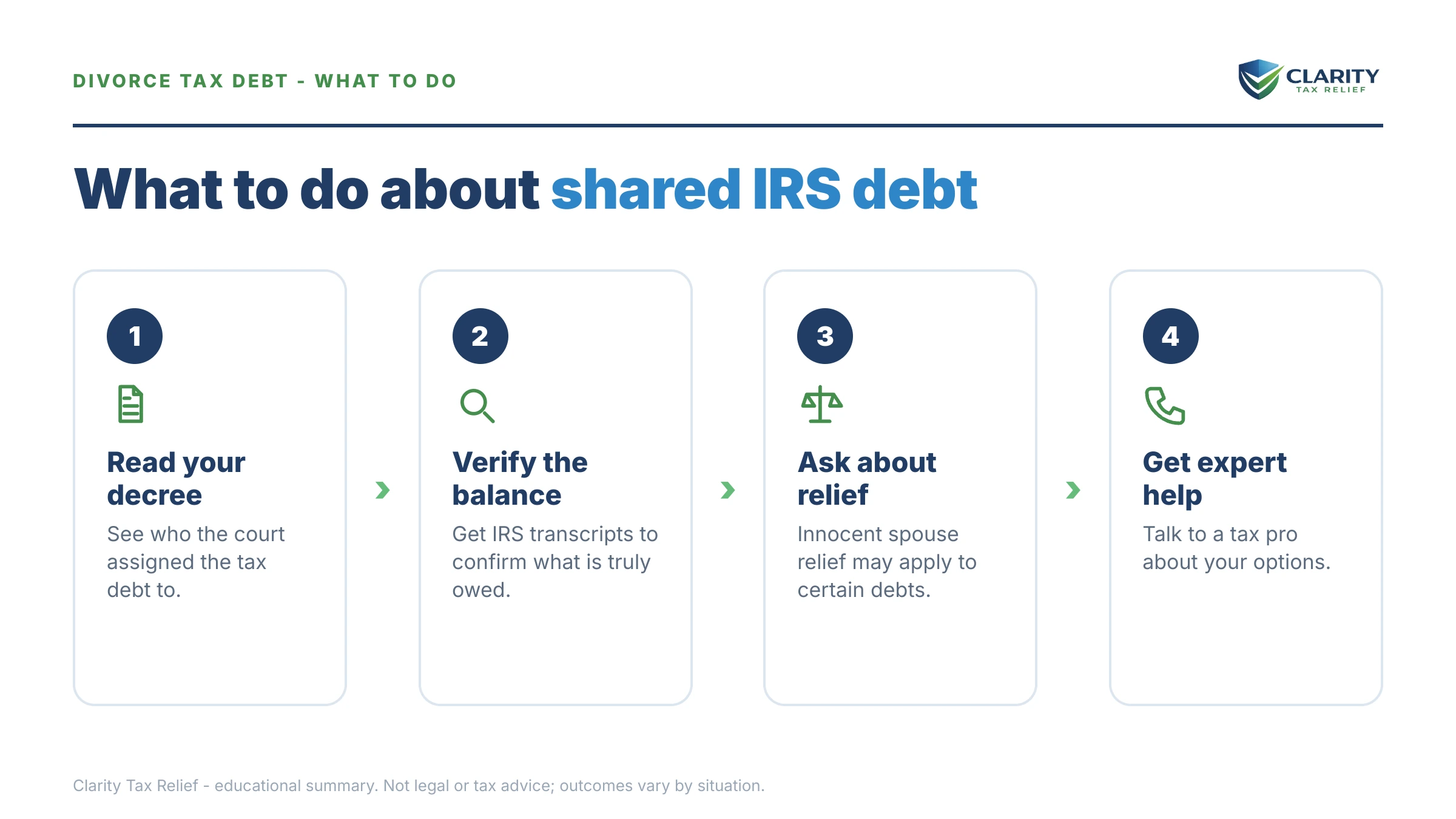
- Pull the record. Get an IRS account transcript for every joint year so you can see exactly what was assessed, when, and whether the IRS has already taken a collection step that started your 2-year Form 8857 clock.
- Sort every dollar. Split the balance three ways — tax the IRS added because of your ex's income (understatement), tax you both reported but didn't pay (underpayment), and penalties and interest — because each bucket has a different relief path.
- File Form 8857. One form requests all three kinds of relief — innocent spouse, separation of liability, and equitable relief. File within 2 years of the IRS's first collection activity against you, and attach the decree pages that assign the debt.
- Stabilize collection. Put any portion that will stay yours into a payment plan or hardship status so levies stop while the relief claim is decided — an 8857 pauses most collection against you, but not refund offsets.
- Enforce the decree. For anything you pay that the decree assigned to your ex, go back to family court for contempt or a money judgment — that is the only forum where the decree has teeth.
If part of the balance simply needs to be paid, compare your payment channels first — the best way to pay the IRS depends on whether you're paying in full, funding a plan, or making designated payments toward a specific year.
When you can handle this yourself, and when help changes the outcome
You can likely handle this alone if the joint balance is small enough to pay within 180 days, or if it's a single year under the streamlined limits and you're not contesting liability — set up the plan, pay it down, and pursue your ex in family court on your own timeline. A straightforward injured-spouse claim on a seized refund is also very DIY-able. If you've remarried and a new joint refund vanished, start with new spouse refund taken.
Experienced help changes outcomes when the allocation math gets contested. Know this going in: the IRS is required to notify your ex-spouse when you file Form 8857 and allow them to participate. An ex with a motive to dispute your version of events often does. (If domestic abuse is part of your history, the IRS still contacts the other spouse but does not share your address or personal information. Say so on the form.) Multi-year allocations, business income woven through joint returns, a levy already in motion, or an 8857 that was previously denied are all situations where the file needs to be built like a case, not a letter.
Terms on your paperwork, decoded
- Joint and several liability — each signer of a joint return owes the entire balance individually. The IRS can collect all of it from either person.
- Indemnification (hold-harmless) clause — the decree language making your ex responsible for the tax debt. Enforceable against your ex in family court, invisible to the IRS.
- Understatement vs. underpayment — tax the IRS added later (audit, CP2000) versus tax you reported but didn't pay. The first can qualify for §6015(b) or (c), the second only for §6015(f).
- Form 8857 — the single form that requests all three types of relief from joint liability.
- Injured spouse — a refund-recovery claim (Form 8379) for a current spouse's separate debt; not the same as innocent spouse relief.
- CSED — the Collection Statute Expiration Date: generally 10 years from assessment, though certain events pause it.
Divorce decree and IRS debt: your questions answered
Can the IRS ignore my divorce decree?
Yes. A divorce decree is a state-court order that binds you and your ex-spouse — the IRS was never a party to it and is not bound by it. Joint and several liability from a joint return survives divorce, so the IRS can collect the full balance from either of you. Your remedy against your ex runs through family court; your remedy against the IRS runs through Form 8857.
My divorce decree says my ex pays the taxes — why is the IRS billing me?
Because you signed the joint return, federal law makes you individually liable for every dollar of it. The decree does not amend that assessment. The IRS collects from whichever ex-spouse is easier to reach, often the one with a findable bank account or steady income. If you pay, the decree gives you the right to recover the money from your ex in family court, not from the IRS.
How long do I have to file Form 8857 after a divorce?
For classic innocent spouse relief and separation of liability, you must file within 2 years of the IRS's first collection activity against you — a levy, an offset of your refund, or a collection suit, for example. Equitable relief has a longer window: generally any time the 10-year collection statute is still open. Don't wait; the 2-year clock often starts before people realize it has.
Can I sue my ex if the IRS collects the debt from me?
Yes — in family court, not against the IRS. If the decree assigned the debt to your ex, paying it yourself gives you grounds to enforce the decree through a contempt motion or a money judgment for indemnification. That can shift the cost back where the judge put it, but it depends entirely on your ex having money or assets worth pursuing.
Does the divorce decree help my case with the IRS at all?
Yes, in one specific place: equitable relief under Section 6015(f). When the IRS weighs equitable relief, your ex-spouse's legal obligation to pay the debt under the decree is a factor in your favor — as long as you had no reason to believe, when the decree was signed, that your ex wouldn't pay. The decree never blocks collection by itself, but it strengthens a well-built relief request.
What's the difference between injured spouse and innocent spouse relief after divorce?
Injured spouse relief (Form 8379) recovers your share of a current refund that was seized for a debt that belongs only to your spouse. It matters most if you've remarried and file jointly with someone new. Innocent spouse relief (Form 8857) removes your personal liability for a joint debt from your prior marriage. Different forms, different problems; many divorced taxpayers eventually need both.
Will the IRS keep taking my tax refund for a joint debt from my marriage?
Yes — every refund you're owed will be applied to the joint balance until it's paid, relieved, or expires. Filing Form 8857 generally suspends levies against you while the claim is pending, but refund offsets can still happen during that time. If relief is granted, offsets against you for the relieved portion stop going forward.
Does it matter whether the tax was understated or just unpaid?
It matters more than almost anything else. Innocent spouse relief and separation of liability only apply to understatements — tax the IRS added later through an audit or CP2000 match. A balance you reported on the return but never paid qualifies only for equitable relief under Section 6015(f), which uses a broader facts-and-circumstances test where the decree itself carries weight.
Your next 24 hours
- Find two things: the tax clause in your decree (who was assigned which years) and the tax years and total balance printed on your most recent IRS notice. Write both down side by side.
- Gather the file: the joint returns for those years, the full decree, any IRS letters you've received, and note the date of the earliest collection action against you, because that's what the 2-year Form 8857 window runs from.
- Get a free case review: call (888) 825-7779 or use the 2-minute form. An experienced tax professional will map which dollars can come off your name under §6015 and which need a payment strategy, while penalties and interest are still accruing on the full joint balance every month.
For the IRS's own overview of these programs, see innocent spouse relief at IRS.gov. Payment options for any balance that stays yours are at IRS.gov/payments. If collection is causing hardship the normal channels won't fix, the independent Taxpayer Advocate Service can intervene.
This guide is general information, not tax or legal advice for your specific situation. Eligibility for IRS programs depends on individual facts and circumstances; no outcome is guaranteed.
Read the transcript
Host: The decree says your ex pays the joint tax years. A judge signed it. And the notice sitting on your kitchen table has your name on it — for the whole balance. Not half.
Tax specialist: Right. And that's not a mistake at the IRS. That's how the law is built.
Host: Explain that, because people find it hard to believe.
Tax specialist: When you signed a joint return, federal law, that's IRC 6013(d)(3), made each of you individually responsible for the entire liability. Not fifty-fifty. The whole thing, each of you. Then you divorced, and a state family-court judge divided the debt between two people. But the federal assessment was never divided at all. The IRS wasn't a party to your divorce.
Host: So the decree is just — what, a contract?
Tax specialist: That's a fair way to hold it. It's a contract between you and your ex about who writes the check. If your ex breaks it, you have somewhere to go with that. But the IRS computers see two names on one account, and they collect from whoever's easier to reach.
Host: Which usually means?
Tax specialist: Current address. Findable bank account. Steady deposits. If you're a self-employed sole proprietor, that's often you. Your business checking, your client receivables, your refund. And unlike a wage earner, there's no employer sitting between the IRS and your income to slow anything down.
Host: Okay. So what actually moves your name off the debt?
Tax specialist: One form. Form 8857. It requests three different kinds of relief — innocent spouse relief, separation of liability, and equitable relief. Same form, three paths, and which one fits depends on how the debt came to exist.
Host: Say more about that. How the debt came to exist.
Tax specialist: This is the biggest fork in the whole thing. Was the tax understated, or was it just unpaid? Understated means the IRS added it later — an audit, or a CP2000 underreporter match caught income that wasn't on the return. Unpaid means you both reported it correctly and never sent the money.
Host: And that changes which door you go through.
Tax specialist: Completely. Innocent spouse under 6015(b) and separation of liability under 6015(c) only touch understatements. A reported-but-unpaid balance qualifies only for equitable relief, 6015(f).
Host: Hm. And the deadlines aren't the same either, are they.
Tax specialist: No. For innocent spouse and separation of liability, you have to file Form 8857 within two years of the IRS's first collection activity against you.
Host: Two years from — wait. First collection activity. Define that, because I think people picture a levy.
Tax specialist: A levy counts, yes. But so does a refund offset. So does a collection suit. And that's the trap — a refund quietly disappearing three years ago may have started the clock, and nobody felt it start.
Host: So it may already be running.
Tax specialist: It may already be running. Equitable relief has a longer window — generally as long as the ten-year collection statute is open. But penalties and interest are accruing on the joint balance every month either way.
Host: Let's do the escalation for a second. If somebody just sets the notices aside — what's the order?
Tax specialist: Balance-due bills first, going to each spouse's last known address, which for a lot of people is still the old marital home. So you can miss them entirely. Refund offsets alongside that. Then CP504 — intent to levy your state refund, and a federal tax lien becomes likely.
Host: CP504. And the lien attaches to what?
Tax specialist: Property you kept in the divorce. Including a house the decree awarded to you. Then LT11, also issued as Letter 1058 — that's the final notice. Thirty-day clock, and it's when your Collection Due Process rights are live. After that passes, bank levies. And for a sole proprietor, the IRS can send levies straight to your clients for what they owe you.
Host: And the passport thing.
Tax specialist: Once a balance is certified seriously delinquent — the article gives the 2026 threshold as $66,000 — the State Department can deny or revoke a passport.
Host: Notice what's not in that list, though.
Tax specialist: There's no step where anybody reads your decree. There never is.
Host: Okay, the article walks a worked example and I want you to take it slow, because the numbers do the arguing.
Tax specialist: Hypothetical. Self-employed sole proprietor, decree assigned all joint tax debt to the ex, IRS is billing $76,400 across two joint years. You pull transcripts and it sorts into three piles. $41,000 is tax the IRS added after a match caught contract income the ex never mentioned — that's an understatement. $24,000 is tax both people reported on the second year and never paid, driven partly by the taxpayer's own Schedule C profit. And $11,400 in penalties and interest.
Host: 41, 24, 11-4. Got it.
Tax specialist: Because they're divorced, separation of liability under 6015(c) can allocate that $41,000 understatement to the ex, since it flows from the ex's income — plus, in the example, roughly $7,000 of related penalties and interest. So about $48,000 potentially off the name. Exposure goes from $76,400 to roughly $28,400.
Host: And the 24?
Tax specialist: Different animal. The share tied to your own business income stays yours under every theory. No form removes tax on money you earned.
Host: Say that again, simply.
Tax specialist: If you made the money, the tax on it is yours. Relief moves your ex's dollars, not yours. Any slice of the underpayment tied to the ex's income can be argued through equitable relief, and there the decree actually helps. Your ex's legal obligation to pay is a factor the IRS has to weigh.
Host: And the difference in what life looks like at 28,400 versus 76,400?
Tax specialist: Real. The failure-to-pay penalty runs half a percent a month — about $142 a month on $28,400. But $28,400 is under the $50,000 streamlined line, so a 72-month online plan pencils out around $395 a month before interest. The full $76,400 sits above $50,000, which means full financial disclosure before any plan, and it's above that $66,000 passport threshold. Same debt. The difference is the allocation work, not the decree.
Host: Two hard parts I want on the record before we close.
Tax specialist: Go.
Host: One — filing 8857 doesn't stop everything.
Tax specialist: Correct. It generally pauses most collection against you while the claim is pending. It does not stop refund offsets.
Host: And two. Your ex finds out.
Tax specialist: The IRS is required to notify your ex-spouse that you filed and let them participate. An ex with a motive to dispute your version often does. And if domestic abuse is part of your history, say so on the form — the IRS still contacts the other spouse, but doesn't share your address or personal information.
Host: What about the family-court side? Enforcing the decree, going after your ex for what you paid.
Tax specialist: That's a real remedy, and it's the only forum where the decree has teeth. It also sits outside what Clarity handles — that's a conversation for your own counsel. What we work is the federal side: transcripts, allocation, the 8857, and whatever balance stays yours.
Host: So next 24 hours. What are we asking for?
Tax specialist: Two documents, side by side. The tax clause in your decree — which years were assigned to whom. And your most recent IRS notice — the years and the total balance. Write them down next to each other. Then gather the joint returns for those years, the full decree, every IRS letter, and try to pin down the date of the earliest collection action against you, because that's what the two-year window runs from.
Host: And then a set of eyes on it.
Tax specialist: Free case review, 888-825-7779, or the short form on the page. Someone maps which dollars can come off your name under 6015 and which ones need a payment strategy. Eligibility depends on your specific facts — nobody can tell you the answer before the transcripts are read.
Host: Right. Start with the transcripts.