
IRS Transcripts
IRS Wage and Income Transcript: How to Get It and Use It to File (2026)
Read the transcript
Host: So the situation is: there are years you didn't file, and the paperwork for those years is just... not in your possession anymore. Divorce, a move, a box that stayed in the other house. And you're sitting there thinking you can't file because you don't have the W-2s.
Tax specialist: Right. And that's the wrong premise. You don't need those W-2s. Every one of them was already sent to the IRS by your employer, and the IRS filed it under your Social Security number. The document that shows you that list is called the wage and income transcript.
Host: Free?
Tax specialist: Free. Current year plus roughly the ten prior years.
Host: Okay, so what's actually on it.
Tax specialist: Every information return a third party filed about you. W-2s, 1099-NEC, 1099-K, 1099-B, 1099-R, interest and dividends, SSA-1099, W-2G, and the 1098 family — mortgage interest, tuition, student loan interest. For each one you get the form type, the payer partially masked, and the federal dollar boxes.
Host: Federal. You said federal twice.
Tax specialist: Because that's the biggest trap on this whole topic. There is zero state or local tax data on the transcript. Your state withholding boxes come back blank. The article's blunt about it. That single omission causes more filing mistakes than anything else here.
Host: So where does state withholding come from?
Tax specialist: Your final paystub for the year, the original W-2 if you ever find it, or a wage record from your state tax or labor agency. If you skip it you can forfeit credit for money you already paid in.
Host: Hm. What else isn't on there?
Tax specialist: Cash income nobody reported — doesn't appear, still has to go on the return. Cost basis on investment sales, often missing. So a 1099-B might show gross proceeds with no basis, and if you file off proceeds alone you wildly overstate the gain. Get basis from the broker. And the transcript tells you nothing about IRS activity on your account — no payments, no penalties, no holds.
Host: Where does that live?
Tax specialist: The account transcript. Different document. Pull both, for every open year. The wage and income one tells you what income to report. The account one tells you what the IRS has already done about that year, whether a return posted, that's code 150, whether there's already an assessment sitting there, code 290.
Host: Code 150 and code 290. Got it. And there are more than two transcript types, right? People order the wrong one?
Tax specialist: All the time. Five types. Tax return transcript shows what you filed — only exists if you filed. Record of account is the two combined. Verification of non-filing just confirms nothing's on file, which lenders and financial aid sometimes want.
Host: Let's do how to get it. Fastest first.
Tax specialist: IRS online account. Sign in, go to the transcripts section, download each year as a PDF. You have to verify your identity through ID.me. That's minutes, not weeks.
Host: And if the online thing doesn't work for you?
Tax specialist: Form 4506-T by mail or fax. You check the wage and income box, which is line 8, list your years, and wait, typically a few weeks.
Host: Line 8. Line 8 is the wage and income box.
Tax specialist: Line 8. And third route, a tax professional pulls them directly from IRS systems with your signature on Form 8821 or Form 2848, often same day, and you're not fighting the phone lines.
Host: Why does that matter if I can just download it myself?
Tax specialist: Masking, mostly. The standard version hides employer names and ID numbers partially, for identity theft protection. Usually that's enough to prepare a return. If you need the unmasked copy, the IRS mails it to your address of record, so if you moved after the divorce, update the address with Form 8822 first, or have someone pull it under that authorization.
Host: Okay. Say something for me more simply, though. Why not just wait? Nothing's happened yet.
Tax specialist: Because the sequence is automated and it's already running. The IRS holds those forms, so its computers know which years are missing. First comes CP59. We have no return from you. Then CP516, then CP518, which is the final request before the IRS starts building the return for you.
Host: Building it. Meaning—
Tax specialist: Substitute for Return. SFR. They draft it using only the income on your wage and income transcript. Single or married filing separately, standard deduction, no dependents, no business expenses. The article calls it the worst legal version of your return, and that's fair.
Host: And then?
Tax specialist: CP3219N. The 90-day letter — a statutory notice of deficiency for non-filers. Ninety days to file your own return or petition Tax Court before that number becomes a legal assessment. After that it posts to your account, the failure-to-file penalty and interest ride on top, and the regular collection notices start.
Host: The penalty number is in the article — 5% a month?
Tax specialist: 5% per month, capped at 25%, on a year where you owe. Plus interest.
Host: And the refund side. That's the one that scares me, because there's no notice at all.
Tax specialist: None. It just closes. Three years from the return's original due date to claim a refund. The 2022 window closed in April 2026. The 2023 window closes in April 2027. Nobody writes to tell you it's gone.
Host: So on years where the IRS owes you, silence is not good news.
Tax specialist: Silence is the clock running.
Host: Walk me through the article's example. Because I think this is where it clicks.
Tax specialist: It's hypothetical, they say so. A 2023 transcript showing $83,100 total. A W-2 with $66,900 in wages and $6,850 federal withheld, a 1099-NEC for $15,800 of freelance design, and $400 of bank interest.
Host: $83,100 total. Same number either way, right?
Tax specialist: Same reported income either way. The difference is what gets built around it. An SFR treats the whole $15,800 as pure profit with self-employment tax on it, files you as single or married filing separately, claims no dependents. If instead you file your own return, you're the one who can claim head of household if your daughter lives with you, deduct documented software, mileage and home office costs against the freelance income, claim the child tax credit, and get credit for the $6,850 already withheld.
Host: So it's not magic. It's that you get to put your actual facts in.
Tax specialist: That's the whole mechanism. And the hard part is the documenting. The gap between transcript gross and actual profit is where the money is, and nobody but you can produce those receipts and mileage logs.
Host: Two divorce-specific things the article flags — go.
Tax specialist: One, confirm who claims the child under the decree and Form 8332. If you both claim, expect a duplicate dependent notice. Two, look hard at any 1099-R. A retirement split under a QDRO is taxed very differently from a plain cash-out, and the transcript cannot tell you which one happened.
Host: And the transcript's per-SSN, so I can't see my ex's income on it.
Tax specialist: Correct. Per-SSN, not per-household, even for joint years. Their W-2s are on their transcript.
Host: Last thing. Does pulling this thing wake the IRS up?
Tax specialist: No. Routine records pull, millions a year, doesn't flag you for examination. And if you have unfiled years, the computers already know from the forms on file. Requesting it changes one thing — now you can see what they see.
Host: So next 24 hours.
Tax specialist: Write out every unfiled year and every employer, client, bank and platform you can remember for each — that's your completeness checklist. Set up the IRS online account and download the wage and income transcript plus the account transcript for each year. And know that current-year data usually isn't complete until late summer, so a thin-looking current year isn't necessarily wrong.
Host: And if it's one or two clean W-2 years?
Tax specialist: Do it yourself. Transcript, paystub for state withholding, file, set up a plan online. The article says it plainly — anyone telling you otherwise is selling. Where experienced help changes things is when an SFR already exists, or multiple years are open and some owe while others refund, or there's self-employment income with thin records, or a 1099-B with no basis.
Host: And that's what Clarity's Enrolled Agents do — pull the transcripts for every open year, tell you which returns actually need filing. Free case review, (888) 825-7779. Nothing about your specific situation is decided by anything we said here.
The short answer: an IRS wage and income transcript lists every W-2, 1099, and other income form reported to the IRS under your Social Security number — for the current year and up to 10 prior years. Download it free in minutes through your IRS online account, or request it by mail with Form 4506-T.
The divorce is final, the file cabinet with every W-2 and tax folder stayed in the other house, and now you're the one who has to file — maybe for more than one year. Here's the part nobody tells you: you don't need those files. The IRS has been quietly keeping a copy of every income form ever filed under your SSN, and it will hand you the list for free.
That list is the wage and income transcript, and it's the single most useful document for anyone rebuilding returns without records. The image below shows exactly what a wage and income transcript looks like and where each reported form appears, so you'll recognize what you're reading before you download your own.
⏱ The real clock: you have 3 years from a return's original due date to claim its refund. The 2022 refund window closed in April 2026; the 2023 window closes in April 2027. And on any unfiled year where you owe, the failure-to-file penalty grows at 5% per month, up to 25%, plus interest.
Why you need a wage and income transcript
A wage and income transcript is the IRS's own record of every information return filed under your SSN for a given year. Every January through March, employers, banks, brokers, gig platforms, and casinos send copies of W-2s and 1099s to the government. The IRS files them by Social Security number, and the wage and income transcript is your window into that file.
People pull this transcript for four main reasons:
- Filing back taxes without records. Lost W-2s, a vanished employer, an ex who kept the paperwork — the transcript replaces most of it. Our guide to filing back taxes with no records covers the full reconstruction process.
- Seeing what the IRS will match against your return. The IRS's underreporter computers compare your filed return to these exact forms. If you file a return that omits a 1099 on this transcript, a CP2000 notice follows a year or two later.
- Checking a substitute return. If the IRS filed a substitute return for you, the transcript shows the income figures it used — the starting point for filing a correct return that replaces it.
- Verifying old income for a mortgage, immigration filing, or income-driven loan application when the originals are gone.
One important limit for divorced filers: the transcript is per-SSN, not per-household. Your transcript shows only forms issued under your number, even for years you filed jointly, your ex's W-2s appear on their transcript, not yours. You cannot use it to see an ex-spouse's income.
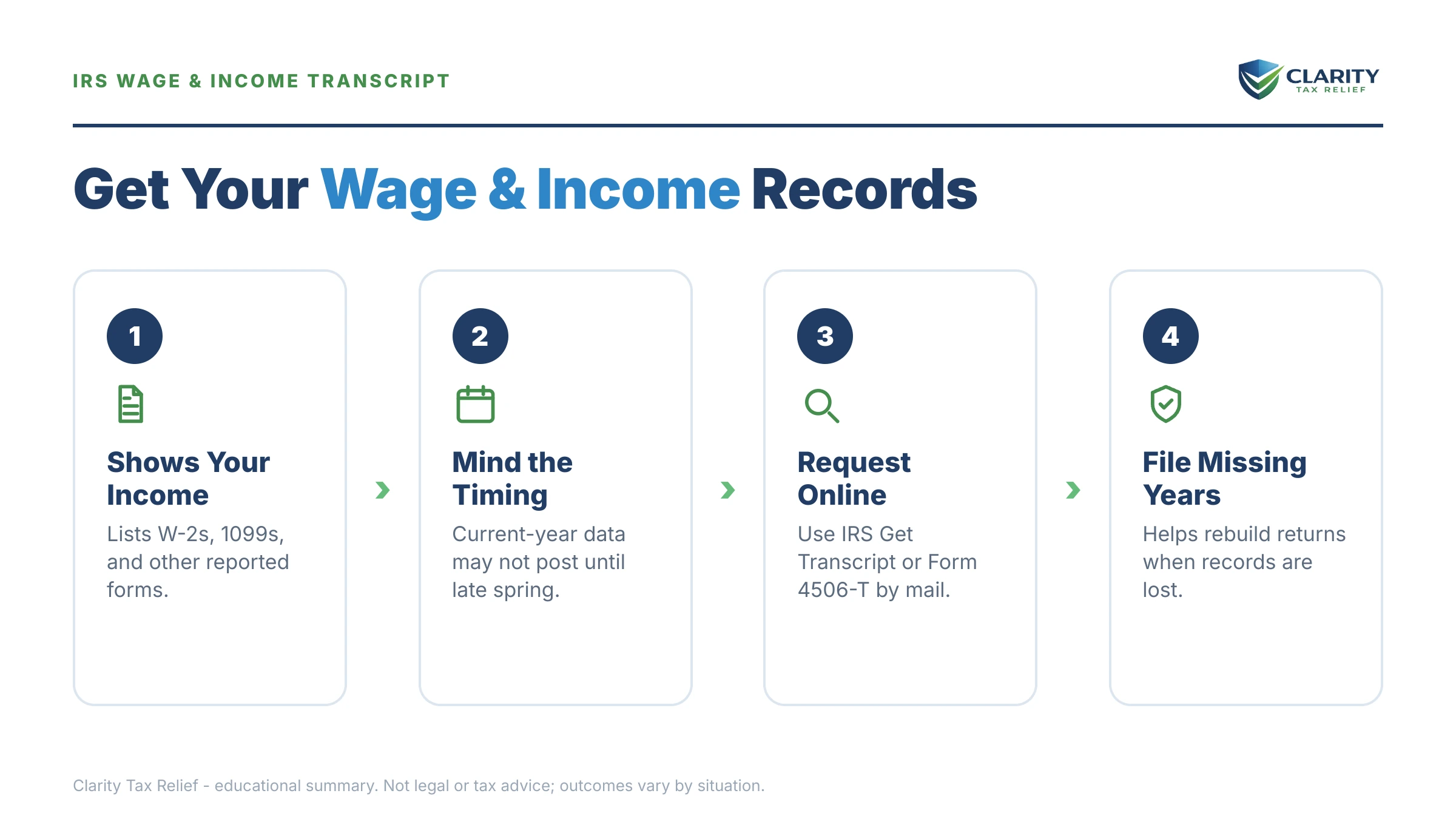
“Wage and income transcript - shows data from information returns we receive such as Forms W-2, 1098, 1099, and 5498. Information for the current processing year will generally be available in the first week in February.”
— Transcript types for individuals and ways to order them (IRS.gov)
What a wage and income transcript shows: form by form
The transcript reports every information return a third party filed about you, with the federal dollar boxes from each form. For each document you'll see the form type, the payer (partially masked). The key amounts — wages, federal withholding, nonemployee compensation, gross proceeds, and so on.
| Form | What it reports | The gotcha when filing from the transcript |
|---|---|---|
| W-2 | Wages and federal withholding from an employer | State and local withholding boxes are blank — federal data only |
| 1099-NEC | Contractor / freelance pay of $600+ from a client | Shows gross pay only; your business expenses are on you to document |
| 1099-K | Payment-platform totals (threshold back at $20,000 / 200 transactions) | Gross figure may overlap with 1099-NECs from the same clients — don't double-count |
| 1099-B | Stock and crypto-broker sale proceeds | Often shows proceeds without cost basis — filing from proceeds alone wildly overstates gains |
| 1099-R | Retirement account and pension distributions | A divorce-year 401(k) split or cash-out shows here; taxability depends on rollover facts the transcript can't show |
| 1099-INT / 1099-DIV | Bank interest and dividends | Small amounts you forgot about are the classic CP2000 trigger |
| SSA-1099 / W-2G | Social Security benefits / gambling winnings | W-2G shows winnings only — losses must come from your own records |
| 1098 / 1098-T / 1098-E | Mortgage interest, tuition, student-loan interest paid | These are the deduction side — easy to miss because they lower your bill, not raise it |
What the transcript does NOT show
A wage and income transcript contains zero state or local tax data. That single omission causes more filing mistakes than anything else on this topic. It also won't show:
- Cash or unreported income. If no one filed a form, nothing appears, but you're still required to report the income.
- Cost basis on many investment sales. Get basis from the broker or you'll be taxed on gross proceeds.
- Your account balance or IRS activity. Payments, penalties, and holds live on the account transcript — see how to read an IRS account transcript for that side of your file, including what code 150 (a return posted — yours or an IRS substitute) and the "as of" date actually mean.
- Complete current-year data before summer. Payers file in Q1 and IRS processing takes months, so a 2025 transcript pulled in March 2026 will look thin. Check again by late summer.
Note the masking: employer names and ID numbers appear only partially on the standard transcript, for identity-theft protection. That's usually enough to prepare a return. If you need the unmasked version, the IRS mails it to your address of record, so if you moved after the divorce, update your address (Form 8822) first, or have a tax professional pull it directly under a Form 8821 authorization.
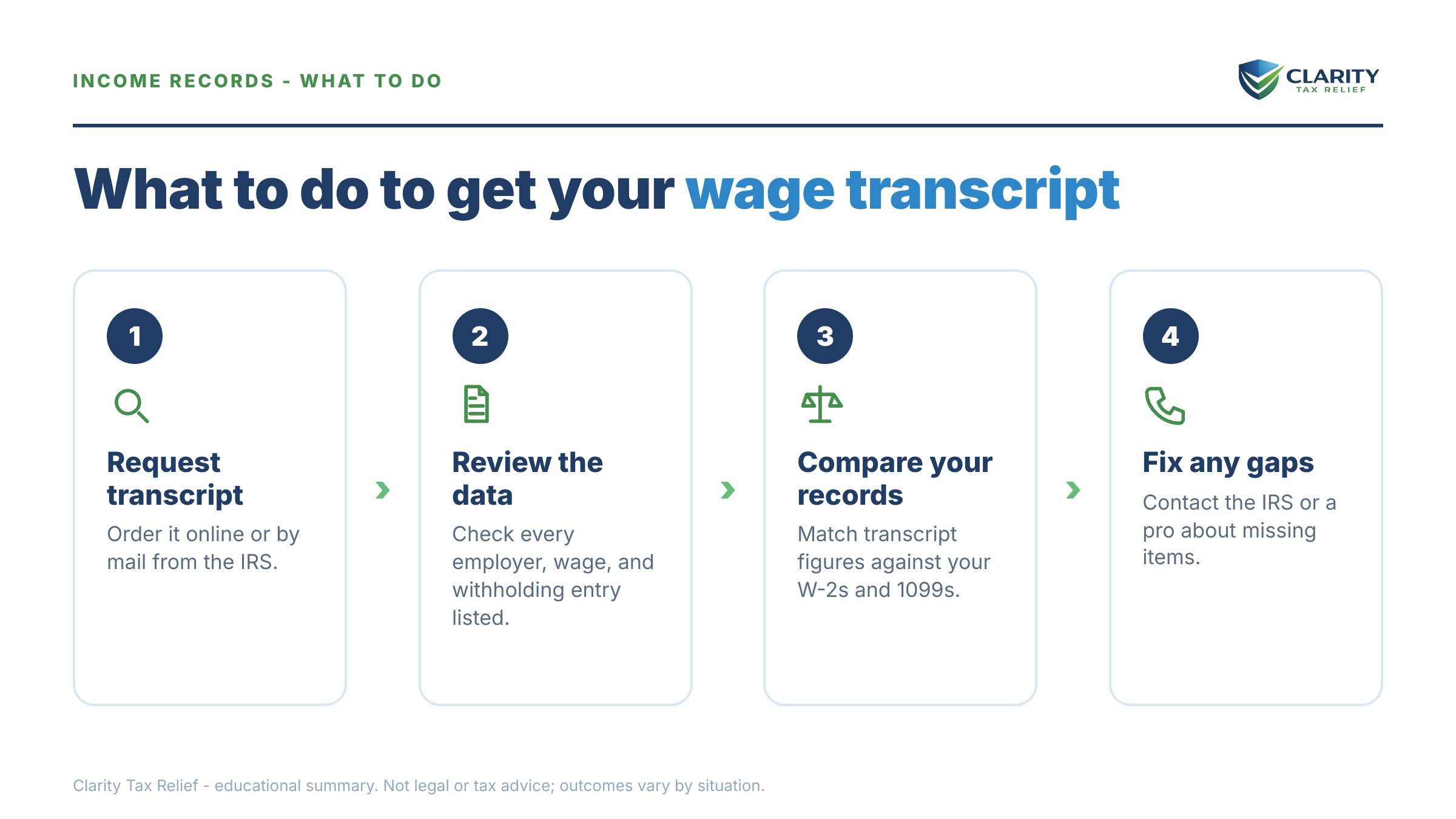
What happens if the unfiled years stay unfiled
The IRS already holds every form on your wage and income transcript — its computers know exactly which years you skipped. Non-filing works through its own automated sequence, and each stage takes options off the table:
- CP59 notice — the IRS's first "we have no return from you" letter for a year where it holds income documents. See the CP59 guide. Filing now, on your own numbers, is still fully in your control.
- CP516, then CP518 — escalating reminders. The CP518 is the final request before the IRS starts building the return for you.
- Substitute for Return (SFR) proposal — the IRS drafts a return using only the income on your wage and income transcript: single or married-filing-separately, standard deduction, no dependents, no business expenses. It's the worst legal version of your return.
- CP3219N — the 90-day letter. A statutory notice of deficiency for non-filers: 90 days to file your own return or petition Tax Court before the SFR amount becomes a legal assessment. See the CP3219N guide.
- Assessment and collection. The inflated balance posts to your account, the failure-to-file penalty (5%/month, capped at 25%) and interest are added. The standard collection-notice sequence begins — ending in liens and levies if ignored.
- The refund side dies quietly. On years where you were owed money, no notice ever comes — the 3-year window simply closes and the refund is forfeited. Details in the 3-year refund deadline.
In 2026, IRS staffing is down sharply, but this entire sequence is automated. The computers that generate CP59s and SFRs never got laid off. You can estimate what an unfiled year is costing you each month with our Penalty & Interest Calculator.
Staring at unfiled years the IRS already has income forms for?
We'll pull your wage and income transcripts for every open year, tell you which returns actually need filing, and map the cheapest way through — free and confidential. Every month an unfiled balance-due year sits, the failure-to-file penalty grows.
How to get your IRS wage and income transcript (every method)
There are three ways to get a wage and income transcript, and all of them are free.
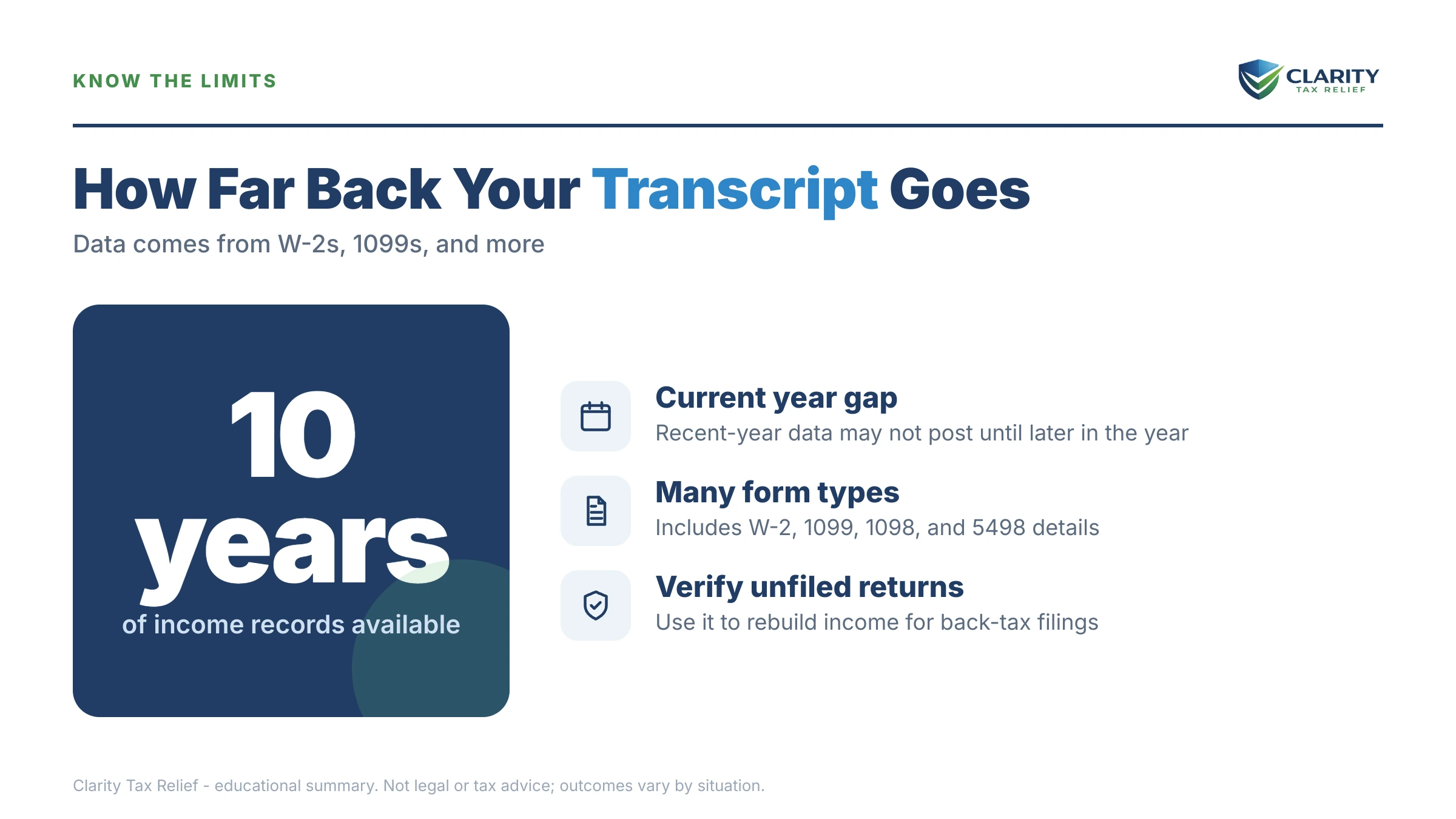
- IRS online account (fastest). Sign in at your IRS online account, open the transcripts section, and download the wage and income transcript for each year as a PDF — instantly, for roughly the last 10 years. You'll need to verify your identity through ID.me. Full walkthrough: getting your transcripts online.
- Form 4506-T by mail or fax. Check the wage and income box (line 8), list the years, and wait, typically a few weeks. This is also the route to the unmasked version, mailed to your address of record.
- Through a tax professional. With your signature on Form 8821 or Form 2848, an experienced tax professional can pull unmasked transcripts for all open years directly from IRS systems, usually the same day, and without you fighting the phone lines.
Make sure you're ordering the right document. The IRS issues five different transcript types, and people routinely request the wrong one:
| Transcript type | What it shows | When you need it |
|---|---|---|
| Wage & income | Every W-2, 1099, 1098, and other info return filed under your SSN | Rebuilding returns without records; checking what the IRS will match |
| Tax account | Assessments, payments, penalties, holds — the transaction-code history | Finding out whether a year was filed, assessed, or SFR'd, and what you owe |
| Tax return | Line items from the return you actually filed | Proving what you reported (mortgages, financial aid) — only exists if you filed |
| Record of account | Return + account transcripts combined | Disputes where you need filed figures and IRS activity side by side |
| Verification of non-filing | Confirmation that no return is on file for a year | Financial-aid and lender requirements for non-filers |
Pull the wage and income transcript and the account transcript together for every open year. The first tells you what income to report. The second tells you what the IRS has already done about that year — including whether an assessment like code 290 (additional tax assessed) is already sitting on the account.
A worked example: rebuilding a return from the transcript
Say your 2023 wage and income transcript shows $83,100 reported under your SSN — and, like a lot of recently divorced filers, you have none of the original paperwork. This is hypothetical, but the math is how it actually works:
- W-2 from your employer: $66,900 in wages, $6,850 federal withholding
- 1099-NEC from freelance design work: $15,800
- 1099-INT from your bank: $400
- Total on the transcript: $66,900 + $15,800 + $400 = $83,100
If the IRS files the SFR: it taxes the entire $83,100, treats the full $15,800 of freelance income as pure profit (plus self-employment tax on it), files you as single or married-filing-separately with only the standard deduction, and claims no credits for your kids. Then it stacks the 25% maximum failure-to-file penalty and interest on top.
If you file your own return: you claim head of household because your daughter lives with you, deduct $5,900 of documented software, mileage, and home-office costs against the freelance income (dropping it to $9,900 of profit), claim the child tax credit, and get credit for the $6,850 already withheld. Same transcript, same $83,100 of reported income — a dramatically smaller bill, and in a scenario like this the difference between the SFR and a properly built return routinely runs into the thousands.
Two divorce-specific checks before you file from the transcript: confirm who claims the child under the decree and Form 8332 (if you both claim, expect a duplicate-dependent notice), and look closely at any 1099-R — a retirement split done under a QDRO is taxed very differently from a plain cash-out. The transcript can't tell you which one happened.
How to get and use your wage and income transcript, step by step
- Sign in to your IRS online account (or create one with ID.me verification) — it's the fastest way to see everything the IRS has under your SSN.
- Download the wage and income transcript for every missing year, up to about 10 years back. The account transcript for each of those years too.
- Check each year for completeness: every employer, client, bank, and broker you remember should appear, and current-year data generally isn't full until summer.
- Fill the gaps the transcript can't cover — state withholding from paystubs or your state agency, stock cost basis from your broker, and any cash income from bank deposits.
- Prepare and file each return, oldest first, matching or explaining every form on the transcript, and compare your numbers against any substitute return the IRS already filed.
- Resolve what the filings produce: claim any refund still inside its 3-year window, and set up a payment arrangement on any balance before collection notices start.
Not sure how many years actually need filing? In most cases the IRS expects the last six — the details are in the 6-year lookback rule. And if a single recent W-2 is all you're missing, getting old W-2s and income records covers the quicker employer-side routes too.
When you can handle this yourself, and when help changes the outcome
If you're missing one or two straightforward W-2 years, you can do this entirely on your own. Pull the transcript, grab state withholding from a paystub, file the returns, and pay or set up a plan online. No professional needed, and anyone who tells you otherwise is selling.
Experienced help starts paying for itself when:
- The IRS already filed substitute returns — replacing an SFR assessment involves reconsideration procedure, not just mailing a 1040.
- There's meaningful self-employment income and the expense records are thin — the gap between "transcript gross" and "actual profit" is where most of the money is.
- Multiple years are open and some owe while others refund — the filing order and timing affect penalties, offsets, and which refunds survive.
- Divorce-year issues are tangled in — disputed dependents, a QDRO distribution, or a joint-year balance your decree says your ex must pay (the IRS doesn't honor decrees — see divorce and IRS debt: who pays).
- 1099-B years show big proceeds with no basis — filing those wrong in either direction is expensive.
Terms on your transcript, decoded
- Information return — any form a third party (employer, bank, platform) files with the IRS to report money it paid you: W-2s, 1099s, 1098s, W-2Gs.
- Payer — the entity that issued the form; on masked transcripts its name and EIN appear only partially.
- Masked transcript — the standard version with identifying details partially hidden for identity-theft protection. An unmasked copy is available by mail or through a tax professional.
- Substitute for Return (SFR) — the return the IRS builds for a non-filer using only transcript income: no dependents, no expenses, worst-case filing status.
- Form 4506-T — the paper request form for any transcript type; line 8 is the wage and income box.
- Form 4852 — the substitute W-2/1099-R you attach to a return when the original form is lost, built from transcript figures.
Wage and income transcript questions, answered
How many years back can I get an IRS wage and income transcript?
The IRS makes wage and income transcripts available for the current year and roughly the 10 prior years. You can pull most of those instantly through your IRS online account, and Form 4506-T covers the same window by mail. If you need records older than 10 years, the transcript system generally can't help — you'll have to reconstruct income from bank records, Social Security earnings statements, and old employer paperwork.
Does a wage and income transcript show state tax withholding?
No. The transcript reports only federal data — wages, federal income tax withheld, and the other boxes payers send to the IRS. State and local withholding boxes come back blank. To file a state return you'll need the original W-2, your final paystub for the year, or a wage record from your state's tax or labor agency.
Why is my current-year wage and income transcript blank or incomplete?
Employers and payers file W-2s and 1099s with the government in the first months of the year. The IRS then has to process millions of them. Current-year data generally isn't complete on the transcript until summer. If a prior year is missing a form you know existed, the payer may never have filed it — you're still required to report that income.
Can I file a tax return using a wage and income transcript instead of a W-2?
Yes. The transcript gives you the federal wage and withholding figures, and Form 4852 (a substitute W-2) lets you attach those numbers to your return when the original is lost. The catch is state withholding, which the transcript omits — pull that from a final paystub or your state agency so you don't forfeit state credit you already paid.
Does the wage and income transcript show cash or self-employment income?
It shows only income that someone reported to the IRS on an information return — a 1099-NEC from a client, a 1099-K from a payment platform, a W-2G from a casino. Cash income nobody reported won't appear, but you're still legally required to include it on your return. Filing only what the transcript shows on a year with known cash income invites trouble later.
Why are names and ID numbers partially hidden on my transcript?
The IRS masks transcripts to protect against identity theft, so employer names and taxpayer ID numbers appear only partially. The masked version is usually enough to prepare a return. If you need a fully unmasked wage and income transcript, the IRS will mail one to your address of record, or an experienced tax professional can pull it directly with your authorization on Form 8821 or Form 2848.
Will requesting my wage and income transcript trigger an audit?
No. Transcript requests are routine records pulls, millions happen every year, and they don't flag your account for examination. If you have unfiled years, the IRS's computers already know from the W-2s and 1099s on file. Requesting the transcript changes nothing except that now you can see what they see and fix it on your terms.
What if the income on my wage and income transcript is wrong?
Two common causes: a payer filed an incorrect form, or someone used your Social Security number. For a payer error, contact them and request a corrected W-2c or 1099. If you see wages from an employer you never worked for, that's an identity-theft signal — file Form 14039 and consider an IP PIN so it can't happen again.
Your next 24 hours
- List every unfiled year and every employer, client, bank, and platform you can remember for each — that's your completeness checklist against the transcript.
- Set up your IRS online account and download the wage and income transcript plus the account transcript for each of those years.
- Get a free case review, if you're facing multiple years, a substitute return, or divorce-year complications, send us what you pulled at the 2-minute form or call (888) 825-7779. On any balance-due year, penalties and interest are accruing monthly until a return is filed.
Primary sources: the IRS's Get Transcript page explains each transcript type and access method; About Form 4506-T covers the mail request. And the Taxpayer Advocate Service can help when transcript or processing problems stall your case.
This guide is general information, not tax or legal advice for your specific situation. Eligibility for IRS programs depends on individual facts and circumstances; no outcome is guaranteed.