
IRS Transcript Codes
IRS Code 150 on Your Transcript: The Amount, the Date and What It Means (2026)
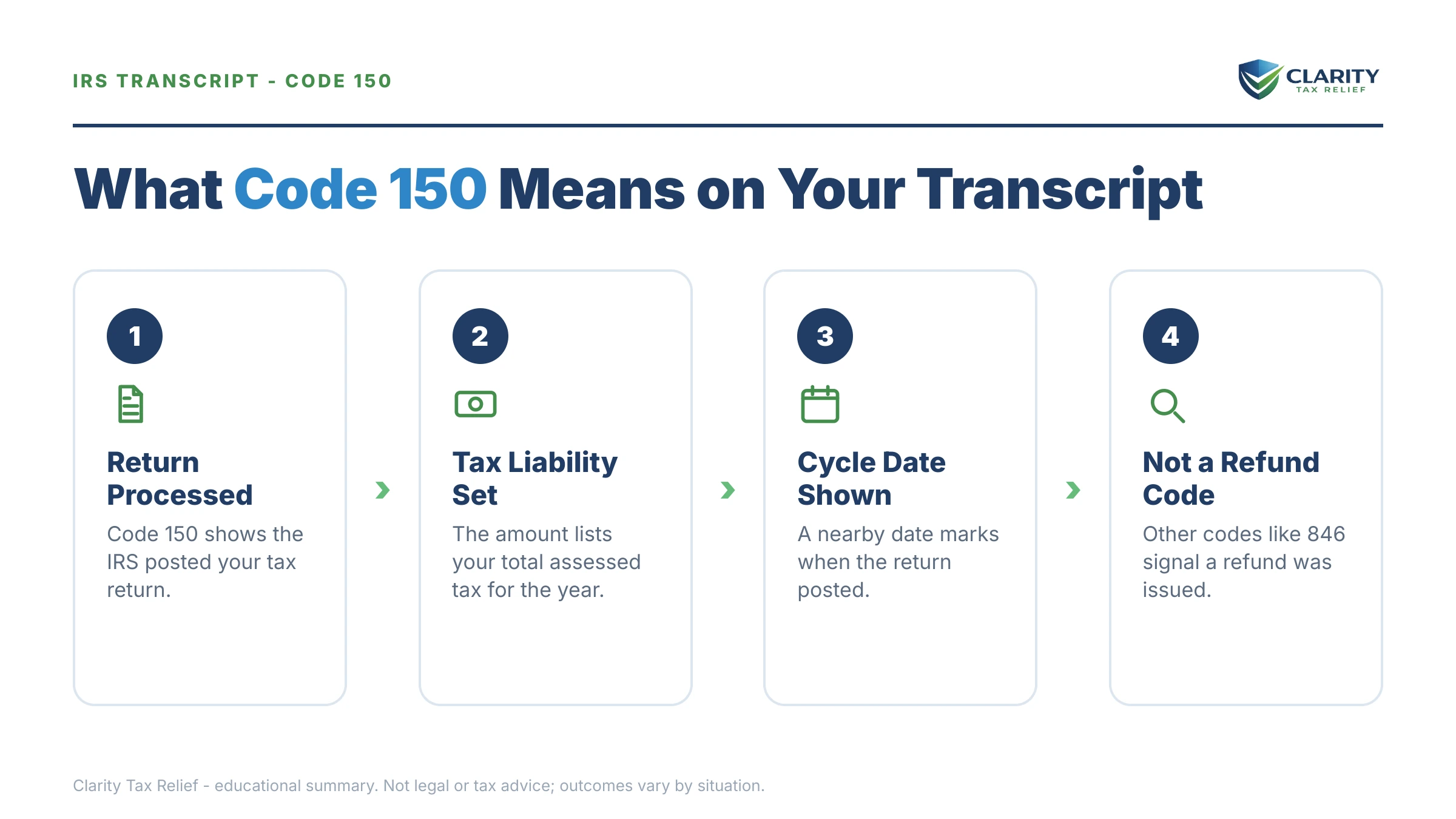
The short answer: code 150 on an IRS transcript means the IRS processed your tax return and assessed the tax on it. The amount beside code 150 is your total tax for the year, not your refund and not a bill. The date beside it is the assessment date, which is why a 150 often shows a date days or weeks after you filed.
You pulled up your account transcript to check on a refund, and the first line under Transactions is code 150 with a dollar figure that matches nothing you recognize. Not your refund, not your withholding. That mismatch is the whole confusion, and it clears up once you know what the 150 line measures.
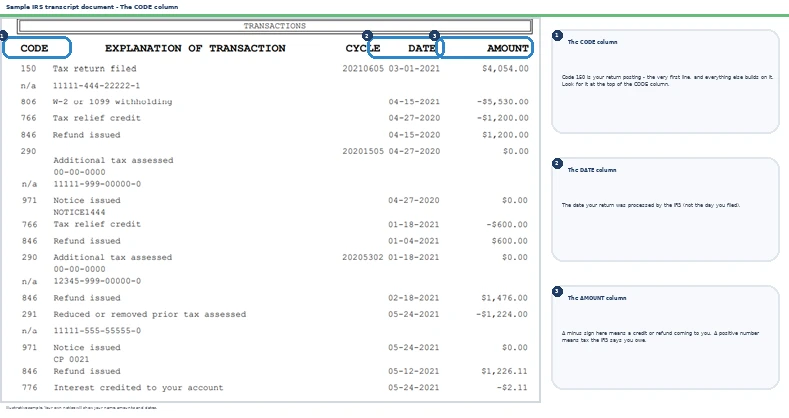
Two figures on the code 150 line do all the work, the amount and the date, and the image below shows what that section of a real transcript looks like and where each one sits. Once you can read those two, every other code on the page falls into place around them.
⏱ The clocks behind code 150: the code itself sets no response deadline. If the assessment left a balance due, failure-to-pay penalties and interest have been running since the return's original due date, and the IRS's 10-year collection window starts from the code 150 assessment date.
What does code 150 mean on an IRS transcript?
Code 150 is the transaction that creates your tax record for the year. It posts when the IRS finishes processing a return and formally puts the tax on its books, which is why the line reads "Tax return filed" on the transcript. Every processed return gets one. It is the anchor line: withholding, credits, holds and refunds all post as separate codes above and below it. If the layout of the whole document is the confusing part, our guide to how to read an IRS account transcript walks it top to bottom.
A code 150 gets onto your transcript one of three ways:
- You filed and the return processed. The normal case. A 150 means processing of the return itself is complete.
- The IRS adjusted the return during processing. The 150 amount can differ from the total tax line on your Form 1040 if a math error or a credit change was applied. A notice explaining the change usually follows.
- The IRS filed for you. A 150 on a year you never filed typically means the IRS prepared a substitute for return from your W-2s and 1099s, with no deductions beyond the basics. If you later file your own return, a code 599 shows the IRS logged it. Your real numbers can replace the inflated assessment.
What code 150 is not: it is not an audit flag, not a refund approval and not a bill. Audits show as code 420, refunds as code 846, and a bill arrives later by mail if the math leaves a balance.
You will only see code 150 on a tax account transcript, not on a tax return transcript, which is a line-by-line copy of the return you sent. The IRS says its online account is "the fastest, easiest way to view, print or download your transcripts". Create an account or sign in at IRS.gov, or request a transcript by mail, which the IRS says arrives in 5 to 10 calendar days at the address it has on file.
“You can view your tax records in your Individual Online Account. This is the fastest, easiest way to: View, print or download your transcripts”
— Get your tax records and transcripts (IRS.gov)
Code 150 with an amount: what the number is
The dollar figure on the 150 line is your total tax for the year, essentially the total tax line from your Form 1040 as the IRS processed it. Your withholding and refundable credits post separately as negative entries, so the 150 amount on its own says nothing about whether you are getting money back or writing a check. Subtract the negative lines below it from the 150 amount. Negative means refund, positive means balance due.
Say a single W-2 employee's transcript shows code 150 of $11,300 and code 806 withholding of −$8,150. Net them and the year ends in a $3,150 balance due, which then grows by the failure-to-pay penalty and interest until it is paid. Flip the withholding to −$12,400 against the same $11,300 and the same transcript points to a $1,100 refund. The line to watch for next is the 846.
A code 150 of $0.00 is also normal. It means no tax was assessed, usually because the standard deduction zeroed out a modest income, or because refundable credits such as the child tax credit or the earned income credit carry the whole refund. Your filing status and those credits are what drive a zero, not an error.
Code 150 with a future date, or a date after you filed
The date beside code 150 is the assessment date, the day the tax legally went on the IRS's books. The IRS posts it according to its processing cycle, so a 150 dated a week or two after you e-filed, or even a few days in the future, is the normal case rather than a warning. It is not a deadline, it is not the day your refund moves, and there is nothing to do about it.
The date matters for one reason. If the year leaves a balance, the IRS's 10-year collection window runs from that assessment date. Our guide to how long the IRS can collect back taxes explains that window, and the CSED calculator estimates how much of it is left on an older year.
Code 150 on a transcript for 2020 through 2025: what changes by year
People searching for code 150 on a 2021 or 2022 transcript are usually looking at an older year for one of two reasons: a refund they never claimed, or a balance the IRS is still collecting. The meaning of the code does not change from year to year. What changes is the two clocks attached to it. The IRS puts the refund rule this way: "The latest date, by law, you can claim a credit or federal income tax refund for a specific tax year is generally the later of these 2 dates: 3 years from the date you filed your federal income tax return, or 2 years from the date you paid the tax," and a return filed before its due date counts as filed on the due date.
| Tax year | Original return due date | Last day to claim a refund if filed on time | If the year owes |
|---|---|---|---|
| 2025 | April 15, 2026 | April 15, 2029 | Collection window runs 10 years from the 150 date |
| 2024 | April 15, 2025 | April 15, 2028 | Same |
| 2023 | April 15, 2024 | April 15, 2027 | Same |
| 2022 | April 18, 2023 | April 18, 2026 (passed) | Same |
| 2021 | April 18, 2022 | April 18, 2025 (passed) | Same |
| 2020 | May 17, 2021 | May 17, 2024 (passed) | Same |
Two cautions on that table. The refund column assumes the return was filed by its due date. A late-filed return runs three years from the date it was actually filed. And a 150 that appears on an old year you never filed is almost always a substitute return, which starts the collection clock on an assessment you may be able to replace with a real return. Our guide on claiming a refund from three years ago covers the refund side.
Code 150 and the codes around it
A code 150 almost never appears alone. The lines around it are what say whether a refund, a hold or a bill comes next.
| Code | What it means | What to do |
|---|---|---|
| 806 | Federal withholding from your W-2s and 1099s, posted as a negative amount | Confirm it matches Box 2 of your W-2s; a shortfall here changes the whole math |
| 766 / 768 | Refundable credits (768 is the earned income credit), also negative amounts | Add them to withholding when netting against the 150 amount |
| 570 | A hold freezing the refund while something is reviewed | Wait for the explanation, often a 971 notice, before assuming the worst |
| 971 | A notice or letter was issued about the account | Watch the mail; the letter says what the IRS wants |
| 846 | Refund issued, the code refund-watchers are waiting for | The date beside it is the release date |
| 290 | Additional tax assessed after the original 150: an adjustment, exam result or CP2000 outcome | Match it to the notice that triggered it; you may have appeal rights |
| 420 | Examination indicator on the return behind your 150 | Gather records and respond to the exam letter |
Is code 150 bad? Only if the math leaves a balance you ignore
Code 150 by itself is neutral. It posts on every processed return, and for most filers it is good news because nothing else can post until it does. The only way a 150 turns into a problem is when the netting leaves a balance due and nobody acts on it. Then the IRS's automated sequence starts: a CP14 bill that typically gives about 21 days, reminder notices CP501 and CP503, a CP504 notice of intent to levy, then the LT11 final notice with its 30-day window and your Collection Due Process rights, after which the IRS can levy. That sequence is generated by automated systems and runs whether or not anyone at the IRS reads your file.
A balance you can pay within 180 days can be set up as a short-term plan on the IRS payment plans page in minutes, and our payment plan guide covers the longer options by balance size. Experienced help changes the outcome in a narrower set of cases: a 150 on a year you never filed, a 150 followed by code 420 exam activity, several years showing balances at once, or a balance over $25,000 where the type of plan and any penalty relief change the total you pay.
Balance behind your code 150, or a 150 on a year you never filed?
Send us the transcript. A licensed tax professional will decode every line, confirm what you actually owe, and map your options before the notice sequence escalates. Free, confidential, no pressure.
Terms on your transcript, decoded
- Assessment: the formal act of recording tax on the IRS's books. Code 150 is that act for your return.
- Tax account transcript: the transcript that shows transaction codes such as 150, as opposed to the tax return transcript, which is a copy of the return itself.
- Cycle code: the eight-digit number near the 150 line showing the year, week and day your return posted. Our cycle code guide decodes it digit by digit.
- "As of" date: a projected balance-calculation date used for interest math. It is not a deadline and moves routinely.
- Substitute for return (SFR): a return the IRS prepares for a non-filer from third-party income reports, with no deductions argued in your favor.
- CSED: the collection statute expiration date, 10 years from the assessment date on the 150 line, pausable by events such as an offer in compromise or bankruptcy.
Code 150 IRS transcript FAQs
What does code 150 mean on an IRS transcript?
Code 150 means the IRS processed your tax return and assessed the tax on it, which is why the line reads "Tax return filed". The amount beside it is your total tax for the year, not your refund and not a bill. The date beside it is the assessment date. Withholding, credits and any refund post as separate codes around it.
Is code 150 on my IRS transcript good or bad?
Neither. It confirms the IRS processed your return and recorded the tax for that year, and it appears on virtually every processed return. For most filers it is good news, because withholding, credits and a refund cannot post until the 150 does. Whether the year ends well depends on the codes around it: an 846 means a refund is coming. A positive balance after withholding means a bill is coming.
What does code 150 with an amount mean?
The amount is your total tax for the year as the IRS processed it, essentially the total tax line on your Form 1040. It is not what you owe and not what you get back. Subtract the negative lines below it, code 806 withholding and codes 766 and 768 credits: a negative result points to a refund and a positive result means a balance due.
What does code 150 with a future date mean?
It is the assessment date, posted according to the IRS processing cycle. A date a few days ahead or a couple of weeks after you filed is normal. It is not a deadline and not the day a refund moves. The date matters only if the year owes, because the IRS's 10-year collection window runs from it.
Why does my code 150 show $0.00?
A $0.00 code 150 means the IRS assessed no tax on the return. That is common when income was low enough that the standard deduction removed the liability, or when refundable credits such as the child tax credit drive the whole refund. It can also appear on some substitute-return postings before the tax is calculated. A zero 150 with credit codes below it usually still produces a refund.
Does code 150 mean my refund is approved?
No. Code 150 means the return posted and the tax was assessed. A refund is approved only when code 846, refund issued, appears with a date. Withholding (code 806) and refundable credits (766 and 768) post as separate lines. A hold such as code 570 can delay the refund even after the 150 appears.
I never filed a return. Why is there a code 150 on my transcript?
A 150 on a year you did not file usually means the IRS prepared a substitute for return from income reported by employers and banks. A substitute return gives you no deductions beyond the basics, so the assessed tax is almost always higher than a real return would show. Filing your own return can replace those figures, and a code 599 on the transcript shows the IRS logged it.
How long after code 150 does the refund code 846 appear?
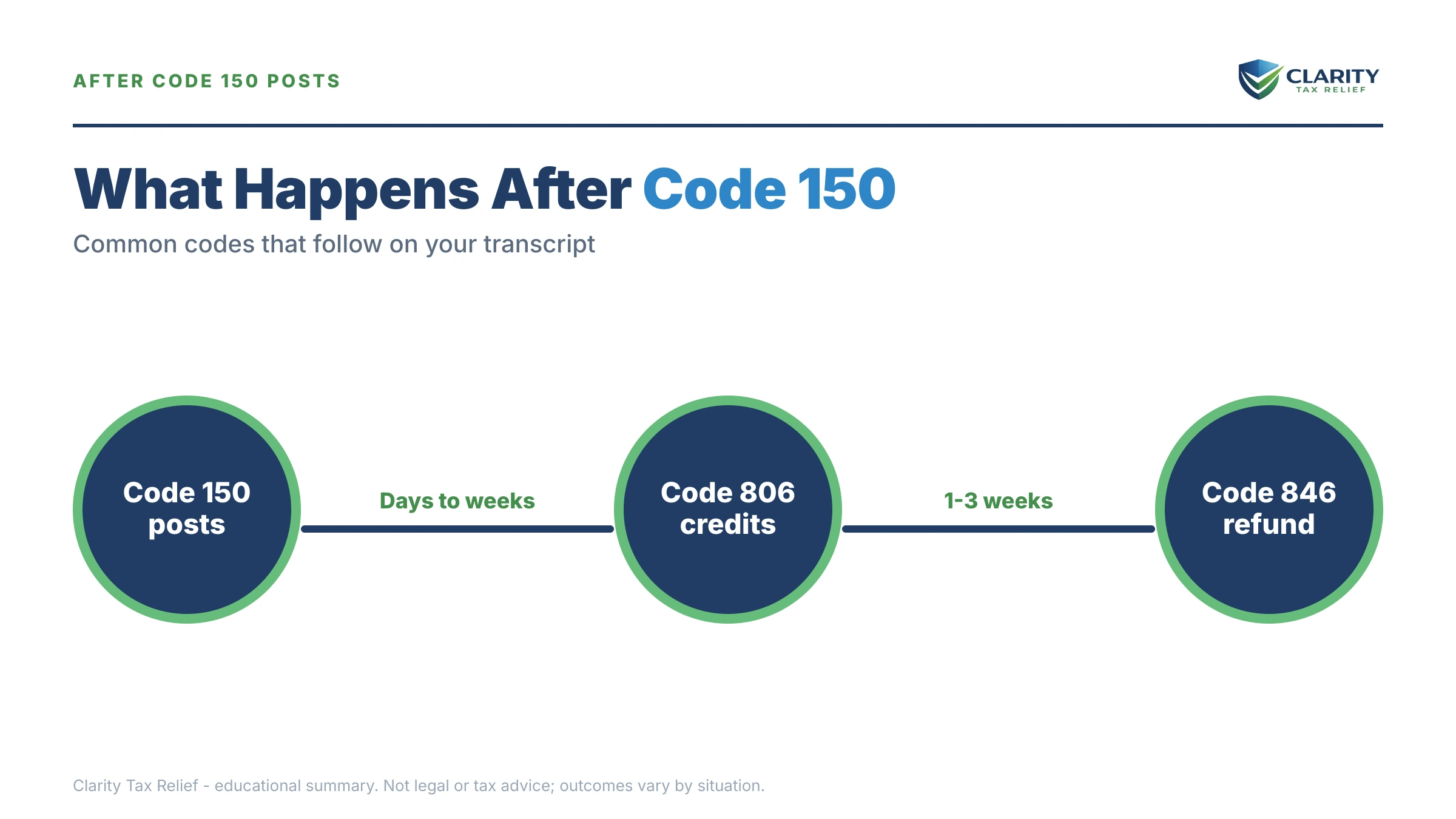
There is no fixed gap. On a clean return the 846 line often posts within one to three weekly transcript updates after the 150. Holds change that: a code 570 freezes the refund until it is resolved, and an identity-verification letter stops the clock until you respond. Your cycle code says which day of the week your transcript updates.
Does code 150 mean I am being audited?
No. Code 150 posts on virtually every processed return and has nothing to do with audit selection. Audit activity shows as code 424, an exam request, or code 420, an audit indicator. A 150 with no exam codes below it means the return simply processed.
Your next 24 hours
- Pull the line. Open your account transcript (free at IRS.gov Get Transcript) and write down the code 150 amount and date for the year in question.
- Gather the paper. Your Form 1040 copy and W-2s, so you can match the 150 amount to the return's total tax line and the 806 withholding to Box 2.
- Get it reviewed if it owes. If the math shows a balance you cannot pay, the 150 sits on a year you never filed, or a hold or exam code follows it, request a free case review at the 2-minute form or call (888) 825-7779. Penalties and interest keep running while the transcript just sits there.
This guide is general information, not tax or legal advice for your specific situation. Eligibility for IRS programs depends on individual facts and circumstances; no outcome is guaranteed.