
IRS Transcript Codes
Code 599 IRS Transcript: What "Return Secured" Means in 2026
What this episode covers
- What does IRS transcript code 599 mean on a tax account transcript?
- Does IRS code 599 mean the tax return has finished processing?
- What does IRS code 570 on a tax transcript mean?
- How many years of back tax returns does the IRS require for a payment plan?
The short answer: code 599 on an IRS transcript means "tax return secured" — the IRS has logged a return it previously had no record of, usually a back return you just filed. It posts with $0.00 because it isn't an assessment; the return still has to process (code 150) before any refund or balance becomes official.
You finally mailed those back returns, gave it a few weeks, and pulled your account transcript to see if anything happened. There it is: "599 — Tax return secured," dated recently, showing $0.00. That line is actually good news — it's the IRS's system confirming your return arrived and the "where's your return?" case for that year is closing.
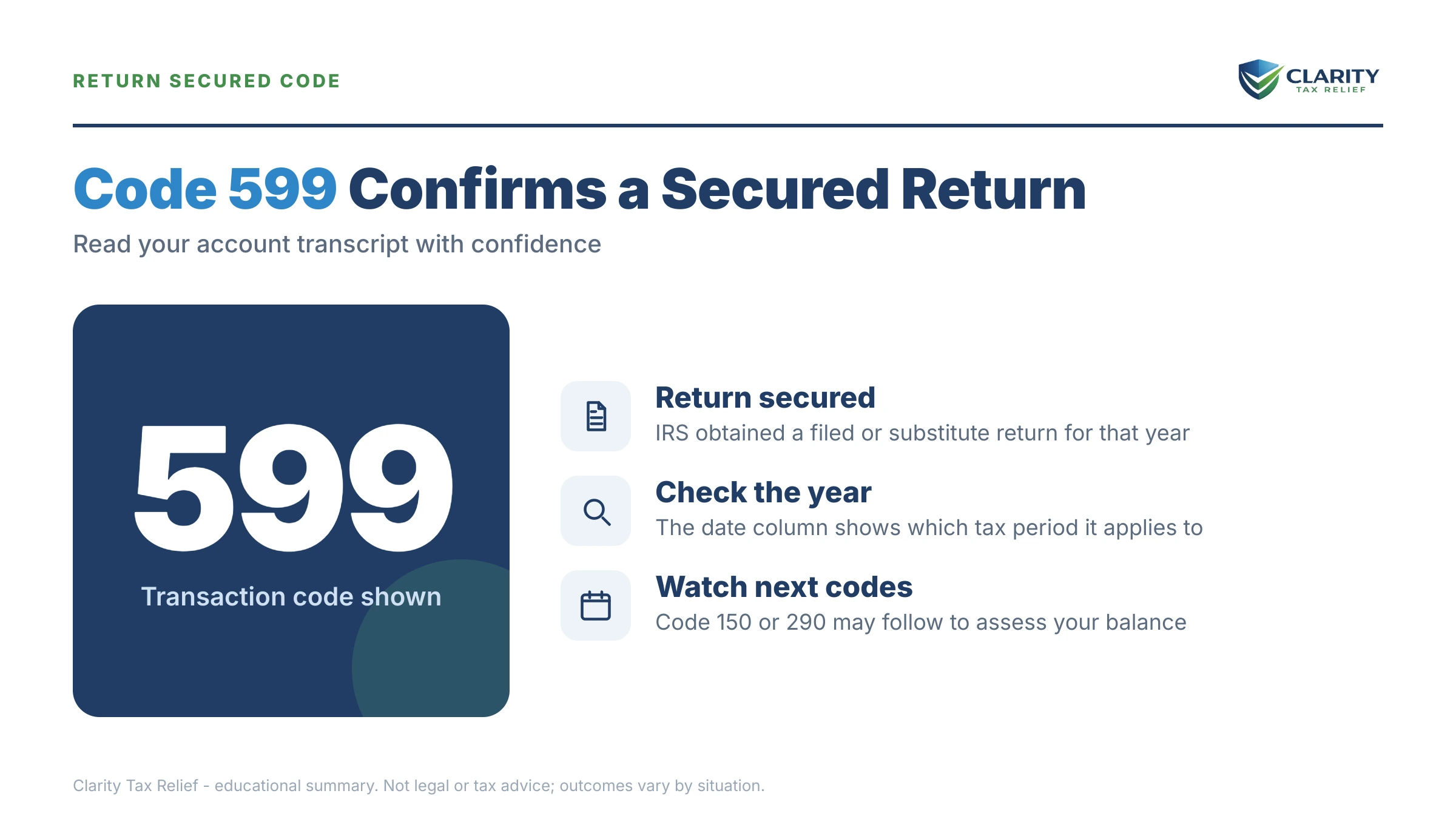
What code 599 does not tell you is whether the year is finished, what you'll owe, or when a refund would arrive. This guide covers what triggers 599, the codes that follow it, and exactly what to do next. The image below shows what a 599 line looks like on a real account transcript and where to look for the year and date that matter.
⏱ The real clocks: code 599 sets no new deadline, but two clocks still run. If your late return shows a balance, the 0.5% monthly failure-to-pay penalty and daily interest keep accruing until you pay or set up a plan. And if it shows a refund, returns filed more than 3 years after the original due date generally forfeit that refund.
Code 599 IRS transcript meaning: "tax return secured"
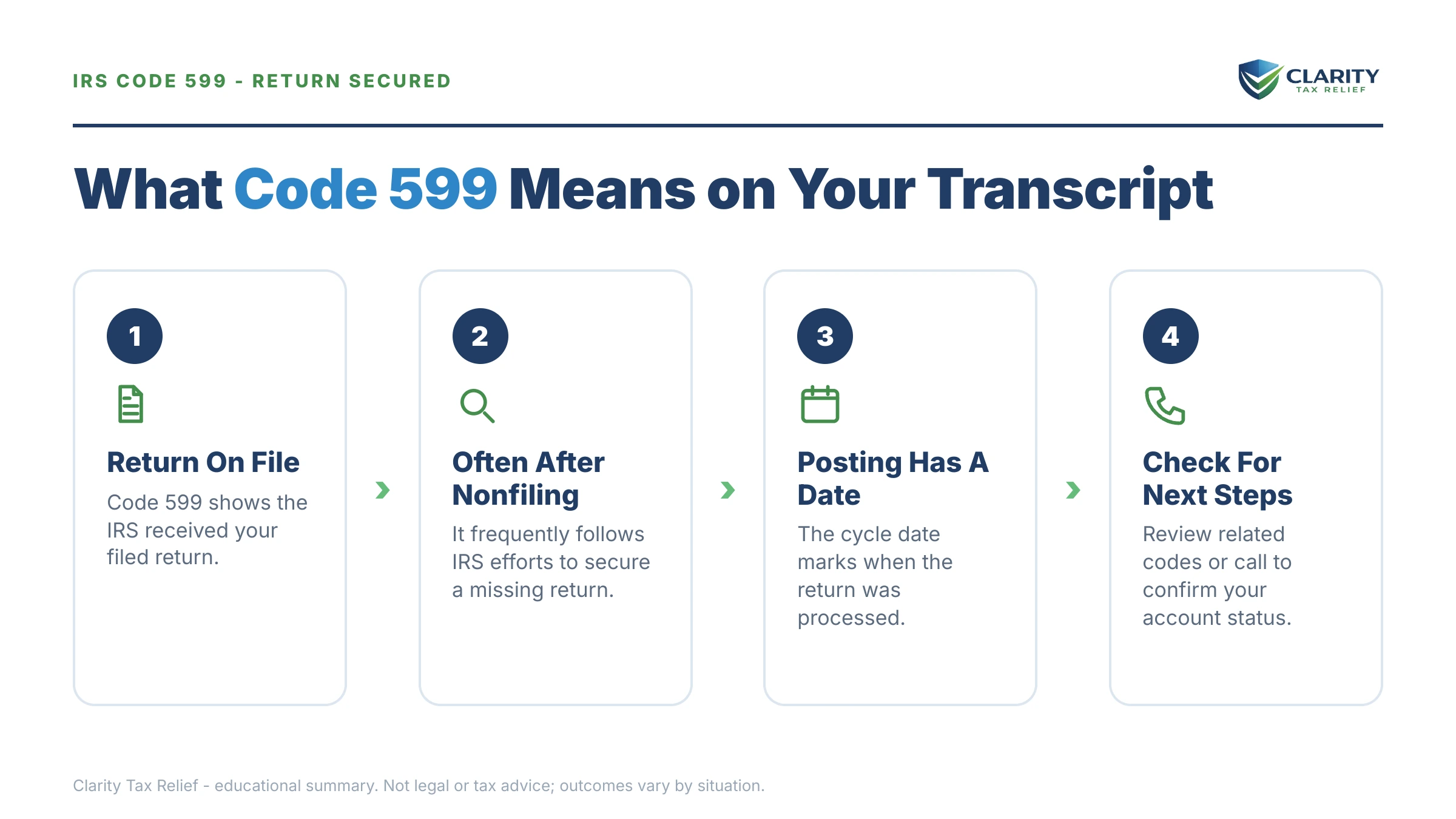
Transaction code 599 means the IRS has recorded a return for a tax year its systems showed as unfiled. Internally, the IRS opens a delinquent-return case when it sees income documents — 1099s, W-2s, 1099-Ks — with no matching return. Code 599 is the transaction that closes that case: the missing return is in hand.
Three things make 599 different from most codes on your transcript:
- It always shows $0.00. It's a compliance-status marker, not a money entry. Tax, penalties, and interest post later under their own codes.
- It's a receipt, not processing. A 599 can post weeks, sometimes months, before the return itself finishes processing and a code 150 IRS transcript entry appears with the assessed tax.
- It sometimes carries a hidden tag. IRS staff attach a two-digit closing code to a 599 recording how the return was obtained, whether it's taxable, non-taxable, or tied to a substitute return. You usually can't see it, and it rarely changes what you should do.
If transcript layouts are new to you, our guide on how to read IRS account transcript pages walks through every section. This article stays focused on what 599 specifically means for you.
Why code 599 appeared on your account
Code 599 posts for one reason — a return the IRS was missing has reached its compliance unit — but it gets there three common ways:
- You filed a back return on your own. The most common trigger. Whether you mailed one prior-year return or a stack of them, each year gets its own 599 as the IRS logs it. If you're catching up after a gap, the year you're seeing may be one of several — see haven't filed taxes in 3 years for how the catch-up sequence works.
- You responded to non-filer notices. If the IRS mailed you a CP59 notice, a CP516, or a final CP518 notice demanding a return, the 599 confirms your response landed and shuts off that notice stream for the year.
- You filed after the IRS created a substitute return. If the IRS already built a return for you — an SFR, using your 1099s with no deductions — your real return posts as a 599 and gets worked as a reconsideration of that inflated assessment. Read the IRS filed a substitute return for me if that's your situation, because the codes that follow look different.
Occasionally a 599 posts for a return a revenue officer or IRS employee secured directly, or for a return you sent long ago that only just got logged. In every case the meaning is the same: the non-filer case for that year is closing. The question shifts to what the return shows.
Code 599 next to other codes: reading the sequence
Code 599 almost never stands alone for long — the codes that post after it tell you where the year is headed. This table decodes the entries you're most likely to see near a 599:
| Code | What it means | What to do |
|---|---|---|
| 599 | Return secured — the IRS logged your late or missing return | Confirm it posted to the right tax year, then wait for processing |
| 150 | Return processed; tax assessed | Check the assessed figure against your copy of the return |
| 166 / 276 | Late-filing and late-payment penalties posted | Check whether penalty relief applies before paying them |
| 196 | Interest charged on the balance | Accrues daily until paid — a reason to resolve sooner |
| 570 | Hold — the account is frozen pending review | See code 570 on IRS transcript; respond to any letter |
| 290 / 291 | Tax increased or reduced — common when your return replaces an SFR | See code 290 IRS transcript; compare to your figures |
| 846 | Refund issued | See 846 refund issued date for how to read the date |
One pattern worth knowing: on an SFR year, your 599 is usually followed by a long quiet stretch and then a 290 or 291 adjusting the substitute assessment, not a fresh 150. That review is slower than normal processing, so silence after a 599 on an SFR year is normal, not a lost return.
What happens after code 599 if the return shows a balance
Code 599 is a receipt, not a resolution, if the late return shows tax due, the standard IRS collection sequence starts once the balance posts. Here's the order it unfolds in:
- Assessment. Code 150 posts with the tax, followed by code 166 (late-filing penalty), code 276 (late-payment penalty), and code 196 (interest). This is also the moment the 10-year collection statute starts running, not the year the return was originally due.
- First bill. A CP14 arrives showing the full balance, with roughly 21 days to pay before the sequence continues (10 business days when the balance is $100,000 or more).
- Reminders. CP501 and CP503 follow if the CP14 goes unanswered, each with a bigger balance than the last.
- CP504 — intent to levy. The IRS can now take your state tax refund, and a federal tax lien becomes a live possibility.
- LT11 — final notice. A 30-day clock starts, with formal appeal rights. After it runs, the IRS can levy bank accounts and, for a 1099 contractor, send levies straight to the clients who pay you.
Two 2026 realities sharpen this. First, the entire sequence is automated — the IRS workforce shrank roughly 27% in 2025, but the notice machine never slowed. Second, filing late already cost you the most expensive penalty in the system: the failure-to-file penalty runs 5% per month, ten times the 0.5% failure-to-pay rate, though in any month where both penalties apply, the failure-to-file portion drops to 4.5% (5% combined). You've stopped that one by filing. The goal now is stopping the rest.
Filed back returns and a balance is about to post?
The window between a 599 posting and the first bill is the cheapest moment to set your resolution up — penalties and interest are accruing monthly while you wait. Get an experienced tax professional's free review of your transcript and options before the notices start.
Owe on the late-filed return? Your realistic options by balance
Most balances under $50,000 can be put on an IRS payment plan online, over as long as 72 months, without a full financial disclosure. Which tier you land in depends on the total after penalties and interest:
| Balance after penalties | Realistic options | What to know |
|---|---|---|
| Any amount you can clear in 180 days | Short-term payment plan | $0 setup fee; interest and penalties still accrue, but enforcement stops |
| Tax under $10,000 | Guaranteed installment agreement | The IRS must accept if you're filing-compliant and pay off the balance, typically within three years |
| Up to $25,000 | Streamlined installment agreement, set up online | Up to 72 months; no detailed financial disclosure required |
| $25,000–$50,000 | Streamlined agreement with direct debit | Direct debit is required to stay in the streamlined lane at this level |
| Over $50,000 | Non-streamlined plan, Currently Not Collectible, or an Offer in Compromise | Full financials on Form 433-F; OIC acceptance is means-tested — the IRS accepted roughly 1 in 5 offers in FY2024 |
One eligibility rule cuts across every tier: the IRS won't approve any of these until your required returns are filed — generally the last six years. Each 599 on your transcript is a year checked off that list. See how many years of back taxes do i have to file — or, using the exact page: how many years of back taxes do I have to file for how the six-year standard works in practice.
A worked example: the $8,900 late return
Say you're a 1099 contractor who just filed a 2023 return two years late, showing $8,900 due — income and self-employment tax with nothing withheld. Here's roughly what the year costs by the time it posts (the figures below are a hypothetical example):
- Late-filing penalty: 4.5% per month when the late-payment penalty also applies, capped at 22.5% × $8,900 = $2,002.50 (a separate 0.5%/month late-payment penalty continues up to 25%).
- Late-payment penalty: 0.5% per month — about $44.50/month. Roughly 24 months in, that's around $1,068, and it keeps running (it caps at 25% too).
- Interest: compounds daily on the whole balance, adding several hundred dollars a year at current rates.
Call it roughly $12,000 and climbing about $45 a month plus interest. Now the levers: because the tax itself is under $10,000, you may fit the guaranteed installment agreement tier if your recent compliance history is clean, and even counting penalties, the total sits comfortably inside the streamlined-online lane, where 72 months works out to roughly $170/month before ongoing interest. Better still, if your prior three years were clean, first time penalty abatement could remove that $2,002.50 late-filing penalty — cutting the balance by roughly a sixth before you make a single payment. You can run your own numbers with our Penalty & Interest Calculator to estimate what your year has accrued.
Flip side: if that 2023 return had shown a refund, filing within three years of the original due date preserves it. Miss that window and the refund is gone — the details are in can I still get a refund from 3 years ago.
How to respond to code 599, step by step
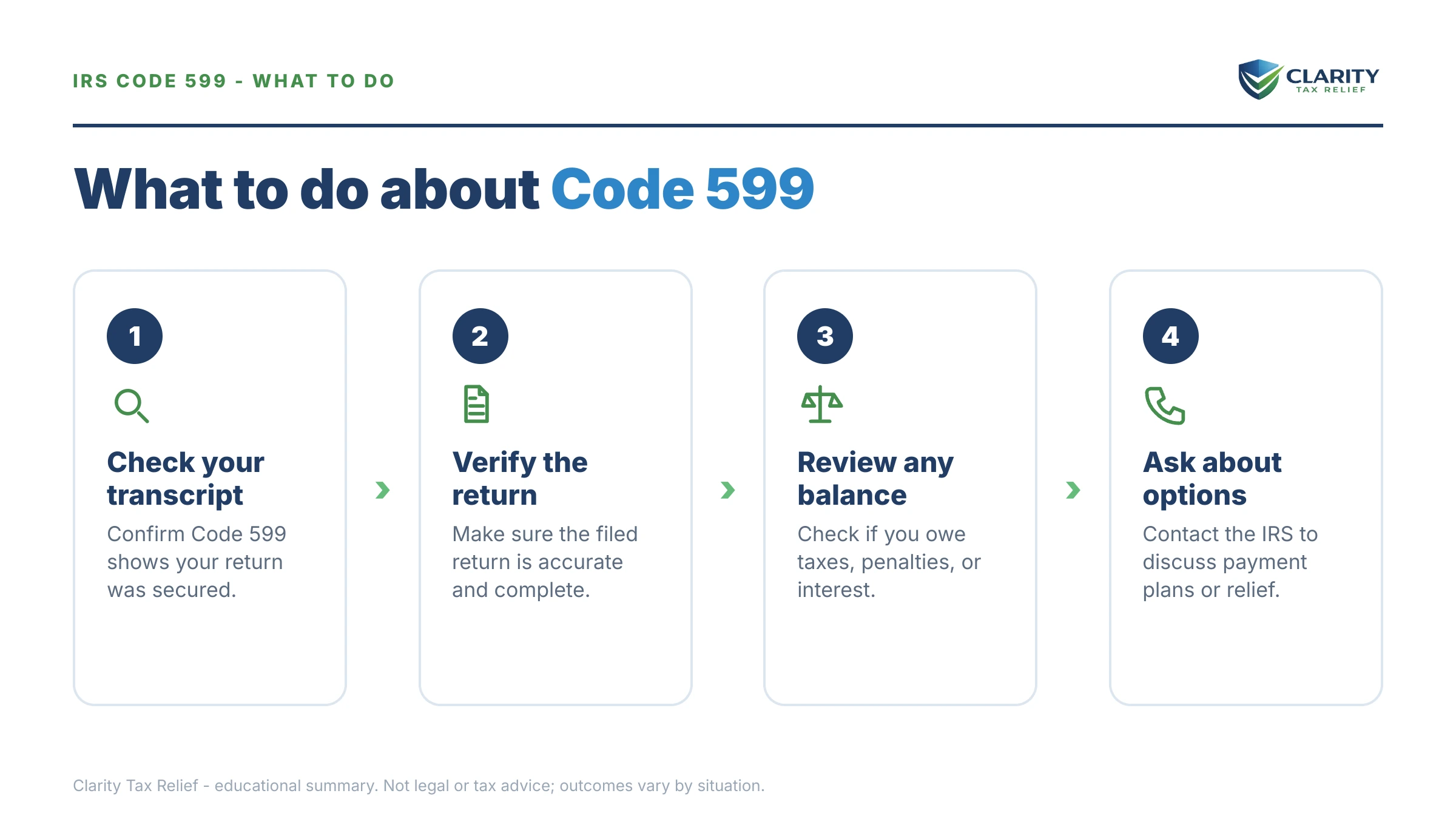
- Confirm the tax year and date. Match the 599 line to the tax year at the top of that transcript module and note the posting date — that's when the IRS logged your return, not when it will finish processing.
- Watch for code 150. Check your transcript every week or two. The return isn't processed until code 150 posts with the assessed tax — that's when a refund or balance becomes official.
- Pull your wage and income transcript. Compare the 1099s and W-2s the IRS has on file against what you reported. Mismatches on late-filed returns trigger holds and underreporter review.
- Plan for the balance now. Estimate tax plus penalties and interest, and set up a payment arrangement as soon as the balance posts — every month you wait adds a 0.5% failure-to-pay penalty plus daily interest.
- Request penalty relief. With a clean compliance history for the prior three years, you may qualify for first-time penalty abatement, and starting summer 2026, the IRS's Automatic Exemption from Penalty applies some relief with no request at all.
- Close out any other unfiled years. One code 599 closes one year. The IRS generally wants your last six years filed before it grants a payment plan or any other resolution, so finish the set.
When you can handle code 599 yourself
Much of the time, a 599 needs nothing from you but patience. You can confidently handle this alone if:
- You filed one late return, the numbers match your income documents, and you're just waiting for it to process;
- The return shows a refund and you filed within the three-year window;
- The balance is one you can pay in full or put on a simple online payment plan under $25,000.
Experienced help changes the outcome in a narrower set of situations: the 599 sits on a year where the IRS already assessed a substitute return (SFR reconsideration is slow and easy to get wrong), multiple years are unfiled and you need them sequenced before collection catches up, the balances across years push past $50,000 and full financial disclosure is coming, or self-employment records are missing and the return has to be reconstructed defensibly. In those cases, the order you fix things in — returns first, then penalties, then the balance — often changes what you ultimately pay.
Terms on your transcript, decoded
- Return secured — IRS-speak for "we received the return we were missing." A status update, not an approval of your numbers.
- Delinquent-return investigation — the internal case the IRS opens when it sees income documents but no return for a year; code 599 closes it.
- Substitute for Return (SFR) — a return the IRS builds for you from 1099s and W-2s, with no deductions or credits — the worst-case version of your tax.
- TC 150 — the transaction that means your return actually processed and the tax was assessed.
- Closing code — a two-digit tag IRS staff attach to a 599 recording how the return was obtained. You generally can't see it and rarely need to.
- CSED — the 10-year collection statute. It starts when tax is assessed, not when the return was originally due, so on a late-filed year, the clock is only starting now.
Code 599 questions, answered
What does code 599 mean on an IRS transcript?
Transaction code 599 means "tax return secured" — the IRS has logged receipt of a return it had flagged as missing, usually a back-year return you recently filed. It closes the IRS's delinquent-return case for that year. It is not an assessment, which is why it posts with $0.00 and no change to your balance.
Is code 599 on my transcript good or bad?
Mostly good. It confirms the IRS received the return it was asking for and shuts off the non-filer notice stream (CP59, CP516, CP518) for that year. What matters now is what the return shows: a refund means waiting for processing, while a balance due means penalties and interest are accruing until you pay or set up a plan.
Does code 599 mean my return has been processed?
No. Code 599 only confirms receipt; processing is complete when code 150 posts with the assessed tax. Late-filed and paper returns move through a slower pipeline than current-year e-filed returns, and with IRS staffing down roughly 27% since 2025, waits of several months are common. Check your transcript every week or two rather than calling.
How long after code 599 will I get my refund?
There is no fixed timeline — a refund is issued only after code 150 (return processed) and code 846 (refund issued) post, which can take months on a late-filed return. One hard limit applies: a return filed more than three years after its original due date generally forfeits the refund entirely, even though the IRS still accepts and records the return.
What does code 599 mean if the IRS already filed a substitute return for that year?
It means your own return was received and is being worked against the substitute-for-return assessment. Instead of a fresh code 150, the correction usually posts later as code 290 or 291, adjusting the SFR's inflated numbers to your actual figures. This review takes longer than normal processing, so keep any balance from growing in the meantime if you can.
Why does code 599 show $0.00?
Because it is an administrative marker, not a money transaction. Code 599 tracks your filing-compliance status. It tells the IRS's systems "the missing return is in." Dollar amounts post separately: tax with code 150, the late-filing penalty with code 166, the late-payment penalty with code 276, and interest with code 196.
Does code 599 mean I'm being audited?
No. Audit activity shows up under codes 420 or 424, not 599 — code 599 simply closes a non-filer case. That said, back returns filed years late do get matched against the income documents the IRS holds, so make sure your reported figures line up with your wage and income transcript before assuming the year is closed.
Will I still get a refund on a return I filed years late?
Only if you filed within roughly three years of the return's original due date. Past that window, the refund is forfeited — the IRS keeps it, and it generally cannot be applied to other years you owe. If your late return shows a balance due instead, there is no expiration working in your favor: the debt stands and grows until resolved.
Your next 24 hours
- Screenshot the 599 line on your account transcript — the tax year at the top of the module and the posting date next to the code — so you know exactly which year is closing and when the IRS logged it. (You can pull transcripts anytime at the IRS's Get Transcript page.)
- Gather your copy of the late return, the 1099s or W-2s behind it, and any non-filer notices you received, so the assessed figures can be checked the day code 150 posts.
- If the return shows a balance, or other years are still unfiled — get a free case review now, while penalties and interest are still the only thing moving: the form at /#consult takes two minutes, or call (888) 825-7779.
When the balance does post, payment plan options and setup are laid out on the IRS's payment plans page, and if processing stalls for months with no movement, the Taxpayer Advocate Service exists for exactly that kind of stuck case.
This guide is general information, not tax or legal advice for your specific situation. Eligibility for IRS programs depends on individual facts and circumstances; no outcome is guaranteed.