
IRS Transcript Codes
Code 826 IRS Transcript: Why Your Refund Was Applied to Another Tax Year (2026)
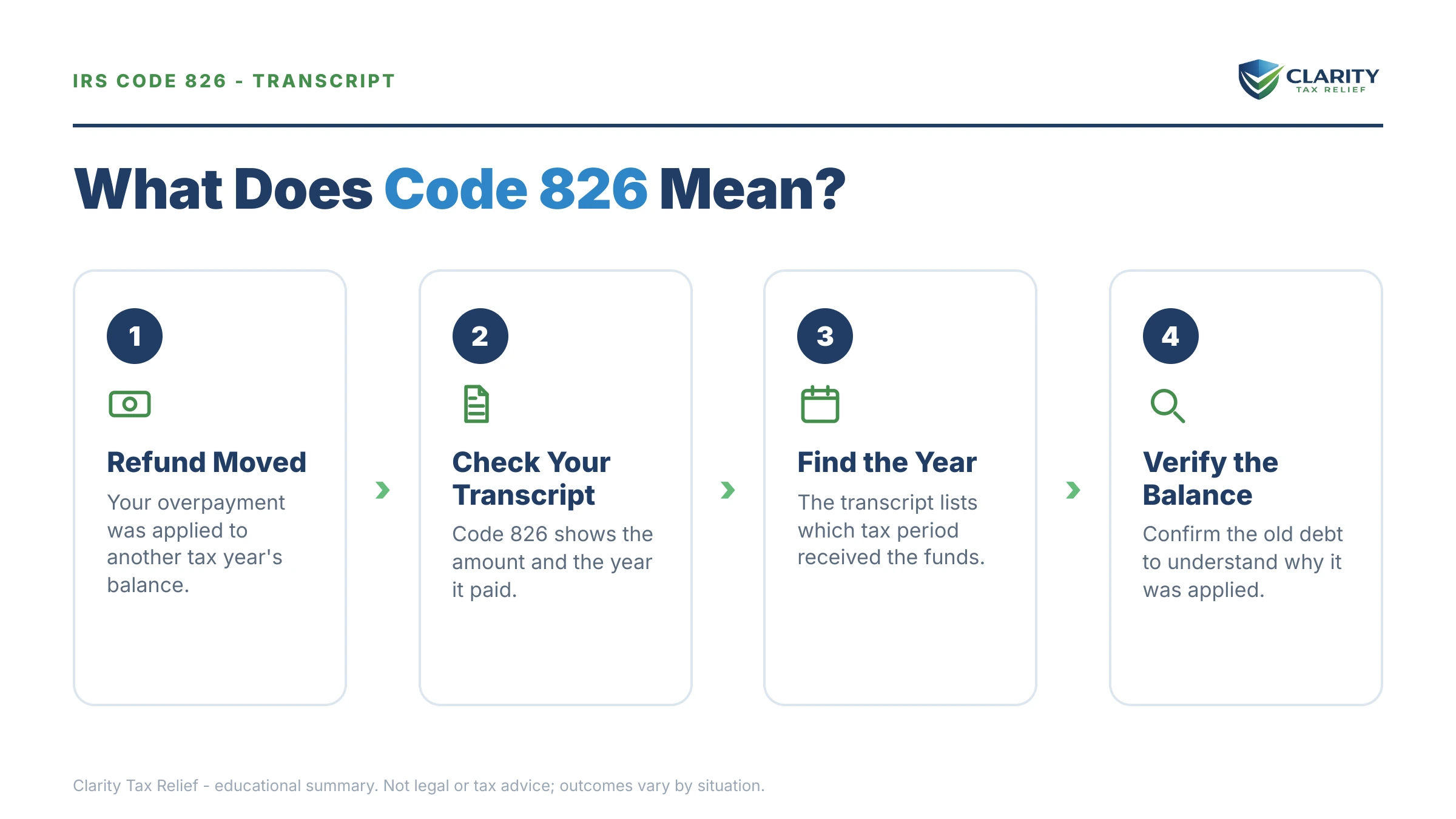
The short answer: code 826 on an IRS transcript means the IRS took your overpayment, the refund you were expecting, and transferred it to a different tax year or account where you owe. The amount next to 826 is how much moved. Any leftover refund posts as code 846, and the receiving year shows code 706.
You checked your transcript expecting a refund date — maybe you'd already earmarked that money for payroll or the quarter's expenses — and instead of code 846 you found "826 Credit transferred out" and a smaller number, or no refund line at all. That money didn't vanish. It went to pay a federal tax balance the IRS says you owe on another year, and your job now is to confirm which year, whether the debt is right, and what's left over.
This page covers exactly that: how to read the 826 line, how to find the matching entry on the other year, and what to do about any balance the transfer didn't cover. The image below shows you exactly where code 826 sits on a real account transcript and how to read the date and amount beside it.
One distinction to lock in early: code 826 moves money between your own IRS accounts — it is not the code for child support, student loans, or state debts. That's code 898 — offset to another agency, and the two have completely different fix paths.
⏱ The real clock: code 826 itself has no response deadline — the transfer already happened. But if it didn't cover the full balance on the old year, the failure-to-pay penalty (0.5% per month) and daily-compounding interest keep accruing on whatever remains, and the IRS's collection notices for that year continue.
Why code 826 is on your IRS transcript
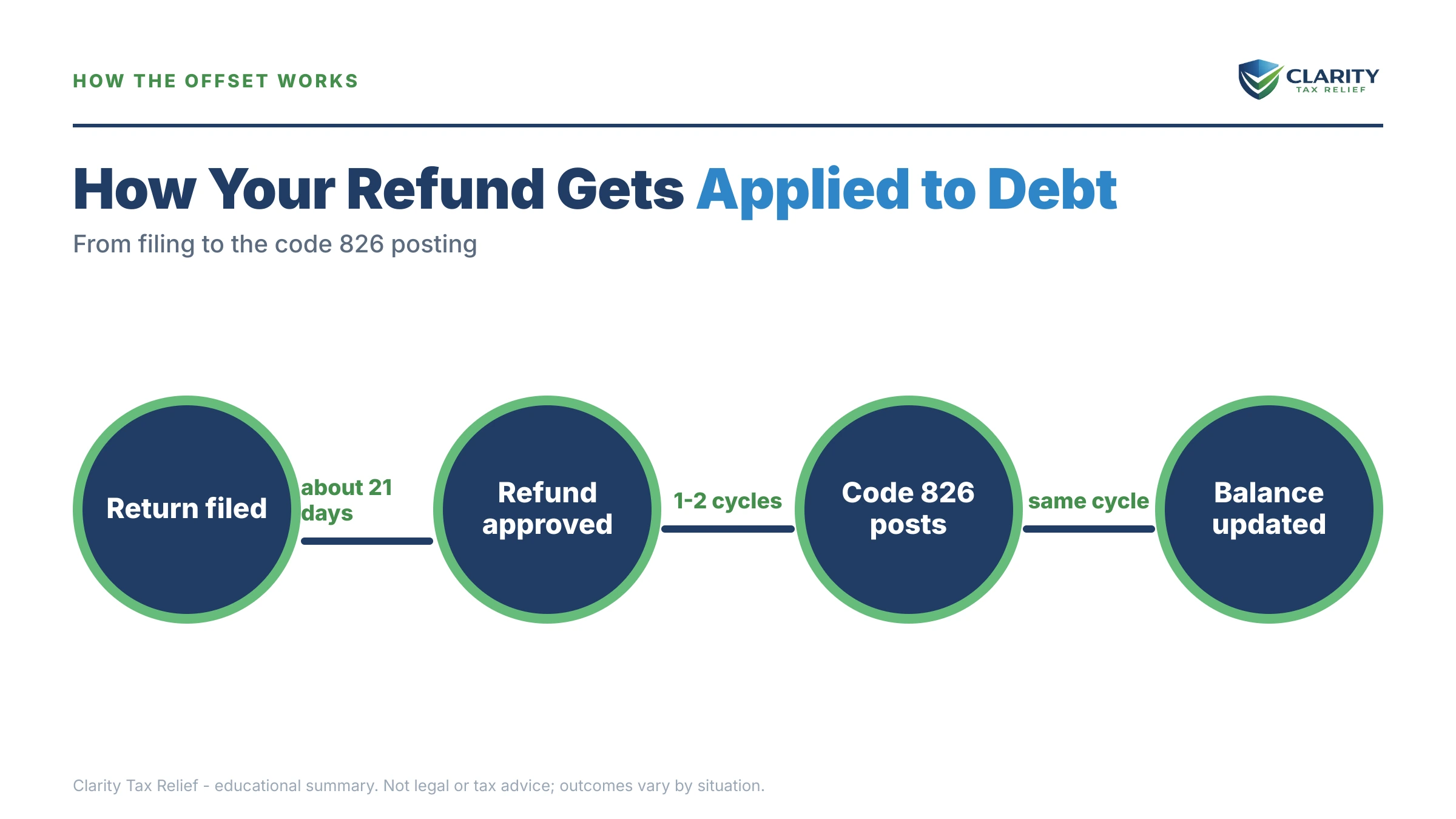
Code 826 posts when the IRS applies an overpayment from one tax year to an unpaid federal tax balance on another year or account. Federal law (IRC §6402(a)) lets the IRS do this before it refunds you a dime — no separate notice or hearing is required first, because both accounts are yours.
The transaction always has two halves. On the year that generated the refund, you see TC 826 "credit transferred out" with the amount that moved. On the year that had the balance, a mirror-image TC 706 "credit transferred in" posts for the same amount. If your transcript names the receiving period (for example, "1040 202312"), that tells you exactly which year absorbed your money. If you owe on several years, the IRS typically applies the money to the oldest balance first.
A few days to a few weeks after the transcript updates, a letter follows — most often a CP49 — refund applied to back taxes — showing the same numbers on paper. Transcript watchers almost always see the 826 before the envelope arrives, which is why the code feels like a surprise: the explanation is still in the mail.
For a refresher on how the transaction-code ledger works as a whole — dates, cycles, and why credits show as negative numbers — see how to read an IRS account transcript. Everything below is specific to 826.
Reading the 826 line: a worked example at $16,400
The three data points on an 826 line — the date, the amount, and the receiving period — tell you the whole story. Here's a clearly hypothetical example with the math shown.
Say you run a small business with a few employees, and your 2025 Form 1040 shows a $16,400 overpayment. You paid heavy estimated taxes during a strong year. But 2023 was rough: between self-employment tax you couldn't fully pay, penalties, and interest, that year's balance has grown to $19,200. Your 2025 transcript will show something like:
- TC 150 — your 2025 return posted (see code 150 IRS transcript for what that line means);
- Your estimated payments and withholding as credit entries;
- TC 826 — $16,400, credit transferred out to your 2023 account;
- No TC 846 — because the entire overpayment was consumed.
Meanwhile your 2023 transcript shows TC 706 — $16,400 arriving. The math: $19,200 owed − $16,400 transferred = $2,800 still due on 2023. That remainder keeps accruing the 0.5%-per-month failure-to-pay penalty plus interest until you deal with it.
Now flip the numbers. If 2023's balance had been $11,900 instead, the transcript would show TC 826 for $11,900 followed by TC 846 for $4,500 — the leftover refund, with its own deposit date. That's the partial-transfer pattern: 826 first, 846 for the difference. If you're hunting for that refund line, code 846 — refund issued date explains how to read it.
If you want to project how fast the leftover $2,800 grows while you decide, you can estimate the penalties and interest with our Penalty & Interest Calculator.
Code 826 vs. the codes that look like it
Four transcript codes get confused with 826 constantly, and mixing them up sends people down the wrong fix path. This table sorts them out.
| Code | What it means | What to do |
|---|---|---|
| 826 | Your overpayment was transferred to another tax year or account you owe the IRS | Pull the receiving year's transcript, verify the debt, resolve any remainder |
| 706 | The mirror entry — the credit arriving on the year that had the balance | Confirm the amount matches the 826 and check what balance is left |
| 898 | Refund sent outside the IRS (child support, student loans, state debt) via the Treasury Offset Program | Contact the agency that took the money, not the IRS — see code 898 |
| 846 | Refund issued — whatever survived the transfer is on its way to you | Note the date; direct deposit usually follows within days |
| 570 | A hold pausing your refund before anything is released or transferred | Different problem entirely — see code 570 on IRS transcript |
| 290 | Additional tax assessed — often the reason the old year has a balance at all | If you disagree with that assessment, see code 290 IRS transcript |
The 826/898 split is the one that matters most. An 826 dispute runs through the IRS, because the IRS both took and received the money. An 898 dispute runs through whichever outside agency got paid — calling the IRS about a child-support offset gets you nowhere.
What happens if the transfer didn't clear your balance
A code 826 transfer pays down your old debt, but any remainder stays in the IRS collection pipeline exactly where it was. For the leftover balance — the $2,800 in the example above — the automated sequence continues in order:
- CP14 or annual balance-due notice — the bill for what remains, typically with about 21 days to pay before the next notice queues up.
- CP501 / CP503 — reminder notices. Still just bills, but penalties and interest compound the whole time.
- CP504 — Notice of Intent to Levy. The IRS can now seize your state tax refund, and a federal tax lien becomes a live possibility.
- LT11 / Letter 1058 — Final Notice of Intent to Levy, starting a 30-day clock and your Collection Due Process rights. After it expires, bank levies and wage garnishment are on the table.
Two things make this worse for business owners specifically. First, next year's refund gets swept the same way — the IRS will take your refund every year until the balance hits zero. Second, if any of your debt is payroll-related and assessed against you personally, that module collects with the same machinery. In 2026, with IRS staffing down roughly 27%, it's hard to reach a human, but the notice-and-levy system is automated and never stopped running.
Code 826 took your refund and you still owe?
Send us both transcripts. An experienced tax professional will confirm the transfer was applied correctly, calculate exactly what's left, and map the cheapest way to stop penalties and interest from compounding on the remainder — free and confidential.
Your options for the balance code 826 left behind
Every remaining balance after an 826 transfer has a resolution path, and which one fits depends on the amount and your finances. The transfer often shrinks the debt into an easier bracket — a balance that needed full financial disclosure last year may now qualify for a streamlined online plan.
| Option | Who may qualify | Key detail |
|---|---|---|
| Pay in full | Anyone | Stops the failure-to-pay penalty and the notice sequence immediately |
| Short-term payment plan | Balance you can clear within 180 days | $0 setup fee; interest and penalties continue but enforcement pauses |
| Guaranteed installment agreement | Owe $10,000 or less | The IRS must accept it if you meet the filing and payment conditions |
| Streamlined installment agreement | Owe $50,000 or less | Up to 72 months, set up online, no detailed financial disclosure |
| Currently Not Collectible | Paying would create genuine hardship | Collection pauses; the debt remains and future refunds still get swept |
| Offer in Compromise | Assets and income genuinely can't cover the debt | $205 fee (waived for low income); the IRS accepted roughly 1 in 5 offers in FY2024 |
| Penalty relief | Clean compliance history or reasonable cause | First-time abatement, and starting summer 2026, the new Automatic Exemption from Penalty (AEP) applies some relief with no request needed |
| Injured spouse allocation | Joint refund paid a spouse's separate debt | Form 8379 — injured spouse recovers your share of the joint refund |
One nuance for anyone already on a payment plan: the 826 sweep does not count as your monthly payment. Keep paying on schedule, or the agreement can default — will the IRS take my refund on a payment plan covers exactly how this works.
And one for the future-refund crowd: if a coming year's refund is about to be swept and losing it would cause a true financial hardship — eviction, utility shutoff, essential business payroll — the Taxpayer Advocate can sometimes arrange an offset bypass refund for hardship. It only works before the transfer posts, which is why it's a planning tool, not a fix for an 826 that already happened.
How to respond to code 826, step by step
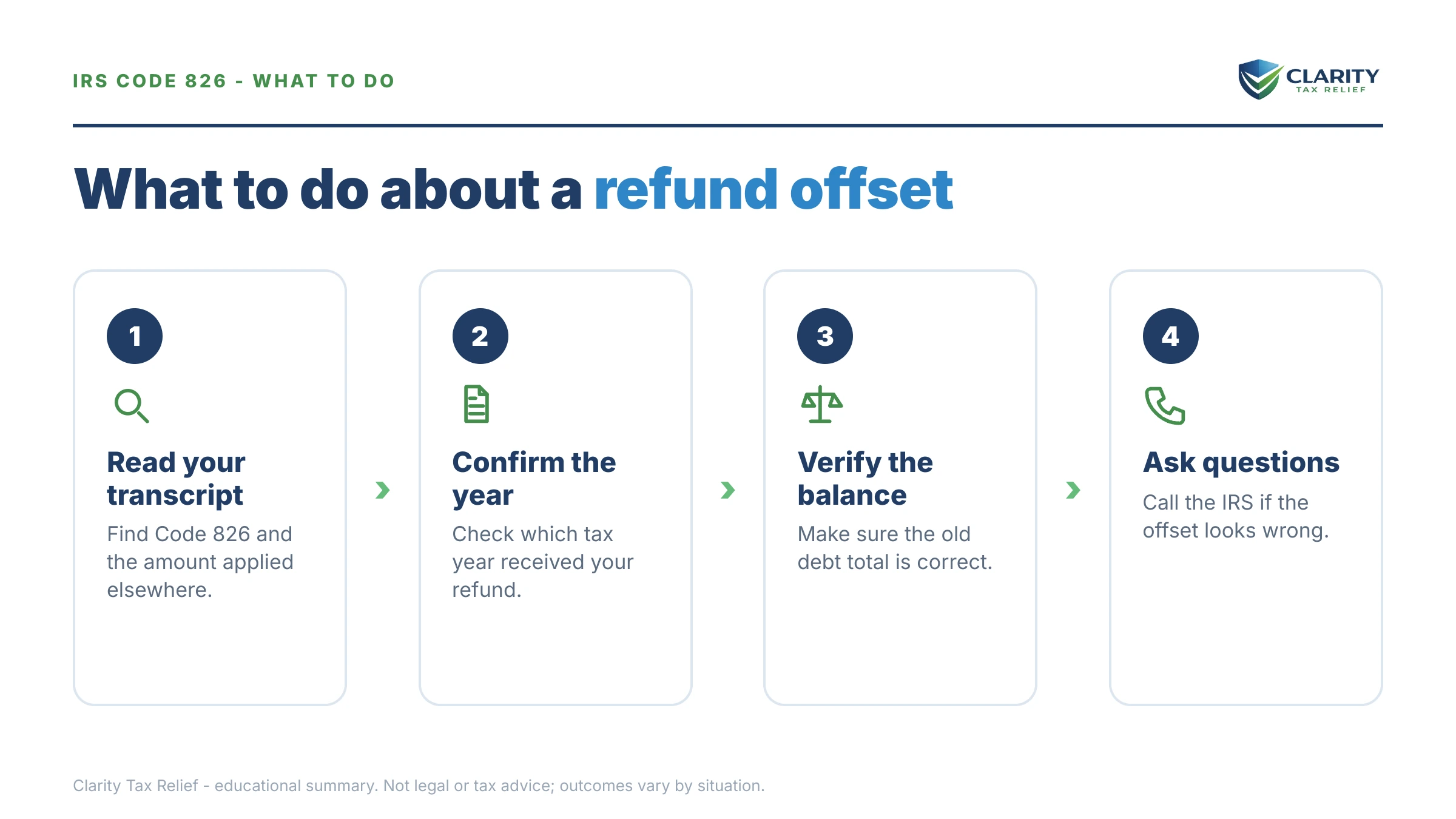
- Pull both transcripts — the year showing code 826 and the year it names, and find the matching code 706 on the receiving year.
- Verify the debt in your IRS online account: confirm the year, the amount, and that the debt is actually yours.
- Recalculate what remains by subtracting the 826 amount from the old balance, and check the 826 year for a partial code 846 refund.
- Dispute a wrong transfer: file Form 8379 if a joint refund paid a spouse's separate debt, or contest the underlying assessment if you never agreed with it.
- Resolve any remaining balance with a payment plan, hardship status, or an offer before the collection notice sequence resumes.
- Adjust your estimated payments or withholding so next year's overpayment isn't swept the same way.
That last step is where business owners leave money on the table. If you carry an IRS balance, deliberately overpaying quarterlies just hands the IRS an interest-free loan it will keep anyway — better to pay estimates accurately and put the difference toward the old year on your own terms, where you control the timing.
When you can handle code 826 yourself
Most code 826 situations don't need professional help. If the old debt is real, the transfer math checks out, and any remainder is small enough to pay or put on a streamlined online plan, you can close this out yourself in an afternoon through your IRS online account.
Experienced help changes the outcome in a narrower set of cases: the receiving balance came from an assessment you dispute (an audit or underreporter change you never answered), the transfer went to a Trust Fund Recovery Penalty assessed against you personally over your business's payroll taxes, you have multiple unfiled or unpaid years and the sweep is just the visible symptom, or the leftover balance is large enough that the difference between a default payment plan and a properly negotiated resolution is measured in thousands. In those cases, the order you fix things in — returns first, then penalties, then the balance — determines what you ultimately pay, and getting the sequence wrong is expensive.
Terms on your transcript, decoded
- Overpayment — the amount your payments and credits exceed your tax for the year. It becomes a refund only after the IRS checks it against every balance you owe.
- Credit transferred out (TC 826) — the ledger entry recording your overpayment leaving one year's account to pay another.
- Credit transferred in (TC 706) — the same money arriving on the year that had the balance; the amounts should match.
- Tax module — the IRS's term for one taxpayer + one tax form + one period; code 826 is a transfer between modules.
- Offset — a refund taken for a debt outside the IRS through the Treasury Offset Program (code 898). Technically distinct from an 826 transfer, though people use "offset" loosely for both.
- CSED — the collection statute expiration date. The IRS generally has 10 years from assessment to collect each year's balance, which is one reason it grabs refunds rather than waiting.
Code 826 questions, answered
What does code 826 mean on an IRS transcript?
Code 826 on an IRS transcript means the IRS took your overpayment, the refund you were expecting, and transferred it to a different tax year or account where you owe. The amount next to 826 is how much moved. Any leftover refund posts as code 846, and the receiving year shows code 706.
Is code 826 on my transcript bad news?
It's disappointing, not dangerous — code 826 means your refund paid down a federal tax debt you already owed, so your total balance with the IRS just went down. Nothing new was assessed and no enforcement action started. The real question is whether the transfer cleared the old year completely. If it didn't, the remainder keeps accruing penalties and interest until you address it.
What is the difference between code 826 and code 898?
Code 826 keeps your money inside the IRS. It moves your overpayment to another tax year or tax account you owe. Code 898 sends your refund outside the IRS through the Treasury Offset Program to debts like child support, defaulted student loans, or state taxes. The distinction matters because the fix is different: 826 disputes go through the IRS, while 898 disputes go to the agency that received the money.
Will I get a notice explaining the code 826 transfer?
Yes — the IRS mails a notice, most commonly a CP49, showing which year received your money and whether any refund is left. If a joint refund went to your spouse's separate debt, you may get a CP39 or CP42 instead. The transcript usually updates days or weeks before the letter arrives, which is why transcript watchers see 826 first and the explanation second.
Can I get my money back after a code 826 transfer?
Usually not, if the debt is genuinely yours — the law lets the IRS apply your overpayment to any federal tax you owe before refunding the rest. There are two real exceptions: if a joint refund paid a spouse's separate debt, Form 8379 (Injured Spouse Allocation) can recover your share, and if the underlying balance came from an assessment you never agreed with, disputing that assessment can undo the transfer's basis.
Does code 826 mean I'm being audited?
No. Code 826 is an accounting entry, not an examination. It simply moves money between years on your account. Audit activity shows up under different codes, such as code 420 or 424, and comes with its own letters. If your transcript shows only 826 and its companion codes, nobody is questioning your return; the IRS is collecting a balance it already assessed.
Will the IRS keep taking my refund every year?
Yes — as long as any federal tax balance remains, each year's overpayment will be swept the same way. That continues even while you're on an installment agreement. The offset does not replace your monthly payment; you must keep paying on schedule or the agreement can default. The only way to stop the annual sweep is to resolve the balance or stop overpaying during the year.
What does code 706 mean on my other year's transcript?
Code 706 is the receiving end of code 826. It marks the credit arriving on the year that had the balance. The 706 amount should match the 826 amount, and its date tells you when the old balance was reduced. Checking the 706 line is how you confirm the money actually landed where the IRS said it would and how much of that year's debt is left.
Can code 826 send my personal refund to a payroll tax debt?
It can when the payroll debt has been assessed against you personally — most often through the Trust Fund Recovery Penalty, which converts a business's unpaid withholding into a personal liability. Once that penalty posts to your individual account, your 1040 refunds can be transferred to it just like any back-tax year. If your business owes 941 taxes but no personal assessment exists, your individual refund generally isn't touched for it.
Your next 24 hours
- Find the receiving year. On your transcript, read the 826 line's amount and the period it names, then pull that year's transcript and locate the matching code 706.
- Gather three things: both years' transcripts, your copy of the old year's return, and any notice (CP49 or otherwise) that has arrived — that's everything needed to verify the transfer and size the remainder.
- Get the remainder reviewed free. If the transfer left a balance, or went to a debt you dispute — call (888) 825-7779 or use the 2-minute form. Penalties and interest compound on whatever's left every month you wait, so the review is cheapest today.
Primary sources: the IRS explains the companion notice at Understanding your CP49 notice, payment-plan terms at IRS payment plans and installment agreements, and hardship-based help through the Taxpayer Advocate Service.
This guide is general information, not tax or legal advice for your specific situation. Eligibility for IRS programs depends on individual facts and circumstances; no outcome is guaranteed.