
IRS Transcript Codes
Code 922 IRS Transcript: What the Underreporter Review Means in 2026
Read the transcript
Host: So you pulled up an old year in your IRS account — maybe just checking that a messy year actually closed out — and there's a line that says 922. Review of unreported income. Zero dollars. No letter, no explanation.
Tax specialist: Right. And the zero is the part that makes people spiral, because it looks like the IRS is holding something back. It isn't. Code 922 is the footprint of an Automated Underreporter case. AUR. It's a computer program that lines up every W-2, 1099, W-2G, SSA-1099 filed under your Social Security number against what's on your return. When something doesn't reconcile, it opens a case, and 922 is how that shows up on the transcript.
Host: And it posts at zero because—
Tax specialist: Because it's a review, not an assessment. Nothing has been added to your account. If tax ever does get added, it posts later under a different code entirely.
Host: Okay. First question everybody has. Is this an audit?
Tax specialist: No. An actual audit posts as code 420 and involves a human examiner looking at your records. Different track, different letters. 922 is a document match. Nobody's questioning your deductions or your judgment — the system just sees a form it doesn't think made it onto the return.
Host: 420 is the audit code, 922 is the matching program. Got it.
Tax specialist: And the whole AUR thing gets resolved by mail. The computer proposes numbers, you answer with documents, an examiner processes what you send.
Host: So what's the clock? Because that's the thing I'd want to know at two in the morning.
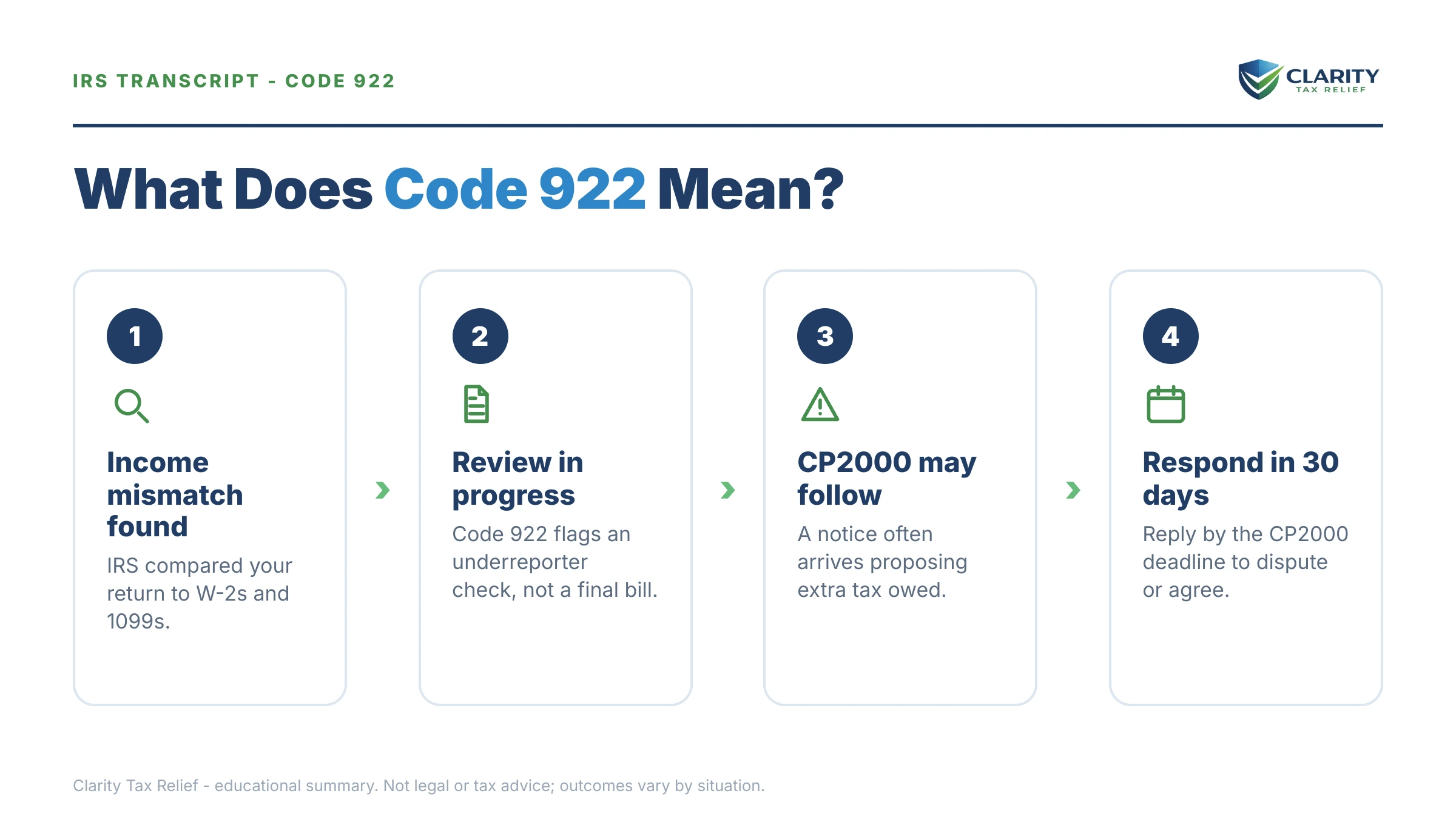
Tax specialist: 922 by itself starts no deadline. None. The deadline arrives with the notice that usually follows it, a CP2501 or a CP2000, and that typically gives you 30 days from the date printed on the notice.
Host: Typically 30 days from the notice date. Not from when you open it.
Tax specialist: From the date on the letter. Which is why the address the IRS has for you matters so much. After a move or a divorce, a notice going to the old address is the most common way people lose that window without ever knowing it existed.
Host: Hm. Okay, so if 922 doesn't start a clock, is there any cost to just... waiting?
Tax specialist: Interest. That's the real cost. If extra tax does get assessed at the end of all this, interest is charged back to the return's original due date. So it's already running on a year you thought was done.
Host: Say more about the codes around it, because you mentioned there's a pattern to watch.
Tax specialist: Yeah. Look for code 971 near your 922. 971 means notice issued — a letter has been generated, so it's coming or already in the mail. Then months later, if you see code 290 for $0.00, that usually means the review closed with no change.
Host: 290 for zero is the quiet ending.
Tax specialist: That's the one. A 290 with an actual dollar amount means tax was assessed. And a 291 after that means part of it came back off.
Host: What about 570? People see that one a lot.
Tax specialist: Separate mechanism. Code 570 is a hold on the account or a refund — a processing issue. It doesn't tell you anything about the underreporter case. Different problem, different guide.
Host: Alright. Walk me through what happens if somebody just... doesn't answer. Because I think that's the fear underneath this.
Tax specialist: It's automated and each stage takes away something the stage before it still offered. 922 posts, review's open, nothing's due. Then 971 posts and the CP2501 or CP2000 mails with specific proposed changes, usually with a 20% accuracy-related penalty attached, and that 30-day window. No response, and the IRS issues a CP3219A — that's the Statutory Notice of Deficiency, the 90-day letter. That's the last chance to dispute the amount in U.S. Tax Court without paying first.
Host: And after the 90 days?
Tax specialist: Assessment. Code 290 posts with the full proposed amount, it's a legal debt, and it enters the collection notice stream that starts with a CP14 and escalates toward liens and levies. Future refunds get offset until it's paid.
Host: So nowhere in that chain does anyone call to ask if the 1099 was actually yours.
Tax specialist: Nowhere. The system treats an unanswered proposal as correct. And with IRS staffing down sharply in 2026, reaching a person to fix a blown deadline is harder than it used to be. The automated side never slowed down.
Host: Wait, back up to the proposal itself. You said before that those numbers can be off.
Tax specialist: Routinely overstated, and for a mechanical reason. The computer sees gross proceeds on a 1099-B but not what you paid for the shares. It sees a 1099-R distribution but not the federal withholding sitting in box 4. So the printed figure can be built on information that's incomplete rather than wrong.
Host: Which is why the rule is—
Tax specialist: Never sign the response form until you've verified the numbers. And don't answer with an amended return. A 1040-X filed on top of an open AUR case tends to cross wires and slow the whole thing down. AUR wants an answer to the notice.
Host: There's an example in the article about a divorce year. Can you run it?
Tax specialist: Sure, and it's hypothetical. Divorce in 2024, $46,000 comes out of a retirement account as part of the settlement, the 1099-R goes to the old address, so it never makes the first return filed alone. 922 posts in early 2026. Later a CP2000 proposes $12,650 in additional tax — that includes the 10% early-distribution addition — a $2,530 penalty, which is 20% of the tax, and roughly $1,220 of interest. About $16,400 total.
Host: $16,400. And what changes that?
Tax specialist: Facts. If the distribution was paid as an alternate payee under a QDRO, the court order that splits a retirement plan, the 10% early-distribution addition generally doesn't apply. If box 4 shows withholding the computer didn't credit, that comes off too. And because the penalty is a percentage of the tax, if the corrected tax is lower, the penalty moves with it. Or it can be challenged on its own.
Host: So the number is math, not a verdict.
Tax specialist: It's a proposal. What the taxpayer controls is whether documents show up inside the window.
Host: Be honest with me. When does somebody actually need help with this?
Tax specialist: Often they don't. If the missing 1099 is real, the income is clearly yours, the balance is one you can pay or put on a simple plan, and no other years are flagged — check the box, respond by the deadline, set up payments at IRS.gov. That's the honest answer.
Host: And the narrower set?
Tax specialist: When the proposal is built on gross 1099-B proceeds with no basis. When the income belongs to an ex-spouse or a joint account you don't control. When more than one year carries a 922. When the 20% penalty is worth contesting. Or when it's already at the CP3219A stage and the 90 days are running. In those, the order and the wording of the response change what you end up paying.
Host: Okay — next 24 hours. What do people actually do today?
Tax specialist: Two things off the transcript first: the date next to code 922, and whether a 971 has posted after it. That tells you if a letter's in motion. Then gather the flagged year — the return you filed, every W-2 and 1099 you have, and order your wage and income transcript so you find the mismatch before the IRS explains it to you.
Host: And if the paperwork's a mess, or it's the divorce-year situation.
Tax specialist: Then have someone read the transcript with you. Clarity's Enrolled Agents will look at the transcript and the flagged year at no cost and tell you what the mismatch is and how to answer it. That's (888) 825-7779. Eligibility for anything with the IRS depends on your specific facts, but the response window is the piece you control, and it's cheapest to work on before the letter lands.
The short answer: code 922 on an IRS transcript means the Automated Underreporter (AUR) program found a mismatch between your return and income documents filed under your Social Security number — W-2s and 1099s. It usually posts with $0.00, it is not an audit, and it often leads to a CP2501 or CP2000 notice proposing additional tax.
You pulled up an old year in your IRS account — maybe checking that the divorce-year return actually closed out — and there it is: 922, Review of unreported income, $0.00. No letter, no explanation, just a code sitting on a return you thought was finished. Nothing has been assessed yet, and the sequence that follows a 922 is predictable — which means you can get ahead of it.
The image below shows you exactly where code 922 sits on an account transcript and which nearby lines, the posting date and any code 971, actually tell you where the case stands.
⏱ Your clock: code 922 itself starts no deadline. The deadline arrives with the notice that usually follows, a CP2501 or CP2000, which typically gives you 30 days from the date printed on it to respond. Until then, the real cost is interest: if extra tax is ultimately assessed, interest is charged all the way back to the return's original due date.
Why code 922 appeared on your IRS transcript
Code 922 posts when the IRS's Automated Underreporter program finds income reported under your Social Security number that doesn't appear to match your tax return. Every W-2, 1099, W-2G, and SSA-1099 issued to you is also filed with the IRS. Long after your return is processed, a computer lines those documents up against what you reported. When something doesn't reconcile, it opens an AUR case, and TC 922 is the transcript footprint of that case.
The most common triggers are a 1099 you never received or forgot: a 1099-NEC for side work, a 1099-K from a payment platform, a 1099-R for a retirement distribution, a 1099-B for stock sales, a 1099-C for cancelled debt, or a W-2G for gambling winnings. The dollar amount next to 922 is almost always $0.00, because 922 marks a review, not an assessment. If tax is ever added, it posts later under a different code.
Divorce years are AUR magnets, and it's rarely anyone's fault. Joint brokerage and bank accounts often issue 1099s under one spouse's SSN, sometimes yours, even when your ex kept the money. A retirement account split can generate a 1099-R you didn't expect. And if your ex handled the paperwork for years, documents may have gone to an address you no longer live at, so the mismatch never made it onto your first solo return. If income on the notice genuinely belongs to your ex, that's an attribution dispute worth reading divorce and IRS debt: who pays before you respond.
One timing note that surprises people: AUR runs far behind the calendar. Code 922 and the notice behind it commonly show up 12 or more months after you filed the return being matched. If you want a walkthrough of every line on the document you're staring at, start with how to read an IRS account transcript. This page covers only what's unique to 922.
“The income or payment information we received from third parties, such as employers or financial institutions, doesn't match what you reported on your tax return. This difference may increase or decrease your tax or may not change it at all.”
— Understanding your CP2000 series notice (IRS.gov)
Code 922 vs. an audit, and the codes around it
Code 922 is a computer document-matching review; a true audit posts as code 420 and involves a human examiner. That distinction changes everything about how you respond. An AUR case is resolved entirely by mail: the computer proposes numbers, you answer with documents, and a tax examiner processes the response. Nobody is questioning your deductions, your books, or your judgment — the system simply sees a form you didn't report. A code 420 audit indicator is a different track with different letters and different rights.
Here's how 922 reads alongside the codes most likely to appear near it:
| Code | What it means | What to do |
|---|---|---|
| 922 | Underreporter (AUR) review opened or updated — often $0.00 | Match your return against your wage & income transcript; watch for a 971 |
| 971 | Notice issued — often the CP2501 or CP2000 for this case | Watch the mail; the response clock starts on the notice date |
| 570 | Hold on the account or a refund — a processing issue, not document matching | Different problem; see the code 570 guide |
| 420 | Return referred to Examination — an actual audit | Different track entirely; exam letters follow |
| 290 | Additional tax assessed ($0.00 usually means the case closed with no change) | An amount here means the AUR case ended in an assessment |
| 291 | Tax reduced | Often posts after a successful response lowers a proposal or assessment |
The pattern to watch: 922 followed by a code 971 notice-issued entry means a letter is coming or already in the mail. 922 followed months later by a code 290 for $0.00 usually means the review closed with no change — the quiet, happy ending. A 290 with a dollar amount means tax was assessed, and a later code 291 means part of it came back off. A code 570 account hold is a separate mechanism and doesn't tell you anything about the AUR case.
What happens if you ignore a code 922 review
An ignored underreporter case ends with the full proposed tax, penalty, and interest assessed against you, without a single human ever weighing your side. The sequence is automated, and each stage removes options the previous one still offered:
- 922 posts — the review is open. No notice yet, no deadline yet. This is the stage where preparation is free.
- 971 posts and a CP2501 or CP2000 mails — the IRS proposes specific changes, usually with a 20% accuracy-related penalty attached, and typically gives you 30 days from the notice date to respond. See the CP2000 guide for the notice itself.
- No response → CP3219A Statutory Notice of Deficiency — the CP3219A is the 90-day letter: your last chance to dispute the amount in U.S. Tax Court without paying first.
- The 90 days pass → assessment — code 290 posts with the full proposed amount. The proposal is now a legal debt, and interest keeps compounding on all of it.
- Collection begins — the balance enters the notice stream that starts with a CP14 bill and escalates toward liens and levies. Your future refunds are offset until it's paid.
Note what's absent from that list: any step where the IRS calls to check whether the 1099 was really yours. The system assumes every unanswered proposal is correct. In 2026, with IRS staffing down sharply, reaching a human to fix a missed deadline is harder than ever. But the automated assessments never slowed down.
Seeing code 922 on your transcript right now?
The CP2000 that usually follows gives you only about 30 days to answer it. The flagged year is cheapest to fix before that letter lands. An experienced tax professional will review your transcript and the flagged year free, and tell you exactly what the mismatch is and how to answer it.
Your options when the notice arrives
Every CP2000 gives you three lawful answers — agree, disagree, or partially agree — plus a fourth default, silence, which always costs the most. The right choice depends on whether the missing income is genuinely yours and whether the IRS's math accounts for things the computer can't see, like cost basis on stock sales or withholding already taken from a distribution.
| Option | What it costs | Typical timeline |
|---|---|---|
| Agree and pay in full | Proposed tax, the 20% accuracy-related penalty if included, and interest through payoff | Case closes within weeks of the IRS processing your signed response |
| Agree but can't pay | Same balance; $0 setup fee for a short-term plan (up to 180 days), a setup fee for longer plans; interest and the 0.5%/month late-pay penalty keep accruing | Plan can be set up online the same day; balances of $50,000 or less can stretch up to 72 months |
| Disagree with documentation | Your time and postage — potentially nothing owed if your proof holds | IRS replies commonly take several weeks to a few months; the case stays open, not assessed |
| Partially agree | Tax on the real mismatch only; the penalty is often removable with a reasonable-cause argument | Similar to a disagreement — expect back-and-forth by mail |
| Do nothing | The full proposal assessed, plus growing interest and eventual collection action | CP3219A → 90 days → assessment (code 290) → CP14 collection stream |
Two rules of thumb. First, never sign the response form until you've verified the numbers — CP2000 proposals routinely overstate tax because the computer sees gross proceeds on a 1099-B but not what you paid for the shares, or a 1099-R distribution but not the withholding in box 4. If any part is wrong, follow the playbook in how to disagree with a CP2000. Second, if the numbers are right but the money is gone, common in a divorce year, see CP2000: agree but can't pay before you panic. A payment arrangement stops the escalation even when it can't stop the interest.
One more thing the notice won't say: don't file an amended return as your response. AUR wants an answer to the notice, and a 1040-X filed on top of an open case usually crosses wires and slows everything down.
A worked example: how a $16,400 proposal gets built, and shrunk
Say you divorced in 2024 and, as part of the settlement, $46,000 came out of a retirement account, and the 1099-R landed at your old address, so it never made it onto your first return filed alone. Code 922 posts in early 2026. Months later a CP2000 arrives proposing: $12,650 in additional tax (including the 10% early-distribution addition), a $2,530 accuracy-related penalty (20% of $12,650), and roughly $1,220 of interest accrued since the return's due date — $16,400 in total.
That number is a proposal, not a bill, and this hypothetical shows why. If the distribution was paid to you as an alternate payee under a QDRO — the court order that splits a retirement plan in divorce — the 10% early-distribution addition generally doesn't apply, which alone knocks thousands off. If box 4 of the 1099-R shows federal withholding the computer didn't credit, the balance drops again. And if the corrected tax is substantially lower, the 20% penalty, calculated as a percentage of the tax, shrinks with it, or can be challenged outright. You can get a rough feel for how much of any proposed balance is penalty and interest rather than tax with our IRS Penalty & Interest Calculator.
The lesson: the person who responds with documents in the 30-day window might resolve this for a fraction of the printed figure. The person who ignores it owes all $16,400, plus every month of interest after.
How to respond to code 922, step by step
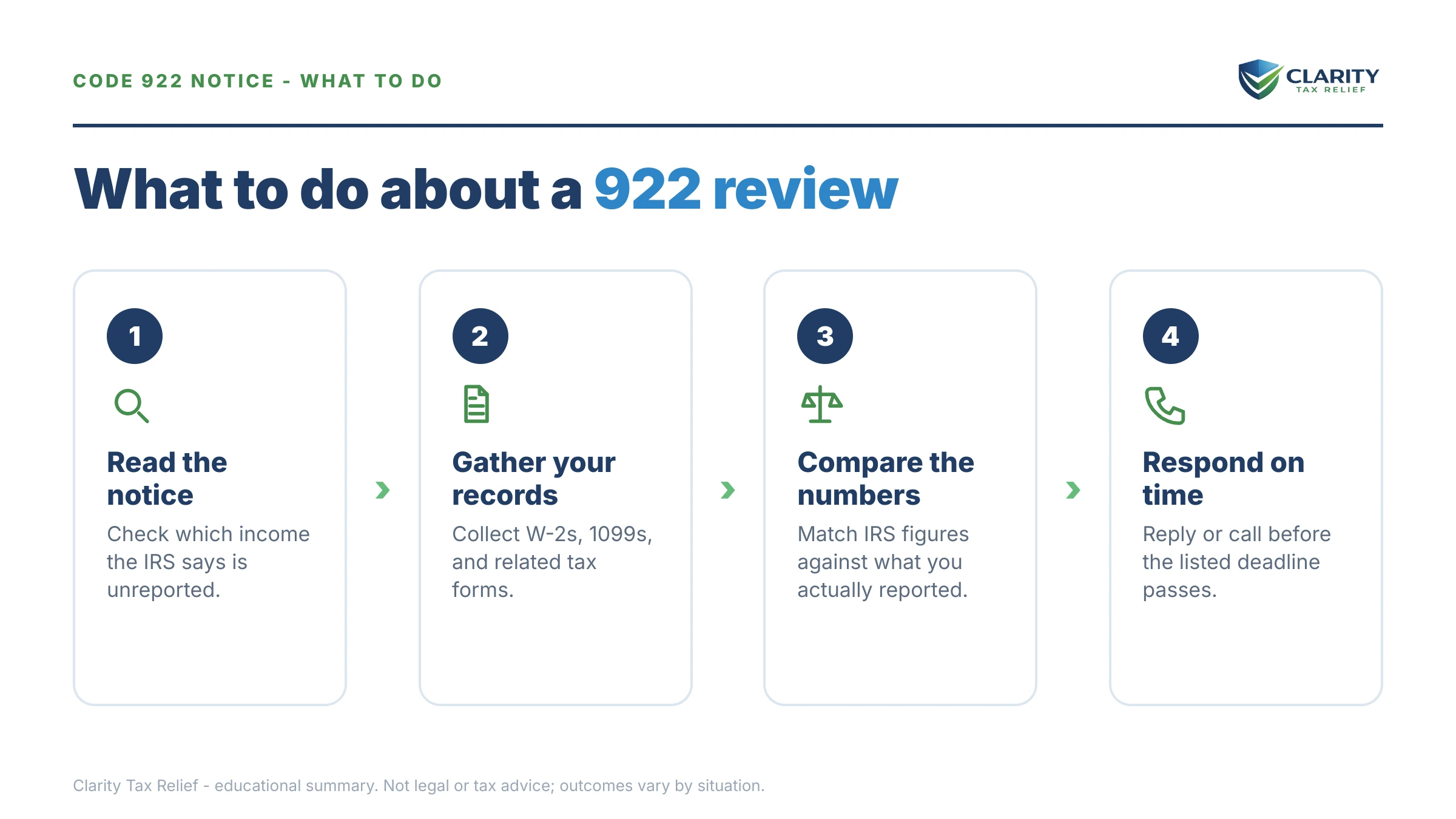
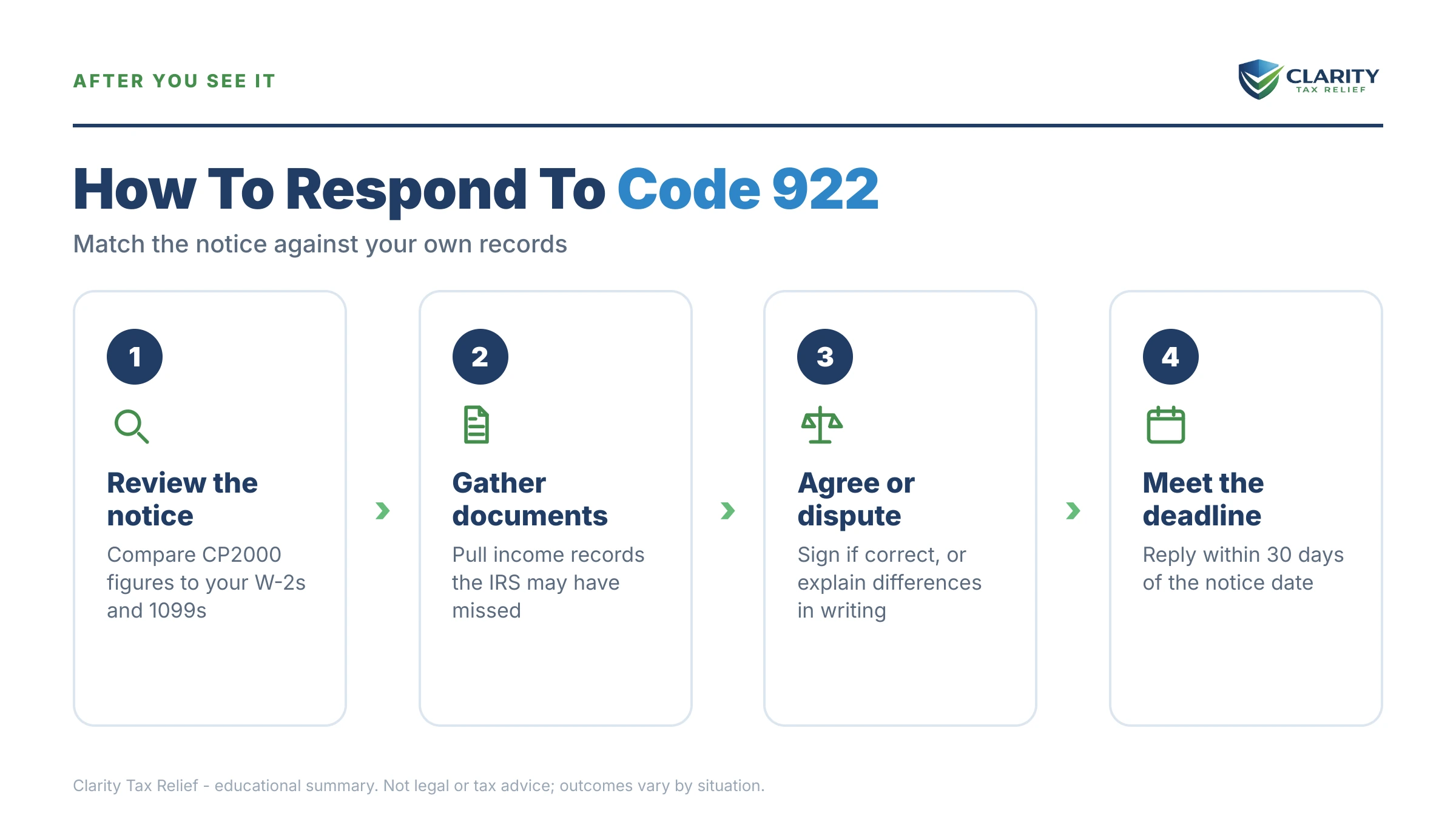
- Pull your full account transcript — confirm the code 922 posting date and scan for a code 971, which means a notice has been generated and is on its way.
- Compare your return against IRS records — order your wage and income transcript and match every W-2 and 1099 the IRS holds against what you filed, so you find the mismatch before the IRS explains it to you.
- Calendar the notice deadline the day it arrives — don't amend your return preemptively. When the CP2501 or CP2000 lands, write down the response date printed on it — typically 30 days from the notice date.
- Respond inside the window — agree, disagree with documentation, or partially agree. But never sign a proposal you haven't verified, especially where cost basis, withholding, or divorce-year income splits are involved.
- Resolve any balance immediately — pay in full, set up a payment plan, or request penalty relief so the assessed amount never reaches the collection notice stream.
When you can handle this yourself
Most single-year AUR cases are genuinely DIY-able. If the missing 1099 is real, the income is clearly yours, the proposed balance is one you can pay or put on a simple payment plan, and no other years are flagged, you don't need to hire anyone — check the box, respond by the deadline, and set up payments at IRS.gov. That's the honest answer.
Experienced help changes the outcome in a narrower set of situations: when the proposal is built on gross 1099-B proceeds with no basis (the printed number can be several times the real tax), when income on the notice actually belongs to an ex-spouse or a joint account you no longer control, when more than one year carries a 922, when a 20% accuracy-related penalty is worth contesting, or when the case has already reached the CP3219A stage and the 90-day Tax Court window is running. In those cases, the order and wording of the response materially changes what you end up paying.
Terms on your transcript, decoded
- AUR (Automated Underreporter): the IRS computer program that matches third-party income documents against filed returns and generates code 922 cases.
- Transaction code (TC): the three-digit number the IRS uses to record each action on your account — 922 is one of hundreds.
- Information return: any form a payer files with the IRS about you — W-2, 1099, W-2G, SSA-1099 — the raw material AUR matches against.
- Proposed amount due: the figure on a CP2000 — a proposal you can accept, contest, or correct, not an assessed debt.
- Accuracy-related penalty: the 20% penalty the IRS adds when it treats an understatement as substantial or negligent; it can often be contested or abated.
- Statutory Notice of Deficiency: the 90-day letter (CP3219A) that is your final chance to dispute the proposal in Tax Court before assessment.
For the IRS's own description of the notice this code usually produces, see Understanding your CP2000 notice. Payment and plan options live at IRS.gov/payments, and if an AUR case is causing hardship the IRS won't resolve, the Taxpayer Advocate Service is an independent avenue.
Code 922 questions, answered
What does code 922 mean on an IRS transcript?
Code 922 means the IRS's Automated Underreporter (AUR) program is reviewing your return because income reported to the IRS by employers, banks, or brokers doesn't match what your return shows. It is a computer-driven document-matching review, not an audit. Many 922 reviews close with no change; the rest lead to a CP2501 or CP2000 notice proposing additional tax.
Does code 922 mean I'm being audited?
No. An audit posts as code 420 on your transcript and involves an examiner reviewing your records. Code 922 is the Automated Underreporter program — a computerized comparison of your return against W-2s and 1099s filed under your Social Security number. The distinction matters: AUR cases are resolved entirely by mail with documentation. You never meet an examiner unless the case is separately referred to exam, which is uncommon.
Why does code 922 show $0.00 on my transcript?
The $0.00 is normal. Code 922 marks the opening or a status update of an underreporter review. It is not an assessment, so no dollar amount attaches to it. If the review ends with additional tax, that amount posts later under code 290. If it closes with no change, you may see a code 290 for $0.00, and often no notice ever arrives.
How long after code 922 posts will I get a CP2000?
There is no fixed schedule, but AUR runs well behind the filing season — CP2501 or CP2000 notices commonly arrive 12 or more months after you filed the return being matched. The 922 posting date tells you the case exists, not when the notice will mail. Make sure the IRS has your current address. After a divorce or a move, a notice mailed to the old address is the most common way people miss the response window entirely.
Can code 922 go away without a notice?
Yes. A meaningful share of AUR screenings close with no change — the mismatch is explained by something already on the return, such as income reported on a different line than the computer expected. When that happens you typically see a code 290 for $0.00, or the case simply goes quiet and no CP2000 is ever mailed. Until a closing entry or notice appears, though, treat the case as open.
Will code 922 delay my refund?
Usually not for the current year. Code 922 reviews a return that was already processed, often a prior year, so it doesn't hold a refund the way a code 570 hold or an 810 freeze does. But if the review ends in an assessed balance you don't resolve, the IRS can offset your future refunds against that balance every year until it is paid.
What happens if I ignore the CP2000 that follows code 922?
The IRS issues a CP3219A Statutory Notice of Deficiency, which gives you 90 days to petition the U.S. Tax Court. If you don't, the proposed tax, the accuracy-related penalty, and interest are all assessed, code 290 posts on your transcript. The balance moves into the collection notice stream starting with a CP14. Answering the CP2000 inside its window is far cheaper than unwinding an assessment later.
Your next 24 hours
- Find two things on your transcript: the date next to code 922, and whether a code 971 (notice issued) has posted after it. That tells you whether a letter is already in motion.
- Gather the flagged year's paperwork: the return you filed, every W-2 and 1099 you have. Your wage and income transcript, so the mismatch is in your hands before the IRS's letter is.
- Get a free case review: an underreporter case is cheapest to resolve before it becomes an assessment, and interest is already running back to the return's due date. Use the 2-minute form or call (888) 825-7779.
This guide is general information, not tax or legal advice for your specific situation. Eligibility for IRS programs depends on individual facts and circumstances; no outcome is guaranteed.