
IRS Notices
IRS CP2000 Disagree: How to Dispute an IRS CP2000 Notice in 2026
Read the transcript
Host: So there's a CP2000 sitting on your kitchen table proposing a few thousand dollars in tax you're pretty sure you don't owe. And the instinct is either write the check or file an amended return. The article says do neither.
Tax specialist: Neither. Right. A CP2000 is a proposal. Nothing's been assessed yet. It came out of the Automated Underreporter program - the AUR - which is a computer matching every 1099 and W-2 filed under your Social Security number against what's on your return. Gap shows up, it proposes tax. No human looked at your file before it went in the mail.
Host: No human at all?
Tax specialist: Not before it's issued, no. And that's actually the opening, because the computer only sees gross amounts. It sees your broker reported twenty thousand in stock sale proceeds. It has no idea what you paid for those shares. It sees a 1099-K, it can't see your business expenses. It sees a 1099-R, it can't tell you rolled that money over.
Host: Okay, so - hang on, before we get into the proof. Where does the disagreement physically go? Because the notice is like eight pages of dense—
Tax specialist: The response form. It's tucked at the back. Three boxes: agree in full, partially agree, do not agree. You check "I do not agree," you sign it, and if you filed jointly, both spouses sign. That last part trips people up constantly.
Host: Even if the missing 1099 is only under one spouse's number?
Tax specialist: Doesn't matter. Joint return, joint dispute, two signatures. One spouse's forgotten brokerage account becomes a shared proposal, and the response has to be signed by both of you.
Host: And the deadline is the respond-by date on page 1.
Tax specialist: Page 1, and it's typically 30 days from the notice date. Write it somewhere you'll see it every day. Now - a late response can still work if the case hasn't moved on yet. The IRS often takes them. But the moment they issue a CP3219A, a Statutory Notice of Deficiency, a hard 90-day Tax Court clock takes over.
Host: And that one—
Tax specialist: Cannot be extended. No exceptions, no extensions. That's the one deadline in this whole process with no give in it at all.
Host: Let's talk about doing nothing, because some people freeze. What actually happens?
Tax specialist: Silence is treated as consent. The respond-by date passes and the proposal stands exactly as the computer wrote it - full income added, zero basis, zero expenses, the twenty percent accuracy penalty included. Then the CP3219A arrives, that's the 90-day letter. After 90 days it's assessed as a legally enforceable balance. Then a CP14 bill, typically a 21-day window, then CP501, CP503, CP504, and an LT11 final notice. That's where refund offsets, a possible lien, and levy power over wages and bank accounts enter the picture.
Host: CP501, 503, 504, then LT11. Got it.
Tax specialist: And there's a downstream piece people don't see coming. The IRS shares assessment data with state tax agencies. So an uncontested federal adjustment frequently spawns a matching state bill months later.
Host: Hm. So two bills from one silence.
Tax specialist: Handling it at the CP2000 stage is where you'd address both.
Host: Alright, the proof. Because the article is blunt about this - a signed statement on its own doesn't do much.
Tax specialist: The AUR unit decides on paper. It's a documents operation. So you match the document to the problem. Missing cost basis on stock or crypto - that's the 1099-B or exchange records plus a completed Form 8949 and Schedule D showing what you actually paid. Income you already reported, just on a different line - highlighted copy of the schedule where it appears. A wrong or duplicated 1099 - the corrected form from the payer, or a letter from the payer admitting the error.
Host: What about a rollover?
Tax specialist: Form 5498 or an account statement showing the deposit landed in the new account within 60 days. Cancelled debt on a 1099-C that's excludable - Form 982 with an insolvency worksheet. And if the income isn't yours at all, identity theft or a mixed-up SSN, that's Form 14039, the identity-theft affidavit, plus a report and a payer statement.
Host: Say the penalty part again more simply, because I want to make sure I've got it. The twenty percent.
Tax specialist: Two things are on the table - the tax and the penalty. They're separately contestable. So even if you look at it and think, yeah, the tax is right, you can still dispute the penalty for reasonable cause. You relied on a wrong 1099, you relied on records you had good reason to trust. But you have to say it explicitly in your response. The unit won't remove it on its own.
Host: Not on its own.
Tax specialist: There's also a newer thing - starting summer 2026 the IRS has an Automatic Exemption from Penalty, AEP, that applies some relief automatically. The article's point stands anyway: still raise the penalty explicitly in your response.
Host: And there's a mechanical link between the two, right? Between the tax number and the penalty?
Tax specialist: There is. The accuracy-related penalty is built on a substantial understatement. So it's proportional to the gap. If your documents bring the understatement down far enough, the understatement may no longer be large enough to support that penalty at all. That's the structure of it - I'm not telling you how your case lands, I'm telling you what the penalty is attached to.
Host: Fair. And partial agreement is real? Because a lot of these notices are half right.
Tax specialist: Very common. The forgotten 1099 is genuinely yours, but the stock sale needs basis applied. You mark which items you accept, which you contest, attach proof only for the disputed ones. And paying the agreed slice now stops interest running on that slice while the rest gets decided. Interest accrues from the return's original due date on whatever amount is ultimately upheld.
Host: What about the amended return instinct? People want to fix it with a 1040-X.
Tax specialist: Resist that. A 1040-X routes to a different IRS unit and can collide with the open AUR case. Respond to the notice itself. On your transcript, by the way, this review shows up as code 922.
Host: Code 922. Then you send it and… wait?
Tax specialist: Plan on at least eight weeks, often longer in 2026 - the IRS workforce is down roughly 27% since the 2025 cuts. You might get a Letter 2645C saying they need more time. That's normal, that's not a rejection. Three ways it goes: they accept the explanation and send a closing letter, and you keep that letter permanently. They revise the proposal, and you check the new math item by item because you can agree or disagree with it the same way. Or they reject it and issue the CP3219A.
Host: Which isn't the end.
Tax specialist: It's a 90-day window to petition Tax Court before anything is assessed, and those petitions typically route through the IRS Independent Office of Appeals first. But the CP2000 window is the cheapest stage this dispute will ever sit in. Every stage after costs you leverage.
Host: When is this a do-it-yourself thing?
Tax specialist: When it rests on one clear document you already have. A rollover on a Form 5498. Income plainly visible on another schedule. A corrected 1099 in hand. Check the box, attach the proof, mail it with tracking, keep a full copy. It gets harder when the notice spans multiple years, or it's a big basis reconstruction across crypto exchanges, or you're essentially building a Schedule C from scratch to substantiate 1099-K expenses, or there's identity theft tangled into a real balance, or a four-figure proposed penalty, or a CP3219A already running.
Host: So today - what, specifically?
Tax specialist: Find the respond-by date on page 1 and write it where you'll see it daily. Pull that year's return, every 1099 and W-2 you got, and the statement behind each item you're disputing. And if you want a set of eyes on it, send us a photo of the notice - an Enrolled Agent here will review it and your records at no cost, before that date passes, and tell you which items are genuinely disputable and what to attach. That's (888) 825-7779.
Host: Keep the statement factual and boring, too.
Tax specialist: Payer name, form number, dollar amount, why it's wrong, what's attached. That's it. And never agree to tax on income you never received just to make the notice go away.
The short answer: if you disagree with a CP2000, don't pay it and don't file an amended return. Check the "I do not agree" box on the response form, attach a signed statement plus proof for every disputed item, and send it by the respond-by date printed on the notice, typically 30 days from the notice date.
A computer at the IRS compared your joint return against every 1099 and W-2 filed under your and your spouse's Social Security numbers, decided something was missing, and mailed you a proposal for thousands of dollars in tax you don't believe you owe. Here's what the dense pages don't make obvious: a CP2000 is a proposed change that hasn't been assessed, and the "CP2000 disagree" path is printed right on the response form. The notice is literally designed to be disputed.
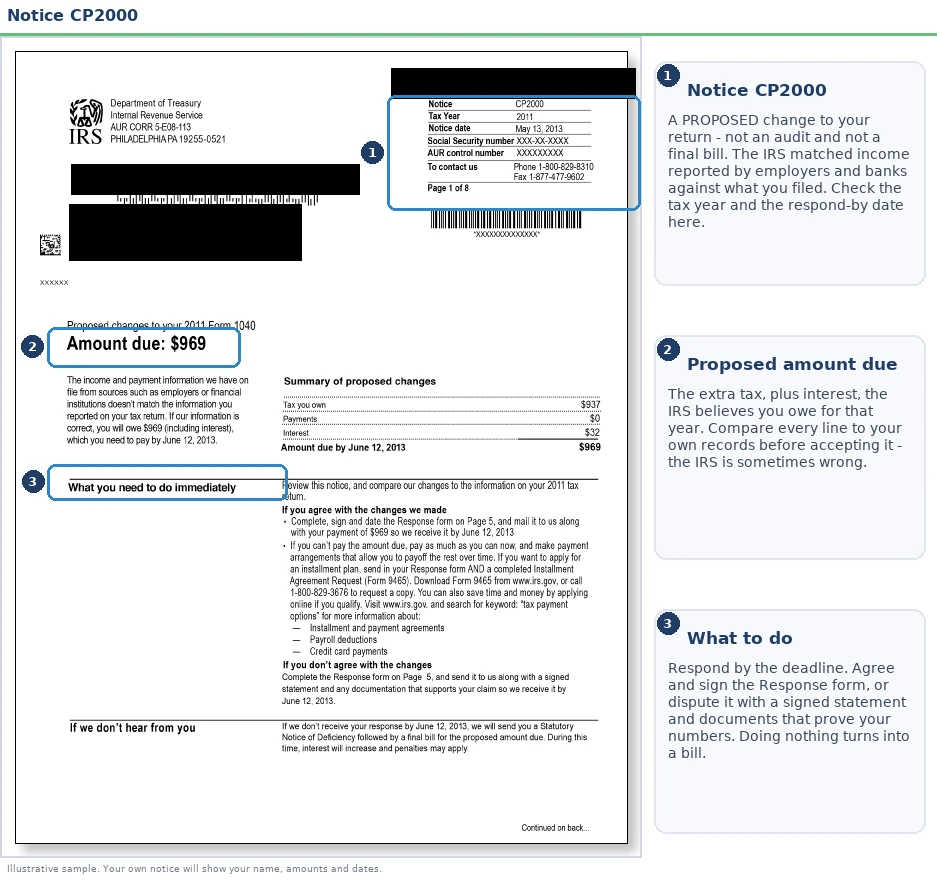
The response form tucked at the back of the notice is where your disagreement lives. The image below shows you exactly what a CP2000 looks like and where to find the respond-by date, the proposed amount due, and the section where you state your position.
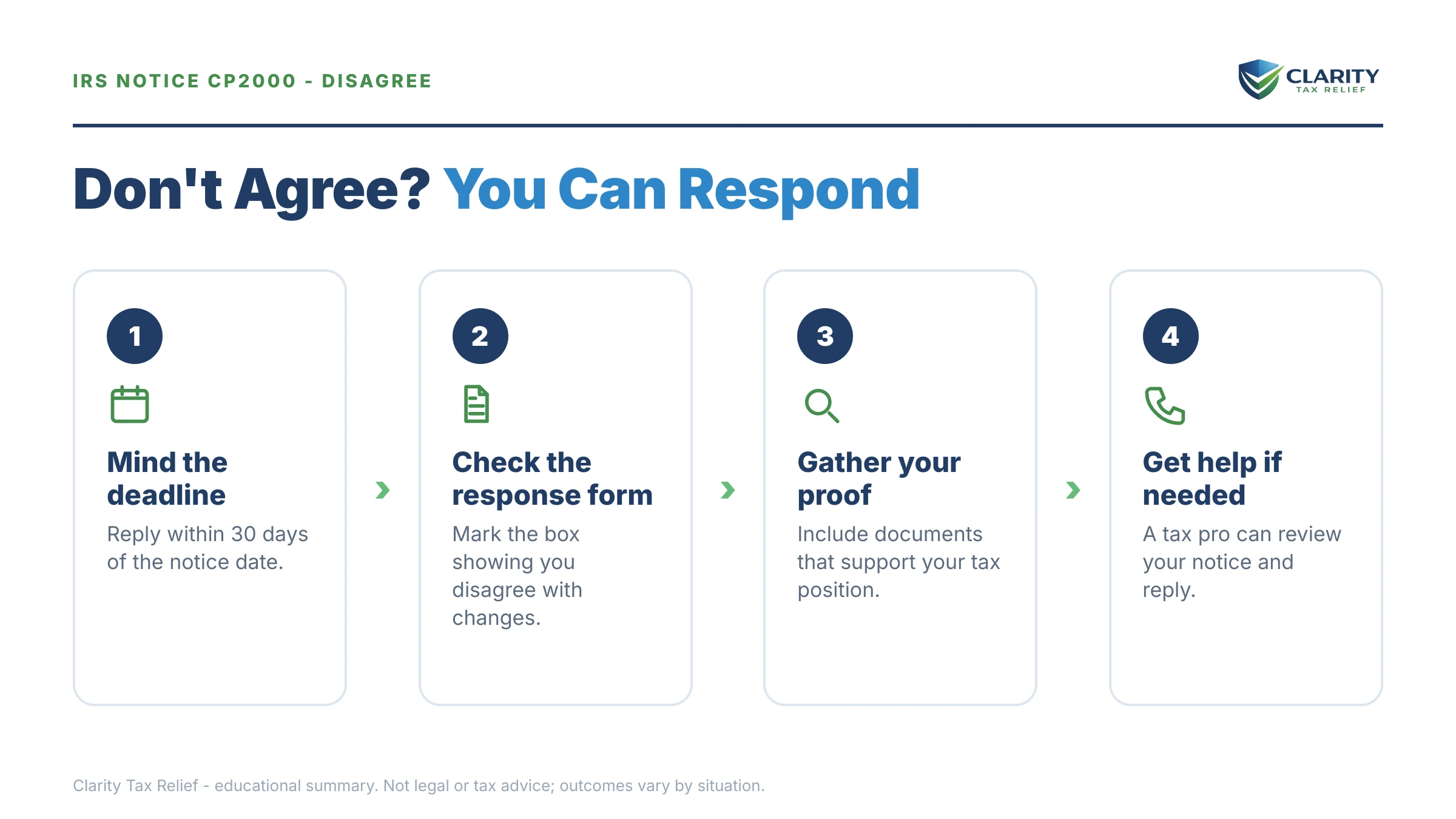
⏱ Your deadline: the "respond by" date printed on page 1 of your CP2000. You typically have 30 days from the date on a CP2000 to send your disagreement. A late response can still work if the case hasn't advanced, but once the IRS issues a Statutory Notice of Deficiency, a hard 90-day Tax Court clock takes over, and that one cannot be extended.
Why disagreeing with a CP2000 is often correct
A CP2000 is a computer-generated proposal from the IRS Automated Underreporter program: not a bill, not an audit, not a final decision. The CP2000 notice guide covers the notice itself. The weakness of the matching process is your opening: the computer sees gross amounts, never your side of the math. It knows your broker reported $20,000 in stock sale proceeds and has no idea you paid $18,500 for the shares. It knows a platform issued a 1099-K and cannot see your business expenses. It knows a 1099-R reported a distribution and cannot tell you rolled it over.
On a joint return the mismatch can sit under either spouse's Social Security number. The notice arrives addressed to both of you, so one spouse's forgotten brokerage account becomes a shared proposal. Both spouses sign the response.
“State whether you agree or disagree with the notice and include any supporting documentation.”
— Understanding your CP2000 series notice (IRS.gov)
If you disagree and don't respond
Disagreeing silently is the same as agreeing. The IRS may send a CP3219A Statutory Notice of Deficiency, which opens the 90-day Tax Court window, and if that passes the proposed tax is assessed and your dispute rights narrow to audit reconsideration or paying and then claiming a refund. The stages, with the IRS's own wording at each, are in what happens if you don't respond to a CP2000. A response postmarked by the printed date, even a partial one, keeps every door open.
Disagree with the CP2000 in your hands?
Send us a photo of the notice and tell us what's wrong with it. An experienced tax professional will review your CP2000 and your documents free, before the respond-by date on page 1 passes, and map exactly what to send and how.
Your options when you disagree with a CP2000
The CP2000 response form gives you three formal positions: agree in full, partially agree, or fully disagree. Which box you check, and what you attach, determines everything that follows.
- Fully disagree. You dispute every proposed item. Check "I do not agree," sign (both spouses on a joint return), and attach a statement plus documents for each item. Do not send payment for amounts you're disputing. Nothing has been assessed, and paying can be read as agreement.
- Partially agree. Real notices are often part right, part wrong: the forgotten 1099 is genuinely yours, but the stock sale needs basis applied. Mark which items you accept and which you contest. Paying the agreed portion now stops interest on that slice while the disputed slice is decided.
- Agree, but can't pay. If your review shows the IRS is actually right, the fight shifts from the amount to the payment terms. That's a different playbook, covered in CP2000, agree but can't pay.
- Dispute the penalty even if the tax stands. The proposed 20% penalty is separately contestable. If you relied on a wrong 1099 or reasonable records, say so, the AUR unit won't waive it unless you ask. Note that starting summer 2026, the IRS's new Automatic Exemption from Penalty (AEP) applies some penalty relief automatically. But a CP2000 penalty dispute should still be made explicitly in your response.
Interest is the quiet cost across every path: it accrues from the return's original due date on whatever amount is ultimately upheld, at the IRS's quarterly rate. You can estimate what penalties and interest add with our Penalty & Interest Calculator while you decide how hard to contest each item.
| Path | What you send | Typical timeline | What it costs |
|---|---|---|---|
| Fully disagree | Signed response form + statement + proof per item | 8 weeks to several months for an IRS answer in 2026 | $0 to respond; interest accrues only on what's ultimately upheld |
| Partially agree | Response form marking agreed vs. disputed items + proof; optional payment of the agreed part | Same review window as a full disagreement | Tax on agreed items; paying them now stops their interest |
| Agree and pay | Signed consent + payment | Case closes in weeks | Full proposed tax + penalty + interest to date |
| Agree, can't pay | Signed consent + payment-plan request | Plan can start immediately; balance paid over time | Setup fee varies by plan type; penalties and interest keep accruing |
| No response | Nothing | Statutory Notice of Deficiency, then assessment after 90 days | The full proposal, including tax on income that may not be taxable at all |
The disputes that win, and the proof each one needs
The most common winning CP2000 dispute is missing cost basis: the IRS computer knows what you sold an asset for, but not what you paid. But there's a whole family of legitimate disagreements, and each one has a specific document that resolves it. The AUR unit decides on paper, a signed statement without evidence almost never carries the day alone.
| Why you disagree | Proof to attach |
|---|---|
| Broker reported gross proceeds; IRS assumed zero basis (stock, crypto) | 1099-B or exchange records + completed Form 8949 and Schedule D showing cost basis and real gain or loss |
| Income was already reported, just on a different line or schedule | Highlighted copy of the return page or schedule where the income appears |
| The 1099 is wrong, duplicated, or was later corrected | The corrected 1099 from the payer, or a payer letter acknowledging the error |
| The income isn't yours, identity theft or a mixed-up SSN | Form 14039 identity-theft affidavit, FTC/police report, payer statement |
| Retirement distribution was rolled over, not cashed out | Form 5498 or account statement showing the deposit into the new account within 60 days |
| Cancelled debt on a 1099-C is excludable | Form 982 with an insolvency worksheet showing debts exceeded assets |
| 1099-K or 1099-NEC income has offsetting business expenses | Schedule C with expense records, mileage logs, receipts, platform statements |
| Income belongs to another taxpayer (nominee account, business partner, ex-spouse) | Nominee 1099 records or a statement identifying who reported the income and where |
Two joint-return wrinkles worth flagging. First, if the mismatched form sits under your spouse's SSN, the dispute still belongs to both of you, both signatures are required on the response for a jointly filed return. Second, if the notice covers a year you filed jointly with a now-ex-spouse and the income was entirely theirs, respond to the CP2000 on the merits first. Liability-splitting relief is a separate, later question.
How to respond to a CP2000 you disagree with, step by step
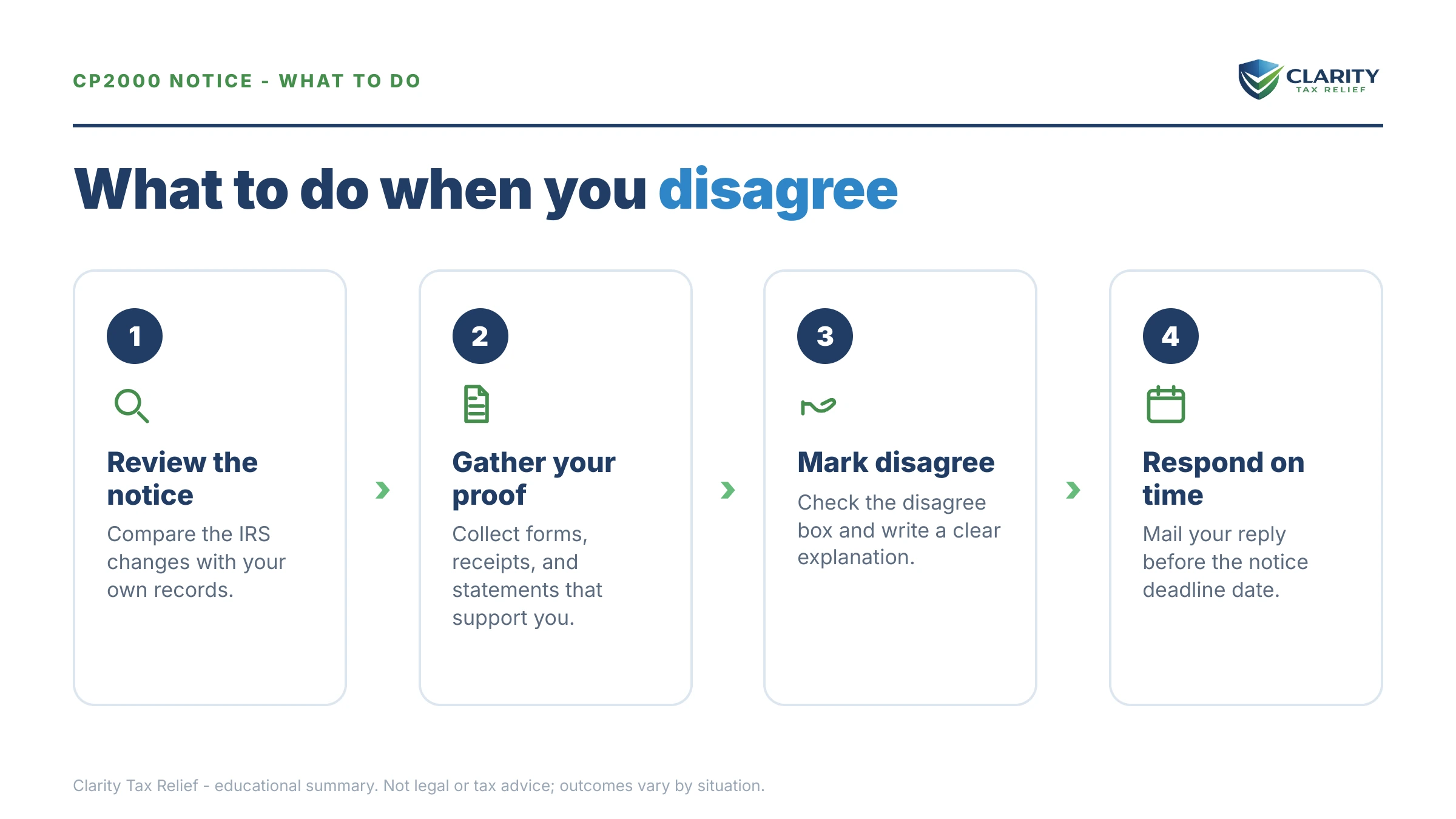
A winning CP2000 disagreement is three things: a signed response form, a short item-by-item statement. A copy of one document for each disputed line. Here's the sequence:
- Read the explanation pages, identify every payer, form type, and dollar amount the IRS is proposing to add, and mark which items you dispute.
- Pull your proof, that year's return, every 1099 and W-2 you received, broker or account statements, and your IRS wage and income transcript.
- Check 'I do not agree' on the response form and sign it, both spouses must sign if you filed jointly.
- Write a short statement, one paragraph per disputed item explaining what the IRS got wrong and what the correct figure is.
- Attach copies of your evidence, never originals, labeled so each document matches the disputed item it supports.
- Send it before the respond-by date, fax it to the number on the notice or mail it with tracking, and keep a complete copy of everything.
Keep the statement factual and boring, payer name, form number, dollar amount, why it's wrong, what's attached. If you'd rather start from a proven format, our CP2000 response letter sample is built exactly for the disagree and partial-agree cases. And resist the instinct to fix it with a Form 1040-X: an amended return routes to a different IRS unit and can collide with the open AUR case. Respond to the notice itself.
A worked example: disputing a $4,800 CP2000
Say you and your spouse file jointly and open a CP2000 proposing $4,800 in additional tax. The trigger: your brokerage reported $20,000 in stock sale proceeds on a 1099-B, and the sale never made it onto your Schedule D. The AUR computer knows the sale price but not your cost, so it treats all $20,000 as taxable income. In this hypothetical:
- Proposed tax: $20,000 × 24% bracket = $4,800
- Proposed accuracy-related penalty: $4,800 × 20% = $960
- Interest from the return's original due date: accruing monthly
- Total proposal: roughly $5,800 and climbing
Now the real numbers. You bought those shares for $18,500 and held them more than a year. Actual gain: $20,000 − $18,500 = $1,500 of long-term capital gain. At the 15% capital-gains rate, the correct additional tax is $225, and with the understatement that small, the proposed 20% penalty typically falls away entirely, because the understatement is no longer large enough to support it.
The disagreement that produces that result is one page: the response form marked "I do not agree" with both signatures, a completed Form 8949 and Schedule D showing the basis. A copy of the 1099-B. A hypothetical $5,800 proposal becomes a roughly $225 correction, a swing of about $5,575, won with documents you already had.
What happens after you send your disagreement
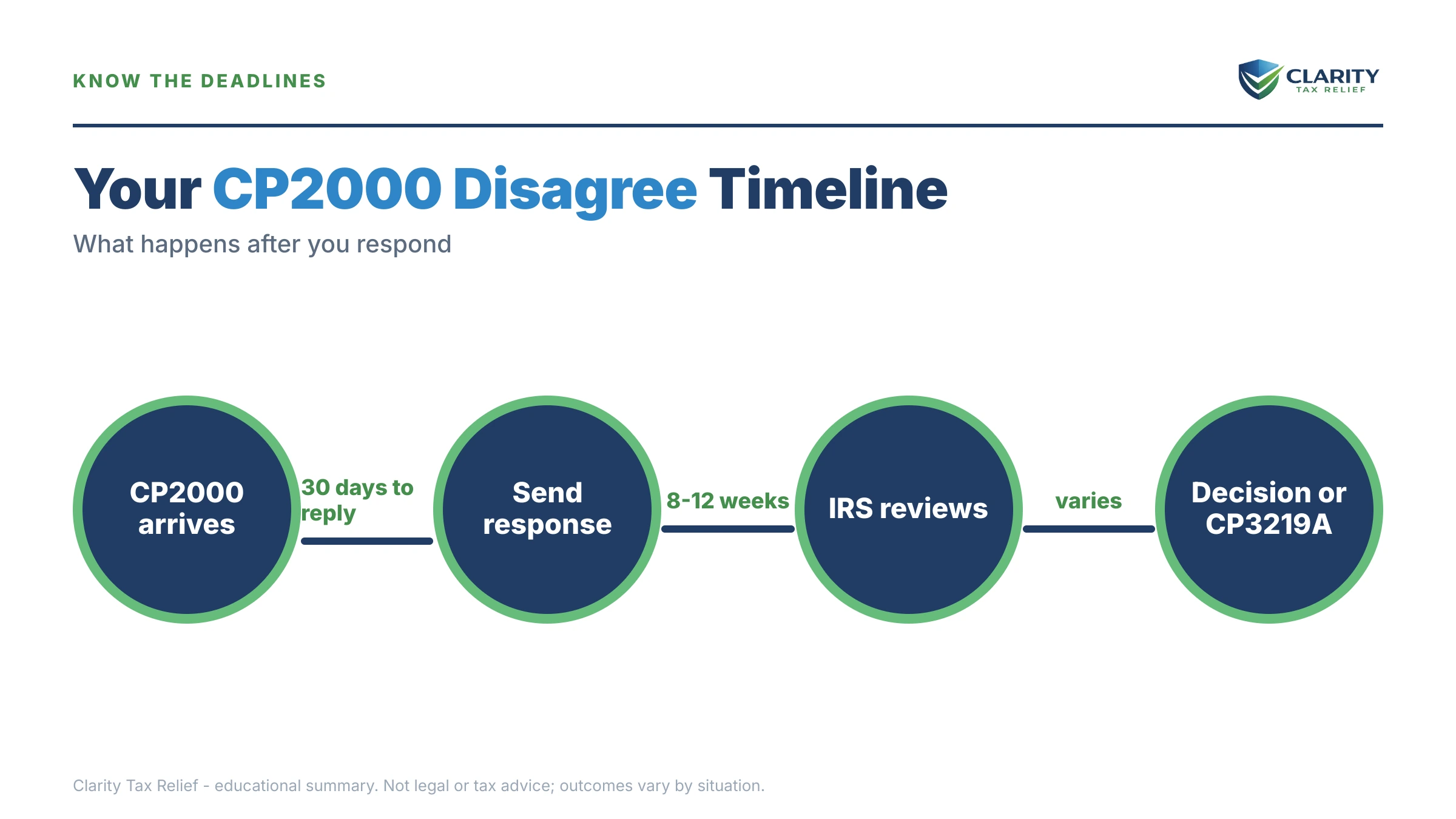
The IRS typically takes at least eight weeks to answer a CP2000 disagreement, and often longer in 2026, with the workforce down roughly 27% since the 2025 cuts. You may get a Letter 2645C in the meantime saying the IRS needs more time. That's normal; it is not a rejection. Three outcomes are possible:
- The IRS accepts your explanation. You receive a closing letter, no additional tax is assessed, and the case ends. Keep that letter permanently.
- The IRS revises the proposal. A recomputed notice arrives reflecting some of your documentation, check its math item by item, because you can agree or disagree with the new figures the same way.
- The IRS rejects the dispute. It issues a CP3219A Statutory Notice of Deficiency. This is not a defeat, it's your ticket to contest the amount in Tax Court before paying a dime. Petitions are typically routed to the IRS Independent Office of Appeals first, where many CP2000 cases are resolved without ever seeing a courtroom. The mechanics are covered in our guide to the 90-day letter and Tax Court petition.
The 90-day deadline on a CP3219A is absolute, no extensions, no exceptions. If it passes, the tax is assessed and your remaining option is audit reconsideration: the same documents, submitted after the fact, while collection machinery is already allowed to run. Every stage you wait costs leverage; the CP2000 response window is the cheapest place this dispute will ever be.
When you can handle a CP2000 disagreement yourself
You can handle a CP2000 dispute yourself when the disagreement rests on one clear document you already have. A rollover shown on Form 5498, income plainly visible on another schedule of your return, a corrected 1099 in hand, these are check-the-box, attach-the-proof, mail-it cases. Follow the six steps above and you'll likely resolve it without spending anything.
Experienced help changes the outcome in a different set of situations: proposed changes covering multiple tax years. Large basis reconstructions for crypto or high-volume trading where the records are scattered across exchanges. Business-expense substantiation on 1099-K income where the response essentially builds a Schedule C from scratch. Identity theft tangled into a real balance. A proposed penalty in the thousands. Or a CP3219A already in hand with the 90-day clock running. In those cases, how the response is framed, and whether Tax Court rights are preserved, materially changes what you end up paying. If you're truly stuck on process rather than substance, the independent Taxpayer Advocate Service can also intervene when IRS delays are causing harm.
If your CP2000 spans multiple years, involves business or crypto income, or carries a four-figure proposed penalty, a free review of the notice and your records takes minutes. Call (888) 825-7779 before your respond-by date.
CP2000 disagree questions, answered
What happens if I disagree with a CP2000 notice?
The IRS Automated Underreporter unit reviews your signed response and documentation, then either accepts your explanation, revises the proposal, or asks for more information. If it accepts, you get a closing letter and no tax is assessed. If it rejects your dispute, it issues a CP3219A Statutory Notice of Deficiency, which gives you 90 days to petition the United States Tax Court before the tax becomes final.
Can I partially agree with a CP2000?
Yes, partial agreement is built into the response form. List the items you accept and the items you dispute, sign the form, and attach proof for the disputed items only. Consider paying the agreed portion right away: interest accrues on any amount that is ultimately upheld, so paying what you genuinely owe stops that part of the meter while the disputed part is decided.
Will disagreeing with a CP2000 trigger an audit?
No, responding to a CP2000, even with a full disagreement, does not by itself trigger an audit. The Automated Underreporter program is a document-matching operation that runs separately from examination. A well-documented dispute usually closes the case; a vague or unsupported one simply gets rejected. The bigger audit risk is a return with the same mismatches year after year, not the act of disputing one notice.
What proof do I need to dispute a 1099 on a CP2000?
Match the proof to the problem. For a wrong 1099, get a corrected form or a letter from the payer. For stock or crypto sales, send the 1099-B plus a completed Form 8949 showing your cost basis. For income already reported, send a highlighted copy of the schedule where it appears. Signed statements alone rarely win. The underreporter unit works from documents, so every disputed line needs paper behind it.
How long does the IRS take to respond to a CP2000 disagreement?
Plan on at least eight weeks, and often several months in 2026. The IRS workforce shrank roughly 27% in 2025 and correspondence units are backed up. You may receive a Letter 2645C saying the IRS needs more time; that is normal, not a rejection. The delay works in your favor procedurally, because nothing is assessed while the case stays open, but interest continues to accrue on any amount that is ultimately upheld.
Can I dispute just the accuracy-related penalty on a CP2000?
Yes. Even when the extra tax is correct, the 20% accuracy-related penalty can be contested separately for reasonable cause, for example, you relied on a wrong 1099, professional advice, or records you had good reason to trust. Say so explicitly in your response, because the underreporter unit will not remove it on its own. If the disputed income drops enough, the penalty often disappears anyway because the understatement is no longer large enough to support it.
What if the income on the CP2000 is not mine?
Say so in your response and back it up. If it is identity theft (someone worked or opened accounts under your SSN), attach Form 14039, the identity-theft affidavit, and ask the payer for a corrected 1099. If it is a mixed-up SSN or a 1099 that belongs to an ex-spouse or business partner, a letter from the payer plus your own records usually resolves it. Never agree to tax on income you never received just to make the notice go away.
Your next 24 hours
- Find the respond-by date on page 1 of your CP2000 and write it somewhere you'll see daily, every option on this page is easiest before that date.
- Gather your paper: the tax return for the year on the notice, every 1099 and W-2 you received that year. The statements behind each item you're disputing: broker records, payoff letters, rollover confirmations.
- Get the notice reviewed free before the respond-by date passes: use the 2-minute form or call (888) 825-7779. An experienced tax professional will confirm which items are genuinely disputable and exactly what to send.
This guide is general information, not tax or legal advice for your specific situation. Eligibility for IRS programs depends on individual facts and circumstances; no outcome is guaranteed.