
IRS Audits
IRS Audit Reconsideration: How to Reopen a Closed IRS Audit (2026)
The short answer: IRS audit reconsideration is the process for asking the IRS to reopen a closed audit and reduce the tax it assessed. There is no fee and no required form — you send documentation the auditor never considered to the office that ran the exam. The assessment must still be unpaid, at least in part.
The audit is over — maybe you didn't even know it happened until a bill arrived. The exam letters went to an address you left, or you mailed records and the auditor rejected them, and now the IRS is collecting a number you never got a fair chance to fight. That number is not final. Audit reconsideration exists for exactly this.
Everything in your request will hinge on one document: the examination report the IRS mailed when it closed the audit. The image below shows exactly what that paperwork looks like and where to find the adjustments your evidence has to answer.
⏱ Your real clock: there is no statutory deadline to request IRS audit reconsideration, but three clocks keep running while you wait. Interest and the 0.5%-per-month failure-to-pay penalty accrue on the full assessment, the automated collection notice sequence keeps escalating toward levy, and the 10-year collection statute is the outer limit for getting the balance fixed.
Why you're stuck with a balance from an audit you never fought
Most IRS audits of self-employed taxpayers are decided entirely on paper, and an unanswered exam closes with every questioned deduction disallowed. No one testifies against you; silence does the job. The IRS treats a non-response as agreement, assesses the tax, and moves the balance to collections.
Audit reconsideration requests come from a handful of recurring situations:
- You never received the audit letters. A move, a bad address on file, or mail that simply didn't arrive. The IRS correspondence audit process gives you response windows, but only if the letters reach you.
- You responded, but your documents were rejected or ignored. Auditors on deadline sometimes disallow items a better-organized package would have saved.
- You have new records now. Bank statements, reissued 1099s, reconstructed logs — evidence that exists today but wasn't in front of the auditor.
- You never filed, so the IRS filed for you. When the IRS files a substitute return, it counts all reported income and allows essentially no deductions — then "audits" its own numbers into an assessment.
- You disagree with how the law was applied — not just the math, but whether an adjustment was legally correct.
Reconsideration is specific to closed exams with an unpaid balance. For how audits get selected and how many years the IRS can reach in the first place, see how far back the IRS can audit. This page stays on what to do after the exam has already gone wrong.
“The statute of limitations is a time period established by law when IRS can review, analyze, and resolve your tax-related issues. When the statutory period expires, we can no longer assess or collect additional tax, or allow you to claim a refund.”
— IRS audits (IRS.gov)
Who qualifies for IRS audit reconsideration
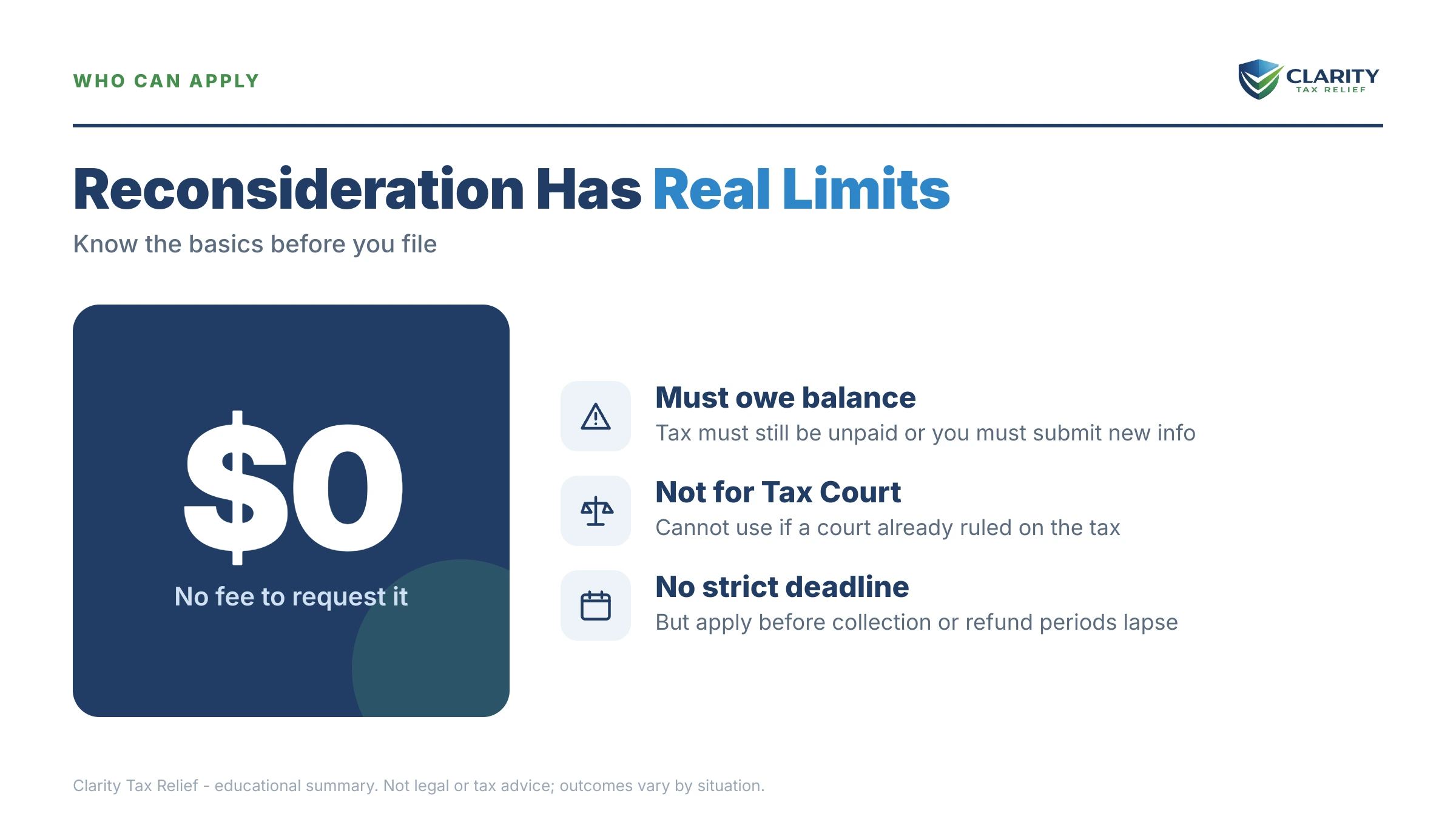
Audit reconsideration is available when the assessment is unpaid and you have information the IRS never considered, and it costs $0 to request. The IRS's own criteria are short. You're eligible if all of these are true:
- You filed a return for the year in question, or you're filing one now to replace a substitute for return.
- The assessment is unpaid, or the IRS reversed credits you believe you're entitled to. (Fully paid balances go through a refund claim instead — more on that below.)
- You can identify exactly which adjustments you dispute.
- You have information the auditor did not previously consider — new documents, a new return, or a legal argument never evaluated.
And you're barred if the liability was already finally decided. Reconsideration is not available when:
- The U.S. Tax Court or another court issued a final decision on the year.
- You signed a closing agreement (Form 906) or a binding settlement such as Form 870-AD.
- The debt was resolved through a compromise agreement with the IRS.
Notice what's not on the disqualifying list: missing your Tax Court window. If the 90-day deadline on a Notice of Deficiency blew past you, reconsideration is often the door that's still open.
What happens if you ignore the assessed balance
An assessed audit balance enters the same automated collection pipeline as any other IRS debt, and that pipeline ends at wage and bank levies. The exam side of the IRS may be slow in 2026, the workforce shrank roughly 27% in 2025. But the collection notices are generated by systems that never stopped running. Here is the sequence:
- Audit-change bill (CP22E or CP14-style notice) — the first demand reflecting the exam changes, typically giving about 21 days before the next notice queues (10 business days when the balance is $100,000 or more).
- CP501 / CP503 — automated reminders. Still just bills, but interest compounds daily and the failure-to-pay penalty posts monthly.
- CP504 notice — intent to levy. After the pay-by date printed on it, the IRS can seize your state tax refund, and a federal tax lien becomes a live risk.
- LT11 / Letter 1058 — final notice of intent to levy. A 30-day clock starts on your Collection Due Process rights; after it, wage and bank levies are authorized.
The table below puts day counts on that sequence. The point isn't panic — it's that a reconsideration request works best when it's mailed before the final notice stage, while a collection hold on the disputed amount is easy to get.
| Notice | What it means | The clock |
|---|---|---|
| CP22E / first bill | Balance due from the exam changes | Typically about 21 days before escalation (10 business days when the balance is $100,000 or more) |
| CP501 / CP503 | Automated reminders | Interest and penalty post monthly; sequence continues if unanswered |
| CP504 | Intent to levy your state tax refund | Pay-by date printed on the notice; refund seizable after it |
| LT11 / Letter 1058 | Final notice of intent to levy | 30 days to request a CDP hearing before wage and bank levies |
One more cost of waiting: on a $61,200 assessment, a meaningful slice of the balance is penalty and interest that grows every month the dispute sits in a drawer. You can estimate how much of your balance is penalties and interest before you decide how fast to move.
Staring at an audit bill you never got to fight?
Send us the audit report or the notice. An experienced tax professional will tell you, free, whether audit reconsideration fits your facts and which adjustments are actually winnable, before the collection notices reach the levy stage.
Your options after a closed audit, compared
Audit reconsideration is one of several ways to challenge a closed exam. The only route that reopens the audit itself after assessment with no fee and no filing deadline. Which door is open depends on where you are in the timeline and whether the balance is paid:
| Route | When it fits | Cost and key limit |
|---|---|---|
| Audit reconsideration | Assessment unpaid + new information, or you never got to respond | $0; no deadline, but interest keeps accruing |
| Audit appeal (30-day letter) | Exam still open, before the tax is assessed | $0; must respond within the letter's 30-day window |
| Tax Court petition | You're within 90 days of a CP3219A Notice of Deficiency | $60 filing fee; hard 90-day deadline |
| OIC — doubt as to liability | You dispute that the assessed amount is legally correct | $0 application fee (Form 656-L) |
| Pay, then refund claim | Balance fully paid; you want the money back | $0; generally 3 years from filing or 2 years from payment |
| CDP hearing (Form 12153) | You received LT11 or a lien notice and never had a prior chance to dispute the liability | $0; 30-day deadline from the notice date |
These routes aren't mutually exclusive — they're sequential. A denied reconsideration can still go to Appeals. A denied Appeals conference can still become a doubt-as-to-liability offer. And a fully documented case can be paid and litigated as a refund claim. Reconsideration is almost always the cheapest first move because it costs nothing, preserves everything, and forces the IRS to actually look at your evidence.
Situations that change your audit reconsideration strategy
Two facts change your strategy more than any others: whether the audited return was joint, and whether the IRS wrote the return for you.
Joint returns. Both spouses are fully liable for an audit assessment on a married-filing-jointly return, and either spouse can request reconsideration. If the disallowed items came entirely from one spouse's business and you've since separated, innocent spouse relief may run alongside, or instead of — reconsideration, on a different legal theory.
Substitute for return years. If you never filed and the balance came from an SFR, don't write a dispute letter — file the actual return. The IRS processes an original, signed return for an SFR year as a reconsideration request, and because the SFR allowed zero business expenses, SFR reconsiderations often produce the largest dollar reductions of any category.
Multiple audited years. Each tax year is its own assessment. Send one request per year, each with its own Form 4549 copy and its own evidence — a single combined package tends to get one year worked and the others lost.
Partially disputed balances. If you agree with some adjustments and dispute others, say so explicitly. Pay or arrange the agreed portion. A payment plan on the undisputed slice does not waive your dispute on the rest. It keeps the collection machine calm while the review runs.
Business and payroll assessments. Reconsideration applies to income tax examinations — 1040s, Schedule C, and similar. Trust fund recovery penalties and payroll tax assessments have their own protest and appeal tracks with different deadlines; don't route those through this process.
State piggyback assessments. Many states, California's FTB is the most aggressive, issue their own bill based on the federal audit changes. A winning federal reconsideration does not automatically fix the state balance: send the IRS's adjustment letter to the state agency and request a corresponding correction.
A worked example: turning $61,200 into about $9,700
Here's how a missed correspondence audit becomes a five-figure assessment, and how reconsideration unwinds it. This is a hypothetical, with rounded math; real numbers depend on your bracket, the quarters involved, and current interest rates.
Say you're a sole proprietor whose 2023 Schedule C claimed $95,000 in expenses — vehicle, contract labor, supplies, insurance. The audit letters went to your old apartment. You never responded, so the IRS disallowed all $95,000 and closed the exam:
- Additional income tax plus self-employment tax on $95,000, at a combined marginal rate of roughly 40%: about $38,000
- 20% accuracy-related penalty on the $38,000: $7,600
- Interest, compounding daily over roughly two years: about $15,600
- Total assessed: about $61,200
Now the reconsideration. You pull two years of business bank and card statements, gather the 1099-NEC copies you issued to subcontractors, and rebuild a mileage log from your calendar and service records. Together they substantiate $80,000 of the $95,000. The recomputation:
- Remaining disallowance: $15,000 → additional tax of roughly $6,000
- Accuracy-related penalty, recomputed at 20% of the new tax: $1,200
- Interest, recomputed automatically on the reduced tax: roughly $2,500
- New balance: about $9,700 — roughly $51,500 abated, with no court petition and no filing fee
This is a hypothetical illustration only — it is not a typical or guaranteed result, and reconsideration outcomes depend entirely on your documentation and facts.
When tax is abated, the penalty and interest attached to it fall away with it. You don't have to request that separately. The remaining $9,700 can then be paid, put on a payment plan, or reduced further if penalty relief applies.
The evidence that wins reconsideration
Reconsideration is won on paper: the IRS reverses an adjustment only where a specific document answers a specific disallowance. A shoebox of receipts loses to a one-page schedule that maps each disputed line on the Form 4549 to the exhibit behind it. For a Schedule C exam, this is what typically carries weight:
| Disallowed item | Documents that carry weight |
|---|---|
| Vehicle & mileage | Reconstructed log tied to calendars and job sites, plus service records showing odometer readings — see when the IRS wants a mileage log |
| Contract labor | 1099-NEC copies you issued, invoices, canceled checks or transfer records |
| Supplies & cost of goods | Vendor invoices matched to bank and card statements for the audited year |
| "Unreported income" from deposits | Statements proving loans, transfers, and refunds aren't income — the core of a bank deposit method audit defense |
| Home office | Utility bills, lease or mortgage records, a simple floor plan with square footage |
| Everything, no receipts | Bank records, vendor reprints, and reasonable reconstruction — the playbook in audited with no receipts |
The one rule that sinks more requests than any other: the information must be new to the IRS. Re-mailing the exact package the auditor already rejected produces the exact result it already produced. New means new documents, a newly filed return, or a legal argument the exam never evaluated.
How to request IRS audit reconsideration, step by step
The IRS lays out the process in Publication 3598, The Audit Reconsideration Process. In practice it comes down to six moves:
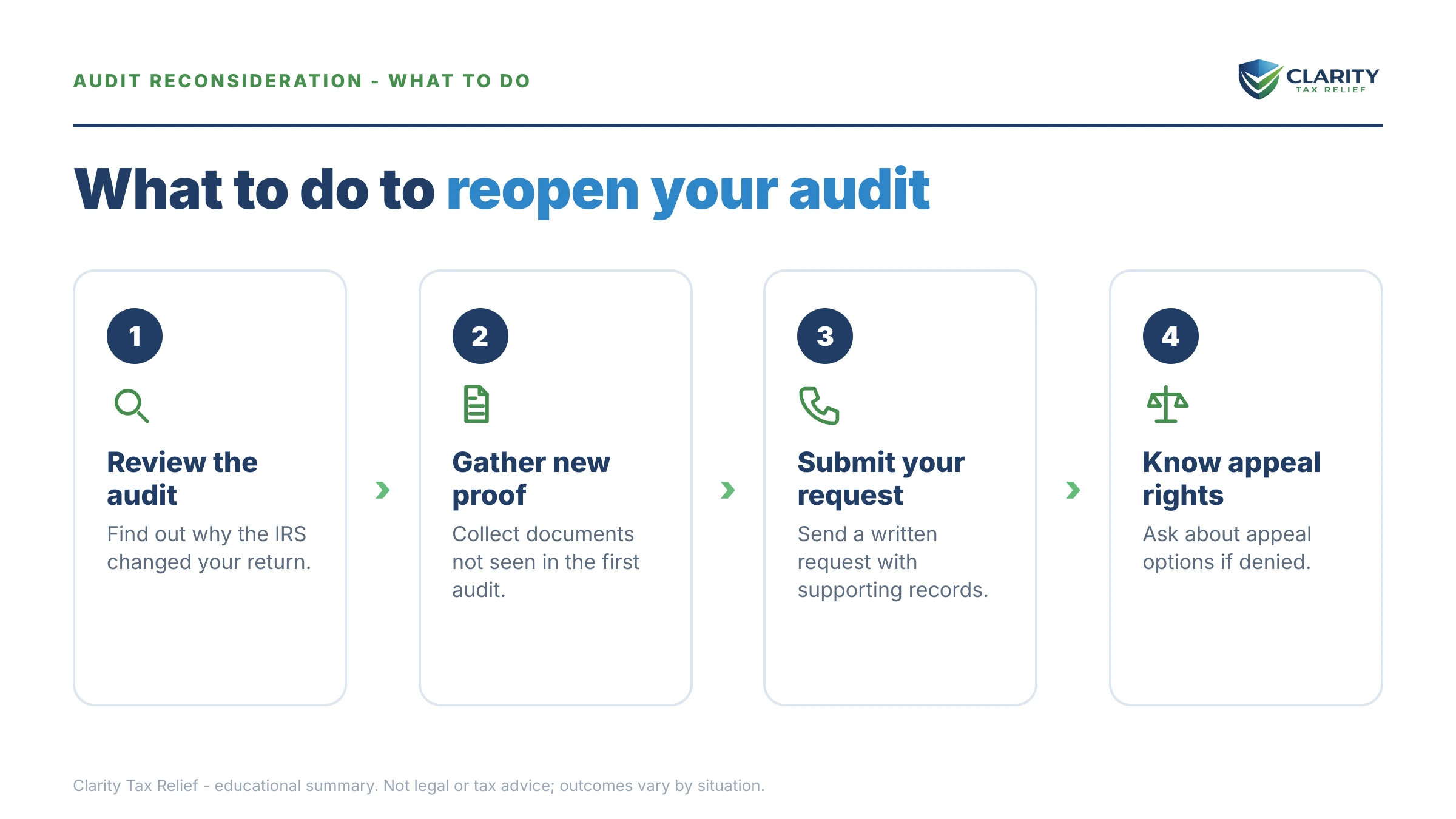
- Pull your audit paperwork and transcripts. Get the audit report (Form 4549) and your IRS account transcript so you know exactly which adjustments created the balance.
- Reconstruct the evidence the auditor never saw. Gather bank statements, invoices, 1099s, and mileage records — documentation that is new to the IRS, not a rerun of what was already rejected.
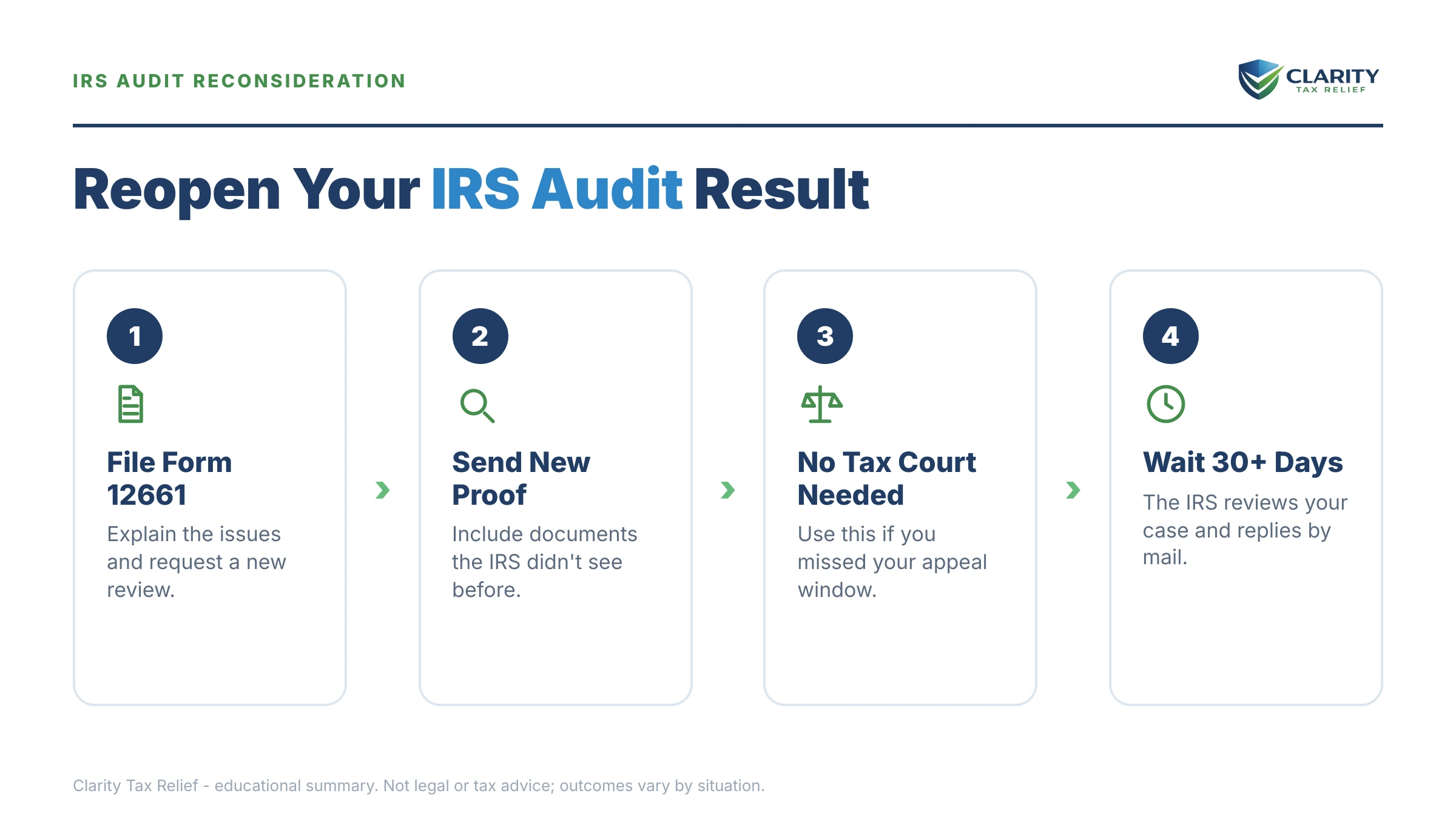
- Write the reconsideration request. Send a short letter identifying each disputed adjustment and the document that answers it; Form 12661 is optional but keeps the package organized. Send copies, never originals.
- Mail the package to the office that ran the audit. Use the address on your audit report or most recent notice, send it by certified mail, and keep a complete copy of everything.
- Request a collection hold and cover the undisputed part. Ask the IRS to pause collection on the disputed portion while it reviews, and pay or arrange the portion you agree with.
- Escalate if the answer is no. Request an Appeals conference, file a doubt-as-to-liability offer, or pay the balance and file a formal refund claim.
For step three, we've published a full breakdown of what goes in the cover letter — structure, tone. The adjustment-by-adjustment format reviewers respond to — in our IRS audit reconsideration letter guide. And any portion you agree with can be paid directly at IRS.gov/payments to stop the penalty clock on that slice.
When you can handle audit reconsideration yourself
You can request audit reconsideration yourself — the IRS designed the process to work without representation, and for straightforward cases you should use that. Handle it on your own when:
- One or two adjustments are in dispute and you hold clean documents that directly answer them — a 1099 the auditor never saw, proof a deposit was a loan, a corrected W-2.
- The balance came from an SFR and your task is simply preparing and filing an accurate original return.
- The amount is small enough that even a total loss is payable within 180 days.
Experienced help changes outcomes in the harder patterns: a levy or final notice already in motion (where the collection defense and the reconsideration have to run in parallel), multiple audited years with interlocking adjustments, income reconstructed through a bank deposit analysis, records that must be rebuilt from scratch, or a joint-return dispute tangled with a divorce. In those cases the sequencing — which year first, what to concede, when to invoke Appeals — often matters as much as the documents. If money is tight, a Low Income Taxpayer Clinic may represent you at no charge, and the Taxpayer Advocate Service can intervene when a reconsideration stalls or collection won't pause.
If your case involves multiple audited years, a levy already in motion, or an assessment built on a bank deposit analysis, have an experienced tax professional review the file free, or call (888) 825-7779 — before you mail anything.
Terms on your audit paperwork, decoded
- Form 4549 — the "Income Tax Examination Changes" report listing every adjustment the auditor made; your reconsideration should answer it line by line.
- Form 12661 — the optional "Disputed Issues Verification" form that organizes which adjustments you dispute and why.
- Substitute for return (SFR) — a return the IRS creates for a non-filer using reported income and essentially no deductions.
- Accuracy-related penalty — the 20% penalty added when the IRS treats an understatement as negligent or substantial; it's recomputed downward when the tax is.
- Doubt as to liability — the Offer in Compromise ground (Form 656-L) for disputing that the assessed amount is legally correct, with no application fee.
- CSED — the Collection Statute Expiration Date: 10 years from assessment, after which the IRS can no longer collect the balance.
IRS audit reconsideration questions, answered
How long does IRS audit reconsideration take?
Plan on several months from mailing your package to a decision — the IRS typically acknowledges receipt within about 30 days, then assigns the file for review. In 2026, with the IRS workforce down roughly 27%, reviews are running slower than the automated collection notices that keep arriving, which is why requesting a collection hold at the same time matters.
Is there a deadline to request IRS audit reconsideration?
No. There is no statutory deadline, which makes reconsideration unusual among audit remedies. Two practical limits apply: the assessment must still be unpaid (fully paid balances go through a refund claim instead). The request only helps while the 10-year collection statute is running. Meanwhile interest and the failure-to-pay penalty accrue monthly, so earlier is always cheaper.
Does audit reconsideration stop IRS collection?
Not automatically. When the IRS accepts your request for review, it will usually pause active collection on the disputed portion. But you should ask for the hold explicitly in your letter and confirm it. Any levy already in motion, and any portion of the balance you don't dispute, still needs its own arrangement, such as a payment plan or hardship status.
What form do I use for audit reconsideration?
None is required — a signed letter works. The IRS provides optional Form 12661 (Disputed Issues Verification) to organize your disputed adjustments. Your package should include a copy of the audit report (Form 4549) plus copies, never originals, of the new documentation. If the assessment came from a substitute for return, the request is simply your original signed return for that year.
Can I get audit reconsideration if I already paid?
No. Reconsideration is only available while the assessment is unpaid or partially paid. If you've paid in full, the route is a formal refund claim — generally Form 1040-X for the tax, or Form 843 for penalties — filed within the refund window: usually three years from filing or two years from the payment, whichever is later.
Does audit reconsideration work for a substitute for return (SFR)?
Yes — it's often where the biggest reductions happen. When the IRS files a return for you, it uses gross income with no business expenses, dependents, or favorable filing status. Filing your own accurate, signed original return for that year is processed as a reconsideration request. The assessment is recomputed from your real numbers.
What are the chances the IRS accepts audit reconsideration?
The IRS doesn't publish an acceptance rate, and outcomes track one variable: whether your documentation is genuinely new and answers the specific adjustments in the audit report. Requests that re-send the same rejected receipts get the same answer. There are three possible outcomes — full abatement, partial abatement, or no change — and a denial still leaves Appeals, a doubt-as-to-liability offer, or a refund claim.
Can I request audit reconsideration twice?
Yes, if you have additional information the IRS still hasn't considered. There's no once-per-audit limit, but a second request built on the same evidence as the first will be rejected on arrival. If you're rebuilding records in stages, it's usually better to send one complete, organized package than several partial ones.
What happens if my audit reconsideration is denied?
You can request a conference with the IRS Independent Office of Appeals, which reviews the exam with fresh eyes. Beyond that, you can file an Offer in Compromise based on doubt as to liability (Form 656-L, no application fee), or pay the balance and pursue a formal refund claim. If a final levy notice arrives, a timely CDP hearing request preserves the right to raise the liability if you never had a prior opportunity.
Your next 24 hours
- Find the audit report. Locate the Form 4549 or the notice listing "examination changes" — note the tax year, the total assessed, and each adjustment line. Those lines are the exact targets your evidence must hit. If you can't find it, request your account transcript from your IRS online account.
- Gather the raw material. Your copy of the audited return (or the fact you never filed one), business bank and card statements for that year, and every 1099, invoice, and log you can put your hands on.
- Get the file reviewed free. Call (888) 825-7779 or use the 2-minute form. An experienced tax professional will map which adjustments are realistically winnable and how to sequence the request, before another month of interest posts to the balance.
This guide is general information, not tax or legal advice for your specific situation. Eligibility for IRS programs depends on individual facts and circumstances; no outcome is guaranteed.