
IRS Audits
EIC Audit Proof of Residency: The Documents That Win Your Case in 2026
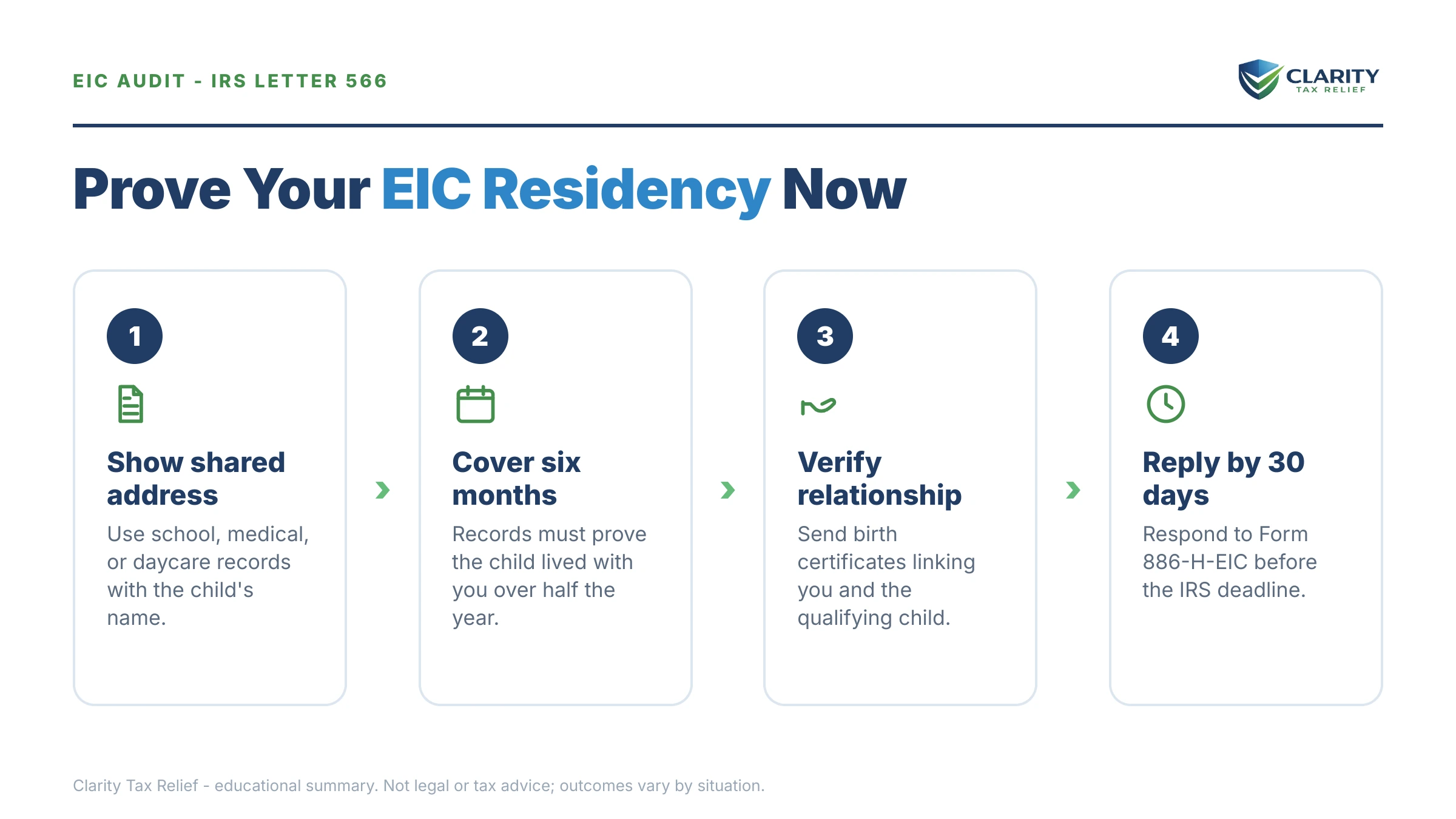
The short answer: in an EIC audit, proof of residency means third-party records — school, medical, daycare, or lease documents — showing your child's name, your address, and dates covering more than half the tax year. The IRS lists what it accepts on Form 886-H-EIC, and your CP75 typically gives you 30 days to send it.
If you're recently divorced, this audit probably landed for one reason: your return is the first one where the kids appear at a new address, or your ex claimed them too. The IRS isn't accusing you of lying. Its computers just can't see where your children sleep, so it's asking you to show it on paper.
The good news: EIC residency audits are won with documents, not arguments. Send the right records and the frozen refund releases. The image below shows exactly what this audit notice looks like and where to find the two things that control your case — the response deadline and the document checklist.
⏱ Your deadline: a CP75 typically gives you 30 days from the date printed on the notice to send your documents. That printed date controls, not the day you opened the envelope. Miss it and the IRS moves to disallow the credit and keep the refund it's holding.
Why the IRS is auditing your Earned Income Credit
The IRS audits EIC claims through its correspondence exam program, and it selects returns where the qualifying-child data doesn't match what its systems expect. EIC returns are examined far more often than typical wage-earner returns — the numbers are in our breakdown of the IRS EITC audit rate.
Three triggers dominate, and a divorce year can hit all three at once:
- A duplicate claim. Your ex, or another relative — claimed the same child's Social Security number. The IRS often opens exams on both returns and lets the evidence decide. See what happens when both parents claimed the same child.
- A changed address or filing status. The child's records on file (last year's return, W-2 addresses, prior claims) point somewhere you no longer live.
- Income the IRS can't verify. If your earned income is self-employment income, the exam may question the income side too — the same reconstruction problem covered in our cash business audit guide.
Your notice is almost certainly a CP75 notice (or CP75A). It arrived as a mail exam — an IRS correspondence audit handled entirely by fax and post, usually with no assigned examiner until you respond.
“If your Earned Income Tax Credit claim is audited, you must provide documents to show your child qualifies. Use the Form 886-H-EIC Toolkit to find out which documents to send to support your EITC claim with a qualifying child.”
— Qualifying child rules (IRS.gov)
What the EIC residency test actually requires
The residency test requires your child to have lived with you in the United States for more than half the tax year — at least 183 nights. That's the single fact this entire audit exists to verify.
Three things matter about how the IRS applies it:
Nights, not custody labels. The test counts where the child actually slept. Temporary absences — school, summer camp, hospital stays, a child's vacation with the other parent — still count as nights with you if your home remained the child's home.
The year in question, not this year. Your CP75 names a specific tax year. If you separated mid-year, count nights from January 1 of that year, not from the divorce date. Kids who moved in with you in March can still easily clear 183 nights.
Residency travels with relationship and age. The examiner is also verifying that the child is your son, daughter, stepchild, foster child, sibling, or a descendant of one of those, and under 19 (under 24 if a full-time student, any age if permanently and totally disabled). Birth certificates and custody orders handle this part, but a response that proves residency and skips relationship still loses.
One more distinction that trips up divorced filers: the IRS is auditing residency for the EIC even if nobody disputes that you support the kids. Support is not the test. A parent who pays every bill from another house still fails. A parent with modest income whose kids sleep at her apartment 200 nights a year passes.
What happens if you ignore a CP75 or miss the deadline
An unanswered CP75 doesn't close quietly. It converts into a disallowance that follows you into future tax years. The sequence runs in stages, each one closing a door:
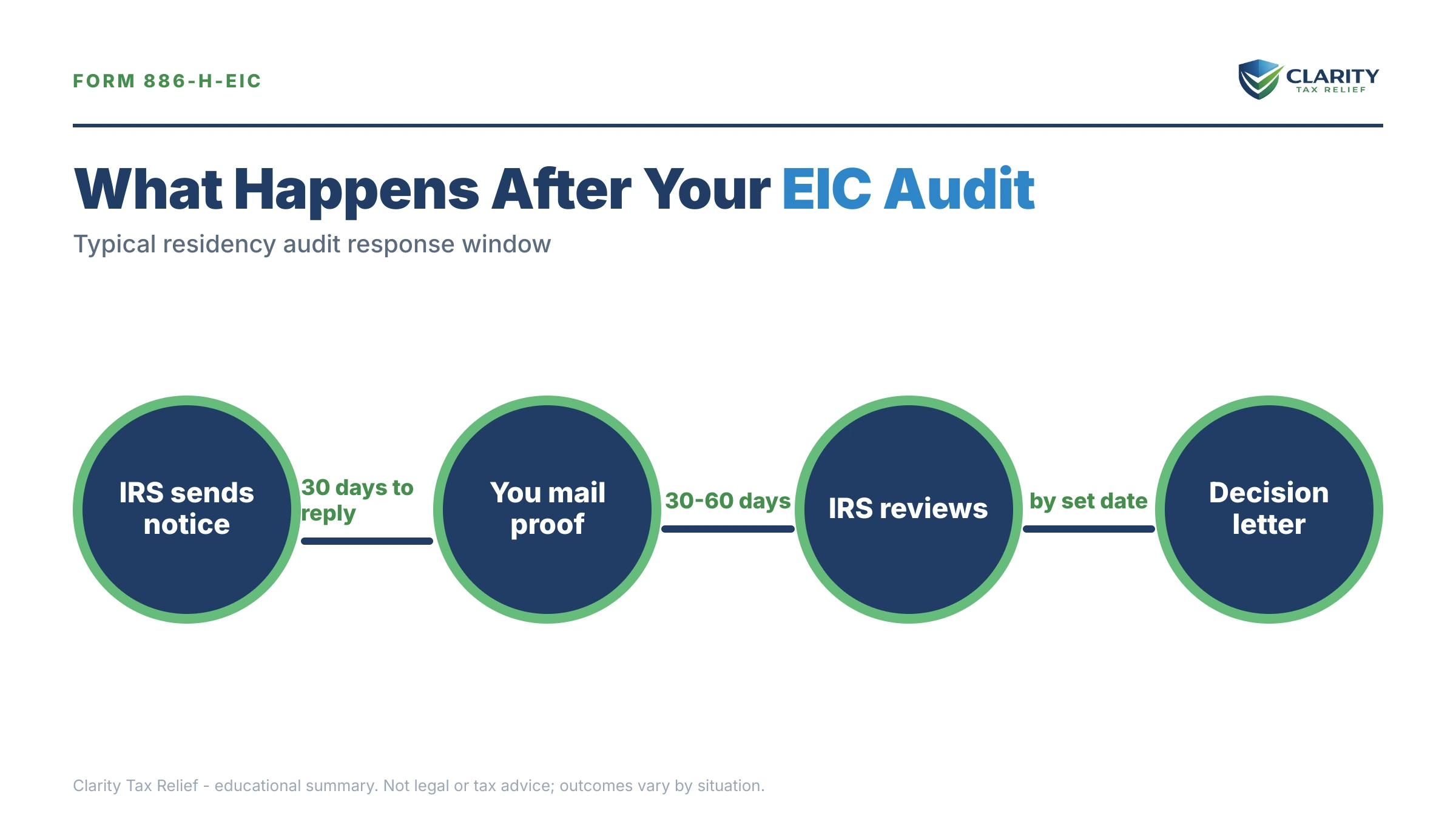
- CP75 document request. Your EIC (and any other credit named in the notice) is frozen out of your refund. You have the response window printed on the notice, typically 30 days, to send proof. Transcript watchers often see this stage as a freeze code; see code 1242.
- Examination report proposing disallowance. No response, or documents that don't cover more than half the year. The IRS issues a report removing the credit and recalculating your refund. The report gives you 30 days to agree, send more evidence, or request an Appeals review.
- Statutory Notice of Deficiency. Still no resolution and the IRS issues a notice of deficiency, starting a 90-day clock to petition Tax Court. Your last chance to contest before the change becomes final. Our guide to the 90-day letter and Tax Court petition explains that filing.
- Disallowance becomes final. The IRS keeps the held refund, and future EIC claims now require Form 8862 (the CP79 notice tells you this). If the IRS decides the claim was reckless, it can ban you from the credit for 2 years — 10 years for fraud. Prior-year claims can also draw a look; our hub on how far back the IRS can audit covers those limits.
| Stage | Response window | The right you lose if it passes |
|---|---|---|
| CP75 document request | Typically 30 days (printed on the notice) | The fastest, cheapest outcome — exam closes with the credit allowed and the refund released |
| Examination report (proposed disallowance) | 30 days (printed on the report) | Your right to an IRS Appeals review before anything is assessed |
| Statutory Notice of Deficiency | 90 days by statute | Your right to contest in Tax Court without paying first |
| After the disallowance is final | No fixed clock | Only slower routes remain — audit reconsideration with new documents, while Form 8862 and possible bans apply |
One caution on timing: if the exam drags near the end of the assessment window, the IRS may ask you to sign an extension of the statute. Whether to sign is a genuine decision, not a formality — see our guide to Form 872 before you do.
Holding a CP75 with your refund frozen?
Send us a photo of the notice and the Form 886-H-EIC checklist. An experienced tax professional will map exactly which records will win your case — free, confidential, and before the response deadline printed on your notice closes.
EIC audit proof of residency: the documents the IRS accepts
The IRS grades your response against Form 886-H-EIC, the checklist enclosed with your CP75. The strongest proof of residency comes from third parties with no stake in your refund. Every document needs three elements: the child's name, your address, and dates within the audit year. A record missing any one of the three proves nothing.
| Record type | What it must show | Where to get it |
|---|---|---|
| School records | Child's name, your address, and enrollment dates — registration forms and report cards mailed to your address are strongest | School registrar or district office; ask for the official records request form |
| Medical & dental records | Visit dates during the year with your address on file as the child's home | Pediatrician, dentist, or clinic records department — a printed "patient demographics" history works |
| Childcare / daycare records | Enrollment period, child's name, and the address the provider has on record for pickup and billing | The provider's office; a signed statement on letterhead with dates is ideal |
| Lease or landlord statement | The child listed as an occupant of your unit, with the lease term dates | Your lease itself, or a dated letter from the landlord or property manager |
| Government or social-service records | Benefits, placement, or case records listing the child at your address during the year | The agency's records office (Medicaid, SNAP, foster or social-service agency) |
| Letterhead letters from officials | Child's name, your address, specific dates, and the writer's title and contact information | School official, healthcare provider, childcare provider, landlord, clergy member, or agency worker |
| Birth certificate / custody order | The relationship. That the child is yours (or a qualifying relative's descendant); orders explain name mismatches | County vital records; your family-court file for custody or adoption orders |
What does not work matters just as much:
- Your own statement or affidavit — the examiner already has your word; the audit exists because your word alone isn't verification.
- Letters from relatives or friends — treated as interested parties, close to zero weight even when notarized.
- Utility bills, mail, or ID showing only your name — they prove where you live, not where the child lives.
- Records covering the wrong months. A school letter covering September through December documents roughly 120 nights — short of 183. Stack records until the covered months add up to more than half the year.
Think in layers: one strong record per season. A daycare statement for winter and spring, a pediatric visit in summer, school registration for fall — together they draw a line through the whole year that no single document can.
Divorced or separated? The rules that decide who wins
For the EIC, only the custodial parent, the one the child slept with for more nights, can claim the credit, no matter what the divorce decree says. This is the rule that blindsides recently divorced filers, because it overrides the deal you negotiated. Courts divide dependency claims; federal law does not let them divide the EIC. Here's why the IRS ignores your divorce decree.
Form 8332 is the second trap. Signing it releases the dependency claim and Child Tax Credit to your ex, but the EIC can never be transferred by Form 8332 or by any agreement. If the kids live with you, the EIC is yours even in your ex's "year to claim them." If they live with your ex, no decree language gives it to you.
| Your situation | Who can claim the EIC |
|---|---|
| Kids spent more nights with you than your ex | You — the custodial parent, regardless of what the decree says |
| Decree gives your ex the kids in even years, but they live with you | You claim the EIC; Form 8332 can move the Child Tax Credit to your ex, never the EIC |
| Nights split exactly equal | The parent with the higher adjusted gross income, under the tiebreaker rules |
| You signed Form 8332 for your ex | Your ex gets the dependency and Child Tax Credit; the EIC stays with you if the kids pass the residency test at your home |
| Kids lived with a grandparent more than half the year | Neither parent — the grandparent the children lived with may qualify instead |
For the audit itself, this means your evidence should do two jobs: prove the nights at your address, and, where your ex also claimed the kids, show that your count is bigger. A custody order with a parenting-time schedule is useful context. But the examiner wants records of where the children actually were, not what the schedule said should happen. If the real schedule differed from the order, the real schedule wins, and your third-party records are how you show it.
A worked example: the $6,200 refund on the line
Say your divorce was final in April, the kids have lived with you since February 1. Your refund was $6,200 — hypothetically $4,100 of EIC and $2,100 of refundable Child Tax Credit. The CP75 freezes the credits under exam while the audit runs.
First, the nights: February 1 through December 31 is 334 nights — far past the 183 needed, even before counting any January nights. You can lose January entirely and still win.
Now the paper trail: a lease dated February 1 listing both kids as occupants (February onward), a daycare statement covering February through May, pediatric visit records in March, June, and October with your address in the file, and school registration at your address from August. Layered together, those records cover the year past the halfway mark several times over. That package typically closes the exam with the credit allowed and the $6,200 released.
Now the cost of silence: no response means the roughly $6,200 in credits is disallowed and kept. If the examiner treats the claim as reckless — which happens when a duplicate claim goes unexplained — a 2-year ban follows. Two more years of similar credits is roughly $12,400 more, putting the real swing near $18,600, plus Form 8862 paperwork on every EIC claim after that. Same kids, same address — the only variable is whether the envelope gets answered.
How to respond to an EIC residency audit, step by step
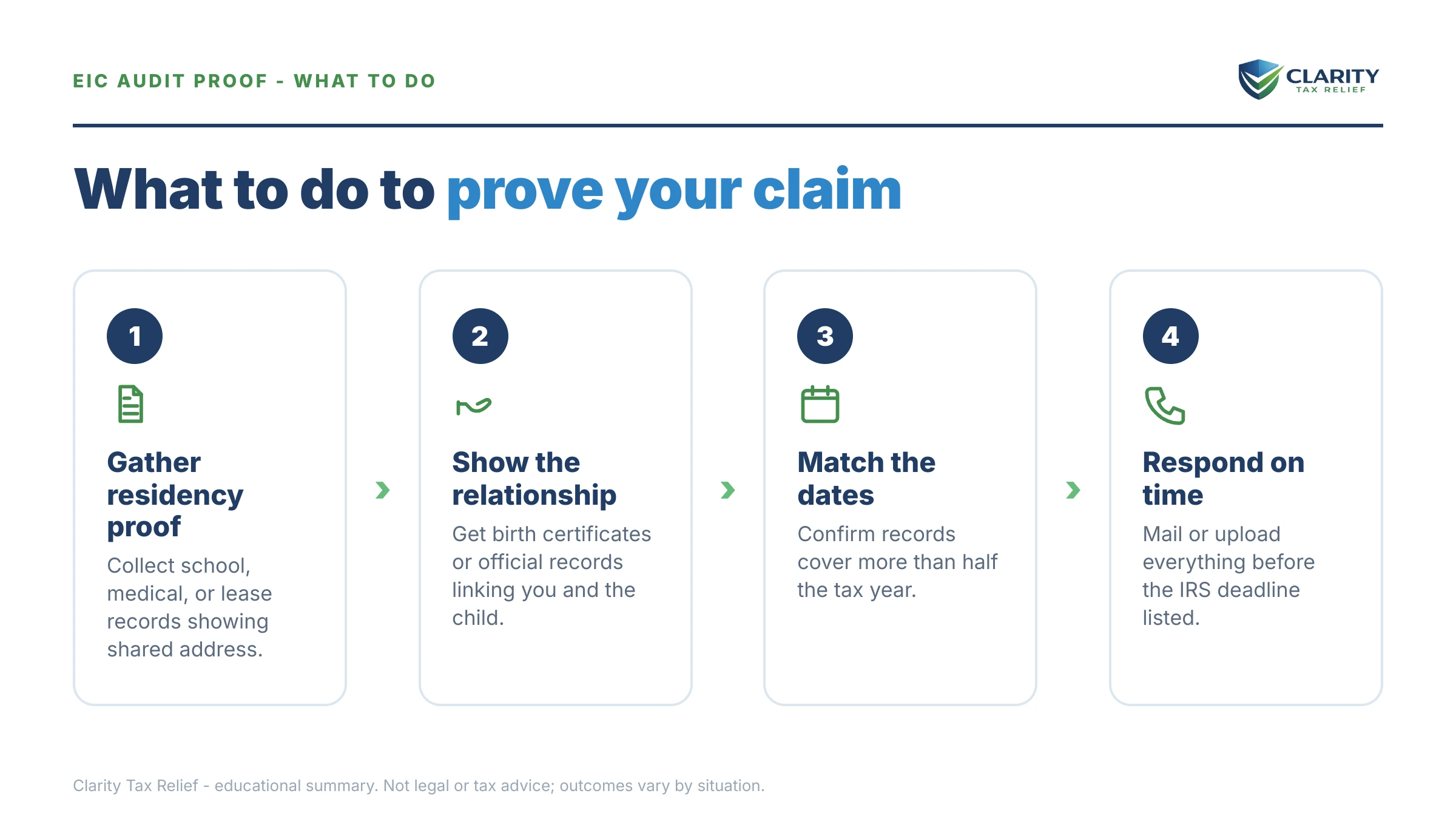
- Read the checklist. Pull Form 886-H-EIC out of the CP75 envelope and mark which listed documents you can actually obtain — the examiner will grade your response against that exact list.
- Count the nights. Build a simple month-by-month calendar showing where each child slept during the tax year, and confirm the total with you exceeds half the year — 183 or more nights.
- Request third-party records. Ask the school, pediatrician, daycare, and landlord for records or letterhead letters that show the child's name, your address. The dates covered.
- Prove the relationship. Copy each child's birth certificate, plus custody, adoption, or name-change orders if the names on the records don't match yours.
- Send copies by the deadline. Fax or mail copies, never originals, with the CP75 response page on top, and keep proof of delivery for everything you send.
- Confirm receipt and follow up. Call the number on the notice if you get no acknowledgment within a few weeks, and request an extension in writing if any records are still pending.
When you can handle this yourself, and when help changes the outcome
Most straightforward EIC residency audits can be handled without professional help. If the kids clearly lived with you, nobody else claimed them. The school and doctor will put your address on letterhead, gather the records, follow the six steps above, and respond by the deadline. The IRS's own page, Understanding your CP75 notice, explains where to send everything. If money is tight, a Low Income Taxpayer Clinic may represent you at no charge, and the Taxpayer Advocate Service can step in if the frozen refund is causing hardship.
Experienced help changes outcomes in the harder patterns:
- A duplicate claim by your ex, where the exam becomes a tiebreaker contest and the evidence has to beat someone else's evidence, not just exist.
- Records that point the wrong way — school files still showing the old marital address, a mid-year move, or a nonstandard custody arrangement that needs a careful narrative.
- Self-employment income under exam alongside residency, where the income reconstruction can cost you more than the credit.
- A deadline already missed — reopening a disallowance through appeal, Tax Court, or reconsideration is a different skill than answering a document request, and the 8862 and ban stakes are now on the table.
If a proposed 2-year ban or a duplicate-claim fight is on your notice, that's the moment a free case review is worth twenty minutes — the ban costs more than the audit year itself.
Terms on your notice, decoded
- Qualifying child — the child who makes you eligible for the EIC by meeting the relationship, age, and residency tests.
- Residency test — the requirement that the child lived with you in the U.S. for more than half the tax year (183+ nights).
- Custodial parent — the parent the child spent more nights with during the year; the only parent who can claim the EIC.
- Form 886-H-EIC — the IRS's checklist of acceptable proof documents, enclosed with your CP75.
- Tiebreaker rules — the rules that decide competing claims: more nights wins; equal nights goes to the higher AGI.
- Disallowance / Form 8862 — if the credit is denied, Form 8862 must accompany future EIC claims, and reckless claims can trigger a 2-year ban (10 years for fraud).
EIC audit questions, answered
What documents prove my child lived with me for an EIC audit?
School records, medical and dental records, daycare or childcare provider statements. A lease or landlord letter showing your child at your address are the documents the IRS accepts most readily. Each record needs three things: the child's name, your address, and dates covering more than half the tax year. The IRS lists acceptable documents on Form 886-H-EIC, which comes with your CP75 — match your evidence to that checklist rather than guessing.
How long do I have to respond to a CP75 EIC audit?
Typically 30 days from the date printed on the notice — the exact deadline appears on page one of your CP75. If you can't gather records that fast, call the number on the notice before the deadline and ask for more time. Examiners routinely grant extensions to taxpayers who are actively collecting documents. Silence, not slowness, is what gets the credit disallowed.
Can I use letters from relatives as proof of residency?
No — statements from relatives carry almost no weight because the IRS treats them as interested parties. Letters must come from third parties on official letterhead: a school official, healthcare provider, childcare provider, landlord or property manager, social-service agency, or member of the clergy. Each letter should state the child's name, your address, and the specific dates the writer knows the child lived there.
My ex claimed our child too — who gets the EIC?
The parent the child lived with for more nights during the year wins under the tiebreaker rules. If the nights are exactly equal, the parent with the higher adjusted gross income wins. The IRS decides based on evidence of where the child slept, not on who filed first or what the divorce decree says. When both parents claim the same child, the IRS typically audits both returns and awards the credit to whoever proves residency.
Does my divorce decree decide who claims the EIC?
No. A divorce decree can assign the dependency exemption and Child Tax Credit to the noncustodial parent, usually through Form 8332. But the EIC can never be transferred. Federal law gives the EIC only to the parent the child actually lived with for more than half the year. The IRS will enforce that residency rule even when it contradicts your court order.
What if the school records show my ex's address?
Records showing the wrong address don't automatically sink your case, but you must explain and outweigh them. Ask the school to update its records and provide a letter stating the dates the child actually lived with you, then add other records — medical, daycare, lease — that show your address. A recently divorced filer's records often lag the move; a dated custody order plus updated third-party letters usually bridges the gap.
What happens if I lose the EIC audit?
The IRS disallows the credit, keeps the held refund, and requires you to file Form 8862 the next time you claim the EIC. If it decides your claim was reckless or intentional, it can ban you from the credit for 2 years, and 10 years for fraud. A loss isn't necessarily final: you can appeal within the exam, petition Tax Court after a notice of deficiency, or request audit reconsideration with new documents.
Will the IRS release the rest of my refund during the audit?
Often yes — the CP75 freeze targets the EIC and any other credits under exam, and many taxpayers receive the portion of the refund that isn't in dispute. Your CP75 states which credits are being verified, so check the notice itself. If the entire refund is held and that creates a genuine hardship, the Taxpayer Advocate Service can sometimes help expedite the undisputed portion.
Can I still claim the EIC next year while this audit is open?
Yes, if you qualify — an open audit of one year doesn't bar you from claiming the credit for a new year. But expect scrutiny: if the earlier year ends in disallowance, you'll need Form 8862 with the new claim. Your refund may be held again while the IRS verifies it. Keep contemporaneous records going forward — school registration, medical visits, and childcare records at your address — so the next verification is fast.
Your next 24 hours
- Find two things on your CP75: the response deadline printed on page one. The tax year being audited — every night you count and every record you request must match that year.
- Start the record requests today: call the school registrar and the pediatrician's records line, pull your lease, and photocopy each child's birth certificate. Third-party offices are the slow step — get them moving first.
- Get a free case review before the printed deadline: use the 2-minute form or call (888) 825-7779. An experienced tax professional will check your document set against Form 886-H-EIC before you send it — one shot at the exam stage beats months of appeals after.
This guide is general information, not tax or legal advice for your specific situation. Eligibility for IRS programs depends on individual facts and circumstances; no outcome is guaranteed.