
IRS Notices
The 90-Day Letter and Your Tax Court Petition: Deadline, Cost, and Options (2026)
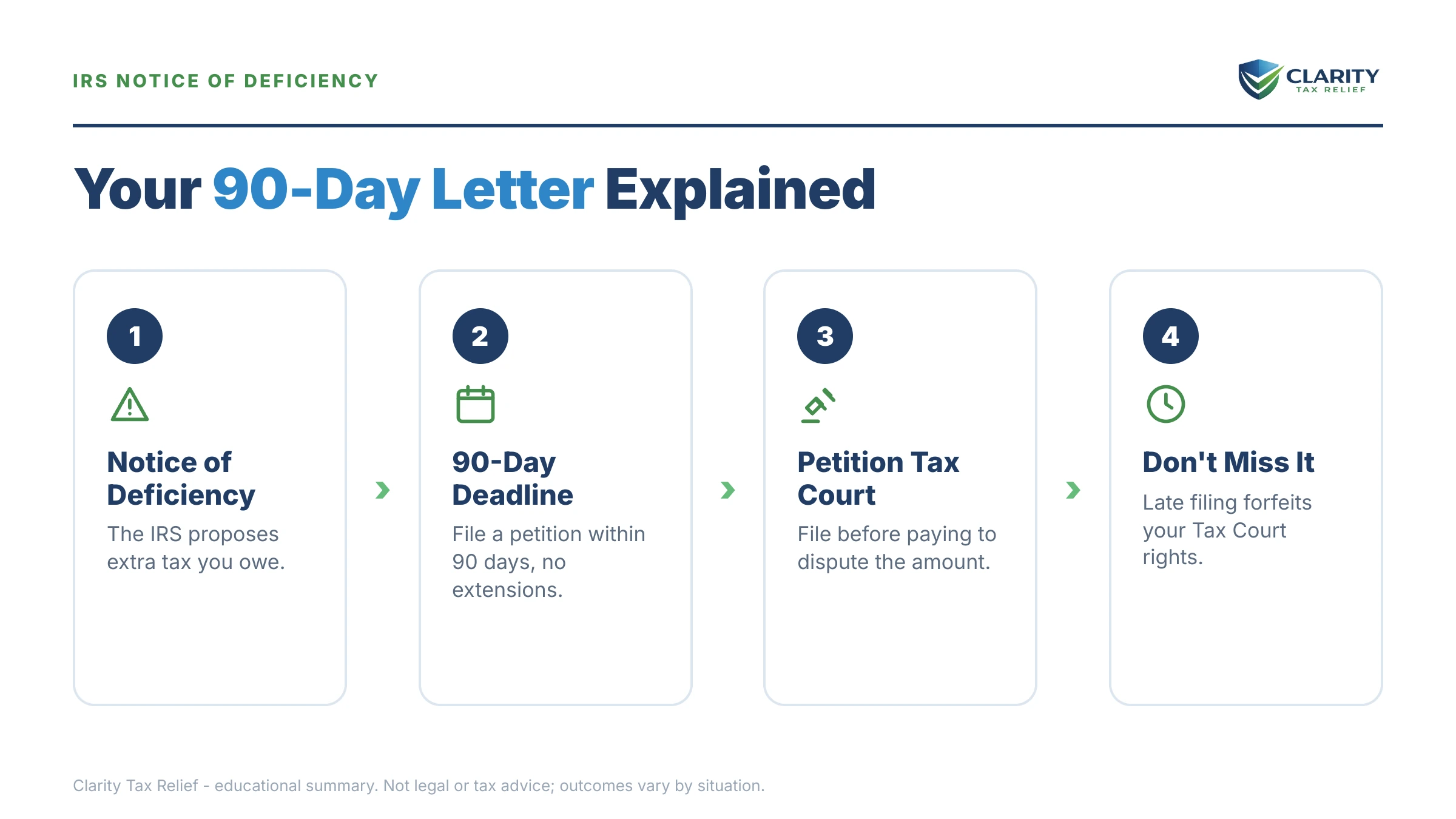
The short answer: a 90 day letter, the IRS Statutory Notice of Deficiency, is your last chance to dispute a proposed tax before you legally owe it. Filing a Tax Court petition within 90 days of the notice date (filing fee: $60) blocks assessment and collection while your case is heard. The deadline cannot be extended.
You didn't respond to an earlier letter, or the audit didn't go your way, and now the envelope says "Notice of Deficiency" over a number you never agreed to. For a sole proprietor, that number often includes self-employment tax and a penalty the IRS computed with zero credit for your business expenses. Here's the good news: unlike almost every other IRS letter, this one comes with a built-in right to a judge, if you act inside the window.
The single most important line on the notice is the one that reads "last day to file a petition with the United States Tax Court." The image below shows exactly what this notice looks like and where that controlling date sits on the page.
⏱ Your deadline: you have 90 days from the date on the notice — 150 days if it was addressed to you outside the United States — to file a U.S. Tax Court petition. The exact last day is printed on the notice itself. The notice prints the exact "Last Day to File a Petition" date — use that printed date rather than counting days yourself; a petition filed by that printed date is timely. The Tax Court generally cannot accept a late petition, and no phone call, letter, or extension request stops this clock.
Why you got a 90-day letter
A 90-day letter means the IRS has finished proposing a change to your tax and is one step from making it official. "Deficiency" is the legal word for the gap between the tax on your return (or no return at all) and the tax the IRS says you actually owe. This notice is your last administrative stop before that proposed amount becomes a legally assessed debt.
It arrives under three main labels, all carrying identical rights:
- A CP3219A notice of deficiency, usually because a CP2000 notice about unreported income went unanswered or unresolved. Common triggers for self-employed readers: a 1099-NEC that never made it onto Schedule C, unreported broker proceeds from day-trading tax debt, or the 1099-R from an early 401(k) withdrawal tax bill.
- A Letter 531 — the deficiency notice issued after an audit you didn't agree to or didn't respond to.
- A CP3219N — for non-filers, after the IRS prepared a substitute return using only the income reported to it, with no deductions.
Whichever version you're holding, the packet typically includes an explanation of the changes, a Form 5564 waiver you sign only if you agree. The petition deadline printed near the top of page one.
What happens if you ignore a notice of deficiency
Once the 90 days expire without a petition, the IRS can assess the full proposed amount, and at that point the dispute window slams shut and the collection machine takes over. The sequence runs in this order:
- Day 91: assessment. The proposed deficiency, plus penalties and accumulated interest, is recorded as a legal debt on your account. Your right to dispute it in Tax Court without paying first is gone.
- Balance-due billing. A demand-for-payment notice arrives, followed by reminder notices. Interest compounds daily and the failure-to-pay penalty accrues monthly. You can estimate how fast the balance grows with our penalty & interest calculator.
- Intent-to-levy notices. A CP504 authorizes seizure of your state tax refund, and a federal tax lien becomes a real possibility.
- Final notice (LT11 / Letter 1058). A 30-day clock starts on levy of bank accounts and income — for a sole proprietor, that can mean levies sent directly to your clients. Your remaining forum is a Collection Due Process hearing via Form 12153, where challenging the underlying tax is far harder than it would have been in Tax Court.
One more trap worth naming: sending the IRS more documents during the 90 days is fine, but it does not pause the petition deadline. People lose their Tax Court rights every year waiting for a reply to a letter while the clock runs out.
Holding a notice of deficiency right now?
This is the one IRS letter with a deadline nobody can extend. Get your 90-day letter reviewed free before your petition window closes — we'll tell you whether the IRS's number is even right, and which path costs you least.
Your options when a 90-day letter arrives
You have four real choices inside the 90 days, and only one of them preserves your right to fight without paying first. Each carries a different cost and a different deadline. (For what happens to a balance after it's assessed — payment plans, hardship status, settlement — see our full guide to how to settle tax debt yourself. This table is about the choice in front of you now.)
| Option | Deadline | Out-of-pocket cost | Best when |
|---|---|---|---|
| Agree — sign Form 5564 and pay or arrange payments | Anytime, but sooner limits interest | The balance itself; $0–$178 plan setup fee if you need time | The IRS's numbers are actually right |
| File a Tax Court petition | Day 90, printed on the notice — unmovable | $60 filing fee (waivable for hardship) | You dispute any part of the tax or penalties and haven't paid |
| Send corrected info to the IRS while the clock runs | Must leave time to petition anyway | $0 | A clear documentation error the IRS may fix fast — never as your only move |
| Pay in full, then sue for a refund in district court or the Court of Federal Claims | After payment, within refund-claim limits | Full balance up front, plus court costs | You can afford to pay first and want a different forum — rare for most readers |
| Do nothing | — | The entire proposed amount, growing monthly | Never a strategy — assessment and collection follow automatically |
Notice what's not on the list: an IRS Appeals conference on its own. If there's meaningful time left, you can ask Appeals to look at the case. But the only way to make sure your rights survive is to file the petition. Once you file, your case will almost certainly be routed to Appeals anyway, with the deadline already protected behind you.
How to file a Tax Court petition after a 90-day letter
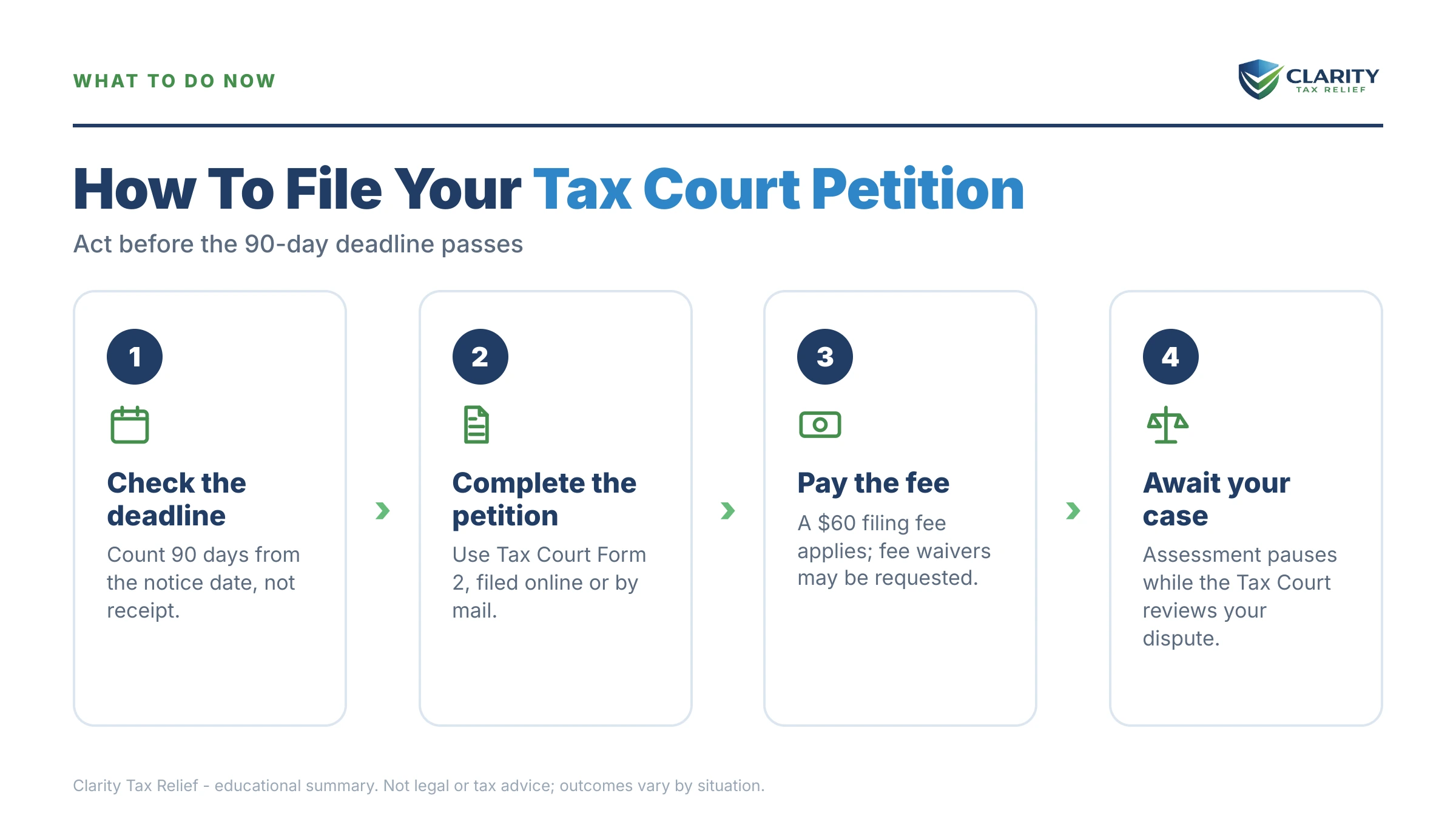
Filing a Tax Court petition costs $60 and does not require paying the disputed tax first. That pay-nothing-first feature is what makes this forum different from every other court. A timely petition also generally freezes assessment and collection of the disputed amount until your case is decided.
The mechanics, in plain terms:
- Where: the U.S. Tax Court's electronic filing system (DAWSON) accepts petitions online, or you can mail one. If you mail it, use certified mail or an IRS-designated private delivery service — a timely postmark counts as timely filing even if the court receives it after day 90.
- What it says: which notice you're disputing, the tax year, which adjustments you disagree with, and why. It doesn't need to read like a legal brief. It needs to be filed on time.
- The fee: $60, with a waiver application available if paying it would be a hardship.
- What happens next: the IRS answers, and most cases are then referred to the IRS Independent Office of Appeals for settlement talks. The large majority of petitions resolve there, without anyone standing in a courtroom.
If your dispute is $50,000 or less per tax year, including penalties, you can elect the small tax case ("S case") procedure — a simplified track built for people representing themselves:
| Feature | Regular case | Small tax case (S case) |
|---|---|---|
| Dispute size | Any amount | $50,000 or less per tax year, including penalties |
| Filing fee | $60 | $60 |
| Formality | Full rules of evidence and procedure | Relaxed rules; informal hearings designed for self-represented taxpayers |
| Right to appeal the decision | Yes — either side can appeal | No — the decision is final for both you and the IRS |
| Typical fit | Large or legally complex disputes | A disputed CP3219A over 1099 income, expenses, or a single-year penalty |
One caution on interest: petitioning stops collection, not the interest meter. If you expect to end up owing a portion of the deficiency, you can make a deposit with the IRS during the case so interest stops growing on the part you'll concede.
Say the deficiency is $7,400: a worked example
Say you're a self-employed sole proprietor and a client's $19,000 1099-NEC never made it onto your Schedule C. The CP2000 got lost in a busy season, and now a CP3219A proposes, hypothetically: about $3,600 in additional income tax, about $2,600 in self-employment tax, and a 20% accuracy-related penalty of roughly $1,240 — call it $7,400, plus interest.
Here's the problem with that math: the IRS computed it on the gross $19,000, because it has no idea you spent money earning it. Suppose your records show $8,000 in deductible expenses tied to that work — software, mileage, subcontracted help. Your real additional net income is $11,000, not $19,000. Rerun the numbers on $11,000 and the added tax lands near $3,650, the penalty near $730 — roughly $4,400 instead of $7,400.
The $60 petition is what keeps that $3,000 difference winnable without paying anything first. File, elect the S-case procedure (well under $50,000), and when Appeals calls, hand over the expense records. If the numbers check out, cases like this hypothetical routinely settle at the corrected figure. The accuracy penalty itself is often negotiable when you can show reasonable cause. Miss the deadline instead. The full $7,400 is assessed. You'd then be arguing the same expenses through slower, weaker channels while collection notices stack up.
How to respond, step by step
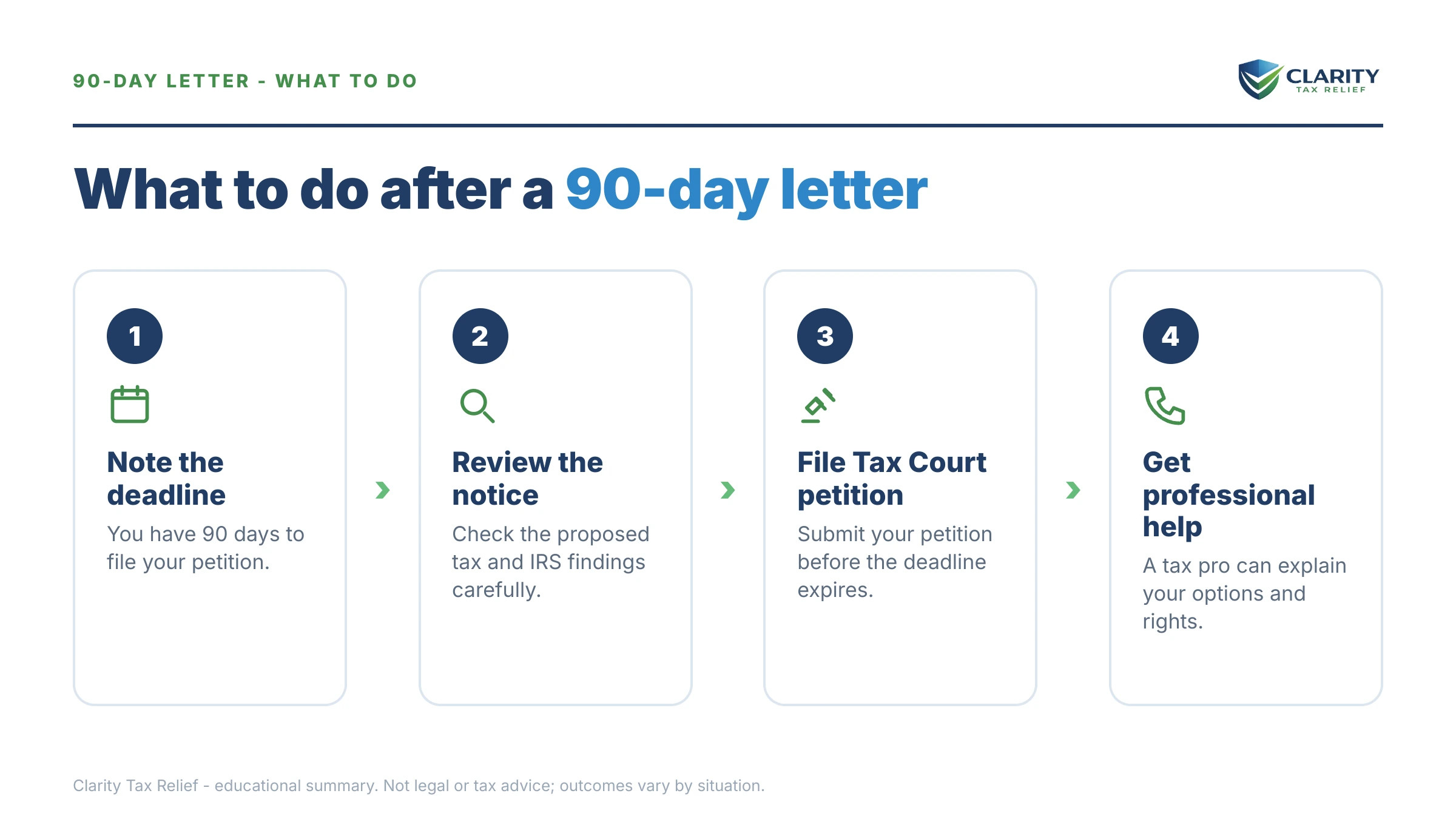
- Find your petition deadline. Locate the "last day to file a petition with the United States Tax Court" date printed on page one of your notice. That printed date, not a count you do yourself, controls everything.
- Compare the IRS's numbers to your records. Pull that year's return, 1099s, and receipts and check whether the income is really missing and which deductions the IRS's calculation ignored.
- If you agree, sign Form 5564 and arrange payment. Return the waiver that came with the notice, then pay in full or set up a payment plan so the balance stops feeding penalties.
- If you disagree, file your Tax Court petition before the deadline. File electronically through the court's DAWSON system or mail the petition by certified mail, pay the $60 fee, and elect S-case procedure if your dispute is $50,000 or less.
- Work toward settlement with IRS Appeals. After you file, most cases are routed to Appeals — respond promptly, send your documentation, and negotiate. The majority of petitions settle without a trial.
Missed the 90 days? What's left
A blown petition deadline closes the Tax Court door, but it does not make a wrong number permanent. Three paths can still fix an incorrect assessment:
- Audit reconsideration — asking the IRS to reopen the assessment with new documentation it never saw. Free to request, but discretionary and slow, and collection can continue while it's pending unless you ask for a hold.
- Offer in compromise — doubt as to liability — a settlement offer arguing the assessed amount itself is wrong, not that you can't pay it. No application fee applies to this offer type.
- Pay and claim a refund — pay the assessed tax, file a refund claim, and sue if it's denied. Legally solid, financially painful.
All three are second-best. If any days remain on your notice, the petition is the move.
When you can handle this yourself
Plenty of 90-day-letter situations are genuinely DIY. If the IRS is right — the income was yours, the math holds — signing Form 5564 and setting up a payment plan needs no professional. If the dispute is small, single-issue, and well-documented (one 1099, one stack of receipts), an S-case petition is deliberately built for self-represented taxpayers, and free help exists through Low Income Taxpayer Clinics and the Taxpayer Advocate Service if you qualify.
Experienced help changes outcomes when the stakes or complexity climb: multiple tax years in one notice, a deficiency built on a substitute return with zero deductions, business income that needs reconstruction, a proposed civil fraud penalty, or a deadline that's days away. An experienced tax professional can also read whether Appeals will settle your specific issue, and what documentation actually moves that number — before you commit to a strategy.
Terms on your notice, decoded
- Deficiency — the difference between the tax you reported and the tax the IRS says you owe; a proposal until it's assessed.
- Statutory Notice of Deficiency — the formal name for the 90-day letter. The law requires the IRS to send it before assessing most additional tax.
- Assessment — the moment a proposed amount is officially recorded as a debt you owe; collection powers attach only after assessment.
- Petition — the document you file with the U.S. Tax Court to dispute the deficiency; filing it on time is what preserves every right discussed here.
- S case — the simplified small-tax-case track for disputes of $50,000 or less per year; informal, faster, but its decisions can't be appealed.
- Form 5564 — the waiver enclosed with the notice. Signing it means you agree with the deficiency and give up the Tax Court route for those amounts.
The IRS's own explainer for the most common version of this notice is at Understanding your CP3219A notice, and petitions are filed through the United States Tax Court.
90-day letter questions, answered
Can the 90-day deadline on a notice of deficiency be extended?
No. The 90 days (150 if the notice was addressed to you outside the United States) is set by statute. The Tax Court generally cannot hear a petition filed late. The only wrinkle: if the last day falls on a Saturday, Sunday, or a legal holiday in Washington, D.C., the deadline rolls to the next business day. Calling the IRS, mailing documents, or requesting an appeal does not stop the clock.
How much does it cost to file a Tax Court petition?
The filing fee is $60, and the court can waive it if paying would be a financial hardship. You do not have to pay the disputed tax to file. That is the entire point of the Tax Court route. Your real costs are time and, if you hire representation, professional fees, which is why smaller disputes often use the simplified S-case procedure.
Do I need a lawyer to go to Tax Court?
No. Many taxpayers represent themselves, especially in small tax cases, and the court's procedures are built to accommodate that. Most petitions never reach trial anyway. They settle with IRS Appeals first. Experienced help matters most when the dollars are large, the issue is technical, or heavy penalties like civil fraud are on the table.
What happens if I miss the 90-day deadline?
The IRS assesses the tax and the proposed amount becomes a legal debt, with collection notices to follow. You lose the right to dispute it in Tax Court before paying, but not every path: audit reconsideration, a doubt-as-to-liability Offer in Compromise, or paying and filing a refund claim can still correct a wrong number. Each is slower and less certain than a timely petition.
Do I have to pay the tax while my Tax Court case is pending?
No. Filing a timely petition generally blocks the IRS from assessing or collecting the disputed amount until the case is decided. Interest keeps accruing on whatever you ultimately owe, though, if you expect to owe part of it, you can make a deposit with the IRS to stop interest from growing while the case plays out.
What is a small tax case (S case) in Tax Court?
It is a simplified procedure for disputes of $50,000 or less per tax year, including penalties. The rules of evidence are relaxed, hearings are less formal, and cases usually move faster. The trade-off is that an S-case decision is final — neither you nor the IRS can appeal it.
Is a 90-day letter the same as a CP3219A?
Yes — "90-day letter" is the nickname for the Statutory Notice of Deficiency, which arrives as a CP3219A (usually after an unanswered CP2000), a Letter 531 (after an audit), or a CP3219N (when the IRS prepared a return for a non-filer). Every version carries the same 90-day Tax Court petition right and the same unmovable deadline.
Your next 24 hours
- Find the date. Pull out the notice and circle the "last day to file a petition" line on page one. Count how many days you actually have left. That number decides how fast everything else must move.
- Gather three things: the full notice packet (including Form 5564), your tax return for the year in question, and every 1099, receipt, or record touching the income the IRS added.
- Get the notice reviewed free. Send us a photo through the 2-minute form or call (888) 825-7779. Before your petition window closes, an experienced tax professional will tell you whether the IRS's number holds up, and whether a $60 petition, a signature, or a corrected calculation is your cheapest way out.
This guide is general information, not tax or legal advice for your specific situation. Eligibility for IRS programs depends on individual facts and circumstances; no outcome is guaranteed.