
IRS Notices
IRS CP05 Notice: Why Your Refund Is Under Review, How Long It Takes and What to Do (2026)
Read the transcript
Host: Your refund's frozen. "Where's My Refund" hasn't moved in weeks, and then a letter shows up saying your return is under review — no amount to pay, no form to send back, no explanation. That's a CP05, and I want to start with the thing people get wrong about it.
Tax specialist: Which is that it's not a bill and it's not an audit. A CP05 means the IRS is holding your refund while it verifies the income, the federal withholding, and any credits you reported. That's it. The first CP05 asks nothing of you. There's no deadline on it for you, no address to mail anything to.
Host: Nothing? People don't believe that.
Tax specialist: I know. It feels like you should be doing something. But the clock on that notice runs on the IRS, not on you. It states a review window, typically 60 days from the notice date.
Host: Sixty days from the notice date, not from when you filed.
Tax specialist: From the notice date. And that date is the one thing on the letter that actually matters, because it's the day you're entitled to start asking for answers.
Host: Okay so let's do the why. Why did this land on this person's return and not their neighbor's?
Tax specialist: It's mechanical. The verification systems couldn't immediately confirm something. Most common ones — withholding that doesn't match what the employers reported on W-2s and 1099s, because a W-2 got filed late or a number got transposed. Refundable credits, the Earned Income Tax Credit and the Additional Child Tax Credit especially, and especially when the dependents are new to your return. A return that just looks different from last year's. Or payments the IRS credited differently than you claimed them.
Host: That last one — say more.
Tax specialist: So think about a divorce year. Estimated payments that got made under a joint account during the marriage may still be sitting under your ex-spouse's Social Security number, even though you're the one claiming them on your return.
Host: Hm. And a divorce-year return stacks all of these at once, doesn't it.
Tax specialist: That's exactly the profile. The article walks a hypothetical — refund of $31,200. Withholding of $27,600 that was set at married rates early in the year and never changed. Then $16,000 in estimated payments. Total payments $43,600, actual tax as head of household with two kids comes to $12,400, so the refund is $31,200.
Host: Thirty-one thousand two hundred. And how many flags is that?
Tax specialist: Four. Filing status changed. Two dependents on your Social Security number for the first time. Withholding way above the tax owed. And $16,000 in estimated payments that may still be credited to a joint or ex-spouse account. Any one of those can trigger the hold.
Host: So notice what's not on that list. No fraud finding, no audit, no balance due.
Tax specialist: Right. The unit doing this is called Integrity and Verification Operations, and their only question is whether they can confirm the numbers before they pay out.
Host: Let's do the sequence. What are the actual paths from here?
Tax specialist: Three ways it ends. The refund gets released in full, the IRS asks you for documents, or the IRS changes the refund. On your transcript, day zero usually looks like code 570, that's the hold, paired with code 971, which is the notice going out.
Host: 570 is the hold, 971 is the notice.
Tax specialist: Yep. Then if the review clears, the hold reverses, that's code 571, and code 846 posts with a deposit date. If they can't verify something, that's when a CP05A shows up.
Host: And a CP05A is a completely different animal.
Tax specialist: Completely. That letter demands documents — pay stubs, W-2s, proof of withholding or credits — by a printed deadline, typically about 30 days out. This is the stage where doing nothing starts costing money, because if you don't respond, the IRS resolves the question against you. Withholding it can't verify gets removed. Credits it can't verify get disallowed. And the refund gets reduced by an adjustment notice.
Host: Ignoring a CP05 costs you nothing. Ignoring a CP05A —
Tax specialist: Can cost you the refund. And if credits are the issue it can escalate further, to a CP75, which is a correspondence audit of your EITC or your dependent claims. On the transcript that shows as code 420, return routed to examination.
Host: There's a 2026 piece here too.
Tax specialist: There is. The IRS workforce shrank roughly 27% in 2025, and manual-review queues are where that shows up. Reviews that used to wrap in a few weeks now routinely use the whole window, and some run past it with just a Letter 2645C, the "we need more time" letter, to show for it.
Host: Okay. Practical. Somebody's sitting there with this notice tonight. What do they do?
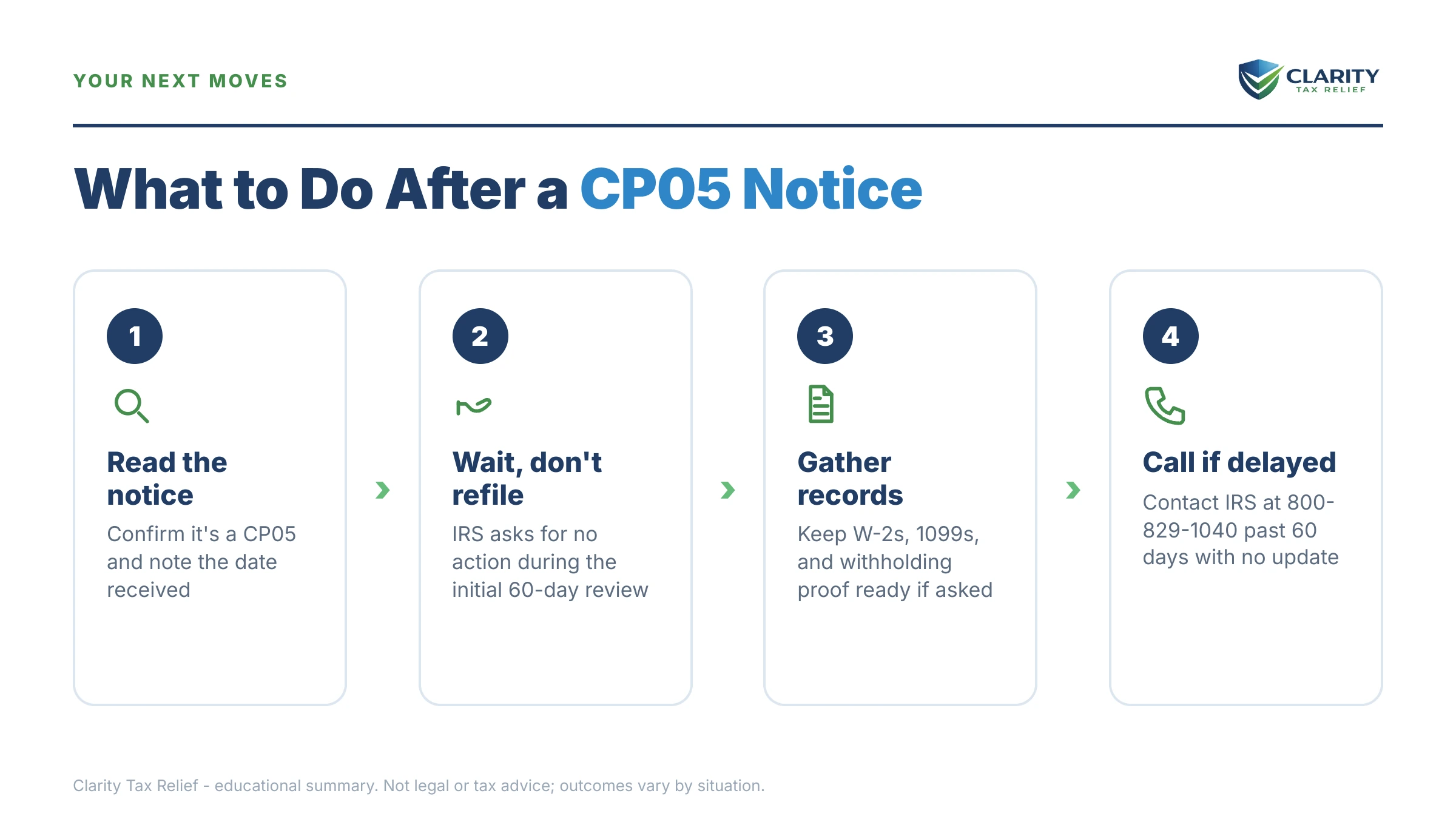
Tax specialist: Four things. One, calendar the review-window date and label it "call the IRS if no refund by today." Two, log into your IRS online account and confirm the notice actually appears there — a real CP05 asks for no payment and no personal information, so anything demanding either is a scam. Three, pull your wage and income transcript.
Host: Explain that one plainer for me.
Tax specialist: It's the IRS's own copy of every W-2 and 1099 that payers filed under your Social Security number. It's the yardstick your return is being measured against. So you compare it line by line. If it matches what you filed, you know a mismatch isn't the problem. If it doesn't match, you've found the trigger before anyone asks you about it.
Host: And four?
Tax specialist: Confirm where any joint estimated payments posted. Your online account shows what's credited to you. If that $16,000 is sitting under an ex-spouse's account, that's fixable, but it takes a call or correspondence, and it's the single most common divorce-year hang-up on these reviews.
Host: Wait — one thing not to do. This is the one I hear all the time.
Tax specialist: Don't file an amended return to hurry it along. A 1040-X filed mid-review doesn't release the hold. It adds a second, slower process on top of the first one.
Host: Watch the transcript, not the mailbox.
Tax specialist: Codes move days before letters arrive. Check it weekly.
Host: And if the window closes and it's just… silence?
Tax specialist: Then you call the number on the notice and ask for the specific status of the review, not "it's processing." And if the delay is causing real hardship, rent, a utility shutoff, medical, the Taxpayer Advocate Service exists for exactly that. You request them with Form 911.
Host: Form 911. One more — interest.
Tax specialist: If the refund is paid more than 45 days after the filing deadline or your filing date, whichever is later, the IRS adds interest automatically. You don't ask for it. The catch is that interest is taxable income in the year you receive it.
Host: Be honest about when someone needs help and when they don't.
Tax specialist: If the first CP05 just arrived, your wage and income transcript matches your return, and you can afford to wait — the correct action is patience plus a calendar entry. Where experienced help changes things is narrower. A CP05A landed and the records live in two households. Joint payments credited to the wrong spouse. A CP75 or code 420 posted. Or the window passed a long time ago and your calls go nowhere — a representative holding a power of attorney can work the practitioner channels and the Advocate routes you can't reach from the general line.
Host: So, next steps. Find the review-window date and calendar it. Pull the wage and income transcript and compare every W-2 and 1099. Gather the return, the payment records, and if you claimed the kids, the decree plus school or medical records. And don't amend.
Tax specialist: And if the window's already passed, or a CP05A is sitting on the counter, send us a photo of the notice. One of our Enrolled Agents will read the transcript and tell you what's actually holding the file. That's 888-825-7779, free and confidential. The review keeps running either way. You might as well know where your file stands.
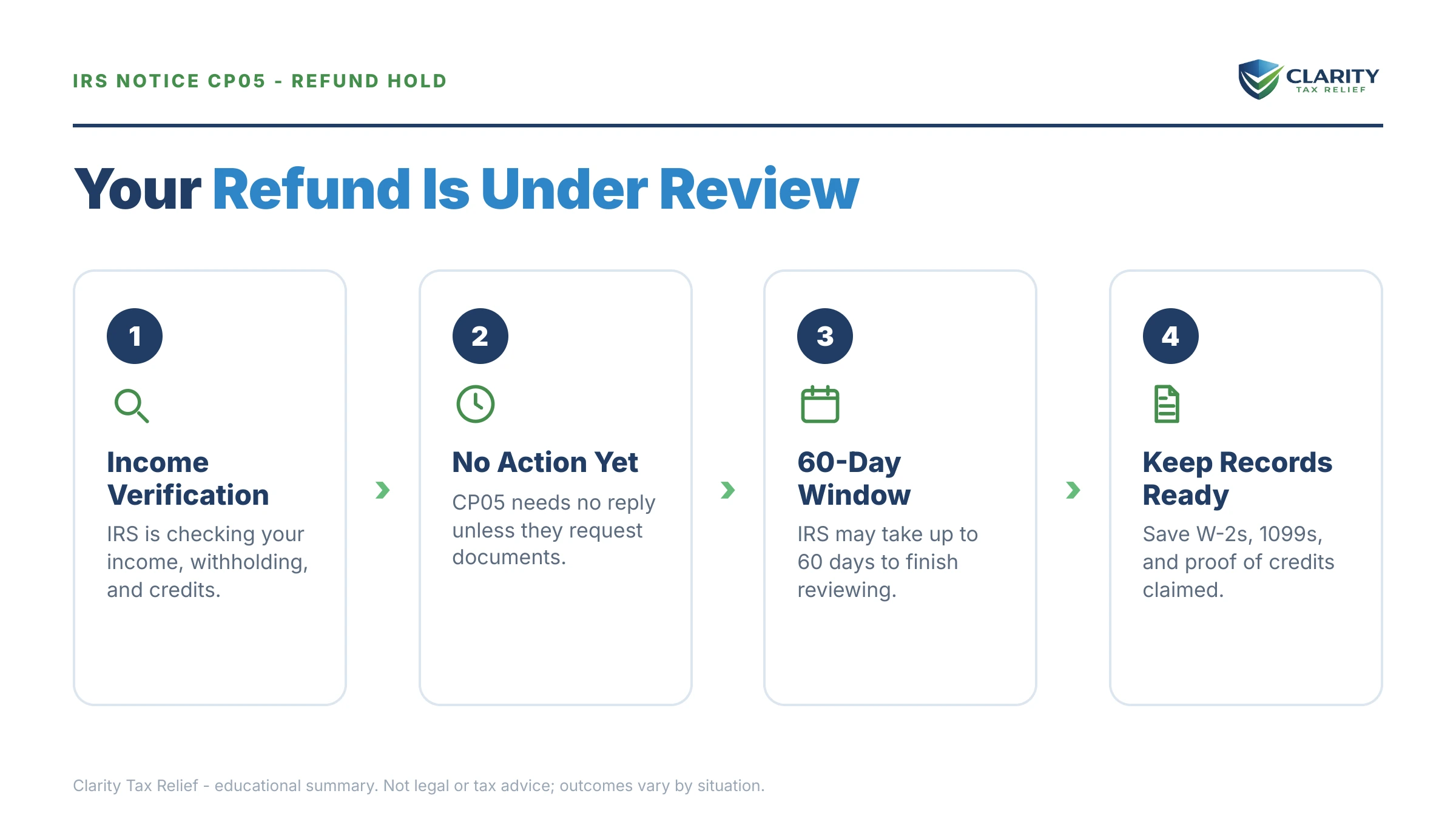
The short answer: an IRS CP05 notice means your refund is on hold while the IRS verifies what you reported. In the IRS's words: "We need more time to verify your income, income tax withholding, tax credits and/or business income." You do not owe money, it is not an audit, and if you filed the return, "You don't need to take any action." The IRS asks you to allow up to 60 days before contacting it.
You filed, watched "Where's My Refund" sit frozen for weeks, and now a letter says your return is under review, with no amount to pay, no form to send and no explanation of what triggered it. That limbo is the whole point of a CP05: the IRS is checking your numbers against the W-2s, 1099s and payment records it already holds before it pays you.
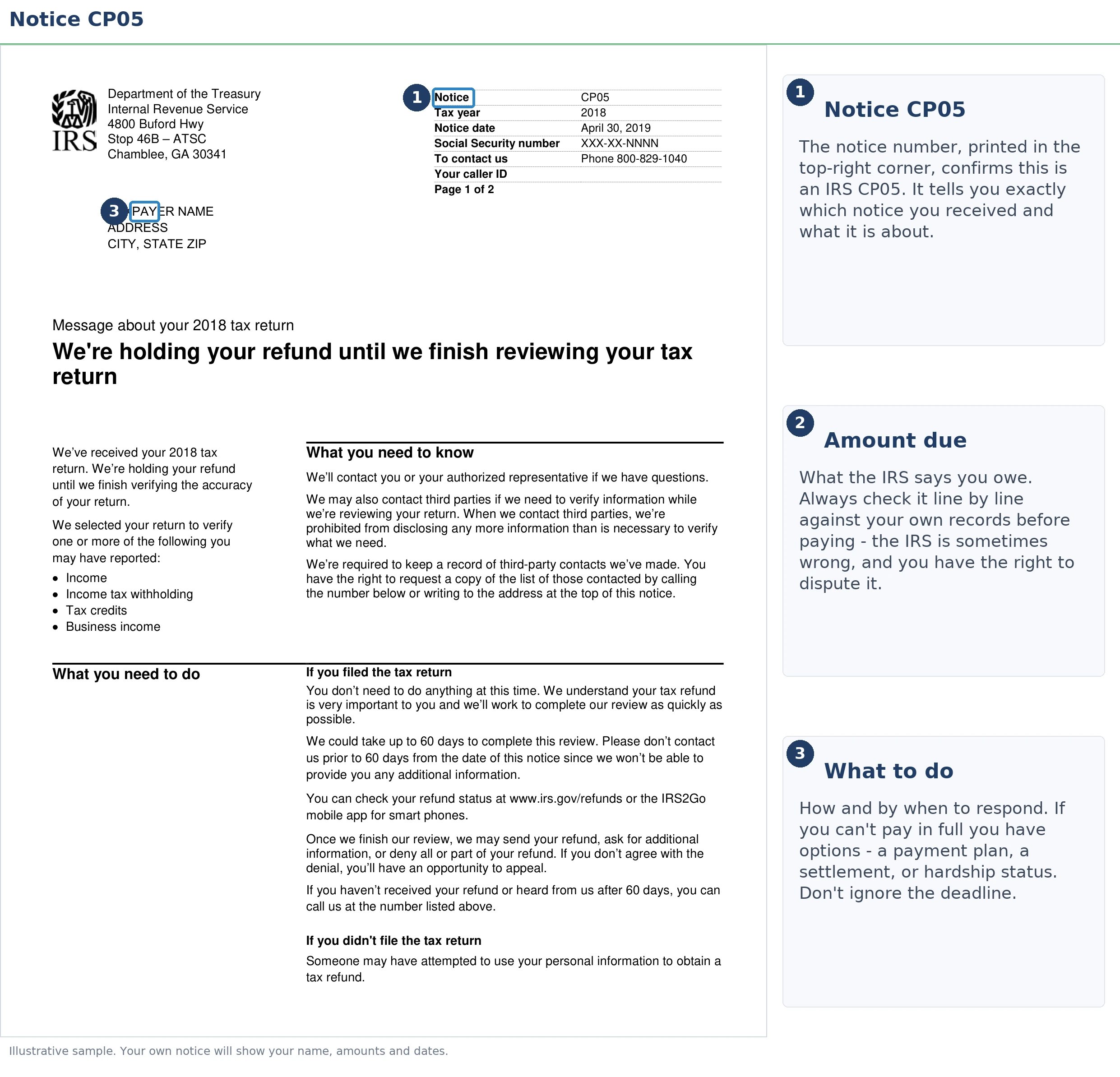
Most CP05 reviews end with the refund released, untouched. This page covers how long that takes, whether the letter is bad news, what turns a CP05 into a CP05A that does need a response, and the one form (14039) people file when they should not. The image below shows what a CP05 looks like and where to find the notice date, the only date on this letter that matters.
⏱ The clock runs on the IRS, not you. The IRS says: "Please do not call us until 60 days after the notice date and only if you haven't received your refund or heard from us by then." Mark 60 days from the notice date on your calendar; that is the day you can start asking for answers. If the refund arrives more than 45 days after the filing deadline (or your filing date, if later), the IRS adds interest to it.
What an IRS notice CP05 means, and why you got one
The IRS sends a CP05 when its verification systems cannot immediately confirm something on your return, usually the income, the federal withholding, a refundable credit or business income. The return was routed to a review unit before the refund was paid, and the CP05 is the letter telling you so. The IRS's own answer to "why is my return being reviewed?" is short: "We select some returns to review so we can determine whether income, expenses, and credits are reported correctly. This doesn't mean you made an error or were dishonest."
The common triggers are mechanical, not accusations:
- Withholding that doesn't match. The withholding on your return differs from what employers reported on W-2s and 1099s, because a W-2 was filed late, an employer made an error, or a number was transposed.
- Refundable tax credits. The Earned Income Tax Credit and Additional Child Tax Credit are the most-verified lines on any return, especially when the dependents are new to it.
- A return that looks different from last year's. A filing-status change plus new dependents plus a new withholding pattern is the profile a divorce-year return presents.
- Payments credited differently than you claimed them. Estimated payments made under a joint account may sit under an ex-spouse's Social Security number even though you are the one claiming them.
Say a divorce-year return shows $27,600 of withholding set at married rates and never adjusted, $16,000 of estimated payments made against the settlement year. A head-of-household tax of $12,400 with two children, for a $31,200 refund. To the verification system that return has four flags stacked. None of them means anything was wrong; each one is something the IRS wants to confirm against its own records before paying out. If both parents claimed the same children, that is a separate process, covered in both parents claimed a child. Background on how the IRS decides who gets which letter is in why did I get a letter from the IRS.
Is a CP05 letter bad?
No. It is a delay, not a finding. Nothing on a CP05 says you owe money, nothing on it opens an audit. The IRS's own explanation is that being selected "doesn't mean you made an error or were dishonest." The cost of a CP05 is time: your refund waits while the IRS confirms the numbers, and on a large refund that wait is expensive. It becomes something more only if a CP05A follows asking for documents you cannot produce, or if a credit cannot be verified and the review turns into a CP75 correspondence audit. Both of those are rarer than the plain release.
How long to get your refund after a CP05 letter
The IRS's instruction is to "allow up to 60 days" from the notice date. Many reviews resolve sooner; some run past the window with only a Letter 2645C ("we need more time") to show for it. The refund is not delayed by anything you do or do not send during the window, because the first CP05 asks you for nothing. What you can watch is your account transcript, where the review shows as code 570 (the hold) paired with code 971 (the notice going out). When the review clears, the hold reverses as code 571 and code 846 posts with your refund date. Codes move days before letters arrive, so the transcript is the earlier signal.
If the refund is paid more than 45 days after the filing deadline or the date you filed, whichever is later, the IRS adds interest to it automatically. You do not request it, and it is taxable income in the year you receive it. If the 60 days pass with no refund and no letter, call the number on the notice and ask for the specific status of the review, not "it's processing." If the delay is causing financial hardship, the Taxpayer Advocate Service takes those cases through Form 911.
| Stage | What you see | Your move |
|---|---|---|
| Day 0 | CP05 arrives; transcript shows 570 and 971 | Verify the notice in your IRS online account, calendar 60 days out, check your numbers |
| Days 1 to 60 | Silence, or transcript movement | Nothing required. Watch the transcript weekly; do not amend |
| Review clears | Code 571, then 846 with a refund date | Confirm the amount matches your return |
| IRS needs proof | CP05A with a reply-by date | Send every requested document by that date; this is now mandatory |
| Day 60 passes, nothing happens | No refund, maybe a Letter 2645C | Call the notice number; TAS via Form 911 if the delay causes hardship |
| IRS can't verify | Adjustment notice or CP75 exam letter | Respond with documentation; this is where refunds get lost |
CP05 vs. CP05A: when you must send documents
A CP05 asks for nothing. A CP05A converts the wait into a task. The IRS describes it this way: "We need more supporting documentation to verify your income and federal tax withholding before we can issue your refund," and tells you to "reply by the date shown on your notice." The IRS names the fastest route as its Document Upload Tool, reached from the link or QR code on the notice. You can also fax to the number on the notice or mail to the address on it. Your reply must include a copy of the notice.
What the documentation has to show, per the IRS: the date you earned the wages, the gross income you received. The federal tax withheld for the year on the notice. What it accepts:
- Copies of at least three pay statements or check stubs, including the end-of-year statement. The IRS specifically says not to send a copy of Form W-2.
- A letter on company letterhead from your employer, with the employer's name, address, telephone and fax number.
- A statement of benefits for retirement income.
After you send documents, the IRS asks you to allow 60 days from the date you provided them before contacting it. If you do not respond to a CP05A, the IRS resolves the question against you: withholding it cannot verify is removed, credits it cannot verify are disallowed. The refund is reduced or eliminated by an adjustment notice.
CP05, identity theft and Form 14039
The two get conflated, and the wrong response costs weeks. If you filed the return the notice refers to, a CP05 is not an identity theft notice. It says the IRS has reviewed your tax return and is holding the refund while it verifies what is on it. It does not say someone filed in your name. Sending Form 14039, the Identity Theft Affidavit, in that situation adds a second workstream to an account already under review and slows the thing you are waiting on.
The exception is on the notice itself. The IRS's CP05 page says that if you did not file a return, "Someone may have used your personal information to file this return," and in that case it tells you to complete Form 14039 and mail it to the address at the top of the notice. So the question is not "did I get a CP05?" but "did I file the return it describes?" If you did, wait. If you did not, file the affidavit, and consider an IRS Identity Protection PIN for future years.
Refund held past the review window, or a CP05A demanding records the divorce scattered?
Send us a photo of your notice. An experienced tax professional will read your transcript, pinpoint what is actually holding the refund, and map the fastest legitimate path to release. Free and confidential.
Other IRS refund-hold letters that look like a CP05
The IRS sends several refund-hold letters that look alike and demand very different responses. Know which one is in your hand before you do anything:
| Letter | What it means | Action required |
|---|---|---|
| CP05 | Refund held while income, withholding and credits are verified | None if you filed the return. Wait, verify your numbers, calendar 60 days |
| CP05A | Review found something it can't verify | Yes. Send documents by the date on the notice |
| 4464C letter | A parallel pre-refund review from a different IRS unit | None initially; the same wait-and-verify posture as a CP05 |
| 5071C letter | The IRS doubts you filed the return: an identity check | Yes. Verify your identity online or by phone before anything moves |
| CP12 notice | The IRS already changed your refund amount for a math error | Only if you disagree; you typically have 60 days to contest |
What to do while the IRS holds your refund
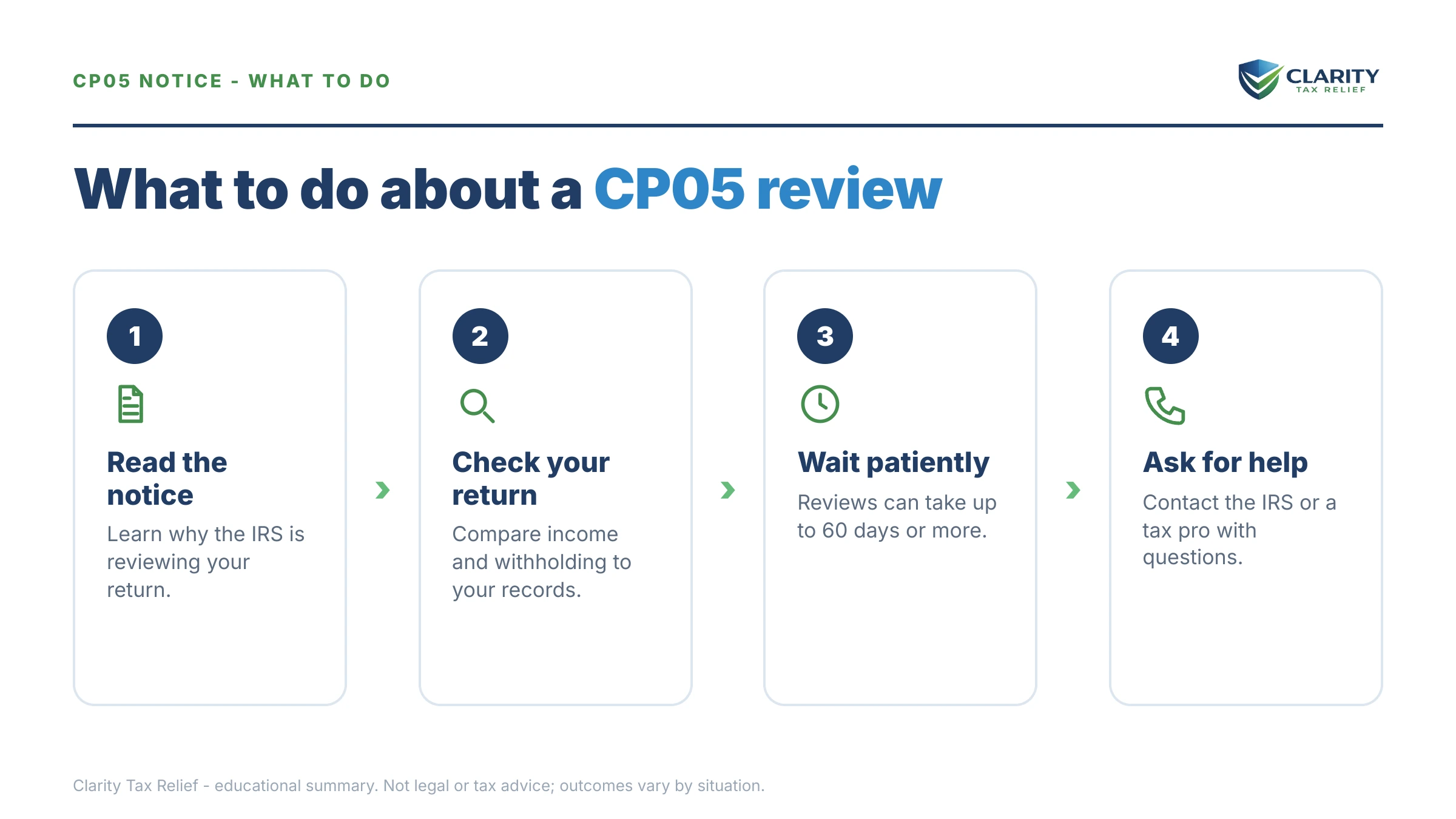
You cannot force a CP05 review to finish, but four moves make sure it finishes in your favor:
- Pull your wage and income transcript. The IRS wage and income transcript shows every W-2 and 1099 payers filed under your Social Security number. If it matches your return, the review will almost certainly clear; if it does not, you have found the trigger before the IRS asks.
- Confirm where joint estimated payments posted. Your IRS online account shows payments credited to you. If the $16,000 you claimed sits under your ex-spouse's account, that is fixable. But it takes a call or correspondence. It is the single most common divorce-year hang-up we see on these reviews.
- Fix real mismatches carefully. If an employer misreported your wages or withholding, ask for a corrected W-2c. If you find an error in what you filed, talk to an experienced tax professional before amending mid-review.
- Use the hardship channel if you need the money. If the held refund is the difference between paying rent and not, the Taxpayer Advocate Service exists for that. See how to contact the Taxpayer Advocate Service.
One thing not to do: do not file an amended return to hurry things along. A 1040-X filed mid-review does not release the hold; it adds a second, slower process on top of the first.
| Code | Meaning | Good or bad sign? |
|---|---|---|
| 570 | Refund hold in place | Neutral; this is the CP05 itself |
| 971 | A notice was issued | Neutral; could be the CP05, a CP05A, or a 2645C |
| 571 / 572 | Hold reversed or resolved | Good; the review cleared |
| 846 | Refund issued, with a date | Good; money is moving |
| 420 | Return routed to examination | Bad; the review became an audit, get help |
When you can handle a CP05 yourself
Most CP05s need no professional help. When the first CP05 just arrived, your wage and income transcript matches your return. You can afford to wait out the window, the review clears on its own more often than not, and the correct action is patience plus a calendar entry. Experienced help changes the outcome in a narrower set of situations: a CP05A arrived and the records live in two households. Joint estimated payments are credited to the wrong spouse, which is a correspondence-and-phone fight most people lose to hold music. The review became a CP75 exam or code 420 posted. Or the window passed long ago and calls go nowhere, where a representative with a power of attorney can work the practitioner channels and Advocate routes you cannot reach from the general line.
Terms on your CP05, decoded
- Refund hold (code 570): the transcript entry that freezes your refund while the review runs; it is not a penalty and creates no debt.
- Wage and income transcript: the IRS's copy of every W-2 and 1099 filed under your Social Security number, the yardstick your return is measured against.
- CP05A: the follow-up notice that asks for documents by a printed date.
- Refund interest: interest the IRS adds when it pays a refund more than 45 days after the filing deadline or your filing date, whichever is later. Taxable in the year you receive it.
CP05 notice FAQs
What is an IRS CP05 notice?
A CP05 notice means the IRS is holding your tax refund while it verifies the income, withholding, tax credits or business income you reported. You do not owe money, it is not an audit, and if you filed the return the IRS says you don't need to take any action. The IRS asks you to allow up to 60 days from the notice date before contacting it.
How long after a CP05 letter will I get my refund?
The IRS asks you to allow up to 60 days from the notice date. Many reviews resolve sooner and some run longer. On your account transcript the release shows as code 571 followed by code 846 with the refund date, usually days before any letter arrives. If the refund is paid more than 45 days after the filing deadline or your filing date, whichever is later, the IRS adds interest to it.
Is a CP05 letter bad?
No. A CP05 is a delay while the IRS confirms your numbers, not a finding against you. The IRS says being selected "doesn't mean you made an error or were dishonest." It becomes a problem only if a CP05A follows and you cannot document your withholding, or if a credit cannot be verified and the review turns into a CP75 audit.
Is a CP05 notice an audit?
No. A CP05 is a pre-refund verification hold, not an examination. The IRS is matching your reported income, withholding and credits against what employers and payers reported. You have nothing to prove at this stage. A small share of reviews escalate: if credits like the EITC cannot be verified, the IRS may open a CP75 audit, which is a different letter with document demands.
Do I need to respond to a CP05?
Not if you filed the return. The IRS's instruction is "You don't need to take any action," and there is no address or deadline for you on the first CP05. Action is required only if a CP05A arrives asking for documents, which has a reply-by date, or if you did not file the return the notice refers to, in which case the IRS tells you to complete Form 14039.
Can I call the IRS about a CP05 before 60 days?
The IRS asks you not to: "Please do not call us until 60 days after the notice date and only if you haven't received your refund or heard from us by then." Calling earlier rarely moves the file, because the hold sits with an automated verification unit. Use the time to pull your wage and income transcript and confirm every W-2 and 1099 matches your return, so any follow-up request is answered the same day.
What if 60 days pass and I still don't have my refund?
Check your account transcript first: code 571 or 846 means it resolved. A new 971 may mean another letter, often a 2645C "we need more time" letter, is coming. Then call the number printed on your CP05 and ask for the specific status of the review. If calls go nowhere and the delay is creating financial hardship, file Form 911 with the Taxpayer Advocate Service.
Will the IRS pay me interest on the held refund?
Generally yes, if the refund is issued more than 45 days after the later of the filing deadline or the date you actually filed. The interest is added to the refund automatically; you do not request it. It is taxable income, so a long hold on a large refund adds a line to next year's return.
Is a CP05 an identity theft notice, and should I file Form 14039?
Only if you did not file the return the notice describes. The IRS says that if you didn't file a return, someone may have used your personal information. It tells you to complete Form 14039 and mail it to the address on the notice. If you did file the return, the CP05 is a verification hold, not an identity theft notice, and filing the affidavit adds a second process that slows the refund.
What's the difference between a CP05 and a CP05A?
A CP05 says the IRS is reviewing your refund and needs nothing from you. A CP05A says the IRS needs supporting documentation to verify your income and federal withholding before it can issue the refund: at least three pay statements including the year-end one (not a W-2), or an employer letter on letterhead, or a retirement benefit statement, sent by the date on the notice through the Document Upload Tool, fax or mail. Ignoring a CP05 costs nothing; ignoring a CP05A can end with the refund reduced or disallowed.
If the notice in your hand is not a CP05, our IRS notice and letter master list explains what each IRS notice and letter number means and what it asks of you.
Your next 24 hours
- Find the notice date on your CP05 and put 60 days after it on your calendar as "call the IRS if no refund by today."
- Gather your proof now, not when a CP05A demands it: a copy of the return, every W-2 and 1099, at least three pay statements including the year-end one, records of estimated payments (and who made them), and if you claimed the kids, the divorce decree and school or medical records showing they live with you.
- Get a free case review if your 60 days have already passed, a CP05A is sitting on your counter, or joint payments from the marriage are tangled in the hold. Call (888) 825-7779 or use the 2-minute form. The review keeps running while you wait, so find out where your file actually stands.
Primary sources: the IRS's own pages at Understanding your CP05 notice and Understanding your CP05A notice, your payment history in your IRS online account, and hardship help through the Taxpayer Advocate Service.
This guide is general information, not tax or legal advice for your specific situation. Eligibility for IRS programs depends on individual facts and circumstances; no outcome is guaranteed.