
IRS Letters
IRS 4464C Letter: Why Your Refund Is on Hold and What to Do (2026)
The short answer: a 4464C letter means the IRS is holding your refund while it verifies the income, withholding, and credits on your return. It is not an audit, and it requires no response from you — the letter asks you to allow 60 days. Most reviews end with the refund released.
You filed weeks ago, "Where's My Refund" froze on one bar, and now the mail brings a 4464C letter that says your return is being reviewed, and asks for exactly nothing. No documents, no signature, no payment. That silence is what makes a 4464C so confusing: your job right now is mostly to watch the right clock and the right transcript codes.
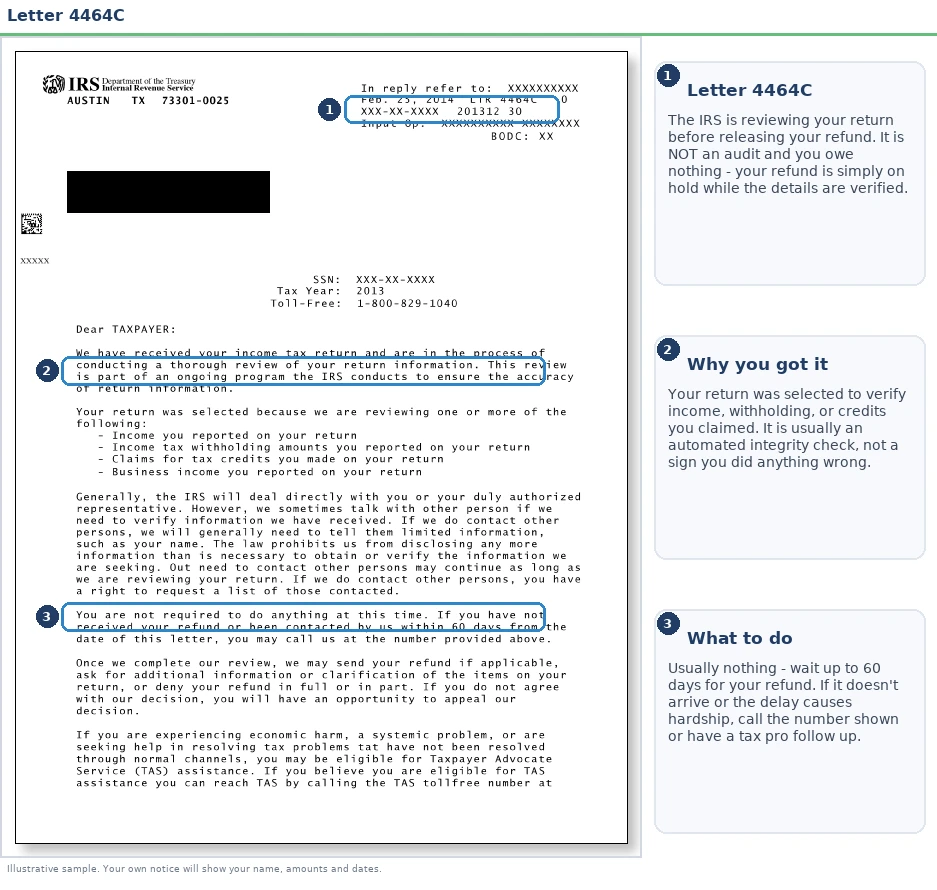
Unlike a 5071C identity verification letter or a 4883C letter, a 4464C never asks you to prove who you are. It comes from the IRS's Integrity and Verification Operations (IVO) unit, which screens returns for questionable withholding or refundable credits before money goes out the door. The image below shows exactly what a genuine 4464C looks like and where to find the letter date — the date that starts the review clock.
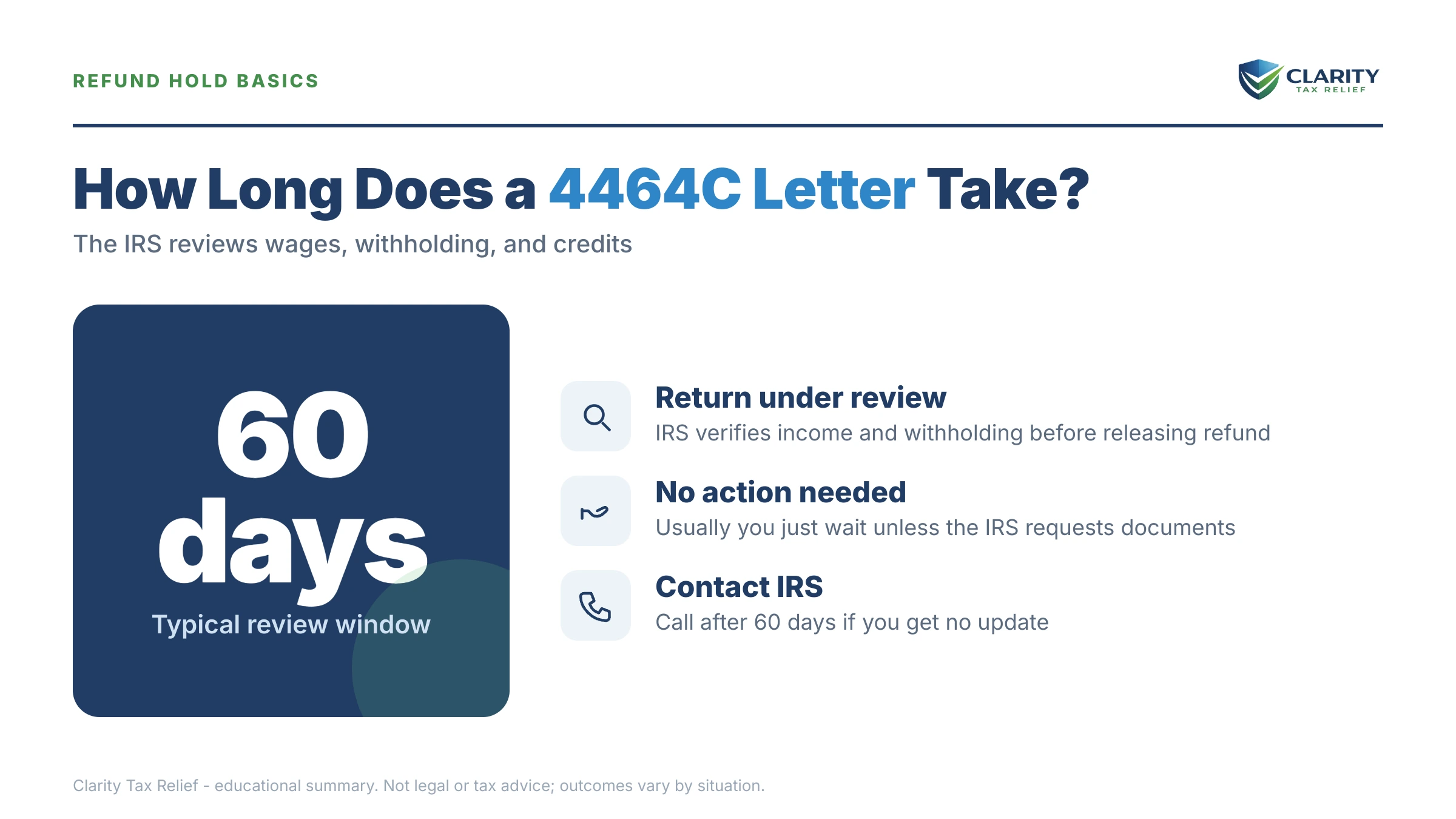
⏱ The clock on a 4464C: the letter asks you to allow 60 days from the letter date for the review. Nothing is required from you during that window. If day 60 passes with no refund, no adjustment notice, and no follow-up letter, that is your cue to call the number printed on the letter.
Why you got a 4464C letter
A 4464C letter is triggered when the IRS's pre-refund screening flags something on your return it wants to verify before paying out. The most common trigger is a mismatch, or a not-yet-confirmed match — between the withholding and income you reported and what your employers and payers filed with the government. The review targets four things: your reported income, your withholding, your refundable credits, and any business income on the return.
Specific situations that route returns to IVO review include:
- Withholding that looks high for the income — a typo in Box 2, a transposed number, or genuinely unusual withholding all look the same to the filter.
- An employer that filed late or not at all. The IRS can't confirm your W-2 numbers until your employer's copy arrives. Filing very early, before employer records post, raises this risk.
- Refundable credits — the Earned Income Tax Credit and Additional Child Tax Credit draw extra pre-refund scrutiny because they pay out even when no tax was withheld.
- A new job, a job change mid-year, or a first joint return — anything that makes this year's income picture look different from prior years.
- Schedule C income with a refund attached — self-employment income the IRS has no third-party record to match against.
None of these mean you did anything wrong. The filter flags patterns, not people, and a large share of flagged returns verify cleanly and pay out in full.
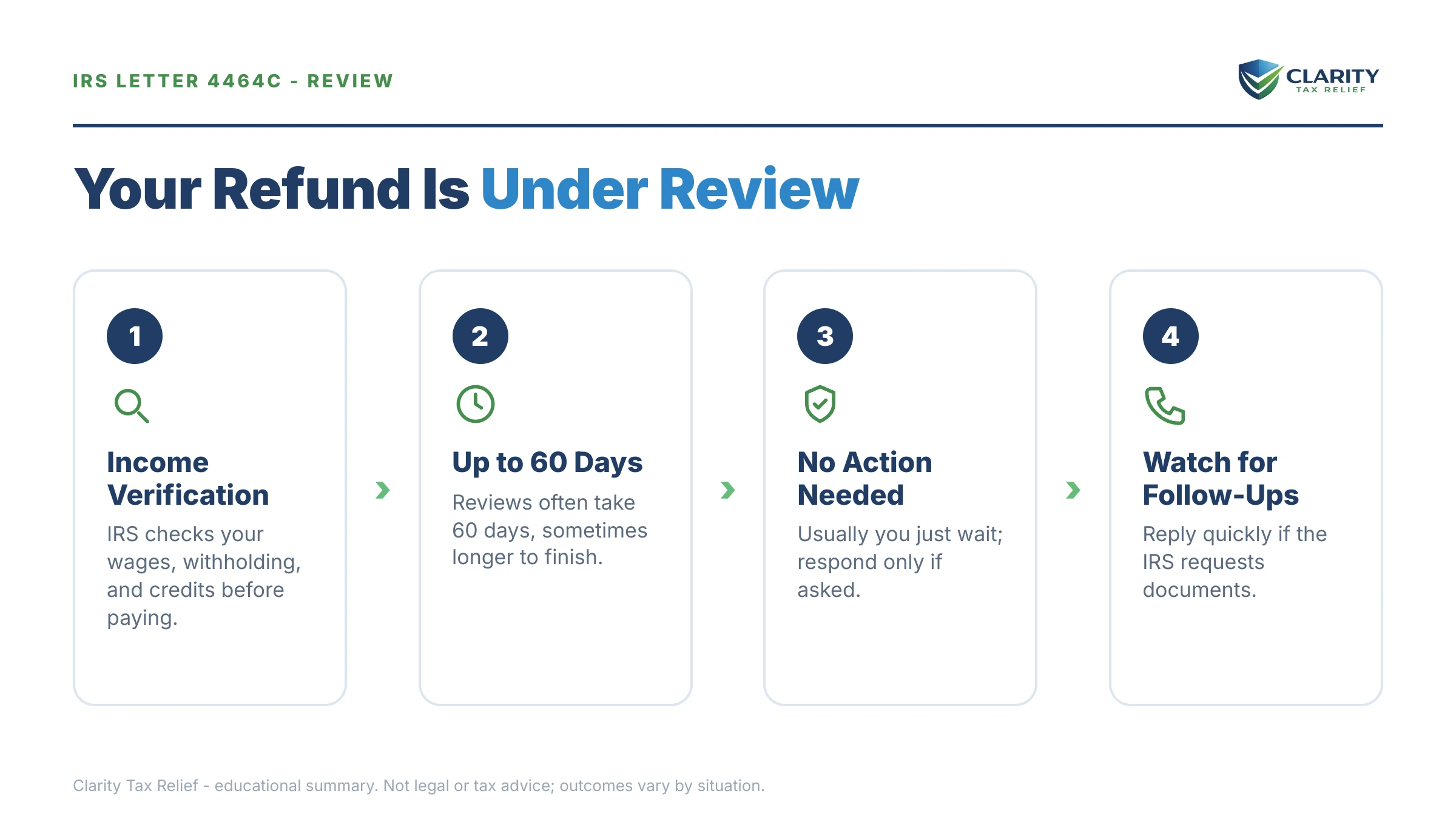
What the 4464C review actually checks (and what it can't see yet)
The IVO unit compares your return line by line against records the IRS already holds — W-2s from employers, 1099s from payers, and prior-year filing history. You don't send anything because the IRS isn't asking you to prove anything; it's waiting on, or reconciling, its own data.
That's also why these reviews stall. If your employer's W-2 file hasn't posted, the review can't finish no matter how many times you call. And in 2026 there's a second bottleneck: the IRS workforce was cut roughly 27% in 2025, and manual verification queues are one of the places the slowdown shows. The review will finish, but "allow 60 days" is a floor more often than it used to be. Our guide to IRS layoffs and 2026 processing delays covers what the cuts mean for held refunds.
On your account transcript, the review shows up as 570 and 971 codes together — a hold plus a notice. If you instead see code 810, that's a different, harder freeze. See our code 810 refund freeze guide, because that path usually involves identity verification, not passive waiting.
A worked example: an $8,900 refund under 4464C review
Say you and your spouse filed jointly on February 2, 2026, expecting an $8,900 refund — $13,600 in combined W-2 withholding from your two jobs, minus $4,700 in total tax after credits. A 4464C dated March 9 means IVO is matching that $13,600 against what your two employers reported. Here's the math on the wait:
- Day 0 (March 9): letter date. The 60-day window runs to roughly May 8.
- The refund doesn't shrink while you wait. A review hold adds no penalties and no interest against you — the $8,900 stays $8,900 unless the IRS finds an actual mismatch and adjusts it.
- Past 45 days, the balance tips your way. If the refund isn't issued within 45 days of April 15 (roughly May 30), the IRS generally owes you interest at the federal overpayment rate, compounded daily. At a hypothetical 7% annual rate, three months of interest on $8,900 is roughly $155 ($8,900 × 7% × 91/365).
The one way this couple loses money: one spouse's W-2 was entered with a withholding typo. Then the review ends in an adjusted, smaller refund — which is why step 3 below (re-checking your own return now) is the single most useful thing you can do during the wait.
What happens after a 4464C letter: the four ways it ends
Every 4464C review resolves in one of four ways, and only one of them requires anything from you. The sequence usually looks like this:
- The review clears. Your transcript posts a code 571/572 releasing the hold, then code 846 with a refund date. This is the most common ending, and it often happens with no further mail at all.
- The IRS adjusts the refund. If IVO finds a mismatch — withholding that doesn't match employer records, a credit you didn't qualify for — it changes the refund and sends a notice explaining the math. You can dispute the change, and if the adjustment flips you to a balance due you can't pay, our hub on how to settle tax debt yourself maps every option.
- The IRS asks for documents. A follow-up CP05A notice requests specific proof — paystubs, W-2 copies, proof of withholding. This notice has a response deadline printed on it, and ignoring it is how held refunds turn into disallowed refunds.
- The IRS extends the review. A Letter 2645C arrives saying the IRS needs more time — typically citing another 60 days. Frustrating, but it means your file is active, not lost.
If you do nothing at all, nothing bad happens to you — no penalty, no enforcement, no escalation. The only thing at risk from pure waiting is time. The exception is path 3: once the IRS asks for documents, the passive strategy stops working.
Refund stuck under a 4464C review?
If your 60 days have passed, or a CP05A or adjustment notice just changed the game — get your letter and transcript reviewed free. An experienced tax professional will tell you whether your review is on track, stalled, or headed for an adjustment, and what to do about each.
Your options while the IRS reviews your refund
A 4464C gives you fewer levers than a collection notice. But the levers you have are real, and each one unlocks at a specific point in the timeline. The IRS names one action itself. If you review your return and find a genuine error, it recommends filing a corrected or amended return to fix the information. Do that only for a real mistake. There is nothing to gain from amending a return that was right the first time.
| Milestone | Typical window | What you can do |
|---|---|---|
| Letter date (day 0) | Review begins | Verify the letter is real; pull your transcript; re-check your return against your W-2s and 1099s |
| Review window | The letter asks for 60 days | Nothing is required; check your transcript weekly for a 571/572 release or 846 refund code |
| You find your own error | Any time | Wait for the review to finish, then amend if the IRS didn't already correct it — don't file a duplicate return |
| CP05A document request arrives | Deadline printed on the notice | Send exactly what's asked, by the date shown. This is the one point where silence hurts you |
| Day 60 passes, no movement | After the letter's window | Call the number on the 4464C and ask for review status; log the date and the name of who you spoke with |
| Financial hardship at any point | No waiting period | File Form 911 with the Taxpayer Advocate Service — hardship cases can jump the queue |
| Refund issued more than 45 days after the due/filing date | Automatic | The IRS generally adds daily-compounded interest to your refund. You don't need to request it |
The hardship path deserves emphasis: you do not have to wait 60 days if the held refund is causing real harm. Eviction notices, utility shutoffs, and inability to afford medicine are exactly what the Form 911 Taxpayer Advocate process exists for. It's free, independent of the IRS collection and review machinery, and it can compel a stalled file to move.
4464C letter vs. CP05, 5071C, 4883C, and 5747C
The single most important distinction: a 4464C reviews your numbers, while the identity-letter family questions whether you filed at all. The identity letters demand action while the 4464C demands none.
| Letter | What it means | Action required |
|---|---|---|
| 4464C | Pre-refund review of income, withholding, and credits (IVO unit) | None — allow 60 days |
| CP05 | Same review, issued as a notice instead of a letter | None — wait for the review |
| CP05A | The review needs documents from you | Respond with proof by the date printed on the notice |
| 5071C | IRS isn't sure you filed the return | Verify your identity online or by phone — return isn't processed until you do |
| 4883C | Identity verification by phone only | Call the number on the letter with your returns in hand |
| 5747C | Identity verification in person | Schedule and attend a Taxpayer Assistance Center appointment |
| 2645C | Interim letter — the IRS needs more time on an open case | None — it resets the waiting clock |
Getting this wrong in either direction costs you. Treat a 5071C like a 4464C and your return sits unprocessed forever. Treat a 4464C like an identity letter and you'll burn hours on hold trying to "verify" something nobody asked you to verify. And if you're not sure your letter is genuine at all, our guide to real vs. fake IRS letters walks through the tells — a real 4464C never asks for payment, gift cards, or your bank login.
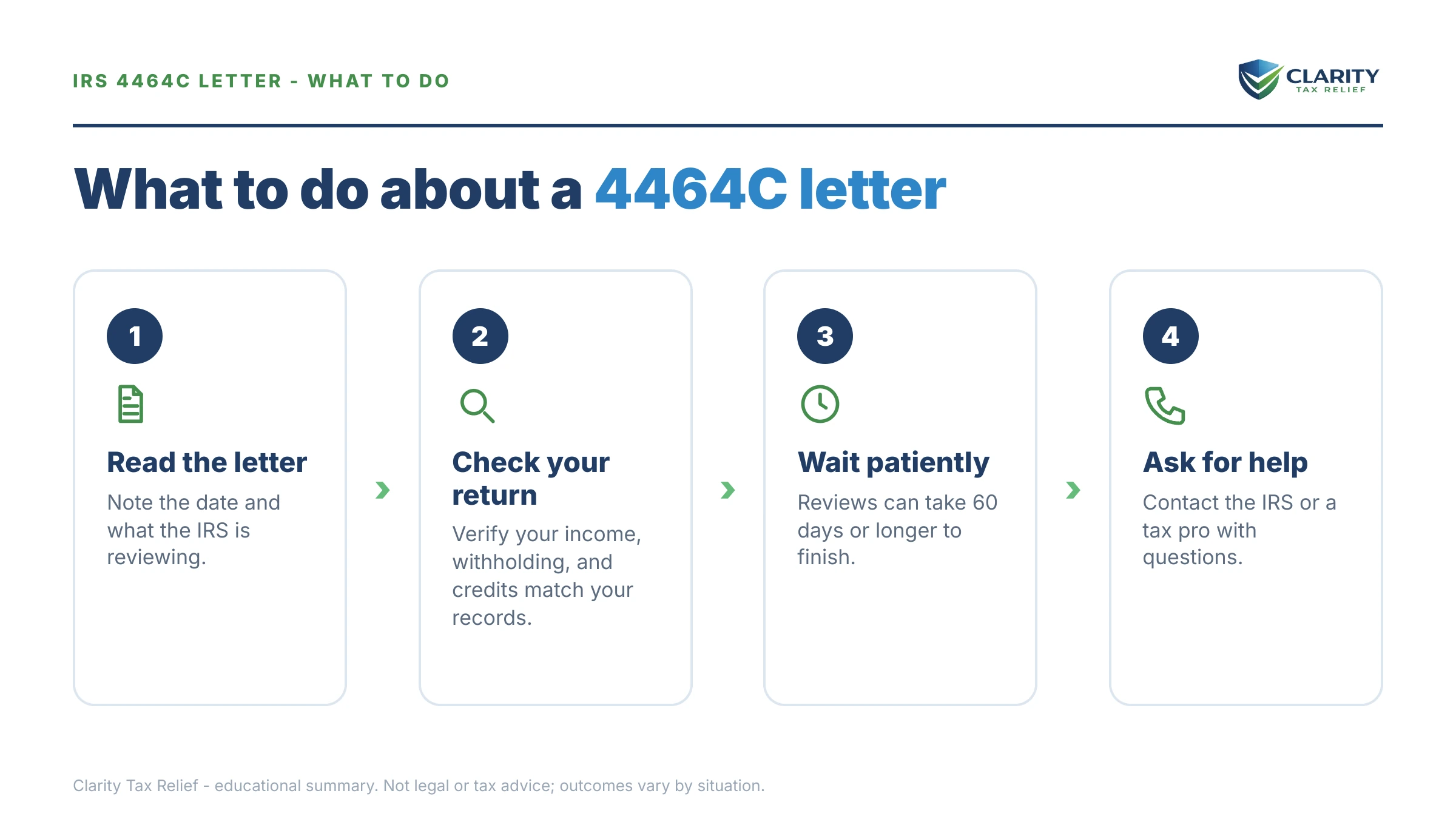
How to respond to a 4464C letter, step by step
- Verify the letter is genuine. A real 4464C arrives by postal mail, asks for no money, and lists an IRS phone number, not a payment link. If anything feels off, log into your IRS online account and check for the notice there.
- Pull your account transcript. Look for code 570 (the refund hold) and code 971 (the letter). Those two codes confirm this is a standard review, not something worse. Our walkthrough on how to get your IRS transcript online takes about five minutes.
- Re-check your return line by line. Compare every W-2 and 1099 against what you filed. A withholding typo or a missed income form is the most common reason a review ends in an adjusted refund.
- Mark day 60 on your calendar. Count 60 days from the letter date. Nothing is required from you before then unless a follow-up notice asks for documents.
- Call the IRS after day 60. If no refund, no adjustment notice, and no new letter has arrived, call the number printed on your 4464C and ask for the review status.
- Escalate genuine hardship. If the held refund is causing eviction, utility shutoff, or similar harm, file Form 911 with the Taxpayer Advocate Service at any point. You do not have to wait 60 days.
One thing not to do: file a second return "just in case." Duplicate filings routinely convert a 60-day review into a months-long identity-screening mess.
When you can handle a 4464C yourself (almost always)
A 4464C is one of the few IRS letters where the honest answer is: you usually don't need professional help. If your return is accurate, your only jobs are the six steps above, and paying someone to wait alongside you adds nothing.
Experienced help changes the outcome in a narrower set of situations:
- A CP05A arrives and you can't cleanly document your withholding — a closed employer, a payroll company that vanished, missing paystubs. Building acceptable substitute proof is a skill.
- The review ends in an adjustment you believe is wrong. Disputing an IVO adjustment means marshaling third-party records against the IRS's own data, on the IRS's timeline.
- You have unfiled prior years muddying the account. The IRS can hold a current refund against unfiled-year exposure, and untangling that is sequencing work, not waiting work.
- The hold is really an 810 freeze or identity-theft overlay. Those paths have their own procedures and their own failure modes.
If your situation is on that second list, a free review costs you nothing and can save the review from going sideways — start with the 2-minute form or call (888) 825-7779.
Terms on your 4464C letter, decoded
- Integrity and Verification Operations (IVO): the IRS unit that screens returns for questionable withholding or credits before refunds go out — the office behind your 4464C.
- Code 570: the transcript hold that pauses your refund while the review runs.
- Code 971: the transcript entry showing a notice was issued, usually this letter.
- Code 846: the transcript entry that means your refund was approved, with the date it goes out.
- Wage verification: the IRS matching the income and withholding you reported against the W-2 and 1099 copies employers and payers filed with the government.
- 45-day interest rule: if your refund is issued more than 45 days after the return due date (or your filing date, if later), the IRS generally pays you interest on it.
4464C letter questions, answered
What is IRS Letter 4464C?
A 4464C letter means the IRS is holding your refund while it verifies the income, withholding, and credits on your return. It is not an audit, and it requires no response from you — the letter asks you to allow 60 days. Most reviews end with the refund released.
How long does a 4464C review take?
The letter itself asks you to allow 60 days from its date, and many reviews finish inside that window. Some take longer — the IRS may send a Letter 2645C asking for more time, and 2026 staffing cuts have slowed manual reviews. If 60 days pass with no refund, no adjustment, and no new letter, call the number on your 4464C and ask for the review status.
Do I need to respond to a 4464C letter?
No. A 4464C requires no response, no documents, and no payment — the IRS is verifying your return against records it already has from employers and payers. The exception is if a follow-up notice like a CP05A arrives asking for specific documents. That one has a response deadline printed on it. You should meet it.
Is a 4464C letter an audit?
No. A 4464C is a pre-refund verification, not an examination. Nobody is questioning your deductions or asking you to prove expenses. The Integrity and Verification Operations unit is matching your reported income, withholding, and credits against third-party records. An audit arrives under different letters and comes with formal appeal rights. A 4464C review usually ends quietly with your refund released.
Will I still get my refund after a 4464C letter?
Most people do, and for the amount they claimed, once the IRS confirms the income and withholding on the return match employer records. If the IRS finds a mismatch, it adjusts the refund and sends a notice explaining the change — which you can dispute. If your refund is issued more than 45 days after the filing deadline (or your filing date, if later), the IRS generally adds interest.
What is the difference between a 4464C letter and a 5071C letter?
A 4464C is a content review — the IRS is checking the numbers on your return and needs nothing from you. A 5071C is an identity check — the IRS is not sure you filed the return. You must verify who you are online or by phone before processing continues. Ignoring a 5071C means your return is never processed; ignoring a 4464C usually costs you nothing but patience.
Why does my transcript show code 570 after a 4464C letter?
Code 570 is the hold that pauses your refund while the review runs, and the 4464C is usually the notice behind the code 971 posted next to it. Neither code means an audit or a balance due. When the review clears, a code 571 or 572 releases the hold and code 846 posts with your refund date.
Can the Taxpayer Advocate speed up a 4464C refund?
Yes, in genuine hardship cases. The Taxpayer Advocate Service can intervene when a held refund is causing eviction, utility shutoff, inability to afford food or medicine, or similar harm. You request help with Form 911. TAS is independent and free, and it can force movement on a stalled review. It will not expedite a refund just because the wait is frustrating; you need a documentable hardship.
Does the IRS pay interest on a refund delayed by a 4464C review?
Generally yes, once the delay runs past 45 days. If your refund is issued more than 45 days after the return due date (or the date you filed, if you filed late), the IRS adds interest at the federal overpayment rate, compounded daily. That interest is taxable income in the year you receive it — the IRS sends a 1099-INT if it totals $10 or more.
Your next 24 hours
- Find the letter date in the top corner of your 4464C and count 60 days forward — write that date on the letter itself. That's the only deadline in play, and it's the IRS's, not yours.
- Gather your return, every W-2 and 1099, and your transcript, and check the withholding figures against each other. Ten minutes of matching now tells you whether this review ends in a full refund or an adjustment.
- If your 60 days are already gone, a CP05A is on the table, or the held refund is causing real hardship, get a free case review — the 2-minute form or (888) 825-7779. A stalled review doesn't cost you penalties, but every week it sits is a week your money sits with the Treasury instead of you.
For the IRS's own explanation of this letter, see Understanding your Letter 4464C. You can track your refund status at IRS.gov/refunds, and hardship help is available through the Taxpayer Advocate Service.
This guide is general information, not tax or legal advice for your specific situation. Eligibility for IRS programs depends on individual facts and circumstances; no outcome is guaranteed.