
IRS Transcript Codes
570 and 971 Codes on Transcript: What the Pairing Means and What to Do (2026)
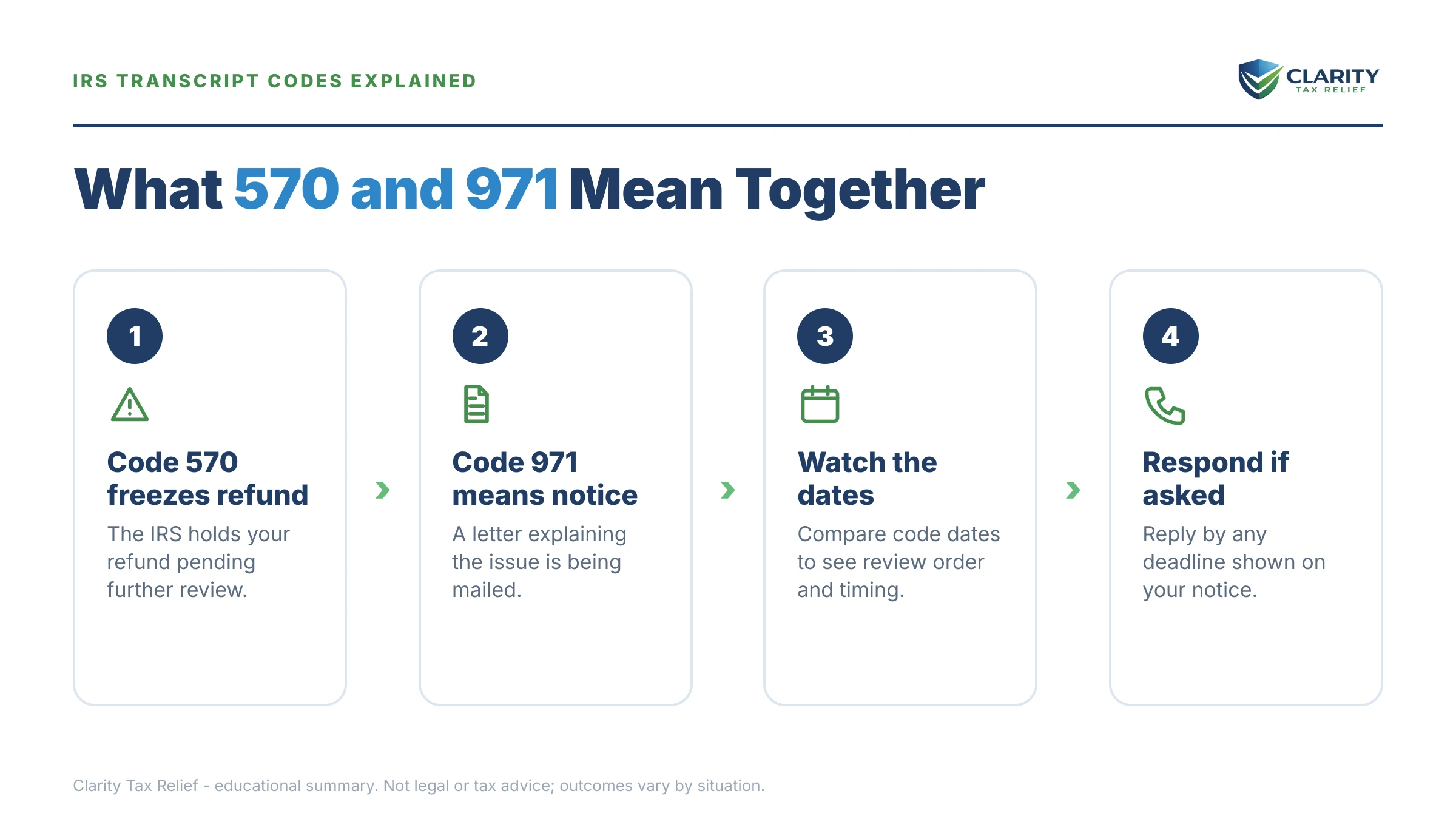
570 and 971 codes on transcript records mean the IRS has paused your account — code 570 is a hold, usually on your refund — and code 971 means a notice explaining it was issued. It's a review, not an audit. Compare the two dates: they tell you whether a letter is coming and when.
You refreshed your transcript on update morning expecting a refund date, and instead two new rows appeared: 570 "additional account action pending" and 971 "notice issued." If you're self-employed and that refund was earmarked for your next quarterly payment, the wait stings twice. The pairing is one of the most common, and most survivable — patterns on any transcript, and the dates beside each code tell you most of what the IRS won't.
The image below shows exactly what a 570/971 pairing looks like on a real account transcript and where the two dates sit — orient yourself there, then use the tables on this page to decode your own.
⏱ The clock to watch: code 570 prints no deadline for you — the hold runs on the IRS's schedule, not yours. The deadline that can hurt you is the response date printed on the notice code 971 represents. If that letter asks for documents and you miss its date, the IRS can adjust your return using only its own records.
Why you got codes 570 and 971 together
Code 570 freezes activity on your account while the IRS verifies something on your return. Code 971 logs the letter that will tell you what. Neither code names the problem — 971 is a generic "notice issued" marker the IRS uses for dozens of different letters, which is why the pairing alone can't tell you whether you need to act. (If transcript rows in general are unfamiliar, start with how to read an IRS account transcript, then come back — this page covers only what's specific to this combination.)
Behind a 570 hold, the most common triggers are:
- Withholding or income mismatch — the wages, withholding, or 1099 income on your return doesn't match what employers and payers reported to the IRS.
- Estimated-payment mismatch — the quarterly payments you claimed don't match what actually posted to your account. For self-employed filers, this is the single most common cause of a 570/971 pair — a payment applied to the wrong year or wrong spouse's account triggers it instantly.
- Refundable-credit review — EITC, Additional Child Tax Credit, or fuel credits being verified before the refund releases.
- Identity verification — the notice behind the 971 may be a 5071C letter asking you to confirm you filed the return.
- Duplicate or amended return — a second filing under your SSN pauses everything while the IRS sorts out which return controls.
Each code also has its own deeper guide — see code 570 on IRS transcript and code 971 — notice issued. But the pairing behaves differently than either code alone, because the dates interact. That's next.
“You can access your personal tax records online or by mail, including transcripts of past tax returns, tax account information, wage and income statements, and verification of non-filing letters.”
— Get your tax records and transcripts (IRS.gov)
570 and 971 codes on transcript: reading the two dates
The gap between your 570 date and your 971 date is the single best clue on the page. Transcripts post on a weekly cycle (here's what day IRS transcripts update). The dates you see are system posting dates, often set slightly in the future, not deadlines for you. Don't confuse them with the "as of" date on your transcript, which is an interest-computation marker, not a decision date.
| Date pattern | What it usually signals | Your move |
|---|---|---|
| 971 dated about one week after the 570 | A mailed notice is coming — commonly a CP05, 4464C, or a payment-mismatch letter. The 971 date approximates the mailing date. | Watch the mail; confirm the IRS has your current address. |
| 971 dated the same day as the 570 | Often a systemic or internal adjustment notice; sometimes no actionable letter ever arrives. | Recheck the transcript weekly; many of these release on their own. |
| 971 posted before the 570 | A notice or event triggered the hold — identity verification and amended-return processing commonly post this way. | Act on the earlier letter if you haven't; the hold usually waits on you. |
| 570 alone, no 971 yet | Hold placed but no notice generated. Many of these release via code 571 without any letter. | Nothing yet — a 971 in a later update means a letter is coming. |
One more distinction that matters: a 570 hold is not an 810 freeze. A code 810 refund freeze is a harder stop, often tied to identity or frivolous-claim review, and it follows a different release path. If you see 810 instead of (or alongside) 570, read that guide — the advice differs.
When the tracker and the transcript disagree
The refund tool and your tax transcript are updated on different schedules, so a mismatch between them is normal rather than a sign of a problem. The transcript is the earlier and more detailed of the two.
Contacting the IRS before a letter arrives rarely produces additional information, because the representative is reading the same account you are. The 971 is the account telling you a letter was generated; waiting for it is usually faster than asking what it says.
What happens if you do nothing
A 570 hold never expires on its own. It ends in either a release (code 571 or 572) or an adjustment (code 290), and which one you get can depend on whether you respond. The sequence runs in stages:
- The hold posts (570). Your refund is frozen. Nothing has been mailed yet, and nothing is being taken from you.
- The notice issues (971). The letter tells you whether this is a no-action review (like a CP05) or a request for documents. This is the fork in the road.
- If the letter asks for proof and you stay silent, the IRS eventually decides using only its own records — which means claimed withholding, credits, or payments it can't verify get disallowed.
- The adjustment posts. You'll see it as code 290 — additional tax assessed or as reduced credits. Your refund shrinks, disappears, or flips into a balance due.
- A balance due starts collections. A CP14 bill arrives, the automated notice sequence begins, and interest plus the 0.5%-per-month failure-to-pay penalty accrue on whatever the adjustment created.
The 2026 wrinkle: the IRS workforce shrank roughly 27% in 2025, so human review inventories move slower. But the holds, notices, and adjustments are all generated by automated systems that never slowed down. Silence doesn't stall the machine; it only removes your side of the story from it.
Two codes on your transcript and no letter yet?
A transcript review takes minutes for someone who reads them every day. Send us yours and an experienced tax professional will tell you, free, what triggered the 570 hold, which notice the 971 likely represents, and whether you're about to collect a refund or owe a balance that's already accruing interest.
What posts next: the codes around a 570/971 pairing
Every 570/971 story ends with one of a handful of follow-up codes, and each one dictates a different move. This is the map:
| Code | What it means | What to do |
|---|---|---|
| 150 | Your return posted; the tax shown is what you reported. | Nothing. This is the baseline every account starts with. |
| 806 | Withholding credited from your W-2s and 1099s. | Verify it matches your forms; a mismatch here often explains the 570. |
| 570 | Hold — additional account action pending. | Decode the dates (table above); gather records now. |
| 971 | Notice issued — the letter names the actual issue. | Watch the mail; respond by the letter's printed date if asked. |
| 571 / 572 | Hold released or reversed — the review closed. | Nothing; a refund date usually follows within a cycle or two. |
| 846 | Refund issued, with your deposit date. | Done — the date beside 846 is when money moves. |
| 810 | Refund freeze — a harder stop than 570. | Expect identity or claim verification; act fast on any letter. |
| 420 | Examination indicator — an actual audit opened. | Rare after 570/971, but if it posts, get help before responding. |
| 290 | Additional tax assessed — the review ended in a change. | Compare it to your return; you can dispute or arrange payment. |
A worked example: the $31,200 estimated-payment mismatch
Say you're a sole proprietor who made four quarterly estimated payments of $7,800 each — $31,200 total — and claimed that full amount on your return, expecting a $2,900 refund. But your January payment was applied to the wrong tax year (a common EFTPS and Direct Pay mistake), so the IRS's records show only three payments: $23,400.
Here's how that plays out on your transcript. The $7,800 gap between what you claimed and what posted triggers a 570 hold. A week later, a 971 posts — the letter behind it is typically a CP23 notice, which recalculates your account using the IRS's payment records:
- Payments claimed: $31,200. Payments the IRS shows: $23,400. Gap: $7,800.
- Your expected $2,900 refund minus the $7,800 gap = a proposed balance due of $4,900 — plus an estimated-tax penalty and interest on top.
The fix isn't a payment plan — it's the record. Your bank statement or EFTPS confirmation proving the fourth $7,800 payment, with a request to move it to the correct year, restores the full $31,200 and your $2,900 refund. This is why reconciling your payments before the letter arrives matters: you respond in days instead of discovering the problem after code 290 posts. If a penalty does stick, you can estimate what it adds with our IRS Penalty & Interest Calculator, and note that starting summer 2026, the IRS's Automatic Exemption from Penalty (AEP) applies some first-time penalty relief automatically, with no request needed.
This example is hypothetical. But the mechanics are exactly how misapplied-payment holds work, and self-employed filers, with four manual payments a year and no employer withholding, hit them far more often than W-2 employees.
If the review turns your refund into a balance due
When a 570/971 review ends in an assessment instead of a release, your realistic options depend mostly on the size of the resulting balance. Dispute first if the numbers are wrong — a misapplied payment or missing withholding is a correction, not a debt. If the balance is real:
| Balance after adjustment | Realistic options | Key detail |
|---|---|---|
| Under $10,000 | Short-term plan (up to 180 days) or a guaranteed installment agreement | Short-term plans have a $0 setup fee; "guaranteed installment agreement" is the official IRS program name for balances of $10,000 or less. |
| $10,000–$25,000 | Streamlined installment agreement, set up online | Up to 72 months, no detailed financial disclosure required. |
| $25,001–$50,000 | Streamlined agreement, typically with direct debit | Still self-service online up to $50,000 total. |
| Over $50,000 | Financial-disclosure plan, hardship (CNC) status, or an Offer in Compromise if your finances qualify | An OIC is strictly means-tested — the IRS accepted roughly 1 in 5 offers in FY2024. |
Interest and the failure-to-pay penalty accrue from the original due date, not from when the adjustment posts, so even on a plan, resolving a disputed number quickly is worth real money. Payment mechanics for any of these live at IRS.gov/payments.
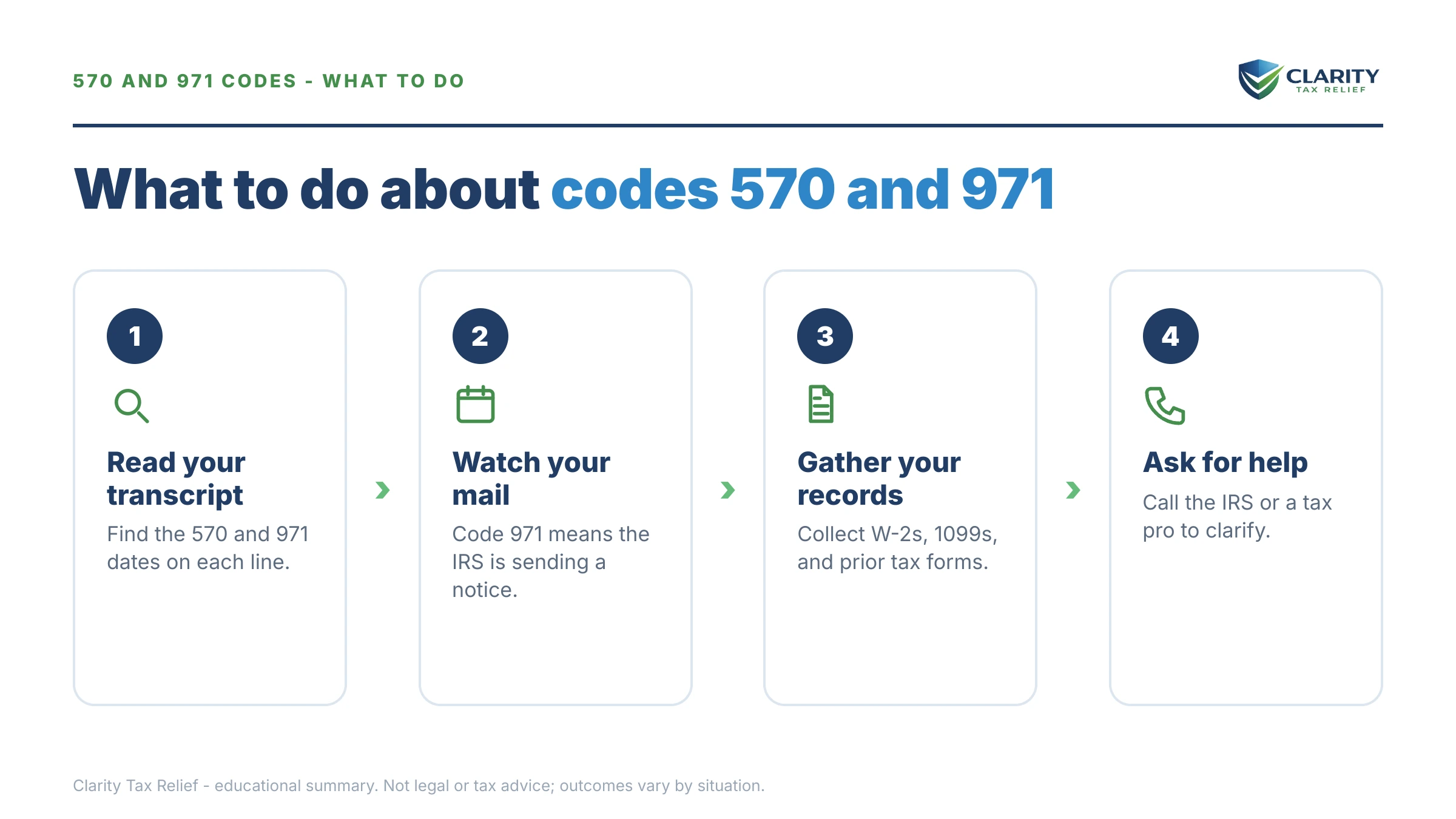
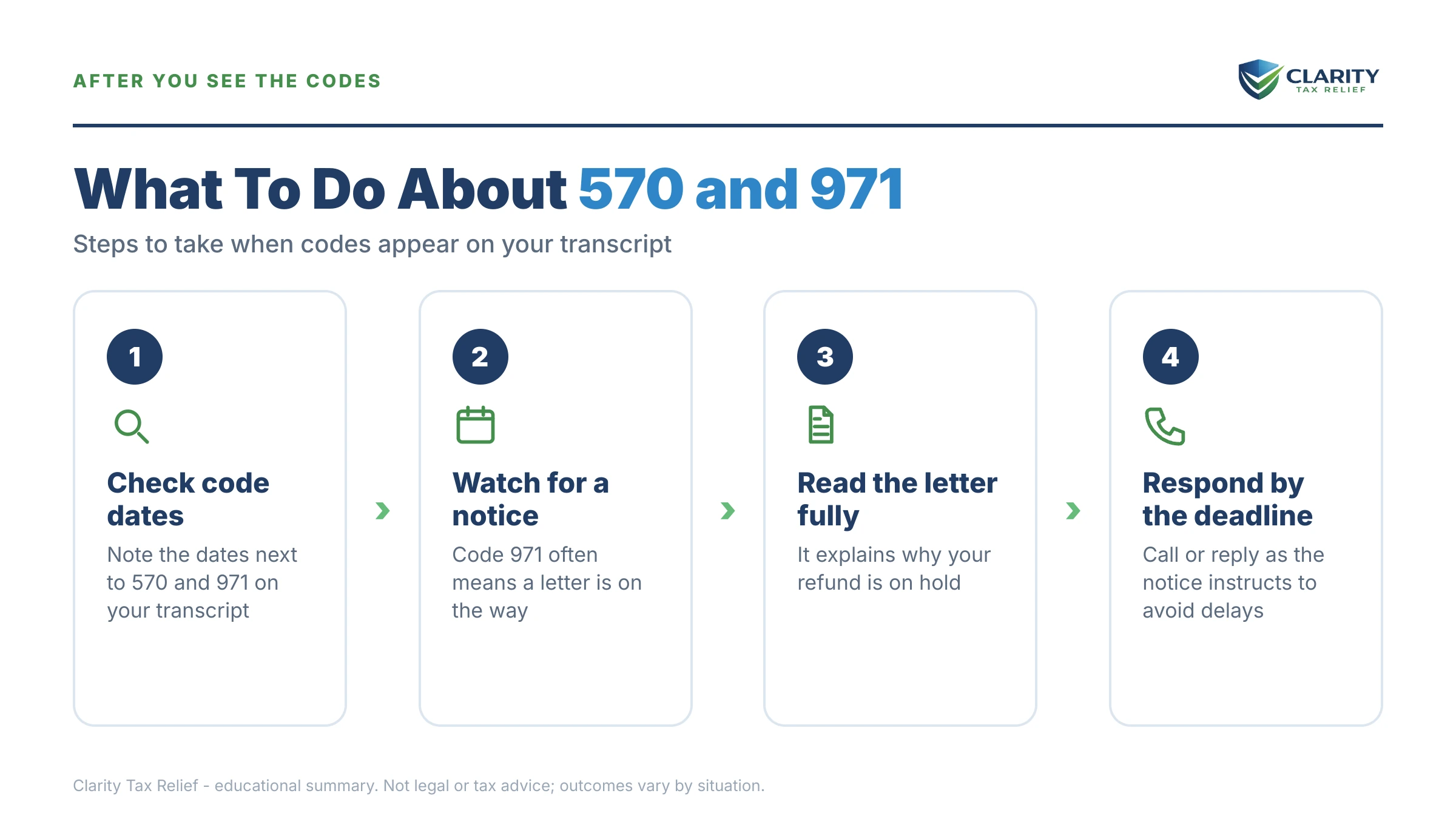
How to respond to codes 570 and 971, step by step
- Pull a fresh account transcript — log in at IRS.gov, open the current year, and write down the dates beside codes 570 and 971.
- Decode the date pattern — use the date-pattern table above to tell whether a letter is coming and roughly what triggered the hold.
- Watch the mail through the 971 date — the notice names the issue and prints any response deadline; nothing on the transcript replaces it.
- Reconcile your numbers now — match every estimated payment, withholding entry, and 1099 against IRS records before the letter arrives.
- Respond by the printed date if asked — send the exact documents requested, in writing, and keep copies of everything.
- Recheck your transcript weekly — code 571 or 572 followed by 846 means the hold released and your money is scheduled.
If you don't yet have transcript access, the IRS's official portal is Get Transcript at IRS.gov — the account transcript, not the return transcript, is the one that shows these codes.
When you can handle this yourself
Most 570/971 pairings need patience, not professionals. You can confidently handle this alone when the notice turns out to be an informational CP05 notice or 4464C letter and your own numbers check out. When it's a single misapplied payment you can prove with one bank record. Or when the review releases with 571 and the only cost was waiting.
Experienced help changes the outcome in a narrower set of situations: the adjustment proposes a five-figure balance you dispute. The hold sits on top of unfiled prior years the IRS wants first. You're self-employed and the fight is over reconstructing income or payments across multiple years. An 810 freeze or identity-theft tangle is layered onto the hold. Or the frozen refund is money you genuinely can't function without — in hardship cases, the Taxpayer Advocate Service can also intervene at no cost. The honest rule: a hold with clean records resolves itself; a hold with messy records resolves against you unless someone builds the paper trail.
Terms on your transcript, decoded
- TC (transaction code): the three-digit label the IRS master file assigns to every action on your account — 570 and 971 are TCs.
- "As of" date: the date interest and penalties are computed through — not a deadline or decision date (full guide: "as of" date on your IRS transcript).
- Cycle code: the eight-digit number showing which weekly (or daily) processing batch your account updates in.
- Hold vs. freeze: a 570 hold pauses your account during review; an 810 freeze is a harder stop with its own release code (811).
- 571 / 572: the release codes — either one means the 570 condition was resolved or reversed.
- Master file: the IRS's central account database; your transcript is a printout of its entries.
570 and 971 questions, answered
What does it mean when codes 570 and 971 appear together on my transcript?
It means the IRS has paused activity on your account, usually a refund hold, and has issued or scheduled a notice explaining why. Code 570 is the hold; code 971 is the notice. It is a review, not an audit: an audit posts as code 420. Most 570/971 pairings resolve once the IRS verifies income, withholding, or payments against its own records.
How long does it take to resolve codes 570 and 971?
There is no fixed timeline — simple verification holds often release within a few weekly transcript updates, while reviews that need documents from you can run several months. The 2025 IRS workforce cuts (roughly 27%) stretched review inventories, so waits are longer than in past years. Watch for code 571 or 572, then 846, which means the hold released and your refund is scheduled.
Does code 971 after code 570 mean I'm being audited?
No. Code 971 only means a notice was generated; a real audit posts as code 420 (and often code 424 before it). The letters behind most 570/971 pairs are review notices like the CP05 or 4464C, which verify wages, withholding, or credits without examining your whole return. If your transcript later shows 420, that is the audit indicator — 971 alone is not.
What if my 971 code has the same date as my 570?
A 971 dated the same day as the 570 usually reflects an internal adjustment notice generated at the moment the hold posted, and in some cases no letter you need to act on ever arrives. When the 971 is dated about a week after the 570, a mailed notice is almost always coming. Either way, confirm your mailing address with the IRS is current so nothing time-sensitive goes astray.
Is code 570 with a $0.00 amount good or bad?
A $0.00 next to code 570 is neutral: it means the IRS paused the account without assessing any change yet. If the review ends in an adjustment, you would see it as a separate posting, often code 290 for additional tax, with a dollar amount attached. Many $0.00 holds release with code 571 and no change to your refund at all.
Should I call the IRS about codes 570 and 971?
Wait for the notice first, before it arrives, a phone representative usually sees the same codes you do and can't speed up the review. Call if no letter arrives within a few weeks after the date beside your 971, or if the letter's response deadline is approaching and you need clarification. In 2026, expect long hold times; have your transcript and filed return in front of you.
Which notice does code 971 usually represent?
The transcript doesn't say — code 971 is a generic "notice issued" marker used for dozens of letters. Behind a 570 hold, the most common are the CP05 (refund under review, no action needed), the 4464C (income verification), the CP05A (documents requested), identity-verification letters like the 5071C, and payment-mismatch notices like the CP23. Only the letter itself tells you which one you have and whether it needs a response.
Can codes 570 and 971 resolve without me doing anything?
Yes, often. If the IRS can verify your income, withholding, or payments against employer and bank records, the hold releases with code 571 or 572 and code 846 schedules the refund — no response needed. But if the notice asks for documents or proposes a change you disagree with, it will not resolve on its own. Missing the printed response date lets the IRS adjust your return using only its records.
Your next 24 hours
- Write down the two dates. Open your account transcript and note the exact dates beside codes 570 and 971, plus your cycle code — that's everything the date-pattern table above needs.
- Gather your proof. Pull your filed return, every W-2 and 1099, and confirmation of every estimated payment (EFTPS receipts or bank statements). If the numbers reconcile, you're likely just waiting; if they don't, you've found the trigger.
- Get a free transcript review. If you can't tell which way this is heading, refund released or balance assessed, send your transcript through the 2-minute form or call (888) 825-7779. If the review ends in an adjustment, interest runs from the original due date, so knowing early is worth money.
This guide is general information, not tax or legal advice for your specific situation. Eligibility for IRS programs depends on individual facts and circumstances; no outcome is guaranteed.