
IRS Letters
IRS 5071C Letter: What It Means and How to Verify Your Identity (2026)
The short answer: a 5071C letter means the IRS received a tax return with your name and SSN but wants you to verify your identity before processing it. Verify online through the IRS Identity and Tax Return Verification Service or by phone using the number on the letter. Your refund stays on hold until you do.
You checked "Where's My Refund" for the third week in a row, saw nothing move, and then this letter showed up asking you to prove you're actually you. Here's the reassuring part: a 5071C is a security checkpoint, not an accusation, and unlike most IRS letters, you can usually clear it from your couch in under 30 minutes.
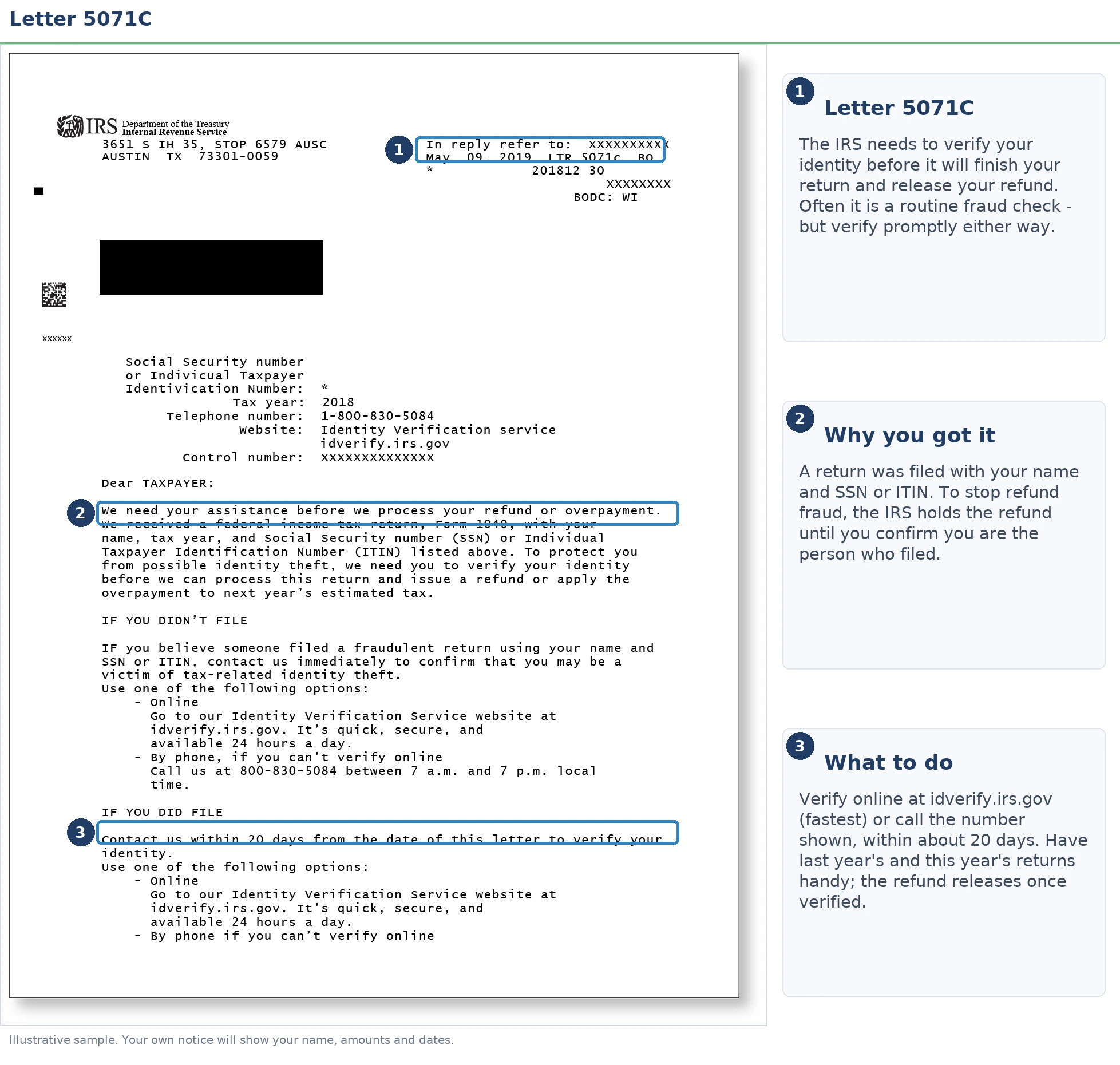
The 5071C is the only letter in the IRS identity-verification family that gives you a fully online option. Its cousins — the 4883C letter (phone only) and the 5747C letter (in-person appointment) — force you into slower channels, so confirm the letter number in the corner before you do anything. The image below shows exactly what a real 5071C looks like and where to find the control number and tax year you'll need before you start.
⏱ Your clock: a 5071C carries no levy deadline, but your return is frozen until you verify. If your letter prints a respond-by date, that date controls. And if the flagged return shows a balance due, the 0.5% per month failure-to-pay penalty and daily interest keep accruing whether you verify or not — the hold pauses processing, never the meter.
Why you got a 5071C letter
A 5071C letter means the IRS's Taxpayer Protection Program flagged a return filed under your Social Security number as possible identity theft before processing it. A computer filter, not a human investigator, scored the return as unusual and paused it until a real person confirms it's legitimate.
The most common triggers have nothing to do with fraud:
- Filing after a gap. If you haven't filed in a few years and suddenly a return arrives, the filters can't tell you from an identity thief using a dormant SSN. Gig workers catching up on three years of unfiled returns hit this constantly.
- Several returns at once. Multiple years filed together is a classic fraud pattern, even when it's just you getting current.
- New details. A changed address, a new bank account for direct deposit, or a first-time e-file provider.
- Income mismatches. Withholding or income that doesn't line up with what employers and payers reported to the IRS.
- Actual identity theft. Sometimes the filter is right — someone did file in your name. The verification process is how you tell the IRS that, too.
Either way, the letter is not an audit, not a bill, and not a penalty. Nobody is questioning your deductions. The IRS simply won't touch the return until you confirm you filed it.
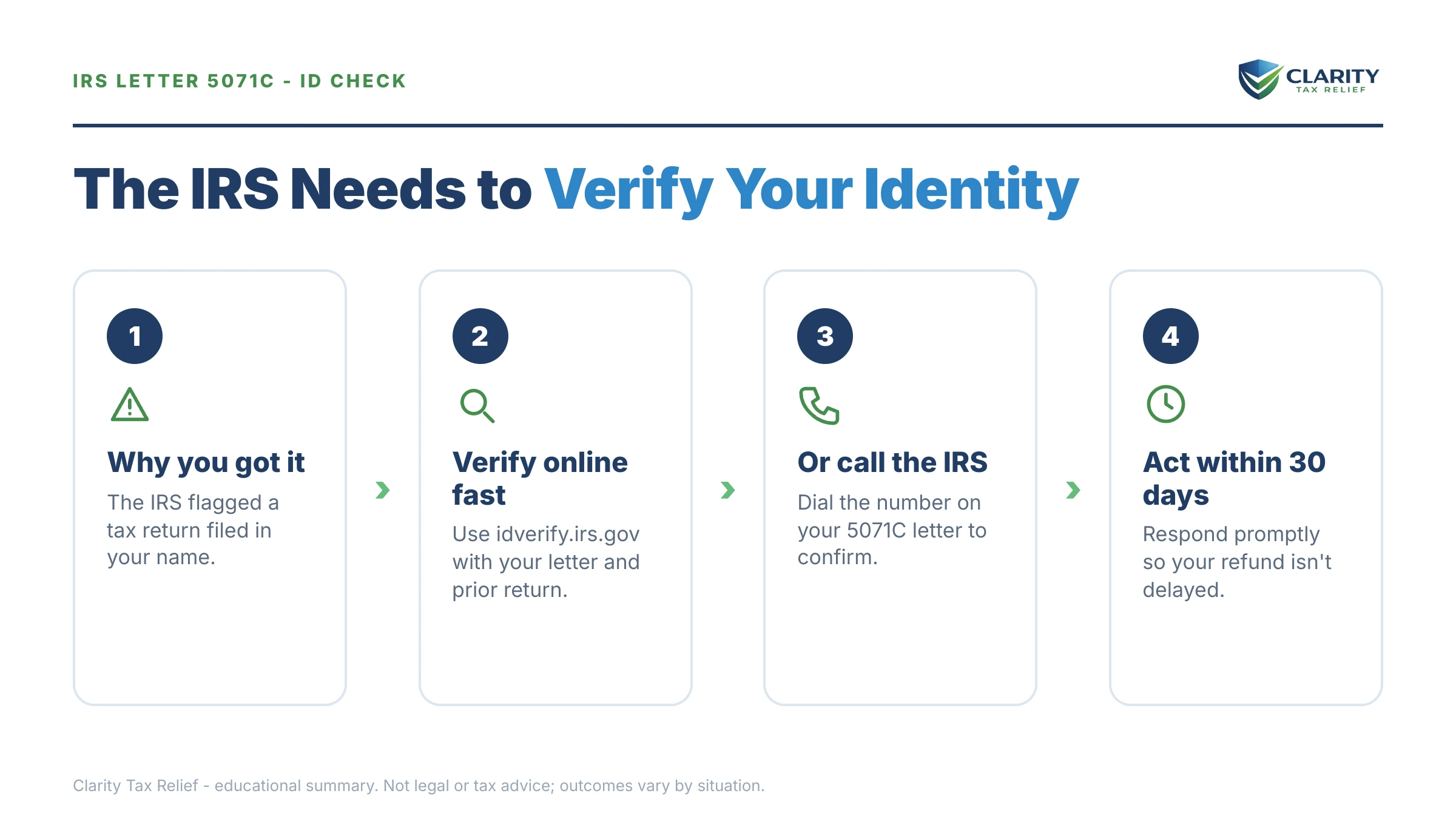
“Sign in or create an account, then answer a few questions to verify your return. If you create an account, you may need to sign in again to complete your return verification.”
— Verify your return (IRS.gov)
5071C vs. 4883C vs. 5747C: which identity letter do you have?
The 5071C is the only IRS identity-verification letter you can resolve entirely online. The IRS sends different letters depending on how much scrutiny the flagged return earned, and each locks you into specific verification channels. Using the wrong channel wastes weeks, so match your letter number first.
| Letter | How you verify | Key difference |
|---|---|---|
| 5071C | Online or phone | The most common identity letter; fastest to clear because of the online option |
| 4883C | Phone only | No online option. You must call the Taxpayer Protection Program line on the letter |
| 5747C | In person at a Taxpayer Assistance Center | Highest scrutiny; requires an appointment and original documents |
| 5447C | Phone (including from abroad) or mail | Sent when the online tool isn't an option — common for international filers |
| 6330C | Online or phone | A variant that works essentially like the 5071C |
If your letter is a 5071C, you're holding the easiest version. Start online; save the phone line as a fallback.
What to have in front of you
Verification goes quickly when the documents are ready and badly when they are not. You will need the letter, the income tax return it refers to, the return you filed the year before. A photo identification number of some kind.
The prior year return is the one people forget. It is often the one that settles it, because the questions are drawn from information only the real filer would have.
What happens if you ignore a 5071C letter
If you never verify, the IRS never processes the flagged return, and never issues the refund on it. There's no dramatic levy countdown here; the damage from ignoring a 5071C is quiet and cumulative:
- Your return sits unprocessed. To the IRS, it's as if the return is in limbo — no refund, no credit toward your account, no acknowledgment you filed.
- Your refund stays frozen indefinitely. "Where's My Refund" will show nothing useful, and no amount of waiting shakes the money loose. Verification is the only key.
- A refund can eventually be lost for good. The three-year window to claim a refund keeps running while your return sits in limbo — wait long enough and the money is forfeited, not delayed.
- A balance-due year gets more expensive. Penalties and interest are calculated from the original due date. The unprocessed return also can't go into a payment plan, so you can't even start resolving what you owe.
- Real fraud goes unaddressed. If a thief filed that return, ignoring the letter leaves your SSN compromised, and next year's filing season will be worse.
In 2026 there's one more wrinkle: with the IRS workforce cut roughly 27% in 2025, phone verification lines are slower than ever. That makes acting early, and using the online tool first — matter more, not less.
Got a 5071C sitting on top of unfiled years or a balance you can't pay?
Verification is the easy part — what the frozen return is attached to is usually the real problem. An experienced tax professional will review your letter, your unfiled years. Your balance for free, and map the fastest order to fix all of it while penalties and interest are still accruing.
How to verify your identity for a 5071C
A 5071C gives you two verification channels: online through ID.me or by phone through the Taxpayer Protection Program line printed on the letter. Online is dramatically faster in 2026, so exhaust it before you dial.
Online. Go to the IRS Identity and Tax Return Verification Service — type the address yourself. Never follow a link from an email or text. You'll sign in (or create an account) with ID.me, which requires a government photo ID, then answer questions about the flagged return and a prior-year return. Have the control number from your letter in front of you. If the tool errors out or ID.me won't accept your documents, our guide to idverify.irs.gov not working walks through every fix before you resort to the phone.
By phone. Call the Taxpayer Protection Program number printed on your letter — only that number. Agents will quiz you on details from the flagged return and a prior year, so have both physically in hand. Getting bounced for missing paperwork means starting the hold queue over. Expect long waits, and try early morning.
If neither works. When the IRS can't confirm you online or by phone, it will direct you to an in-person appointment at a Taxpayer Assistance Center — essentially converting your case into the 5747C letter process. Frustrating, but it still ends the same way: verified, unfrozen, processed.
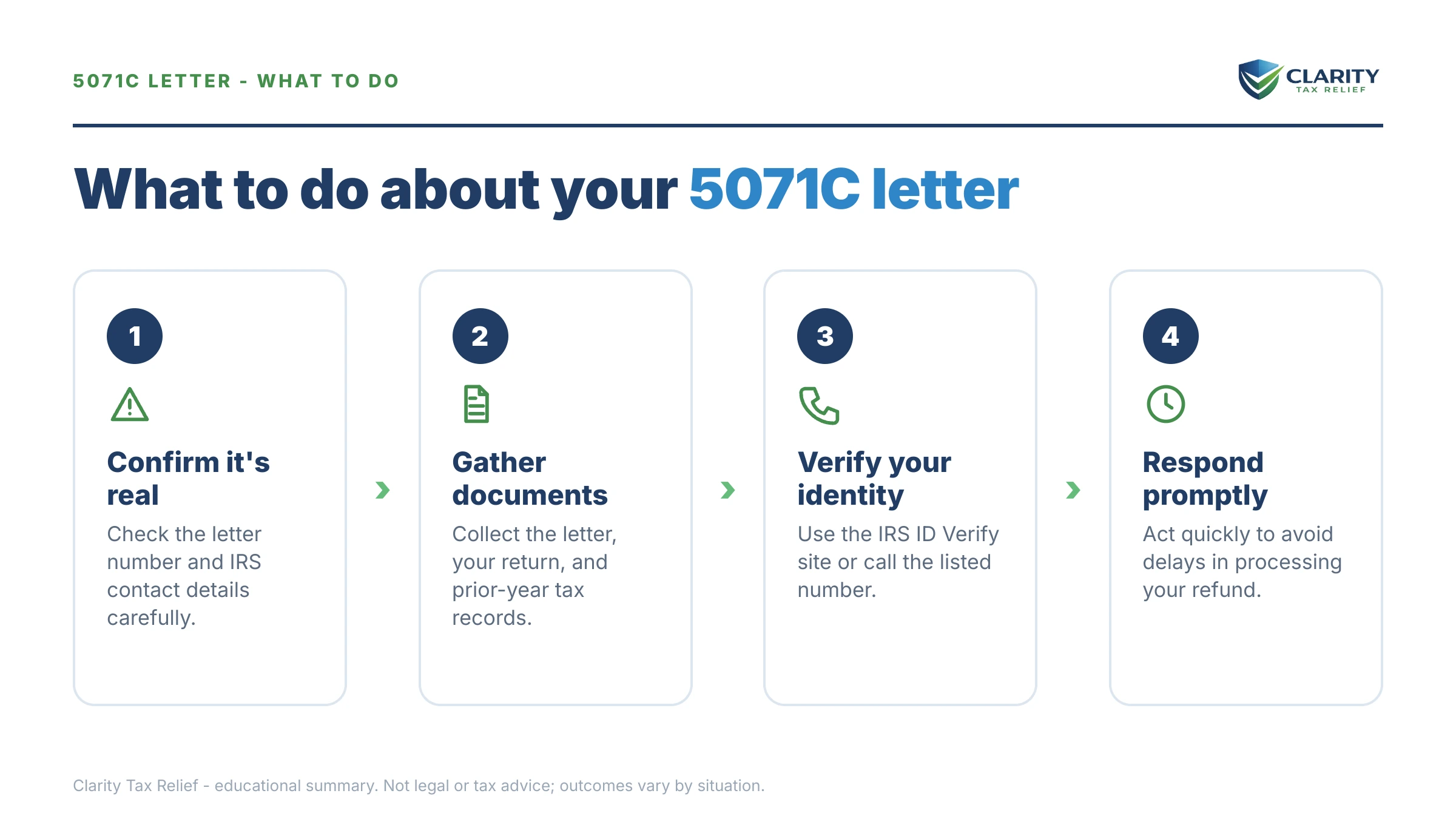
How to respond to a 5071C letter, step by step
- Confirm the letter is real. Check that it arrived by postal mail, names a specific tax year, and directs you only to IRS.gov or a phone number printed on the letter — see our guide on how to tell if an IRS letter is real.
- Gather your documents. Pull the 5071C letter itself, the tax return it references, a prior-year return, your W-2s and 1099s. A government photo ID for ID.me.
- Verify online first. Go directly to the IRS Identity and Tax Return Verification Service, sign in with ID.me, and answer the questions about the flagged return.
- Call if the tool fails. Use the Taxpayer Protection Program number printed on your letter, never a number from a search engine, with every document from step 2 in front of you.
- Report a return you didn't file. Answer no when asked whether you filed. The IRS will block the fraudulent return and tell you whether to submit Form 14039.
- Watch your transcript. After verifying, check your account transcript for code 150 (return posted) and code 846 (refund issued), and set up a payment arrangement if the return shows a balance.
If you didn't file the return on the letter
A 5071C about a return you never filed means someone submitted a return using your SSN. The IRS filter caught it before paying out. That's the system working. Your job now is to say so clearly, in the same verification process everyone else uses: both the online tool and the phone agents ask whether you filed the return in question, and answering "no" stops it from ever posting to your account.
Then close the loop. Depending on what the IRS finds, you may be directed to file the Form 14039 identity-theft affidavit. You should request an IP PIN — a six-digit code that blocks anyone from e-filing under your SSN in future years. If you haven't filed your own legitimate return yet, file it; the IRS will process yours separately from the fraudulent one. Our guide to someone filed taxes in my name covers the full cleanup, including credit monitoring and state-return exposure.
When a 5071C sits on top of back taxes: a worked example
Verification delay is most expensive when the frozen return is part of a bigger catch-up. Say you're a gig worker who just filed three overdue returns — 2022, 2023, and 2024 — in the same batch, showing a combined balance of $54,600. Filing several years at once after a gap is exactly the pattern the Taxpayer Protection Program flags, so a 5071C on one of those returns is common even though nothing is wrong.
Here's what the hold costs while you wait:
- The penalty meter keeps running. The failure-to-pay penalty is 0.5% per month: on $54,600, that's roughly $273 every month, plus daily compounding interest — none of it paused by the identity hold. You can estimate your own accrual with our Penalty & Interest Calculator.
- You can't resolve a year the IRS hasn't processed. A payment plan has to cover every assessed balance, so the flagged return must post before all three years can go into one agreement. Every week you don't verify is a week you can't start fixing the debt.
- The $50,000 line matters. At $54,600 you're above the threshold for a streamlined 72-month online payment plan. Verify quickly, then pay the balance down by about $4,600 to get under $50,000 — where a 72-month plan runs roughly $695/month before interest. Stay above it and expect to submit financial disclosure instead.
This is a hypothetical, but the sequence is universal: verify first, let the returns post, then pick your resolution. Our guide on how to settle tax debt yourself walks through every option — payment plans, hardship status, penalty relief, and settlement — once the identity hold is behind you.
What your transcript shows during a 5071C hold
Many 5071C holds leave your transcript looking completely blank, because the flagged return never posted to your account in the first place. Others show the return posted and then frozen. Here's how to read what you see:
| What you see | What it means | What to do |
|---|---|---|
| "N/A" or no return on file | The flagged return hasn't posted — normal during a Taxpayer Protection Program hold (see transcript shows N/A) | Verify; the return posts afterward |
| Code 570 | An account hold is pausing processing — details in our code 570 on your transcript guide | Verify if you haven't; wait if you have |
| Code 971 | A notice was issued, often the 5071C itself | Match the code's date to your letter's date |
| Code 810 | A refund freeze, which sometimes accompanies identity flags — see the 810 freeze with identity verification path | Verify, then confirm the freeze releases |
| Code 150 | Your return posted — verification was processed | Nothing; you're through the checkpoint |
| Code 846 | Refund issued, with the date it's sent | Watch your bank account or mailbox |
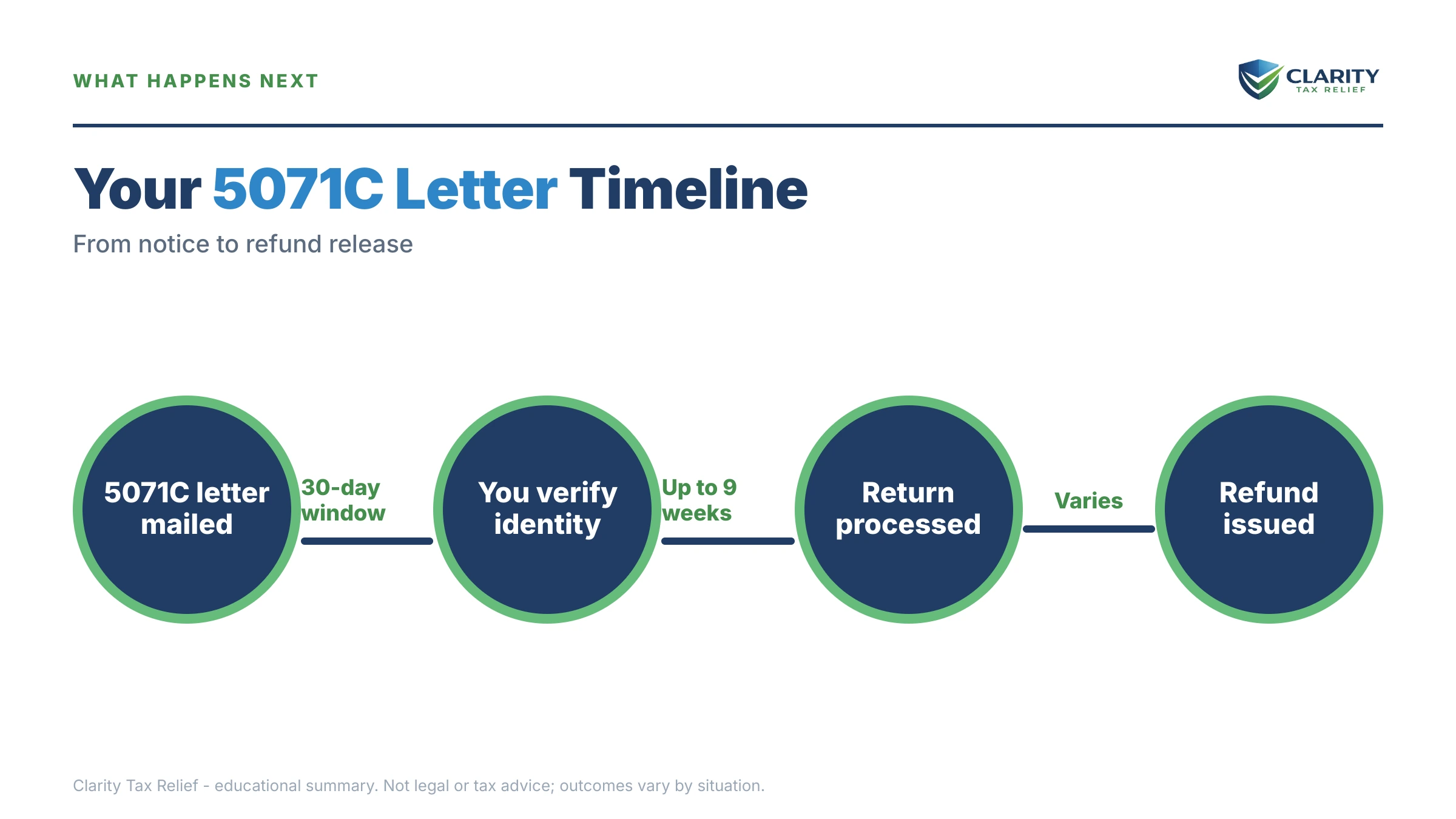
After a successful verification, the IRS typically quotes up to nine weeks to finish processing, though many returns clear much sooner. The transcript, not "Where's My Refund," is where movement shows first.
When you can handle a 5071C yourself
Most people should handle a 5071C on their own — verification is designed to be done by you, about you, and no professional can answer the identity quiz for you. If you filed the return, have photo ID for ID.me, and the letter matches a return you recognize, verify today and move on. That's the honest answer.
Experienced help changes the outcome in a narrower set of situations: when the 5071C reveals a fraudulent return and multiple years of your account look compromised. When the frozen return sits on top of unfiled years and a balance you can't pay. The order you fix things determines what you ultimately owe. When repeated verification failures are holding a refund you need for genuine hardship. Or when Schedule C income across several catch-up years needs to be reconstructed before anything can be filed at all. In those cases the verification is step one of ten, and steps two through ten are where representation earns its keep.
If your 5071C came with $10,000 or more of balance behind it, it's worth a free case review before you commit to a payment path — the cheapest resolution is rarely the one the first IRS notice suggests.
Terms on your 5071C letter, decoded
- Taxpayer Protection Program (TPP): the IRS unit that screens suspicious returns and runs identity verification — the sender of your letter.
- Control number: the identifier printed on your 5071C that ties your verification session to the flagged return. You'll need it online and on the phone.
- ID.me: the third-party identity service the IRS uses for online sign-in; it requires a government photo ID and a selfie or video check.
- IP PIN: a six-digit Identity Protection PIN that, once issued, must accompany any e-filed return under your SSN — the strongest defense against repeat fraud.
- Form 14039: the Identity Theft Affidavit you file when someone used your SSN on a tax return and the IRS directs you to formally report it.
- Refund hold: the pause on your refund while the return sits unverified — released by verification, not by waiting.
5071C letter FAQs
What is IRS Letter 5071C?
A 5071C letter means the IRS received a tax return with your name and SSN but wants you to verify your identity before processing it. Verify online through the IRS Identity and Tax Return Verification Service or by phone using the number on the letter. Your refund stays on hold until you do.
Why did I get a 5071C letter from the IRS?
The IRS's fraud filters flagged a return filed under your Social Security number as possible identity theft before processing it. Common triggers include filing after a gap of unfiled years, submitting several returns at once, a new address or bank account, or withholding that doesn't match employer records. Most people who get a 5071C filed the return themselves — verifying simply releases it for processing.
Is a 5071C letter bad?
No — a 5071C is protective, not punitive. It is not an audit, it adds no penalty, and it doesn't mean the IRS thinks you did anything wrong. The real cost is delay: your return and any refund stay frozen until you verify, so the letter only becomes a problem if you ignore it.
Can I verify a 5071C letter online?
Yes — online verification is the defining feature of the 5071C. Use the IRS Identity and Tax Return Verification Service with an ID.me account, the control number from your letter. A copy of the flagged return. If the tool rejects you, the fallback is calling the Taxpayer Protection Program number printed on the letter.
How long after verifying a 5071C will I get my refund?
The IRS typically quotes up to nine weeks to finish processing after a successful verification, though many refunds arrive sooner. Watch your account transcript: code 150 means the return posted, and code 846 shows the refund date. If nothing moves after nine weeks, call the number on your letter or contact the Taxpayer Advocate Service.
What happens if I ignore a 5071C letter?
The IRS will not process the flagged return, which means no refund is ever issued and, if you owe, the balance is never formally set up so you can't resolve it. Penalties and interest on a balance-due year are calculated from the original due date, so the delay makes the eventual bill larger. If you were owed a refund, the three-year window to claim it keeps running while you wait.
What if I didn't file the return in my 5071C letter?
Tell the IRS exactly that — the verification tool and the phone agents both ask whether you filed. The IRS will pull the fraudulent return so it never posts to your account. Follow up by filing Form 14039 if directed, request an Identity Protection PIN so it can't happen next year, and file your own legitimate return if you haven't.
How do I know my 5071C letter is real and not a scam?
A genuine 5071C arrives by postal mail, references a specific tax year and return, and directs you only to IRS.gov or a phone number printed on the letter. The IRS never sends identity-verification requests by email, text, or social media, and never asks for payment to verify. Type the verification address into your browser yourself rather than clicking any link.
What's the difference between a 5071C and a 4883C letter?
The verification channel. A 5071C lets you verify online or by phone; a 4883C requires a phone call. There is no online option. A 5747C goes further and requires an in-person appointment at a Taxpayer Assistance Center. Check your letter number in the top right corner before you start, because using the wrong channel wastes weeks.
For more on how the IRS handles identity theft generally — including what happens after you report a fraudulent return — see the IRS's identity theft central. If your verified return still hasn't processed after the quoted window and the delay is causing financial hardship, the Taxpayer Advocate Service can intervene at no cost.
Your next 24 hours
- Find two things on your letter: the control number and the tax year of the flagged return — both are printed on page one, and you'll need them for any verification channel.
- Gather your kit: the return the letter references, a prior-year return, your W-2s and 1099s. A government photo ID — then attempt online verification today, before the phone lines become your only option.
- If there's more behind the letter — unfiled years, a balance you can't pay, or a return you didn't file — get a free case review at the 2-minute form or (888) 825-7779. Penalties and interest on any balance keep accruing while the return sits frozen, so the sooner the hold clears, the sooner the meter can be dealt with.
This guide is general information, not tax or legal advice for your specific situation. Eligibility for IRS programs depends on individual facts and circumstances; no outcome is guaranteed.