
IRS Identity Verification
IDVerify.irs.gov Not Working? Every Fix, Step by Step (2026)
The short answer: if idverify irs gov is not working, it's usually because the old address now redirects to the IRS Identity and Tax Return Verification Service, which requires an ID.me account. When ID.me's selfie, document, or phone check fails, three backups exist: a live video-chat agent, phone verification, or an in-person appointment.
You typed the address from your letter, made an ID.me account, held your phone up for the selfie scan, and it failed. Again. Meanwhile the refund from the returns you finally filed is frozen behind a website that won't let you in.
This is fixable, and usually without ever getting the website to cooperate. The IRS built four separate ways to verify, and the letter in your hand tells you which ones you're allowed to use — the image below shows exactly what that letter looks like and where to find the number that controls your options.
⏱ The real clock: there's no penalty for a failed verification attempt — the cost is time. Your return is not processed and your refund is not issued until verification is complete, and the IRS says processing can take up to nine more weeks after you succeed. Every week of failed attempts pushes your money back another week, while any balance-due years keep accruing interest. Respond by the date printed on your letter.
Why idverify.irs.gov is not working in 2026
The address idverify.irs.gov no longer hosts its own verification tool. It redirects to the IRS Identity and Tax Return Verification Service, which requires an ID.me sign-in. If your letter, a forum post, or an old bookmark points you at "idverify," you're being routed into a different system than the one the letter describes. That mismatch alone explains a lot of "the site is broken" complaints.
The second big reason: not every verification letter is allowed to use the online tool at all. A 5071C letter and a Letter 6330C generally offer the online option. A 4883C letter tells you to call, and a 5747C letter requires an in-person visit. If you hold one of those last two, the online service will refuse you no matter how many browsers you try — it's not broken, it's telling you to use a different door.
Why did you get flagged in the first place? The IRS Taxpayer Protection Program pulls returns that look unusual before processing them. A sudden change in filing pattern is a classic trigger — several years filed at once after a gap, 1099 income with no withholding history, a new address, or a new bank account. If you're a gig worker who just caught up on unfiled years, your return may look exactly like what the filter is hunting for, even though it's completely legitimate.
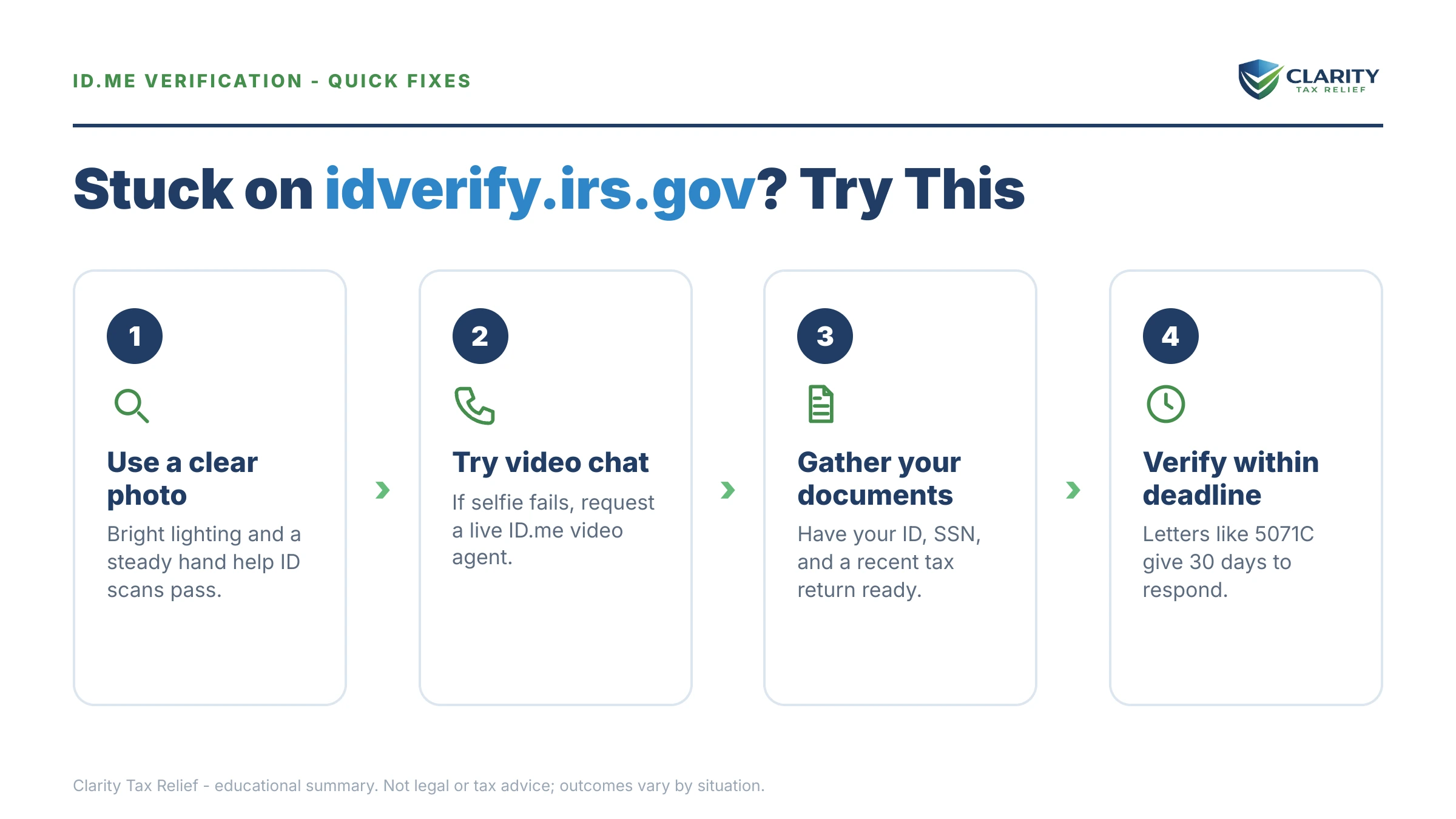
Can't verify identity with the IRS online? The failure decoded
Most ID.me failures trace to one of seven specific causes, and each has a specific fix. Retrying the same way rarely works — match your error to the row below and change your approach instead.
| What you see | Why it happens | The fix |
|---|---|---|
| Old idverify address bounces or looks different | The standalone site was retired; it redirects to the ID.me-based service | Navigate from irs.gov directly to the Identity and Tax Return Verification Service |
| Online tool won't accept your letter | Your letter type requires phone (4883C) or in-person (5747C) verification | Use the exact method your letter names — the tool can't override it |
| Selfie / liveness check keeps failing | Laptop webcam, dim light, glare on glasses, hats or headphones | Use a phone camera in bright, even light; remove glasses and hats; hold still |
| ID document rejected | Expired ID, glare, cropped edges, blurry photo | Unexpired government ID, flat dark surface, all four corners visible, no flash glare |
| "We couldn't verify your phone number" | Prepaid, VoIP, work phone, or a plan in someone else's name | Choose the alternative-verification path or the video-chat agent, which skips the carrier check |
| Account locked / "try again later" | Too many failed attempts, or a duplicate ID.me account | Recover your original account through ID.me's help resources — never create a second account |
| Site errors, spinning, timeouts | Peak-season traffic on IRS systems | Try early morning or late evening, a different browser, or a private/incognito window |
One rule saves more people than any other: after two clean, well-lit failures, stop retrying the selfie and switch paths. Repeated failures are what trigger lockouts, and a lockout adds days to a problem the video-chat or phone route could solve this week.
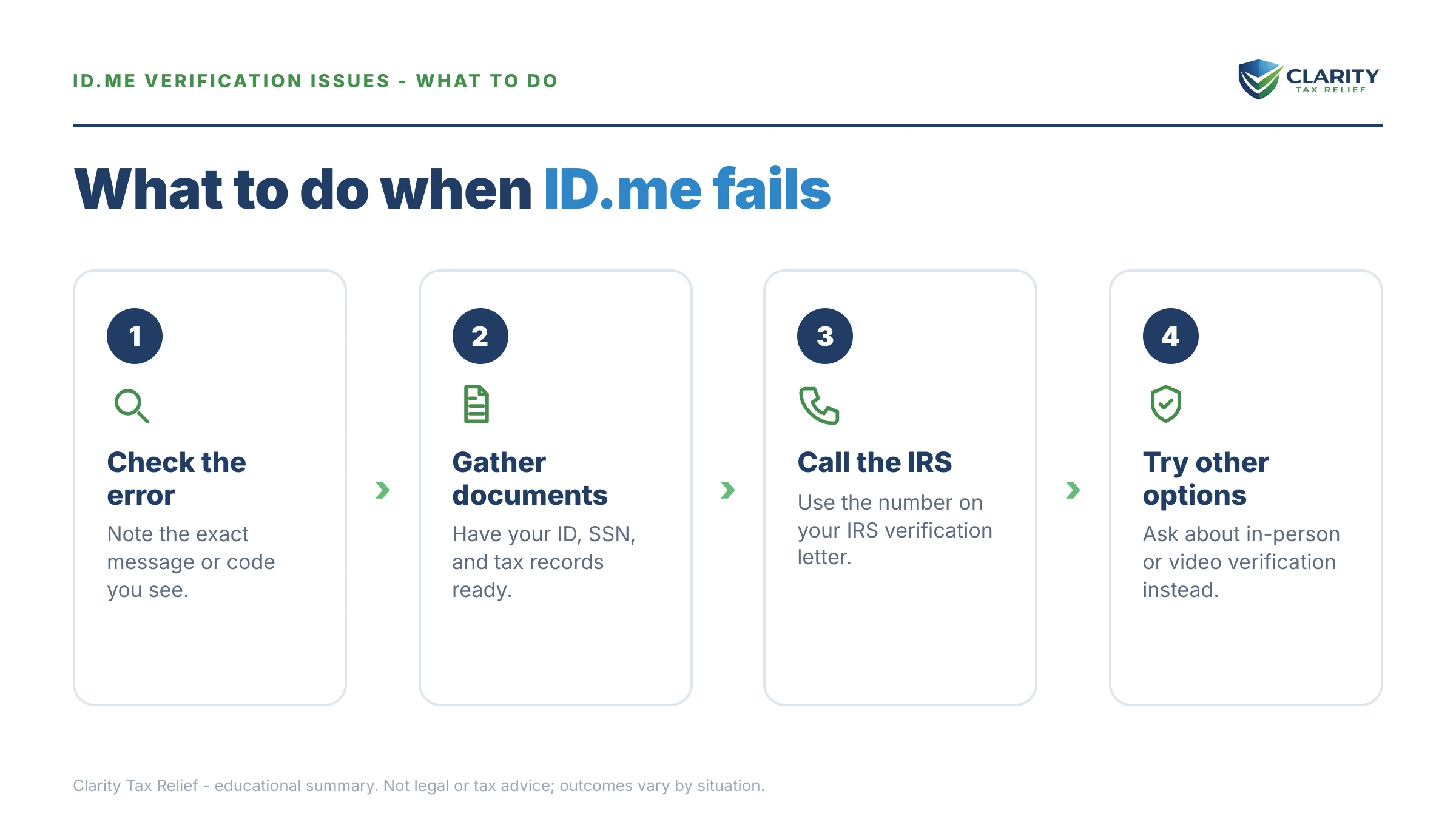
What happens if you never finish verifying
An unanswered verification letter doesn't trigger levies or new penalties. It triggers permanent limbo. The sequence looks like this:
- Your return sits in suspense. The Taxpayer Protection Program holds it unprocessed. "Where's My Refund" stalls. Your transcript may show a freeze or nothing at all — the same pattern covered in our 810 freeze verify identity guide.
- Your refund stays frozen. Withholding and refundable credits from that return are not paid out and can't offset anything else you owe.
- The IRS may send a follow-up letter, but no human chases you. With the IRS workforce down roughly 27% since 2025, nobody calls to remind you; the file simply waits.
- The return is never processed. If you never verify, the refund is never issued. For older returns, the three-year window to claim a refund keeps running — see can I still get a refund from 3 years ago — so abandoned verification can eventually forfeit the money entirely.
- If a thief filed the return, the theft goes unresolved. Future e-filed returns can reject, and you'll eventually need Form 14039, the identity-theft affidavit, to untangle it.
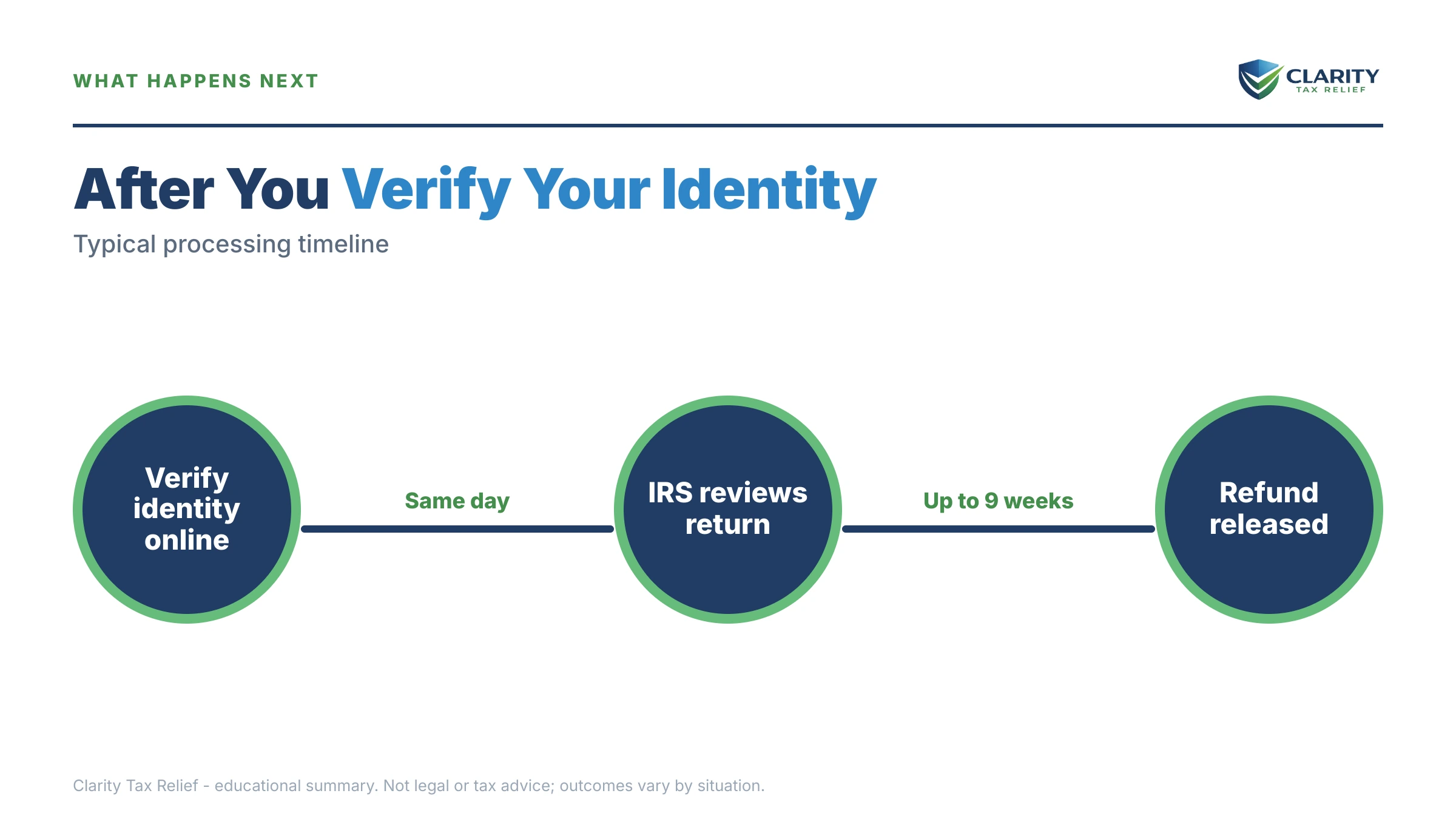
Locked out of IRS identity verification?
If ID.me keeps failing and your refund is frozen behind it, we'll map your fastest verification path, and handle everything waiting on the other side, from held refunds to balance-due years. Free, confidential, no pressure.
Your options: four ways to verify when the website fails
The online tool is only one of four verification paths, and the other three exist precisely because the automated checks fail so often. Which ones you may use depends on the letter number printed at the top of your notice.
| Verification path | What you need | Typical timeline |
|---|---|---|
| Online self-service (ID.me) | A letter that permits online verification, unexpired government photo ID, a phone or webcam, and your SSN or ITIN | Minutes once it works; the IRS says up to nine weeks afterward to process the return |
| ID.me video chat with a live agent | An ID.me account plus government ID documents — the agent tells you which combinations qualify | A wait for the next available agent, often resolved the same day; skips the selfie and phone checks |
| Phone (the number printed on your letter) | The letter, the tax return it references, a prior-year return if you have one, and supporting forms like W-2s or 1099s | Long holds in 2026; usually completed in a single call if your documents are in front of you |
| In person (Taxpayer Assistance Center) | An appointment, the letter, government photo ID, and copies of the returns in question | Appointments can run weeks out in 2026 — book immediately if remote paths fail |
One catch matters for anyone catching up on old returns: phone verification leans on questions from a prior-year return. If you haven't filed in years, you may not have one — which makes the video-chat agent or the in-person appointment your strongest fallback, since both verify you from documents instead of filing history.
What a stuck verification actually costs: a worked example
Say you're a gig worker who just filed three years at once: 2023 shows a $7,400 refund from withholding and credits, while 2024 and 2025 show balances due of $2,100 and $1,800. Verification freezes the refund year, and until that return processes, the $7,400 can't be issued or applied to anything.
Meanwhile the $3,900 you owe keeps growing. The failure-to-pay penalty runs 0.5% per month: $3,900 × 0.005 = $19.50 a month in penalty alone, plus compounding interest on top (estimate your own accrual with our IRS Penalty & Interest Calculator). Six months of failed selfies costs you roughly $117 in penalties plus interest, while $7,400 that could clear both balances the day it releases sits locked behind a webcam check. The math says the same thing every time: switch verification paths early rather than retrying for months.
Once the freeze lifts, choosing how to handle the balance years is its own decision — our guides to the best way to pay the IRS and how to settle tax debt yourself walk through every option and threshold so this page can stay focused on getting you verified.
How to respond when idverify.irs.gov won't work, step by step
- Find your letter number. Look at the top right of your IRS letter for 5071C, 6330C, 4883C, or 5747C. That number controls which verification methods you're allowed to use, and it's the first thing every IRS agent will ask for.
- Retry the online tool the right way. Go through irs.gov (not an old bookmark), use a phone camera in bright light, an unexpired government photo ID. Your one existing ID.me account — never a second one.
- Switch to an ID.me video-chat agent. If the selfie or phone check fails twice, choose the video-chat option and verify with a live agent using your ID documents instead of the algorithm.
- Call the toll-free number printed on your letter. Have the letter, the tax return it references. A prior-year return in front of you. Call early in the morning to shorten the hold.
- Book an in-person appointment if remote paths fail. Schedule a visit to a Taxpayer Assistance Center and bring your letter, government photo ID, and copies of the returns — appointments can run weeks out in 2026, so book immediately.
- Confirm the hold released. After verifying, watch your account transcript and Where's My Refund. If nothing moves within nine weeks, escalate to the Taxpayer Advocate Service.
If your refund still shows no movement long after verification, our guide to a refund stuck on still processing covers the post-verification holds, and Form 911 is how you formally request Taxpayer Advocate help.
When you can handle this yourself, and when help changes the outcome
Verification itself is always a do-it-yourself task — by law and by design, only you can verify your own identity. No preparer, spouse, or power of attorney can take the selfie, answer the call, or sit in the appointment chair for you. If your only issue is a cranky website and a clean return, work the four paths above and you'll get through without spending a dollar.
Experienced help changes the outcome in the situations layered behind the verification: when the IRS says a return was filed that you didn't file (the someone filed taxes in my name problem, which adds Form 14039 and a long identity-theft workstream). When you have multiple unfiled years and balances waiting on the other side of the freeze. When penalties and interest have stacked up and you want to know whether IRS interest can be waived or penalties abated. Or when nine-plus weeks have passed post-verification and the file needs a professional to shake it loose. A professional can't verify for you, but they can make sure the moment you're verified, everything else is already teed up to resolve.
Terms on your letter, decoded
- Taxpayer Protection Program (TPP): the IRS unit that pulls suspicious-looking returns before processing and sends the verification letters.
- ID.me: the private identity-verification company the IRS uses for online sign-in; it runs the document, selfie, and phone checks.
- Trusted referee / video chat: ID.me's live-agent option — a human verifies your documents over video when the automated checks fail.
- 810 refund freeze: a transcript code showing your refund is administratively frozen; identity verification is one common cause.
- Taxpayer Assistance Center (TAC): a local IRS office where in-person verification happens — by appointment only.
- IP PIN: a six-digit PIN that locks your SSN against fraudulent e-filing going forward. Consider one after any verification scare — see our IP PIN (CP01A) guide.
IRS identity verification problems, answered
Why is idverify.irs.gov not working?
The standalone idverify.irs.gov site was retired — the address now redirects to the IRS Identity and Tax Return Verification Service, which requires an ID.me account to sign in. If the page loads but rejects you, check your letter number: only certain letters, like the 5071C, allow online verification. A 4883C requires a phone call and a 5747C requires an in-person visit, so the online tool will refuse them no matter how many times you try.
Can I verify my identity with the IRS without ID.me?
Yes — two of the four verification paths skip ID.me entirely. You can call the toll-free number printed on your letter and answer questions from your tax returns, or book an appointment at a local Taxpayer Assistance Center and verify face to face. There's also a middle path: ID.me's video-chat option still uses an ID.me account. But a live agent replaces the automated selfie and phone checks that cause most failures.
How long does the IRS take to release my refund after I verify?
The IRS says it can take up to nine weeks after successful verification to finish processing your return and issue your refund. Many refunds arrive sooner, but nothing moves until verification is complete, so a month of failed ID.me attempts adds a month to the total. If nine weeks pass with no movement, check your account transcript and consider contacting the Taxpayer Advocate Service, which can intervene when a verified return stays stuck.
What happens if I never verify my identity with the IRS?
Your return is never processed — the IRS treats it as unconfirmed and will not issue your refund or apply your withholding. If a thief filed the return, ignoring the letter leaves the identity-theft question unresolved and can cause future e-filed returns to reject. And if you're claiming refunds from older years, the three-year refund window keeps running, so an abandoned verification can eventually cost you the money outright.
Why does ID.me keep rejecting my selfie?
The automated liveness check is picky about lighting, camera quality, and movement — laptop webcams, dim rooms, glare on glasses, and hats or headphones are the most common culprits. Switch to a phone camera in bright, even light, remove glasses and hats, and hold still while the scan runs. If it still fails after a couple of clean attempts, stop retrying and choose the video-chat option, where a live agent verifies you instead of the algorithm.
Can my tax preparer or spouse verify my identity for me?
No. IRS identity verification is strictly personal — the entire point is proving that you, not someone else, filed the return, so even a spouse on a joint return or a professional holding power of attorney can't complete it for you. What they can do is help you gather the letter, returns, and ID documents beforehand, sit with you during the phone call, and handle everything that comes after — the frozen refund, balances due, or an identity-theft affidavit.
Is the identity verification letter I got a scam?
A real verification letter arrives by postal mail and directs you only to an irs.gov address or a toll-free number printed on the letter itself. The IRS never sends verification links by text, email, or social media. Those are phishing attempts built to steal the same identity data. To be safe, don't type any address from a text message; go to irs.gov directly and navigate to the identity verification service yourself.
Why can't ID.me verify my phone number?
ID.me checks that the phone number is a standard carrier line registered in your name. Prepaid phones, VoIP numbers like Google Voice, work phones, and family plans under a parent's or partner's name routinely fail that check even when everything else is right. When it happens, look for the alternative-verification option or switch to the video-chat path, where a live agent confirms your identity from documents instead of carrier records.
Your next 24 hours
- Find your letter number. It's printed at the top right of the notice — 5071C, 6330C, 4883C, or 5747C. That single number tells you which of the four verification paths are open to you, so check it before another attempt.
- Gather your documents. The letter, the tax return it references, a prior-year return if one exists, your unexpired government photo ID, and any W-2s or 1099s. Every path — online, video, phone, or in person — uses the same stack.
- Get a free case review. If verification keeps failing, or there's a frozen refund and balance-due years waiting behind it, call (888) 825-7779 or use the 2-minute form. Interest and penalties on any balance keep accruing while the return sits unprocessed — the sooner you're verified, the sooner everything else can be fixed.
Primary sources: the IRS's own Identity and Tax Return Verification Service page explains the current process, ID.me's help center covers account recovery and video-chat verification, and the Taxpayer Advocate Service can intervene when a verified return stays frozen.
This guide is general information, not tax or legal advice for your specific situation. Eligibility for IRS programs depends on individual facts and circumstances; no outcome is guaranteed.