
IRS Scams & Contact
Does the IRS Call You? How Real IRS Phone Contact Works in 2026
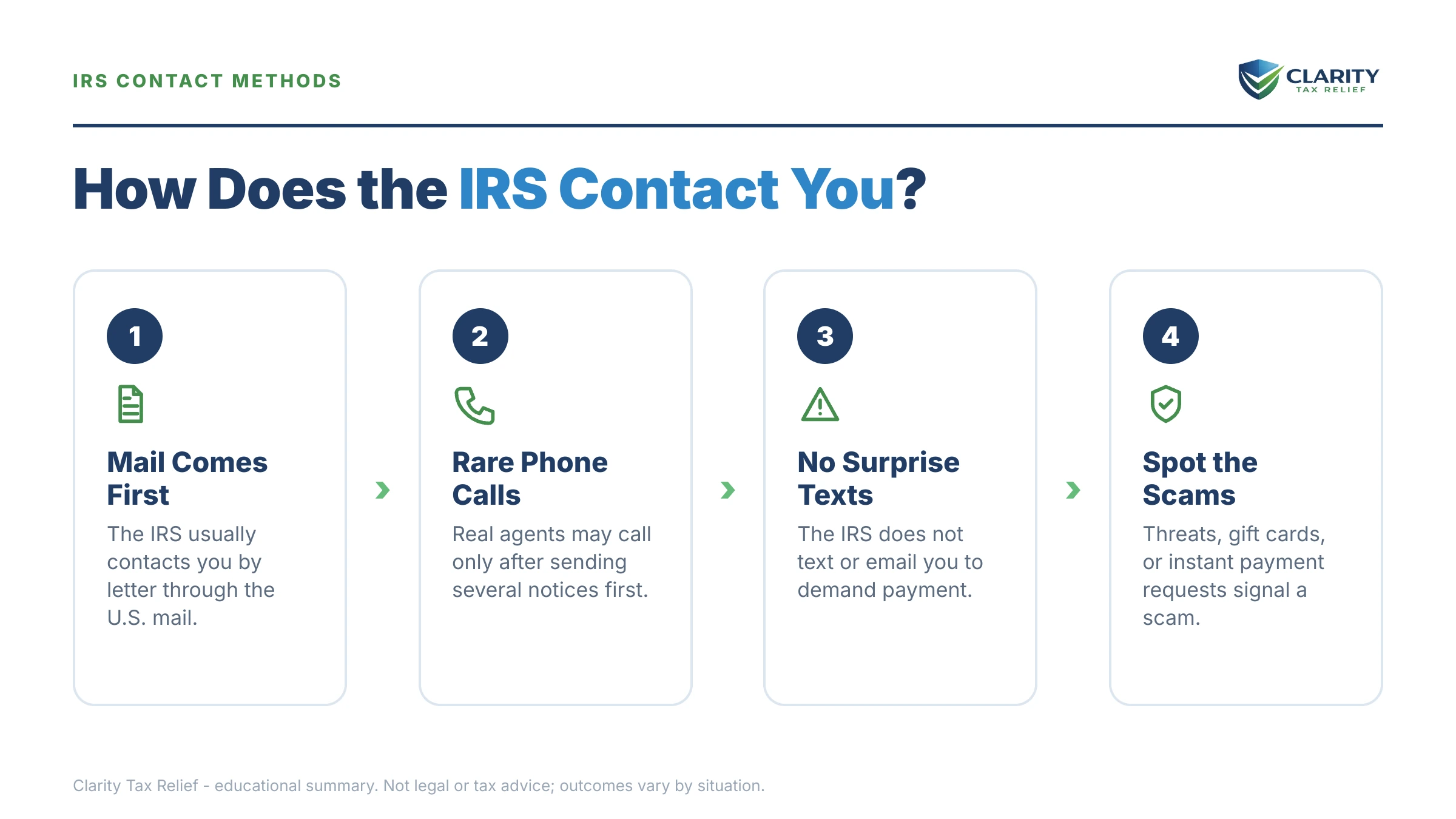
The short answer: the IRS almost never calls you first. Real IRS contact starts with letters in the U.S. mail — phone calls happen only after multiple mailed notices, from an assigned revenue officer, or from one of three contracted collection agencies. Any caller demanding immediate payment, gift cards, or threatening arrest is a scammer.
So does the IRS call you? The phone rang, the caller ID said something official, and a firm voice told you that you owe $61,200, and that your Social Security check gets seized tonight unless you act. Your stomach dropped. Here's the steadying fact: that script violates actual IRS procedure in at least three ways, and in the next few minutes you'll be able to spot every one of them.
This guide covers the four situations where a genuine IRS call really happens, the giveaways that expose an impersonator in the first thirty seconds, and — because sometimes there IS a real balance underneath a fake call — exactly what to do if you owe. The image below shows how legitimate IRS contact actually unfolds and where phone calls fit in that sequence.
⏱ There is no such thing as a phone deadline. Every real IRS deadline is printed on a mailed notice, never delivered by voice. The only real clock is this: if you do owe, penalties and interest accrue monthly until the balance is resolved — no caller can speed that up or pause it.
When does the IRS actually call you? The short list
A legitimate IRS phone call happens in only four situations, and every one of them follows mail you've already received. If there's no paper trail, there's no real call. The four:
- A revenue officer assigned to your case. Larger balances and unfiled returns get assigned to a human collector, who may call to schedule a meeting, but since the IRS ended most unannounced visits in 2023, that contact starts with Letter 725-B, an appointment letter, not a surprise. (Wondering about door knocks instead? See will the IRS come to my house.)
- A private collection agency (PCA). The IRS contracts three companies — CBE Group, Coast Professional, and ConServe — to call about certain older accounts. Before either dials, the IRS mails a CP40 notice containing a taxpayer authentication number. Our guide to the IRS private collection agency program explains how to verify one.
- Follow-up on an open case. An examiner working an audit that began by mail, or an employee returning a call you made, may phone you — about an issue you already know exists.
- A callback you requested. The IRS's callback option returns your own call. In 2026, with the workforce cut roughly 27% in 2025 per TIGTA reports, even those callbacks are slow — which scammers exploit, because frightened people can't easily reach a real agent to check.
Notice what's missing from that list: the IRS never cold-calls to announce a brand-new debt, never calls about a refund, and never texts or emails first either — does the IRS text you covers those channels in detail.
| Channel | Does the real IRS use it? | The scam giveaway |
|---|---|---|
| U.S. mail | Yes — always first. Every collection step starts with a letter. | Fake letters exist too; verify against your IRS online account. |
| Phone call | Rarely — only after mail, from an assigned officer or a PCA. | Payment demands, arrest threats, or no prior letters. |
| Text message | No — the IRS does not initiate contact by text. | Any "IRS" text with a link is phishing. Don't tap it. |
| No — the IRS does not initiate contact by email. | Refund or "verify your account" emails steal logins. | |
| Social media / messaging apps | Never, for any account matter. | Any DM claiming to be the IRS is fraud, full stop. |
| In-person visit | Rare — scheduled by Letter 725-B, or criminal special agents with credentials. | Real employees never collect payment at your door. |
“Before you are contacted by a private collection agency, you will receive two letters. The IRS will first send Notice CP40 to let you know that your overdue tax account was assigned to a private collection agency.”
— Private debt collection (IRS.gov)
How to tell a real IRS call from a scam in 30 seconds
Real IRS employees never demand payment on the phone, never take gift cards, and never threaten arrest — any one of those ends the question. The full list of instant scam markers:
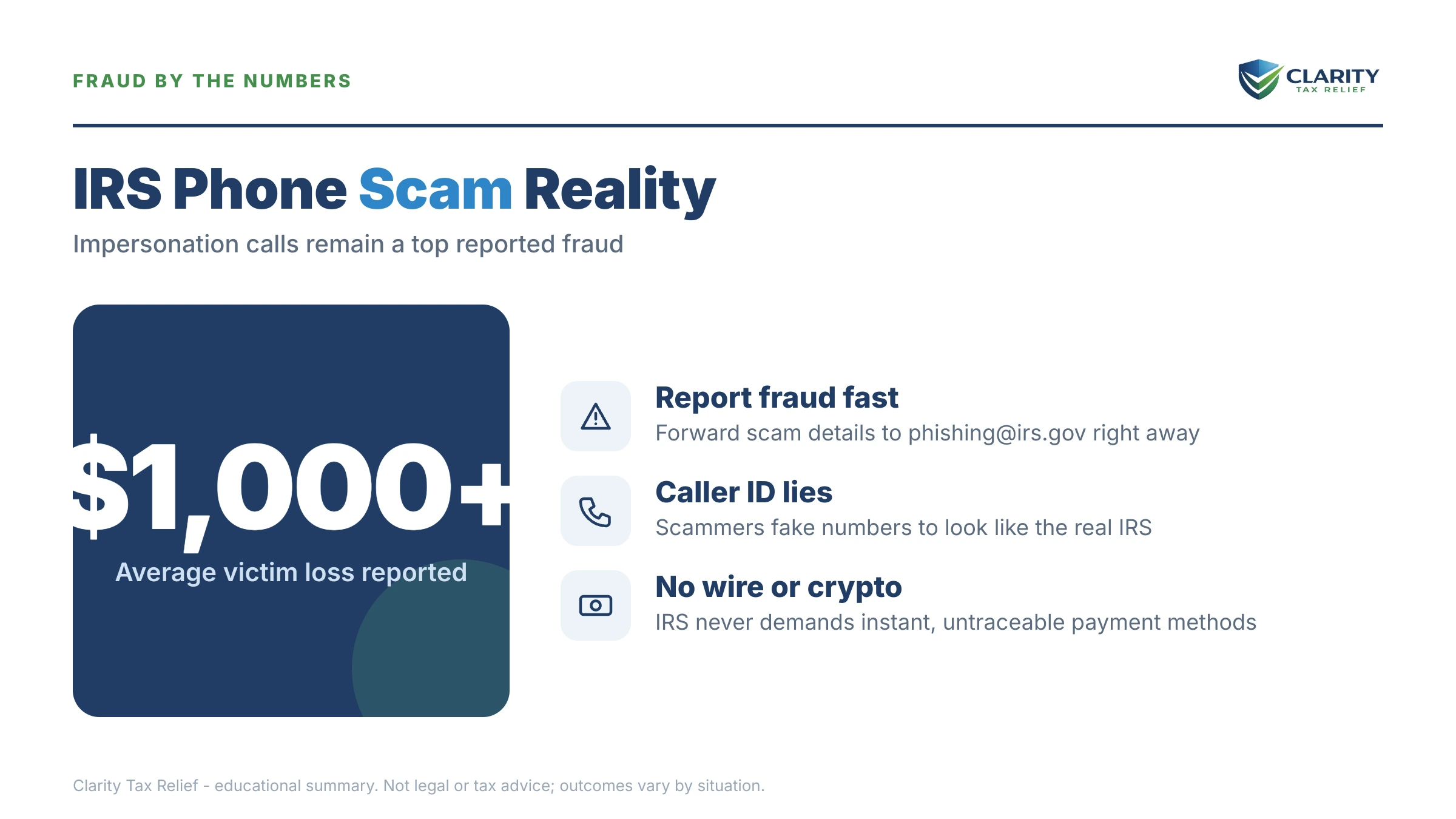
- Payment by gift card, wire transfer, cryptocurrency, or payment app. Real tax payments go only to the United States Treasury or through IRS.gov. There are no exceptions, ever.
- Threats of arrest, deportation, or a "suspended" Social Security number. Owing taxes is civil, not criminal. Police do not come for unpaid balances — can you go to jail for owing irs draws that line precisely.
- Pressure to act before you hang up. A real employee expects you to verify. A scammer's entire business model collapses if you call back through the official line, so keeping you on the phone is the whole game.
- A demand for your card or bank number to "stop the levy." The IRS already knows how to reach your accounts. It never asks you to read numbers aloud.
- Convincing caller ID. Spoofing software displays any number — including real IRS lines. Caller ID is evidence of nothing.
A genuine employee, by contrast, gives a name and badge (HSPD-12) number, discusses only issues you already have letters about, and is fine with you hanging up to verify. If a letter arrived alongside the calls and you're unsure about that too, here's how to tell if an IRS letter is real.
What happens if the debt is real and you keep ignoring the mail
Real IRS phone contact only happens near the end of a long, automated notice sequence, so if a legitimate collector is calling, several letters came first. The sequence runs like this:
- CP14 — the first bill. Typically about 21 days to pay before the machine moves on, or 10 business days when the balance is $100,000 or more. No enforcement yet.
- CP501 / CP503 — reminders. Still just bills, but penalties and interest compound the whole time.
- CP504 — intent to levy your state refund. Under IRC §6331(d), the IRS can now take your state tax refund. A federal tax lien becomes realistic.
- LT11 / Letter 1058 — final notice of intent to levy. A 30-day clock starts, along with Collection Due Process appeal rights (Form 12153). This is the last exit before enforcement.
- Enforcement and human contact. Bank levies (funds held 21 days before they leave), wage levies that run until released, up to 15% of Social Security through the Federal Payment Levy Program, and only now, assignment to a revenue officer or a PCA. This is the stage where real phone calls finally happen.
That's the paradox worth remembering: a real IRS call means you're deep into collections, not at the start. A call about a debt with no letters behind it means there's probably no debt at all.
Got the call, and there's a real balance behind it?
If your IRS account shows a genuine debt, the calls are the least of it: penalties and interest are accruing monthly and the notice sequence doesn't pause. Get your balance and notices reviewed free by an experienced tax professional — we'll tell you which options actually fit your numbers.
If you verify a real balance: your options by how much you owe
Your realistic options depend mostly on the size of the verified balance — the number in your IRS online account, not the number a caller recited. The DIY mechanics for most of these live in our guide on how to settle tax debt yourself; here's the map:
| Verified balance | Realistic paths | What to watch |
|---|---|---|
| Under $10,000 | Pay in full, a 180-day short-term plan ($0 setup), or a guaranteed installment agreement | Interest and penalties accrue until paid — payoff speed is savings. |
| $10,000–$25,000 | Streamlined installment agreement, minimal financial disclosure | Stay current on this year's taxes or the agreement defaults. |
| $25,001–$50,000 | Online long-term plan, up to 72 months; direct debit keeps it streamlined | Lien filing is possible but often avoidable with direct debit. |
| $50,001–$66,000 | Full financial disclosure (Form 433-F), or pay the balance below $50,000 to unlock the online plan; see IRS payment plan over $50,000 | A federal tax lien is likely, and you're approaching the passport line. |
| Over $66,000 | Negotiated agreement, Currently Not Collectible, or an Offer in Compromise if the math supports it | At $66,000 (the 2026 threshold), the IRS can certify your debt to the State Department — see passport revoked for tax debt. |
| Any amount, genuine hardship | Currently Not Collectible status pauses collection; low-income OIC terms waive the $205 fee and down payment if AGI ≤ 250% of poverty | CNC doesn't erase the debt — interest accrues, but levies stop. |
Two honest cautions. Per IRS data, the IRS accepted roughly 1 in 5 Offers in Compromise in FY2024 — it's a real program with strict math, not the "pennies on the dollar" fantasy scam callers and late-night ads sell. And no option makes calls stop instantly; legitimate collection pauses when an agreement or status is actually in place.
A worked example: the $61,200 call that turned out to be half true
Say you're retired, living on Social Security, and a caller claims you owe $61,200. You hang up, log into IRS.gov, and your account really does show $61,200 from a decade-end retirement-account distribution year. Here's the actual math of your options:
- Pay-down route: paying $11,200 brings the balance to $50,000, unlocking the online 72-month plan — about $695/month base ($50,000 ÷ 72), with interest and the 0.5% monthly failure-to-pay penalty still accruing, so real payoff runs somewhat higher.
- Disclosure route: keep the $61,200 balance and submit Form 433-F. If your Social Security is, hypothetically, $1,850/month and allowable living expenses consume all of it, the honest answer may be Currently Not Collectible — collection paused, though the debt and interest remain.
- The cost of freezing up: ignore it. The Federal Payment Levy Program can take up to 15% of that check, about $277/month, while penalties and interest push $61,200 toward the $66,000 passport-certification threshold. Doing nothing is the one option with no upside.
Fixed-income situations like this have their own playbook — see retired and owe back taxes and can the IRS garnish Social Security for how benefit levies actually work and how they're released.
How to respond to an IRS phone call, step by step
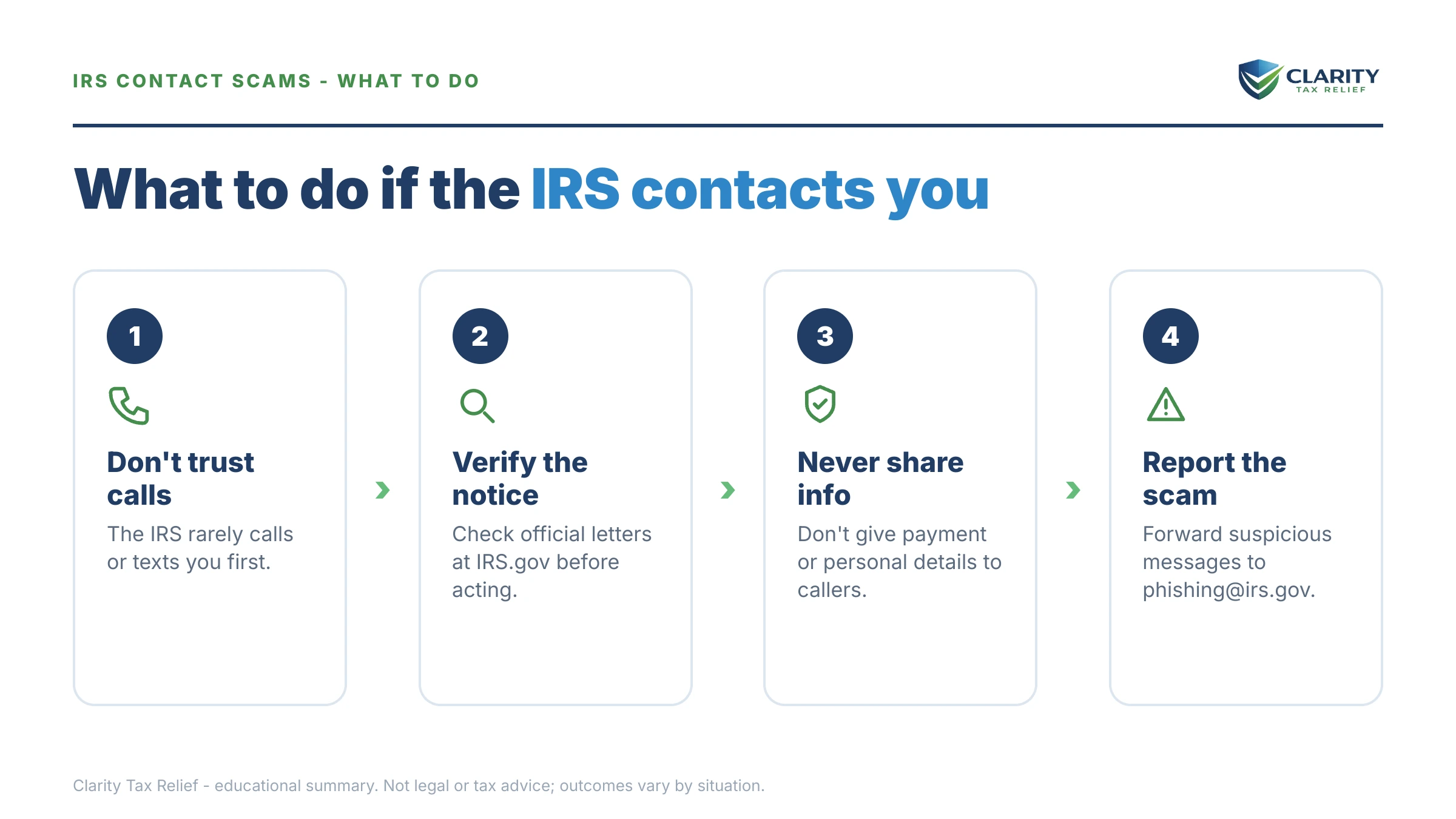
- Hang up without confirming anything. Don't say "yes," don't verify your Social Security number, and don't press any buttons — just end the call.
- Check your real balance online. Log into your account at IRS.gov and see exactly what, if anything, the IRS says you owe, year by year.
- Pull your recent mail. Real IRS contact leaves a paper trail — look for a CP-series bill, an LT-series letter, or a CP40 collection-assignment notice.
- Call the IRS directly at 800-829-1040. Use the published number, never a number the caller gave you, to confirm anything about your account.
- Report the call. Send impersonation-call details to TIGTA at 800-366-4484 and forward scam emails or text screenshots to phishing@irs.gov.
- Fix any real balance before it escalates. If the debt exists, set up a payment plan, request hardship status, or get a professional review while every option is still open.
When you can handle this yourself
Most people who search "does the IRS call you" need ten minutes of verification, not professional representation. Handle it yourself when:
- It's a pure scam call — no balance in your IRS online account, no letters. Report it, warn family (retirees are these crews' primary targets), and move on.
- You owe a small, undisputed amount you can pay within 180 days. The short-term plan has no setup fee and takes minutes online.
- You owe under $50,000 with all returns filed. The online installment agreement exists precisely for self-service.
Experienced help genuinely changes outcomes when a levy on Social Security or a bank account is already in motion, when the balance tops $50,000 and financial disclosure will decide your monthly payment, when years are unfiled, or when Offer in Compromise math is on the table. Those are cases where how the paperwork is presented moves real dollars.
Terms you'll hear on these calls, decoded
- Spoofing — software that makes any phone number appear on your caller ID, including real IRS lines.
- PCA (private collection agency) — one of three IRS-contracted firms (CBE Group, Coast Professional, ConServe) allowed to call about certain older accounts.
- CP40 notice — the mailed letter, with a taxpayer authentication number, that must precede any legitimate PCA call.
- Letter 725-B — the appointment letter a revenue officer sends before visiting or calling, replacing most unannounced visits since 2023.
- Revenue officer — a civil IRS collector assigned to larger cases; not a police officer, and never a payment-by-gift-card caller.
- FPLP — the Federal Payment Levy Program, which can take up to 15% of Social Security benefits for unpaid taxes.
Does the IRS call you? Your questions, answered
Does the IRS ever call taxpayers on the phone?
Yes, but rarely, and essentially never as the first contact. A real IRS employee calls only after the agency has already sent you letters about the same issue, typically a revenue officer assigned to a larger unpaid balance or unfiled returns, or an examiner following up on an audit that began by mail. If a call arrives out of nowhere about a debt you've never received mail about, treat it as a scam until you verify otherwise.
Will the IRS call you before sending a letter?
No. IRS policy is to initiate contact through U.S. mail, and every collection action — bills, levy warnings, lien filings, collection-agency assignments — is preceded by written notice. Even revenue officers now send Letter 725-B to schedule an appointment before showing up or calling, a policy in place since the IRS ended most unannounced visits in 2023. A phone call with no paper trail behind it is the single biggest scam giveaway.
What phone number does the IRS call from?
You cannot rely on caller ID at all — scammers routinely spoof real IRS numbers, including the main 800-829-1040 line, so a legitimate-looking number proves nothing. Genuine IRS employees give their name and badge (HSPD-12) number and never object when you say you'll hang up and call back through the IRS's published line. If a caller pressures you to stay on the phone, that pressure is the tell.
Does the IRS leave voicemails or robocall you?
A real IRS employee working an assigned case may leave a simple voicemail with a name, badge number, and callback request. The IRS does not use threatening pre-recorded robocalls. It never leaves messages saying a warrant has been issued, your Social Security number is "suspended," or you'll be arrested unless you call back. Those recorded-threat voicemails are a mass-dialed scam — delete them and report the number.
Are debt collectors calling about IRS taxes legitimate?
Sometimes. The IRS contracts with three private collection agencies — CBE Group, Coast Professional, and ConServe — and they do call about certain older accounts. But before any of them dials, the IRS mails you a CP40 notice with a taxpayer authentication number. The agency sends its own letter. A legitimate PCA can repeat part of that authentication number, never threatens enforcement, and directs payment only to the U.S. Treasury — never to itself, and never by gift card.
Can the IRS call and threaten to arrest you?
No — arrest threats over the phone are a 100% reliable scam marker. Owing taxes is a civil matter, not a crime, and neither the IRS nor local police arrest people for an unpaid balance. Criminal tax cases are rare, involve willful fraud or evasion, and are handled by special agents who visit in person with credentials. They don't demand money by phone. Any caller threatening jail, deportation, or license revocation unless you pay today is a criminal impersonating the government.
Does the IRS call you about your refund?
No. Refund status is communicated through the Where's My Refund tool, your IRS online account, and mailed notices — never an unsolicited call, text, or email asking you to "verify" bank details to release the money. Calls promising a bigger refund, a stimulus payment, or asking for your account number to deposit funds are phishing for your banking and identity information. If a refund is genuinely held up, the IRS tells you why by letter.
How do I report a fake IRS phone call?
Report IRS impersonation calls to the Treasury Inspector General for Tax Administration (TIGTA) at 800-366-4484 or through tigta.gov, and forward scam emails or text screenshots to phishing@irs.gov. If you gave the caller money or personal information, also file a report with the FTC and consider an IRS identity-protection PIN. Reporting matters: TIGTA builds cases against these call centers from exactly these complaints.
Your next 24 hours
- Verify before you believe. Log into your IRS online account and look at the actual balance-due figure, year by year — that number, not the caller's, is your reality.
- Gather the paper trail. Collect any IRS letters you've received, your last filed return. A note of your monthly income — that's everything a real assessment of your options requires.
- If a balance is real, get it reviewed free. Call (888) 825-7779 or use the 2-minute form — an experienced tax professional will match your verified balance to the option that fits, before another month of penalties and interest posts.
Official resources: the IRS maintains a current list of impersonation schemes at IRS tax scams and consumer alerts, every legitimate payment method lives at IRS.gov/payments, and impersonation calls should be reported to the Treasury Inspector General for Tax Administration.
This guide is general information, not tax or legal advice for your specific situation. Eligibility for IRS programs depends on individual facts and circumstances; no outcome is guaranteed.