
Tax Identity Theft
Someone Filed Taxes in My Name: What to Do Now (2026)
The short answer: if someone filed taxes in your name, report it to the IRS on Form 14039, the Identity Theft Affidavit, then file your real return on paper and request an IP PIN so it can't happen again. The fake return doesn't erase what you truly owe, or file the returns you still haven't.
You typed "someone filed taxes in my name" after your e-file bounced back rejected — a return with your Social Security number was already accepted — or after an IRS letter arrived about a return you never sent. Someone beat you to your own SSN. This is fixable, the IRS has a dedicated unit for it, and your refund is recoverable. Here's the map.
Most victims first learn what happened from one of the IRS's identity-verification letters — the image below shows you exactly what that letter looks like and where to look for the parts that decide your next move.
⏱ Your real clocks: there is no single statutory deadline for reporting tax identity theft, but two clocks are running. Your legitimate return is still due on time — identity theft does not extend your filing deadline. Any verification letter gives you the response window printed on it, and a refund from a prior year is generally lost three years after that return's due date.
Why someone filed a tax return in your name
Tax identity theft happens when a criminal uses your stolen Social Security number to file a fraudulent return early in the filing season, claiming a refund before you file. The thief doesn't need your W-2. They invent wages and withholding, e-file in January, and route the refund to a prepaid card or a mule account. By the time you file in March, the IRS computer sees your SSN as "already filed."
How did they get your number? Usually a data breach, a phishing text, or a stolen W-9, and if you're a 1099 worker, your SSN has been handed to every platform, client, and payer you've ever invoiced. Gig workers are disproportionately exposed for exactly that reason. Nothing you did caused this, and the IRS does not treat victims as suspects.
One thing this is not: a sign you're being audited or investigated. It's a fraud case with your name on the folder, and the IRS's job is to separate the thief's return from your real one.
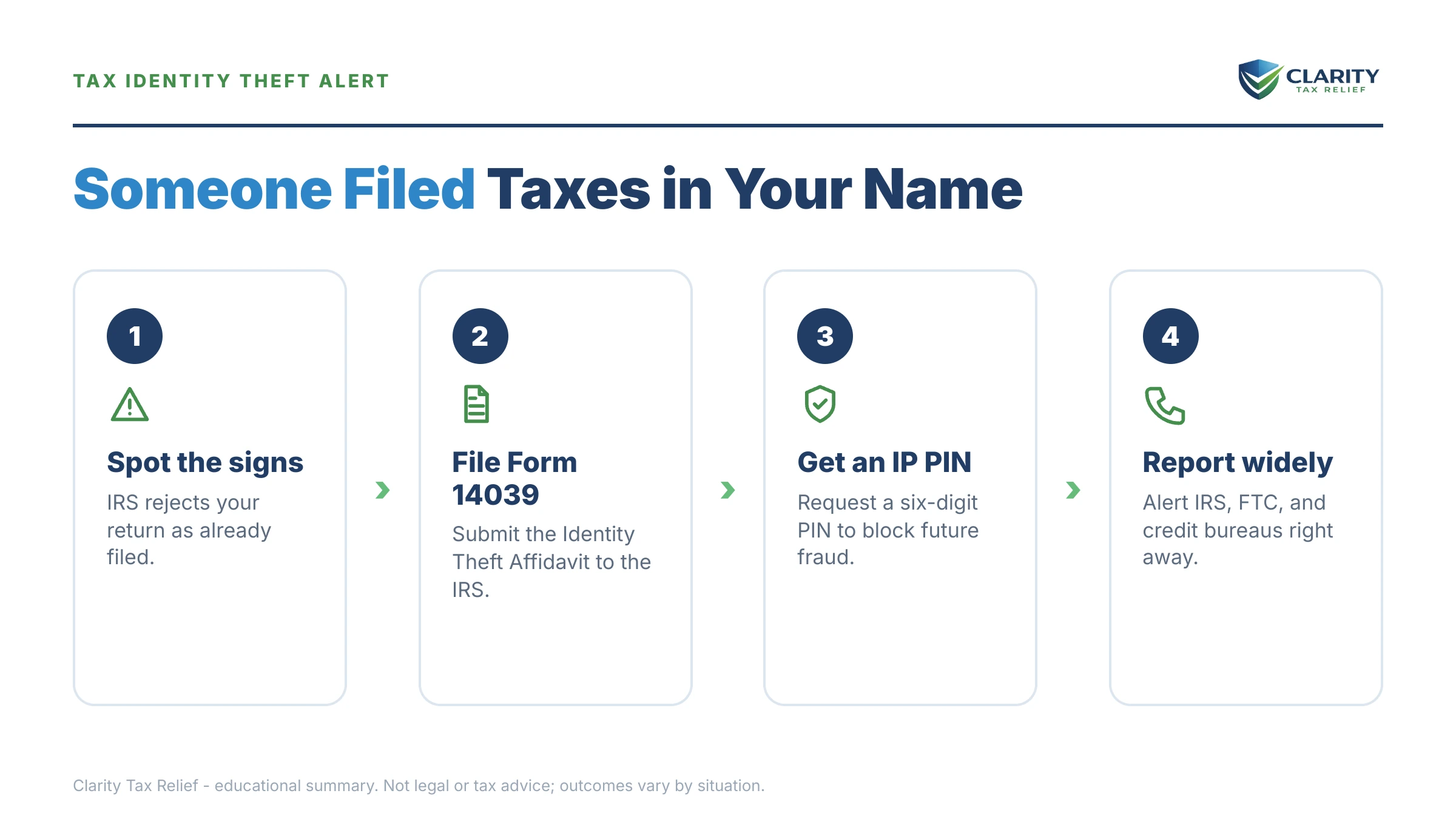
“An identity protection PIN (IP PIN) is a six-digit number that prevents someone else from filing a tax return using your Social Security number (SSN) or individual taxpayer identification number (ITIN). The IP PIN is known only to you and the IRS.”
— Get an identity protection PIN (IRS.gov)
The IRS letters that follow, and what each one means
A verification letter is often good news: it means the IRS flagged the suspicious return before paying the refund. The filters catch millions of suspect returns each season, and when one trips, processing stops until the real SSN owner proves who they are. Compare your letter to the sample in the image on this page, then find your letter number in the top corner. It dictates exactly how you're allowed to respond.
| Letter | What it means | Your move |
|---|---|---|
| 5071C letter | The IRS stopped a suspicious return and needs you to confirm whether you filed it | Verify online at the site named in the letter, or by phone if online fails |
| 4883C letter | Same flag, but the IRS wants voice verification | Call the number on the letter with last year's return and the flagged one in hand |
| 5747C letter | Highest-risk flag — identity must be proven in person | Book the Taxpayer Assistance Center appointment the letter describes; bring photo ID |
| Letter 4310C | The IRS believes someone attempted to misuse your SSN | Read it carefully — it's often informational, but follow any instructions it gives |
| CP01A notice | Your annual Identity Protection PIN after a confirmed theft | Guard the six digits and enter them on every return you file that year |
If you verify that the return wasn't yours, the IRS pulls it. You usually don't even need Form 14039 in that scenario. The affidavit is for the other path: your e-file was rejected, or you discovered the fraud yourself, and no letter ever came. Answer only through the channel your letter names; scammers send fake "verify your identity" texts and emails precisely because these letters exist.
What happens if you ignore it
An unreported fraudulent return doesn't fade away — the false data sits on your IRS account and corrupts everything the automated system does with it afterward. Here's the sequence, stage by stage:
- The thief's return stands. Until you report it, IRS records show a "filed" return, and possibly a paid-out refund — under your SSN for that year.
- Your real refund freezes. When your paper return arrives as a duplicate, the account typically locks for review. On your transcript that often shows up as the 810 freeze pending identity verification — nothing releases until you prove who you are.
- Phantom income becomes real bills. If the thief also used your SSN for employment, fake W-2s and 1099s enter the IRS matching system, which later bills you, via CP2000, for tax on wages you never earned.
- Your own unfiled years escalate on a separate track. The fraud case doesn't pause non-filer enforcement. Skip filing long enough and the IRS files a substitute return for you, with zero deductions and the highest possible tax.
- It happens again next January. Without an IP PIN on your account, the same stolen SSN works next filing season too.
The 2026 backdrop makes speed matter more, not less: the IRS workforce shrank roughly 27% in 2025, so identity-theft cases sit in longer queues. But the automated matching, freezing, and billing never stopped. The earlier your affidavit enters the system, the earlier your case number exists.
A thief filed one return in your name, and yours still aren't done?
If you're untangling identity theft on top of unfiled years or a real balance, get both reviewed free before penalties and interest add another month's growth. An experienced tax professional will map the fastest sequence for your exact case.
Your options when you also owe real back taxes
Removing the thief's return fixes the fraud. It does nothing for tax you genuinely owe, which the IRS can collect for 10 years from assessment. Many people who discover tax identity theft discover something else in the same moment: the fraud is sitting on top of their own unfiled years or unpaid balances. Those get resolved on a parallel track. The full playbook for doing that lives in our guide to how to settle tax debt yourself. Here's the short version, by eligibility:
| Option | Who's eligible | What it costs / means |
|---|---|---|
| Short-term payment plan | Can pay in full within 180 days | $0 setup; interest and penalties continue until paid |
| Guaranteed installment agreement | Owe $10,000 or less, returns filed | Approval is automatic by statute if you meet the criteria; up to 3 years to pay |
| Streamlined installment agreement | Owe $50,000 or less | Up to 72 months, set up online, no detailed financial disclosure |
| Currently Not Collectible | Paying anything would prevent basic living expenses | Collection pauses; the debt and interest remain and the IRS reviews periodically |
| Offer in Compromise | Assets plus future income genuinely can't cover the debt | $205 fee and 20% down on lump-sum offers (both waived with low-income certification); roughly 1 in 5 offers accepted in FY2024 |
| Penalty relief | Clean compliance for the prior 3 years (First-Time Abate), or reasonable cause | Removes penalties, not tax; starting summer 2026 the automatic AEP exemption applies some relief with no request needed |
A worked example: the $36,200 double problem
Say you're a gig worker who hasn't filed taxes in 3 years. This January, a thief filed a fake return under your SSN before you could finally catch up. The fraud case and the debt case run side by side. Here's hypothetical math on the debt side:
- Roughly $48,000 in net 1099 income per year for three unfiled years ≈ $9,500 per year in combined income and self-employment tax → about $28,500 in base tax.
- The failure-to-file penalty (4.5% per month in months where the failure-to-pay penalty also applies, 5% combined, capped at 22.5% for the failure-to-file portion) has maxed out on all three years → about $6,413 more.
- Failure-to-pay penalties and compounding interest add roughly $1,275 → a total near $36,200.
Because $36,200 sits under the $50,000 streamlined line, an online installment agreement over 72 months works out to a floor of about $36,200 ÷ 72 ≈ $503 per month, though interest keeps accruing, so paying faster costs less overall. Two things can shrink the number before you ever set up a plan: filing your own returns with real Schedule C deductions (instead of letting the IRS assess without them), and penalty abatement on a qualifying year. You can estimate your own penalty-and-interest buildup with our IRS penalty and interest calculator. And note what the identity theft changed: nothing. The thief's return is not "filing," and it bought you no time. If your gap is longer — say you haven't filed taxes in 5 years — the sequence is the same. But the IRS generally wants the last six years filed to get you back in good standing.
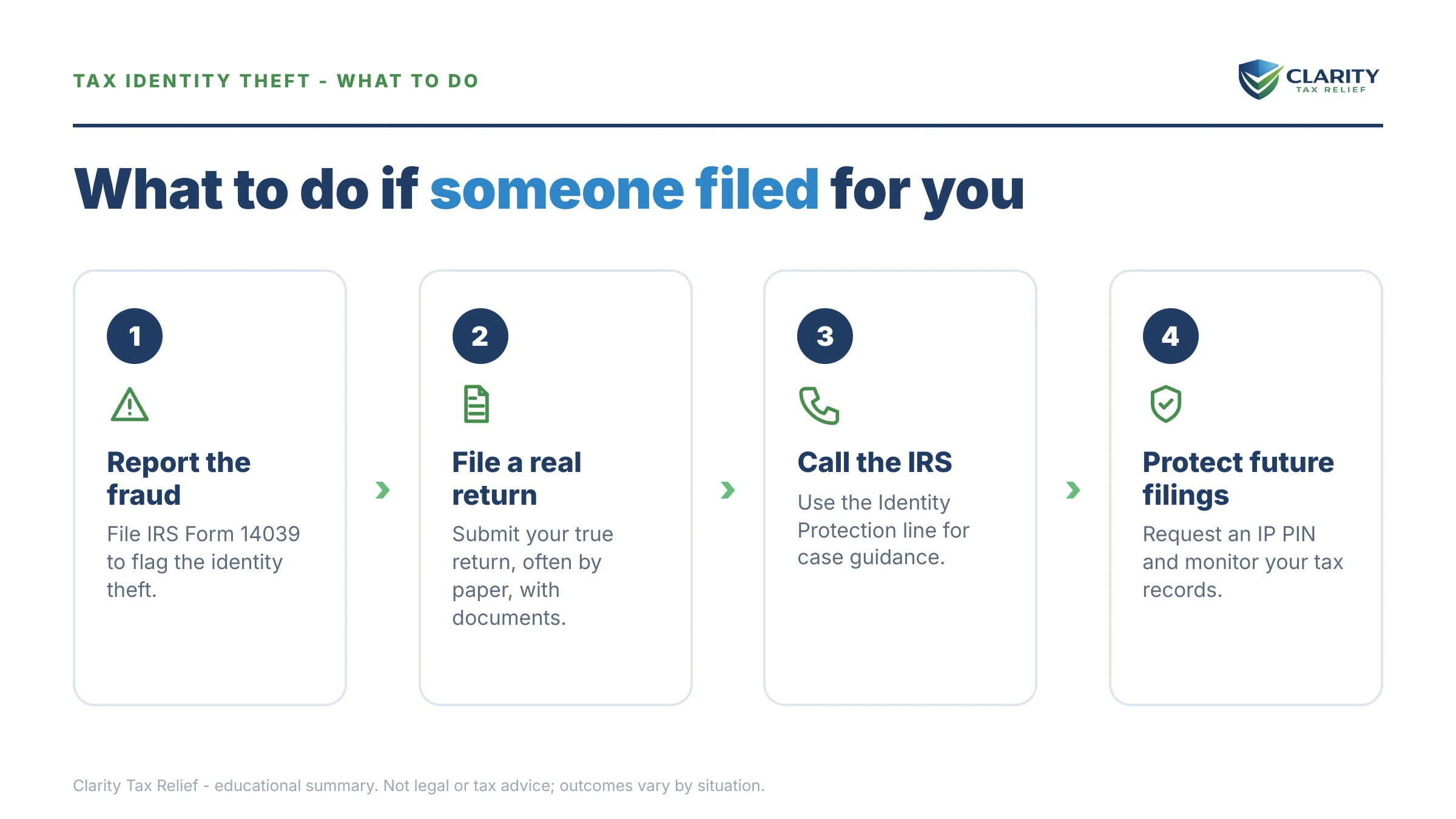
How to respond when someone filed taxes in your name, step by step
- Verify the letter is real. Confirm any 5071C, 4883C, or 5747C actually came from the IRS before sharing personal information — real letters arrive by postal mail and never demand gift cards or payment apps.
- Respond through the exact channel the letter names. Use the online verification site, phone number, or in-person appointment printed on your letter — the IRS assigns the channel. You can't swap a 5747C visit for a phone call.
- File Form 14039 if your e-file was rejected or no letter came. The Form 14039 identity theft affidavit is what officially opens your case with the IRS Identity Theft Victim Assistance unit. You can submit it online through IdentityTheft.gov or on paper.
- File your real return on paper. Attach Form 14039, sign it, mail it to your normal filing address, and pay whatever you can — the thief's return doesn't satisfy your filing requirement or extend your deadline.
- Request an IP PIN. Opt in through your IRS online account so no return can be processed under your Social Security number without the six-digit PIN issued to you each year.
- Lock down everything else. Report the theft at IdentityTheft.gov, freeze your credit at all three bureaus, and pull your wage and income transcript to check for phantom W-2s or 1099s.
When you can handle this yourself
Most straightforward tax identity theft cases are genuinely DIY. If your situation is one fraudulent return, no balance due. A letter telling you exactly how to verify, you don't need to pay anyone: respond to the letter, submit Form 14039 if it applies, mail your real return, and opt into the IP PIN — all free, all doable in an afternoon.
Experienced help changes outcomes in a narrower set of situations: the fraud is tangled with multiple unfiled years and a real five-figure balance (the order you fix things in changes what you pay). The IRS has already assessed tax on phantom income and is billing you for it. Collection notices or levies are arriving on a debt built partly from fraudulent data. Or your case has sat in the Identity Theft Victim Assistance queue for a year with a refund you need frozen inside it. In those cases, someone who works IRS files daily can run the fraud track and the resolution track at the same time instead of letting one stall the other.
Terms on your IRS letters, decoded
- Form 14039 — the Identity Theft Affidavit; the sworn statement that opens your fraud case with the IRS.
- IP PIN — a six-digit Identity Protection PIN, reissued yearly, that must accompany any return filed under your SSN.
- IDTVA — Identity Theft Victim Assistance, the IRS unit that untangles fraudulent returns from real ones.
- 810 refund freeze — the transcript code that halts a refund, commonly while identity is verified.
- SFR (substitute for return) — a return the IRS files for a non-filer using only reported income, with no deductions.
- IND-515 — the common e-file rejection code meaning a return with your SSN was already accepted this year.
"Someone filed taxes in my name": your questions answered
How do I find out if someone filed a tax return in my name?
The most common tip-off is an e-file rejection saying a return with your Social Security number was already accepted (commonly code IND-515). Other signs: an IRS letter about a return you didn't file, a refund or transcript entry you don't recognize, or a W-2 from an employer you never worked for. You can confirm by pulling your account transcript through your IRS online account.
Do I still have to file my own tax return if someone filed in my name?
Yes — the fraudulent return doesn't satisfy your filing requirement, and identity theft doesn't extend your deadline. Because e-file will reject a duplicate Social Security number, you'll typically file on paper with Form 14039 attached. If you owe, pay what you can with the return. The failure-to-file penalty runs 5% per month, ten times the failure-to-pay rate, though in months where both penalties apply, the failure-to-file portion drops to 4.5% (5% combined).
Will I still get my refund if someone stole it?
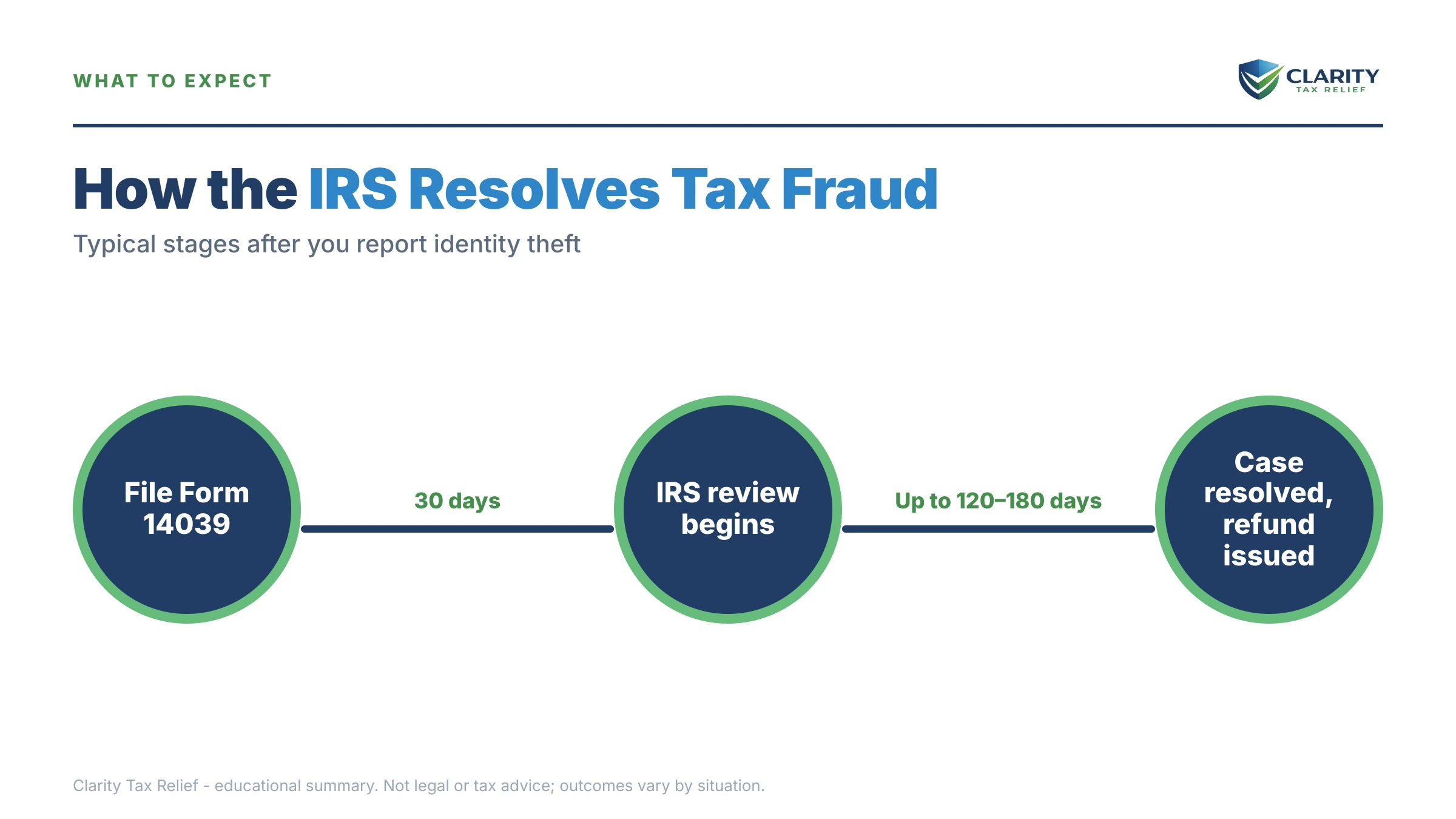
Yes — legitimate refunds are eventually paid even when a thief collected one first; the government absorbs that loss, not you. But you must file your real return and Form 14039 to start the process. The case runs through the IRS Identity Theft Victim Assistance unit, where resolution has often taken a year or more recently. Also, a refund from an old year generally must be claimed within three years of that return's due date or it's gone.
How long does the IRS take to resolve tax identity theft?
Far longer than most victims expect. The IRS has historically described these cases as taking several months. But the National Taxpayer Advocate has repeatedly flagged real-world resolution times stretching well past a year, and 2026 staffing cuts haven't helped. If the delay is causing financial hardship, such as needing a frozen refund to cover rent, the Taxpayer Advocate Service can take your case and push it.
Should I file a police report or contact the FTC?
Report it at IdentityTheft.gov, the FTC's central identity-theft site. It generates a recovery plan and an official report that many banks and credit bureaus accept. A local police report is rarely required for the IRS side but can help with banks and disputed accounts. Also freeze your credit at all three bureaus: a thief who had enough of your data to file a tax return can open accounts with it too.
What is an IP PIN and should I get one?
An Identity Protection PIN is a six-digit number that must appear on any return filed under your Social Security number, without it, e-filed returns are rejected and paper returns get extra screening. Once you're a confirmed identity-theft victim, the IRS issues a new one automatically each year on a CP01A notice. Anyone else can opt in through their IRS online account. Get one — it's the single best prevention tool that exists.
Could someone be using my SSN to work, not just to file?
Possibly — employment-related identity theft often travels with refund fraud. Pull your wage and income transcript and look for W-2s or 1099s from payers you don't recognize. That phantom income can later trigger a CP2000 bill taxing money you never earned. If you find any, note it on Form 14039 and check your earnings record with the Social Security Administration as well.
Does identity theft erase taxes I actually owe?
No. The IRS will remove the fraudulent return and any assessment built on it. But your genuine balances — unpaid tax, unfiled years, penalties, interest — survive untouched and keep accruing while the fraud case is worked. Resolve them on a parallel track with a payment plan, hardship status, or, if your finances qualify, an Offer in Compromise.
Your next 24 hours
- Find the letter number in the top corner of any IRS letter you received (5071C, 4883C, 5747C, 4310C), or your e-file rejection code if no letter came. That single detail dictates your response channel.
- Gather your proof kit: a government photo ID, last year's return (if you have one), the letter itself, and income records for any years you still need to file.
- Get a free case review, especially if the fraud sits on top of unfiled years or a balance you can't pay, because interest and penalties on the real debt keep growing while the fraud case waits in a queue. Call (888) 825-7779 or use the 2-minute form.
Primary sources: the IRS's hub for victims is IRS Identity Theft Central, the FTC's recovery portal is IdentityTheft.gov, and if your case stalls and creates hardship, the Taxpayer Advocate Service is an independent IRS organization that can intervene.
This guide is general information, not tax or legal advice for your specific situation. Eligibility for IRS programs depends on individual facts and circumstances; no outcome is guaranteed.