
Unfiled Returns
Haven't Filed Taxes in 5 Years? How to Catch Up in 2026
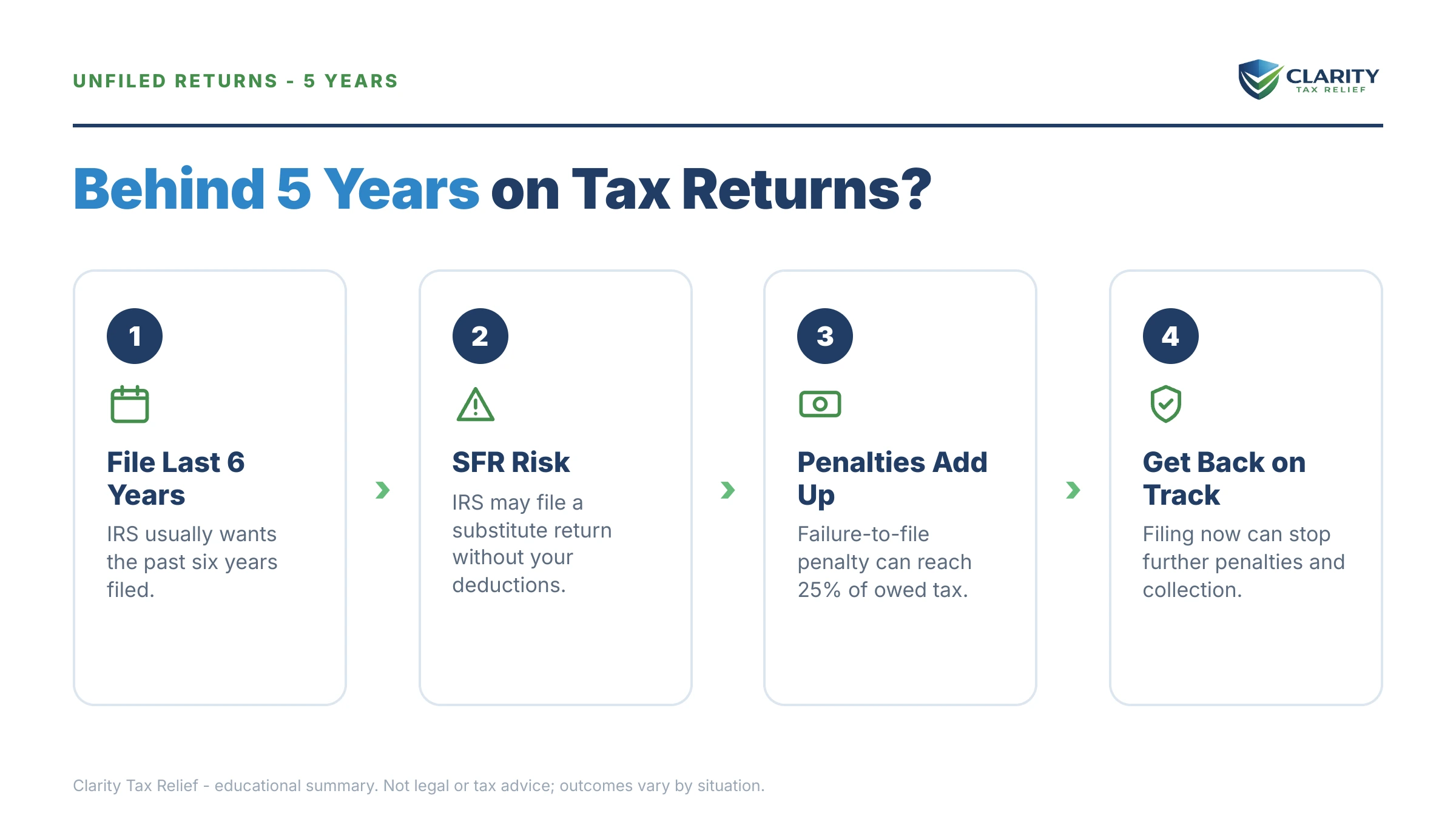
The short answer: if you haven't filed taxes in 5 years, plan to file all five returns — every one falls inside the IRS's standard six-year compliance lookback. Come forward before the IRS contacts you and the matter almost always stays civil. Refunds from the two oldest years are gone; the newest three are still claimable.
Five Aprils have come and gone. Somewhere in a drawer sit five years of 1099-NECs you never turned into returns, and every new client payment adds a little weight to the thing you've been avoiding. Name it once, dread, then hear the useful part: this is a solved problem with a known sequence, and people finish it every week.
The single document that unlocks everything is your IRS wage and income transcript — the image below shows you exactly what it looks like and where each year's 1099 entries appear, so you can see what the IRS already has before you file a thing.
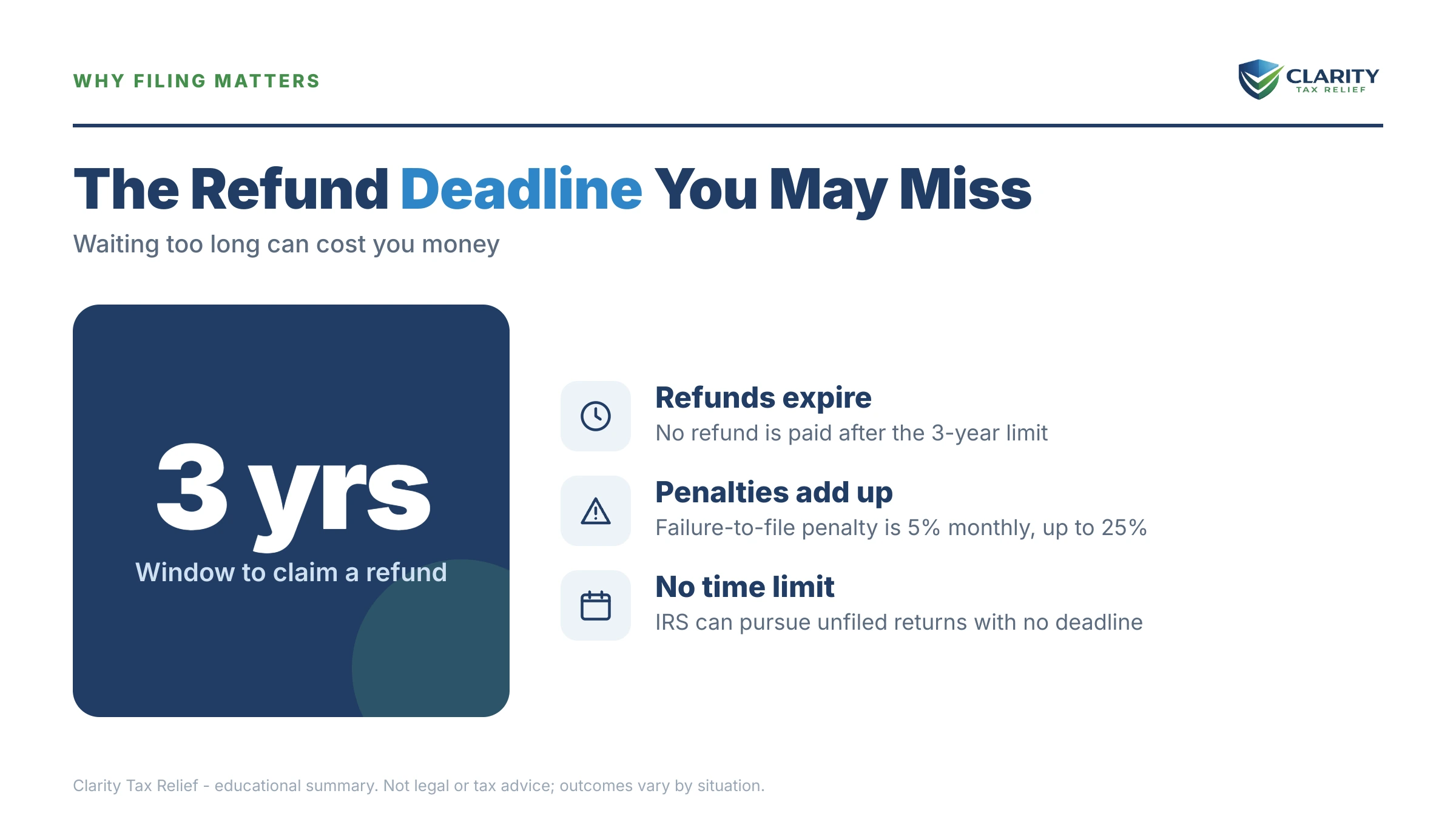
⏱ The real clocks: a refund expires 3 years after the return's original due date. Your 2021 and 2022 refund windows have already closed; any 2023 refund expires April 15, 2027 (later if you filed an extension for that year). And on every year you owe, the failure-to-pay penalty and daily-compounding interest keep running each month you wait.
Why 5 years of unfiled tax returns is its own situation
At five years behind, all of your unfiled years sit inside the IRS's standard six-year filing-compliance window. Under IRS Policy Statement 5-133, the IRS generally treats the last six years of returns as full compliance — which means, unlike someone who hasn't filed taxes in 7 years or hasn't filed in 10 years, you don't get to leave the oldest years behind. You file all five. (The 6-year lookback rule explains how the IRS applies this in practice.)
Five years also sits at a specific point on the refund cliff. The two oldest years' refunds are permanently forfeited, the middle year's is on a countdown, and the two newest are safely claimable — the table below maps it year by year.
One more thing five years is not: a criminal case, as long as you move first. The IRS's own practice treats voluntary late filing, before an agent contacts you, as a civil matter of penalties and interest. Waiting until the IRS opens the conversation is what removes that protection.
What the IRS already knows about your five years
Every 1099-NEC, 1099-K, and W-2 issued under your Social Security number since 2021 is already sitting in IRS systems, matched and waiting. As a 1099 contractor, each client that paid you $600 or more filed a copy of your 1099 with the IRS, so "they don't know about me" has been false the entire time. What they don't have is your side: your mileage, supplies, software, home office, and every other business expense that shrinks the bill.
You can see their side for free. Your wage and income transcript lists every information return by year, and it's the backbone of reconstructing five returns even if your records are a shoebox of nothing — the full method is in filing back taxes with no records.
“File all tax returns that are due, regardless of whether or not you can pay in full. File your past due return the same way and to the same location where you would file an on-time return.”
— Filing past due tax returns (IRS.gov)
Your 5 unfiled years at a glance
Filing in 2026, your unfiled years are tax years 2021 through 2025, and they are not all in the same shape. Refunds die at three years; penalties cap and then interest takes over.
| Tax year | Refund status (3-year rule) | Penalty status if you owe |
|---|---|---|
| 2021 | Expired April 2025 — gone permanently | Failure-to-file and failure-to-pay both at or near their caps; interest still compounds daily |
| 2022 | Expired April 2026 | Failure-to-file capped; failure-to-pay approaching its 25% cap |
| 2023 | Claimable until April 15, 2027 (later if you filed an extension for that year) | Failure-to-file capped; failure-to-pay still climbing monthly |
| 2024 | Claimable until April 2028 | Failure-to-file capped; failure-to-pay in its second year |
| 2025 | Claimable until April 2029 | Smallest balance growth so far — filing now costs the least here |
As a contractor with no withholding, most of your years probably show balances rather than refunds. But if you made estimated payments, had a W-2 side job, or qualify for refundable credits, the newer years can still pay you — details on the deadline are in the 3-year refund rule.
What happens if you haven't filed taxes in 5 years and keep waiting
If you never file, the IRS can file for you — a Substitute for Return built from your 1099s with zero business expenses, single filing status, and no dependents. For a contractor, an SFR routinely doubles or triples the real liability, because gross 1099 income gets taxed as if every dollar were profit.
The non-filer sequence runs in a fixed order, each stage narrowing your options:
- CP59 — the first "we have no return on file" notice. A request, not yet a threat.
- CP516 / CP518 — escalating demands to file; CP518 is the final unfiled-return notice.
- Substitute for Return — the IRS drafts its worst-case version of your return and proposes the tax (often via CP2566). What that looks like and how to undo it: the IRS filed a substitute return for me.
- CP3219N — a statutory notice of deficiency giving you 90 days to petition Tax Court before the SFR amount becomes a legal assessment.
- Assessment and collection — once assessed, the balance enters the normal collection machine: bills, then intent-to-levy notices, then liens, bank levies, and levies on your clients' payments to you. Any future refunds are seized, and if certified debt reaches $66,000 (the 2026 threshold), your passport can be denied or revoked.
The 2026 wrinkle: IRS staffing is down roughly 27% since 2025, so reaching a human is harder than ever, but every step above is automated and never stopped. The machine escalates on schedule whether anyone answers the phone or not.
Five years behind? Get the whole map before the IRS draws it for you
An experienced tax professional will pull your IRS transcripts, tell you which of the five years the IRS has flagged or already SFR'd, and lay out the exact filing order — free and confidential. There's no notice deadline here, but penalties and interest compound every month you wait, and an SFR can land at any time.
Your options once the five returns are filed
Every IRS resolution program requires filing compliance first — no payment plan, offer, or hardship status is available until all five returns are in. That's the whole reason the sequence is returns first, resolution second. The mechanics of negotiating the balance yourself are covered in our guide to how to settle tax debt yourself. Here's how the options line up against a five-year balance:
| Option | Who's eligible | Cost and catch |
|---|---|---|
| Pay in full | Anyone | Stops the failure-to-pay penalty and interest immediately; no fees |
| Short-term payment plan | Any balance you can clear within 180 days | $0 setup; interest and the 0.5% monthly penalty keep running until paid |
| Guaranteed installment agreement | $10,000 or less in tax, with clean recent compliance | Approval is required by law when the conditions are met; pay within 3 years |
| Streamlined installment agreement | Combined balance of $50,000 or less | Up to 72 months, set up online with no financial disclosure; setup fee applies |
| Non-streamlined agreement | Balances over $50,000 | Requires full financial disclosure on a Form 433 and IRS review |
| Currently Not Collectible | Genuine hardship — allowable expenses consume your income | Collection pauses; the debt remains, interest accrues, and the IRS re-reviews periodically |
| Offer in Compromise | Assets plus future income genuinely can't cover the debt | $205 fee plus 20% down on lump-sum offers (both waived with low-income certification); roughly 1 in 5 offers were accepted in FY2024 |
| Penalty relief | Clean 3-year history before the year (first-time abatement) or circumstances beyond your control | Free to request; can remove thousands across five years; automatic AEP relief begins summer 2026 |
Penalty relief deserves special attention at five years, because a big slice of your balance is penalty, not tax. First-time penalty abatement can wipe the penalties on one year outright, and reasonable cause — illness, disaster, a genuinely broken stretch of life — can reach the others.
What catching up actually costs: a worked example
Say you're a 1099 contractor whose five unfiled returns each show about $6,240 in combined income and self-employment tax — $31,200 across 2021–2025. This is a hypothetical, but the math is the real math:
- Failure-to-file penalty: 5% per month, capped at 25% after five months. Every one of your five years hit the cap long ago — roughly $7,800 total (slightly less in months where the two penalties overlap, since failure-to-file drops to 4.5% then).
- Failure-to-pay penalty: 0.5% per month, still running. Capped at 25% on 2021 (about $1,560), sliding down to roughly 6% on 2025 — call it $5,200 so far, still climbing about $90 a month across the years that haven't capped.
- Interest: compounds daily on tax and penalties at the federal rate, adding several thousand more on the older years.
Realistic total: somewhere around $46,000–$48,000 — nearly 50% above the original tax, with combined penalties approaching their 47.5% cap on the oldest years. You can rough out your own numbers with our IRS penalty and interest calculator.
Two takeaways from that math. First, it's still under the $50,000 streamlined line, barely, so balances of $50,000 or less generally qualify for a 72-month streamlined plan (roughly $640 a month in this example) with no financial disclosure, though balances over $25,000 must be set up on direct debit. Wait longer and interest may push you over it. Second, almost $8,000 of that balance exists only because the returns weren't filed — the failure-to-file penalty is ten times the failure-to-pay penalty (and in months where both apply, the failure-to-file portion drops to 4.5%, for a 5% combined monthly rate), which is exactly why filing comes before worrying about payment.
How to file 5 years of back taxes, step by step
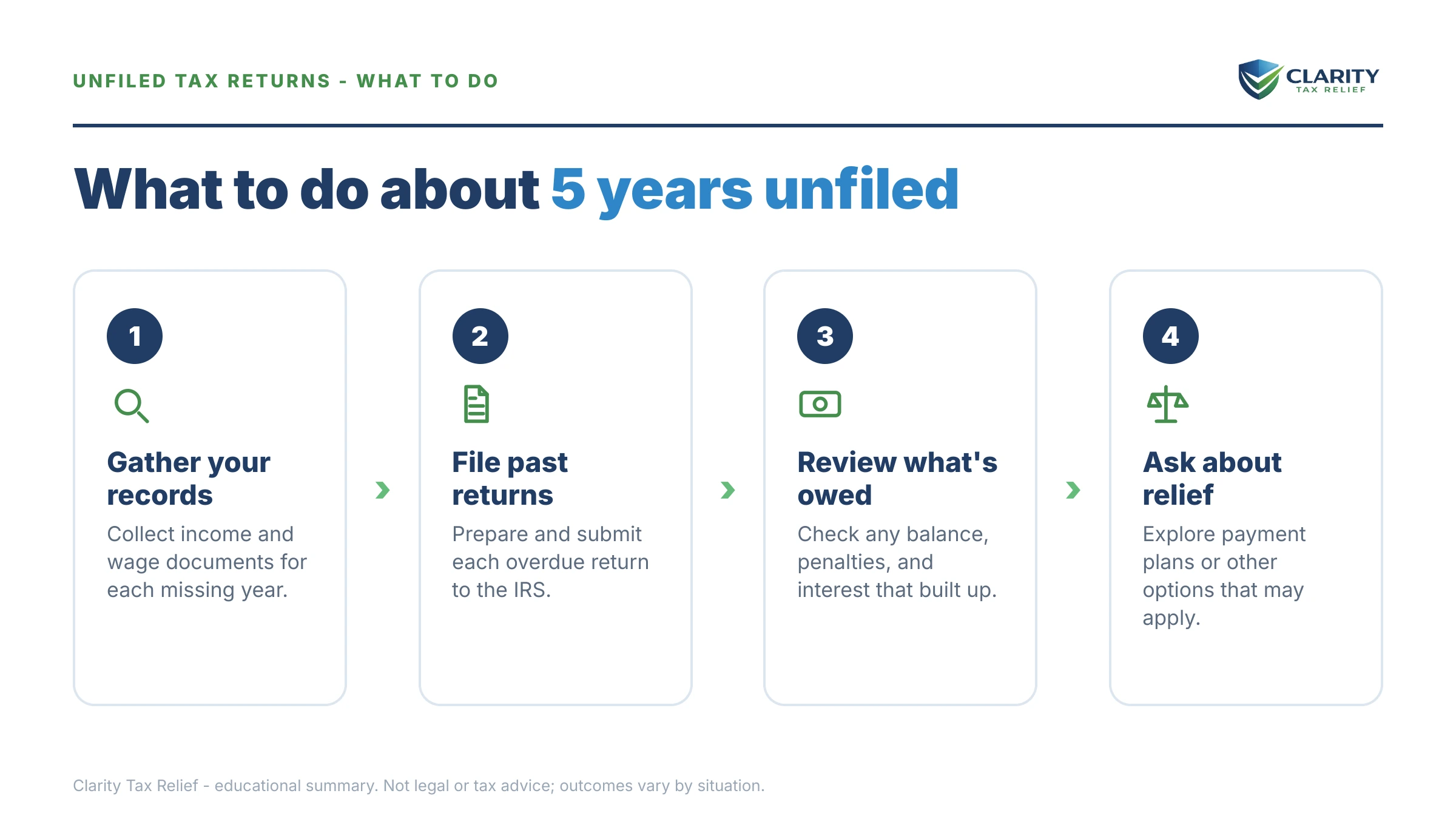
- Pull your IRS transcripts. Create an IRS online account and download the wage and income transcript and the account transcript for each year, 2021 through 2025. Together they show every 1099 and W-2 the IRS has on file and whether anything has been assessed.
- Check each year for SFR activity. A code 150 on a year you never filed means the IRS assessed a substitute return. Those years need original returns first to correct the inflated balance.
- Prepare all five returns, oldest first. Use each year's correct forms and rates, report every 1099 on your transcript, and reconstruct business expenses from bank statements and reasonable records.
- Mail each return separately by certified mail. Older years generally cannot be e-filed, so send each year in its own envelope with tracking and keep every receipt as proof of your filing date.
- Set up your resolution once the returns post. Choose a payment plan, hardship status, or an offer based on the total assessed balance and what your budget can actually support.
- Request penalty relief. Ask about first-time abatement on your best year and reasonable-cause relief on the rest — penalties are the most removable part of a five-year balance.
Reading your transcript before you file: the codes non-filers see
Your account transcript for each unfiled year tells you exactly where that year stands before you send anything. These are the entries that matter most for a five-year non-filer:
| Transcript entry | What it means for a non-filer | What to do |
|---|---|---|
| "No record of return filed" | Nothing has been assessed for that year — no SFR yet | File your original return before the IRS starts one |
| Code 150 on an unfiled year | The IRS assessed a return — almost certainly an SFR with no deductions | File your original return to replace the inflated numbers |
| Code 290 | Additional tax assessed, often the SFR's proposed tax posting | Compare it to what a real return would show before paying anything |
| Code 971 | A notice went out — CP59, CP518, or a deficiency notice | Match the date to the letter you received and honor its deadline |
| Code 599 | The IRS has recorded your late return as received | Watch for the assessment to post, then set up your resolution |
When you can handle this yourself, and when help changes the outcome
Plenty of five-year catch-ups are genuinely DIY. If your income was mostly W-2, your transcripts are clean of SFR activity. The total balance fits a streamlined online payment plan, you can pull transcripts, file the five returns, and set up the agreement at IRS.gov/payments without paying anyone. If money is tight, the Taxpayer Advocate Service and low-income taxpayer clinics offer free help.
Experienced help earns its fee in specific situations: SFR assessments already on file (unwinding an inflated assessment is procedural and unforgiving), five years of self-employment expenses that need defensible reconstruction, a balance near or over $50,000 where the resolution choice swings the outcome by five figures, Offer in Compromise math, or any sign of a revenue officer or levy already in motion. The honest test: if the returns are simple and the balance is manageable, do it yourself. If the numbers above sound like your numbers, a one-hour review costs nothing and can change the shape of the whole case.
And once you're caught up, stay caught up — quarterly estimated payments are what keep a 1099 contractor from rebuilding this exact problem one April at a time.
Terms on your transcripts, decoded
- Substitute for Return (SFR): a return the IRS files for you using only reported income — no business expenses, no dependents, worst-case filing status.
- Wage and income transcript: the IRS's year-by-year list of every W-2 and 1099 reported under your Social Security number.
- Policy Statement 5-133: the internal IRS rule that generally treats the last six years of returns as full filing compliance.
- RSED (refund statute expiration date): the deadline, three years from the return's due date, after which an unclaimed refund is permanently forfeited.
- CSED (collection statute expiration date): the 10-year limit on collecting an assessed tax. It never starts running on a year that was never filed or assessed.
Haven't filed in 5 years: your questions, answered
Can you go to jail for not filing taxes for 5 years?
Jail is extremely unlikely if you come forward before the IRS comes to you. Willful failure to file is technically a criminal misdemeanor, but prosecutions are rare and almost always involve large income, fraud indicators, or people who ignored direct IRS contact. Voluntarily filing five late returns is treated as a civil matter — penalties and interest, not prosecution.
How many years of back taxes do I have to file if I'm 5 years behind?
All five, in most cases. IRS Policy Statement 5-133 generally requires the last six years of returns for a taxpayer to be considered filing-compliant, and every one of your five unfiled years falls inside that window. There is no partial catch-up at the five-year mark the way there sometimes is at seven or ten years, though an IRS employee can require more years in unusual cases.
Can I still get refunds for the years I didn't file?
Only for the newer years. A refund must be claimed within three years of the return's original due date. Filing in 2026, refunds for tax years 2023, 2024, and 2025 are still claimable. The 2021 window is gone and the 2022 window closed in April 2026. As a 1099 contractor with no withholding you are more likely to owe, but estimated payments or refundable credits can still produce refunds worth claiming.
What if I don't have records or 1099s from five years ago?
The IRS already has most of what you need. Your wage and income transcript lists every W-2, 1099-NEC, 1099-K, and 1098 reported under your Social Security number, going back roughly ten years, free through your IRS online account. Bank statements and reasonable reconstruction fill in business expenses. Missing records are the most common reason people stall for five years, and the easiest problem to solve.
What happens if the IRS already filed a substitute return for me?
You can still file your own original return, and you usually should. A Substitute for Return uses worst-case assumptions — single filing status, no dependents, zero business expenses — so it almost always overstates what a 1099 contractor owes. Your filed return generally replaces the inflated SFR assessment with the real number, though the IRS reviews it before adjusting the balance.
Can I set up a payment plan before all five returns are filed?
No. The IRS requires filing compliance before it will approve an installment agreement, an Offer in Compromise, or Currently Not Collectible status, so all five returns must be filed, not necessarily paid, first. That is why the sequence is always returns first, resolution second. Filing also stops the failure-to-file penalty on any year still accruing it.
Does the 10-year collection statute wipe out my unfiled years?
No, and this is the most expensive misconception in the non-filer world. The 10-year collection clock only starts when tax is assessed, and no assessment exists for a year you never filed and the IRS never SFR'd. An unfiled year can be pursued indefinitely. Filing is what starts the clock; waiting does not run it out.
Will filing 5 years of back taxes at once trigger an audit?
Filing late returns does not by itself raise your audit odds. What invites scrutiny is a return that contradicts the 1099s and W-2s already on your transcript, because the IRS computer-matches every information return. Report every form the IRS has on file, keep your expense estimates reasonable and documented, and five late returns typically process like any others.
Your next 24 hours
- Pull the IRS's version of your five years. Create your account and download the wage and income transcript for 2021–2025 at IRS.gov Get Transcript — ten minutes, and the "I don't know what they know" fear is gone.
- Gather what you have. Bank statements for the five years, any 1099s or expense records you kept. Your last filed return — perfect records are not required. Reasonable reconstruction is.
- Book the free case review. Call (888) 825-7779 or use the 2-minute form and an experienced tax professional will map which years to file first, which refunds are still alive, and what your realistic resolution looks like, before another month of penalties and interest posts, or an SFR does it the expensive way.
This guide is general information, not tax or legal advice for your specific situation. Eligibility for IRS programs depends on individual facts and circumstances; no outcome is guaranteed.